
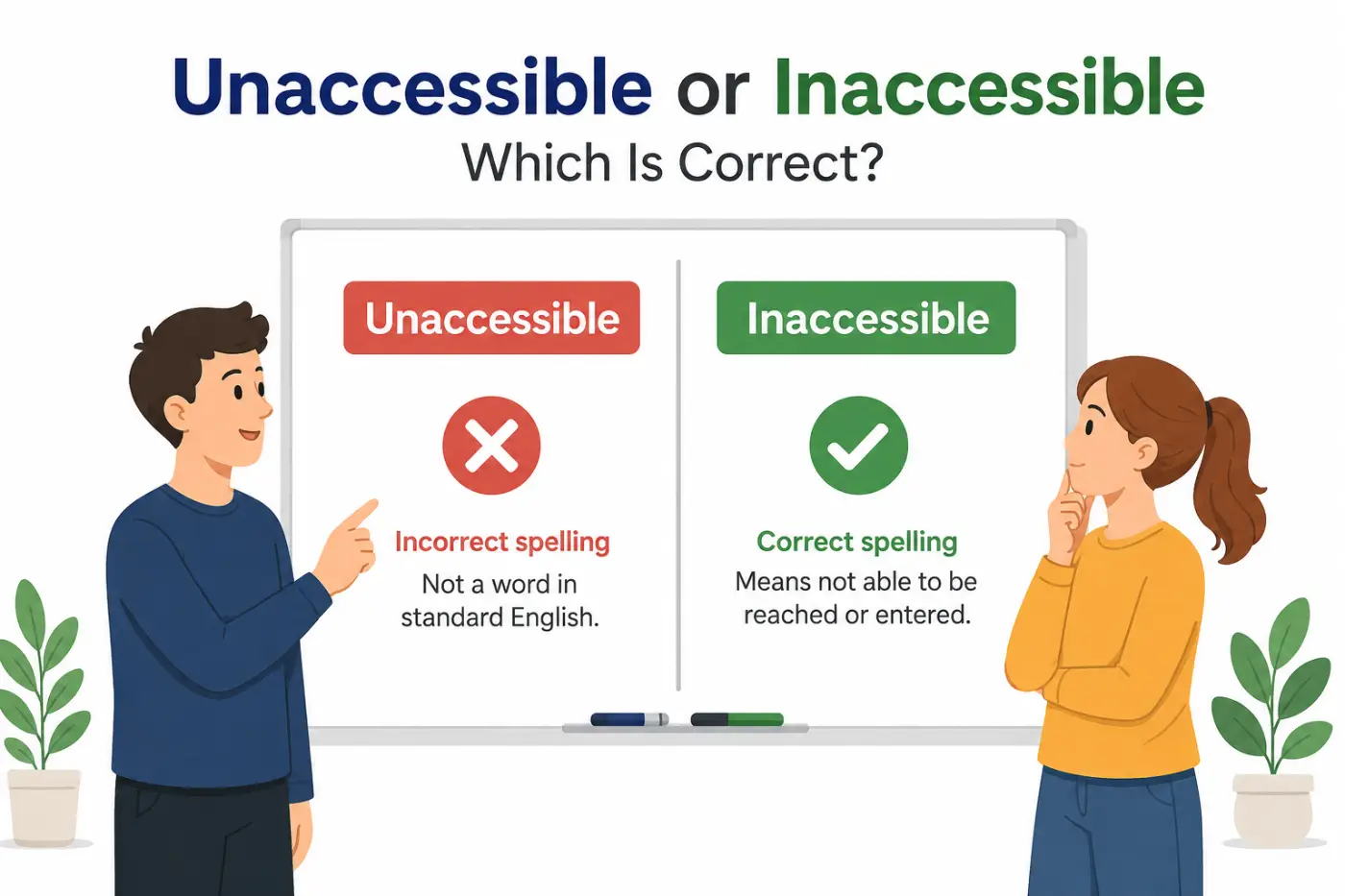
Unaccessible or inaccessible can be confusing because both forms seem to follow a familiar English pattern. You may know words such as uncertain unusual and unnecessary and assume that unaccessible should work in the same way. The standard choice is inaccessible. It means not accessible or not easy to reach use enter obtain or understand.
The confusion comes from English word formation. The prefix un can mean not or the opposite of something and English uses it in thousands of words. Accessible already means easy to reach use enter obtain or understand. So it’s natural to think that adding un creates the opposite. In this case English has settled on inaccessible as the normal form.
That distinction matters when you’re writing an email describing a locked building a report about unavailable information a website accessibility statement or an academic paper. Choosing the standard form makes your sentence sound natural and polished.
This guide explains the difference between the two spellings their meanings grammar pronunciation word history regional usage and common mistakes. You’ll also see practical examples that show exactly how native English speakers use inaccessible.
Short Answer
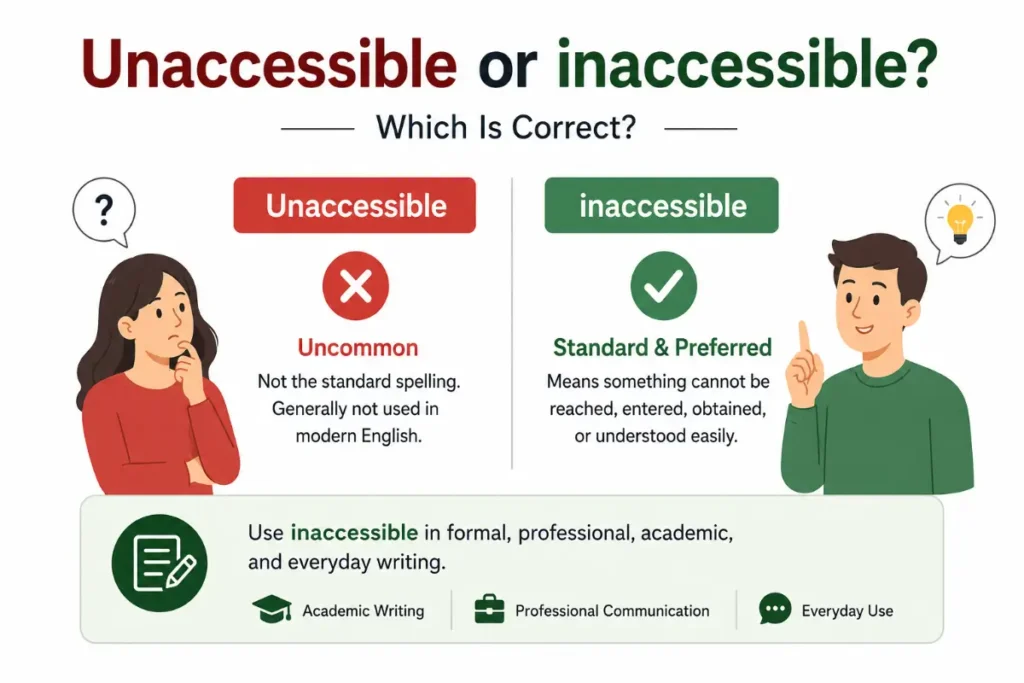
Unaccessible or inaccessible is a spelling comparison where inaccessible is the standard and preferred form in modern English. It means something cannot be reached entered obtained or understood easily. Unaccessible does appear occasionally but it is uncommon and generally not the word you should choose in standard American English. Use inaccessible in formal professional academic and everyday writing.
Table of Contents
- The Correct Spelling.
- What Inaccessible Means.
- What Unaccessible Means.
- The Main Difference.
- Why Inaccessible Is Preferred.
- Grammar and Part of Speech.
- How to Use Inaccessible in a Sentence.
- Pronunciation Guide.
- Real Life Examples.
- Common Mistakes.
- Why People Write Unaccessible.
- Formal and Informal Usage.
- American and British English.
- Similar Words and Related Terms.
- Memory Tips.
- Expert Editor Advice.
- Frequently Asked Questions.
- Key Takeaways.
- Conclusion.
The Correct Spelling
The standard spelling is inaccessible.
It is formed from the prefix in plus accessible. The word describes something that cannot be reached entered used obtained or understood.
For example:
- The mountain village became inaccessible after the heavy snowfall.
- The document is inaccessible without the correct password.
- Some older websites remain inaccessible to people with disabilities.
- His explanation was inaccessible to readers without technical knowledge.
The spelling unaccessible is found occasionally. It isn’t the normal choice in contemporary standard English. You may encounter it in older writing unusual contexts or texts written by people who formed the word independently from accessible.
For modern American English the safest rule is simple.
Use inaccessible.
What Inaccessible Means
Inaccessible is an adjective. It describes something that cannot be reached accessed entered obtained or understood easily.
The meaning changes slightly depending on context.
Physically Difficult to Reach
A place can be inaccessible because of distance terrain weather damage or a physical barrier.
For example:
- The remote cabin became inaccessible during the winter.
This means people could not easily reach the cabin.
Impossible or Difficult to Enter
A building or room can be inaccessible because a door is locked a passage is blocked or entry is restricted.
For example:
- The upper floor was inaccessible because the elevator was broken.
The floor still exists. People simply cannot reach it through the available route.
Difficult to Obtain
Information services resources or opportunities can also be inaccessible.
For example:
- The research database is inaccessible without a university account.
The database exists but access is restricted.
Difficult to Understand
Inaccessible can describe language ideas or writing that ordinary readers find difficult to understand.
For example:
- The textbook uses inaccessible technical language.
Here inaccessible doesn’t mean physically unreachable. It means difficult for the intended audience to understand.
Difficult to Use
A product website service or technology can be inaccessible when people cannot use it effectively.
For example:
- The website became inaccessible after the server failed.
In accessibility discussions the word can also describe digital or physical barriers that prevent people with disabilities from using a service or environment.
What Unaccessible Means
Unaccessible is an understandable formation but it isn’t the standard spelling most writers should use.
Someone seeing unaccessible will probably understand the intended meaning immediately. That doesn’t make it the preferred form.
English contains many words beginning with un that mean not or opposite. This creates a strong pattern in the language.
Consider:
- Available becomes unavailable.
- Certain becomes uncertain.
- Comfortable becomes uncomfortable.
- Necessary becomes unnecessary.
- Reliable becomes unreliable.
That pattern makes unaccessible look reasonable.
However English doesn’t always create opposites with the prefix un. The language has many words that use in or another form instead.
Accessible has developed with inaccessible as its established negative form.
That is why spelling based only on logic can lead you astray. English vocabulary is shaped by history usage pronunciation and convention. A word can look perfectly logical and still be less natural than the form native speakers normally use.
The Main Difference
The main difference between these forms is standard usage.
| Feature | Inaccessible | Unaccessible |
|---|---|---|
| Standard modern form | Yes | No |
| Meaning | Not accessible | Intended to mean not accessible |
| Part of speech | Adjective | Rare adjective formation |
| Common in American English | Yes | Very uncommon |
| Suitable for formal writing | Yes | Avoid |
| Common in everyday writing | Yes | Uncommon |
| Pronunciation | Inaccessible | Usually intended to resemble inaccessible |
| Best choice | Yes | No |
The two forms aren’t normally treated as two words with different meanings.
Instead the issue is mainly one of established English usage.
Why Inaccessible Is Preferred
English has a large number of negative prefixes. That doesn’t mean every adjective can take every negative prefix.
The word accessible is closely connected with Latin roots and entered English through French. Its established negative form developed with the prefix in.
This is a useful reminder that English spelling isn’t always a mathematical system. You can’t simply attach a familiar prefix to a word and assume the result is standard.
For example:
- Inaccurate is standard rather than unaccurate.
- Incomplete is standard rather than uncomplete.
- Incompatible is standard rather than uncompatible.
- Inaccessible is standard rather than unaccessible.
There are exceptions in English. Some words can accept both in and un forms in different circumstances. But that doesn’t apply equally to every adjective.
When a standard form is well established there is little reason to choose an unusual alternative.
Grammar and Part of Speech
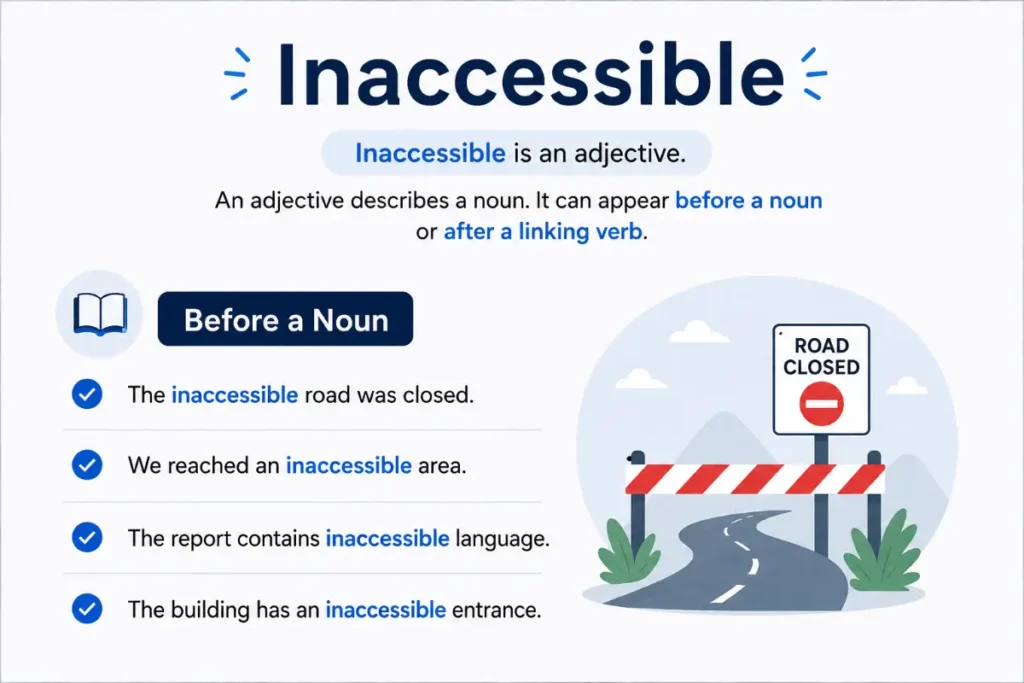
Inaccessible is an adjective.
An adjective describes a noun. It can appear before a noun or after a linking verb.
Before a Noun
- The inaccessible road was closed.
- We reached an inaccessible area.
- The report contains inaccessible language.
- The building has an inaccessible entrance.
In each sentence inaccessible describes a noun.
After a Linking Verb
- The road is inaccessible.
- The information remains inaccessible.
- The trail became inaccessible.
- The archive appears inaccessible.
The word can also be modified by adverbs.
- The area is extremely inaccessible.
- The information was completely inaccessible.
- The location became almost inaccessible.
The noun form is inaccessibility.
For example:
- The inaccessibility of the building created problems for visitors.
The adverb form is inaccessibly but it is much less common.
How to Use Inaccessible in a Sentence
The easiest way to use inaccessible correctly is to ask what cannot be reached or used.
Physical Access
- The road is inaccessible after the landslide.
- The cave is inaccessible without special equipment.
- The island became inaccessible during the storm.
Digital Access
- The website was inaccessible for several hours.
- The account became inaccessible after the security update.
- The file is inaccessible to users without permission.
Information
- The report contains inaccessible technical language.
- Important records remained inaccessible to the public.
- The data was inaccessible because the file was corrupted.
Social or Emotional Meaning
Inaccessible can also describe a person who seems difficult to approach or communicate with.
For example:
- The professor seemed inaccessible to new students.
This doesn’t mean the professor was physically unreachable. It suggests that students found the person difficult to approach.
Pronunciation Guide
The standard pronunciation of inaccessible is commonly represented in American English as:
/ˌɪnəkˈsɛsəbəl/
You can think of it as:
in ak SES uh bul
The strongest stress falls on the syllable that sounds like ses.
The word contains four syllables in ordinary pronunciation:
- in.
- ak.
- ses.
- uh bul.
Some speakers may pronounce the unstressed vowels slightly differently. That’s normal in English.
The most common pronunciation mistake comes from trying to pronounce every letter with equal strength. Native speakers usually reduce the weaker vowels.
The related word accessible is commonly pronounced:
/əkˈsɛsəbəl/
Adding the initial in sound creates inaccessible.
Real Life Examples
Everyday Conversation
- The back road is inaccessible right now because of the snow.
This means people can’t reasonably travel along that road.
- My old account is inaccessible because I forgot the login details.
The account still exists but the speaker cannot access it.
Workplace Writing
- The shared folder is currently inaccessible to several employees.
This sentence clearly communicates a technical access problem.
- The instructions are inaccessible to new employees.
Here the problem isn’t physical access. The instructions are too difficult to understand.
Academic Writing
- Complex terminology can make scientific research inaccessible to general readers.
The sentence describes a communication barrier.
- The archive remained inaccessible for decades.
This refers to restricted access to historical material.
News Writing
- Several mountain communities became inaccessible after the storm.
The word works well in news reporting because it clearly describes physical access.
- The website remained inaccessible throughout the afternoon.
This describes a service that users couldn’t reach.
Professional Communication
- The document is currently inaccessible because the permission settings were changed.
This is direct and appropriate for workplace communication.
- Please let us know if the link remains inaccessible.
The word fits naturally in customer service and technical communication.
Common Mistakes
Several errors can make this word confusing.
Writing Unaccessible
This is the most obvious mistake.
Incorrect:
The trail is unaccessible during winter.
Better:
The trail is inaccessible during winter.
The writer has applied the common un pattern to a word that normally takes in.
Confusing Inaccessible With Unavailable
These words overlap but they aren’t identical.
Unavailable usually means something cannot be obtained or used at the moment.
Inaccessible focuses more strongly on the inability to reach or access something.
For example:
The doctor is unavailable.
This means the doctor cannot see you or isn’t available at that time.
The clinic is inaccessible.
This suggests that you cannot physically or practically reach or enter it.
Confusing Inaccessible With Impossible
Inaccessible doesn’t always mean impossible.
An inaccessible mountain may be extremely difficult to reach today but might become reachable later.
Impossible means something cannot happen or be done at all.
Using Inaccessible When You Mean Unclear
Inaccessible can describe difficult language but unclear is often more precise when the problem is simply lack of clarity.
Compare:
The explanation is unclear.
The explanation is inaccessible to beginners.
The first sentence says the explanation isn’t clear. The second suggests the explanation is too difficult for a particular audience.
Treating The Prefix as a Universal Rule
This is a common spelling trap.
English prefixes have patterns but they aren’t perfectly predictable. Learning the established form is more reliable than trying to build every opposite from scratch.
Why People Write Unaccessible
The spelling mistake has a logical explanation.
English speakers encounter many adjectives where un creates the opposite.
For example:
- Unavailable.
- Uncomfortable.
- Unclear.
- Uncommon.
- Unnecessary.
- Unreliable.
- Unusual.
When someone sees accessible they may instinctively apply the same pattern.
There is also a visual and phonological issue. The beginning of inaccessible is unstressed in normal speech. The word can sound less distinct when spoken quickly. A writer who hasn’t seen the word often may rely on morphological intuition rather than stored spelling knowledge.
This is a useful NLP perspective. People don’t process words only as individual strings of letters. They also recognize familiar prefixes roots endings and sound patterns. When several patterns compete the brain can produce a form that looks logical even though standard usage prefers another form.
That’s why the error is understandable.
It’s still best corrected.
Formal and Informal Usage
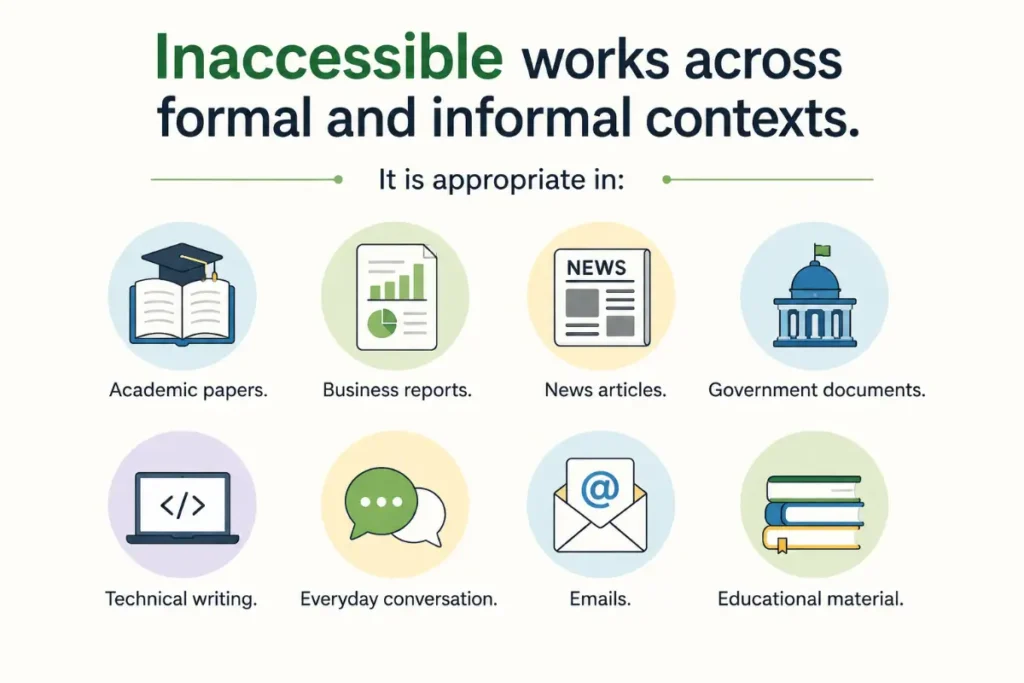
Inaccessible works across formal and informal contexts.
It is appropriate in:
- Academic papers.
- Business reports.
- News articles.
- Government documents.
- Technical writing.
- Everyday conversation.
- Emails.
- Educational material.
The word doesn’t sound excessively formal. It is a normal English adjective.
Unaccessible is different. Because it is uncommon it can distract readers. A reader may stop to wonder if the writer intended inaccessible.
That kind of interruption is exactly what good editing tries to prevent.
If your goal is clear professional writing choose the established form.
American and British English
American and British English both use inaccessible as the normal standard form.
The spelling difference here isn’t like center and centre or color and colour. There isn’t a major American versus British spelling distinction between inaccessible and unaccessible.
Canadian Australian and New Zealand English also commonly use inaccessible.
So you don’t need to switch forms based on the country of your audience.
For an American audience the recommendation is straightforward.
Use inaccessible.
Similar Words and Related Terms
Several words overlap with inaccessible but carry slightly different meanings.
Unavailable
Unavailable means something cannot be obtained or used at a particular time.
The meeting room is unavailable.
Unreachable
Unreachable means something cannot be reached. It can describe a physical place a person or even a goal.
The village became unreachable after the bridge collapsed.
Impassable
Impassable usually describes a route that cannot be traveled.
The road was impassable after the flood.
Unattainable
Unattainable means something cannot be achieved or obtained.
The target seemed unattainable.
Incomprehensible
Incomprehensible means impossible or extremely difficult to understand.
The technical explanation was incomprehensible to most readers.
Remote
Remote can describe a place that is far away or isolated.
They live in a remote mountain region.
Restricted
Restricted means access is limited or controlled.
The files are restricted to authorized employees.
These words can overlap with inaccessible but shouldn’t automatically replace it. Choose the word that describes the exact problem.
Word Origin and Etymology
Accessible ultimately traces back to Latin accessus meaning approach or coming near. The Latin verb accedere meant to approach or come toward.
The word passed through French before becoming part of English vocabulary.
English uses accessible to describe something that can be approached reached entered obtained or understood.
The negative form inaccessible uses the prefix in to express the opposite meaning.
This prefix appears in many English words with Latin roots. It can mean not or the opposite of the adjective that follows it.
That history helps explain why inaccessible became the established form.
The spelling isn’t simply an arbitrary preference. It reflects a long pattern of word formation that English inherited through Latin and French vocabulary.
Memory Tips
A simple memory trick can keep you from writing the uncommon form.
Think:
Accessible means you can access it.
Inaccessible means you can’t access it.
Then remember that the opposite uses in rather than un.
You can also connect the word directly to access.
- Access.
- Accessible.
- Inaccessible.
That word family makes the spelling easier to remember.
Another useful trick is to group it with familiar words that use the same negative prefix.
- Accurate becomes inaccurate.
- Complete becomes incomplete.
- Visible becomes invisible.
- Accessible becomes inaccessible.
You don’t need to memorize complicated spelling rules. Remembering the established word family is usually enough.
Related Grammar and Usage Notes
Inaccessible can take different modifiers depending on the intended degree.
For example:
- Completely inaccessible.
- Almost inaccessible.
- Practically inaccessible.
- Physically inaccessible.
- Digitally inaccessible.
- Financially inaccessible.
These combinations make the meaning more specific.
Compare these examples.
The building is inaccessible.
This gives a general statement.
The building is physically inaccessible.
This identifies a physical barrier.
The service is financially inaccessible.
This suggests that the cost prevents people from using it.
The information is intellectually inaccessible to beginners.
This suggests that the concepts are too advanced for the intended readers.
This flexibility makes inaccessible useful in many fields.
Inaccessible In Accessibility Writing
The word has an especially important role in accessibility discussions. A website can be inaccessible when people with disabilities cannot properly access its content or functions. A building can be inaccessible when its design prevents some people from entering or moving through it.
A document can be inaccessible when its structure or format prevents people from using assistive technology effectively. In these contexts precision matters. The word isn’t merely a fancy way to say inconvenient.
For example:
The website is inaccessible to screen reader users.
This identifies a specific access problem.
The website is inconvenient.
That sentence communicates something much weaker.
Good professional writing should identify the actual barrier rather than soften it with a vague word.
Expert Editor Advice
As an editor I’d treat inaccessible as the clear default. It is established standard English and works comfortably in casual professional academic and technical contexts. I’d correct unaccessible unless the unusual spelling appears in a historical quotation a proper name or a context where the writer intentionally preserves original wording. Spell checkers can help catch the error but your knowledge of word families is more useful. When in doubt connect the word to access. If something cannot be accessed it is inaccessible.
Key Takeaways
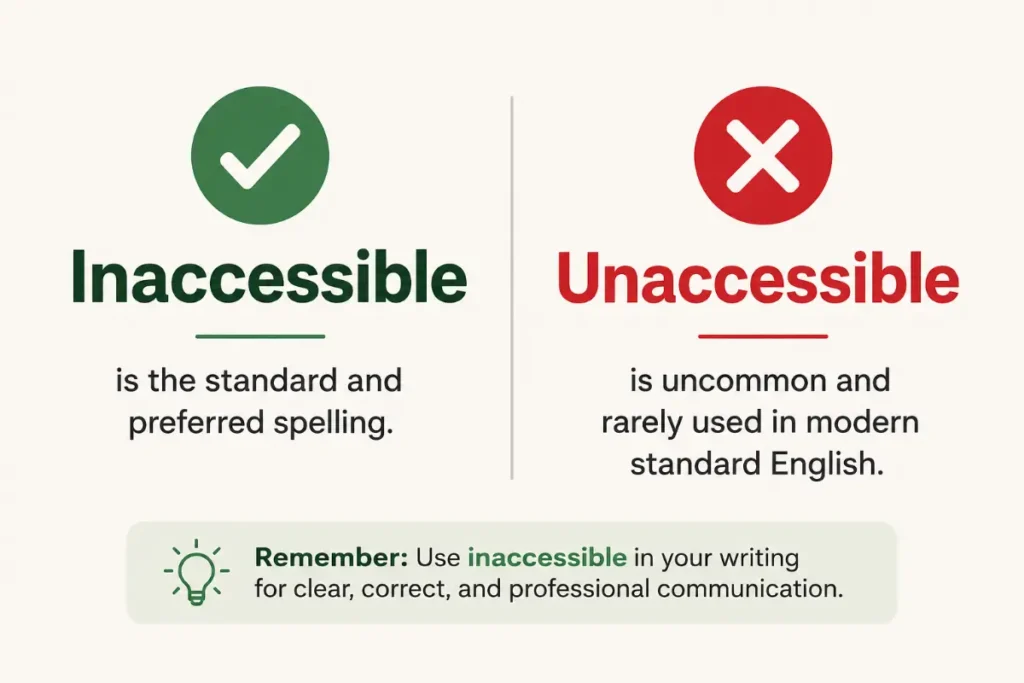
- Inaccessible is the standard and preferred spelling.
- Unaccessible is uncommon and rarely used in modern standard English.
- Inaccessible can describe something that’s difficult or impossible to reach, enter, obtain, or understand.
- Use inaccessible in formal, academic, professional, and everyday writing.
- When you’re unsure which form to use, choose inaccessible.
Conclusion
Inaccessible is the standard and preferred form in modern American English. It describes something that cannot be reached, entered, obtained, or understood easily.
Although unaccessible appears occasionally, it’s uncommon and generally isn’t the best choice for standard writing. For clear and professional English, use inaccessible in academic, professional, and everyday contexts.
Frequently Asked Questions
Is unaccessible a correct English word?
Unaccessible can be found in some English usage but it is uncommon and isn’t the preferred standard form in modern American English. In most writing you should use inaccessible. The standard word means difficult or impossible to reach enter use obtain or understand. Choosing inaccessible will sound more natural to contemporary readers.
Is inaccessible the correct spelling?
Yes. Inaccessible is the standard spelling. It is the established adjective used to describe something that cannot be reached entered obtained used or understood easily. For example you can say The road is inaccessible after the storm. This spelling works in everyday professional academic technical and formal writing.
Unaccessible or inaccessible which is correct?
Inaccessible is the preferred form. Unaccessible is an uncommon formation that looks logical because English frequently uses un to create negative adjectives. However accessible has established the negative form inaccessible. Use inaccessible in standard American English and avoid unaccessible unless you have a specific reason to preserve an unusual historical or quoted form.
What does inaccessible mean?
Inaccessible means not accessible. Depending on context it can describe something that cannot be physically reached entered or approached. It can also describe information technology services or ideas that people cannot obtain use or understand easily. The exact meaning comes from context but the central idea is lack of access.
Why do people spell inaccessible as unaccessible?
People often write unaccessible because un is a very common negative prefix in English. Words such as unavailable and uncomfortable make the spelling look logical. The problem is that English word formation isn’t completely predictable. Accessible has an established negative form with in. Remembering the word family can prevent this mistake.
Is inaccessible formal English?
Yes. Inaccessible is standard English and works well in formal writing. You can use it in academic papers professional reports technical documents news articles government writing and business communication. It isn’t restricted to formal language either. Native speakers also use it naturally in everyday conversation when something is difficult or impossible to access.
What is the difference between inaccessible and unavailable?
Inaccessible focuses on access. Unavailable focuses on something not being available for use or acquisition. A building can be inaccessible because you cannot reach or enter it. A meeting room can be unavailable because someone else is using it. The words overlap in some situations but they highlight different ideas.
Can inaccessible describe a person?
Yes. Inaccessible can describe a person who seems difficult to approach communicate with or understand. For example The manager seemed inaccessible to new employees. In this use the word doesn’t mean that the person is physically impossible to reach. It describes social or emotional distance that makes communication difficult.
What is the opposite of inaccessible?
The direct opposite is accessible. Accessible means easy or possible to reach enter use obtain or understand. For example an accessible building can be entered easily while an inaccessible building presents barriers. The same contrast works for information websites services and ideas.
How do you remember the spelling of inaccessible?
Connect the word to access. Think of the sequence access then accessible then inaccessible. The negative form uses in rather than un. You can also remember related words such as inaccurate incomplete and invisible. These examples reinforce the spelling pattern and make inaccessible easier to recall when you’re writing quickly.

English Grammar & Usage
Nathan Holloway is an American grammar writer and language researcher who specializes in English grammar, sentence structure, verb usage, and common writing mistakes. He enjoys breaking down confusing grammar rules into practical explanations with clear examples, making English easier for students, professionals, and everyday writers.