
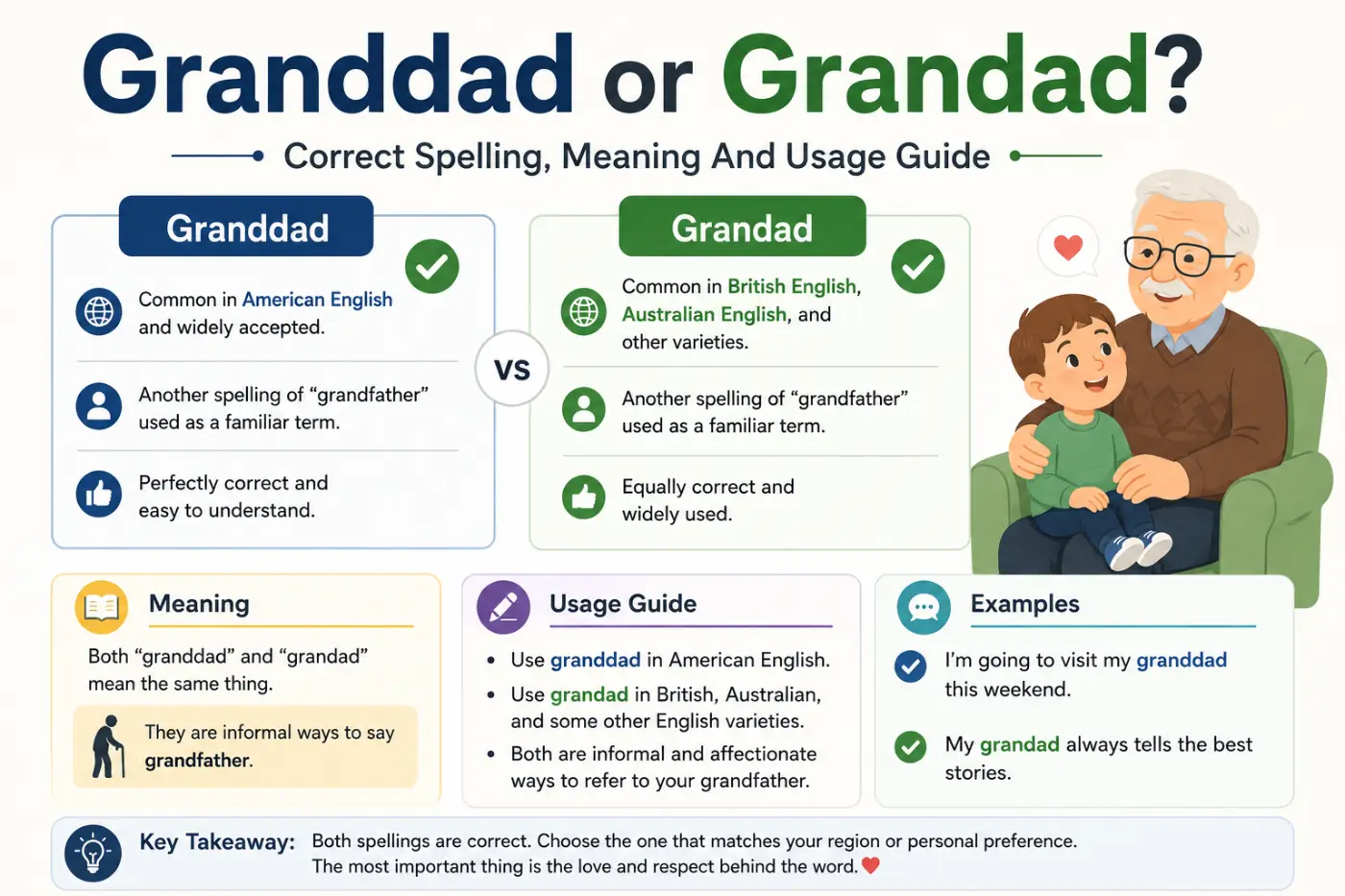
Granddad or grandad is a common spelling question because both forms look right and mean the same thing. If you want to write about your grandfather in a birthday card, family story, school assignment, or personal message, you might wonder which version you should choose. The good news is that neither spelling is inherently wrong.
The difference mainly comes down to regional spelling preferences. American English generally favors granddad, while British English commonly uses grandad. However, you may encounter either spelling on both sides of the Atlantic. The word is informal and affectionate, making it a natural choice when talking about a grandfather in everyday conversation.
Understanding this distinction helps you choose the right form for your audience without second guessing yourself. You do not need to memorize a complicated grammar rule or worry that one version changes the meaning. Both spellings refer to the same family relationship, and your choice should reflect your preferred English variety, your publication’s style guide, or the spelling used by the person you are writing about.
Short Answer
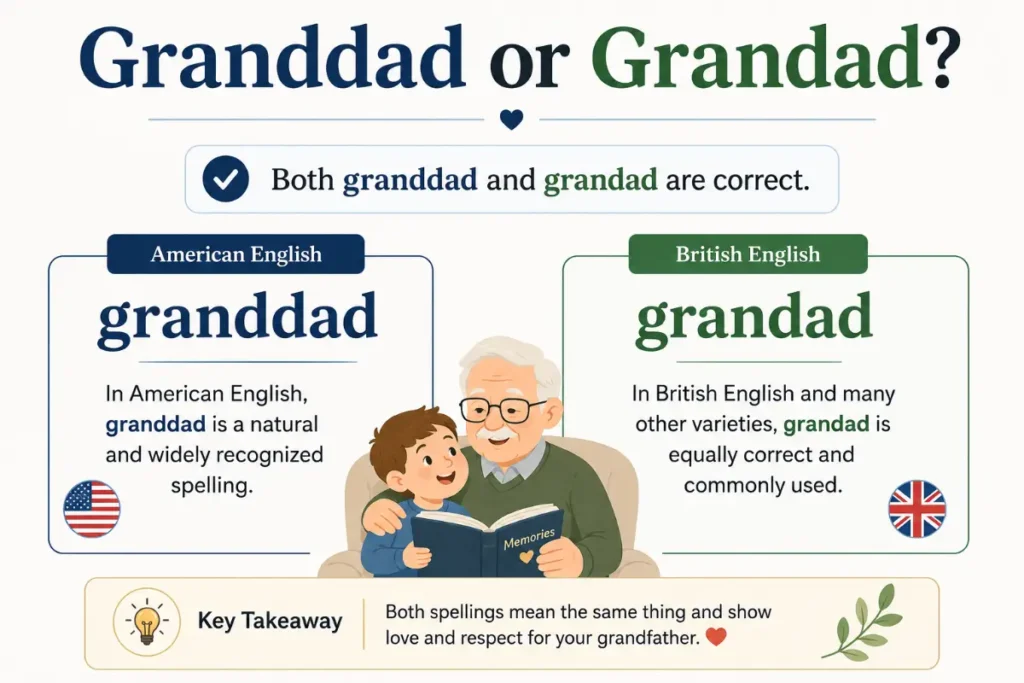
Granddad and grandad are both correct spellings of the informal word for grandfather. The main difference is regional preference. Granddad is more common in American English, while grandad is widely used in British English. Both words have the same meaning and pronunciation in ordinary use. Choose the spelling that fits your audience and use it consistently throughout your writing.
Table of Contents
- What Granddad and Grandad Mean.
- The Difference Between Granddad and Grandad.
- Which Spelling Is Correct in American English.
- Which Spelling Is Correct in British English.
- Pronunciation and Word Formation.
- When to Use Each Spelling.
- Granddad and Grandad in Everyday Sentences.
- Common Spelling Mistakes.
- Memory Tips for Choosing the Right Spelling.
- Related Words for Grandfather.
- Professional Writing Tips.
- Frequently Asked Questions.
- Key Takeaways.
- Conclusion.
What Granddad and Grandad Mean
Granddad and grandad both mean grandfather. They are familiar, informal terms people use when speaking about or addressing their father’s father or mother’s father.
For example, someone might say, My granddad taught me how to ride a bicycle. Another person might write, My grandad makes the best pancakes. Both sentences communicate the same idea.
The words express a family relationship, but they can also carry warmth, affection, and personal meaning. A granddad or grandad may be someone who shares family stories, offers advice, teaches practical skills, or creates lasting childhood memories.
Is Granddad a Real Word
Yes. Granddad is a standard English word found in dictionaries. It is an informal term for a grandfather and is especially familiar in American English.
The spelling contains two d’s at the end of the first part and two d’s in the full compound form where the word grand joins dad. This makes it easy to recognize as a combination of grand and dad.
Example: My granddad visits us every Sunday.
In this sentence, granddad refers to the speaker’s grandfather. The word works as a noun and identifies a family member.
Is Grandad a Real Word
Yes. Grandad is also a standard English word. It has the same meaning as granddad and is widely used in British English.
The spelling combines grand and a shortened form of dad without repeating the final d. Although the spelling differs, the meaning remains unchanged.
Example: My grandad enjoys gardening.
This sentence tells the reader that the speaker’s grandfather enjoys gardening. It does not suggest a different kind of grandfather from the person described by the American spelling.
Are Both Spellings Accepted
Yes. Both forms are accepted English spellings. The choice depends mainly on regional preference and personal style rather than a difference in grammar or meaning.
You can use either form in casual writing, family correspondence, and personal stories. For schoolwork, professional documents, or published articles, follow the spelling conventions expected by your audience.
The Difference Between Granddad and Grandad
The difference between these words is spelling preference, not definition. Both refer to a grandfather, and neither form describes a different family relationship.
The easiest way to understand the distinction is to look at the English variety in which each spelling is more common.
| Feature | Granddad | Grandad |
|---|---|---|
| Meaning | Grandfather | Grandfather |
| Word type | Noun | Noun |
| Common regional preference | American English | British English |
| Formality | Informal | Informal |
| Pronunciation | Generally the same | Generally the same |
| Grammar | Standard English | Standard English |
| Suitable for family messages | Yes | Yes |
| Suitable for general writing | Yes | Yes |
Why Does the Spelling Differ
English spelling varies across regions. Some words have different accepted forms in American and British English, and this variation can develop through historical usage, publishing conventions, and everyday speech.
Granddad and grandad are examples of this kind of regional variation. American writers often use the form that clearly includes dad, while British writers frequently use the shorter form.
However, this is a general preference rather than a strict national rule. A British writer may use granddad, and an American writer may use grandad because of family tradition, personal preference, or the wording of a source.
Does One Spelling Have a Different Meaning
No. Neither spelling changes the meaning of the word.
Consider these examples.
1. My granddad gave me a book for my birthday.
This sentence describes a grandfather giving a birthday gift.
2. My grandad gave me a book for my birthday.
This sentence communicates exactly the same information.
The spelling changes, but the family relationship and action remain identical. You should not choose one form based on the age, personality, or side of the family of the person you mean.
Is Granddad More Correct Than Grandad
No. Granddad is not universally more correct than grandad, and grandad is not a misspelling of granddad.
Both are established forms. The idea that only one spelling is correct usually comes from regional habits or familiarity with one version.
If you write for an American audience, granddad is generally the more natural choice. If you write for a British audience, grandad may fit local usage better. In either case, consistency matters more than treating the other form as an error.
Which Spelling Is Correct in American English
Granddad is generally the preferred spelling in American English. It is a familiar informal term for a grandfather and appears naturally in personal conversations, family stories, greeting cards, and other everyday writing.
American English often uses dad as a familiar word for father. The spelling granddad makes that connection visible, which may help explain its appeal to American writers.
Examples in American English
1. My granddad taught me how to fish when I was six.
The sentence uses granddad as the subject of the sentence. It describes a childhood memory involving the speaker’s grandfather.
2. We are taking my granddad out for dinner on Saturday.
Here, granddad identifies the family member who will join the family for dinner.
3. My granddad always tells the funniest stories.
The word describes a grandfather who regularly entertains the family with stories.
4. I bought a warm jacket for my granddad.
In this sentence, granddad identifies the person receiving the jacket.
These examples show how naturally the word fits into everyday American English. It works in both spoken and written contexts without sounding overly formal.
Should American Writers Always Use Granddad
Not necessarily. American English has regional and personal variation, so grandad is still understandable and may be the preferred spelling in a particular family.
For example, a person may use grandad because that is how their grandfather’s name appears on family documents or greeting cards. Another writer may follow a British publication’s spelling conventions.
The practical rule is simple. Use granddad as your default for general American writing, but respect established personal or editorial preferences when they apply.
Which Spelling Is Correct in British English
Grandad is widely used in British English and is a natural choice for many readers in the United Kingdom. It appears in informal conversations, family messages, children’s writing, and personal accounts.
British English uses several familiar family terms, including dad, mum, grandad, and grandpa. These words often communicate closeness rather than formality.
Examples in British English
1. My grandad lives near the coast.
This sentence identifies the speaker’s grandfather and tells the reader where he lives.
2. We visited our grandad during the school holidays.
The word refers to a family member whom the speaker and others visited.
3. My grandad taught me to grow vegetables.
This example describes a practical skill the grandfather passed on to the speaker.
4. I am making a birthday card for my grandad.
Here, grandad identifies the person who will receive the card.
Each example uses the same meaning that granddad carries in American English. The difference lies in the spelling preference, not in the relationship or action being described.
Can British Writers Use Granddad
Yes. British writers can use granddad without making a grammatical mistake. The spelling is recognized and may appear in British publications or individual family usage.
However, if you are writing an article specifically for a British audience, grandad may be the more familiar choice. Following the preferred form helps your writing feel consistent with the language variety you have selected.
Remember that regional conventions guide spelling choices. They do not always create absolute rules that every speaker follows.
Pronunciation and Word Formation
Granddad and grandad are generally pronounced the same way in ordinary English. The spelling difference does not normally create a meaningful difference in pronunciation.
Both words combine the idea of a grandparent with the familiar family term dad. They are informal nouns that identify a grandfather.
How Do You Pronounce Granddad and Grandad
Both spellings commonly have the same pronunciation, with the main stress on the first syllable of grand. The second syllable sounds like dad.
The exact vowel quality may vary by accent. For example, speakers in different parts of the United States and the United Kingdom may pronounce the vowel in dad differently. That regional variation does not make either spelling incorrect.
Why Does Granddad Have Two Ds
Granddad visibly combines grand and dad. Since grand ends in d and dad begins with d, the combined form retains the double d at the boundary.
The spelling grandad uses a more compact form of the same familiar word. Both forms are established in English, so you do not need to apply a universal rule requiring the double d in every regional variety.
Is Granddad a Compound Word
Granddad can be understood as a compound word formed from grand and dad. It combines two familiar elements to create a word for a grandfather.
Grandad follows the same general idea, although the spelling is shorter. Both forms function as single nouns in a sentence.
Example: My granddad lives in Ohio.
The whole word serves as the subject. You do not need to separate grand from dad or add a space between the parts.
When to Use Each Spelling
The best spelling depends on your audience, the type of writing, and any established preference you need to follow.
Use Granddad for General American Writing
Choose granddad when writing for a broad American audience. It is a familiar spelling and fits naturally into everyday American English.
For example, you might write a personal blog post about your granddad, prepare a birthday card, or describe a family tradition in a school assignment.
If your article targets American readers, using granddad consistently can help maintain a natural regional style.
Use Grandad for General British Writing
Choose grandad when writing for a British audience if you want to follow the common British preference.
For example, a British family newsletter might refer to a grandad who enjoys taking his grandchildren to the park. A personal letter might use the same spelling when describing a weekend visit.
Using grandad helps align the writing with a familiar British form without changing the meaning.
Follow the Person’s Preferred Spelling
Sometimes personal preference matters more than regional convention. A grandfather may use Grandad, Granddad, Grandpa, or another family nickname.
If you are writing a personalized card, family biography, memorial, or tribute, use the spelling the person prefers. This small detail can make the writing feel more personal and respectful.
For example, if a family always calls someone Grandad, keep that form in a birthday message even if your publication normally uses granddad.
Follow Your Style Guide
Writers, editors, and publishers often use a style guide to keep spelling consistent. If your organization specifies a preferred English variety, follow that standard throughout the document.
For example, an American publication may choose granddad as its house style, while a British publication may prefer grandad. Neither decision makes the alternative spelling incorrect.
Consistency helps readers focus on your message instead of noticing unnecessary spelling changes.
Granddad and Grandad in Everyday Sentences
Examples make the distinction easier to remember because they show how the words function in real situations.
Family Conversations
1. My granddad is coming over for lunch.
The sentence tells someone that the speaker’s grandfather will visit for a meal.
2. My grandad loves playing chess with the children.
The sentence describes an activity the grandfather enjoys sharing with younger family members.
3. I called my granddad to ask about our family history.
Here, granddad identifies the person the speaker contacted for information.
4. We took a photograph with our grandad at the wedding.
The sentence describes a family photograph taken at a special event.
All four sentences use the word as a noun. The spelling can change according to regional preference without changing the sentence’s meaning.
Birthday Cards and Personal Messages
1. Happy birthday to my wonderful granddad.
This message expresses affection and celebrates the grandfather’s birthday.
2. Thank you for all the memories, Grandad.
This sentence addresses the grandfather directly and uses Grandad as a personal form of address.
3. I hope you have a lovely day, Granddad.
The message wishes the grandfather an enjoyable day.
4. Sending lots of love to my grandad.
This phrase expresses affection in a short personal message.
When addressing someone directly, writers often capitalize a family title when it functions like a name. In a general sentence, the word is usually lowercase.
School Assignments and Personal Essays
1. My granddad inspired me to become a teacher.
The sentence explains how the grandfather influenced the speaker’s career goals.
2. My grandad taught me the importance of patience.
This example describes a personal lesson the grandfather shared.
3. I learned to bake bread with my granddad.
The sentence describes a practical skill learned through time spent together.
These examples are appropriate for personal essays and school assignments. If the assignment requires a specific regional form, follow the teacher’s instructions.
Stories and Family Memories
1. Every summer, my granddad took us to the lake.
This sentence describes a repeated childhood experience.
2. My grandad kept old photographs in a wooden box.
The sentence gives a detail about the grandfather and his belongings.
3. My granddad used to tell us stories about his childhood.
The phrase used to describes a past habit that may no longer happen.
4. We still remember the songs our grandad sang at family gatherings.
This sentence highlights a family memory that remains meaningful.
The examples show that both spellings work naturally in storytelling. The writer’s chosen English variety determines the preferred form.
Common Mistakes
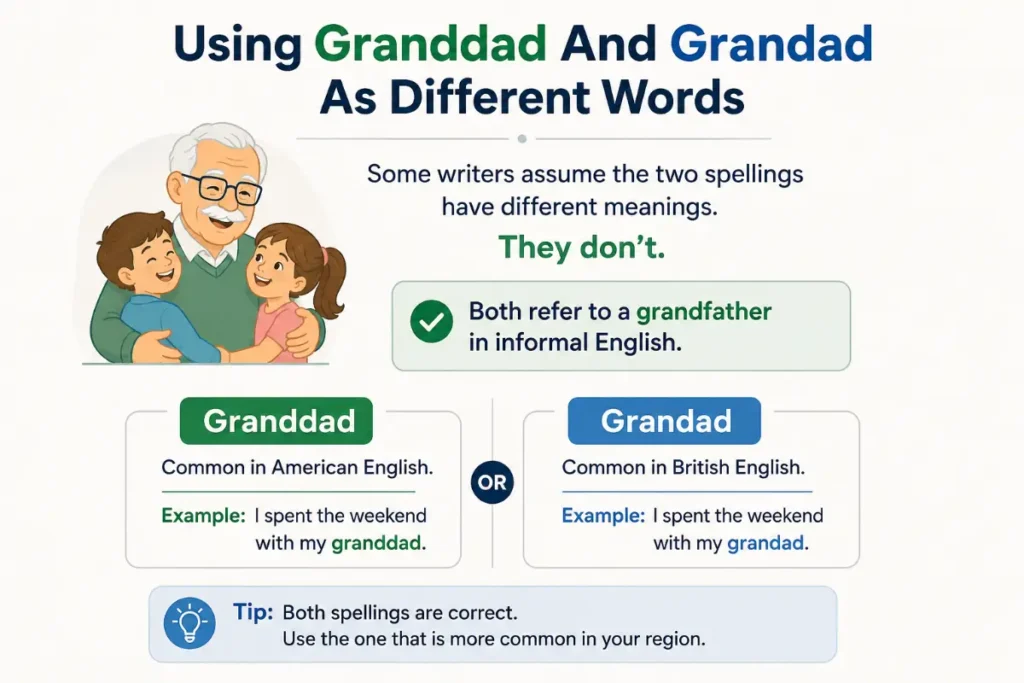
Most mistakes involving these words come from assuming that one spelling is universally correct or changing between forms without a clear reason.
Treating Grandad as a Misspelling
Incorrect assumption: Grandad is always wrong because it has only one d at the end of grand.
Correct understanding: Grandad is an accepted spelling, particularly in British English.
The shorter spelling does not make the word incorrect. It reflects a recognized regional form.
Treating Granddad as a Misspelling
Incorrect assumption: Granddad is wrong because grandad is the spelling used in a British family.
Correct understanding: Granddad is a standard spelling and is especially common in American English.
A word can have more than one accepted spelling. Regional variation is common in English, so you should check the relevant convention before correcting another writer.
Assuming the Words Have Different Meanings
Incorrect assumption: Granddad refers to the father’s father, while grandad refers to the mother’s father.
Correct understanding: Both words can refer to either grandfather.
The spelling does not identify which side of the family the person belongs to. If that distinction matters, write paternal grandfather for your father’s father or maternal grandfather for your mother’s father.
Switching Between Spellings Without a Reason
Inconsistent example: My granddad visited on Friday. My grandad brought us gifts on Saturday.
This passage might confuse readers because the writer changes spelling without explaining why. If both references describe the same person in the same document, the variation may look accidental.
Better example: My granddad visited on Friday. He brought us gifts on Saturday.
The revised version uses granddad consistently and avoids an unnecessary spelling change.
Capitalizing the Word Every Time
Incorrect: My Granddad lives in Florida.
Correct: My granddad lives in Florida.
In ordinary sentences, family terms generally remain lowercase when they follow words such as my, our, or his. Capitalization is appropriate when the word begins a sentence or functions as a name in direct address.
Example: Granddad lives in Florida.
The word starts the sentence, so it begins with a capital letter.
Example: I love you, Granddad.
The word is used as a direct form of address, so capitalization is appropriate.
Using an Apostrophe Incorrectly
Incorrect: My granddad’s are visiting us today.
Correct: My granddads are visiting us today.
The first sentence uses an apostrophe incorrectly if the writer simply means more than one grandfather. The regular plural is granddads.
However, granddad’s is correct when it shows possession or forms part of a contraction.
Example: My granddad’s garden looks beautiful.
Here, granddad’s shows that the garden belongs to the grandfather.
Memory Tips for Choosing the Right Spelling
A simple memory trick can help you select the form that fits your writing.
Connect Granddad With Dad
The spelling granddad contains the familiar word dad. This connection makes it an easy choice to remember, particularly when writing for an American audience.
Think of granddad as a grandfather described through the familiar family word dad. The spelling offers a straightforward visual clue.
Connect Grandad With British Usage
If you write for a British audience, remember that grandad is a widely used form in British English.
You do not need to memorize a complicated rule. Simply associate grandad with the British spelling preference and check the conventions of your publication when necessary.
Remember That Both Mean Grandfather
The most useful memory tip is that both words identify the same family relationship.
If you forget which spelling is preferred in a particular region, you can still recognize both as accepted forms. Check a reputable dictionary or style guide when precision matters.
Use One Form Consistently
Once you select a spelling, use it throughout the document unless you are preserving a person’s preferred name or quoting a source exactly.
For example, if you begin a family essay with granddad, keep using granddad in later paragraphs. This habit prevents accidental variation and makes proofreading easier.
Related Words for Grandfather
English has several words for a grandfather. They vary in familiarity, regional use, and personal meaning, so choosing the right one depends on your audience and the relationship you want to express.
| Word | Meaning or Usage | Typical Tone |
|---|---|---|
| Grandfather | A standard term for a parent’s father | Neutral |
| Granddad | An informal term for grandfather | Familiar |
| Grandad | An informal term for grandfather | Familiar |
| Grandpa | A common affectionate term for grandfather | Warm |
| Gramps | An informal nickname for grandfather | Casual |
| Grandpapa | A traditional or affectionate term | Old fashioned or affectionate |
| Paternal grandfather | Your father’s father | Formal or precise |
| Maternal grandfather | Your mother’s father | Formal or precise |
Granddad vs Grandpa
Both words refer to a grandfather, but families may prefer one term over the other.
Granddad is closely connected to the word dad, while grandpa uses pa as a familiar family term. Neither is inherently more affectionate than the other. The emotional meaning often comes from family tradition and personal experience.
Example: My granddad taught me to swim.
Example: My grandpa taught me to swim.
Both sentences communicate the same basic information. The choice depends on the name the speaker naturally uses.
Granddad vs Grandfather
Grandfather is the standard, more neutral term. Granddad is more informal and often sounds warmer in everyday conversation.
Example: My grandfather worked as a doctor.
This sentence sounds neutral and may suit a formal biography or school report.
Example: My granddad worked as a doctor.
This sentence sounds more personal and conversational.
Both sentences are correct. The best choice depends on the tone and context of your writing.
Grandad vs Gramps
Grandad is a familiar term for a grandfather, while gramps is a more casual nickname.
Example: My grandad lives in Manchester.
Example: Gramps lives in Manchester.
Both sentences identify a grandfather, but gramps may sound more playful or distinctive. It is often a personal family nickname rather than a formal label.
Paternal Grandfather vs Maternal Grandfather
These expressions distinguish the two sides of a family.
Your paternal grandfather is your father’s father. Your maternal grandfather is your mother’s father.
For example, if you are writing a family history and need to distinguish the two men, these precise terms remove ambiguity. In ordinary conversation, granddad or grandad is usually enough when the context makes the relationship clear.
Professional Writing Tips
Even a simple family term deserves careful treatment when you are writing for a specific audience. A few practical habits can help you use the word accurately and naturally.
Match the Audience
Choose the spelling that best fits the readers of your content. For American audiences, granddad is generally a safe default. For British audiences, grandad is a familiar choice.
If your content serves readers from several countries, either accepted spelling can work. Define your regional style early in the editing process and apply it consistently.
Respect Personal Names and Nicknames
A person’s preferred family title can be more important than the usual regional convention.
If someone identifies their grandfather as Grandad, use that form when writing a personalized tribute or family story. Do not automatically change it to granddad just because your usual spelling preference differs.
This approach respects the person’s own language and keeps personal writing authentic.
Avoid Unnecessary Corrections
Before marking grandad as an error, consider the writer’s intended audience. A spelling that looks unfamiliar to one reader may be entirely natural to another.
Editors should distinguish between genuine mistakes and accepted regional variants. That distinction prevents needless corrections and improves the quality of the final text.
Keep Regional Spelling Consistent
Consistency helps readers recognize the English variety used in a document. If you choose American English, check related spellings and style choices across the article. If you choose British English, follow the corresponding conventions.
Consistency does not mean every English speaker must use the same form. It means your own writing should have a clear and deliberate style.
Use the Right Term for the Context
Granddad and grandad suit informal writing, family messages, and personal stories. Grandfather may be more appropriate in formal reports, genealogical records, or writing that requires a neutral tone.
For example, a personal memoir might refer to granddad throughout the story. A family tree may label the same person as grandfather to keep the relationships clear.
Neither choice is universally better. The context determines which term serves the reader most effectively.
Expert Editor Insight
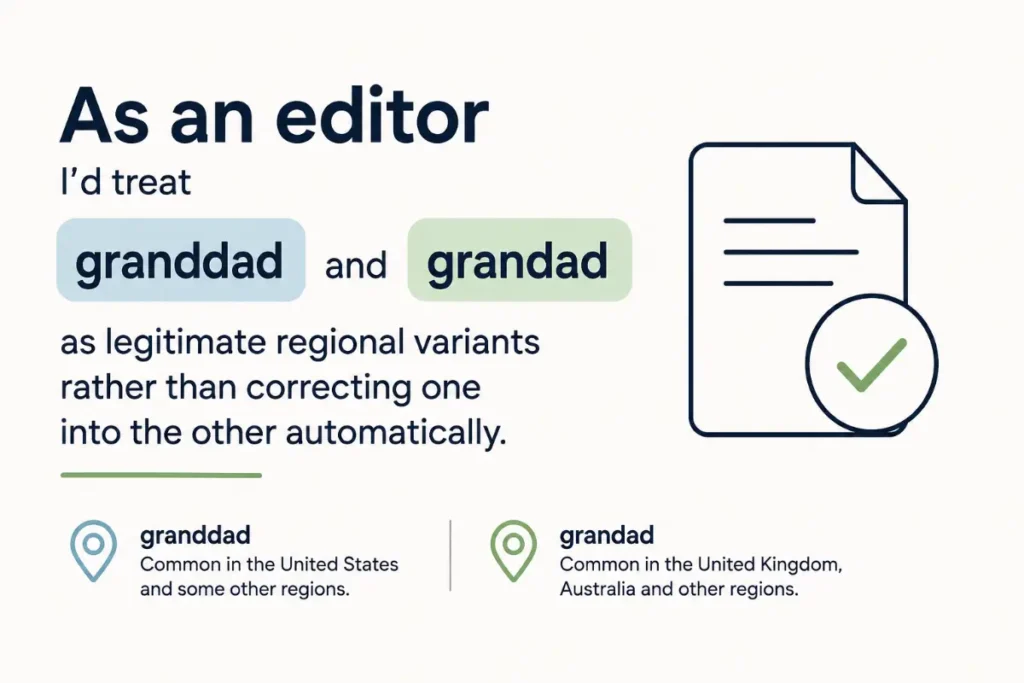
As an editor I’d treat granddad and grandad as legitimate regional variants rather than correcting one into the other automatically. Dictionary evidence matters here because both forms have established entries and usage histories. Merriam Webster lists grandad as a variant of granddad while Oxford and Cambridge clearly recognize both forms.
My practical tip is simple. Decide who your readers are before choosing the spelling. For an American audience granddad is a strong default. For a British audience grandad is often the natural choice. Then keep the spelling consistent. Good editing isn’t about making every writer use one form. It’s about choosing the form that fits the audience and preserving consistency.
Key Takeaways
1. Granddad and grandad are both correct spellings of the informal word for grandfather.
2. Granddad is generally more common in American English.
3. Grandad is widely used in British English.
4. Both spellings have the same meaning and are generally pronounced alike.
5. Neither spelling identifies the father’s side or the mother’s side of the family.
6. Use the spelling that fits your audience, publication style, or family preference.
7. Keep the spelling consistent throughout your writing unless you are preserving a personal name or a source’s original wording.
Conclusion
Granddad or grandad comes down to regional preference rather than a difference in meaning. Both spellings refer to a grandfather, and both are accepted in English. Granddad is generally the more familiar choice in American English, while grandad is widely used in British English. You can use either form without changing the meaning of your sentence.
When choosing between the two, think about your audience and the kind of writing you are creating. Use granddad for general American content and grandad for general British content. If your family has a preferred spelling, or a person uses one form as a personal name, respect that choice. Consistency will help your writing feel polished and natural.
The easiest rule to remember is that both spellings are correct, but one may fit your audience better. You do not need to worry about a major grammar difference or memorize a complicated spelling rule. Choose the form that suits your readers, use it consistently, and focus on the message you want to share.
Frequently Asked Questions
1. Is Granddad or Grandad Correct?
Both granddad and grandad are correct English spellings. They have the same meaning and refer to a grandfather. Granddad is generally more common in American English, while grandad is widely used in British English.
2. Is Grandad British or American?
Grandad is widely associated with British English. However, the spelling is not limited to the United Kingdom. English speakers in other countries may use it because of family tradition, personal preference, or exposure to British English.
3. Is Granddad American English?
Granddad is especially common in American English. It is an informal term for grandfather and is widely understood in other English speaking regions as well.
4. Do Granddad and Grandad Mean the Same Thing?
Yes. Both words mean grandfather. Neither spelling indicates a different side of the family or a different type of relationship. The distinction is mainly regional and stylistic.
5. How Do You Spell Grandad in the United States?
Granddad is generally the preferred spelling in the United States. However, grandad is also an accepted form, so it should not automatically be treated as a spelling error.
6. How Do You Spell Grandad in the United Kingdom?
Grandad is a widely used spelling in the United Kingdom. Granddad is also recognized, but grandad may be the more familiar choice for a British audience.
7. Is Granddad One Word or Two?
Granddad is written as one word. It does not need a space, hyphen, or apostrophe when used as a singular noun.
Correct: My granddad lives nearby.
Incorrect: My grand dad lives nearby.
8. Is Grandad More Informal Than Grandfather?
Grandad is an informal family term, while grandfather is more neutral and often suits formal writing. Both refer to the same family relationship, but they create slightly different tones.
9. Should I Capitalize Granddad or Grandad?
Capitalize the word at the beginning of a sentence or when using it as a name in direct address. Otherwise, use lowercase in ordinary sentences.
Example: My granddad is visiting today.
Example: Thank you, Grandad.
10. What Is the Plural of Granddad?
The usual plural is granddads. You do not need an apostrophe to make the word plural.
Example: Both granddads attended the family celebration.
The same general pattern applies to grandad, giving the plural grandads.
11. Can I Use Granddad in a Formal Essay?
You can use granddad in a personal essay, reflective assignment, or piece of writing that allows an informal tone. For a formal academic report or genealogical document, grandfather may be more appropriate.
Always follow your teacher’s or editor’s instructions when they specify a preferred style.
12. Which Spelling Should I Use in a Birthday Card?
Use the form that feels natural to your family or matches the name your grandfather prefers. If you are writing for an American audience, granddad is a natural default. If you are writing for a British audience, grandad is a familiar choice.
The personal meaning of the message matters more than the regional spelling difference.

Confusing Words, Spelling & Word Choice
Claire Whitmore is a U.S.-based English editor who writes about commonly confused words, spelling differences, and word choice. Her work helps readers understand subtle distinctions between similar-looking words through simple definitions, practical examples, and modern usage guidance in both American and British English.