
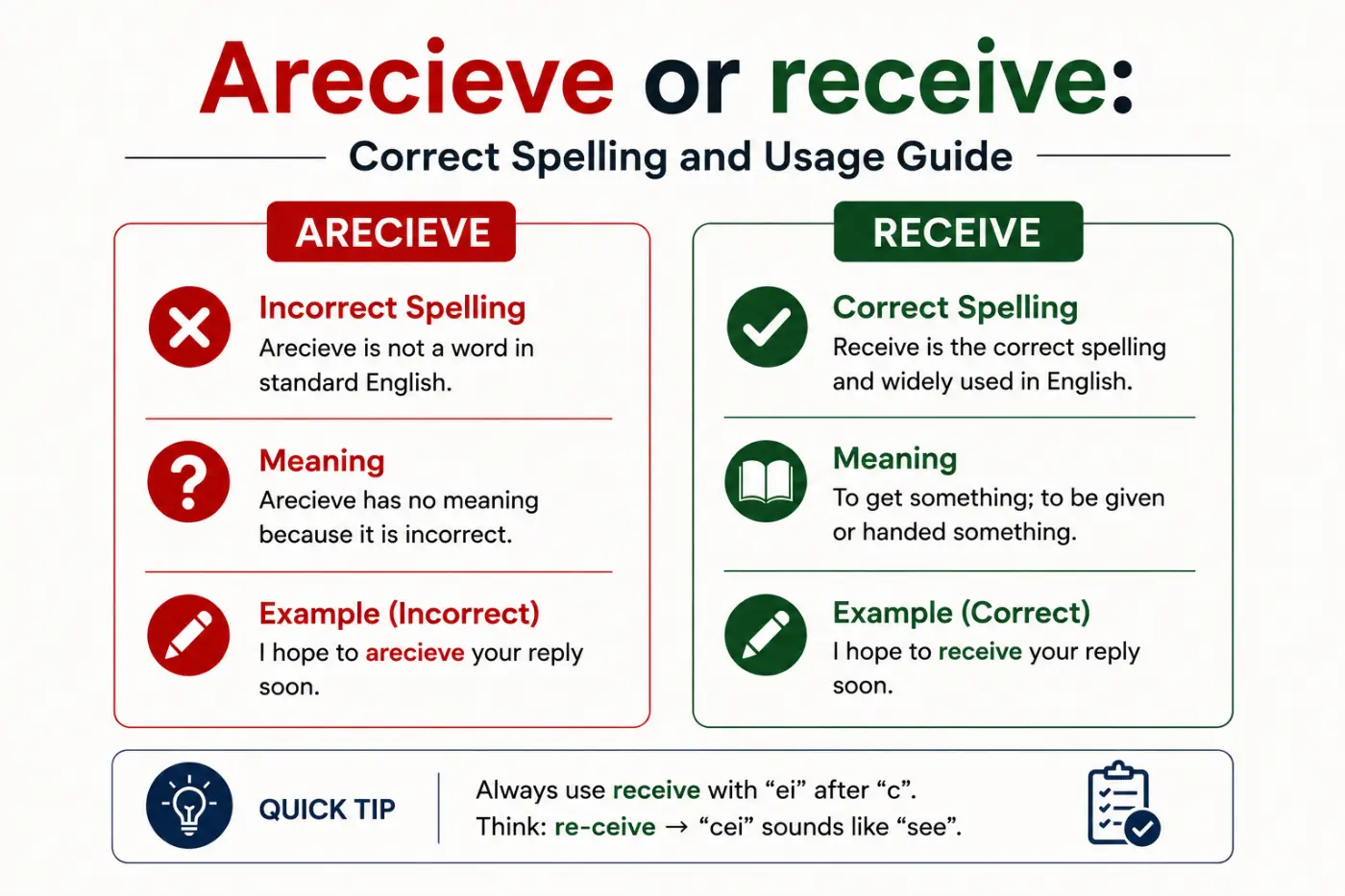
Recieve or receive is a common spelling question because the two vowels in the word can be confusing. The correct spelling is receive, with e before i after the letter c. Recieve is incorrect in standard English, so you should correct it whenever it appears in your writing.
The confusion comes from a familiar English spelling pattern. Many people learn the rule i before e except after c, but English has enough exceptions to make the rule tricky. Receive follows the after c part of that pattern, which makes its spelling easier to remember once you understand how the letters work together.
You use receive in many everyday situations. You might receive an email, receive a package, receive payment, or receive advice from a friend. Learning the correct spelling helps you write more clearly and avoid a mistake that can stand out in professional and academic writing.
Short Answer
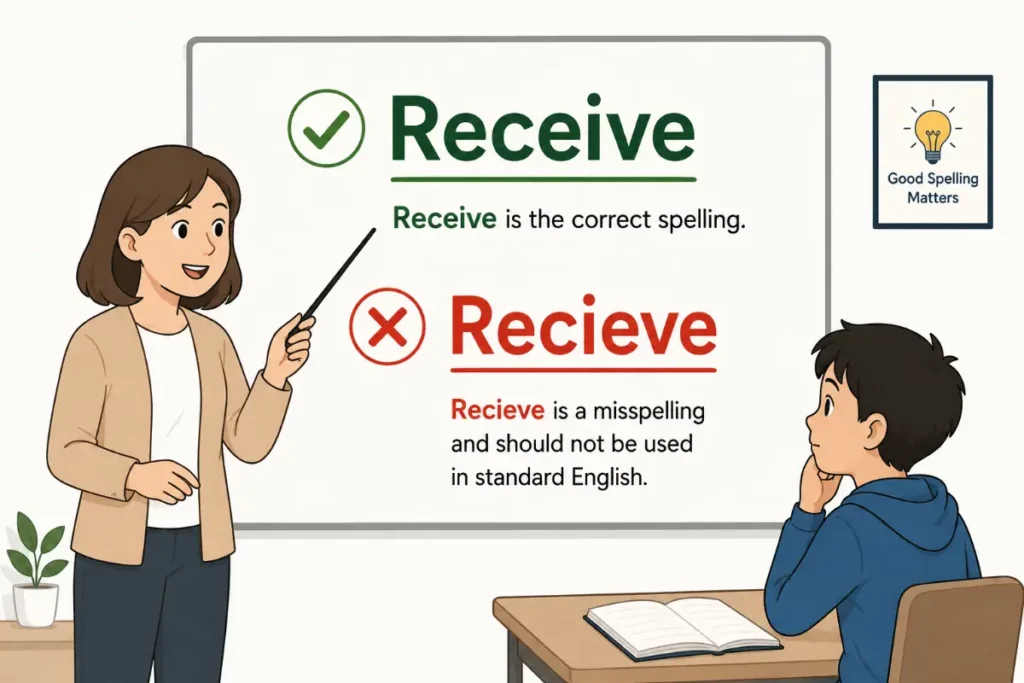
Receive is the correct spelling. Recieve is a common misspelling. The word receive means to get, accept, or be given something. It follows the English spelling rule often remembered as i before e except after c. In this case the letters ei follow c, so receive is correct. Use receive in emails, school assignments, business documents, and everyday writing.
Table of Contents
- The Correct Spelling of Receive.
- What Receive Means.
- Why Receive Is Spelled With Ei.
- Receive vs Recieve.
- How to Use Receive in a Sentence.
- Different Forms of Receive.
- Common Spelling Mistakes.
- Easy Ways to Remember Receive.
- Receive in American and British English.
- Related Words and Expressions.
- Frequently Asked Questions.
- Key Takeaways.
- Conclusion.
The Correct Spelling of Receive
The correct spelling is receive. The spelling recieve is a mistake and should not be used in standard English.
Receive is a verb. It describes getting something from another person or source, accepting something offered, or experiencing something that happens to you.
Consider these examples.
- I will receive the package tomorrow. The sentence means that the speaker expects the package to arrive the next day.
- She received an award for her excellent work. The sentence explains that she was given an award in recognition of her work.
- We receive several emails every morning. The sentence describes something that happens regularly.
- He hopes to receive good news soon. The sentence expresses his expectation of hearing something positive.
In each example the spelling remains the same at its core. The verb changes to fit the sentence, but the letters in receive appear in the correct order.
Why Recieve Is Incorrect
Recieve places the i before the e after c. That order does not match the standard spelling of the word.
People often make this mistake because they remember the sound of the word but not its exact letter sequence. English spelling does not always match pronunciation closely, so relying on sound alone can lead to errors.
For example, writing I will recieve your message is incorrect. The correct sentence is I will receive your message.
The best approach is to learn the spelling as a complete word and connect it with a memory trick. That way you do not have to guess the order of the vowels every time you write it.
What Receive Means
Receive means to get, accept, or be given something. The word can describe physical objects, information, money, help, communication, or an experience.
Its exact meaning depends on the situation. The central idea stays the same: something comes to a person or place.
Receive Something Physical
You can use receive when someone gives you an object or sends something to you.
Examples.
- I received a birthday gift from my cousin. The sentence means that the cousin gave the speaker a gift.
- The office received a new printer yesterday. The sentence explains that the printer arrived at the office.
- She received a letter from the bank. The sentence tells us that the bank sent her a letter that she got.
In these situations receive often describes the arrival of an item from another person or organization.
Receive Information or Communication
Receive can also describe getting information through a message, phone call, email, or other form of communication.
Examples.
- Did you receive my text message. The speaker wants to know if the message reached the other person.
- We received confirmation of the appointment. The sentence means that someone sent information confirming the appointment.
- He received a phone call from his manager. The sentence tells us that his manager called him.
This use is especially common in workplace communication. You may receive instructions, updates, reminders, reports, or feedback.
Receive Money or Payment
The word also applies to money and financial transactions.
Examples.
- The employee receives a salary every month. The sentence describes regular payment for work.
- The seller received payment for the order. The sentence means that the seller got the money owed.
- Our organization received a donation from a local business. The sentence explains that the organization was given financial support.
In business writing receive is useful because it describes the arrival of money without suggesting that the recipient requested or earned it in a particular way.
Receive Help or Support
You can receive something that isn’t physical. Help, advice, permission, support, and encouragement can all be received.
Examples.
- She received helpful advice from her teacher. The sentence means that the teacher gave her advice.
- The family received support from their neighbors. The sentence explains that the neighbors helped the family.
- He received permission to leave early. The sentence means that someone in authority allowed him to leave.
These examples show that receive has a broad meaning. It applies to both physical things and ideas or actions directed toward someone.
Receive an Experience or Response
Receive can describe how people respond to a person, idea, performance, or event.
Examples.
- The proposal received positive feedback. The sentence means that people responded favorably to the proposal.
- The movie received mixed reviews. The sentence explains that reviewers had different opinions about the movie.
- Her speech received a warm welcome. The sentence means that the audience responded positively to her speech.
This usage appears frequently in reviews, reports, news writing, and professional discussions.
Why Receive Is Spelled With Ei
The spelling of receive follows a well known English spelling pattern called i before e except after c. The rule suggests that i comes before e in many words, but e comes before i when the pair follows c.
Receive follows the second part of this pattern. The letters appear in this order: r, e, c, e, i, v, e. The important detail is the vowel pair ei after c.
Here are some other words that follow the same pattern.
| Word | Example sentence |
|---|---|
| Receive | I receive a weekly newsletter. |
| Deceive | Never deceive someone who trusts you. |
| Conceive | They conceived a plan to improve the service. |
| Perceive | Children may perceive situations differently from adults. |
| Receipt | Keep the receipt for your records. |
| Ceiling | The ceiling needs a fresh coat of paint. |
Each word contains ei after c. This pattern can help you remember how to spell receive and several related words.
Is the I Before E Rule Always Correct
No. The rule is a useful memory aid, but it doesn’t explain every English word. Some words follow different patterns, and others have spellings that must be learned individually.
For example, believe and field have ie, while science and ancient contain ei after c but don’t follow the simple sound pattern in exactly the same way. English spelling has developed through several languages and historical changes, so one short rule cannot cover every word.
Use the rule as a guide rather than an absolute law. When you are unsure about a word, check its standard spelling instead of relying entirely on the rule.
Why the Rule Helps With Receive
Receive is a good example of the after c pattern because the vowel pair comes directly after c. Once you remember that sequence, you can avoid switching the i and e.
A practical memory method is to focus on the middle of the word rather than trying to memorize all seven letters separately. Remember that c is followed by ei, and you will have the part that most often causes trouble.
Receive vs Recieve
The difference between receive and recieve is spelling. Receive is the accepted spelling in standard English, while recieve is an error.
Both forms may look believable to someone who is writing quickly. However, only receive belongs in edited writing, schoolwork, workplace communication, and published content.
| Feature | Receive | Recieve |
|---|---|---|
| Spelling status | Correct | Incorrect |
| Meaning | To get or accept something | No standard meaning as a separate word |
| Part of speech | Verb | Not a standard English word |
| Use in formal writing | Appropriate | Incorrect |
| Example | I receive your updates every week. | I recieve your updates every week. |
| Correction needed | No | Replace with receive |
Which Spelling Should You Use
Always use receive when you mean to get or accept something. Do not use recieve as an alternative spelling.
For example, write Please confirm that you received the payment. The spelling received follows the same pattern as receive, with the regular past tense ending added.
Likewise, write You will receive a confirmation email shortly. The word receive is correct even when it appears in a formal business message.
If you see recieve in a document, correct it unless you are reproducing a source exactly for a specific reason, such as discussing a spelling error.
Why People Mix Up the Two Spellings
There are several reasons people make this mistake.
- The vowel order is easy to reverse. The letters i and e appear in many familiar words, and writers sometimes place them in the wrong order.
- English spelling patterns are inconsistent. A rule that works for one word may not work for another, so writers may rely on guesswork.
- Typing quickly encourages errors. When people write messages in a hurry, they may not notice that they have switched two letters.
- Spellcheck does not catch every problem. Many writing tools identify misspellings, but a missed error can remain in the final document if no one reviews it.
The simplest solution is to learn the correct spelling and proofread words that commonly cause trouble.
How to Use Receive in a Sentence
Receive works in several grammatical structures. You can use it in the present tense, past tense, future tense, continuous forms, and passive constructions.
Understanding these patterns helps you use the word correctly as well as spell it correctly.
Receive in the Present Tense
Use receive for general facts, habits, routines, and events that happen regularly.
Examples.
- I receive a monthly statement from my bank. The sentence describes a regular event.
- They receive new orders throughout the day. The sentence explains what happens during their working hours.
- We receive feedback from customers after each project. The sentence describes a repeated process.
With he, she, or it, use receives in the simple present tense.
Examples.
- She receives a weekly report from her supervisor. The verb receives agrees with the singular subject she.
- The company receives hundreds of applications each year. The verb receives agrees with the singular subject company.
Remember that the s ending belongs to the verb in the simple present when the subject is he, she, it, or a singular noun.
Receive in the Past Tense
Use received to describe something that happened in the past.
Examples.
- I received your invitation yesterday. The sentence describes an event that is already complete.
- He received his certificate last week. The sentence tells us when the certificate arrived.
- We received several complaints after the announcement. The sentence describes a past response.
Receive is a regular verb. You form its simple past tense by adding ed to the base form.
The spelling changes from receive to received, but the original letter sequence remains intact. You do not write recieved.
Receive in the Future Tense
Use will receive to talk about something expected to happen later.
Examples.
- You will receive a tracking number after the order ships. The sentence explains what the customer can expect in the future.
- We will receive the final report tomorrow. The sentence describes an expected future event.
- She will receive an answer by Friday. The sentence gives a future expectation.
The structure is simple.
Subject + will + receive + object.
For example, They will receive their certificates next month. The base form receive follows will, so you do not add s or ed.
Receive in the Present Continuous Tense
Use am receiving, is receiving, or are receiving for an action happening now or around the present period.
Examples.
- I am receiving too many notifications today. The sentence describes something happening during the current period.
- She is receiving treatment at the hospital. The sentence describes an ongoing process.
- They are receiving applications for the position. The sentence explains that applications are currently coming in.
The present continuous form combines the verb be with receiving. The ending ing is added to the base verb after removing the final silent e.
Receive becomes receiving, not receiveing.
Receive in the Passive Voice
Use the passive voice when the recipient or the thing received deserves more attention than the person sending it.
Examples.
- The payment was received this morning. The sentence focuses on the payment rather than the person who sent it.
- All applications will be received by the admissions office. The sentence emphasizes the office’s role in accepting applications.
- Your request has been received. The sentence confirms that the request reached the intended person or organization.
The passive form is common in formal notices and business communication. It can sound impersonal, so use an active sentence when identifying the person or team responsible makes the message clearer.
For example, We have received your request sounds more direct than Your request has been received.
Receive With Modal Verbs
Modal verbs include can, could, may, might, should, and must. When you use receive after a modal verb, keep receive in its base form.
Examples.
- You can receive updates by email. The sentence explains an available option.
- Students may receive extra time for the examination. The sentence describes a possibility or permission.
- You should receive a confirmation message shortly. The sentence expresses an expectation.
- All applicants must receive a response. The sentence expresses a requirement.
Do not write can receives or should received. The modal verb already determines the grammatical structure, so the base form receive follows it.
Different Forms of Receive
The word receive changes form to fit different sentence structures. Learning these forms helps you avoid spelling and grammar errors.
| Verb form | Correct spelling | Example |
|---|---|---|
| Base form | Receive | I receive messages daily. |
| Third person singular | Receives | She receives messages daily. |
| Simple past | Received | She received a message yesterday. |
| Past participle | Received | She has received the message. |
| Present participle | Receiving | She is receiving a message. |
Receive and Receives
Receive is the base form. Receives is the simple present form used with a singular third person subject.
Correct: He receives a new assignment every Monday.
Incorrect: He receive a new assignment every Monday.
The subject he requires receives in this sentence because the verb describes a regular event in the simple present tense.
However, receive remains correct after modal verbs and auxiliary verbs such as do and does.
For example, Does he receive a weekly update is grammatically correct. The auxiliary does carries the tense marking, so the main verb stays in its base form.
Receive and Received
Received is both the simple past form and the past participle of receive.
Use received for a completed past action.
Example: We received the documents last night.
Use received with have, has, or had to form perfect tenses.
Examples.
- I have received your email. The present perfect connects the completed action to the present.
- She has received the results. The sentence explains that the results have arrived and are relevant now.
- They had received the notice before the meeting began. The past perfect shows that one past event happened before another.
The spelling received is correct in all these examples. The form recieved is incorrect.
Receive and Receiving
Receiving is the ing form of receive. You use it in continuous tenses and in some noun or adjective structures.
Examples.
- We are receiving new orders. The verb describes an ongoing action.
- Receiving clear instructions makes the task easier. Here receiving acts as a gerund and functions as the subject of the sentence.
- The receiving department checks incoming goods. Here receiving helps describe the department’s role.
When you add ing to receive, drop the final silent e. This produces receiving.
Do not write receiveing. The correct form is receiving.
Common Spelling Mistakes With Receive
Knowing the correct spelling is useful, but understanding related mistakes can help you catch errors before they reach your final draft.
Writing Recieve Instead of Receive
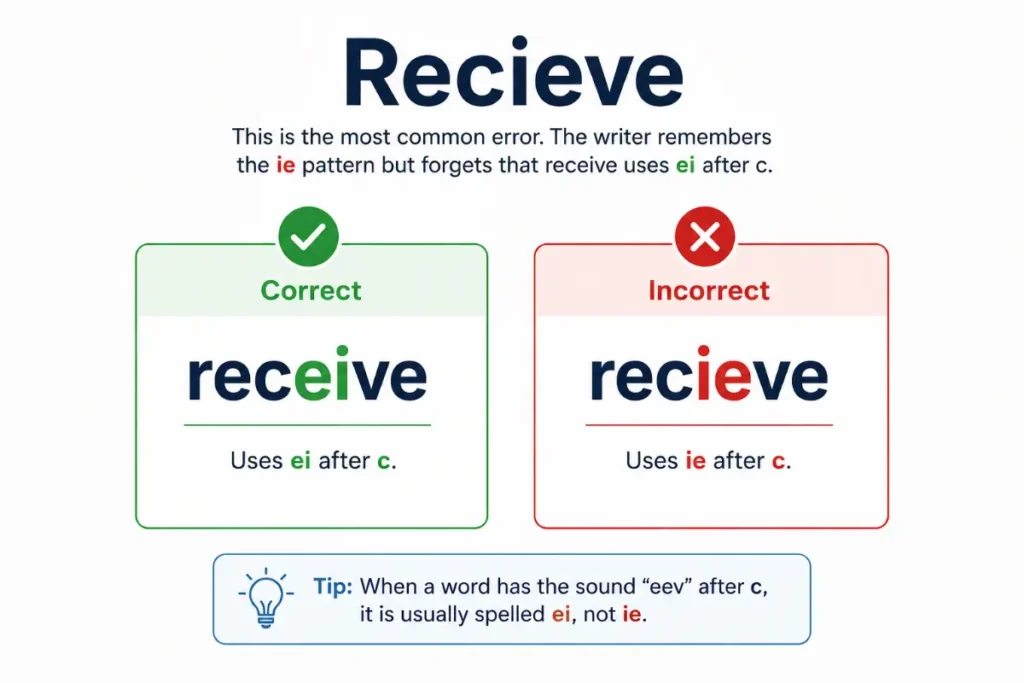
This is the main error that causes confusion. The writer places i before e instead of using ei after c.
Incorrect: I hope to recieve your response soon.
Correct: I hope to receive your response soon.
The corrected sentence uses receive because the writer expects to get a response. Remember that the vowel pair after c is ei.
Writing Recieved Instead of Received
Some writers carry the same vowel mistake into the past tense.
Incorrect: She recieved the package yesterday.
Correct: She received the package yesterday.
Received is the correct past tense and past participle. It keeps the same ei sequence found in receive.
Writing Receiveing Instead of Receiving
This mistake happens when writers add ing without removing the final silent e.
Incorrect: We are receiveing new applications.
Correct: We are receiving new applications.
To form the ing form, remove the final e and add ing. This spelling pattern also appears in words such as write and writing.
Confusing Receive With Receipt
Receive and receipt are related words, but they have different grammatical roles.
Receive is a verb that describes getting something. Receipt is a noun that can mean a record of a transaction or the act of receiving something.
Examples.
- I will receive the package tomorrow. Receive describes the action of getting the package.
- Please keep the receipt after your purchase. Receipt refers to the proof of purchase.
The p in receipt is silent in pronunciation. This can make the word harder to spell because the written form includes a letter you do not hear.
Using Receive When Another Verb Is More Natural
Receive is correct in many contexts, but another verb may communicate the meaning more clearly.
For example, I received your email is correct. However, I read your email is more precise if you want to confirm that you looked at its contents.
Similarly, I received your call can mean that you got a call, but I answered your call specifically means that you picked up.
Choose receive when the focus is on getting or accepting something. Choose a more specific verb when you need to explain exactly what happened.
Easy Ways to Remember Receive
Spelling becomes easier when you connect a word with a simple pattern or a familiar example. You do not need to memorize complicated grammar terms to remember receive.
Use the After C Rule
The familiar rule i before e except after c can help you remember the vowel order in receive.
Think of the word in three parts.
- Start with rec.
- Remember that e comes before i after c.
- Finish with ve.
The complete spelling is receive.
This method focuses on the part that causes the most mistakes. It also connects receive with other words that contain ei after c.
Keep in mind that the rule has exceptions. Use it as a memory aid for receive rather than assuming it works for every English word.
Connect Receive With Receipt
Receive and receipt share the same opening letters and the same general idea of getting something.
Imagine receiving a package and then keeping the receipt as proof of purchase. This everyday connection gives you two related words to practice together.
Write both words several times in short sentences.
- I receive a receipt with my purchase.
- She received the receipt by email.
- We are waiting to receive the final receipt.
The examples help you connect spelling with meaning and grammar.
Remember the Difference Between Getting and Giving
Receive focuses on the person who gets something. Give focuses on the person who provides it.
For example, Maria gives Alex a book. Alex receives the book from Maria.
This simple contrast helps you remember the meaning of receive while giving you a natural context for the spelling.
Practice With a Short Sentence
Choose a sentence you can easily remember, such as I receive emails every day.
Write it a few times while paying attention to ei. Then change the sentence into the past tense.
I received an email yesterday.
This exercise helps you remember both the base form and the past form.
Test Yourself Without Looking
Cover the word and try to spell it from memory. Then compare your answer with the correct spelling.
You can use this short practice exercise.
Quick Spelling Practice
1. Which spelling is correct?RecieveReceive
2. Which past tense is correct?RecievedReceived
3. Which ing form is correct?ReceiveingReceiving
Try Again
Practicing a word in context is more useful than repeating its letters without thinking about meaning. A few seconds of deliberate practice can help the correct spelling become familiar.
Receive in American and British English
The spelling of receive is the same in American and British English. Unlike words such as color and colour, receive does not have separate standard American and British spellings.
| Usage | American English | British English |
|---|---|---|
| Present tense | Receive | Receive |
| Third person singular | Receives | Receives |
| Past tense | Received | Received |
| Present participle | Receiving | Receiving |
| Common misspelling | Recieve | Recieve |
Both English varieties use receive in school assignments, business writing, emails, newspapers, and formal documents.
Pronunciation can vary slightly across speakers and accents, but those differences do not change the standard spelling.
If you write for a US audience, use receive. If you write for a UK audience, use receive as well.
Does the Meaning Change in British English
No. The basic meaning remains the same across both varieties. In both American and British English, receive means to get, accept, or be given something.
For example, an American customer may receive a delivery, and a British customer may receive a delivery. The word has the same spelling and function in both sentences.
The surrounding vocabulary may differ in some contexts, but receive itself does not require a regional spelling adjustment.
Pronunciation and Word Origin
Understanding a word’s pronunciation and history can make it easier to recognize, but spelling still requires attention to the written form.
How to Pronounce Receive
In American English, receive is commonly pronounced /rɪˈsiːv/.
The word has two syllables. The second syllable carries the main stress, and its vowel has the long ee sound.
When saying receive, focus on the stressed second syllable. The final v sound is voiced, meaning your vocal cords vibrate as you produce it.
The letters ei do not create a separate syllable. They work together in the written word, so the spelling and pronunciation need to be learned as a unit.
Where the Word Receive Comes From
Receive entered English through Anglo French and Old French forms related to the Latin verb recipere, which meant to take back or take in. Its historical development helps explain why its modern spelling does not follow the way every letter might appear to sound.
The Latin origin is also connected with English words such as recipient and reception. These words share a related idea of accepting, taking in, or welcoming something.
Knowing the origin is not necessary for everyday spelling, but it offers a useful connection between receive and other English vocabulary.
Related Words From the Same Word Family
| Word | Part of speech | Meaning |
|---|---|---|
| Receive | Verb | To get or accept something |
| Receiver | Noun | A person or device that receives something |
| Reception | Noun | The act of receiving or a place or event where people are welcomed |
| Recipient | Noun | A person who receives something |
| Receipt | Noun | A record of a transaction or the act of receiving |
| Receivable | Adjective or noun | Capable of being received or an amount owed to a business |
These related words can reinforce your understanding of receive. They also help you build vocabulary for everyday, academic, and professional writing.
Related Words and Expressions
Receive appears in many common expressions. Learning these phrases helps you understand how the verb works in natural English.
Receive a Message
This expression means to get a message from someone.
Example: I received a message from my supervisor before the meeting.
The sentence explains that the supervisor sent information to the speaker. It does not necessarily mean the speaker replied or acted on the message.
Receive Approval
Receive approval means to get permission or a favorable decision from someone with the authority to give it.
Example: The project received approval from the board.
The sentence means that the board approved the project. The passive sounding expression focuses on the outcome rather than the individuals who made the decision.
Receive Attention
Receive attention means to attract notice or interest.
Example: The new policy received considerable attention from local residents.
The sentence explains that people noticed and discussed the policy. The expression is common in journalism, business reports, and public discussions.
Receive Feedback
Receive feedback means to get comments or information about your work or performance.
Example: Employees receive feedback after each performance review.
The sentence describes a regular process in which employees learn how others assess their work.
Receive Recognition
Receive recognition means to be acknowledged for an achievement, contribution, or quality.
Example: The researcher received recognition for her work.
The sentence explains that the researcher was acknowledged for her contribution.
Receive With Thanks
This phrase appears in polite correspondence when someone acknowledges something they have been sent or given.
Example: We received your documents with thanks.
The sentence is understandable, but it can sound formal or old fashioned. In modern American business writing, We received your documents. Thank you. usually sounds more natural.
Professional Writing Tips for Receive
Correct spelling is only one part of clear writing. You should also make sure the word fits the sentence and communicates the intended meaning.
Use Receive in Business Emails
Receive works well when confirming that a message, file, order, or payment has arrived.
Examples.
- We received your application and will review it shortly. This sentence confirms arrival and explains the next step.
- You should receive an order confirmation within a few minutes. This sentence tells the customer what to expect.
- I have received the updated report. This sentence confirms that the report has arrived.
When possible, give the reader useful information after confirming receipt. A message that says We received your request and will respond by Thursday is more helpful than a vague confirmation alone.
Use More Direct Language When Appropriate
Receive is useful, but it can make a sentence sound distant when a more direct verb would work better.
For example, Your request has been received is grammatically correct. We received your request is shorter and makes the responsible party clear.
Similarly, The customer received assistance is acceptable. Our team helped the customer sounds more direct because it identifies the action and the people who performed it.
Choose the wording that best fits your purpose. Formal writing does not have to sound complicated to be professional.
Proofread High Visibility Content
Spelling errors can distract readers, especially in documents that represent a business or organization.
Pay special attention to receive in subject lines, website copy, application forms, customer notices, reports, and public announcements. These are places where even a small error can make the writing look less polished.
A spellchecker can help, but a final review remains useful. Read the sentence slowly and check the vowel order if the word looks unfamiliar.
Expert Editor Insight
As a senior editor, I’d treat recieve as a straightforward spelling error rather than a vocabulary problem. Native speakers recognize the intended word immediately, but the error can still weaken polished writing. Spell checkers and grammar tools commonly flag it because receive is the established dictionary form. My practical advice is simple: don’t rely only on pronunciation. Memorize the visual sequence cei after the c. Once that pattern becomes familiar, the correct spelling starts to feel automatic.
Key Takeaways
- Receive is the correct spelling. Recieve is incorrect in standard English.
- Receive means to get, accept, or be given something.
- The word follows the familiar i before e except after c pattern.
- Received is the correct past tense and past participle.
- Receiving is the correct ing form because the final silent e is removed.
- American and British English use the same spelling.
- Remember the ei sequence after c to avoid the most common mistake.
- Proofread important documents to catch spelling errors before sharing them.
Conclusion
Recieve or receive is a spelling question with a simple answer. Receive is correct, and recieve is a common misspelling. The correct word means to get, accept, or be given something, and it appears in everyday conversations, school assignments, business emails, and formal documents.
The easiest way to remember receive is to focus on the letters ei after c. The familiar spelling rule can help you recall the vowel order, and related words such as receipt and receiver give you extra practice. Remember that the rule has exceptions, so learn the standard spelling of each word rather than relying on the pattern alone.
Use receive when you write about getting a message, accepting an offer, collecting a payment, or being given something. Use received for the past tense and past participle, and use receiving for the ing form. With these patterns in mind, you can spell the word correctly and use it with confidence.
Frequently Asked Questions
Is it recieve or receive?
Receive is correct. Recieve is a misspelling that should be corrected in standard English. The correct spelling places e before i after c.
Why is receive spelled with ei?
Receive follows the familiar spelling pattern i before e except after c. The letters ei appear after c in this word. The rule is a helpful memory aid, although English has exceptions.
Is recieve ever correct?
Recieve is not a standard English spelling of the verb meaning to get or accept something. You should use receive in ordinary writing, including emails, schoolwork, and business documents.
What is the past tense of receive?
The past tense is received. For example, I received your package yesterday. Received is also the past participle used in forms such as has received and had received.
What is the difference between receive and receipt?
Receive is a verb that means to get or accept something. Receipt is a noun that often refers to proof of payment or the act of receiving something. For example, you receive a receipt after making a purchase.
How do you spell receiving?
The correct spelling is receiving. Remove the final silent e from receive before adding ing. Do not write receiveing.
Is receive spelled the same in American and British English?
Yes. American and British English both use receive. The spelling does not change between these varieties of English.
How do you remember the spelling of receive?
Remember the pattern ei after c. You can also connect receive with related words such as receipt and receiver. Practicing the word in a short sentence helps reinforce the correct letter order.
What part of speech is receive?
Receive is a verb. It describes getting, accepting, or being given something. It can take different forms, including receives, received, and receiving.
How do you use receive in a sentence?
You can write I receive emails every morning. The sentence uses receive in the simple present tense to describe a regular event. You can also write She received a package yesterday to describe a completed past action.
Is receive a regular verb?
Yes. Receive is a regular verb. Its simple past tense and past participle are both received, formed by adding ed to the base form.
What words are related to receive?
Related words include receiver, recipient, reception, receipt, and receivable. These words share a historical connection and often relate to getting, accepting, or welcoming something.

Confusing Words, Spelling & Word Choice
Claire Whitmore is a U.S.-based English editor who writes about commonly confused words, spelling differences, and word choice. Her work helps readers understand subtle distinctions between similar-looking words through simple definitions, practical examples, and modern usage guidance in both American and British English.