
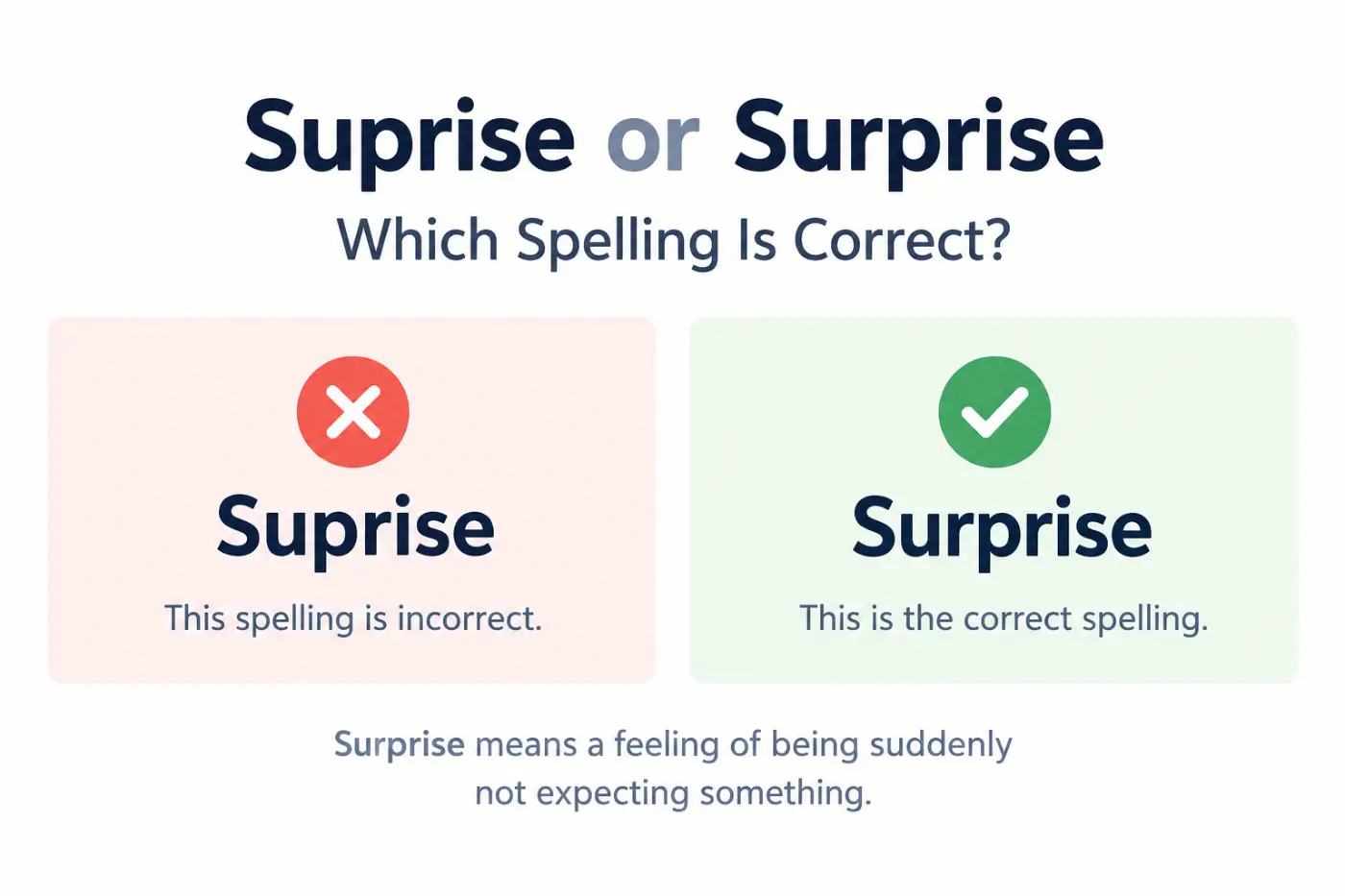
Suprise or surprise is a common spelling question because the word doesn’t always sound the way people expect it to. The correct spelling is surprise, with an r after the first s and another r after the p. Suprise leaves out the first of those two r letters and is considered a misspelling in standard English.
The confusion often comes from pronunciation. When people say surprise quickly, the first r can be easy to overlook. This happens in everyday messages, school assignments, emails, social media posts, and professional documents. Even strong writers can make this mistake when typing quickly.
The good news is that you only need one simple rule to remember the correct spelling. Write surprise with two r letters. Once you recognize the spelling pattern and practice it in a few sentences, you’ll be less likely to make the same mistake again.
Short Answer
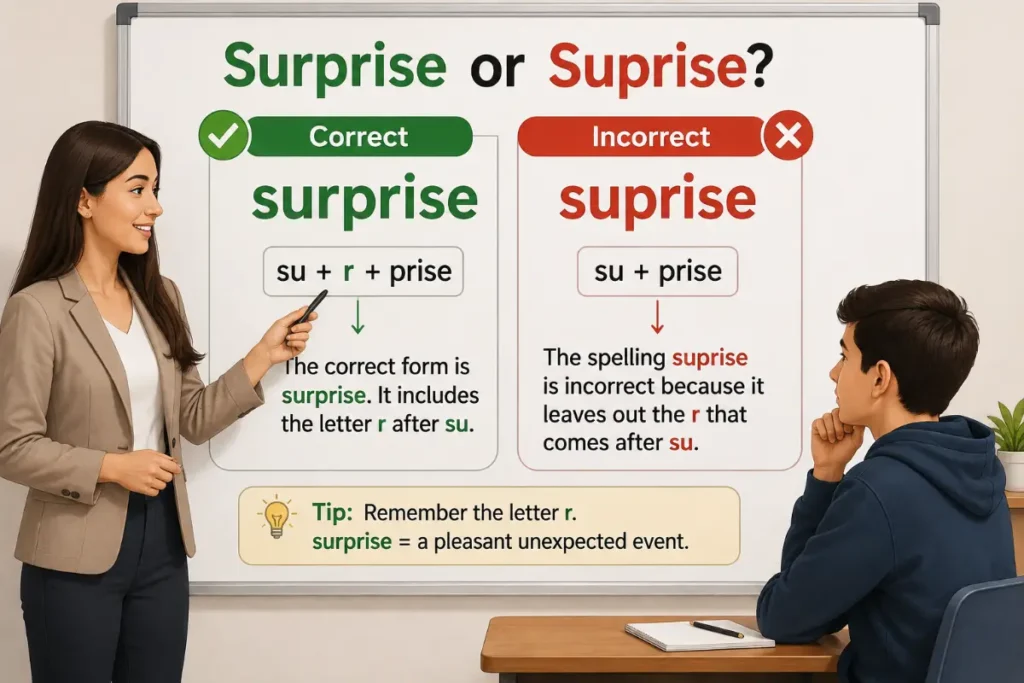
Surprise is the correct spelling in American English and standard written English. Suprise is a common misspelling because people often leave out the first r after the initial s. The word surprise means an unexpected event or the feeling caused by something unexpected. Remember to include both r letters in surprise.
Table of Contents
- The Correct Spelling of Surprise.
- What Surprise Means.
- Why People Misspell Surprise.
- How to Spell Surprise Correctly.
- How to Pronounce Surprise.
- Surprise as a Noun and a Verb.
- Surprise vs Suprise Comparison.
- Examples of Surprise in Everyday English.
- Common Spelling Mistakes.
- Memory Tricks to Remember Surprise.
- Related Words and Expressions.
- American and British English Usage.
- Tips for Using Surprise in Professional Writing.
- Frequently Asked Questions.
- Key Takeaways.
- Conclusion.
The Correct Spelling of Surprise
The correct spelling is surprise. The spelling suprise is incorrect in standard written English.
The word contains eight letters: s, u, r, p, r, i, s, and e. The key detail is the r that appears between the u and p. If you leave out that letter, you create the common misspelling suprise.
Here are two examples that show the difference.
- Incorrect: I have a suprise for you.
- Correct: I have a surprise for you.
The correct sentence tells someone that you have something unexpected planned for them. The only spelling change is the missing r, but that small difference matters in standard writing.
Why Surprise Is the Correct Form
English spelling follows patterns, but it doesn’t always match pronunciation perfectly. The standard spelling of surprise has been established through the history of the word and its use in modern English. Removing a letter because it seems unnecessary doesn’t make the shorter version correct.
Dictionaries recognize surprise as the standard spelling. In schoolwork, business communication, published articles, and formal documents, use surprise every time.
Is Suprise Ever Correct
No. Suprise isn’t an accepted alternative spelling of the standard English word. You may see it in casual messages, online comments, usernames, or informal posts, but those examples don’t make it correct.
If you encounter suprise in a draft, correct it to surprise. The same rule applies to related forms such as surprised, surprising, and surprisingly, which also retain the first r.
What Surprise Means
Surprise refers to something unexpected or the feeling you experience when something happens that you didn’t anticipate. It can describe a sudden event, an unexpected gift, a surprising discovery, or the emotion caused by an unforeseen situation.
The word can express a pleasant feeling, an unpleasant reaction, or a neutral response. Context tells readers which meaning applies.
Surprise as an Unexpected Event
As a noun, surprise can describe something that happens without warning or isn’t expected.
Examples.
1. My friends planned a surprise for my birthday.
The sentence means the friends arranged something secretly that the speaker didn’t expect.
2. The announcement came as a surprise to everyone.
The announcement was unexpected, so the people who heard it felt surprised.
3. We bought our parents a surprise gift.
The gift was intended to be unexpected, making it more exciting for the recipients.
In these examples, surprise names an event or thing rather than an action.
Surprise as a Feeling
Surprise can also refer to the emotion you experience when something unexpected happens.
Examples.
1. She looked at the result in surprise.
Her expression showed that she hadn’t expected the result.
2. To my surprise, I passed the exam.
The speaker didn’t expect to pass, so the outcome caused a feeling of surprise.
3. He couldn’t hide his surprise when he saw the decorated room.
The room’s appearance was unexpected, and his reaction made that clear.
The phrase to my surprise is especially common in everyday English. It introduces an outcome that differs from what someone expected.
Surprise as an Action
Surprise also works as a verb. It means to cause someone to feel surprised by doing or revealing something unexpected.
Examples.
1. We want to surprise our teacher with a thank you card.
The students plan to give the teacher something unexpected.
2. Her visit surprised me.
I didn’t expect her to visit, so her arrival caught me off guard.
3. The final score surprised the fans.
The result differed from what the fans had anticipated.
Understanding these meanings helps you use surprise naturally in different situations. The spelling stays the same, but the word’s grammatical role changes with the sentence.
Why People Misspell Surprise
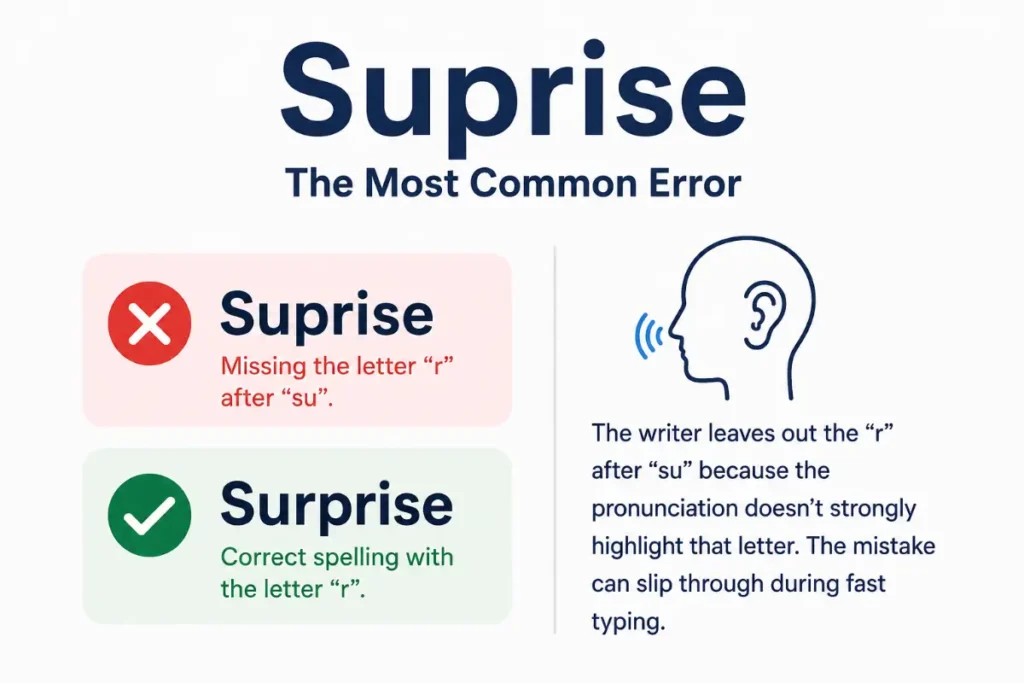
People often misspell surprise because the word is easier to recognize when written than to analyze by sound. When someone says it quickly, the first r may not stand out clearly. As a result, a writer may remember the general sound but leave out a letter.
Several common factors contribute to this error.
The First R Is Easy to Overlook
The beginning of surprise contains the letters s, u, and r. Some writers remember the sound as su and move directly to the p when spelling the word. That skips the r between the u and p.
The correct sequence is surp. Paying attention to this short letter group makes the spelling easier to remember.
Pronunciation Can Be Misleading
English doesn’t give every letter the same level of emphasis in spoken language. Speakers often pronounce words quickly and connect their sounds. A consonant may be less noticeable in normal conversation than it appears in writing.
Surprise is a good example of why pronunciation alone isn’t always a reliable spelling guide. Learning the written form and practicing it in context can help you avoid the mistake.
Typing Quickly Can Cause Errors
Spelling mistakes often happen when people focus on the message rather than the individual letters. A person may type suprise in a text message without noticing the missing r.
Autocorrect can catch some errors, but it doesn’t identify every spelling problem. Some applications may leave a misspelling unchanged, especially when it resembles a familiar letter pattern. Proofreading remains useful even when you use spelling tools.
Familiarity Doesn’t Guarantee Accuracy
You may have read the word hundreds of times and still spell it incorrectly from memory. Repeated exposure helps, but it doesn’t always build a reliable spelling habit.
A practical solution is to write the word correctly several times in meaningful sentences. This reinforces the full letter sequence instead of encouraging you to rely on a vague memory of its sound.
How to Spell Surprise Correctly
The easiest way to spell surprise correctly is to divide it into smaller parts. Focus on the opening letters first, then check the ending.
The word is spelled:
S U R P R I S E
It begins with sur, continues with pri, and ends with se. The two r letters are separated by p. Remembering that pattern makes the spelling more manageable.
Learn the Letter Sequence
Instead of memorizing the word as one long sequence, focus on the part that causes the problem.
- Start with sur.
- Add p to make surp.
- Add rise to complete surprise.
This method draws attention to the first r, which writers often omit. It also helps you check the word quickly when proofreading.
Practice With Complete Sentences
Writing the word in context is more useful than repeating isolated letters without meaning.
Try these examples.
- I have a surprise waiting for you.
- The surprise made everyone smile.
- We surprised our neighbors with homemade cookies.
- Her surprising answer changed the discussion.
- He was surprisingly calm during the emergency.
Each sentence uses the same basic spelling pattern. Practicing several related forms also helps you recognize the word when it appears in different grammatical roles.
Check the Word Before Sending a Message
If you frequently type the word incorrectly, pause briefly when you reach it. Look for the r between u and p before you send your message.
For longer documents, use a spelling checker and review the final draft. This simple habit can prevent avoidable errors in reports, essays, cover letters, and other important writing.
How to Pronounce Surprise
In American English, surprise is commonly pronounced /sərˈpraɪz/. The main stress falls on the second syllable.
The first syllable is relatively weak, while the second carries the strongest emphasis. The final sound is voiced like the z in zoo.
A simple way to practice is to say the word slowly at first, paying attention to the opening sound and the stressed second syllable. Then say it at a normal conversational pace without dropping the first r from your mental spelling.
Why Pronunciation Doesn’t Show the Spelling Clearly
The first r in surprise may blend into the surrounding sounds during normal speech. That can make the word sound as if it begins with a simpler sequence than its spelling suggests.
This doesn’t mean the letter is optional. English words often contain letters that are less noticeable in speech, so readers and writers benefit from learning conventional spellings rather than relying only on sound.
Pronunciation Tips for English Learners
If you’re learning English, practice surprise alongside related words such as surprised and surprising. These words share the same opening spelling and a similar sound pattern.
Read each word aloud in a sentence. Then write it from memory and compare it with the correct spelling. Combining speaking, reading, and writing helps reinforce the word more effectively than relying on only one method.
Surprise as a Noun and a Verb
The word surprise can function as both a noun and a verb. Recognizing its grammatical role helps you build sentences correctly.
| Word form | Part of speech | Meaning | Example |
|---|---|---|---|
| Surprise | Noun | An unexpected event or feeling | The party was a surprise. |
| Surprise | Verb | To cause an unexpected reaction | I will surprise my sister. |
| Surprised | Adjective or past tense verb | Feeling unexpected amazement or having caused surprise in the past | She looked surprised. |
| Surprising | Adjective or present participle | Causing surprise | The news was surprising. |
| Surprisingly | Adverb | In an unexpected way | He surprisingly agreed. |
Using Surprise as a Noun
A noun names a person, place, thing, or idea. When surprise acts as a noun, it often refers to an event, a gift, or an emotion.
Examples.
1. The surprise was worth the wait.
Here, surprise refers to an unexpected event or reveal.
2. Her face showed surprise.
In this sentence, surprise names the emotion visible in her expression.
3. We prepared a small surprise for the children.
The word refers to something planned to delight or astonish them.
Using Surprise as a Verb
A verb describes an action or state. When you use surprise as a verb, someone or something causes another person to experience an unexpected reaction.
Examples.
1. The magician will surprise the audience.
The magician will perform something the audience doesn’t anticipate.
2. The news surprised everyone.
The news caused an unexpected reaction among the people who heard it.
3. I didn’t mean to surprise you.
The speaker explains that causing the other person’s unexpected reaction wasn’t intentional.
Using Surprised and Surprising
Surprised usually describes the person experiencing the feeling. Surprising usually describes the event or thing that causes the feeling.
Compare these sentences.
1. I was surprised by the result.
The speaker experienced surprise.
2. The result was surprising.
The result caused surprise.
This distinction is useful because writers sometimes confuse the emotion with the cause of that emotion. Choosing the right form makes the meaning clearer.
Surprise vs Suprise Comparison
The difference between surprise and suprise is straightforward. Surprise is the standard spelling, while suprise is an error caused by leaving out the first r.
| Feature | Surprise | Suprise |
|---|---|---|
| Spelling status | Correct | Incorrect |
| Standard dictionary form | Yes | No |
| Accepted in formal writing | Yes | No |
| Meaning | An unexpected event or feeling | No standard meaning as a spelling variant of surprise |
| Use in American English | Standard | Misspelling |
| Recommended for publication | Yes | No |
Which Spelling Should You Use
Use surprise in every standard English context. This includes school assignments, workplace emails, articles, text messages, social media captions, and personal letters.
Even in casual writing, the correct spelling makes your message easier to read and helps you communicate clearly. A quick spelling check is worthwhile when a word is frequently misspelled.
Can Suprise Be Used as a Creative Spelling
Someone might use suprise intentionally in a username, brand name, fictional setting, or stylized design. In that case, the spelling may serve a creative purpose rather than follow standard English conventions.
However, that doesn’t make suprise an accepted spelling of the ordinary word. If you mean an unexpected event or feeling, use surprise unless you’re deliberately reproducing a name or a specific stylized form.
Examples of Surprise in Everyday English
Examples show how surprise works in ordinary conversation. They also help you remember the spelling through familiar situations.
Everyday Conversation
1. I have a surprise for you.
The speaker has something unexpected planned for another person.
2. What a wonderful surprise.
The speaker expresses happiness about an unexpected event.
3. You surprised me by arriving early.
The speaker didn’t expect the other person to arrive so soon.
4. I wasn’t expecting such a big surprise.
The speaker explains that the event was more unexpected than anticipated.
5. Her message came as a surprise.
The message arrived unexpectedly.
These examples show that surprise fits naturally into everyday speech. You can use it to describe a planned event, an unexpected discovery, or someone’s reaction.
School and Academic Writing
1. The teacher planned a surprise quiz for the class.
The quiz was unexpected because the students didn’t know it was coming.
2. To my surprise, I received the highest score.
The writer didn’t expect to achieve the highest result.
3. The research findings surprised the students.
The findings differed from what the students had expected.
4. The experiment produced a surprising result.
The result was unexpected based on the students’ previous understanding.
Students should use the correct spelling in essays, assignments, examinations, and presentations. A spelling error can distract readers from otherwise strong ideas.
Workplace Communication
1. The manager announced a surprise change to the schedule.
The change wasn’t expected by the employees.
2. We were surprised by the client’s positive response.
The client’s response differed from what the team had anticipated.
3. The final report revealed a surprising improvement in sales.
The improvement was greater or less expected than the team had predicted.
4. The company prepared a surprise celebration for its employees.
The celebration was organized without telling the employees in advance.
In professional writing, correct spelling supports clear communication. It also shows care and attention to detail, particularly in documents shared with clients, managers, or colleagues.
Family and Personal Life
1. My parents gave me a surprise birthday party.
The parents arranged a celebration that the speaker didn’t expect.
2. We surprised our grandmother with flowers.
The family gave her flowers unexpectedly.
3. His visit was a pleasant surprise.
The visit was unexpected and welcome.
4. She looked surprised when she opened the gift.
Her expression showed that she hadn’t anticipated what was inside.
These sentences demonstrate how surprise often appears in stories about gifts, celebrations, visits, and personal reactions.
News and Public Events
1. The election result came as a surprise to many voters.
Many voters didn’t expect the result.
2. The team surprised its supporters with a dramatic victory.
The team won in a way that supporters hadn’t anticipated.
3. The announcement surprised industry experts.
Experts had different expectations before the announcement.
4. The sudden decision was a surprise to the public.
The public wasn’t expecting the decision.
In news writing, surprise can describe an unexpected result without telling readers if the outcome was good or bad. Additional context explains the significance.
Common Spelling Mistakes
The most common error is leaving out the first r. However, a few related mistakes can also occur when writers use different forms of the word.
Writing Suprise Instead of Surprise
Incorrect: The children planned a suprise for their mother.
Correct: The children planned a surprise for their mother.
The corrected sentence includes the missing r. The meaning remains unchanged, but the spelling now follows standard English.
Misspelling Surprised
Incorrect: I was suprised by the announcement.
Correct: I was surprised by the announcement.
Surprised retains the first r from surprise. Adding the ending ed doesn’t remove any letters from the original spelling.
Misspelling Surprising
Incorrect: It was a suprising discovery.
Correct: It was a surprising discovery.
Surprising keeps the same opening letter sequence. The ing ending changes the word’s grammatical form but doesn’t change its core spelling.
Misspelling Surprisingly
Incorrect: She was suprisingly calm.
Correct: She was surprisingly calm.
The correct adverb is surprisingly. The first r remains in place, and the word ends with ly.
Trusting Autocorrect Too Much
Spelling tools can catch many common errors, but you shouldn’t assume every mistake will be corrected automatically. Different applications use different dictionaries and correction settings.
Review words that you often misspell. If a spelling checker doesn’t flag an error, compare the word with a trusted dictionary or a reliable spelling reference.
Memory Tricks to Remember Surprise
A good memory trick makes the correct spelling easier to recall at the moment you need it. The best method is one that highlights the letter people usually forget.
Remember the Two Rs
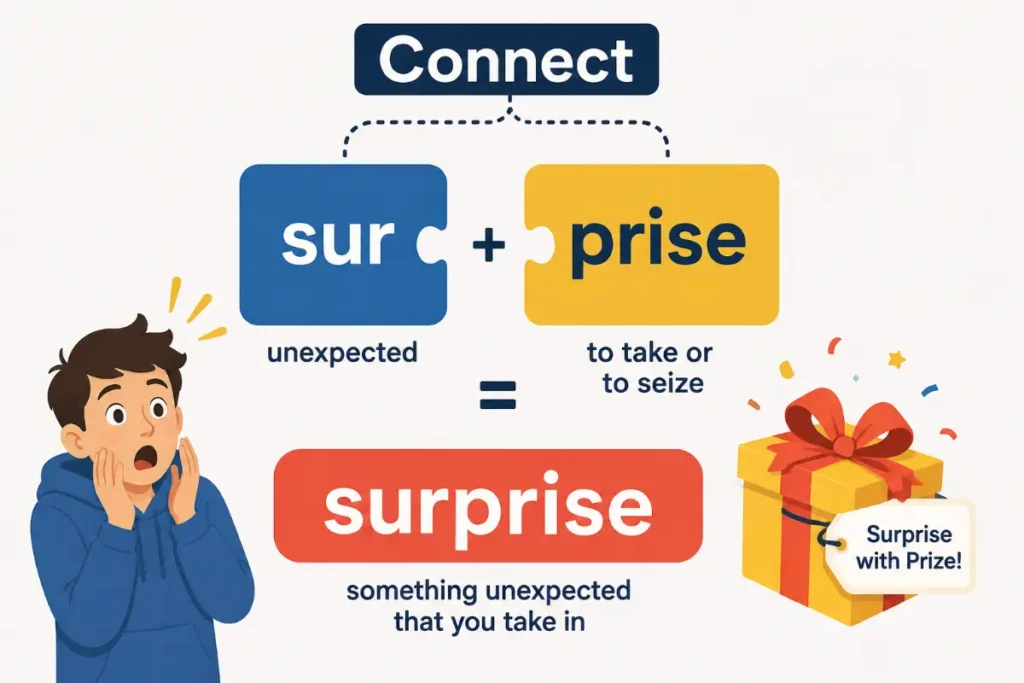
The simplest trick is to remember that surprise contains two r letters.
Write it as sur plus prise to keep the opening r visible. This is a spelling aid rather than a claim about the word’s historical origin.
Focus on the First Four Letters
Remember the opening sequence s, u, r, p. The first r appears before p, and another r appears after p.
If you can recall the first four letters correctly, you’re less likely to write the shorter incorrect form.
Connect Surprise With Surprised
Learn the related forms together.
- Surprise.
- Surprised.
- Surprising.
- Surprisingly.
All four retain the first r. Practicing the word family helps reinforce the spelling across different sentence types.
Use a Short Memory Sentence
Try this reminder.
Surprise requires both Rs.
It is short enough to recall while writing and draws attention to the exact spelling feature that causes confusion.
Practice With a Quick Recall Test
Read the following sentences, then cover the word surprise and try to write it from memory.
- I planned a surprise.
- The gift surprised him.
- The ending was surprising.
- She reacted surprisingly well.
Check your spelling after writing each sentence. If you leave out the first r, repeat the exercise and focus on the opening letters.
Related Words and Expressions
Learning related vocabulary can improve your spelling and help you express different kinds of unexpected experiences.
Surprised
Surprised describes someone who experiences surprise.
Example: I was surprised to see my old friend at the airport.
The speaker didn’t expect to meet the friend there.
Surprising
Surprising describes something that causes surprise.
Example: The results were surprising.
The results differed from what people expected.
Surprisingly
Surprisingly is an adverb that describes an unexpected action, quality, or outcome.
Example: The injured player recovered surprisingly quickly.
The recovery happened faster than expected.
Unanticipated
Unanticipated means not expected or predicted.
Example: The company faced an unanticipated delay.
The delay wasn’t part of the company’s expectations or plans.
Unexpected
Unexpected describes something that happens without being anticipated.
Example: An unexpected visitor arrived after dinner.
The visitor’s arrival wasn’t planned or predicted.
Astonishment
Astonishment means great surprise or amazement.
Example: She stared at the enormous building in astonishment.
Her reaction showed strong amazement at its size.
Amazement
Amazement describes a feeling of strong wonder or surprise.
Example: The children watched the fireworks in amazement.
The display filled them with wonder.
Shock
Shock can describe a sudden and powerful emotional reaction to unexpected news or an event.
Example: The sudden announcement left the employees in shock.
The announcement caused a strong reaction because they hadn’t expected it.
These words overlap in meaning, but they aren’t always interchangeable. Surprise is a broad term, while astonishment and amazement often suggest stronger wonder. Shock can suggest distress or a more intense emotional response.
American and British English Usage
The spelling surprise is standard in both American English and British English. Unlike some words that have different spellings across these varieties, surprise doesn’t change its spelling based on the country.
American writers use surprise in everyday communication, academic work, business documents, and published material. British writers use the same spelling in those contexts.
The same rule applies to surprised, surprising, and surprisingly. None of these forms requires a different spelling in American or British English.
Is Surprise an American Spelling or a British Spelling
Surprise is used in both varieties of English. It isn’t an American only spelling or a British only spelling.
For example, an American writer might say, The announcement was a surprise. A British writer can use exactly the same sentence with the same spelling.
Does Pronunciation Change Between American and British English
Pronunciation can vary slightly by accent, but the spelling remains the same. Both American and British speakers use the standard form surprise.
If you’re writing for a US audience, you don’t need to change the word. Simply use surprise and keep your spelling consistent throughout the document.
Tips for Using Surprise in Professional Writing
Correct spelling is only one part of effective writing. You also need to choose the right word form and make sure the sentence communicates your meaning clearly.
Choose the Correct Grammatical Form
Use surprise as a noun when naming an unexpected event or feeling. Use surprise as a verb when describing an action that causes an unexpected reaction.
For example, The gift was a surprise uses the noun. The gift will surprise her uses the verb.
This distinction prevents awkward sentences and helps readers understand your message immediately.
Use Surprised and Surprising Correctly
Use surprised when describing the person who experiences the feeling and Use surprising when describing the event or thing that causes it.
For example, The audience was surprised describes the audience’s reaction. The performance was surprising describes the performance itself.
This rule is especially useful in reports, reviews, essays, and professional emails.
Avoid Overusing the Word
Surprise is a useful word, but repeating it in every sentence can make writing sound dull. Depending on the context, you might use unexpected, astonishing, remarkable, or unanticipated.
Choose a replacement only when it expresses the intended meaning accurately. A surprising result isn’t always astonishing, and an unexpected event isn’t necessarily shocking.
Proofread Important Documents
Before submitting an essay, sending a business email, or publishing an article, check the spelling of frequently confused words. Pay particular attention to words that you tend to type from memory.
A final proofreading pass can catch small errors that interrupt the reader’s attention. Correct spelling also helps your ideas appear polished and professional.
Key Takeaways
- Surprise is the correct spelling. Suprise is a common misspelling.
- The word contains two r letters. Remember the opening sequence surp.
- Surprise has several meanings. It can describe an unexpected event, a feeling, or an action that causes an unexpected reaction.
- The spelling is the same in American and British English. No regional spelling change is needed.
- Related words keep the first r. Write surprised, surprising, and surprisingly with the same opening letter sequence.
- Context determines the grammatical form. Use surprise as a noun or verb, surprised to describe a reaction, and surprising to describe something that causes that reaction.
- Proofreading helps prevent errors. Check the spelling before submitting important writing.
Conclusion
Suprise or surprise is a spelling question with a simple answer. Surprise is the correct form in standard English, while suprise is a misspelling caused by leaving out the first r. The correct spelling contains two r letters, and remembering the opening sequence surp can help you avoid this common mistake.
Use surprise when describing an unexpected event or feeling. Use it as a verb when something causes an unexpected reaction, and remember that related forms such as surprised, surprising, and surprisingly keep the same first r. These small spelling and grammar details make your writing clearer and more accurate.
The easiest way to remember the correct spelling is to practice it in everyday sentences. Write surprise with both r letters, check your work when proofreading, and use the standard form in school assignments, professional documents, and casual messages. Once you build that habit, you’ll have one less spelling mistake to worry about.
Frequently Asked Questions
Is suprise or surprise correct?
Surprise is correct. Suprise is a misspelling because it leaves out the first r. Always use surprise in standard English writing.
Why is surprise spelled with two Rs?
The standard spelling contains two r letters as part of the established form of the word. The first r appears before p, and the second appears after p. Both belong in the spelling.
How do you spell surprise correctly?
Spell it s u r p r i s e. The easiest way to remember it is to focus on the opening sequence surp and make sure the first r is present.
Is suprise a real word?
Suprise isn’t an accepted standard spelling of surprise. You may see it in informal writing or as part of a stylized name, but it isn’t the correct form for ordinary English usage.
What does surprise mean?
Surprise can mean an unexpected event or the feeling caused by something unexpected. It can also work as a verb meaning to cause someone to feel surprised.
Is surprise spelled differently in American and British English?
No. Surprise is the standard spelling in both American and British English. The spelling stays the same across these varieties.
What is the difference between surprised and surprising?
Surprised usually describes a person who experiences an unexpected reaction. Surprising describes something that causes that reaction. For example, I was surprised by the news, but the news was surprising.
How can I remember the spelling of surprise?
Remember that surprise contains two r letters. Focus on the opening sequence surp, and practice writing surprise, surprised, and surprising in complete sentences.
Is surprise a noun or a verb?
Surprise can be both. In The party was a surprise, it is a noun. In We will surprise her, it is a verb.
What are the related forms of surprise?
Common related forms include surprised, surprising, and surprisingly. Each keeps the first r found in surprise.

English Grammar & Usage
Nathan Holloway is an American grammar writer and language researcher who specializes in English grammar, sentence structure, verb usage, and common writing mistakes. He enjoys breaking down confusing grammar rules into practical explanations with clear examples, making English easier for students, professionals, and everyday writers.