
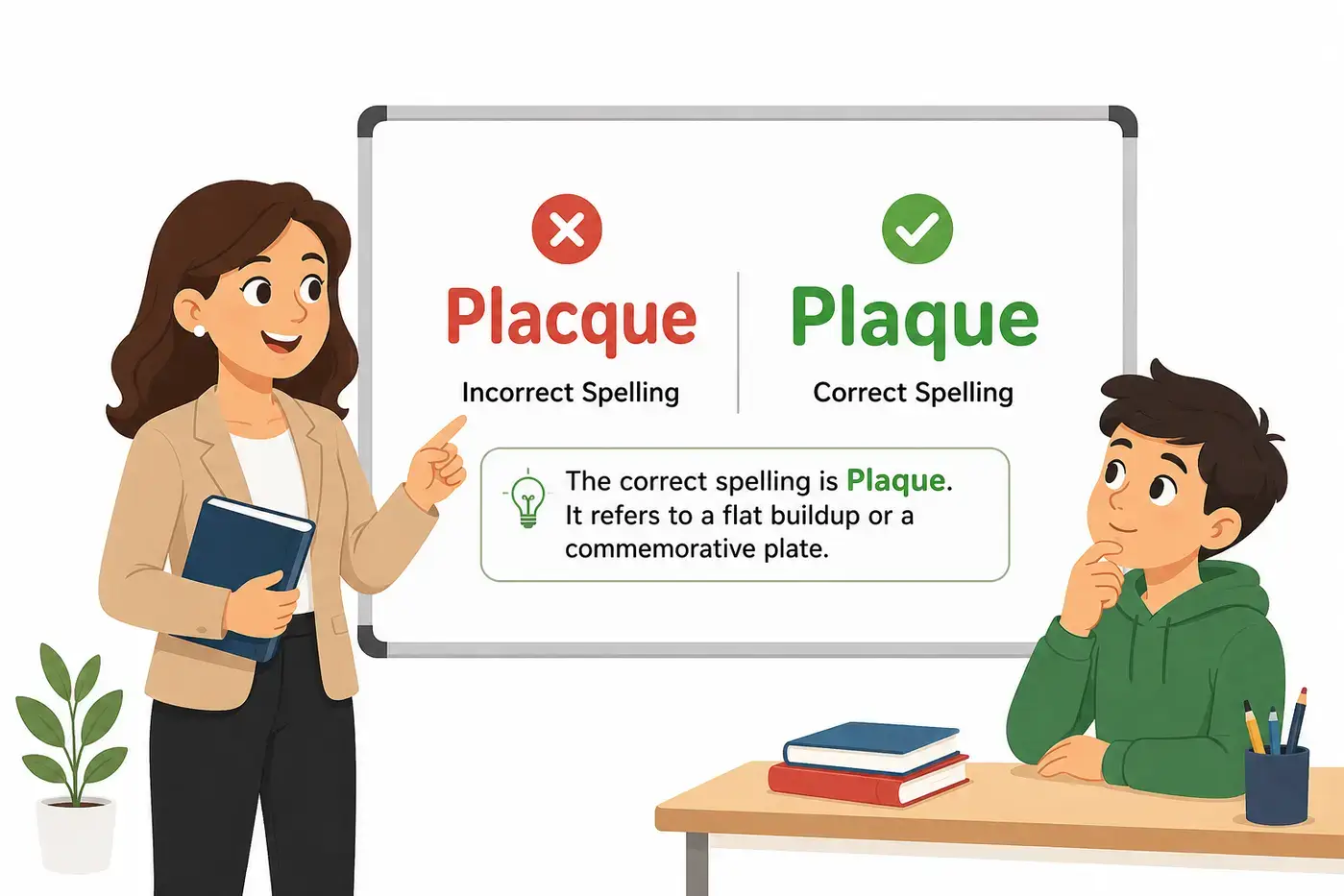
Placque vs plaque is a common spelling confusion because both forms look plausible at first glance. However, plaque is the standard spelling you should use in American English. The spelling placque is generally considered incorrect when you mean a commemorative object, dental buildup, or a deposit inside the body.
The confusion often comes from the way English words preserve unexpected letter patterns. People may add an extra c because they associate the sound with words such as acclaim or accommodate. Yet familiar spelling patterns do not always tell you how to spell a particular word. In this case, the standard form has no second c.
Learning the correct spelling helps in everyday writing, dental care discussions, medical explanations, school assignments, workplace communication, and formal documents. Once you understand what plaque means and see it in a few natural sentences, remembering the correct form becomes much easier.
Short Answer
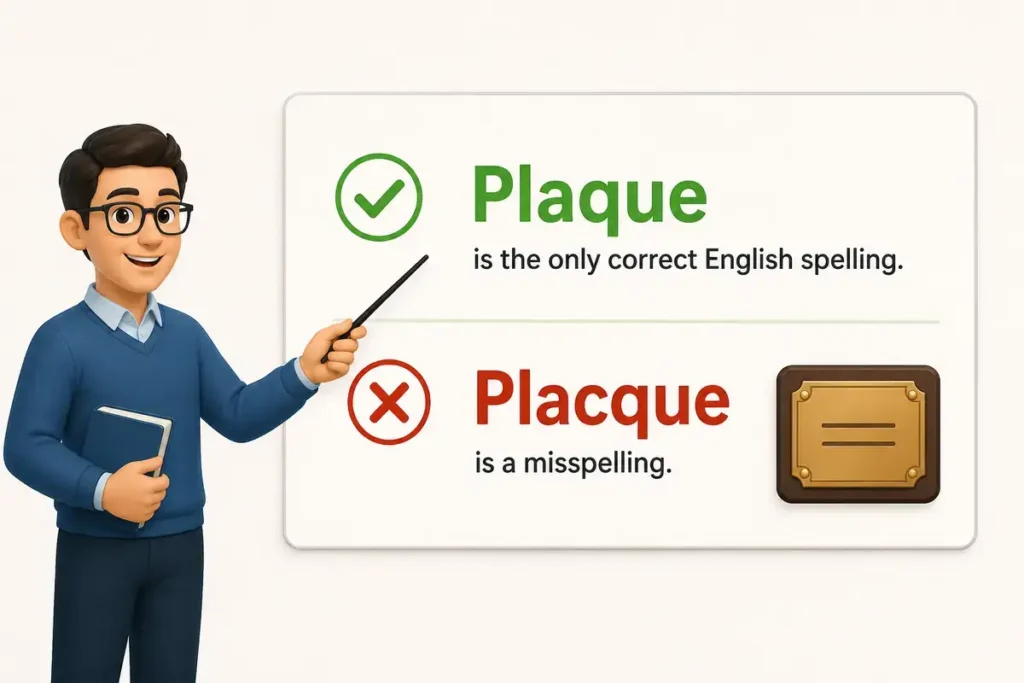
Placque vs plaque comes down to one simple spelling rule. Plaque is the correct standard English spelling for a commemorative plate, a buildup on teeth, or a deposit that forms inside arteries. Placque is a common misspelling of plaque and generally should not appear in standard writing. Remember the spelling without the extra c after the a.
Table of Contents
- What Is the Difference Between Placque and Plaque.
- What Plaque Means.
- How to Use Plaque in a Sentence.
- How to Spell Plaque Correctly.
- Why People Misspell Plaque.
- How to Pronounce Plaque.
- The Origin of the Word Plaque.
- Plaque in American and British English.
- Plaque in Dental and Medical Contexts.
- Common Spelling Mistakes.
- Memory Tips for Remembering Plaque.
- Related Words and Expressions.
- Frequently Asked Questions.
- Key Takeaways.
- Conclusion.
What Is the Difference Between Placque and Plaque
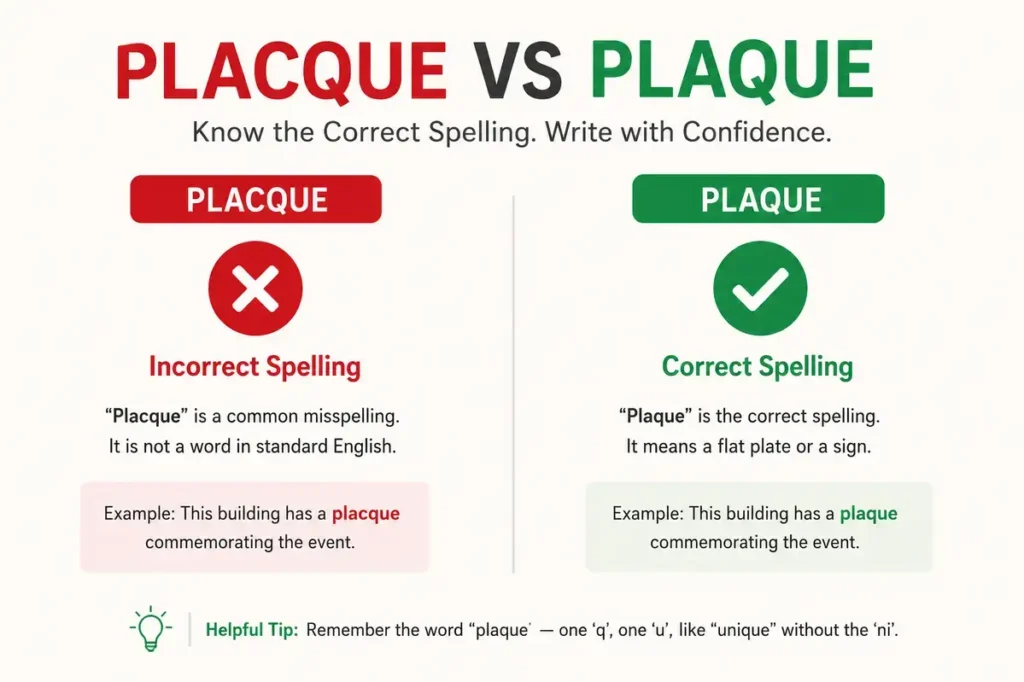
The main difference is spelling. Plaque is the accepted standard English word, while placque is generally a misspelling. If you are writing about an award displayed on a wall, a sticky substance on teeth, or a deposit in an artery, use plaque.
The extra c in placque does not create a separate standard meaning in ordinary modern English. It is not the spelling you should choose for professional writing, academic work, health information, or everyday communication.
Comparison Table
| Feature | Plaque | Placque |
|---|---|---|
| Spelling status | Correct standard spelling | Generally a misspelling |
| Meaning | A commemorative plate or a bodily deposit | No generally accepted separate meaning in standard English |
| Dental use | Correct | Incorrect |
| Medical use | Correct | Incorrect |
| Award or memorial use | Correct | Incorrect |
| Recommended for formal writing | Yes | No |
For example, write, The school placed a plaque near the main entrance to honor its founder. The sentence uses the correct spelling because it refers to a commemorative object.
Similarly, write, The dentist explained how plaque can build up on teeth. Here, the word describes a substance that forms on tooth surfaces. In both cases, adding an extra c would introduce a spelling error.
What Plaque Means
The word plaque has several meanings. Its meaning depends on the subject you are discussing, but the spelling stays the same in every context.
Plaque as a Commemorative Plate
A plaque is a flat plate made from materials such as metal, wood, stone, or plastic. People often display it on a wall, building, monument, or other surface to honor a person, record an event, or mark an important achievement.
You might see a plaque outside a historic building, inside a school, or at the entrance to a public park. It often contains a name, date, message, or short description.
Examples include the following.
1. The university installed a plaque to honor its first president. The plaque recognizes the person’s contribution to the institution.
2. A bronze plaque marks the location of the historic meeting. The plaque provides information about an important event.
3. The family donated a memorial plaque to the local library. The plaque serves as a lasting tribute to someone they loved.
In each example, plaque refers to an object that displays information or commemorates a person or event.
Plaque as a Dental Substance
In dentistry, plaque is a soft and sticky film of bacteria that forms on teeth. It develops when bacteria in the mouth interact with food particles and other substances.
Dental plaque can accumulate along the gumline and between teeth. If you don’t remove it regularly through brushing and cleaning between your teeth, it can contribute to tooth decay and gum disease.
For example, consider this sentence.
The dentist recommended brushing twice a day to control plaque.
The word describes the substance that can build up on teeth. The spelling remains plaque, even in technical dental writing.
Plaque that remains on teeth can harden into tartar, also called dental calculus. Unlike soft plaque, tartar generally requires professional dental cleaning for removal.
Plaque as a Medical Deposit
In medicine, plaque can describe a deposit that forms inside an artery. Arterial plaque may contain cholesterol, fats, calcium, and other substances. Its buildup can narrow arteries and interfere with blood flow.
For example, The scan showed plaque buildup in one of the patient’s coronary arteries.
In this sentence, plaque refers to a deposit associated with atherosclerosis. This is different from the bacterial film that forms on teeth, even though both conditions use the same word.
The term also appears in other medical settings. Depending on the condition, a plaque may describe a distinct patch or area of altered tissue, such as a raised or discolored skin lesion.
The surrounding words help readers understand the intended meaning. You don’t need a different spelling for each medical use.
How to Use Plaque in a Sentence
The word plaque works as a noun. It names an object, substance, or deposit rather than describing an action.
You can use it in several common sentence patterns.
Using Plaque for an Award or Memorial
When the word refers to a commemorative plate, it often appears with verbs such as display, install, dedicate, engrave, present, and unveil.
Examples include the following.
1. The mayor unveiled a plaque outside the community center. The sentence describes the public presentation of a commemorative object.
2. The company presented an engraved plaque to its retiring director. Here, the plaque recognizes the director’s service.
3. A small plaque hangs beside the painting. This sentence describes the object’s location.
4. The historical society installed a plaque to preserve the memory of the event. The plaque records information for future visitors.
These examples show how the word fits naturally into sentences about recognition, history, and public displays.
Using Plaque for Dental Health
In dental writing, common verbs include form, build up, remove, control, and reduce.
Examples include the following.
1. Plaque forms on teeth throughout the day. The sentence explains a normal process in the mouth.
2. Regular brushing helps remove plaque. The word refers to the substance that brushing helps control.
3. The hygienist explained how plaque contributes to gum problems. This sentence connects the term with oral health.
4. The patient asked how to prevent plaque buildup. The sentence uses plaque in a common dental care context.
These patterns are useful for patient education, school assignments, health articles, and everyday conversations.
Using Plaque in Medical Writing
Medical writing often combines plaque with terms such as arterial, coronary, buildup, deposit, and formation.
For example, The physician discussed ways to manage the patient’s risk factors for arterial plaque buildup.
The word describes a deposit inside an artery. The rest of the sentence establishes the medical context.
Another example is, Researchers studied how plaque develops along artery walls. This sentence uses the term in a discussion of medical research.
When writing about a health condition, choose enough context to make the intended meaning clear. A reader may interpret the word differently depending on the surrounding subject.
How to Spell Plaque Correctly
The easiest way to spell the word correctly is to remember its five letters.
P L A Q U E
The letter sequence is important because the word contains qu followed by e. It does not contain an extra c between the a and the q.
A useful spelling check is to divide the word visually into two parts.
PLA + QUE
This is a memory aid rather than a formal linguistic division. It helps you recognize the correct letter sequence when typing or proofreading.
Why the Extra C Is Incorrect
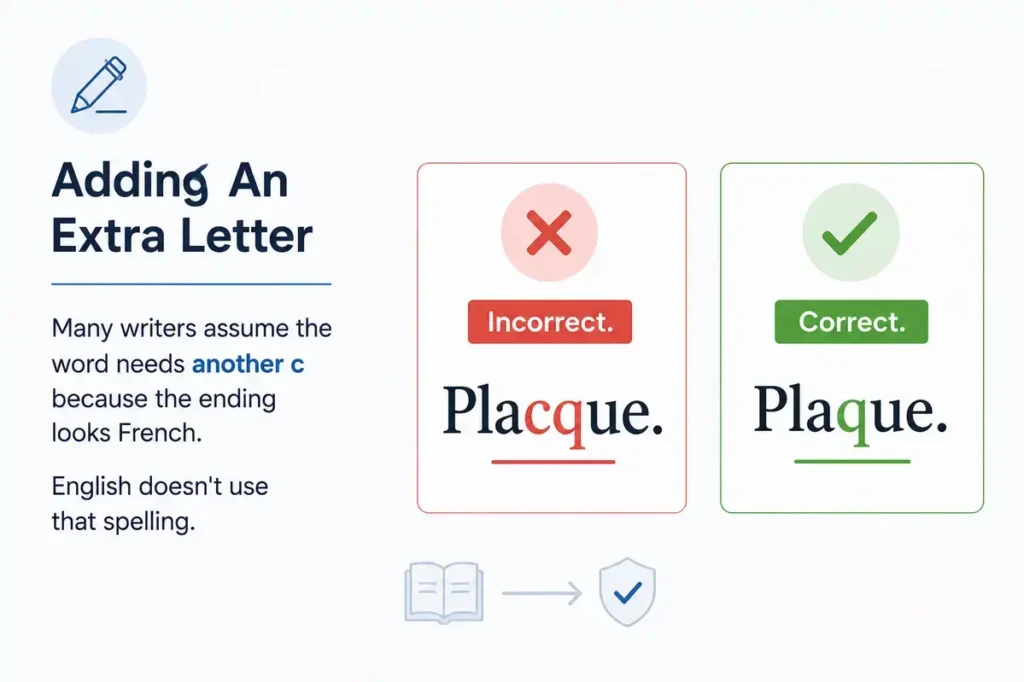
The misspelling placque adds a letter that doesn’t belong in the standard spelling. Although the extra c may look reasonable to some writers, it doesn’t reflect the accepted form of the word.
Compare these examples.
| Incorrect spelling | Correct spelling |
|---|---|
| The dentist removed placque. | The dentist removed plaque. |
| They installed a memorial placque. | They installed a memorial plaque. |
| Arterial placque can affect blood flow. | Arterial plaque can affect blood flow. |
| She received a placque for her service. | She received a plaque for her service. |
The correction is the same in every sentence. Remove the extra c and use plaque.
A Quick Proofreading Method
When proofreading your work, use these steps.
1. Look for the letter sequence placque.
2. Check the context to confirm that you mean the standard word plaque.
3. Replace the misspelling with the correct form.
4. Read the full sentence again to make sure the correction preserves your intended meaning.
This simple check can help you catch the error in emails, reports, essays, website content, and printed materials.
Why People Misspell Plaque
There are several reasons writers may add an extra letter to this word. Understanding the source of the confusion can make the correct spelling easier to remember.
The Word Looks Unusual
English spelling doesn’t always follow one predictable pattern. Words with the same or similar sounds may use different letter combinations, so writers sometimes rely on visual guesses.
The letter sequence in plaque may look unfamiliar, especially to someone who doesn’t use the word regularly. Adding another c may seem like a reasonable guess, but spelling depends on established usage rather than appearance alone.
The Pronunciation Doesn’t Reveal Every Letter
The word’s pronunciation doesn’t provide a clear clue about its full spelling. In particular, the qu combination represents a sound that doesn’t require an additional c.
This is common in English. Many words contain letters or letter combinations that aren’t obvious from pronunciation alone.
For instance, the spelling of receipt includes a silent p, while debt includes a silent b. These examples show why spelling from sound alone can lead to mistakes.
Writers May Remember the Wrong Visual Pattern
People often remember the general shape of a word without recalling every letter. When they type quickly, they may insert an extra letter that seems to fit.
This can happen with technical terms, unfamiliar vocabulary, and words used only occasionally. Repeated exposure to the correct spelling helps build stronger visual recognition.
Spellcheck Doesn’t Always Catch Every Error
Modern spelling tools can identify many mistakes, but they don’t guarantee perfect proofreading. A tool may miss an error in some contexts, especially when the surrounding sentence is unusual or the spelling appears in a name or specialized document.
For important writing, don’t rely on automated correction alone. Learn the standard form and review the final text before publishing or submitting it.
How to Pronounce Plaque
The word plaque is pronounced like plack. It has one syllable, and the final ue doesn’t create an additional syllable.
The pronunciation can be represented in the International Phonetic Alphabet as /plæk/ in common American English pronunciation.
A simple way to practice is to say the familiar word black and replace the initial bl sound with pl. Keep the word short and finish with the same final sound you hear in back.
Remember that pronunciation and spelling serve different purposes. You can pronounce the word correctly and still misspell it by adding an extra c. For written communication, you need to remember the established letter sequence.
The Origin of the Word Plaque
The history of a word can sometimes help explain its spelling. Plaque entered English through French and is related to a word meaning a flat plate or tablet.
Its historical connection to a flat surface helps explain its use for a commemorative object. Over time, the word also developed specialized meanings in dentistry and medicine.
In dental terminology, it refers to the film that collects on tooth surfaces. In medical terminology, it can describe a deposit or a distinct area of altered tissue, depending on the condition.
Although the meanings differ, the spelling remains consistent. The word’s history doesn’t support adding an extra c to the modern standard form.
Plaque in American and British English
American and British English use the same standard spelling for this word. There is no general US versus UK spelling distinction between plaque and placque.
| Context | American English | British English |
|---|---|---|
| Commemorative plate | Plaque | Plaque |
| Dental buildup | Plaque | Plaque |
| Arterial deposit | Plaque | Plaque |
| Recommended spelling | Plaque | Plaque |
You can use plaque in American school assignments, British publications, international business documents, and formal medical writing.
This differs from genuine regional spelling variations such as color and colour or center and centre. Those pairs reflect established differences between major varieties of English. The spelling placque isn’t a standard British alternative.
If you write for an American audience, use plaque and follow the rest of your publication’s preferred spelling conventions.
Plaque in Dental and Medical Contexts
Because the word appears in health writing, it helps to understand its basic meanings and use it accurately. Correct spelling is only one part of clear medical communication.
Dental Plaque and Tartar
Dental plaque is a sticky film that forms on teeth. It contains bacteria and can contribute to cavities and gum disease if it isn’t removed regularly.
Tartar is hardened plaque that attaches to tooth surfaces. Although daily oral hygiene helps control plaque, hardened tartar generally requires professional removal.
Consider this example.
Brushing and cleaning between the teeth help control plaque before it hardens into tartar.
The sentence distinguishes the soft film from the hardened deposit. That distinction makes the explanation more useful to readers.
When writing about dental care, avoid treating plaque and tartar as interchangeable terms. They are related, but they describe different stages or forms of buildup.
Arterial Plaque and Atherosclerosis
Arterial plaque develops within artery walls and can contribute to a condition called atherosclerosis. The deposits may narrow the arteries and reduce blood flow. In some cases, complications can lead to serious cardiovascular problems.
For example, The doctor explained that arterial plaque can increase cardiovascular risk.
The sentence uses the term in its medical sense. It doesn’t refer to dental buildup or a commemorative object.
Medical writing should also avoid suggesting that every plaque deposit causes the same symptoms or carries the same risk. The significance depends on its location, extent, and the person’s overall health.
Plaque in Skin Conditions
Dermatology uses plaque to describe certain types of skin lesions. A skin plaque is generally a raised or palpable area that is broader than it is thick. Its appearance and cause depend on the condition.
For example, The dermatologist examined a scaly plaque on the patient’s elbow.
Here, the term describes an area of altered skin rather than a dental or arterial deposit.
The meaning becomes clear because the sentence mentions a dermatologist and a body part. In medical writing, context helps readers distinguish among different uses of the same word.
Common Spelling Mistakes
Some errors occur because writers confuse similar looking words or assume that related terms follow identical spelling patterns.
Using Placque in Formal Writing
Incorrect: The organization installed a placque to recognize the volunteers.
Correct: The organization installed a plaque to recognize the volunteers.
The correction removes the extra c. The sentence now uses the standard spelling for a commemorative object.
Using Placque in Dental Advice
Incorrect: Daily brushing helps reduce placque on your teeth.
Correct: Daily brushing helps reduce plaque on your teeth.
The correct form refers to the sticky bacterial film that develops on teeth. Using the standard spelling also makes the advice easier to understand and search for.
Using Placque in Medical Reports
Incorrect: The scan revealed placque in the artery.
Correct: The scan revealed plaque in the artery.
The medical term requires the standard spelling. In professional records, even small spelling errors can make documents appear less carefully prepared.
Assuming an Extra Letter Creates a Different Meaning
Some misspellings produce another valid word. This isn’t generally the case with placque in ordinary standard English.
Writers shouldn’t assume that the extra c marks a separate dental, medical, or commemorative meaning. Use plaque unless a specific proper name or documented specialized usage requires something else.
Failing to Proofread Repeated Words
A writer may spell the word correctly in one paragraph and incorrectly in another. This often happens in long documents where the same term appears several times.
A final search for placque can help you catch inconsistent spelling. If the word appears in an article, presentation, or report, check every occurrence rather than correcting only the first one.
Memory Tips for Remembering Plaque
A good memory trick should be quick and easy to recall. You don’t need to memorize a long spelling rule to get this word right.
Remember That Plaque Has No Extra C
The simplest rule is also the most reliable.
Plaque has one c, not two.
When you feel tempted to add another c, pause and check the word. The correct spelling is plaque.
Connect Plaque With a Plate
Think of a commemorative plaque as a flat plate attached to a wall. Both words describe familiar objects, and that connection can help you remember the correct spelling.
For example, imagine a metal plate outside a historic building. The engraved object is a plaque, not a placque.
This visual association is particularly useful for students and anyone who encounters the word only occasionally.
Memorize One Sentence
Choose a short sentence that uses the word correctly.
The school displayed a plaque near the entrance.
Read it aloud and write it down a few times. The goal is to recognize the correct letter sequence without having to stop and think about every letter.
Use the Word in Different Contexts
Learning the word through different meanings can strengthen your memory.
1. The museum displayed a plaque.
2. The dentist discussed plaque buildup.
3. The doctor explained arterial plaque.
All three sentences use the same spelling. Practicing the word in several contexts helps reinforce the fact that its spelling doesn’t change with its meaning.
Add It to Your Personal Word List
If you regularly confuse the spelling, keep a short list of words you want to remember. Include the correct form, a simple definition, and one example sentence.
For this word, your entry could look like this.
Word: Plaque.
Meaning: A commemorative plate or a deposit that forms in the body.
Example: The city placed a plaque on the historic building.
Reviewing the entry before writing can help turn an occasional spelling problem into a familiar pattern.
Related Words and Expressions
Learning related vocabulary can improve your understanding of the word and help you use it precisely.
Plaque and Plate
A plate is a broad term for a flat object or a dish used for serving food. A plaque is a specific kind of flat object, often displayed to commemorate a person or event.
For example, She put the dinner plate on the table describes a dish. In contrast, She read the plaque on the memorial describes an object containing commemorative information.
Although the words look and sound somewhat alike, they aren’t interchangeable.
Plaque and Tartar
In dentistry, plaque refers to a soft bacterial film on teeth. Tartar refers to plaque that has hardened and attached to the teeth.
For example, Brushing helps remove plaque, but a dental professional usually needs to remove hardened tartar.
This distinction matters in health education because the terms describe related but different conditions.
Plaque and Atherosclerosis
Atherosclerosis is a medical condition involving the buildup of plaque in artery walls. The two words are connected, but they don’t mean the same thing.
For example, The physician discussed atherosclerosis and explained how arterial plaque can affect circulation.
The first term names the condition. The second identifies the deposits associated with it.
Plaque and Memorial
A memorial is something that honors or remembers a person or event. A plaque can serve as a memorial, but the terms aren’t exact synonyms.
For example, The memorial included a plaque listing the names of local residents.
The memorial is the broader tribute, while the plaque is the physical object displaying the names.
Plaque and Inscription
An inscription is writing engraved, carved, or otherwise marked on a surface. A plaque may contain an inscription, but the inscription is the text rather than the plate itself.
For example, The inscription on the plaque recorded the building’s opening date.
This distinction helps writers describe historical objects more accurately.
Professional Writing Tips
Correct spelling improves credibility, but good writing also depends on context, consistency, and precision.
Choose the Meaning That Fits the Context
Before using the word, identify the subject you’re discussing. A sentence about a museum may refer to a commemorative plate, while a sentence about a dentist may refer to bacterial buildup.
For example, The plaque was removed during cleaning could describe a dental procedure. Adding a few words about the teeth or dental visit would make the meaning clearer.
Use Specific Terms in Technical Writing
In professional documents, use the most precise term available. Write dental plaque when discussing oral health and arterial plaque when discussing deposits in arteries.
Specific wording reduces confusion, especially when a document covers several topics that use the same word.
Check Spelling Before Publishing
Run a spelling check and review the document manually. Search for the incorrect form and confirm that each occurrence uses the intended word.
This step is useful for website articles, newsletters, educational materials, medical information, and award inscriptions. An error engraved on a metal plate can be expensive to correct, so verify the wording before production.
Keep Usage Consistent
If you’re editing a long document, make sure the spelling remains the same throughout. Don’t alternate between plaque and placque.
Consistency helps readers focus on the message instead of noticing a distracting spelling error. It also makes the document look more professional.
Expert Language Insight
After editing thousands of articles, reports, academic papers, and website pages, one pattern appears again and again. Most spelling mistakes don’t happen because people don’t know the correct word. They happen because the eye expects a familiar pattern instead of the actual spelling. Plaque is a perfect example.
Key Takeaways
1. Plaque is the correct standard English spelling.
2. Placque is generally a misspelling and shouldn’t be used in ordinary formal or informal writing.
3. Plaque can refer to a commemorative plate, dental buildup, an arterial deposit, or certain skin lesions.
4. American and British English use the same standard spelling.
5. The word is pronounced like plack and has one syllable.
6. A useful memory trick is to remember that plaque has one c and doesn’t need an extra one.
7. Proofread important documents carefully, especially when preparing engraved plaques, medical materials, or published articles.
Conclusion
Placque vs plaque has a straightforward answer. Plaque is the correct spelling in standard English, while placque is generally a misspelling. Use the standard form when writing about a commemorative plate, dental buildup, an arterial deposit, or a skin lesion.
The easiest way to remember the spelling is to focus on the five letters in plaque. The word contains one c, followed by q u e, with no extra c. This simple rule works across everyday writing, academic assignments, professional documents, and health related content.
Once you recognize the correct spelling, you can use the word with confidence. Check for the extra c when proofreading, choose enough context to make the meaning clear, and keep the spelling consistent throughout your writing.
Frequently Asked Questions
Is placque or plaque correct?
Plaque is the correct standard English spelling. Placque is generally a misspelling and should be corrected in ordinary writing.
Why is plaque spelled without an extra c?
The standard spelling uses the letter sequence p l a q u e. Adding another c creates a misspelling rather than a separate standard word for the same meaning.
Is placque vs plaque a British and American spelling difference?
No. American and British English both use plaque as the standard spelling. Placque isn’t a recognized regional alternative in ordinary standard usage.
How do you spell plaque correctly?
Spell it P L A Q U E. Remember that the word contains one c and doesn’t need an extra c before the q.
What does plaque mean?
A plaque can be a flat plate that honors a person or records an event. It can also mean a sticky bacterial film on teeth or a deposit inside an artery. The intended meaning depends on the context.
How do you pronounce plaque?
In common American English, plaque is pronounced like plack. It has one syllable, and the final letters don’t create another syllable.
Is plaque a noun or a verb?
Plaque is a noun in standard usage. It names a commemorative plate, a dental substance, or a deposit or lesion in a medical context.
Is dental plaque the same as tartar?
No. Dental plaque is a soft bacterial film that forms on teeth. Tartar is hardened plaque that generally requires professional cleaning to remove.
Can plaque refer to a skin condition?
Yes. In dermatology, plaque can describe a raised or palpable area of altered skin. The precise meaning depends on the condition being discussed.
How can I remember the correct spelling of plaque?
Remember the rule plaque has no extra c. You can also picture a commemorative plate on a wall and practice writing the word in a short sentence.

Confusing Words, Spelling & Word Choice
Claire Whitmore is a U.S.-based English editor who writes about commonly confused words, spelling differences, and word choice. Her work helps readers understand subtle distinctions between similar-looking words through simple definitions, practical examples, and modern usage guidance in both American and British English.