
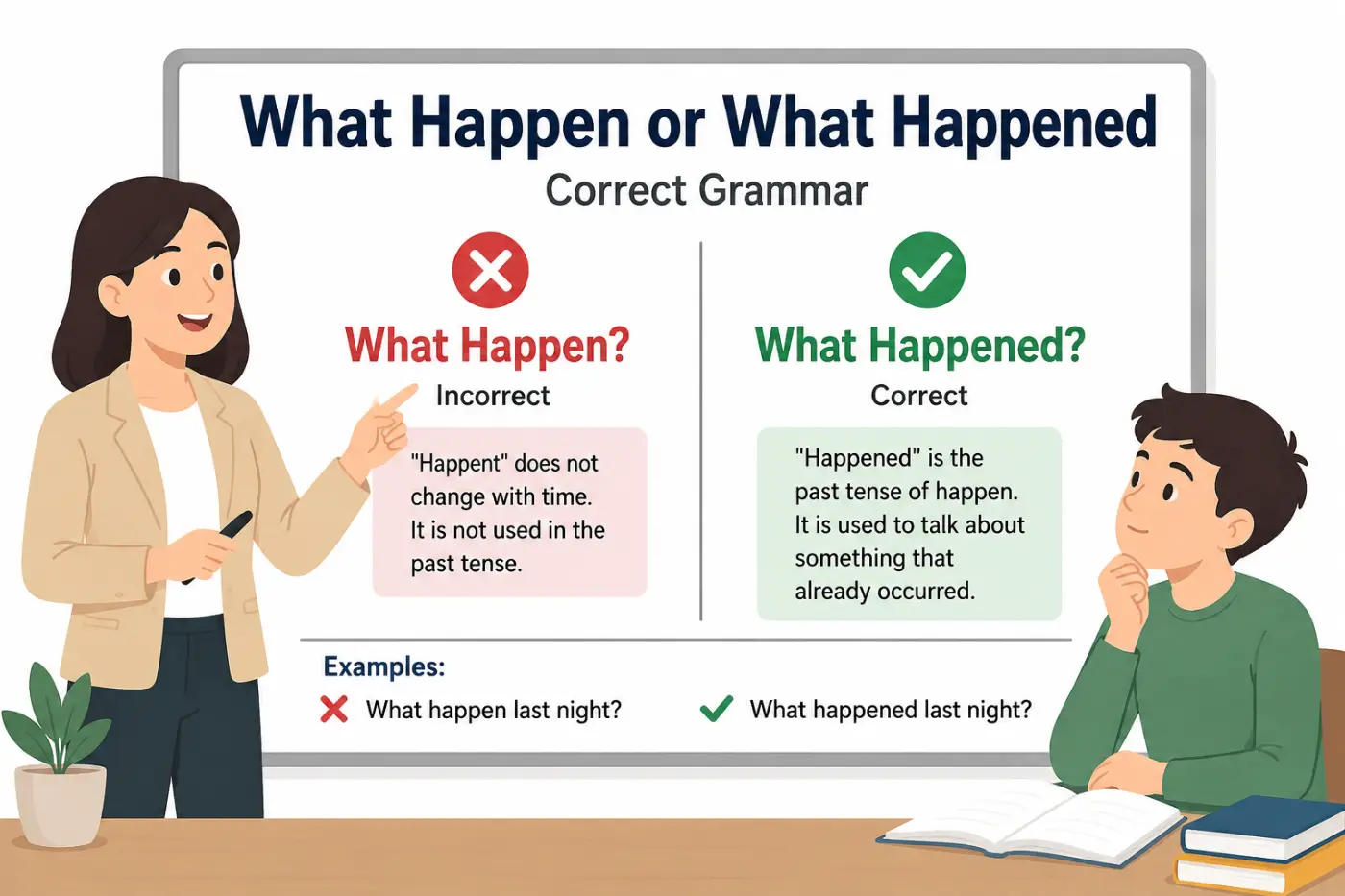
What Happen or What Happened is a common grammar question because the two phrases look almost identical. The difference comes down to verb tense and sentence structure. When you’re asking about something that already took place you should say What happened? When you’re asking about something that normally takes place or is currently taking place you may need What happens? or another present tense structure.
The confusion often comes from the word what. English speakers sometimes expect the verb after what to stay in its basic form. That works in some sentence patterns but not in a simple question such as What happened? The word happened is the past tense of happen and correctly tells the listener that the event is already over.
This guide explains the grammar behind these phrases in plain American English. You’ll learn when to use each form how auxiliary verbs change the sentence why what happen is usually incorrect and how native speakers naturally phrase questions about events. You’ll also see practical examples common mistakes memory tips and answers to related questions.
Short Answer
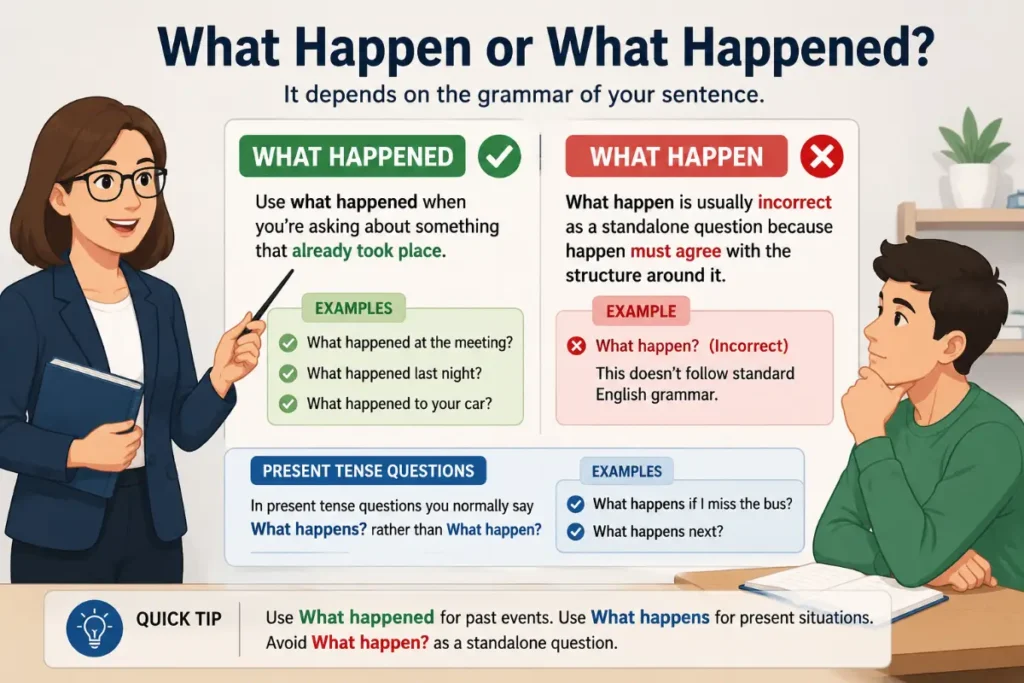
What Happen or What Happened depends on the grammar of your sentence. What happened is correct when you’re asking about something that already took place and What happen is usually incorrect as a standalone question because happen must agree with the structure around it. In present tense questions you normally say What happens? rather than What happen?
Table of Contents
- The Quick Grammar Rule.
- Understanding The Two Forms.
- Why What Happened Is Correct.
- When What Happens Is Better.
- When What Happen Can Be Correct.
- Comparing The Main Forms.
- Real Life Examples.
- Common Grammar Mistakes.
- Questions With Did.
- Questions With Does.
- Questions With Can Will And Other Modals.
- Formal And Informal Usage.
- American English Usage.
- Memory Tips.
- Related Grammar Questions.
- Expert Editor Advice.
- Frequently Asked Questions.
- Key Takeaways.
- Conclusion.
The Quick Grammar Rule
Use what happened when you’re asking about a completed event in the past.
For example:
What happened at the meeting?
The meeting has already taken place so happened is the correct past tense form.
Use what happens when you’re asking about something that occurs regularly or about a general result.
For example:
What happens when you press this button?
The question isn’t asking about one completed event. It asks about the usual result of pressing the button.
The form what happen can be grammatical inside a larger structure when another word controls the verb form.
For example:
What will happen next?
Here will is the modal verb and happen stays in its base form.
So the key isn’t simply choosing between happen and happened. You need to look at the entire sentence.
Understanding The Two Forms
What Happened
Happened is the simple past form of happen.
Use it when the event took place before now and you’re asking about that completed event.
Examples include:
- What happened last night?
- What happened after the alarm rang?
- What happened to your phone?
- What happened at school today?
- What happened during the game?
Each question points toward an event that has already occurred.
The exact time doesn’t always need to be stated. Context can make the past meaning clear.
For example:
You look upset. What happened?
The speaker understands that something has already occurred. The question asks the listener to explain that past event.
What Happens
Happens is the simple present form used with a third person singular subject.
It commonly appears in questions about routines facts processes and expected results.
Examples include:
- What happens after the timer rings?
- What happens when water freezes?
- What happens at the end of the story?
- What happens if I forget my password?
- What happens during the final step?
The word happens agrees with an implied third person singular subject.
You can think of the structure as asking about the thing that happens.
What Happen
On its own what happen is usually not correct in standard English.
A common reason is that learners know happen is the base form and use it after what without considering the rest of the sentence. English grammar doesn’t work that way in every question.
However happen becomes correct after auxiliary verbs and modal verbs.
Examples include:
- What did happen yesterday?
- What will happen next?
- What can happen during the process?
- What might happen if we leave early?
- What should happen now?
In each example another verb or modal controls the grammar. That is why happen remains in its base form.
Why What Happened Is Correct
The phrase what happened works because happened carries the past tense. English often forms simple past questions differently depending on the verb structure.
Compare these sentences:
Something happened.
To ask about the event you can say:
What happened?
The word what replaces the unknown subject or event. No auxiliary verb is needed. This is different from a question where the subject is already known.
For example:
Did something happen?
Here did carries the past tense. Because did already marks the past tense the main verb returns to its base form.
That gives us:
What happened?
But:
What did happen?
Both can be grammatical. They simply have different structures and emphasis.
The first is the normal neutral question. The second usually adds emphasis or contrast.
For example:
I know something happened. But what did happen?
The speaker is stressing the question because they want a clearer explanation.
When What Happens Is Better
Use what happens when the question concerns a regular event a process a rule or a general outcome.
Consider these examples:
What happens when you mix oil and water?
This asks about a general result.
What happens after the interview?
This can ask about the usual next stage.
What happens if I miss the deadline?
This asks about a possible consequence.
The phrase can also describe events in stories.
What happens at the end of the movie?
The movie may already exist but the question asks about its plot rather than a particular event that occurred in real life.
That distinction can be useful. Tense depends on meaning rather than simply on whether the thing being discussed already exists.
When What Happen Can Be Correct
There are several structures in which happen is completely correct after what.
After Did
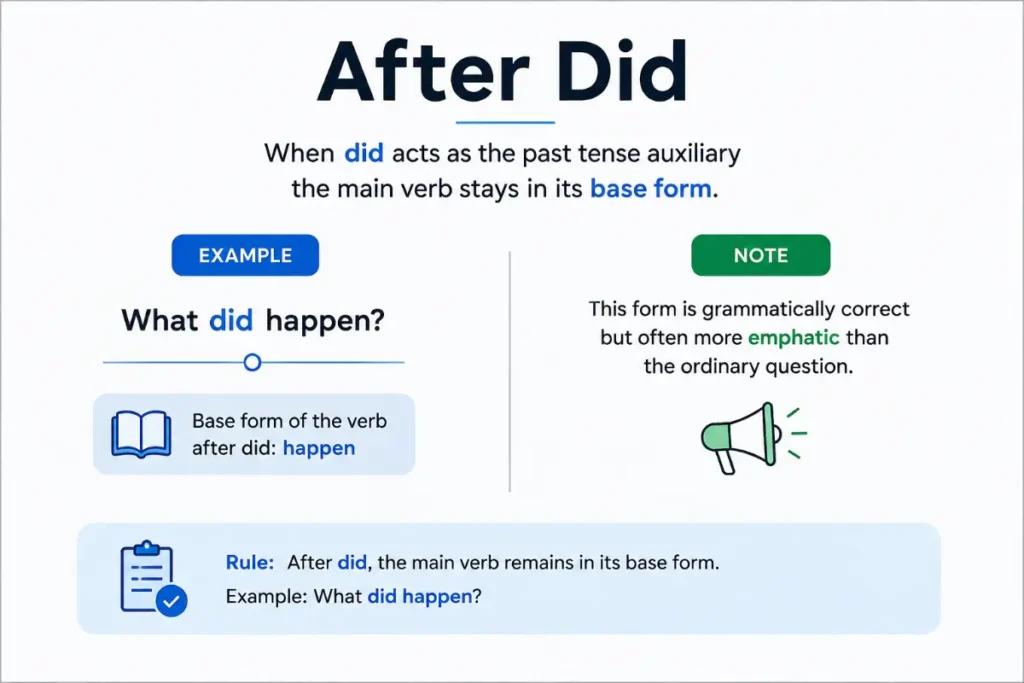
When did acts as the past tense auxiliary the main verb stays in its base form.
What did happen?
This form is grammatically correct but often more emphatic than the ordinary question.
Compare:
What happened?
with:
What did happen?
The first sounds neutral. The second can sound surprised doubtful or insistent.
After Will
Will is followed by the base form.
What will happen tomorrow?
Not:
What will happened tomorrow?
The modal will already establishes the future construction so happen remains unchanged.
After Can
Can also takes the base form.
What can happen if we ignore the warning?
Not:
What can happened if we ignore the warning?
After Could
Could works in the same way.
What could happen next?
The word happen stays in its base form.
After Might
Might also takes the base verb.
What might happen after the change?
Again the modal controls the structure.
After Should
You can say:
What should happen now?
This asks about the expected or appropriate next event.
The pattern is simple. Modal verbs such as can could may might shall should will and would are followed by the base form of the main verb.
Comparing The Main Forms
| Form | Grammar | Main Use | Example |
|---|---|---|---|
| What happened | Simple past | A completed event | What happened yesterday? |
| What happens | Simple present | A regular event or general result | What happens next? |
| What did happen | Past with emphasis | Stronger focus on a past event | What did happen at the meeting? |
| What will happen | Future | An expected future event | What will happen tomorrow? |
| What can happen | Modal | A possible result | What can happen if we wait? |
| What could happen | Modal | A possible or hypothetical result | What could happen next? |
| What might happen | Modal | A possible future result | What might happen after the change? |
| What should happen | Modal | Expected or appropriate result | What should happen now? |
The table shows why looking at only one word can lead you astray. English verb forms are shaped by the complete grammatical structure.
Real Life Examples
Talking About Yesterday
What happened at the restaurant?
This asks about an event that has already occurred.
What happened after you left?
The speaker wants information about a completed past event.
Talking About A Routine
What happens when the store closes?
This asks about a regular process.
What happens after the class ends?
The question can refer to the usual sequence of events.
Talking About The Future
What will happen if we cancel the order?
Will establishes the future construction.
What will happen next?
The speaker wants to know about a future event.
Talking About Possibilities
What could happen if the weather changes?
The question discusses a possible result.
What might happen during the test?
The speaker is asking about something that may occur.
Asking For An Explanation
You seem worried. What happened?
This is one of the most natural everyday uses of the past form.
Your computer stopped working. What happened?
Again the question refers to something that has already occurred.
Common Grammar Mistakes
Using What Happen Alone
What happen? is generally incorrect as a standalone question.
The usual choices are:
What happened?
or
What happens?
Choose the tense according to the meaning.
Using Happened After Did
A frequent error is:
What did happened?
The correct form is:
What did happen?
Did already marks the past so the main verb returns to its base form.
Using Happened After Will
Another common error is:
What will happened?
The correct form is:
What will happen?
Will takes the base verb.
Using Happens For A Completed Event
A person might say:
What happens yesterday?
That mixes present and past time incorrectly in ordinary contexts.
The natural sentence is:
What happened yesterday?
Adding An Unnecessary Auxiliary
Some learners try to add did to every past question.
For example:
What did happen yesterday?
This is grammatical but usually sounds more emphatic than:
What happened yesterday?
Native speakers normally choose the shorter form when they simply want information.
Questions With Did
Did deserves special attention because it causes many mistakes.
When did is the auxiliary verb the main verb stays in its base form.
The pattern is:
What + did + subject + base verb?
For example:
What did you see?
What did they find?
But when what itself is the subject the structure can be different.
What happened?
Here what functions as the subject of happened. There is no need for did.
Compare:
What happened?
with:
What did you see?
In the first sentence what is asking about the thing that caused the event. In the second sentence you is the subject and what is the object of see.
This subject and object distinction explains a lot of English question patterns.
Questions With Does
The same principle applies to does.
Compare:
What happens here?
with:
What does he do here?
In the first sentence what is the subject. In the second sentence he is the subject and what is the object.
The presence of does changes the verb form.
You say:
What does she want?
Not:
What does she wants?
But:
What happens next?
This distinction is worth learning because it applies far beyond the word happen.
Questions With Can Will And Other Modals
Modal verbs make the pattern especially easy.
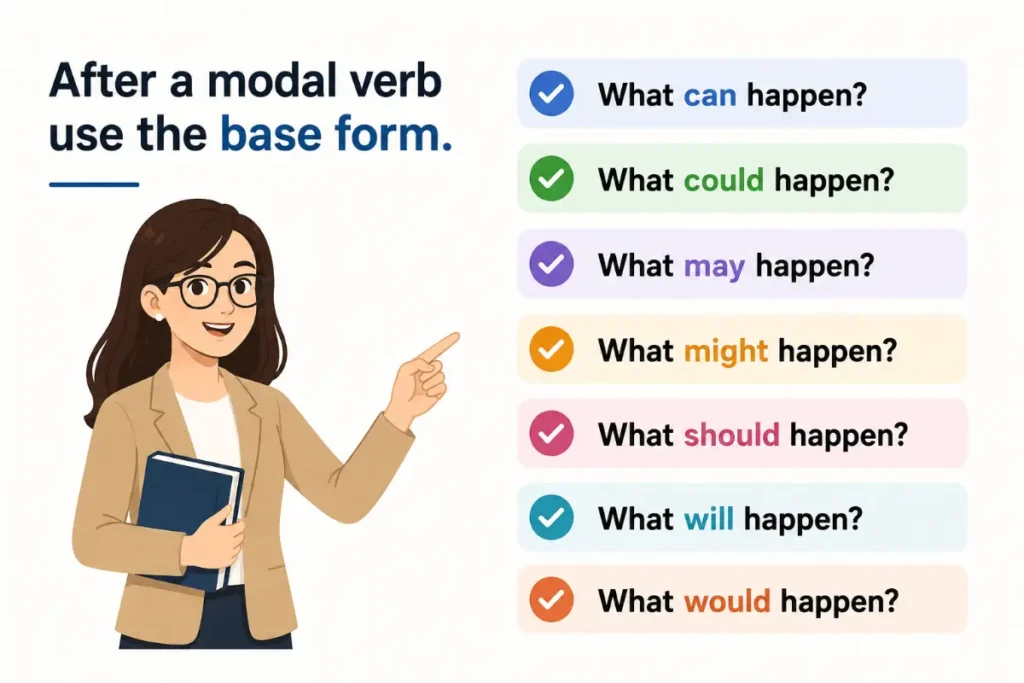
After a modal verb use the base form.
- What can happen?
- What could happen?
- What may happen?
- What might happen?
- What should happen?
- What will happen?
- What would happen?
Notice that happen stays the same in every example.
You don’t need to change it to happens or happened after these modal verbs.
For example:
What would happen if we changed the plan?
The phrase discusses an imagined result. Would carries the grammatical information so happen remains unchanged.
Formal And Informal Usage
The basic grammar stays the same in both formal and informal English.
In casual conversation you might hear:
What happened?
What happens now?
These are completely natural.
Professional writing uses the same grammatical structures but may give more detail.
For example:
The report does not explain what happened during the final stage of the investigation.
Or:
The document describes what happens after the application is submitted.
The key difference is not the verb itself. Formality comes from vocabulary sentence structure context and purpose.
American English Usage
American English uses what happened as the standard way to ask about a completed event.
You’ll hear it constantly in everyday conversation.
A friend arrives late and you might ask:
What happened?
Someone looks upset and you might ask:
What happened?
A project suddenly changes and you might ask:
What happened with the original plan?
American speakers also use what happens for routines processes and expected results.
What happens if I change the setting?
What happens after the meeting?
These patterns are ordinary standard American English.
British English Usage
British English follows the same core grammar.
Speakers use what happened for completed events and what happens for regular or general events.
The difference between American and British English doesn’t create a separate rule for these phrases. Regional vocabulary and pronunciation may vary in some areas but the basic verb structure remains the same.
That makes this grammar point useful across major English varieties.
Memory Tips
A simple memory trick can help you choose the right form quickly.
Past Event Means Happened
Think about something already finished.
What happened?
The event is behind you.
Regular Event Means Happens
Think about something that occurs repeatedly or as part of a process.
What happens?
The event is general or recurring.
Modal Means Happen
When you see a modal verb remember that the main verb stays basic.
What will happen?
What should happen?
Did Means Base Verb
When did appears before the subject use the base form.
What did happen?
What did they find?
A useful editing question is simple. Look for the word that carries the tense. Once you find it the correct verb form usually becomes much easier to choose.
Related Grammar And Usage Notes
The same principle applies to many English verbs.
Consider:
What did she do?
Not:
What did she did?
Consider:
What does he want?
Not:
What does he wants?
Consider:
What will she say?
Not:
What will she says?
The auxiliary or modal determines the form of the main verb.
Another useful distinction involves happen to.
What happened to your bag?
Here to introduces the person or thing affected by the event.
You can also say:
What happened to the old building?
This may ask what became of it or what event affected it.
Another expression is happen to meaning to do something accidentally or unexpectedly.
Did you happen to see my keys?
That is a different construction but it follows the same general verb rules.
Why This Mistake Happens
The confusion usually comes from three sources.
First the words happen and happened look closely related. A writer may remember the base word and use it without checking the tense.
Second English questions use auxiliary verbs in some structures but not others. This makes the difference between what happened and what did happen less obvious to learners.
Third speakers often focus on pronunciation rather than sentence structure. In natural speech the final sounds can be reduced which makes the written distinction less obvious.
The solution isn’t to memorize dozens of isolated sentences. Learn the structure.
Ask yourself three questions.
- Is the event already completed?
- Is there an auxiliary or modal before the main verb?
- Is the question about one event or a general process?
Those three checks will solve most problems.
Professional Writing Tips
Good editing starts with meaning.
If your sentence asks about a completed event use the simple past.
What happened during the meeting?
If it asks about a process use the present.
What happens after approval?
If it asks about a possible future result use a modal.
What might happen after approval?
If you’re using did remember that the following main verb stays in its base form.
What did happen during the meeting?
The last sentence is grammatical but it has extra emphasis. In most neutral situations the simpler What happened during the meeting? sounds more natural.
That small distinction is the kind of detail that makes writing sound polished rather than merely grammatically acceptable.
Expert Editor Insight
A professional editor would rarely correct what happened because it is standard natural English. The bigger concern is often tense consistency across the surrounding sentence. Writers sometimes switch between happened happens and happen because they focus on individual words instead of the timeline and sentence structure. Native speakers usually choose the form almost automatically because they process the entire construction. If you pause while writing ask yourself what tense the sentence needs and look for any auxiliary or modal verb controlling the main verb.
Key Takeaways
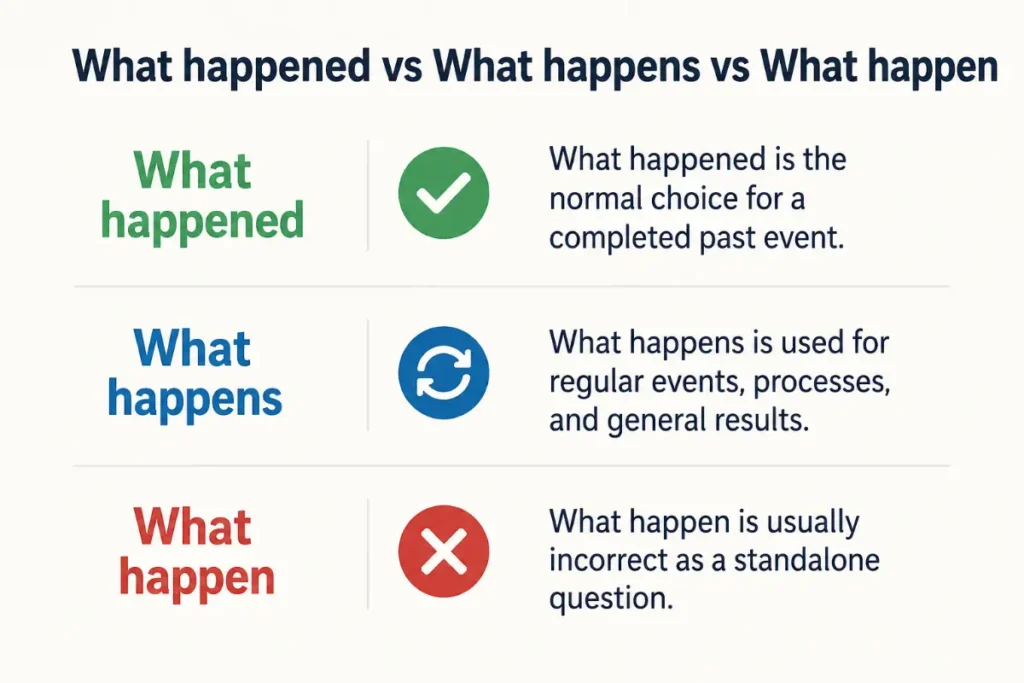
- What happened is the normal choice for a completed past event.
- What happens is used for regular events processes and general results.
- What happen is usually incorrect as a standalone question.
- Happen is correct after modal verbs such as will can could might and should.
- After did the main verb stays in its base form.
- What happened is usually neutral while what did happen can add emphasis.
- Tense depends on the meaning and structure of the whole sentence.
- The easiest way to choose the form is to identify the timeline and any auxiliary or modal verb.
Conclusion
What Happen or What Happened becomes easy once you focus on tense and sentence structure. Use what happened when you’re asking about a completed event and Use what happens for a regular event a process or a general result. Use happen after modal verbs such as will can could might and should.
The most common mistake is writing what happen as a standalone question. That form usually needs another word to make the grammar work. For example What will happen is correct because will controls the verb form. What did happen is also correct but normally adds emphasis. These patterns follow a clear rule rather than a random spelling preference.
When you’re unsure pause for a second and identify the time of the event. Past event means happened. General or repeated event means happens. A modal means happen. That quick check will make your questions sound natural and accurate in American English.
Frequently Asked Questions
What happen or what happened which is correct?
What happened is correct when you’re asking about a completed past event and What happen is generally incorrect as a standalone question. However happen can be correct after words such as did will can could might and should. For example you can say What will happen next and What did happen. The surrounding grammar determines the correct form.
Is what happen grammatically correct?
What happen is not normally correct as a standalone question in standard English. You would usually say What happened when asking about a past event or What happens when asking about a regular event or general result. Happen becomes correct when an auxiliary or modal requires the base form such as in What will happen next.
What is the difference between what happens and what happened?
What happens uses the simple present and usually asks about a regular event a process or a general result. and What happened uses the simple past and asks about a completed event. Compare What happens after the alarm rings with What happened after the alarm rang. The first asks about a general sequence while the second asks about one past occasion.
Why do we say what happened instead of what did happen?
We normally say what happened because what can function as the subject of the sentence. When what is the subject there is no need for did. What did happen is also grammatical but it usually adds emphasis. A speaker might use it to challenge an assumption or ask for a fuller explanation of an event.
Can I say what did happen?
Yes. What did happen is grammatically correct. It usually sounds more emphatic than the neutral What happened. For example someone might say I know something went wrong but what did happen. The speaker uses did to place extra focus on the event. In ordinary conversation What happened is usually the more natural choice.
What happens or what happened in a story?
Both forms can be correct depending on the purpose of the question. What happens at the end of the story asks about the plot or general sequence. What happened in the story asks about events that took place. Book discussions often use the present tense when describing fictional plots even though the story itself has already been written.
What will happen or what will happened?
The correct form is What will happen. Will is a modal verb and modal verbs are followed by the base form of the main verb. Happened is the past form and cannot normally follow will. The same rule gives us What can happen What might happen and What should happen.
How do you remember the correct form?
Think about the timeline first. A finished event takes happened. A regular process takes happens. A modal such as will can or might takes happen. If did appears before the subject the main verb also stays in its base form. This simple check prevents most mistakes with these three forms.
Is what happened formal English?
Yes. What happened is standard English and works in formal and informal contexts. The phrase is natural in conversation but can also appear in reports academic writing journalism and professional communication. The surrounding vocabulary determines the overall level of formality. There is no need to replace happened simply because the writing is formal.
Can what happened refer to something that just occurred?
Yes. What happened can refer to something that occurred only moments ago. For example if a glass suddenly falls you can immediately ask What happened. The simple past works because the event has already occurred. English doesn’t require a long amount of time to pass before you can use the past tense.

English Grammar & Usage
Nathan Holloway is an American grammar writer and language researcher who specializes in English grammar, sentence structure, verb usage, and common writing mistakes. He enjoys breaking down confusing grammar rules into practical explanations with clear examples, making English easier for students, professionals, and everyday writers.