
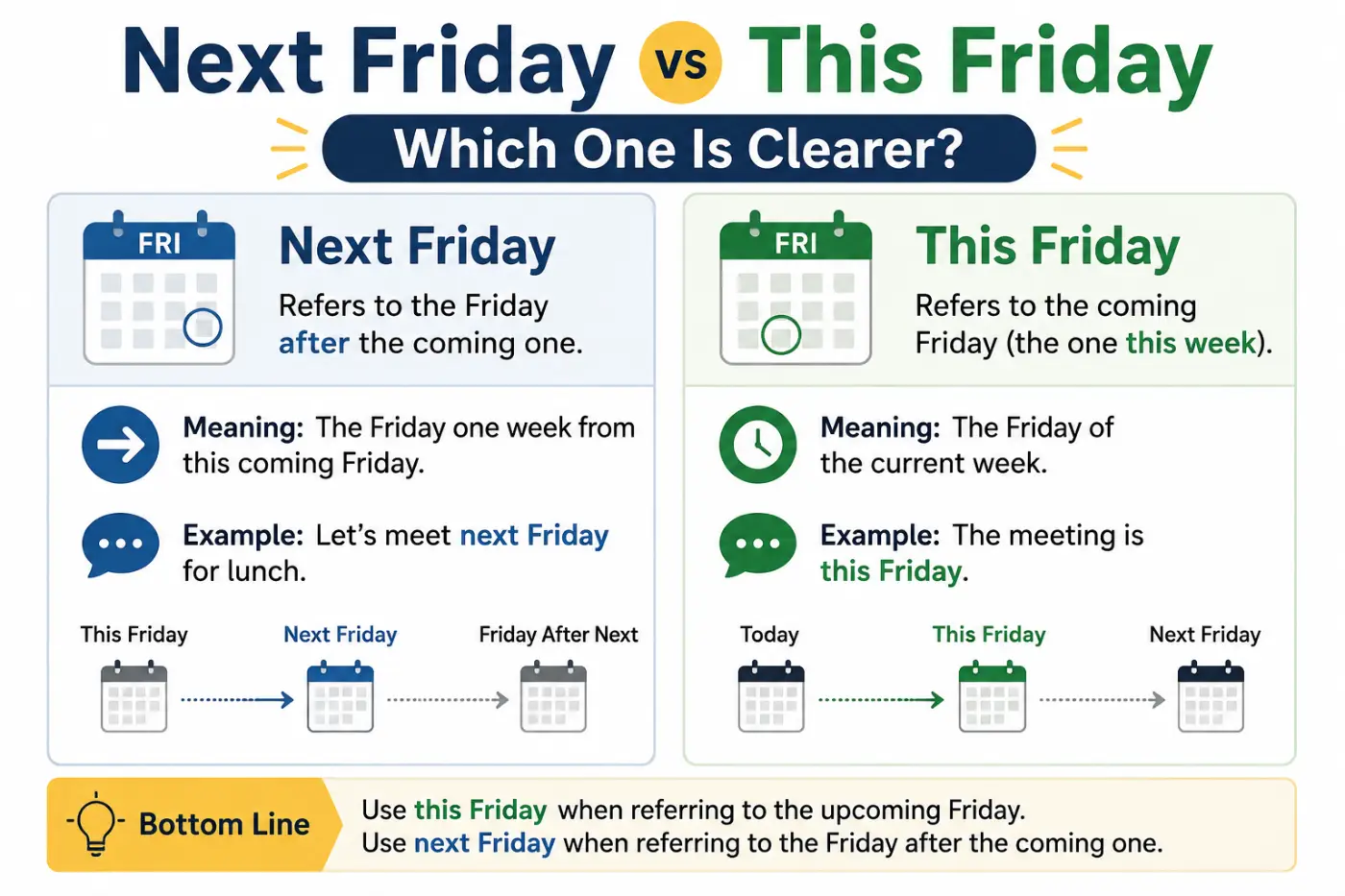
Next Friday vs This Friday can point to different dates depending on the day you say it and the context around it. In American English this Friday usually points to the Friday in the current week while next Friday usually points to the Friday after that. The trouble starts when a conversation happens near the end of the week or when two people use different assumptions about what next means.
For example if today is Monday and you say I’ll see you this Friday most people will understand that you mean the Friday coming in a few days. If you say I’ll see you next Friday many people will understand that you mean the following Friday. Still some speakers use next Friday for the closest upcoming Friday. That difference can create unnecessary confusion.
This guide explains how native speakers use both expressions. You’ll learn the basic rule how context changes the meaning why next Friday can be ambiguous how American and British usage compares and how to make your writing completely clear. You’ll also get practical examples you can use in emails texts conversations appointments and professional messages.
Short Answer
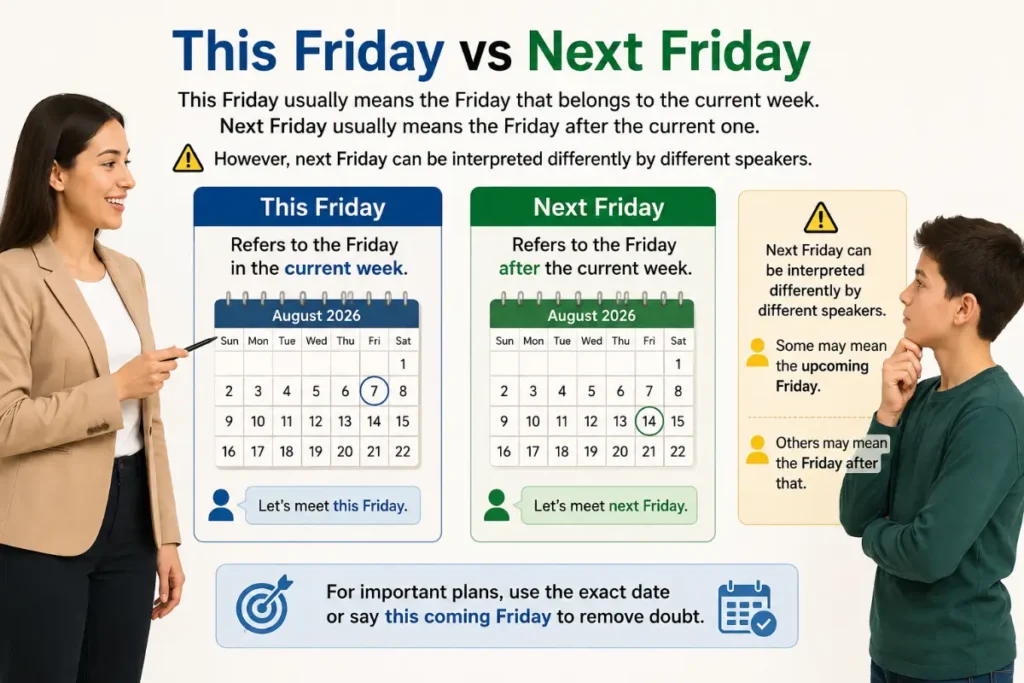
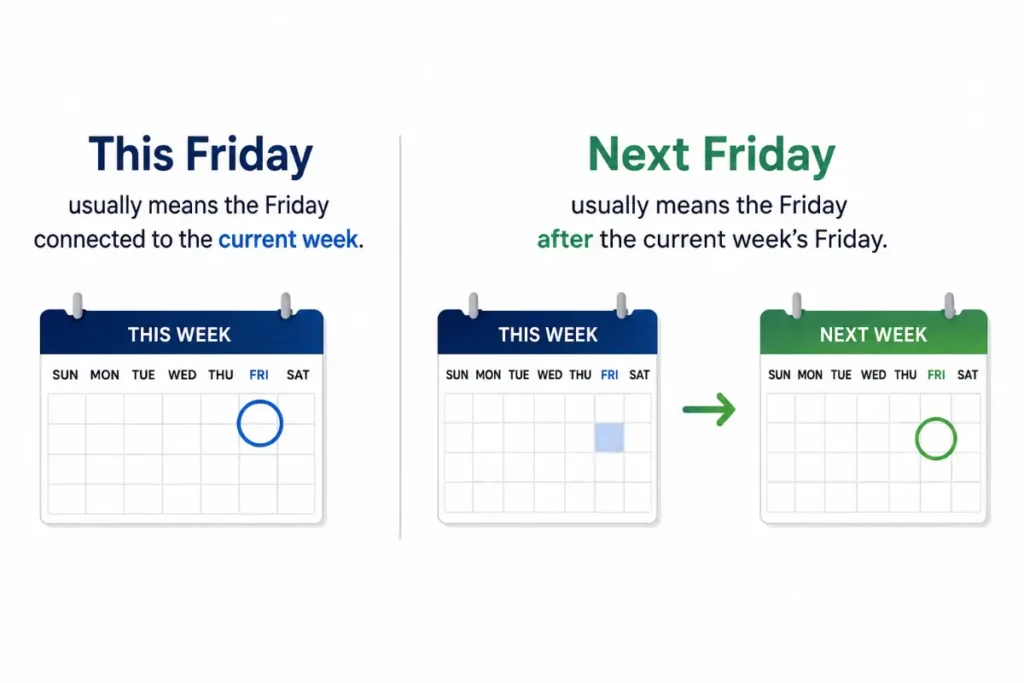
This Friday usually means the Friday that belongs to the current week. Next Friday usually means the Friday after the current one. However next Friday can be interpreted differently by different speakers. For important plans use the exact date or say this coming Friday to remove doubt.
Table Of Contents
- The Basic Difference.
- What This Friday Usually Means.
- What Next Friday Usually Means.
- Why Next Friday Causes Confusion.
- A Simple Timeline.
- How The Meaning Changes During The Week.
- American English Usage.
- British English Usage.
- Professional And Formal Writing.
- Text Messages And Everyday Conversation.
- Using Dates To Remove Confusion.
- Common Mistakes.
- Related Time Expressions.
- Memory Tips.
- Real Life Examples.
- Grammar And Punctuation.
- Expert Editor Advice.
- Frequently Asked Questions.
- Key Takeaways.
- Conclusion.
The Basic Difference
The easiest way to understand these expressions is to think about the relationship between this and next. This normally points to something connected to the current period. Next normally points forward to the period that follows the current one.
So when someone says this Friday they generally mean the Friday associated with the current week. When someone says next Friday they generally mean the Friday that follows it.
Imagine that today is Monday.
The upcoming Friday is four days away. Most American speakers would call it this Friday. The Friday after that is eleven days away. Most speakers would call it next Friday.
That seems simple. The problem is that natural conversation doesn’t always follow a perfectly fixed calendar rule. People use these expressions based on their own mental timeline. That is why two people can hear next Friday and picture different dates.
The safest interpretation comes from the surrounding conversation.
If someone says We have a meeting this Wednesday and then a follow up next Friday the intended sequence is clear. Next Friday refers to the Friday after that Wednesday.
If someone simply says Let’s meet next Friday without giving any other information the listener may need to ask which date they mean.
What This Friday Usually Means
This Friday normally refers to the Friday within the current week.
Suppose today is Tuesday. You have a dinner planned for Friday. You might naturally say I’m meeting Sarah this Friday.
The word this connects Friday to the current week.
The same idea works with other days.
- I’ll call you this Monday.
- We have class this Wednesday.
- The store opens this Thursday.
- We’re leaving this Saturday.
These expressions connect the day to the current period.
There is one important wrinkle. The meaning of this Friday depends on when the sentence is spoken.
Imagine today is Saturday. Saying this Friday could refer to the Friday that just passed because that Friday belongs to the current calendar week. Many people avoid that interpretation and instead use next Friday for the upcoming Friday. Others may say this coming Friday to make their intention obvious.
That is why time expressions work best when the speaker and listener share the same mental timeline.
What Next Friday Usually Means
Next Friday normally refers to the Friday following the current week’s Friday.
Suppose today is Monday.
This Friday is the upcoming Friday.
Next Friday is the Friday after it.
You can picture the sequence like this.
- Today is Monday.
- This Friday arrives later in the same week.
- Next Friday arrives one week after that.
This pattern is especially common in American English.
For example.
I’m working from home this Friday.
This normally means the nearest Friday in the current week.
I’m working from home next Friday.
This normally means the following Friday.
The word next suggests movement forward to the next occurrence after the one currently being discussed.
Still there is no universal rule that makes every speaker interpret the phrase in exactly the same way. Context remains powerful.
Why Next Friday Causes Confusion
The problem comes from the word next.
People use next in two closely related ways.
One meaning is the next occurrence of something.
Another meaning is the period after the current one.
Those meanings can overlap.
Consider the phrase next Friday.
A speaker might think next means the next Friday that arrives. Another speaker might think it means the Friday after this week’s Friday.
Both interpretations can feel logical.
The confusion becomes stronger when today is Thursday Friday Saturday or Sunday. At that point the current week is nearly finished or has just finished. The words this and next can point to different mental reference points.
This is a classic example of deictic language. Deictic words get part of their meaning from the situation in which they are spoken. Words such as this that here there today tomorrow yesterday and next depend on time place or context.
That explains why a phrase can be grammatically correct while still being unclear.
A Simple Timeline
A timeline makes the distinction much easier.
Imagine today is Monday.
Monday today
Friday this week
Friday next week
In that situation most American speakers understand the first Friday as this Friday and the second Friday as next Friday.
Now imagine today is Thursday.
The phrase this Friday usually points to tomorrow.
Next Friday usually points to the Friday after tomorrow.
Now imagine today is Saturday.
The phrase next Friday usually points to the upcoming Friday.
The phrase this Friday becomes less reliable because the current Friday has already passed.
This is one reason speakers often switch to phrases such as this coming Friday or the Friday after next.
The more important the appointment the more useful an exact date becomes.
How The Meaning Changes During The Week
The day of the week affects how people interpret these expressions.
Monday Through Wednesday
During the first half of the week the distinction is usually easy.
If today is Tuesday then this Friday is only a few days away. Next Friday normally refers to the following Friday.
For everyday conversation there is rarely a problem.
Thursday
Thursday can still be straightforward.
This Friday normally means tomorrow.
Next Friday normally means one week from tomorrow.
Still if the plan matters it’s smart to include the date.
Friday
Friday itself creates more room for confusion.
Someone saying this Friday on Friday might mean today. Someone else might use next Friday to mean the Friday coming after today.
A listener can usually understand the meaning from context but an important appointment shouldn’t depend on guesswork.
Saturday And Sunday
The weekend can create even more ambiguity.
The current week is ending and people often start thinking about the next week. As a result next Friday becomes the natural phrase for the upcoming Friday.
This Friday can feel strange if Friday has already passed.
That doesn’t mean everyone uses the expression in exactly the same way. It means context becomes more important.
Next Friday or This Friday In American English
American English commonly uses this Friday for the Friday coming within the current week and next Friday for the following Friday.
That pattern works well in casual speech and everyday writing.
For example.
I’ll send the report this Friday.
This normally means the report will be sent on the Friday in the current week.
I’ll send the report next Friday.
This normally means the report will be sent on the following Friday.
American speakers also use this coming Friday when they want to make the upcoming date unmistakable.
For example.
I’ll send the report this coming Friday.
That wording strongly points toward the nearest upcoming Friday.
In professional communication the best choice is often even simpler.
I’ll send the report Friday August 21.
An exact date removes the mental calendar problem altogether.
British English Usage
British English also uses this Friday and next Friday in much the same general way. The current week and following week often provide the reference point.
However British speakers can also differ in how they interpret next Friday. Context matters more than nationality.
This is worth remembering because English speakers from different regions may share the same grammar while using time expressions slightly differently.
The safest approach in international communication is to state the date.
For example.
I’ll see you on Friday August 21.
That sentence works regardless of the speaker’s regional habits.
Professional And Formal Writing
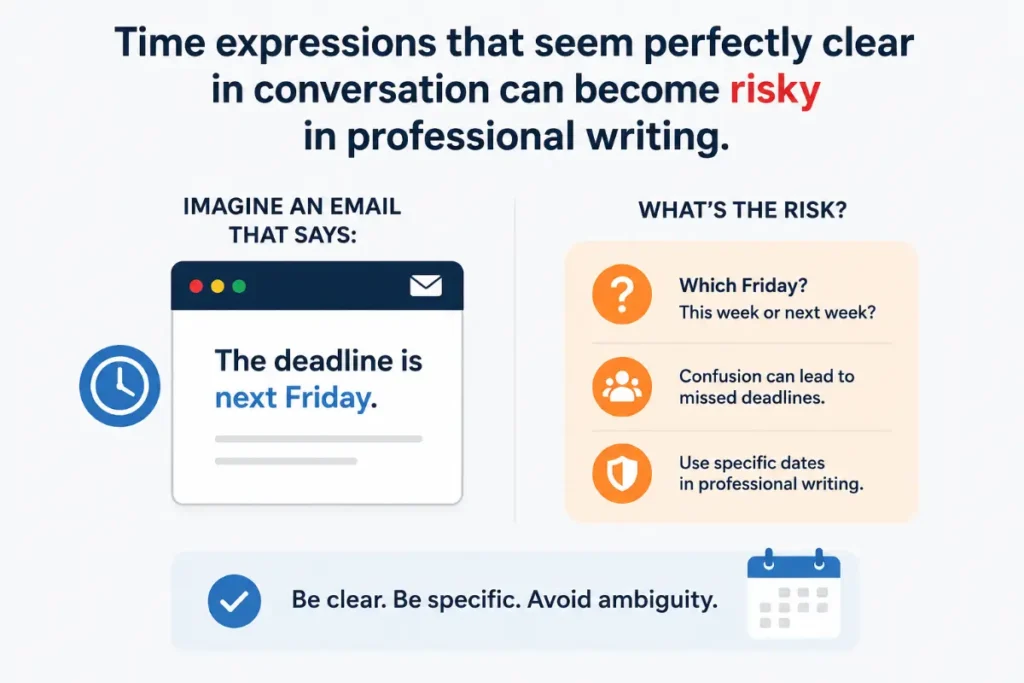
Time expressions that seem perfectly clear in conversation can become risky in professional writing.
Imagine an email that says.
The deadline is next Friday.
If the recipient reads the message several days later the intended date may not be obvious. The reader might even wonder which Friday you had in mind when the message was sent.
Professional writers can avoid that problem by including the date.
The deadline is Friday August 21.
That sentence is stronger because the reader doesn’t have to calculate anything.
For contracts schedules medical appointments business plans academic deadlines and travel arrangements exact dates are usually better than relative expressions.
You can still use this Friday in a casual professional email when the context is obvious.
For example.
I’ll send the revised file this Friday.
If the email is sent on Monday and everyone knows the schedule there may be no problem.
When the cost of misunderstanding is high use the date.
Text Messages And Everyday Conversation
Casual conversation gives speakers more freedom.
Friends often say.
Are you free this Friday.
That sounds completely natural.
Another person might reply.
I’m busy this Friday but I’m free next Friday.
The meaning is clear because the two phrases create a contrast.
This Friday refers to the closer date.
Next Friday refers to the later date.
Text messages can be even more flexible because people often rely on shared context.
Someone might write.
See you next Friday.
If the two people have already discussed the date there is no problem.
The issue appears when the conversation contains no shared reference.
That’s when a quick clarification helps.
Do you mean Friday the 21st or Friday the 28th.
One short question can save an entire chain of messages.
Using Dates To Remove Confusion
Dates are the strongest solution when clarity matters. Instead of saying I’ll call you next Friday you can say I’ll call you Friday August 28. Instead of saying Let’s meet this Friday you can say Let’s meet Friday August 21. This approach works especially well for business communication.
It also helps when messages are stored for later. An email might be read immediately or three days later. The phrase next Friday changes its practical reference as time moves forward.
An exact date stays fixed.
This principle applies to other relative expressions too.
Today becomes yesterday.
Tomorrow becomes today.
Next week eventually becomes this week.
But a calendar date remains the same.
That makes dates more reliable in records schedules and written plans.
Common Mistakes
Treating Both Expressions As Exact Synonyms
This Friday and next Friday can overlap in casual speech but they usually create different expectations. Using them as perfect synonyms can cause confusion.
Assuming Everyone Uses Next The Same Way
People don’t always share the same interpretation of next. The surrounding conversation often determines the intended meaning.
Using Relative Dates In Important Documents
A relative phrase may become unclear when a document is read later. Use the exact date for deadlines appointments and official records.
Forgetting The Current Day
The meaning of this Friday depends partly on when you speak. A phrase that sounds perfectly clear on Monday may feel less clear on Saturday.
Writing Only Friday
Sometimes Friday is actually the clearest option.
For example.
Can we meet Friday.
If the conversation already establishes the relevant Friday there may be no need for this or next.
Context can do the work.
Memory Tips
A simple memory trick is to connect this with current and next with following.
This Friday means the Friday connected with the current week.
Next Friday usually means the following Friday.
Another useful trick is to picture two Fridays on a calendar.
The first Friday is this Friday.
The Friday after it is next Friday.
If the phrase still feels unclear ask for the date.
You can also remember this rule.
The more important the plan the less you should rely on relative time words.
A coffee plan can survive a little ambiguity.
A flight departure cannot.
Related Grammar And Usage Notes
This As A Determiner
This can point to a specific person thing time or event connected to the speaker’s current context. Examples include this morning this week this month and this Friday.
The word identifies something as close in the speaker’s current frame of reference.
Next As A Determiner
Next points toward a following period or occurrence.
Examples include next week next month next year and next Friday.
The meaning depends on the reference point.
The Role Of Context
Grammar alone cannot solve every ambiguity involving time expressions.
The speaker’s current date the listener’s expectations and previous statements all matter.
That is why native speakers often understand these phrases effortlessly in conversation. They combine the words with the surrounding situation.
Punctuation
Neither this Friday nor next Friday needs special punctuation.
For example.
I’ll see you this Friday.
I’ll see you next Friday.
When a date is added you can write.
I’ll see you on Friday August 21.
In American English a comma may appear after the weekday when a full date includes the year.
For example.
The meeting is on Friday August 21 2026.
In polished formal writing many style guides prefer a comma before the year in a full date.
The meeting is on Friday August 21 2026.
The exact punctuation can vary with the style guide but the central spelling of Friday stays the same.
Real Life Examples
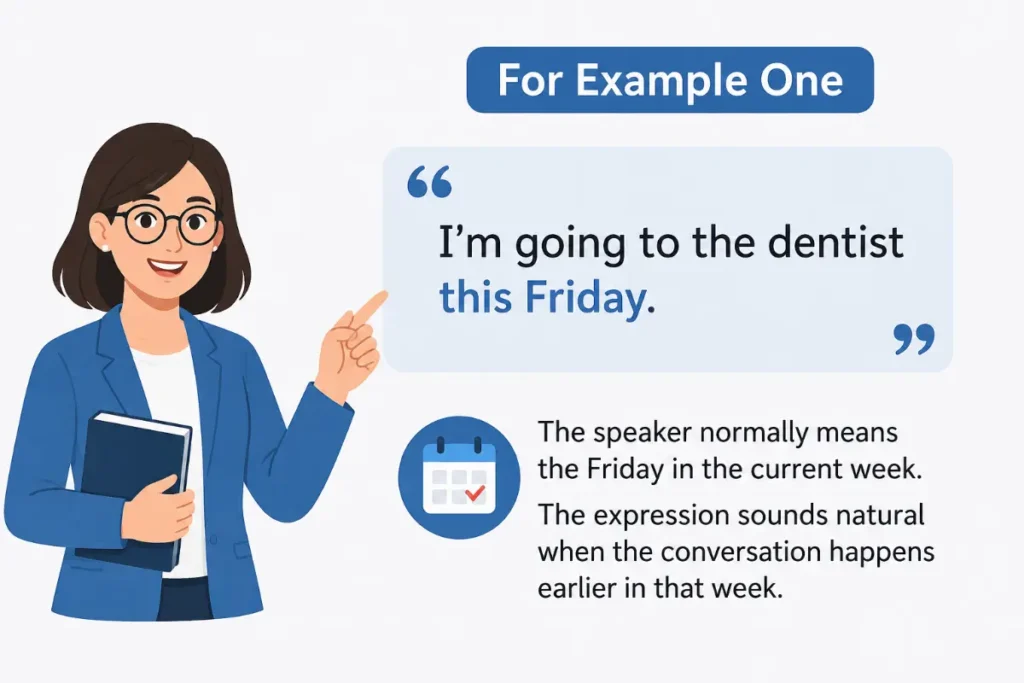
Example One
I’m going to the dentist this Friday.
The speaker normally means the Friday in the current week. The expression sounds natural when the conversation happens earlier in that week.
Example Two
I’m going to the dentist next Friday.
The speaker normally means the Friday after the current week’s Friday.
Example Three
Can you finish the report this Friday.
The speaker is asking for completion by the upcoming Friday associated with the current week.
Example Four
Can you finish the report next Friday.
The speaker normally means the following Friday.
Example Five
Let’s meet this coming Friday.
This expression makes the intended date clearer. It usually means the nearest Friday that has not yet arrived.
Example Six
Let’s meet Friday August 21.
The speaker removes the ambiguity entirely.
Example Seven
We have training this Friday and the final test next Friday.
The contrast makes the timeline especially clear. The first Friday comes before the second Friday.
Example Eight
I’ll be out of town next Friday.
The listener normally understands that the speaker means the Friday after the current week’s Friday.
Example Nine
Are you available Friday.
This can be the clearest option when both people already know which Friday they are discussing.
Example Ten
Do you mean Friday August 21 or Friday August 28.
This is the best response when the original phrase creates uncertainty.
When To Say This Coming Friday
This coming Friday is useful when you mean the nearest future Friday.
It can be clearer than this Friday when the conversation happens late in the week.
For example if today is Sunday you can say.
I’ll see you this coming Friday.
That strongly suggests the Friday that is about to arrive.
You can also say the upcoming Friday.
The two expressions are similar but this coming Friday sounds especially natural in everyday American conversation.
Still the exact date remains the clearest option for formal plans.
When To Say Friday After Next
Friday after next refers to the Friday that comes after next Friday.
Suppose today is Monday.
This Friday is the nearest Friday.
Next Friday is the following Friday.
Friday after next is the Friday after that.
The phrase is useful in conversation but it can sound less precise in formal writing.
If there is any risk of misunderstanding use the calendar date instead.
Is Next Friday Ambiguous
Yes. Next Friday can be ambiguous in some situations.
The ambiguity doesn’t mean the phrase is incorrect. It means speakers can use next from different reference points.
One person may interpret next Friday as the upcoming Friday.
Another may interpret it as the Friday after the upcoming one.
Most of the time context settles the issue. When it doesn’t the date should settle it.
This is a good example of the difference between grammatical correctness and practical clarity.
A sentence can be grammatically correct and still leave the reader unsure about the intended date.
Good writing handles both.
Expert Editor Advice
A professional editor doesn’t judge this Friday and next Friday only by dictionary definitions. The surrounding context matters. In casual American conversation the distinction is usually understood naturally. In business writing the safest practice is to give the exact date when a misunderstanding could cause a problem. If you’re speaking and the listener looks uncertain don’t repeat the same phrase louder or slower. Simply give the date. That is faster and clearer.
Key Takeaways
- This Friday usually means the Friday connected to the current week.
- Next Friday usually means the Friday after the current week’s Friday.
- Next Friday can be interpreted differently by different speakers.
- The ambiguity becomes more noticeable near the end of the week.
- This coming Friday can make the upcoming Friday clearer.
- Friday after next refers to the Friday after next Friday.
- Casual conversation usually provides enough context to understand the intended date.
- Professional communication should use an exact date when timing matters.
- American and British speakers generally follow similar patterns but individual usage can vary.
- The clearest possible choice is often the actual calendar date.
Conclusion
Next Friday vs This Friday can both be correct. The usual American English distinction is simple. This Friday points to the Friday connected with the current week while next Friday normally points to the Friday that follows it. The main complication comes from context because speakers don’t always use next from exactly the same calendar reference point.
For casual conversation the surrounding discussion usually makes the meaning clear. If you’re talking with a friend about weekend plans either expression may work naturally. Near the end of the week however a little extra clarity can save you from an unnecessary misunderstanding. This coming Friday is often useful for the nearest upcoming Friday.
For business emails appointments deadlines travel plans and other important arrangements the best habit is to give the exact date. That small detail turns a potentially fuzzy time expression into a clear plan. When the date matters more than conversational ease always choose precision.
Frequently Asked Questions
What is the difference between this Friday and next Friday?
This Friday usually means the Friday in the current week. Next Friday usually means the Friday after it. The distinction can become less clear near the weekend because speakers may use next to mean the upcoming Friday. Context helps but an exact date is the best way to remove uncertainty.
Is next Friday the same as this Friday?
Usually no. This Friday normally points to the Friday connected to the current week while next Friday normally points to the following Friday. However casual speakers can use next Friday differently. If two people might interpret the phrase differently give the exact date instead of relying on an informal calendar expression.
Which phrase is more correct in American English?
Both phrases are grammatically correct. American English commonly uses this Friday for the Friday in the current week and next Friday for the Friday that follows it. The main issue isn’t correctness. It’s clarity. When a specific date matters use the calendar date so the reader doesn’t have to guess.
Can I say this coming Friday?
Yes. This coming Friday is a natural way to identify the nearest upcoming Friday. It can be especially useful when this Friday might sound unclear because the current week is nearly finished. The phrase is common in everyday American English and works well in casual professional communication too.
What does next Friday mean on Saturday?
On Saturday next Friday usually means the upcoming Friday because the current Friday has already passed. This is one reason speakers often use next Friday naturally during the weekend. Still personal usage can vary. For an important plan say the exact date or use this coming Friday with the date included.
Is Friday after next the same as next Friday?
No. Next Friday usually refers to the Friday following the current week’s Friday. Friday after next refers to the Friday after that. For example if today is Monday and this Friday is August 21 then next Friday is August 28 and Friday after next is September 4.
Should I use next Friday in a business email?
You can use it when the context makes the date completely clear. For important deadlines meetings appointments and schedules an exact date is safer. Instead of saying Please send the document next Friday you can write Please send the document by Friday August 28. The second version leaves no room for calendar confusion.
How can I avoid confusion about Friday dates?
Use the exact date whenever the timing matters. Phrases such as this Friday and next Friday work well in ordinary conversation but can become unclear when messages are read later. You can also say this coming Friday or the Friday after next. A date is still the clearest option for important plans.

Confusing Words, Spelling & Word Choice
Claire Whitmore is a U.S.-based English editor who writes about commonly confused words, spelling differences, and word choice. Her work helps readers understand subtle distinctions between similar-looking words through simple definitions, practical examples, and modern usage guidance in both American and British English.