
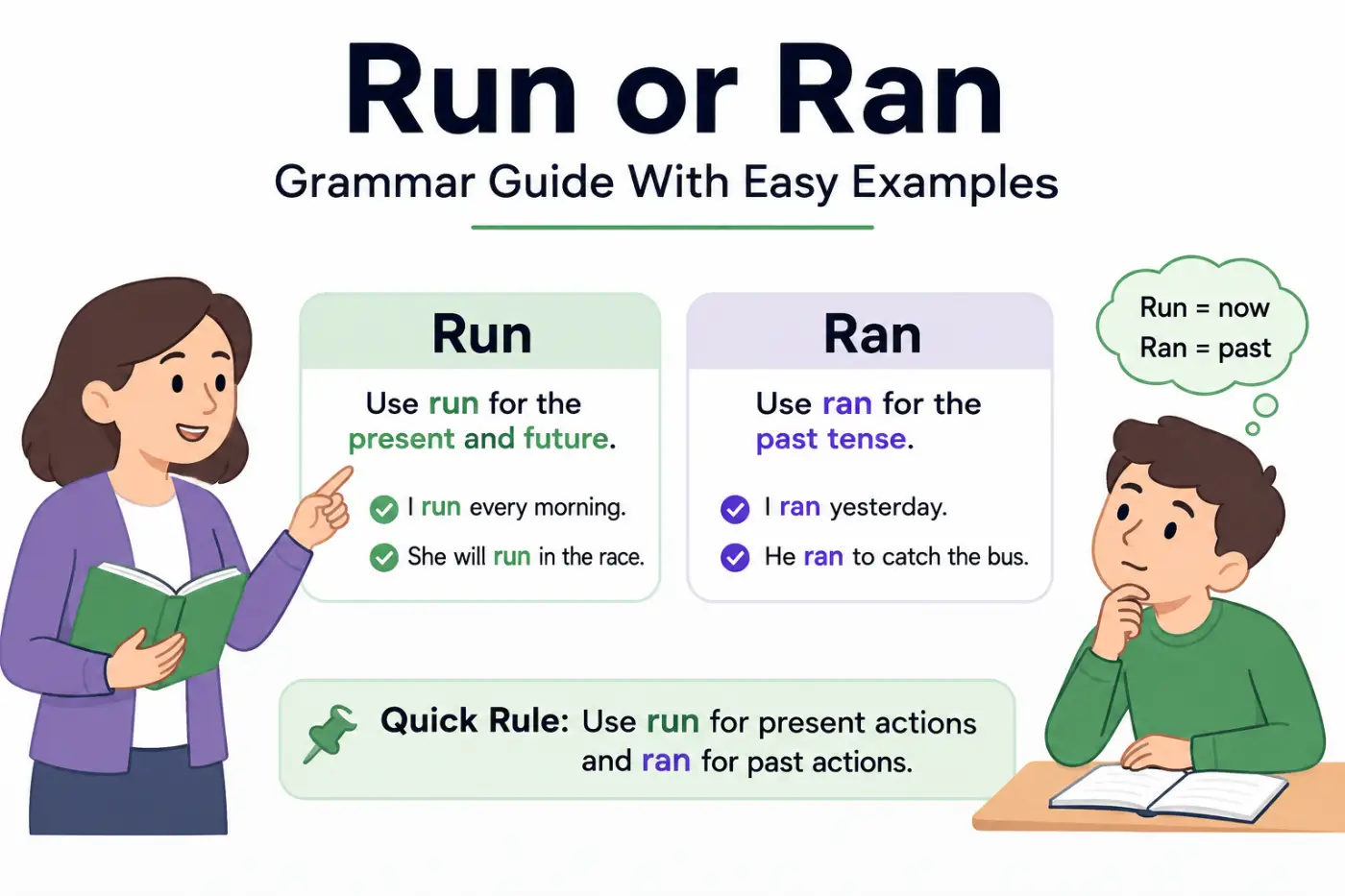
Run or Ran can be confusing because both forms come from the same irregular verb. The key difference is simple. Use ran for the simple past and run as the base form and past participle. For example you can say She ran to the store yesterday but She has run to the store many times.
English has many irregular verbs that don’t follow the usual pattern of adding ed for the past tense. Run changes to ran in the simple past while its past participle stays run. That unusual pattern is one reason learners sometimes mix up the two forms.
The confusion becomes clearer when you look at the helping verb. Use run after words such as have has had can and will. Use ran when you’re describing a completed action in the simple past without a helping verb. Each form has its own grammatical job.
In this guide you’ll learn how to use both forms correctly in everyday American English. You’ll also see clear examples common mistakes pronunciation guidance and simple memory tips that make the difference easier to remember.
Short Answer
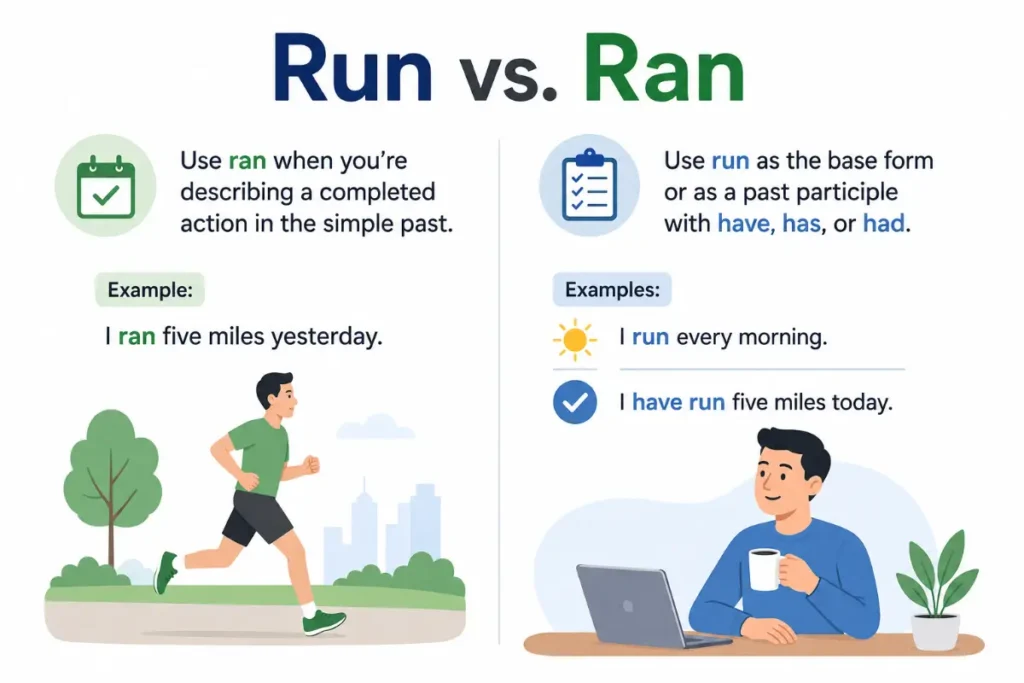
Use ran when you’re describing a completed action in the simple past. For example I ran five miles yesterday. Use run as the base form or as a past participle with have has or had. For example I run every morning and I have run five miles today.
Table Of Contents
- What run means.
- What ran means.
- The main difference between the two forms.
- When to use run.
- When to use ran.
- How helping verbs change the form.
- Comparison table.
- Real life examples.
- Common mistakes.
- Questions with run and ran.
- Memory tips.
- Related grammar notes.
- Frequently asked questions.
- Key takeaways.
- Conclusion.
What Run Means
Run is the base form of the irregular verb run. It can describe movement on foot but it has many other meanings. A person can run a race. A machine can run. A business can run efficiently. Someone can run a program. A person can run for office.
The base form appears after certain words and structures. It is also the form used for the simple present with I you we and they.
Consider these examples.
- I run every morning.
The speaker describes a regular activity. Because the subject is I the base form run is correct.
- They run a small restaurant.
Here run doesn’t mean physical movement. It means manage or operate. The grammar is still the same.
- We need to run before the rain starts.
The word run follows need to. After to the base form is required.
- Please run the report again.
Here run follows the command structure and means execute or process the report.
The word can therefore carry several meanings while keeping the same basic grammatical form.
What Ran Means
Ran is the simple past form of run. It describes an action that happened in the past and is presented as a completed event.
For example.
- I ran five miles yesterday.
The action happened yesterday. The simple past form ran fits the time reference.
- She ran home after school.
The running happened in the past. Ran tells the reader that the action has already happened.
- We ran out of milk this morning.
Here ran is part of the expression ran out of. The phrase means that the supply became empty.
- He ran the company for ten years.
In this sentence ran means managed or operated. It still functions as the simple past form.
A useful point is that ran doesn’t always describe physical movement. The same past tense form can express many meanings of the verb.
The Main Difference Between The Two Forms
The central distinction is tense and grammatical position.
Run can be the base form.
- I run every day.
- They run after work.
- We should run now.
Run can also be the past participle.
- I have run every day this week.
- She has run three races this year.
- They had run five miles before lunch.
Ran is the simple past form.
- I ran yesterday.
- She ran last weekend.
- They ran before breakfast.
The easiest test is to look for a helping verb.
If you see have has or had before the verb then use run rather than ran.
- I have run.
- She has run.
- They had run.
If the sentence simply describes a completed past action without a perfect helping verb then ran is usually the correct form.
- I ran.
- She ran.
- They ran.
Run Or Ran In A Comparison
The difference between Run or Ran becomes much clearer when you place the forms side by side.
| Form | Grammar Role | Typical Use | Example |
|---|---|---|---|
| Run | Base form | Present habits and after certain helping words | I run every morning. |
| Ran | Simple past | Completed past actions | I ran yesterday. |
| Run | Past participle | Present perfect and past perfect | I have run three miles. |
| Running | Present participle | Continuous forms | I am running now. |
The key point is that run has two major grammatical jobs. It works as the base form and as the past participle. Ran has one main job. It marks simple past tense.
That difference is easy to remember once you stop treating the words as interchangeable versions of the same form.
When To Use Run
Use run in the simple present with I you we and they.
- I run before work.
- You run faster than I do.
- We run together on Saturdays.
- They run every afternoon.
With he she and it the simple present usually requires runs.
- She runs every morning.
- He runs a successful store.
- The engine runs smoothly.
Use run after modal verbs.
- I can run fast.
- She will run tomorrow.
- They should run now.
- We might run later.
Use run after do does and did when the auxiliary is carrying the tense.
- I do run every day.
- Does he run regularly.
- Did she run yesterday.
Notice the third example carefully. Even though the action happened in the past the verb after did stays in its base form. You say Did she run. You don’t say Did she ran.
Use run with have has and had as the past participle.
- I have run three races.
- She has run five miles.
- They had run for an hour before the storm arrived.
This is one of the most important rules in the entire topic.
When To Use Ran
Use ran for a completed action in the simple past.
- I ran yesterday.
- She ran home after dinner.
- We ran around the park.
- They ran in the school race.
Time expressions often make the past meaning obvious.
Common examples include yesterday last night last week last year two days ago and in 2024.
- He ran five miles yesterday.
- We ran together last weekend.
- She ran a marathon two years ago.
Ran can also describe past situations that are no longer current.
- My grandfather ran a hardware store.
- She ran the department before moving to another job.
- The old machine ran for twenty years.
Remember that the word does not tell you the meaning by itself. Context determines what run means. Grammar determines which form you need.
How Helping Verbs Change The Form
Helping verbs are one of the fastest ways to choose between run and ran.
After can could may might must shall should will and would use run.
- She can run fast.
- He could run much farther when he was younger.
- They will run tomorrow.
- We should run before it gets dark.
After have has or had use run when you’re forming a perfect tense.
- I have run three miles.
- She has run every day this week.
- They had run for hours before they stopped.
Use run after did.
- Did you run yesterday.
- Did she run in the race.
- Why did they run away.
This rule works because English places tense information in the auxiliary verb in these structures. Once did carries the past tense the main verb returns to its base form.
That is why Did you run is correct while Did you ran is not.
Present Tense Past Tense And Perfect Tense
Understanding the three main patterns makes the whole topic much easier.
Simple Present
Use run for I you we and they.
- I run every morning.
- We run after work.
- They run on weekends.
Use runs with he she and it.
- She runs every morning.
- He runs the business.
- The motor runs quietly.
Simple Past
Use ran for every subject.
- I ran yesterday.
- You ran yesterday.
- She ran yesterday.
- We ran yesterday.
- They ran yesterday.
Unlike the simple present there is no separate form such as runs for different subjects. Ran works with all subjects.
Present Perfect
Use have or has plus run.
- I have run five miles.
- You have run before.
- She has run three races.
- They have run all morning.
Past Perfect
Use had plus run.
- I had run before breakfast.
- She had run five miles before the race ended.
- They had run out of food before help arrived.
The pattern is consistent once you identify the tense.
Real Life Examples
Everyday Conversation
- I ran to the store because I was out of milk.
Ran tells us that the trip happened in the past.
- I run to the store every Saturday.
Run describes a regular habit.
- I’ve run out of coffee.
Here run appears after have and forms the present perfect. The phrase run out of means use all of something.
- She ran upstairs when she heard the noise.
The action is a completed past event.
Work And Business
- She runs a small design company.
Runs means manages or operates.
- She ran the company for five years.
Ran places that management in the past.
- She has run the company since 2021.
Has run connects a past starting point with the present.
- The software runs on most modern computers.
Here run refers to operation rather than physical movement.
Sports
- He runs five miles every morning.
This describes a habit.
- He ran five miles yesterday.
This describes a completed past event.
- He has run five miles every day this week.
The perfect construction connects the activity to the current period.
- She can run a mile in eight minutes.
The modal can requires the base form run.
Common Mistakes
Using Ran After Did
Incorrect: Did you ran yesterday.
Correct: Did you run yesterday.
The word did already carries the past tense. The main verb returns to its base form.
Using Ran After Have
Incorrect: I have ran five miles.
Correct: I have run five miles.
Have requires the past participle. For this verb that form is run.
Using Run For A Completed Past Event
Incorrect: I run five miles yesterday.
Correct: I ran five miles yesterday.
The time expression yesterday clearly places the action in the past.
Using Ran After Can
Incorrect: She can ran very fast.
Correct: She can run very fast.
Modal verbs take the base form.
Confusing Ran With Running
Incorrect: I am ran to the store.
Correct: I am running to the store.
The continuous form requires running after am is or are.
These mistakes are common because English has several forms of the same irregular verb. The solution isn’t memorizing random sentences. Learn the grammatical pattern behind each form.
Why Irregular Verbs Cause Confusion
Regular English verbs usually form the simple past by adding ed.
Walk becomes walked.
Jump becomes jumped.
Clean becomes cleaned.
Run doesn’t follow that pattern.
Run becomes ran in the simple past.
This makes it an irregular verb. Its past participle returns to run rather than keeping the past form ran.
That gives you this pattern.
- Base form: run.
- Simple past: ran.
- Past participle: run.
- Present participle: running.
- Third person singular present: runs.
The pattern looks unusual at first but it becomes familiar with practice.
Pronunciation Guide
Run and ran don’t sound the same.
Run is commonly pronounced /rʌn/. The vowel sound is similar to the sound in sun and fun.
Ran is commonly pronounced /ræn/. The vowel is similar to the sound in man and hand.
The distinction matters in spoken English because the vowel tells listeners which verb form you’re using.
Try saying these pairs aloud.
- run and sun.
- ran and man.
- run and fun.
- ran and hand.
Don’t stretch the vowel in run into the sound used in ran. American English keeps a clear difference between these forms.
The past participle run has the same basic pronunciation as the base form. So I run and I have run use the same pronunciation for run.

Run And Ran In American English
American English follows the same basic grammar rule found throughout standard English.
Use ran for simple past.
Use run after have has and had.
There isn’t a special American rule that changes these forms. You may hear differences in pronunciation and regional speech patterns but standard written grammar keeps the distinction clear.
This matters when writing emails school assignments reports resumes and professional documents. Informal speech can sometimes blur grammatical boundaries but formal writing should keep the standard forms.
Run And Ran In British English
British English uses the same basic distinction.
A British writer would normally say I ran yesterday and I have run today.
The forms don’t change simply because the variety of English changes. Regional vocabulary can differ between American and British English but this particular verb pattern is broadly shared.
Canadian Australian and New Zealand English also follow the same standard pattern.
Different Meanings Of Run
Run is an unusually flexible English verb. It doesn’t only mean moving quickly on foot.
Physical Movement
She runs every morning.
Operating A Machine
The engine runs smoothly.
Managing A Business
He runs a restaurant.
Organizing An Event
They run a yearly charity event.
Competing For Office
She plans to run for mayor.
Continuing
The show runs for two hours.
Flowing
Water runs down the hill.
Becoming Unavailable
We ran out of sugar.
The past form ran can carry these meanings too.
- She ran the restaurant for ten years.
- The engine ran all night.
- The show ran for three seasons.
- Water ran down the street.
- We ran out of time.
Context does the heavy lifting when determining meaning.
Run In Common Expressions
Several everyday expressions use run.
Run Out Of
This means use all of something.
We ran out of gas.
Run Into
This can mean meet someone unexpectedly or encounter a problem.
I ran into an old friend yesterday.
Run Away
This means leave quickly or escape.
The dog ran away.
Run Across
This can mean find something unexpectedly.
I ran across an interesting article.
Run Through
This can mean review or examine something quickly.
Let’s run through the plan again.
Notice how the past form changes to ran when the entire expression describes a simple past event.
I ran into Sarah yesterday.
I have run into Sarah several times.
The first sentence uses simple past. The second uses present perfect.
Memory Tips
A simple memory trick can save you from many errors.
Think of three main forms.
- Today: run.
- Yesterday: ran.
- Have or had: run.
You can remember the pattern with this sentence.
I run today.
I ran yesterday.
That one sequence captures the core grammar.
Another useful trick is to associate ran with a finished past event. If you can naturally add yesterday last week or two hours ago then ran may be the form you need.
If have has had did or a modal verb appears before the verb then check the structure carefully. In many cases those words tell you that run is required.
Related Grammar Notes
Do And Does
After do and does use run.
- Do you run every day.
- Does she run every morning.
The auxiliary carries the grammatical information.
Did
After did use run.
- Did you run yesterday.
- Why did he run away.
Never add the simple past form after did.
Have Has And Had
After these perfect auxiliaries use run.
- I have run.
- She has run.
- They had run.
Am Is And Are
For an action happening around the present moment use running.
- I am running.
- She is running.
- They are running.
This gives you a useful four form pattern.
Run.
Ran.
Run.
Running.
Runs.
The exact form depends on the tense and sentence structure.
Formal And Informal Usage
The verb run is completely standard in formal English. It appears in academic writing business writing journalism technical documents and everyday speech.
The informal issue usually comes from expressions rather than the verb itself.
For example a business report might say The organization operates three facilities rather than The organization runs three facilities. Both can be grammatically correct but operates may sound more formal.
In ordinary professional writing run is still perfectly acceptable.
The important thing is grammatical accuracy. Using ran after have or using run after a simple past time marker can make polished writing look careless.
Professional Writing Tip
When editing a sentence don’t choose the verb form based only on the word that comes before it. First identify the tense.
Ask three questions.
- Is this a regular or current action.
- Is this a completed simple past action.
- Is this a perfect construction using have has or had.
If the answer to the second question is yes use ran.
If the sentence uses have has or had as a perfect auxiliary use run.
This approach is more reliable than trying to memorize every possible sentence.
How To Explain The Difference To A Student
A simple classroom explanation works well.
Tell the student that run has an unusual past pattern.
The present form is run.
The simple past form is ran.
The past participle is run.
Then give three sentences.
- I run every day.
- I ran yesterday.
- I have run this week.
Ask the student to identify the time and helping verb in each sentence.
This turns a confusing spelling question into a clear grammar pattern.
Key Takeaways
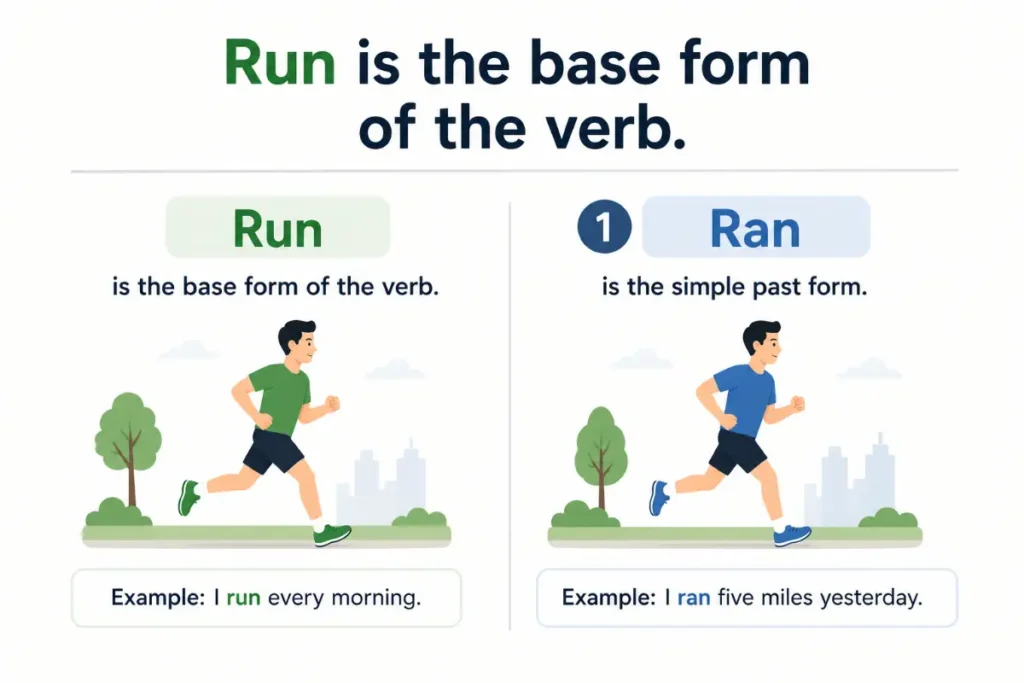
- Run is the base form of the verb.
- Ran is the simple past form.
- Run is also the past participle.
- Use ran for a completed simple past action.
- Use run after have has and had.
- Use run after modal verbs such as can should and will.
- Use run after did.
- Use running after am is and are for continuous actions.
- The pronunciation of run and ran is different.
- The same verb can mean physical movement management operation continuation or many other things depending on context.
Conclusion
The difference between Run or Ran comes down to one central grammar rule. Use ran for the simple past and use run as the base form or past participle. Say I ran yesterday but I have run today. Say She runs every morning but She can run faster. Once you recognize the tense the correct form becomes much easier to choose.
The most common mistakes happen after helping verbs. Remember that did takes the base form so you say Did you run. Have has and had take the past participle so you say I have run and She had run. Ran stands on its own as the simple past form.
A practical memory trick is simple. Run today. Ran yesterday. Have run before. Keep that pattern in mind and you’ll avoid most errors with this irregular verb. The forms may look tricky at first but the rule is consistent once you see how English uses each form.
Frequently Asked Questions
Is run the present tense and ran the past tense?
Yes. Run is the base form and is used in the simple present with I you we and they. Ran is the simple past form. For example I run every morning describes a habit while I ran yesterday describes a completed action. Run also serves as the past participle after have has and had.
Can I say I have ran?
No. In standard English the correct form is I have run. The word have requires the past participle and the past participle of run is run. Ran is the simple past form. Compare I ran yesterday with I have run today. The helping verb determines which form belongs in the sentence.
Is I ran yesterday correct?
Yes. I ran yesterday is completely correct. Yesterday identifies a completed past time so the simple past form ran is appropriate. You could also say I ran five miles yesterday or I ran to the store yesterday. The word ran clearly places the action in the past.
Is I have run correct?
Yes. I have run is correct because run is the past participle used with have. The present perfect can describe an experience or an action connected to the present. For example I have run three races this year tells us that the experience has occurred during the current period.
Why can’t I say did you ran?
After did you need the base form of the verb. The correct sentence is Did you run. Did already marks the sentence as past tense so adding ran would mark the past twice. The same rule applies to other verbs. You say Did you go rather than Did you went.
What is the past participle of run?
The past participle is run. The three key forms are run for the base form ran for simple past and run for the past participle. You use the participle with have has or had. Examples include I have run and she has run and they had run.
Can ran be used with every subject?
Yes. Ran is the same simple past form for all subjects. You say I ran you ran he ran she ran we ran and they ran. Unlike the simple present where he and she take runs the simple past doesn’t change according to the subject.
Is run an irregular verb?
Yes. Run is an irregular verb because its simple past and past participle forms don’t follow the regular ed pattern. The simple past is ran while the past participle is run. Learning these three forms together makes the verb much easier to use accurately.

English Grammar & Usage
Nathan Holloway is an American grammar writer and language researcher who specializes in English grammar, sentence structure, verb usage, and common writing mistakes. He enjoys breaking down confusing grammar rules into practical explanations with clear examples, making English easier for students, professionals, and everyday writers.