
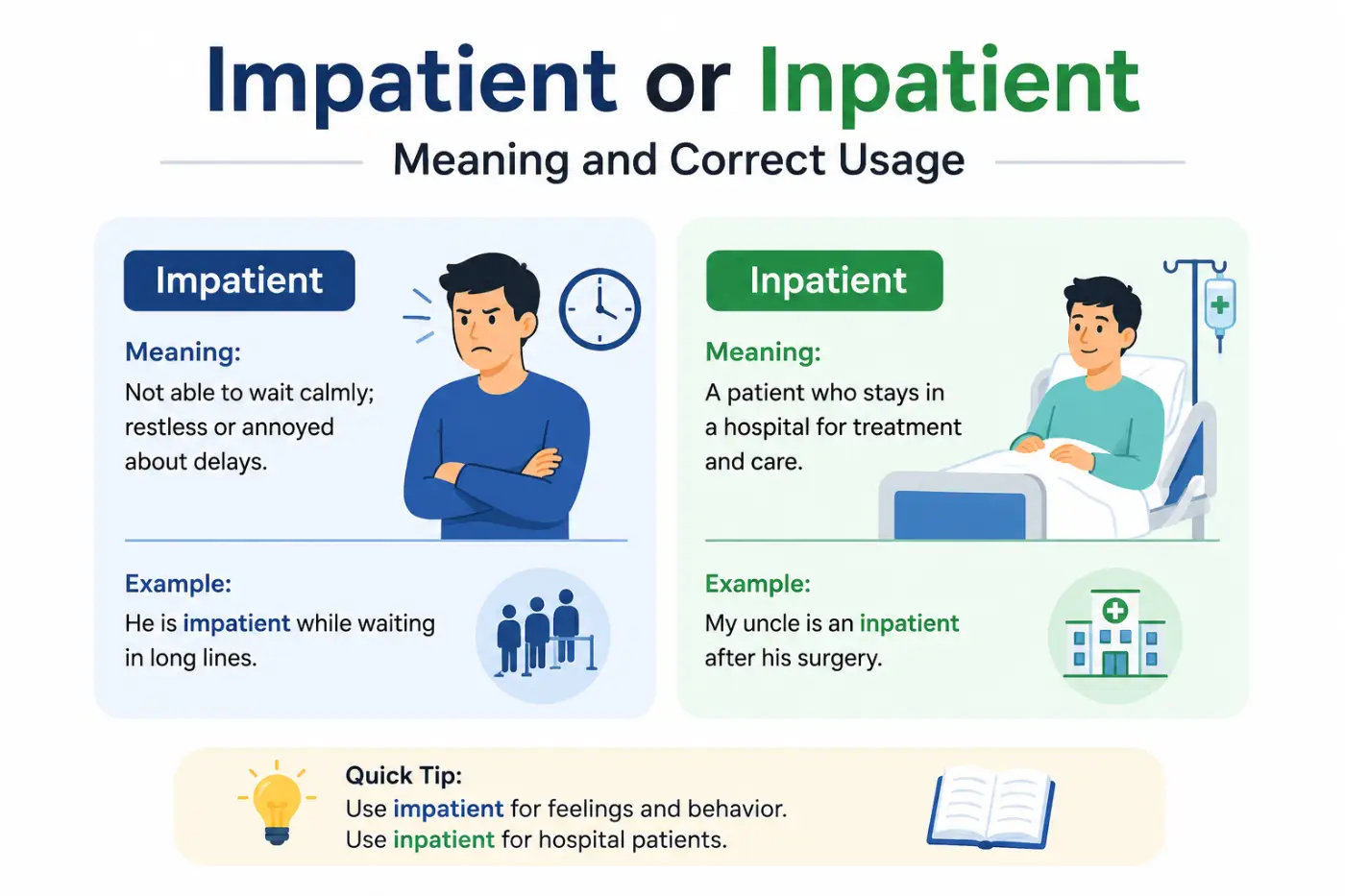
Impatient or inpatient can cause confusion because the two words share the same base word and differ by only one letter. Yet that small spelling difference changes the meaning completely. One describes a person who struggles to wait calmly. The other describes a patient who stays in a hospital or healthcare facility for treatment.
The easiest way to remember the difference is to focus on the first part of each word. Impatient contains the prefix im which gives the word a negative meaning. An impatient person lacks patience. Inpatient contains in and describes someone who is in a hospital or healthcare facility for treatment.
This distinction matters in everyday English as well as professional writing. Saying that someone is impatient describes their behavior or attitude. Calling someone an inpatient describes their medical status. In this guide you’ll learn the meanings pronunciation grammar rules examples common mistakes word origins and practical memory tricks that make the difference easy to remember.
Short Answer
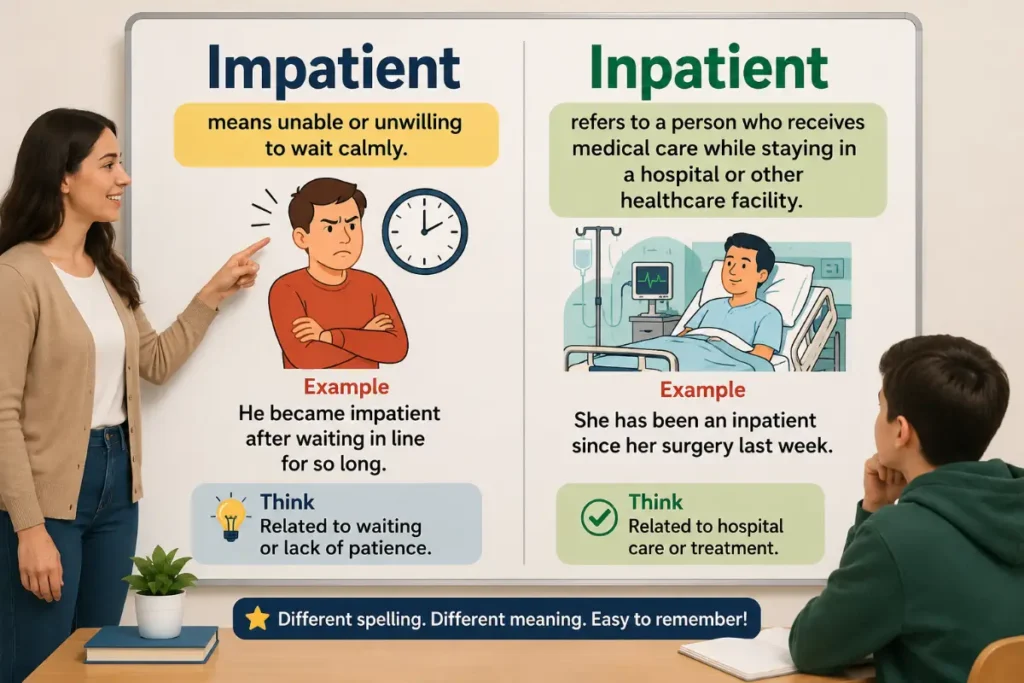
Impatient means unable or unwilling to wait calmly. Inpatient refers to a person who receives medical care while staying in a hospital or other healthcare facility. The words look and sound similar because they share the word patient. Their meanings are completely different. Use impatient for a lack of patience and inpatient for someone admitted for medical treatment.
Table Of Contents
- The Quick Difference.
- What Impatient Means.
- What Inpatient Means.
- Impatient or Inpatient Explained.
- Comparison Table.
- How The Words Are Pronounced.
- Why These Words Get Confused.
- Grammar And Part Of Speech.
- How To Use Impatient Correctly.
- How To Use Inpatient Correctly.
- Real Life Sentence Examples.
- Common Mistakes.
- Memory Tricks.
- Formal And Professional Usage.
- American English Usage.
- Word Origins.
- Related Words And Expressions.
- Expert Editor Tips.
- Frequently Asked Questions.
- Key Takeaways.
- Conclusion.
The Quick Difference
Impatient describes someone who doesn’t want to wait or who becomes annoyed by delay.
Inpatient describes someone who receives medical treatment while staying inside a hospital or another healthcare facility.
Consider these two sentences.
- Maria became impatient after waiting for an hour.
- Maria was admitted as an inpatient for treatment.
The first sentence describes Maria’s attitude. The second describes her healthcare status.
That single distinction solves most confusion between the two words.
What Impatient Means
Impatient is an adjective. It describes a person who finds waiting difficult or who wants something to happen immediately.
An impatient person may become irritated when a line moves slowly. They may dislike delays. They may interrupt someone because they don’t want to wait for the conversation to finish.
For example.
- The customer became impatient after waiting twenty minutes.
This sentence describes the customer’s reaction to the delay.
- My son is getting impatient because dinner isn’t ready.
Here impatient describes frustration caused by waiting.
The word can also describe someone who wants action or results quickly. The person doesn’t necessarily have to be angry. They may simply feel restless or eager for something to happen.
For example.
- The students were impatient to hear the results.
- She was impatient for the meeting to begin.
In these examples the word communicates eagerness and a lack of willingness to wait.
Impatient can also describe actions or attitudes that show a lack of patience.
- He gave an impatient sigh.
- She made an impatient gesture toward the door.
The word remains an adjective even when it describes a person’s behavior rather than the person directly.
What Inpatient Means
Inpatient is usually a noun in healthcare. It refers to a person who has been admitted to a hospital or healthcare facility and stays there while receiving treatment.
For example.
- The hospital admitted twelve inpatients overnight.
- The inpatient received treatment from several members of the medical team.
Inpatient can also function as an adjective.
- The hospital has an inpatient unit.
- She received inpatient treatment.
- The doctor recommended inpatient care.
In these examples inpatient describes something connected with treatment that involves staying at a healthcare facility.
The central idea is admission and residence for care. An inpatient generally stays at the facility rather than simply arriving for an appointment and leaving afterward.
This creates a useful contrast with outpatient. An outpatient receives medical care without being admitted for an overnight or extended stay.
For example.
- The patient received outpatient treatment and went home afterward.
- The patient was admitted for inpatient treatment.
Healthcare professionals use these terms because they provide a concise way to distinguish different types of care.
Impatient or Inpatient Explained
The difference between impatient and inpatient becomes much easier when you separate their meanings.
Impatient relates to patience.
Inpatient relates to medical admission.
The words aren’t interchangeable.
You could say.
- The child became impatient while waiting for the doctor.
Here the child is frustrated by waiting.
You could also say.
- The child became an inpatient after being admitted to the hospital.
Here the word describes the child’s healthcare status.
The first word concerns behavior. The second concerns medical care.
That distinction is especially important in healthcare communication. A spelling mistake can change the meaning of a sentence in a way that sounds strange or even misleading.
Imagine writing that a hospital treated an impatient last night when you mean a person receiving inpatient care. The sentence would suggest that the hospital treated someone who was annoyed rather than someone admitted for medical treatment.
Comparison Table
| Feature | Impatient | Inpatient |
|---|---|---|
| Main meaning | Unable or unwilling to wait calmly | Person receiving care while staying at a healthcare facility |
| Common part of speech | Adjective | Noun and adjective |
| Main context | Behavior feelings waiting and attitude | Healthcare medicine and hospital care |
| Related word | Patience | Patient |
| Opposite or contrast | Patient | Outpatient |
| Pronunciation | im PAY shunt | IN pay shunt |
| Example | He became impatient during the delay. | The inpatient received treatment overnight. |
| Formality | Common in everyday and formal English | Common in medical and professional English |
How The Words Are Pronounced
The pronunciation difference is subtle enough to cause confusion when you’re listening rather than reading.
Impatient is commonly pronounced approximately as:
/ɪmˈpeɪʃənt/
A simple pronunciation guide is:
im PAY shunt.
The strongest stress falls on the second syllable.
Inpatient is commonly pronounced approximately as:
/ˈɪnˌpeɪʃənt/
A simple pronunciation guide is:
IN pay shunt.
The first syllable receives the stronger stress.
The middle sound in both words comes from patient. The main difference appears at the beginning.
When people speak quickly the distinction can become less obvious. That helps explain why the words are sometimes confused in speech and later misspelled in writing.
A useful listening trick is to focus on the first syllable. If the speaker is describing someone’s attitude toward waiting the intended word is probably impatient. If the conversation involves hospital admission and treatment the intended word is probably inpatient.
Why These Words Get Confused
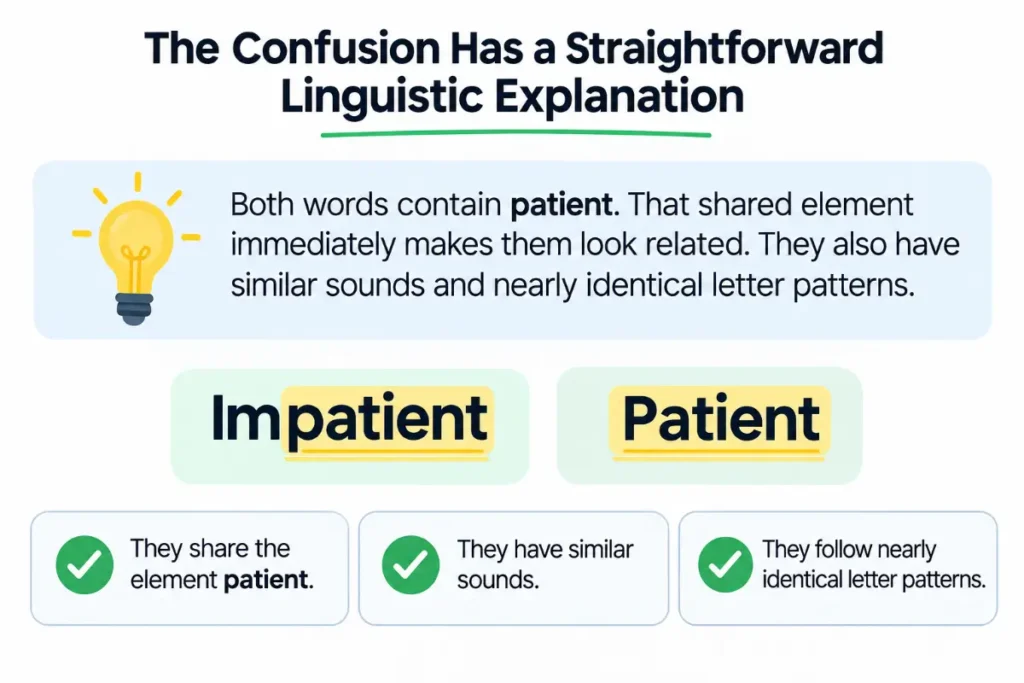
The confusion has a straightforward linguistic explanation. Both words contain patient. That shared element immediately makes them look related. They also have similar sounds and nearly identical letter patterns.
There is another reason the confusion persists. The word patient itself has more than one important meaning. Patient can describe someone who receives medical care. It can also describe someone who can wait calmly without becoming annoyed.
Those two meanings developed along different historical paths. Modern English uses the same spelling for both.
That creates an interesting connection.
- A patient can receive medical treatment.
- A patient person can wait calmly.
- An impatient person lacks patience.
- An inpatient is a person receiving treatment while staying at a healthcare facility.
The prefixes help separate the modern meanings.
The prefix im often expresses negation in English. Impatient therefore relates to a lack of patience. The word inpatient uses in to suggest being inside a healthcare setting. This isn’t a perfect word building rule for every English word but it provides a useful memory aid for this pair.
Grammar And Part Of Speech
Impatient is an adjective.
It normally describes a noun or pronoun.
- The impatient customer complained.
- She became impatient.
- They seemed impatient with the delay.
It can appear after linking verbs such as become seem feel look and appear.
- He felt impatient.
- She looked impatient.
- The audience became impatient.
Inpatient can work as both a noun and an adjective.
As a noun it refers to a person.
- The inpatient was moved to another room.
As an adjective it describes something related to treatment involving a hospital stay.
- The doctor discussed inpatient care.
- The facility provides inpatient services.
This grammatical difference is useful because it can help you recognize the intended word before you even consider its spelling.
How To Use Impatient Correctly
Use impatient when the sentence concerns waiting frustration delay eagerness or a lack of patience.
Here are several common patterns.
Impatient With
Use impatient with when someone becomes annoyed by a person situation or delay.
- She became impatient with the slow service.
- He was impatient with his younger brother.
- The teacher grew impatient with repeated interruptions.
Impatient For
Use impatient for when someone eagerly wants something to happen.
- The children were impatient for summer vacation.
- She was impatient for the results.
- He was impatient for his turn.
Impatient To
Use impatient to before a verb when someone strongly wants to do something.
- The team was impatient to begin.
- She was impatient to see the final design.
- He was impatient to return home.
These patterns give you a practical way to use the word naturally rather than simply memorizing its definition.
How To Use Inpatient Correctly
Use inpatient in medical contexts.
As a noun it identifies a person who has been admitted for treatment.
- The inpatient was transferred to another department.
- Each inpatient received an identification bracelet.
As an adjective it describes healthcare services or treatment involving admission.
- The doctor recommended inpatient treatment.
- The hospital expanded its inpatient capacity.
- The patient needed inpatient rehabilitation.
The word commonly appears alongside terms such as care treatment unit services facility admission rehabilitation and psychiatric care.
The exact services associated with inpatient treatment vary by medical setting. The central concept remains the same: the person receives care while staying at the healthcare facility.
Real Life Sentence Examples
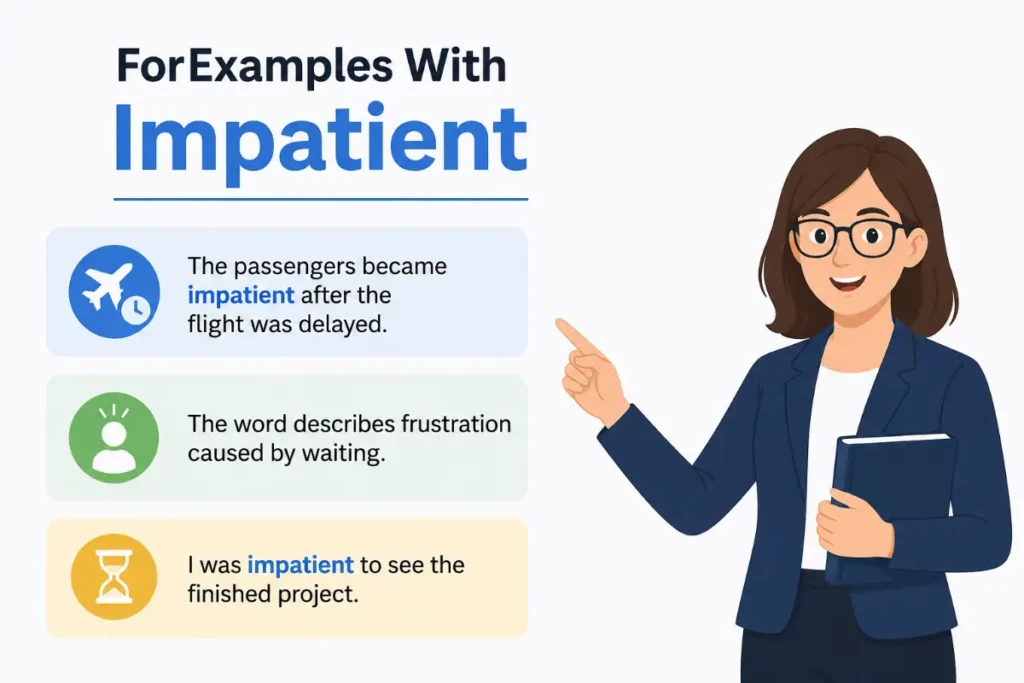
Examples With Impatient
- The passengers became impatient after the flight was delayed.
The word describes frustration caused by waiting.
- I was impatient to see the finished project.
Here the word expresses strong eagerness.
- Don’t get impatient with the children.
The sentence describes an attitude toward other people.
- She gave an impatient glance at the clock.
The adjective describes a gesture that communicates frustration.
- The manager sounded impatient during the call.
The word describes the manager’s tone.
Examples With Inpatient
- The hospital admitted the patient as an inpatient.
The word identifies the person’s medical status.
- He received inpatient treatment for several days.
Here inpatient describes the type of treatment.
- The facility has a separate inpatient unit.
The adjective describes the unit.
- The doctor discussed inpatient rehabilitation with the family.
The word identifies rehabilitation that involves staying at a facility.
- The inpatient care team reviewed the treatment plan.
Here the adjective describes the type of care.
Common Mistakes
Using Inpatient To Mean Impatient
This is one of the most common errors.
Incorrect meaning.
The customer was inpatient because the line was long.
The intended word is impatient because the customer doesn’t want to wait.
Correct.
The customer was impatient because the line was long.
Using Impatient For Hospital Care
Another mistake happens when writers reverse the words.
Incorrect.
The patient was transferred to an impatient unit.
Correct.
The patient was transferred to an inpatient unit.
The unit provides care for people who stay at the facility.
Confusing Patient With Both Words
Patient is the shared base that causes much of the confusion. Remember that patient has its own meanings.
A patient can be a person receiving medical care.
A patient person can also be someone who waits calmly.
Impatient means lacking patience.
Inpatient refers to medical care involving admission.
Assuming The Prefixes Always Work The Same Way
The memory trick involving im and in is useful but shouldn’t be treated as a universal rule for English. Prefixes can behave differently across words because English has borrowed vocabulary from several languages and developed many spelling patterns over time.
Use the prefix trick as a memory aid rather than as a complete linguistic rule.
Choosing The Wrong Word In Professional Writing
Healthcare writing requires precision. Confusing impatient with inpatient can create an obvious semantic error.
When you’re editing medical content always check the surrounding nouns and verbs. Words such as admission unit treatment services and care strongly suggest inpatient. Words such as waiting frustration annoyed eager and delay point toward impatient.
Memory Tips
A simple memory trick can make this distinction stick.
Think of impatient as impatient with waiting.
The word describes a person who doesn’t want to wait.
Think of inpatient as someone in care.
The word refers to someone staying in a healthcare setting for treatment.
Another trick is to connect each word with a familiar contrast.
- Impatient versus patient.
- Inpatient versus outpatient.
The first pair concerns patience.
The second pair concerns healthcare.
You can also create a mental picture.
Imagine someone tapping their fingers while waiting for a bus. That person is impatient.
Now picture someone staying in a hospital room for treatment. That person is an inpatient.
The two images are completely different. Once you connect each word with its own mental picture the spelling becomes much easier to recall.
Formal And Professional Usage
Impatient is perfectly acceptable in professional writing when you are describing behavior or attitude.
For example.
- The customer became impatient after several delays.
- The committee appeared impatient with the repeated questions.
The word doesn’t sound informal. Its meaning simply needs to fit the context.
Inpatient is especially common in medical and healthcare writing.
You may encounter phrases such as inpatient care inpatient treatment inpatient admission inpatient services and inpatient rehabilitation.
These expressions are standard professional terminology.
One useful editing principle is to avoid replacing a precise healthcare term with a vague phrase. If you need to distinguish hospital based treatment from treatment that doesn’t require admission then inpatient provides useful precision.
At the same time don’t use inpatient simply because the sentence involves a hospital. A person can visit a hospital as an outpatient. The context must involve admission or care as an admitted patient.
American English Usage
Both words are standard in American English.
Impatient appears throughout everyday speech professional writing journalism fiction and academic prose.
Inpatient is especially common in healthcare settings. American medical writing frequently contrasts inpatient care with outpatient care.
The distinction is stable and doesn’t depend on regional slang.
American speakers may pronounce the two words quickly enough that the opening syllable becomes difficult to hear. In writing however the difference is clear and meaningful.
For American readers the safest approach is simple. Use impatient for a lack of patience. Use inpatient for medical care involving admission.
Word Origins
The history of these words becomes clearer when you look at patient. Patient comes through Old French from Latin patientem which relates to the idea of suffering or enduring. The Latin root is connected with the verb pati meaning to suffer or endure.
Over time English developed the familiar sense of patient as someone able to endure difficulty or delay calmly. The medical sense developed from the same broader idea of someone undergoing or enduring medical treatment. English eventually used patient as the standard noun for someone receiving medical care.
Impatient developed by adding a negative prefix to patient. The resulting word describes someone who lacks patience.
Inpatient developed in the medical vocabulary to distinguish people receiving care while staying in a healthcare institution from those receiving care without admission. The shared history explains why the words look so similar today. Their meanings separated through different uses even though patient remains visible inside both.
Related Words And Expressions
Understanding nearby words can strengthen your grasp of the distinction.
Patient
Patient can describe someone receiving medical care or someone who can wait calmly.
- The patient spoke with the nurse.
- She is patient with young children.
Patience
Patience is the ability to remain calm while waiting or dealing with difficulty.
- Learning a new language requires patience.
Impatience
Impatience is the state of lacking patience.
- His impatience became obvious after the delay.
Outpatient
An outpatient receives medical care without being admitted for an extended stay.
- The procedure was performed on an outpatient basis.
Hospitalized
Hospitalized means admitted to a hospital for treatment.
- She was hospitalized after the accident.
Admission
Admission refers to the process of accepting someone into a healthcare facility for treatment.
- The doctor recommended hospital admission.
These words form a useful semantic network. Once you understand the relationship among them the distinction becomes much easier to apply.
Impatient And Inpatient In Everyday Writing
Most people encounter impatient far more often in everyday conversations.
You might say.
- I’m getting impatient.
- Don’t be impatient.
- He was impatient with the delay.
- She seemed impatient to leave.
These expressions are ordinary parts of conversational English. Inpatient appears more often in healthcare conversations.
You might hear.
- The doctor wants to keep her as an inpatient.
- He needs inpatient care.
- The hospital has limited inpatient beds.
- She moved from inpatient care to outpatient treatment.
The context usually gives you a strong clue.
A conversation about traffic waiting customer service school queues or delays points toward impatient.
A conversation about admission treatment hospital rooms rehabilitation or healthcare services points toward inpatient.
Impatient And Inpatient In Editing
Professional editors often catch these words by examining the sentence around them rather than looking at spelling alone.
Suppose you see this sentence.
The hospital increased its impatient capacity.
The noun capacity immediately suggests a healthcare service. That makes inpatient the likely intended word.
Now consider this sentence.
The audience became inpatient after waiting forty minutes.
The phrase became and the reference to waiting indicate an emotional state. Impatient is clearly intended.
This is a useful example of contextual editing. A spelling checker may identify the unusual word but a skilled editor also asks what the sentence means.
That approach matters because English contains many words that are close in spelling but far apart in meaning. Context often provides the strongest clue.
Expert Editor Tips
One reliable way to proofread these words is to replace them mentally with a longer phrase. Replace impatient with not willing to wait calmly.
Replace inpatient with a person staying in a healthcare facility for treatment. If the longer phrase fits the sentence then the shorter word probably does too.
For example.
The customer was not willing to wait calmly.
That clearly points to impatient.
The person staying in a healthcare facility for treatment.
That clearly points to inpatient.
Another useful technique is to look at the noun after the word.
Phrases such as impatient customer impatient child impatient driver and impatient response usually concern behavior.
Phrases such as inpatient unit inpatient treatment inpatient care and inpatient services belong to healthcare. This kind of context based editing is more reliable than trying to memorize isolated spellings.
Key Takeaways
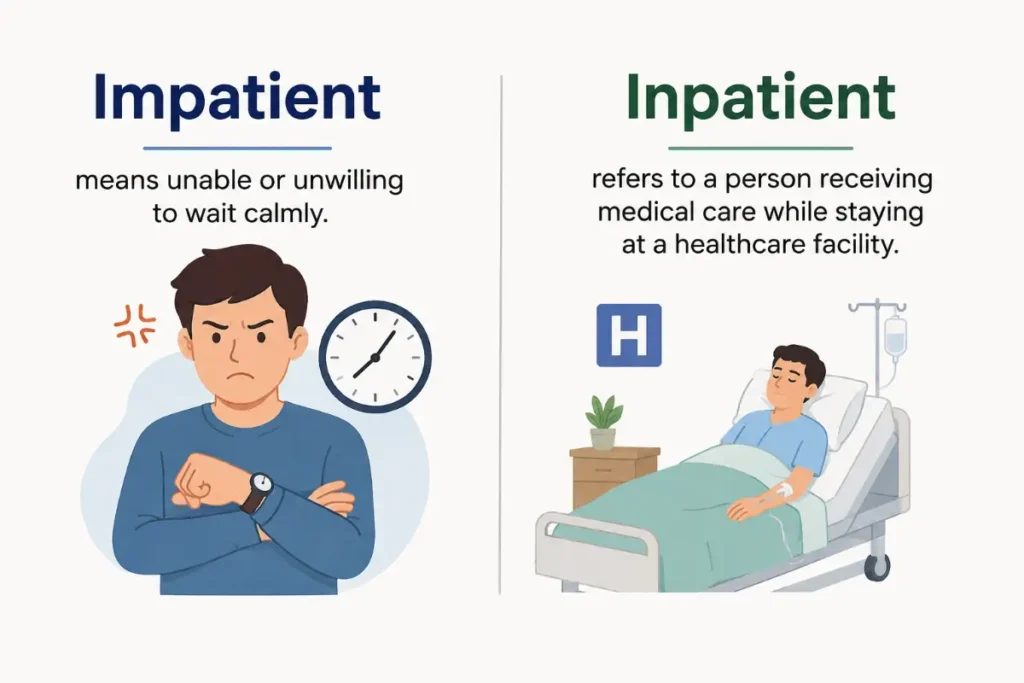
- Impatient means unable or unwilling to wait calmly.
- Inpatient refers to a person receiving medical care while staying at a healthcare facility.
- Impatient is an adjective.
- Inpatient can be a noun or an adjective.
- Patient is the shared word inside both terms.
- Impatient relates to patience and waiting.
- Inpatient relates to medical admission and treatment.
- Outpatient is the common healthcare contrast with inpatient.
- Context usually reveals which word belongs in a sentence.
- Professional and medical writing should use these terms carefully because the meanings are very different.
Conclusion
Impatient or inpatient becomes easy to distinguish once you connect each word with its core meaning. Impatient describes someone who doesn’t want to wait calmly or who becomes frustrated by delay. Inpatient describes someone receiving medical care while staying at a healthcare facility. The shared word patient makes the spellings look closely related but the meanings point in different directions.
Think about the situation before choosing the word. Waiting frustration eagerness and delays point toward impatient. Hospital admission treatment medical units and residential care point toward inpatient. The contrast with outpatient can also help you remember the medical meaning.
A simple memory trick can save you from the mistake. Think impatient means lacking patience and inpatient means in medical care. Once that connection becomes familiar the difference should feel as natural as the words themselves.
Frequently Asked Questions
What is the difference between impatient and inpatient?
Impatient means unable or unwilling to wait calmly. Inpatient refers to a person receiving medical care while staying at a hospital or healthcare facility. The words share patient but have different meanings. A customer can be impatient because of a long wait. A person admitted to a hospital can be an inpatient.
Is impatient related to patient?
Yes. Impatient is formed from patient with a negative prefix. Patient can describe someone who waits calmly. Impatient describes someone who lacks that patience. Patient also has a separate medical meaning for someone receiving healthcare. That shared word helps explain why impatient and inpatient look so similar even though their meanings differ.
Is inpatient a noun or an adjective?
Inpatient can be both a noun and an adjective. As a noun it refers to a person admitted to a healthcare facility for treatment. As an adjective it describes care services units treatment or other medical matters connected with inpatient admission. For example inpatient care is an adjective phrase while the inpatient identifies a person.
What is the opposite of inpatient?
The usual contrasting term is outpatient. An inpatient receives care while staying at a healthcare facility. An outpatient receives care without being admitted for an extended stay. These terms are widely used in healthcare settings to distinguish two different types of treatment arrangements.
Can impatient describe something other than a person?
Yes. Impatient usually describes people but it can also describe behavior expressions actions or attitudes associated with a lack of patience. You can write impatient tone impatient gesture or impatient response. The word still communicates a sense of frustration eagerness or unwillingness to wait.
How do you pronounce impatient?
Impatient is commonly pronounced approximately as im PAY shunt with the strongest stress on the second syllable. Its IPA pronunciation is /ɪmˈpeɪʃənt/. The word contains three syllables. The pronunciation resembles patient with the im sound added at the beginning.
How do you pronounce inpatient?
Inpatient is commonly pronounced approximately as IN pay shunt. Its IPA pronunciation is /ˈɪnˌpeɪʃənt/. The first syllable receives the strongest stress. The word is built from in and patient in its modern healthcare sense.
Can a hospital patient be impatient and inpatient?
Yes. A person can be both at the same time. For example an inpatient may become impatient because treatment is taking longer than expected. In that sentence inpatient describes the person’s healthcare status while impatient describes the person’s emotional reaction. The two words can therefore appear naturally in the same context.
Which word should I use in medical writing?
Use inpatient when you mean a person receiving care while staying at a healthcare facility or something related to that type of care. Use impatient only when you mean a lack of patience. Medical writing needs precise terminology because confusing the two words can change the meaning of a sentence.
Is inpatient the same as hospitalized?
They are closely related but not always identical in every context. Inpatient specifically describes someone admitted for care and can also describe the type of care or facility service. Hospitalized means admitted to a hospital. The terms often overlap but their grammatical uses and precise contexts can differ.

English Grammar & Usage
Nathan Holloway is an American grammar writer and language researcher who specializes in English grammar, sentence structure, verb usage, and common writing mistakes. He enjoys breaking down confusing grammar rules into practical explanations with clear examples, making English easier for students, professionals, and everyday writers.