
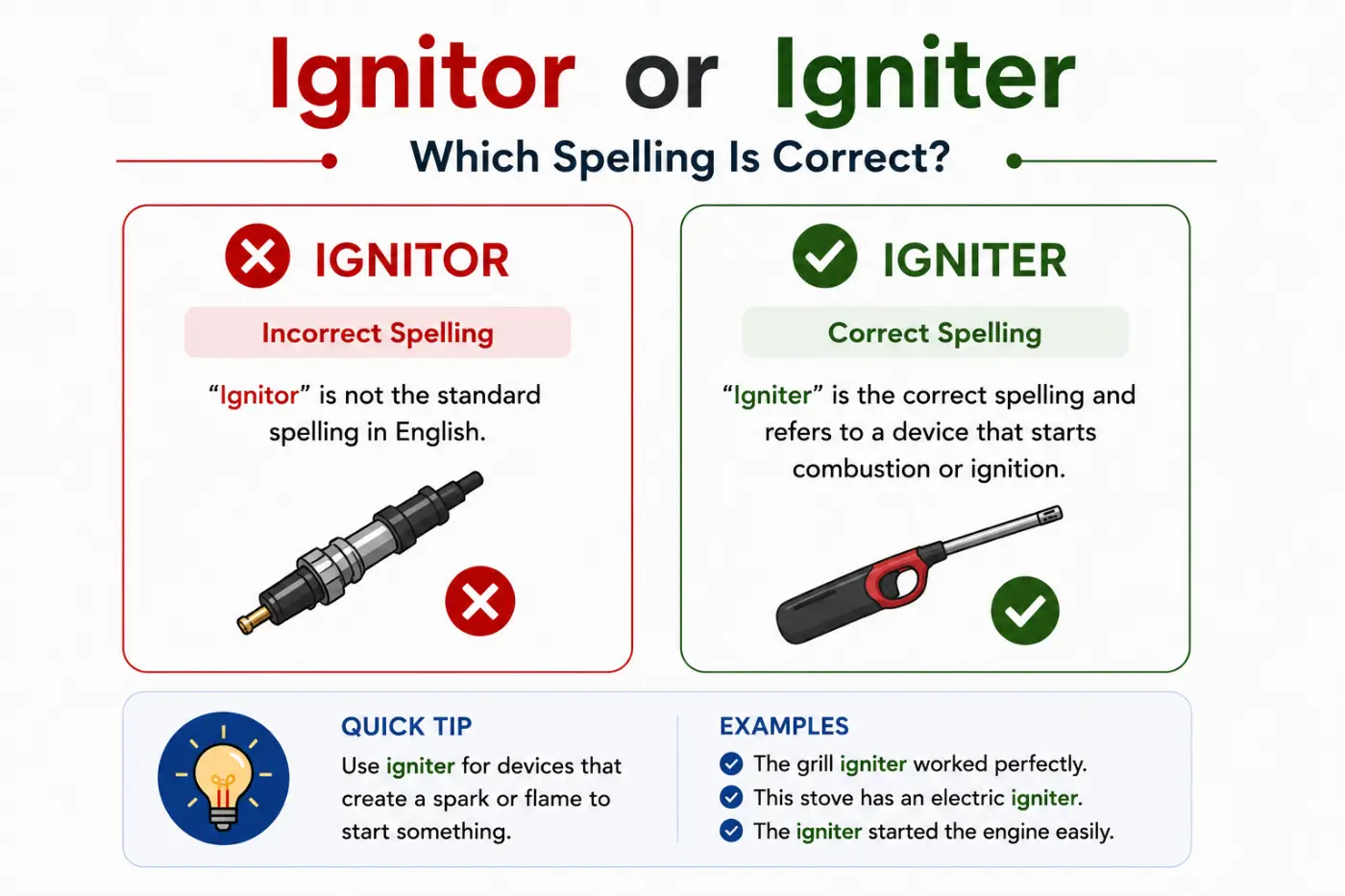
Ignitor or Igniter is a common spelling question because both forms appear in technical manuals product descriptions and ordinary writing. The two words have the same basic meaning and refer to something that causes ignition. The difference mainly comes from spelling preference rather than a difference in meaning.
If you’re writing for an American audience igniter is the better choice. Merriam Webster lists igniter as the main noun and gives ignitor as a variant. That means you won’t be dealing with two completely different words. You’re looking at two accepted forms with one spelling carrying stronger modern preference.
This guide explains the meaning pronunciation grammar usage history and practical differences between the two forms. You’ll also see examples from everyday writing technical contexts and professional communication so you can choose the spelling that fits your sentence without second guessing yourself.
Short Answer
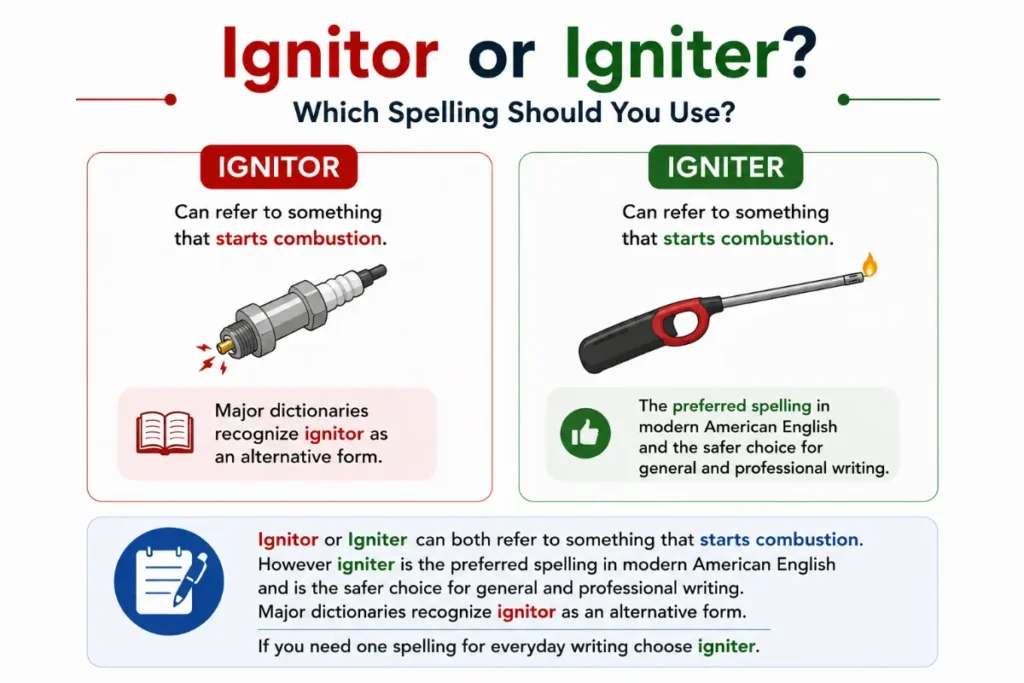
Ignitor or Igniter can both refer to something that starts combustion. However igniter is the preferred spelling in modern American English and is the safer choice for general and professional writing. Major dictionaries recognize ignitor as an alternative form. If you need one spelling for everyday writing choose igniter.
Table of Contents
- Which spelling is correct.
- What igniter means.
- What ignitor means.
- Igniter compared with ignitor.
- Why the spelling causes confusion.
- How to pronounce the word.
- How to use the word in a sentence.
- Igniter in technical writing.
- Igniter in everyday English.
- Ignitor in real world usage.
- Common spelling mistakes.
- Grammar rules for the word.
- Related words from the same family.
- American English usage.
- British English usage.
- Memory tips.
- Professional writing advice.
- Frequently asked questions.
- Key takeaways.
- Conclusion.
Which Spelling Is Correct
The standard choice for most modern English writing is igniter. Merriam Webster defines igniter as something that ignites. The dictionary includes several specialized meanings including a charge used to help start combustion and a device used to ignite a fuel mixture. It also lists ignitor as a variant.
That distinction matters because some online sources describe ignitor as simply wrong. That claim goes too far. Ignitor is a recognized English noun and is listed as an alternative spelling by established dictionary sources.
For ordinary American English the practical rule is simple.
Use igniter when you want the most familiar and widely preferred spelling. Use ignitor only when you are following an established product name technical document historical source or industry convention that specifically uses that form.
The choice becomes especially important in professional writing. Consistency matters. If a company manual uses one spelling throughout its documentation then changing the spelling simply because another form looks more familiar may create unnecessary inconsistency.
What Igniter Means
An igniter is something that causes another substance to ignite.
The word usually functions as a noun. It can describe a device component charge or other mechanism that starts combustion.
For example:
The technician replaced the faulty igniter in the furnace.
The sentence describes a physical component that helps create ignition.
The word can also appear in highly specialized technical contexts. Merriam Webster includes an igniter used in engines jet engines rockets and other systems where controlled ignition is necessary.
The basic idea stays the same across these contexts. An igniter starts the process of ignition.
Think of the word as an agent noun. English often forms nouns that describe a person or thing performing an action by adding a form of the suffix er.
A writer writes.
A driver drives.
A heater heats.
An igniter ignites.
This pattern makes the spelling igniter easy to understand once you connect it with the verb ignite.
What Ignitor Means
Ignitor has the same basic meaning as igniter. It refers to something that ignites another substance or starts combustion. Merriam Webster recognizes it as a variant of igniter rather than defining it as a separate concept.
For example:
The engineer inspected the ignitor before testing the system. The meaning is clear. The sentence refers to a component involved in starting ignition. The main issue isn’t meaning. It is preference.
Igniter fits modern general writing more naturally for many American readers. Ignitor can still appear in technical documents product names and specialized contexts.
That distinction helps explain why you may see both spellings without seeing any meaningful difference in the equipment being described.
Igniter Compared With Ignitor
| Feature | Igniter | Ignitor |
|---|---|---|
| Word class | Noun | Noun |
| Basic meaning | Something that causes ignition | Something that causes ignition |
| Standard status | Preferred modern form | Recognized variant |
| American English | Common choice | Less common choice |
| Technical usage | Very common | Also used in some contexts |
| Pronunciation | ig NITE er | ig NITE er |
| Plural | igniters | ignitors |
| Best general choice | Yes | Usually not the first choice |
The important point is that the two forms don’t normally represent two different devices.
If you write:
The stove igniter failed.
And someone else writes:
The stove ignitor failed.
Both sentences communicate the same basic idea. The first spelling is generally the safer choice for modern general English.
Why The Spelling Causes Confusion
The confusion comes from a familiar pattern in English word formation. English uses several suffixes to create nouns that describe people things or devices associated with an action. The endings can vary because English has absorbed vocabulary from many languages and developed spelling patterns over centuries.
The verb is ignite.
From that verb we get igniter and ignitor.
The two endings can look equally reasonable at first glance. That’s why people often hesitate when writing the word. Another source of confusion is technical vocabulary. Equipment manufacturers and specialized industries sometimes preserve terminology that doesn’t match the spelling a general dictionary user expects.
Product labels can also reinforce an alternative spelling. Once readers see a particular form repeatedly they may assume it must be the only correct version.
Language isn’t always that tidy.
A spelling can be accepted while another spelling remains more common. That is exactly the situation here.
How To Pronounce The Word
The standard pronunciation is roughly:
ig NITE er
The stress falls on the second syllable.
The beginning sounds like the word ig followed by the long i sound in night. The final part sounds like er.
Both spellings are pronounced essentially the same.
You don’t need to change the pronunciation when you move from igniter to ignitor. The spelling changes while the spoken form remains effectively the same.
This makes the pair a spelling issue rather than a pronunciation issue.
A useful way to remember the pronunciation is to connect the word directly to ignite.
Say:
ignite
Then add:
er
You get:
igniter.
How To Use The Word In A Sentence
The word is a noun. It normally names a device or component that causes ignition.
Consider these examples.
The oven igniter stopped working.
Here igniter names the part responsible for starting the flame.
The mechanic tested the igniter before replacing it.
The word functions as the object of the verb tested.
A faulty igniter can prevent the burner from starting.
Here igniter acts as the subject of the sentence.
The technician cleaned the igniter carefully.
Again the word identifies a physical component.
The new igniter produces a stronger spark.
The sentence describes the function of the component.
These examples show an important grammar point. Igniter isn’t the action itself. The action is ignite.
You can say:
The device will ignite the fuel.
You can also say:
The igniter will ignite the fuel.
The first sentence uses ignite as a verb. The second uses igniter as a noun and ignite as a verb.
That distinction prevents a common grammatical mistake.
Igniter In Technical Writing
Technical writing often uses the word in contexts involving controlled combustion.
You may encounter the term in documentation for furnaces boilers engines burners ovens rockets and other equipment.
The exact function depends on the system.
In one machine the igniter may create an electrical spark.
In a specialized application it may refer to a charge or mechanism designed to initiate a larger combustion process.
Merriam Webster includes an igniter as a device used to ignite a fuel mixture in systems such as internal combustion engines jet engines and rockets.
Technical writers should pay attention to terminology used by the manufacturer or engineering standard involved.
Suppose a manual consistently calls a component an ignitor. Replacing every occurrence with igniter may not be helpful. Technical documentation values consistency because a specific term can become part of a system’s established vocabulary.
For general explanatory writing the preferred modern spelling remains igniter.
For product documentation the official terminology of the manufacturer should take priority.
Igniter In Everyday English
You don’t have to use the word only in engineering.
It can describe everyday devices that start flames.
For example:
The grill igniter isn’t producing a spark.
The fireplace igniter needs to be replaced.
The stove igniter works intermittently.
The furnace has a faulty igniter.
These sentences sound natural because the word identifies a component with a clear job.
You may also encounter the word in figurative language.
An igniter can describe something that starts a larger event or reaction.
For example:
Her speech became an igniter for public discussion.
The phrase is metaphorical. A speech doesn’t literally create a flame. Instead it starts a reaction in the same way that a physical igniter starts combustion.
Still the literal technical meaning remains the core meaning of the noun.
Ignitor In Real Life Usage
Although igniter is usually the better general choice ignitor hasn’t disappeared from English.
It appears in dictionaries and in specialized writing. Merriam Webster specifically lists it as a variant of igniter.
You may find the spelling in older documents or in particular technical environments.
Some equipment terminology also preserves the spelling because manufacturers have used it for years.
That doesn’t make the spelling preferable for every situation.
Imagine you’re writing a general grammar article for American readers. Igniter will usually be the clearest choice.
Now imagine you’re documenting a machine whose official service manual calls a particular part an ignitor. In that setting matching the established terminology may make more sense.
Good editing isn’t about forcing every word into one universal pattern. It’s about choosing the form that best fits the audience purpose and context.
Common Spelling Mistakes
Several mistakes can happen when people aren’t sure how to spell this word.
Using Ignitor As The Only Correct Form
Some writers assume that the ending or must be correct because words such as actor and creator use that ending.
That reasoning doesn’t work consistently in English.
The accepted form igniter follows a common agent noun pattern and is the preferred choice in modern general writing.
Treating Ignitor As Completely Wrong
This is the opposite mistake.
Calling ignitor an invalid word isn’t accurate. Established dictionary sources recognize it as a variant.
It is better to describe it as an alternative spelling that is less suitable as the default choice for many modern writing situations.
Confusing Ignite With Igniter
These words have different grammatical roles.
Ignite is a verb.
Igniter is a noun.
For example:
The spark will ignite the fuel.
The igniter creates the spark.
The first sentence describes an action. The second names the device involved in the action.
Changing The Spelling Inside A Technical Document
Consistency matters in technical communication.
If a document uses ignitor as an official component name then randomly switching between ignitor and igniter can confuse readers.
Choose the established terminology and use it consistently.
Grammar Rules For The Word
Igniter is a countable noun.
That means you can use it with singular and plural forms.
One igniter.
Two igniters.
A replacement igniter.
Several igniters.
The plural form is igniters.
The alternative spelling forms its plural as ignitors.
For example:
The technician ordered three igniters.
The service department keeps several ignitors in stock.
The noun can also appear after possessive nouns.
The furnace’s igniter failed.
The engine’s igniter needs inspection.
The rocket’s igniter was tested before launch.
It can also work with adjectives.
A faulty igniter can cause starting problems.
The new igniter produced a reliable spark.
The electrical igniter requires careful inspection.
These examples show how easily the noun fits into ordinary English grammar.
Related Words From The Same Family
Understanding related words makes the spelling easier to remember.
Ignite
Ignite is the verb.
It means to set something on fire or cause it to begin burning. It can also describe the start of something in a figurative sense. Merriam Webster gives examples involving fire as well as events and emotions.
Example:
The spark ignited the fuel.
Ignition
Ignition is a noun.
It can refer to the act or process of starting combustion. It can also refer to a system or mechanism involved in starting an engine.
Example:
The ignition system needs inspection.
Ignitable
Ignitable is an adjective.
It describes something capable of being ignited.
Example:
The material is highly ignitable.
Merriam Webster also recognizes ignitible as a less common form.
Igniting
Igniting is the present participle of ignite.
Example:
The spark is igniting the fuel.
Ignited
Ignited is the past tense and past participle of ignite.
Example:
The fuel ignited immediately.
Seeing these related forms together makes the family easier to remember.
American English Usage
For an American audience igniter is the strongest default choice.
It looks familiar in general writing and fits the normal agent noun pattern that readers recognize.
If you’re writing an article a report an email a product description or general educational content then igniter is usually the form to choose.
That doesn’t mean you should erase ignitor from your vocabulary.
You may still encounter it in technical material product terminology and older sources.
The useful distinction is preference rather than a completely different meaning.
When you’re writing for a broad American audience and you have no special reason to use the alternative form choose igniter.
That simple rule will cover most situations.
British English Usage
English spelling can vary across regions but this particular pair doesn’t behave like some famous differences such as color and colour or center and centre.
The spelling ignitor exists as an English variant and isn’t limited neatly to one national variety.
For that reason it would be misleading to claim that one spelling belongs exclusively to British English while the other belongs exclusively to American English.
Instead focus on standard usage and context.
If your audience expects modern general English then igniter is a strong choice.
If you’re reproducing established technical terminology then follow the terminology used by the relevant source or organization.
This approach is more reliable than trying to force the word into a simple US versus UK rule.
Formal And Informal Usage
The word is mainly neutral.
It isn’t slang.
It isn’t normally considered casual vocabulary.
You can use igniter in technical documents reports manuals educational articles and ordinary explanations.
The context determines how technical the word feels.
For someone discussing a kitchen appliance the term can be completely ordinary.
For someone discussing rocket propulsion it becomes highly specialized.
The same noun can therefore work across different levels of language.
The spelling ignitor can also appear in formal technical contexts. Its presence doesn’t automatically make a document informal or incorrect.
Still igniter is usually the better default for writers who want a modern broadly recognized form.
Professional Writing Tips
Professional writing rewards precision.
If you’re writing about a machine component first identify the exact terminology used by the manufacturer or relevant technical documentation.
Then keep that terminology consistent.
For general writing use igniter unless you have a specific reason to use the variant.
Don’t alternate between igniter and ignitor simply to make the writing look varied. Spelling variants aren’t synonyms that need to be rotated.
Consistency is more valuable than artificial variety.
You should also avoid explaining the spelling difference every time the word appears. Once you’ve established the preferred form your reader can simply move on to the information that matters.
Good editing removes friction.
The reader shouldn’t have to stop and wonder why one paragraph says igniter and the next says ignitor.
Memory Tips
The easiest memory trick is to connect the noun to the verb ignite.
Start with:
ignite
Then add the common agent ending:
er
That gives:
igniter.
You can also compare it with familiar words.
Write becomes writer.
Drive becomes driver.
Fight becomes fighter.
Ignite becomes igniter.
This isn’t a universal spelling rule for every English word. It is simply a useful memory aid for this particular word.
Another trick is to remember the sentence:
The igniter ignites.
The noun names the thing.
The verb describes the action.
That short pairing can make the distinction stick.
If you see ignitor in a technical manual you don’t need to panic. Recognize it as an accepted variant and then return to the context.
Why Igniter Is The Better Default
There are two separate questions here.
First ask if ignitor is a real English word.
Yes.
Then ask which form you should normally choose.
For most modern general writing the answer is igniter.
Merriam Webster places igniter as the main dictionary entry and identifies ignitor as a variant. Its entry also defines igniter as one that ignites and gives several technical meanings.
That dictionary treatment provides a useful editorial signal.
When one spelling appears as the main form and another appears as a variant the main form is generally the safer choice for broad communication.
You can still respect established terminology when context requires it.
Real Life Example Sentences
Home Appliances
The stove igniter isn’t producing a spark.
The technician replaced the oven igniter.
A faulty igniter can stop the burner from lighting.
The new igniter worked immediately.
These examples use the word in a familiar household setting.
Automotive Context
The mechanic tested the engine igniter during the inspection.
The faulty igniter was affecting the ignition process.
The replacement igniter restored normal operation.
Here the word refers to a component associated with ignition in a mechanical system.
Industrial Context
The furnace requires a reliable igniter to start combustion.
The engineer inspected the igniter before starting the test.
The maintenance team replaced the damaged igniter.
The context becomes more technical but the grammatical role stays the same.
General Writing
The new idea became an igniter for a wider discussion.
The speech acted as an igniter for public debate.
These examples use the word figuratively. They compare the start of an idea or reaction with the start of a fire.
That metaphor works because the underlying concept remains stable.
Something acts as the spark that starts a larger process.
Is Igniter A Verb
No.
Igniter is a noun.
The verb is ignite.
You can say:
The igniter starts the flame.
You can’t use igniter as the ordinary verb meaning starts a fire.
Instead say:
The device ignites the fuel.
This distinction is simple but useful.
Many English words have related noun and verb forms that look similar. Keeping the grammatical role in mind prevents awkward sentences.
Is Ignitor A Different Part Of Speech
No.
Ignitor is also a noun.
It represents an alternative spelling of the same basic word.
You don’t need a different grammar rule for it.
The main difference lies in spelling preference and usage.
For example:
The igniter failed.
The ignitor failed.
Both sentences use the word as a noun and describe the same general situation.
Is Igniter More Common
Igniter is the preferred modern form in major dictionary treatment.
Merriam Webster lists igniter as the primary noun and identifies ignitor as a variant.
That makes igniter the practical choice for most writers.
Frequency can also vary by industry. A specialized field may preserve a particular spelling for historical or product related reasons.
So a writer shouldn’t assume that seeing ignitor in a manual means the manual contains a spelling mistake.
Context matters.
Can You Use Ignitor In Professional Writing
Yes.
You can use ignitor when it matches established terminology.
For broad professional writing however igniter is usually the cleaner choice.
Suppose you’re preparing a general report for customers. Using igniter will probably make the terminology immediately familiar.
Now suppose you’re copying a component name from a manufacturer’s official specification. Preserving ignitor may be the right editorial decision.
The key principle is consistency with purpose.
Professional writing isn’t about choosing the longest or most formal looking word. It is about choosing accurate terminology that your intended readers can understand.
Key Takeaways
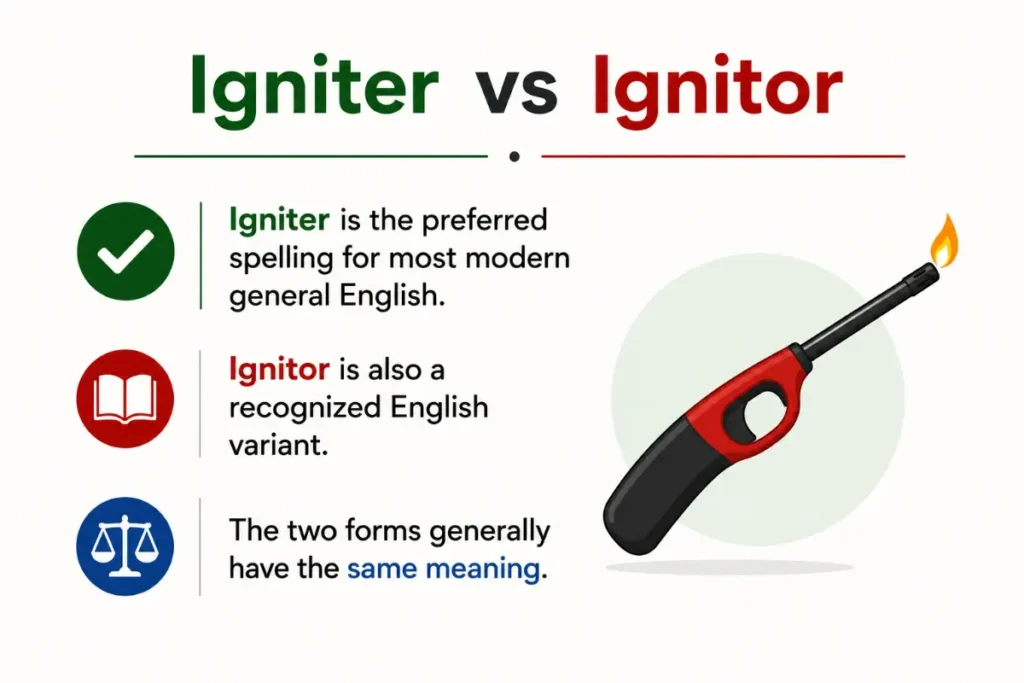
- Igniter is the preferred spelling for most modern general English.
- Ignitor is also a recognized English variant.
- The two forms generally have the same meaning.
- Both forms function as nouns.
- The related verb is ignite.
- The plural of igniter is igniters.
- The plural of ignitor is ignitors.
- Both spellings have essentially the same pronunciation.
- Technical terminology can preserve the alternative spelling.
- For general American writing igniter is the safest choice.
Conclusion
Ignitor or Igniter can cause unnecessary hesitation because both forms exist in English. The good news is that the choice is simpler than it first appears. Igniter is the preferred modern spelling for most general and professional writing while ignitor remains a recognized variant.
When you’re writing for a broad American audience choose igniter unless a specific technical source uses ignitor as its established terminology. That choice gives your readers the form they are most likely to recognize while keeping your writing consistent and polished. You can also remember the spelling by connecting it directly with the verb ignite and the familiar agent noun pattern seen in words such as writer and driver.
If you encounter ignitor in a manual product description or technical document don’t assume you’ve found an error. It is an accepted variant. The practical rule is simple: use igniter as your normal choice and respect ignitor when a specific source or technical context calls for it. That approach keeps your English accurate clear and natural.
Common Questions About The Spelling
Is Igniter Or Ignitor Correct?
Both forms are recognized. Igniter is the preferred modern form for most general writing while ignitor is an accepted variant.
Is Igniter The American Spelling?
Igniter is a strong standard choice for American English. It is widely recognized and is listed as the main noun form in Merriam Webster.
Is Ignitor A Misspelling?
No. Ignitor is recognized as a variant of igniter. Calling it an outright misspelling would be inaccurate.
What Does Igniter Mean?
An igniter is something that causes ignition. It can be a device component charge or other mechanism used to start combustion.
How Do You Pronounce Igniter?
Igniter is pronounced roughly like ig NITE er. The stress falls on the second syllable.
How Do You Spell The Plural Of Igniter?
The plural is igniters.
For example:
The technicians inspected several igniters.
Is Igniter A Noun Or Verb?
Igniter is a noun. The related verb is ignite.
For example:
The igniter failed.
The spark will ignite the fuel.
Can Ignitor And Igniter Be Used Interchangeably?
They can generally refer to the same thing. However the choice should follow standard usage and established terminology. For general American writing igniter is usually the better default.
Which Form Should I Use In A Grammar Article?
Use igniter as the main form and explain that ignitor is an accepted variant. That gives readers the clearest and most accurate guidance.
Which Form Should I Use In Technical Documentation?
Follow the terminology established by the relevant manufacturer standard or technical system. If no specific terminology controls the document igniter is a sensible default.
Does Ignitor Have A Different Meaning?
No major difference in basic meaning separates the two forms. Both describe something that causes ignition.

Confusing Words, Spelling & Word Choice
Claire Whitmore is a U.S.-based English editor who writes about commonly confused words, spelling differences, and word choice. Her work helps readers understand subtle distinctions between similar-looking words through simple definitions, practical examples, and modern usage guidance in both American and British English.