
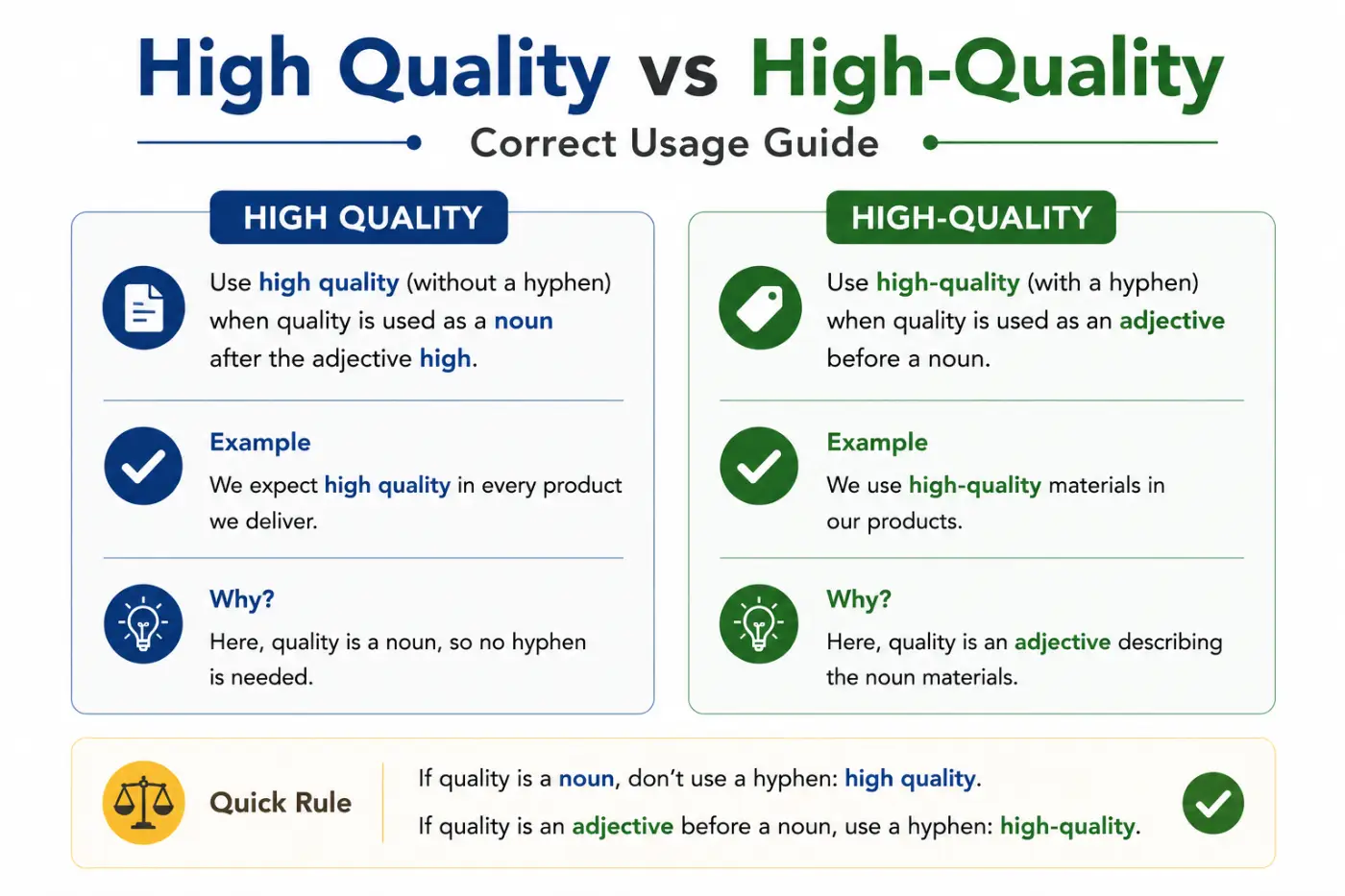
High Quality vs High-Quality can look like a tiny formatting choice but the difference matters when you want polished English. The correct form depends mainly on how the phrase functions in your sentence. When high quality comes after a noun as a normal descriptive phrase it is usually written as two words. When it comes before a noun and works together as a compound adjective many style guides recommend a hyphen between the words.
The confusion happens because English does not use hyphens in every adjective phrase. Writers often see phrases such as high quality product and wonder if high quality should be treated as one unit. The answer depends on its position and the risk of ambiguity. For example you can write The product is high quality. Before a noun you can write a high quality product. Some editors may prefer a high quality product while others use high quality product depending on their style guide and the context.
This guide explains the grammar behind the choice. You’ll learn how compound modifiers work how dictionaries and style guides approach the phrase how to use it in professional writing and how native speakers naturally handle it. You’ll also see practical examples common mistakes related expressions and an editor’s method for making the right choice quickly.
Quick Definition
High quality is normally written as two words when it follows a noun or works as a normal phrase. Before a noun it can function as a compound modifier and a hyphen can make the relationship clearer. For example the service is high quality but a high quality service may be written with a hyphen in careful edited prose.
Quick Answer
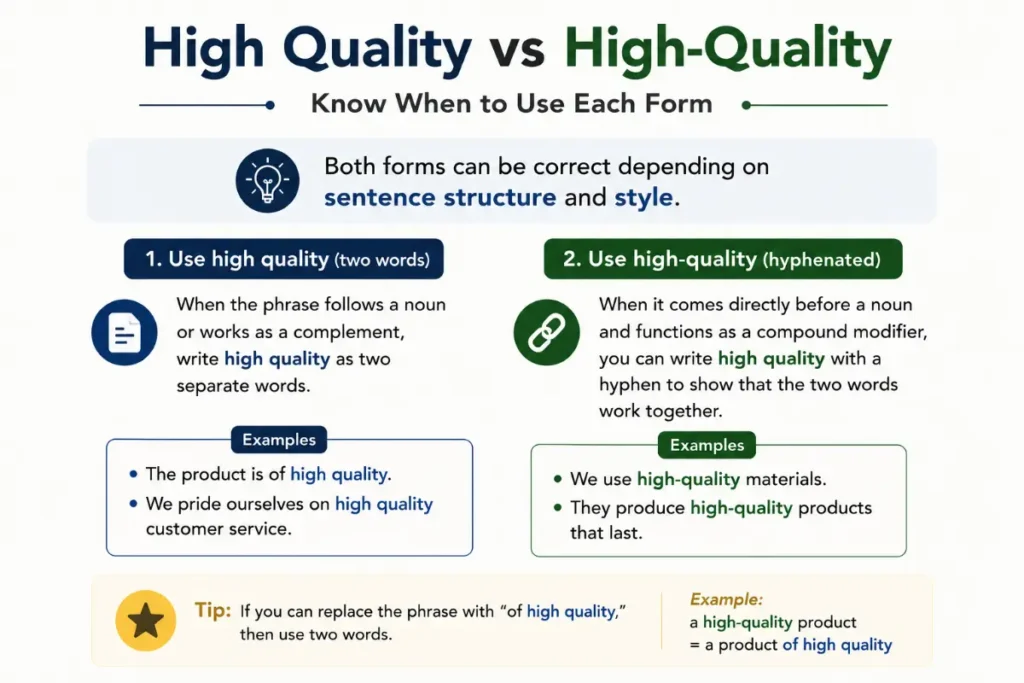
Both forms can be correct depending on sentence structure and style. When the phrase follows a noun or works as a complement write high quality as two separate words. When it comes directly before a noun and functions as a compound modifier you can write high quality with a hyphen to show that the two words work together.
Comparison Table for High Quality or High Quality
| Correct Form | Meaning | Part of Speech | Origin | Usage Frequency | Formality | Common Contexts | Example |
|---|---|---|---|---|---|---|---|
| high quality | Excellent standard or level | Adjective phrase or noun phrase | High plus quality | Very common | Neutral and formal | Reviews descriptions conversation business writing | The product is high quality. |
| high quality | Describes a noun as having an excellent standard | Compound adjective | High plus quality | Very common | Neutral and formal | Product descriptions reports marketing and general prose | We bought a high quality product. |
| high quality | Excellent standard used as a noun phrase | Noun phrase | High plus quality | Common | Neutral and formal | Business education manufacturing and services | High quality matters to customers. |
Meaning and Definition
Meaning of high quality
High quality means having a very good standard or level. It describes something that performs well has desirable characteristics or meets a strong standard.
For example:
The restaurant serves high quality food.
This means the food is considered very good.
You can use the phrase for physical products services experiences materials work results information and many other things.
The phrase doesn’t describe one specific type of excellence. Its meaning depends on the noun that follows or the situation being discussed.
A high quality article may provide accurate information and useful explanations.
A high quality service may be reliable and professional.
The basic idea stays the same. The thing being described has a strong level of quality.
Meaning of high quality when used before a noun
When high quality appears directly before a noun it acts as a compound modifier.
Consider:
We need high quality materials.
Here high quality works together to describe materials.
In careful edited writing many style guides recommend a hyphen when two or more words work together before a noun as one modifier. This can produce:
We need high quality materials.
However style guides don’t all handle every compound modifier in exactly the same way. Some editors leave familiar combinations open when the meaning is already obvious. Others prefer the hyphen for consistency and clarity.
The key grammatical idea matters more than memorizing one universal rule. When the words function together before a noun you should consider the hyphen.
Meaning of high quality after a noun
When the phrase comes after the noun it normally remains open.
For example:
The materials are high quality.
The service is high quality.
Her work is high quality.
In these sentences high quality is a complement that describes the subject. There is no need to join the words with a hyphen.
Writing high quality in this position is natural and standard.
Key Differences Explained
Spelling
High quality consists of two separate words. The words don’t normally become one word.
The question is mainly about the hyphen.
You may see:
high quality
or:
high quality
The second form uses a hyphen between high and quality.
The hyphen doesn’t change the basic meaning. It signals that the two words work together as one modifier before a noun.
Grammar Role
The phrase can function as an adjective phrase or compound adjective depending on its position.
In:
The service is high quality.
The phrase describes the service after the linking verb.
In:
We chose a high quality service.
The phrase comes before service and modifies it directly.
This distinction explains most of the punctuation choice.
Meaning
The meaning remains essentially the same. The phrase describes a strong or excellent standard.
The hyphen doesn’t create a new meaning. It simply clarifies the grammatical relationship between the modifier and the noun.
Tone
High quality is neutral and widely accepted. You can use it in casual conversation professional communication academic writing reports product descriptions and general prose.
The hyphenated form can look slightly more deliberate because it follows a common editorial convention for compound modifiers.
Context
You will see the phrase in almost every type of English writing.
People use it when discussing products services education research materials food workmanship content technology and customer experiences.
Because the phrase is so common it helps to understand its grammar rather than simply copying whatever version you see online.
Which Form Is Correct?
Both forms can be correct.
The most useful rule is based on position.
When the phrase follows the noun or appears after a linking verb use high quality as two words.
For example:
The product is high quality.
The photographs are high quality.
Their work is high quality.
When the phrase comes directly before a noun and functions as one compound modifier a hyphen can improve clarity.
For example:
We bought a high quality product.
She submitted a high quality report.
They provide high quality services.
Some established style guides allow familiar compound modifiers to remain open when readers won’t misunderstand them. This is why you may encounter both high quality product and high quality product in published English.
The important point is that the hyphen isn’t a spelling requirement in every situation. It is a punctuation choice connected to grammatical function and editorial style.
An experienced editor looks at the entire sentence rather than treating high quality as a phrase that must always be written one way.
Why The Hyphen Can Matter
A hyphen can tell the reader that two words belong together.
Compare these structures:
a high quality product
a high quality product
The hyphenated version makes the compound relationship explicit.
This becomes more useful when modifiers are longer or when the sentence could be interpreted in more than one way.
English uses hyphens to reduce ambiguity. The purpose isn’t decoration. A good hyphen gives the reader a small signpost.
However not every adjective phrase needs one. Common phrases can become familiar enough that the meaning remains obvious without the punctuation.
That’s why style guides sometimes differ.
Sentence Examples
Here are natural examples where high quality follows the noun or works as a complement.
- The new furniture is high quality.
- Their customer service is high quality.
- The restaurant is known for high quality food.
- Her work has always been high quality.
- We expect high quality from this manufacturer.
- The materials are high quality and durable.
- This school provides high quality education.
- The photographs are surprisingly high quality.
- The company focuses on high quality results.
- The software produces high quality images.
Here are examples where the phrase comes before a noun as a compound modifier.
- We need a high quality printer.
- She bought a high quality camera.
- They published a high quality report.
- The company produces high quality equipment.
- He submitted a high quality application.
- We are looking for high quality materials.
- The team created a high quality presentation.
- Customers expect high quality products.
- The laboratory requires high quality samples.
- They offer high quality training.
In careful edited writing a hyphen may be used in these attributive examples:
a high quality printer
a high quality product
The choice can depend on the publication’s style guide.
Common Mistakes and Misunderstandings
Treating the phrase as one word
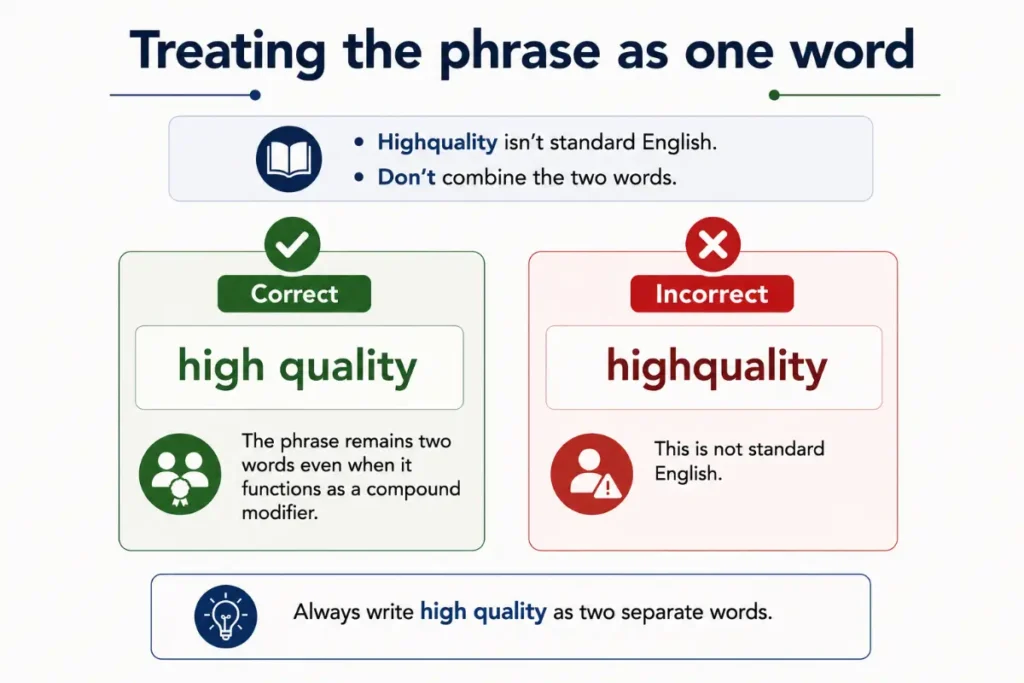
Highquality isn’t standard English.
Don’t combine the two words.
Correct:
high quality
Incorrect:
highquality
The phrase remains two words even when it functions as a compound modifier.
Adding a hyphen everywhere
Some writers learn that compound adjectives take hyphens and then apply the rule to every occurrence.
That creates unnecessary punctuation.
For example:
The product is high quality.
There is no need to connect the words simply because they describe the product.
Removing the hyphen from every compound modifier
The opposite mistake also happens. Writers assume that high quality never needs a hyphen.
In careful edited writing a hyphen can be useful before a noun when the phrase functions as a single modifier.
Confusing quality with high quality
Quality alone doesn’t always mean excellent.
For example:
The product has quality materials.
That construction can sound awkward because quality is being used adjectivally.
The phrase high quality clearly communicates a strong standard.
Using high quality as empty praise
This is more of a style problem than a grammar mistake.
If you describe something as high quality explain what makes it good when the context allows.
For example:
The report is high quality.
That is broad.
The report is high quality because it uses current data and explains the findings clearly.
That gives the reader evidence.
Strong writing doesn’t simply label something excellent. It shows the qualities that justify the description.
Pronunciation Guide
High quality is usually pronounced with the natural stress on both major words.
A common US pronunciation can be represented approximately as:
high KWAH luh tee
The phrase contains the familiar words high and quality. The pronunciation doesn’t change significantly because of a hyphen.
The main difficulty for learners isn’t pronunciation. It is recognizing the grammatical role of the phrase in writing.
Quality is commonly pronounced:
KWAH luh tee
The first syllable receives the strongest stress.
In normal speech the phrase flows naturally:
high quality
There isn’t a special pause between the words.
This is another reason learners may wonder about the hyphen. Spoken English doesn’t show punctuation. The listener hears the same phrase regardless of how an editor chooses to punctuate it.
Etymology and Word Origin
The phrase combines two ordinary English words with long histories.
High comes from Old English heah which referred to great height or elevated position. Over time its meaning expanded beyond physical height. English speakers began using high to describe levels intensity standards amounts and degrees.
Quality comes through Old French qualité and Latin qualitas. The Latin word relates to qualis which means of what kind or of what sort.
When high combines with quality the phrase expresses a high level of excellence or a strong standard.
This is a natural example of English creating meaning by combining familiar words. Neither word is unusual on its own. Together they form a phrase that has become extremely common in modern English.
The phrase appears in descriptions of products services workmanship education information and experiences.
Regional Usage in the US
American English commonly uses high quality as an open phrase.
For example:
The product is high quality.
Before a noun American writers may use a hyphen when treating the phrase as a compound modifier. Style varies across publishers and organizations.
The important distinction is grammatical position rather than regional vocabulary.
There is no separate American spelling that changes the words themselves.
Regional Usage in the UK
British English also uses high quality widely.
British publications may follow house styles that differ in their treatment of compound modifiers. Some may prefer high quality product while others use high quality product.
The underlying grammar remains the same.
High quality isn’t a special American expression. It is normal English across major varieties.
Regional Usage in Australia
Australian English uses the same phrase.
Writers may encounter different editorial preferences for hyphenation depending on the publication school university or organization.
The words high and quality remain separate words.
The question is mainly one of punctuation and sentence structure.
Regional Usage in Canada
Canadian English also uses high quality naturally.
Canadian publishers may follow different style manuals and therefore vary in hyphenation choices. The phrase itself doesn’t change.
If you’re writing for a Canadian audience the safest approach is to follow the publication’s style guide when one exists.
Grammar Rules and Part of Speech
High quality can be understood as an adjective phrase when it describes the standard of something.
For example:
The service is high quality.
Here the phrase describes service.
When it appears before a noun it can function as a compound adjective.
For example:
They provide high quality service.
The entire phrase modifies service.
When to use the open form
Use the open form after a noun.
The product is high quality.
The food was high quality.
Their work remains high quality.
This is the simplest situation.
When to consider a hyphen
Consider a hyphen when the phrase appears directly before a noun and acts as one modifier.
For example:
a high quality product
a high quality material
The hyphen makes the relationship clear.
When no hyphen is needed
Don’t automatically hyphenate a phrase simply because it contains an adjective and a noun.
When high quality follows a linking verb there is normally no hyphen.
The product is high quality.
Not:
The product is high quality.
What style guides do
Style guides differ in how aggressively they hyphenate familiar compound modifiers. Some recommend hyphenating compound adjectives before nouns for clarity. Others allow commonly understood combinations to remain open.
This means you shouldn’t treat one punctuation choice as universally wrong.
For professional work consistency matters. If you’re writing for a company publication university newspaper or journal check its preferred style.
High Quality in Professional Writing
The phrase is completely acceptable in professional writing.
You can use it in reports proposals emails presentations and technical documents.
For example:
The team delivered a high quality analysis.
The materials are high quality.
The company maintains high quality standards.
However professional writing benefits from specific evidence.
Instead of repeatedly calling your work high quality you can explain why it meets a strong standard.
For example:
The analysis uses five years of verified data and clearly explains the limitations.
That sentence gives the reader something concrete.
This is especially useful for EEAT focused content. Claims about quality become stronger when you support them with evidence experience process or measurable characteristics.
High Quality in SEO and Content Writing
Writers often use high quality to describe articles images products information and services.
The phrase itself isn’t a magic quality signal. Search engines don’t reward a page simply because the writer repeats the words high quality.
A stronger approach is to demonstrate quality.
For an article that means accurate information clear organization useful examples original insight and trustworthy sourcing.
For a service page it means describing the actual process expertise outcomes and customer experience.
The phrase can summarize those qualities but it shouldn’t replace them.
High Quality Versus Good Quality
These expressions overlap but high quality is usually stronger.
Good quality suggests that something meets a satisfactory or positive standard.
High quality suggests a particularly strong standard.
For example:
The restaurant serves good quality food.
The restaurant serves high quality food.
The second statement generally makes a stronger claim.
However good quality can sound less natural in some forms of American English. Many speakers would simply say good food or quality food depending on the intended meaning.
High quality is especially common when writers want to emphasize standards.
High Quality Versus Premium Quality
Premium quality is often used in marketing to suggest superior quality or a higher market position.
High quality is broader and doesn’t necessarily imply luxury or a premium price.
A product can be high quality without being expensive.
That distinction matters in honest writing. If you mean reliable and well made then high quality may be accurate. If you mean positioned as an upscale product then premium may communicate something different.
High Quality Versus Top Quality
Top quality is another common expression.
It usually means extremely good or among the best available.
High quality and top quality can overlap but top quality often carries a stronger promotional tone.
In neutral professional writing high quality may sound more measured.
In advertising top quality can sound more persuasive.
The best choice depends on the evidence and the tone you want.
Related and Confused Terms
High standard
High standard emphasizes the level that something reaches.
The laboratory maintains a high standard of accuracy.
Superior quality
Superior quality suggests that something is better than another option or standard.
The new material offers superior quality.
Excellent
Excellent is a strong adjective that directly describes something as very good.
The results were excellent.
Premium
Premium often suggests a higher grade or market position.
The company sells premium materials.
Top quality
Top quality emphasizes an exceptionally high level.
The store is known for top quality products.
First rate
First rate means excellent or of very high standard.
She received first rate training.
Well made
Well made focuses on construction or workmanship.
The furniture is well made.
Reliable
Reliable focuses on consistent performance rather than quality in the broadest sense.
The equipment is reliable.
These alternatives aren’t perfect substitutes. Each one highlights a slightly different aspect of excellence.
Why Context Matters More Than Memorization
A common grammar mistake is to search for one permanent answer.
Writers often ask:
Is it high quality or high quality?
The better question is:
How is the phrase functioning in my sentence?
That question solves the problem.
If the phrase follows a noun or linking verb then the open form is natural.
The service is high quality.
If it appears before a noun and works as a combined modifier then a hyphen can clarify the structure.
They offer a high quality service.
This approach is much easier than trying to memorize a long list of hyphen rules.
Think about the job the words are doing. Grammar often gives you the answer.
Expert Editor Insight
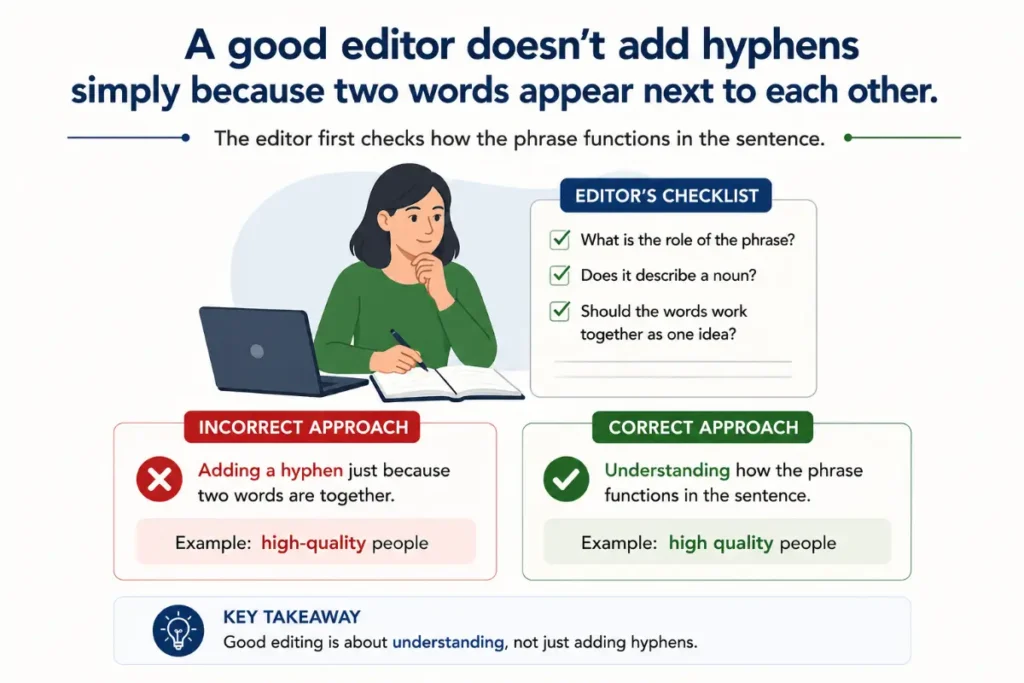
A good editor doesn’t add hyphens simply because two words appear next to each other. The editor first checks how the phrase functions in the sentence. High quality is a familiar expression and readers usually understand it instantly. That means the hyphen question often comes down to position house style and clarity. In a sentence such as The service is high quality there is no reason to hyphenate the phrase. Before a noun a hyphen can signal that high and quality work together as one modifier. My practical tip is to use the hyphen when it improves clarity and then stay consistent with the style guide you’re following.
Conclusion
When comparing High Quality vs High-Quality the answer depends on how the phrase works in your sentence. High quality is normally written as two words when it follows a noun or acts as a complement. Before a noun it can function as a compound modifier and a hyphen may be used to make that relationship clear. The meaning stays the same either way.
Your main job is to look at sentence structure and follow the style guide you’re using. A simple practical tip is to ask if high quality directly modifies the noun that follows. If it does consider the hyphen. If it comes after the noun leave the words open.
Frequently Asked Questions
Is high quality one word?
No. High quality is not normally written as one word. The phrase consists of the adjective high and the noun quality. Depending on sentence position the words can remain open or work together as a compound modifier before a noun. A hyphen may be used in the latter situation when it improves clarity or follows the chosen style guide.
Is high quality grammatically correct?
Yes. High quality is grammatically correct and extremely common in English. It can describe a strong standard or level. For example you can say The product is high quality. When the phrase comes before a noun it can function as a compound modifier. In that position a hyphen may be appropriate depending on style and context.
Should high quality have a hyphen?
A hyphen can be used when high quality comes before a noun and works as one compound modifier. For example a high quality product. When the phrase comes after a noun you normally leave it open. For example The product is high quality. Different style guides vary in their treatment of familiar compound modifiers.
Is high quality formal English?
Yes. High quality is suitable for both formal and informal English. You can use it in academic writing professional reports business emails technical documents and everyday conversation. The phrase itself doesn’t sound casual. However strong professional writing should support broad claims about quality with specific evidence rather than relying on promotional language alone.
What is another way to say high quality?
Depending on context you can use excellent superior top quality premium first rate well made or high standard. These expressions aren’t identical. Well made focuses on construction while reliable focuses on performance. Premium often suggests a higher market position. Choose the alternative that describes the specific quality you want to communicate.
Can high quality describe a person?
Yes but the meaning depends on context. You can describe someone’s work performance character or contribution as high quality. For example The team produced high quality work. Saying a person is high quality by itself can sound unusual or promotional. More natural English usually identifies the specific quality being praised.
Is high quality hyphenated before a noun?
It can be. When high quality comes before a noun as a compound modifier a hyphen can make the relationship clear. For example a high quality product. Some style guides allow familiar combinations to remain open. If you’re writing for a publication or organization follow its house style and apply the same approach consistently.
Is high quality acceptable in academic writing?
Yes. High quality is acceptable in academic writing when the claim is justified. Academic writers should avoid vague praise when specific evidence is available. Instead of simply saying a high quality study you may explain that the study uses a strong sample design reliable measurements and appropriate analysis. The phrase is grammatically fine but evidence makes the statement more convincing.

Confusing Words, Spelling & Word Choice
Claire Whitmore is a U.S.-based English editor who writes about commonly confused words, spelling differences, and word choice. Her work helps readers understand subtle distinctions between similar-looking words through simple definitions, practical examples, and modern usage guidance in both American and British English.