
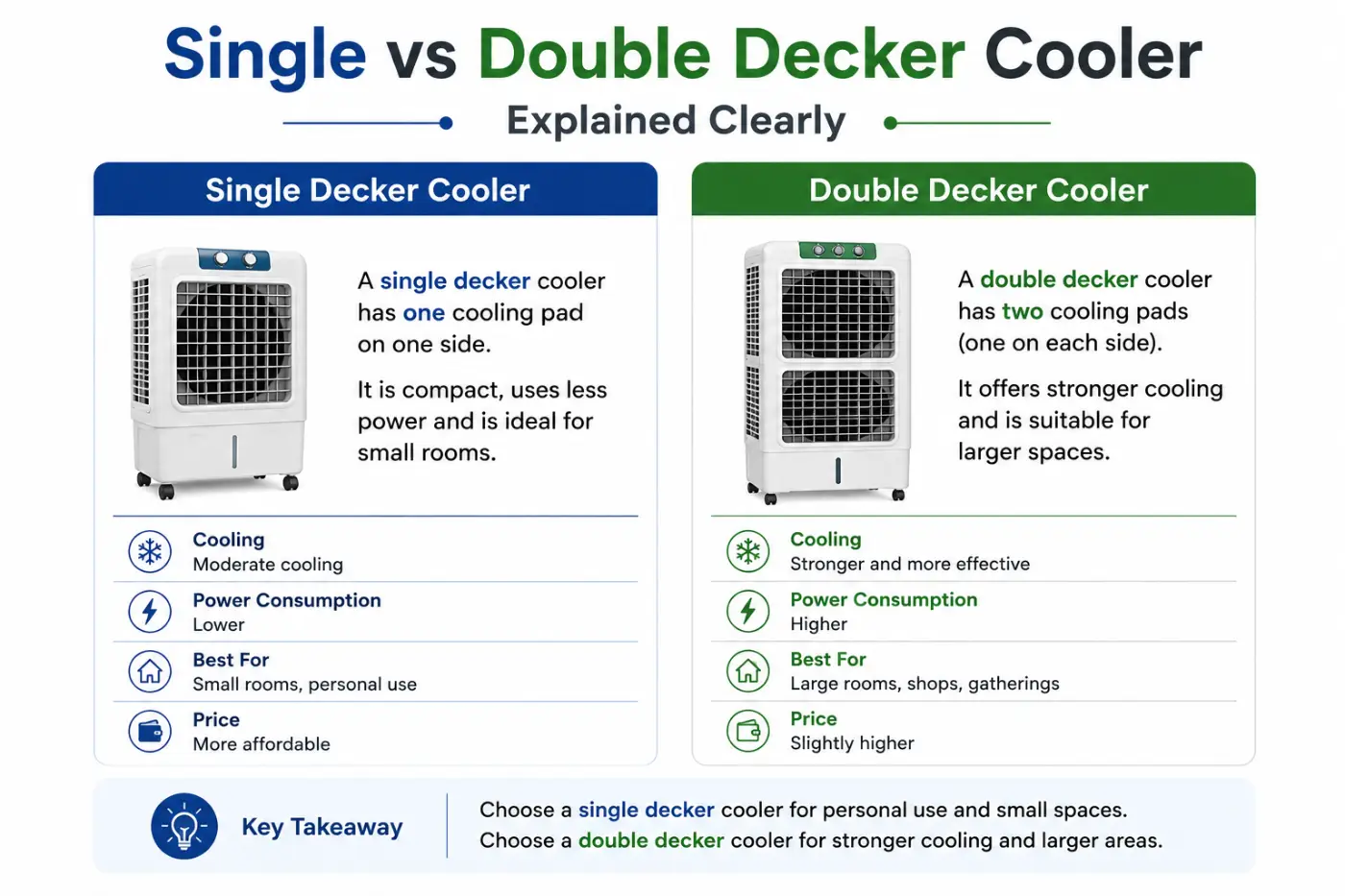
Single vs Double Decker Cooler can mean different things depending on the industry. In portable food storage a double decker cooler usually has two separate compartments for organizing food and drinks. In feed manufacturing a single deck cooler and double deck cooler are industrial machines that cool pellets after production. Understanding the context matters because the design advantages are very different.
For everyday buyers the main question is usually simple. Do you need one large cooling compartment or separate storage sections? A single compartment cooler keeps the design straightforward. A two section cooler can make packing easier because different items can stay apart. For industrial users the decision involves much more than storage because deck design can affect production capacity product changeover and cooling workflow.
This guide explains the terminology from both angles so you can identify the meaning that fits your search. You will learn the basic definitions key differences practical uses common mistakes and important technical points. You will also see why a double deck design does not automatically mean a cooler is better or simply twice as large.
Short Answer
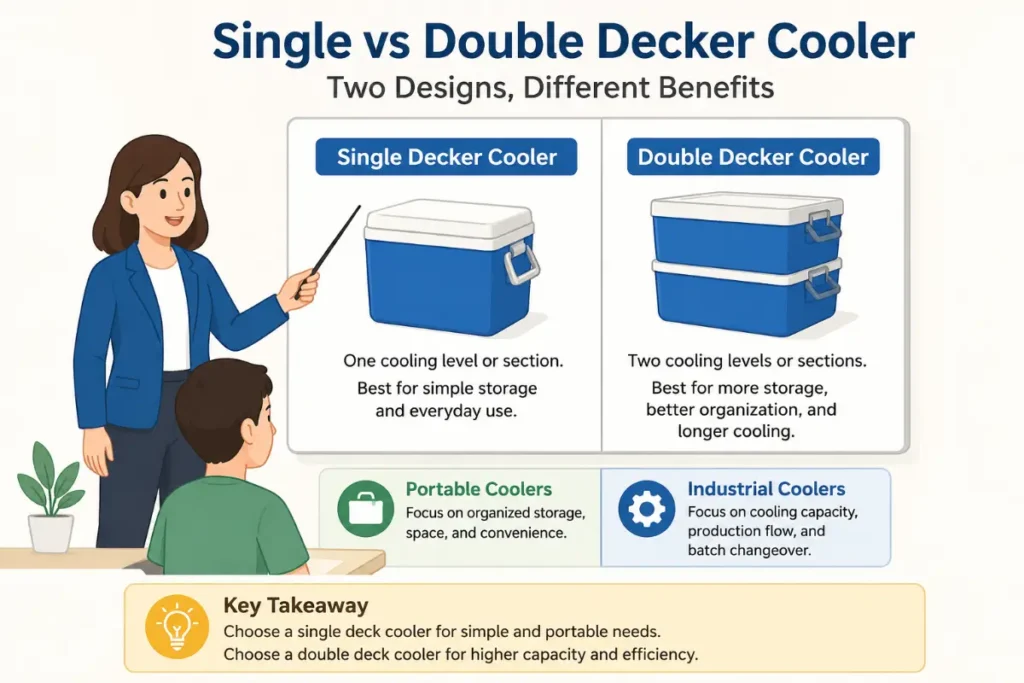
Single vs Double Decker Cooler describes two different cooler designs that can appear in both portable food storage and industrial pellet cooling. A single deck cooler generally uses one cooling level while a double deck cooler adds a second level or cooling section. The right choice depends on the application. Portable coolers focus on organized storage while industrial coolers focus on cooling capacity production flow and batch changeover.
Table Of Contents
- What The Term Means.
- What A Single Deck Cooler Is.
- What A Double Deck Cooler Is.
- Single vs Double Decker Cooler Differences.
- Portable Cooler Meaning.
- Industrial Cooler Meaning.
- How A Single Deck Industrial Cooler Works.
- How A Double Deck Industrial Cooler Works.
- Cooling Performance And Capacity.
- Storage And Organization.
- Portability And Space.
- Cost And Maintenance.
- Real Life Examples.
- Common Mistakes.
- Memory Tips.
- Related Usage Notes.
- Frequently Asked Questions.
- Key Takeaways.
- Conclusion.
What The Term Means
The word deck refers to a level or section within a structure. When manufacturers use single deck and double deck terminology they are generally describing the arrangement of the cooling area. A single deck design has one primary cooling level. A double deck design has two levels or cooling sections that work within the overall system. The exact construction depends on the product. A portable lunch cooler may simply have an upper and lower compartment. An industrial pellet cooler can use two cooling bins with an intermediate deck that allows production batches to move through the machine in a controlled way. That distinction is worth remembering because the phrase does not describe one universal product category. It describes a design concept.
What A Single Deck Cooler Is
A single deck cooler has one main cooling area.
In a portable cooler this can mean one primary insulated compartment. You place drinks food ice or other cold items inside that space. The design is generally easy to understand and easy to pack. In industrial feed production the meaning becomes more technical. A single deck pellet cooler receives warm pellets and passes air through the product layer so the pellets can cool before storage or transport. Manufacturers describe this as counterflow cooling because the air moves against the direction of product movement.
What A Double Deck Cooler Is
A double deck cooler adds another cooling level or compartment to the design. In a portable cooler the upper and lower sections can help separate different types of food. One commercial double decker cooler for example has two cooler sections and is specifically designed to provide separate storage areas. Industrial equipment uses the concept in a more sophisticated way. A double deck pellet cooler can contain an intermediate deck and a second cooling bin. This arrangement can allow one batch to continue cooling while another batch is temporarily held in the upper section.
Single vs Double Decker Cooler Differences
The biggest difference is the number and arrangement of cooling sections. A single deck design concentrates the process in one main level. A double deck design adds another level that can provide additional storage separation or process flexibility.
| Feature | Single Deck Design | Double Deck Design |
|---|---|---|
| Main structure | One cooling level | Two cooling levels or sections |
| Storage organization | Usually simpler | More separated |
| Portable use | One main compartment is common | Two compartments are common |
| Industrial use | One primary cooling bin | Multiple cooling sections |
| Product changeover | More limited | Can be faster |
| Footprint | Often simpler | Can require more structural space |
| Operation | Straightforward | More involved |
| Maintenance | Generally simpler | More components may require attention |
| Best for | Simple cooling needs | Organized storage or higher process flexibility |
The table shows why you should not judge the two designs by size alone. A double deck cooler is not automatically twice as powerful. It is not automatically twice as large either. The number of decks tells you about the structure and process arrangement rather than giving you a guaranteed capacity figure.
Portable Cooler Meaning
When people search for a portable double decker cooler they are often talking about an insulated food or lunch cooler. These products use two compartments to organize contents. A manufacturer listing for one double decker cooler describes an upper compartment and a lower main compartment. Another model has two cooler sections designed to separate hot and cold foods.
Industrial Cooler Meaning
In feed manufacturing the terminology refers to cooling machinery rather than a personal food container. Warm pellets leave the pelleting process at a temperature that needs to be reduced before the product moves into storage or transport. Counterflow coolers use airflow to bring the product closer to ambient temperature. A single deck industrial cooler normally uses one cooling bin.
How A Single Deck Industrial Cooler Works
The cooling process begins when warm pellets enter the cooling chamber. Air moves through the product layer in the opposite direction of product movement. This counterflow arrangement transfers heat from the pellets into the moving air. The cooled product then leaves through the discharge system.
How A Double Deck Industrial Cooler Works
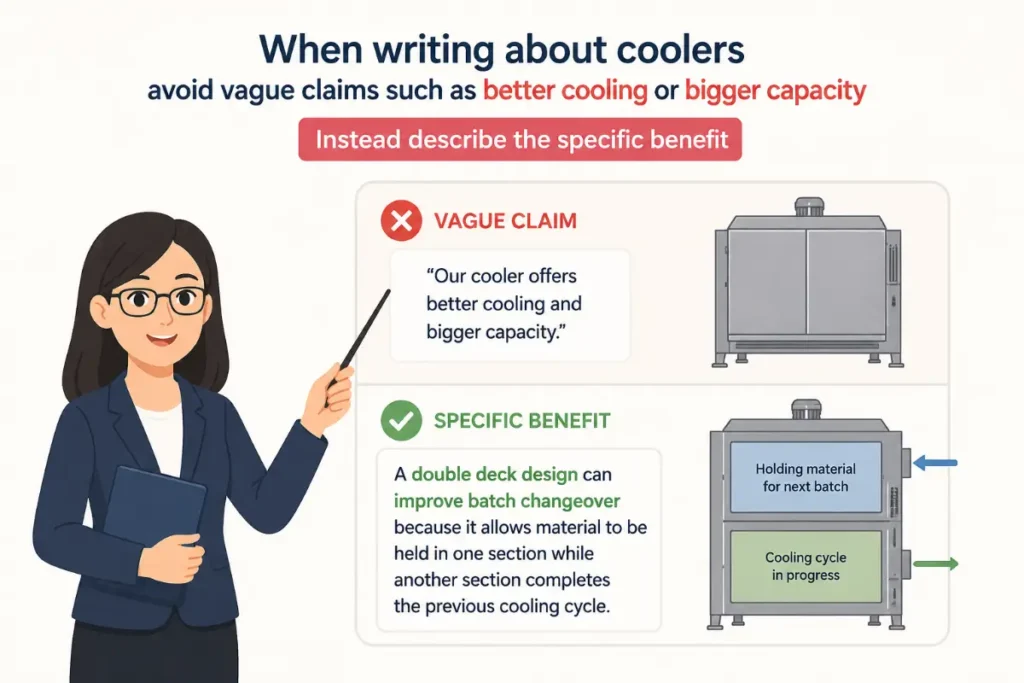
A double deck industrial cooler adds an intermediate level and another cooling section. uring normal operation the upper deck may remain open so the system behaves much like a single deck arrangement. During a product changeover the intermediate deck can close. New material can then remain temporarily in the upper section while the previous material continues through the lower cooling section. This creates a useful buffer. Instead of forcing the entire production process to wait for one batch to finish before the next batch can move into the cooler the system can handle two stages at once.
Cooling Performance And Capacity
Cooling performance depends on much more than the number of decks.
Airflow rate matters. Product depth matters. Product temperature matters. Moisture level matters. Residence time matters. The characteristics of the material also influence the final result. For industrial pellet cooling a manufacturer may design the machine around a specific product and production rate. FeedTech states that its single deck cooler is designed to bring hot pellets down to roughly five degrees Celsius above ambient temperature at the end of the production process.
That figure belongs to the specific equipment and application. It should not be treated as a universal specification for every single deck cooler. The same caution applies to double deck machines. A double deck arrangement can support higher throughput in some installations because of the additional process flexibility. ISF reported a specific upgrade that increased throughput from about twelve tonnes per hour to around sixteen tonnes per hour. That does not mean every double deck cooler provides the same increase. Equipment capacity always depends on the complete system.
Storage And Organization
For portable coolers organization is one of the clearest differences.
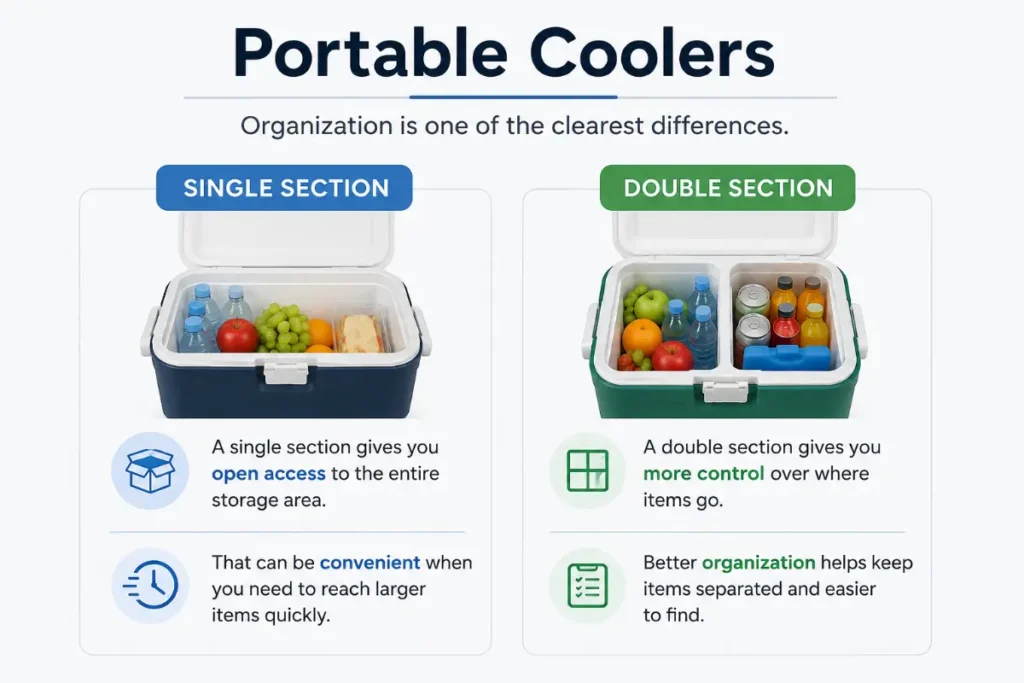
A single section gives you open access to the entire storage area. That can be convenient when you need to reach larger items quickly. A double section gives you more control over where items go. You can keep fruit in one area and drinks in another. You can separate food that needs careful handling from heavier containers. You can also use one section for items that need more frequent access. The advantage comes from separation rather than magic cooling power. A double decker cooler does not automatically keep food colder simply because it has two compartments. Insulation quality sealing material ice placement and ambient temperature still matter.
Portability And Space
Portable users should pay attention to the physical design. A simple single compartment cooler can be easier to carry because there are fewer structural elements. It may also be easier to place in a vehicle or under a table. A double compartment model can offer better organization but may use its space differently. Some compact double decker coolers are designed around two smaller compartments rather than one large cavity. That means a larger internal volume does not always translate into better usability. Think about the objects you actually carry. large single container may work better for several bottles and a large food box. Two smaller sections may work better for snacks drinks and personal lunches. The best design depends on the shape of your load as much as the stated capacity.
Cost And Maintenance
Price depends on materials construction insulation capacity brand and features.
A simple portable cooler with one main compartment may cost less because its construction is straightforward. A divided cooler can cost more if it uses additional insulation zippers compartments straps or reinforced materials.
Industrial equipment follows a different calculation.
Real Life Examples
Example For A Picnic
You are taking sandwiches fruit water and soft drinks to a local park. A single compartment cooler can handle everything. You place the food and drinks together and use ice to maintain the temperature. A double compartment cooler gives you another option. You can place drinks in one section and food in the other. The second design may make the trip more organized but it does not automatically provide better cooling.
Example For A Road Trip
A family traveling several hours may prefer separate sections. Drinks can stay in the lower compartment while snacks remain in the upper section. Frequently used items can stay closer to the top. This can reduce the need to dig through the entire cooler every time someone wants a drink.
Example For A Feed Mill
A feed mill produces one pellet formulation and then needs to switch to another. With a single deck system the existing product must complete the cooling and discharge process before the next production sequence can move smoothly through the cooler. With a double deck arrangement the new product can be held temporarily while the previous product completes its cooling cycle. That can reduce waiting during changeover.
Example For A Production Upgrade
A facility with limited space may still consider a double deck upgrade. ISF documented a project where a customer needed a double deck cooler despite height restrictions. The resulting installation increased throughput and improved changeover efficiency. This shows why machine selection should consider the entire production environment rather than one specification.
Common Mistakes
Mistake One
Assuming double deck always means double capacity. That conclusion is too simple. A second deck changes the equipment arrangement. Capacity depends on airflow product characteristics cooling time machine dimensions and the overall production line.
Mistake Two
Assuming double deck always means better cooling. The number of decks alone does not determine cooling quality. A properly designed single deck cooler can provide excellent cooling performance for its intended application. Manufacturers specifically design single deck machines for controlled pellet cooling.
Mistake Three
Assuming every double decker cooler is industrial equipment. The phrase can describe a small portable food cooler too. Consumer products use the term to describe separate compartments. Industrial manufacturers use the term to describe multi level cooling machinery.
Mistake Four
Assuming a single deck cooler has only one possible design. Single deck machines can differ greatly in dimensions discharge mechanisms airflow systems controls and applications. The phrase identifies the deck arrangement rather than every detail of the machine.
Mistake Five
Using deck and compartment as exact synonyms in every situation. They overlap in some portable products but they are not always interchangeable. A portable cooler may have two compartments. An industrial machine may have two decks that form part of a controlled cooling process. Context gives the term its practical meaning.
Memory Tips
The easiest memory trick is simple. Think of single as one level. Think of double as two levels. For a portable cooler imagine a lunch bag with one large space compared with a bag that has an upper and lower section. For industrial equipment imagine two stages that can help manage the production flow. Another useful memory line is this. Single means simple structure. Double means divided structure. Keep in mind that divided does not automatically mean better. It means the design provides another level or section for a specific purpose.
Related Usage Notes
The expression single deck is normally written as two separate words when it appears as a noun phrase.
For example you can write that the factory installed a single deck cooler.
When the phrase comes directly before another noun it can sometimes appear in a compound form such as single deck cooler depending on the publication style and manufacturer terminology. Manufacturers themselves vary in presentation. Some use single deck cooler while others use single deck cooler as part of a longer product name or specification. The same applies to double deck. In consumer product descriptions you may also see double decker cooler. That form emphasizes the stacked or divided design of the portable product. From a grammar perspective the important point is clarity. If you are writing for consumers say what the compartments do. If you are writing about industrial equipment explain what the decks do within the cooling process. Technical terminology works best when readers can connect the term to a physical function.
Professional Writing Tips
When writing about coolers avoid vague claims such as better cooling or bigger capacity without evidence. Instead describe the specific benefit. For example you could say that a double deck design can improve batch changeover because it allows material to be held in one section while another section completes the previous cooling cycle. That statement explains the mechanism rather than making a broad marketing claim. The same principle applies to portable coolers. Instead of saying that a double decker cooler is more convenient simply explain that two compartments can separate drinks from food. Clear writing builds trust because readers can see why the feature matters.
When A Single Deck Design Makes Sense
A single deck design makes sense when simplicity is the priority. For portable use it can be ideal for short outings and everyday lunches. One large compartment gives you straightforward access and flexible packing. For industrial use it can make sense when the production process does not require rapid changeover or additional buffering. A smaller facility may also prefer a simpler system because installation maintenance and operation can be easier to manage. The important question is not which design sounds more advanced. Ask which design solves the actual problem.
When A Double Deck Design Makes Sense
A double deck design becomes attractive when separation or process flexibility matters. For a portable cooler that might mean keeping drinks away from food. For an industrial cooler it can mean reducing production delays during batch changes and supporting higher throughput in the right installation. This is where the second deck can earn its keep. The additional structure creates another place for material or another section for organized storage. That extra flexibility can be valuable when the workflow demands it.
How To Choose The Right Cooler
Start with the purpose.
If you need a personal cooler for lunch or a short outing ask how much organization you need. One large space may be perfect for your needs. Separate sections may be more useful if you carry different food types. If you are selecting industrial cooling equipment start with production requirements. Look at product type. Consider production rate. Review cooling temperature targets. Examine batch changeover requirements. Check available floor and building space. Evaluate airflow requirements. Review maintenance access. Then compare the total system cost. A manufacturer specification should always take priority over a generic article when you are making an industrial equipment decision. The machine needs to match your process.
Why The Context Matters
The phrase can create confusion because the same terminology appears in very different markets. A person shopping for a lunch cooler may think about compartments insulation and portability. A feed mill engineer thinks about airflow cooling time product residence time discharge systems and production changeover. Both can correctly use terms related to single deck and double deck coolers. The words are not wrong in either context. The application changes their meaning. That is why a strong explanation should never assume that every person searching for the term wants the same product.
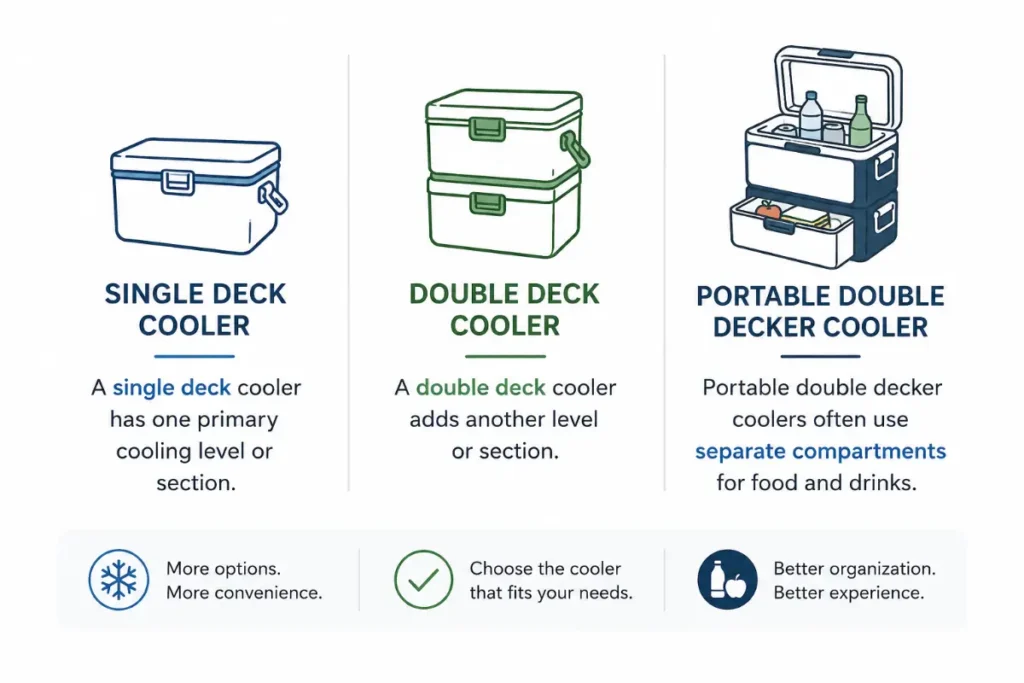
Key Takeaways
- A single deck cooler has one primary cooling level or section.
- A double deck cooler adds another level or section.
- Portable double decker coolers often use separate compartments for food and drinks.
- Industrial double deck coolers can use multiple cooling sections to improve production flow.
- A double deck design does not automatically mean twice the capacity or twice the cooling performance.
- Single deck systems can offer simpler operation and maintenance.
- Double deck systems can provide useful separation and greater process flexibility.
- Industrial capacity depends on airflow product characteristics machine design and production requirements.
- The intended application should guide your choice.
- Manufacturer specifications matter most when selecting industrial equipment.
Conclusion
Single vs Double Decker Cooler comes down to structure and purpose. A single deck design uses one primary cooling level while a double deck design adds another level or section. For portable products that difference often means one main compartment compared with separate storage sections. For industrial pellet cooling the second deck can provide a process buffer that helps improve product changeover and production flow.
The better option depends on the problem you need to solve. A single deck cooler can be the practical choice when you want simple access straightforward operation and fewer components. A double deck cooler can make more sense when you need organized storage or greater flexibility during production. Real equipment performance still depends on design specifications rather than the deck count alone.
The safest way to choose is to focus on function instead of labels. Look at what you need to cool how much material you handle how often you change products and how much organization you need. Once you understand those requirements the difference between single and double deck designs becomes much easier to see.
Frequently Asked Questions
What is the main difference between a single deck and double deck cooler?
The main difference is the number and arrangement of cooling levels or sections. A single deck cooler uses one primary cooling level. A double deck cooler adds another level or section that can provide additional organization in portable products or greater process flexibility in industrial systems.
Is Single vs Double Decker Cooler about portable products or industrial machines?
It can refer to both. Portable cooler manufacturers use double decker terminology for products with separate storage sections. Industrial manufacturers use single deck and double deck terminology for pellet cooling machinery.
Is a double deck cooler always better?
No. A double deck design provides additional structure and flexibility but that does not make it the best option for every situation. A single deck design can be simpler and more suitable when one cooling section is enough.
Does a double deck cooler cool faster?
Not automatically. Cooling speed depends on the equipment design airflow product characteristics temperature moisture and cooling time. A double deck industrial system can improve production flow and changeover efficiency without simply making the cooling process twice as fast.
What is a single deck pellet cooler?
A single deck pellet cooler is industrial equipment that cools warm pellets after pelleting. Counterflow air passes through the product layer to reduce its temperature before storage or transport.
What is a double deck pellet cooler?
A double deck pellet cooler uses two cooling sections or levels. Its design can allow one batch to continue cooling while another batch is temporarily held during a product changeover. This can improve production efficiency in suitable feed manufacturing systems.
Does a double deck cooler have more storage space?
For a portable cooler it may provide more organized storage rather than simply more total capacity. For industrial equipment the second deck serves a process function and should not be interpreted as ordinary storage space.
Is a single deck cooler easier to maintain?
A single deck system can be simpler because it generally has fewer structural and operating components. Maintenance requirements still depend on the specific equipment. Industrial systems should always follow the manufacturer’s maintenance schedule.
Can a single deck cooler be upgraded?
Some industrial models can be designed for upgrades. FeedTech states that its single deck cooler can be upgraded to a double deck configuration for faster product changeover.
What should I consider before buying a cooler?
Start with the intended use. For a portable product consider capacity organization insulation portability and cleaning. For industrial equipment consider production rate cooling requirements airflow product characteristics changeover time available space maintenance and total operating cost.
Why do manufacturers use double deck designs?
Manufacturers use double deck designs when an additional level can solve a practical problem. In portable products that problem may be organization. In industrial pellet cooling the second level can help manage product flow and reduce delays during batch changes.
Is the term double decker cooler grammatically correct?
Yes. Double decker cooler is a recognizable product description and is used by commercial cooler sellers. Industrial manufacturers more commonly use the technical form double deck cooler.

Confusing Words, Spelling & Word Choice
Claire Whitmore is a U.S.-based English editor who writes about commonly confused words, spelling differences, and word choice. Her work helps readers understand subtle distinctions between similar-looking words through simple definitions, practical examples, and modern usage guidance in both American and British English.