
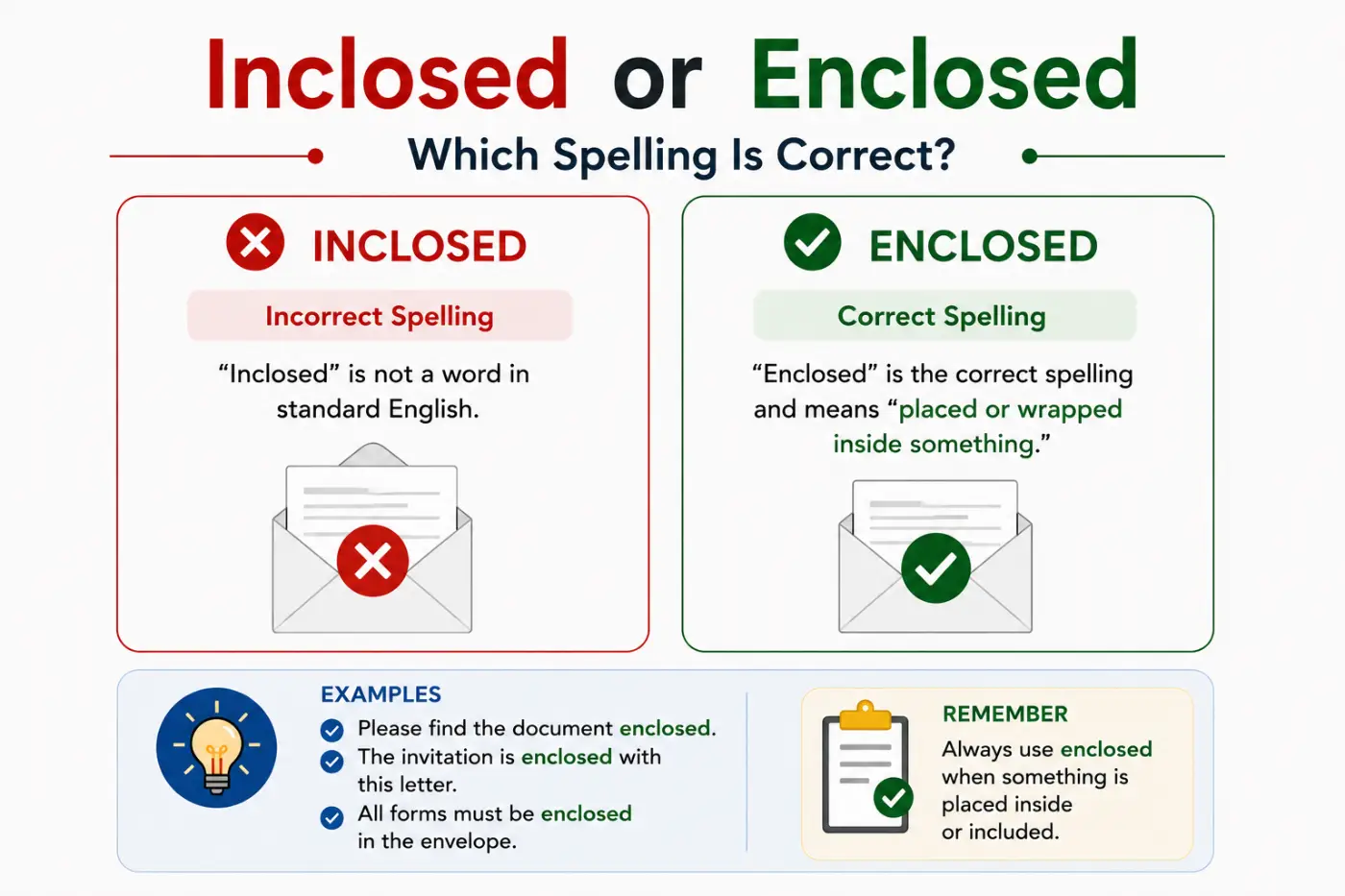
Inclosed or Enclosed is a spelling question that usually comes up when someone sees the older form in a book document or historical text. The two forms have the same basic meaning. The important difference today is that enclosed is the normal modern spelling while inclosed survives mainly as a historical or less common variant. Merriam Webster lists inclosed as a less common variant connected to the verb enclose.
If you’re writing an email, business letter, school assignment, legal document, application, or everyday message, use enclosed. It describes something you put inside another thing or something a boundary surrounds. For example, you can write that you enclosed a document with a letter or that a fence encloses the garden.
The confusion makes sense because inclosed has a real history in English. Older dictionaries and literary works used the spelling. Historical sources even show inclosed in definitions and published texts from earlier centuries. Today the spelling has largely settled on enclosed in ordinary modern writing.
Short Answer
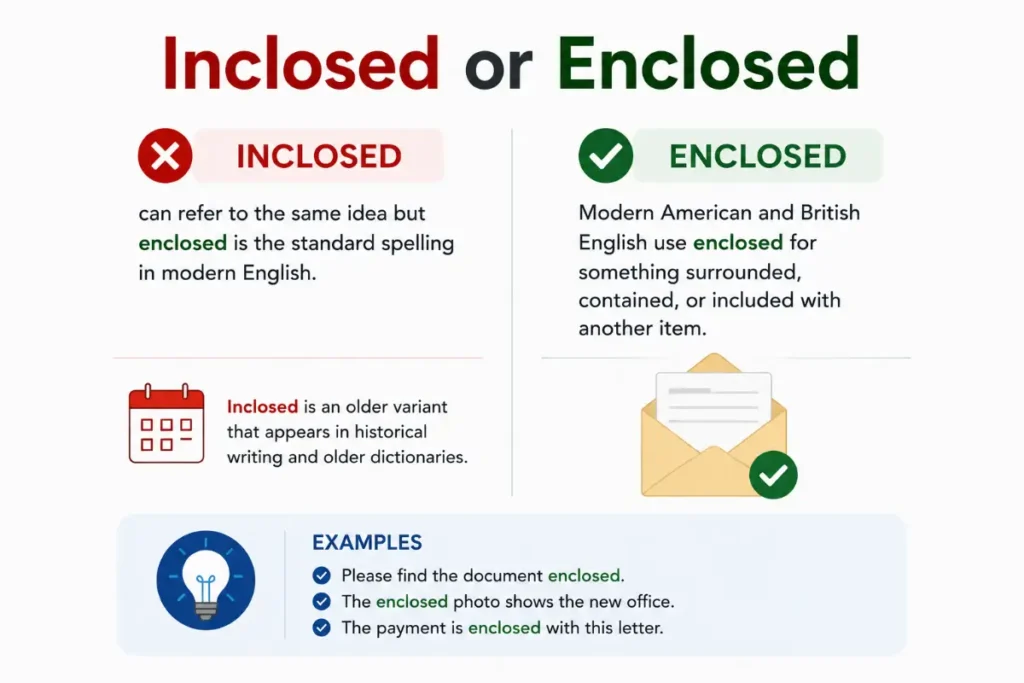
Inclosed or Enclosed can refer to the same idea but enclosed is the standard spelling in modern English. Inclosed is an older variant that appears in historical writing and older dictionaries. Modern American and British English use enclosed for something surrounded contained or included with another item.
Table Of Contents
- Inclosed or Enclosed at a glance.
- What enclosed means.
- What inclosed means.
- The main difference between the two spellings.
- How to use enclosed correctly.
- Enclosed as a past participle.
- Enclosed as an adjective.
- Enclosed in letters and emails.
- Enclosed in physical spaces.
- Enclosed in professional writing.
- Pronunciation of enclosed.
- Word origin and history.
- American and British English usage.
- Common mistakes.
- Memory tips.
- Related words.
- Real life examples.
- Frequently asked questions.
- Key takeaways.
- Conclusion.
Inclosed or Enclosed At A Glance
The easiest answer is simple. Use enclosed in modern English.
| Form | Modern status | Meaning | Best use |
|---|---|---|---|
| Enclosed | Standard modern spelling | Surrounded contained or included | Everyday and professional writing |
| Inclosed | Historical or less common variant | Surrounded contained or included | Historical texts and quotations |
| Enclose | Standard verb | To surround contain or include | Modern writing |
| Inclose | Less common variant | Same basic meaning as enclose | Mainly historical or uncommon usage |
Merriam Webster lists enclosed as the standard form and inclosed as a less common variant. It defines enclosed as meaning to close something in, surround it with a boundary, or include it with something else in a parcel or envelope. This distinction matters because a spelling can have a legitimate history without being the best choice for modern writing. Think of inclosed as an old road that still appears on the map. You may find it in older texts, but for current writing, use enclosed as the standard form.
What Enclosed Means
Enclosed generally means surrounded by something or placed inside something.
It can describe a physical space.
The garden is enclosed by a wooden fence.
It can also describe an object placed inside another object.
The receipt is enclosed with the package.
The same word can describe something included in a letter.
The signed form is enclosed with this letter.
Merriam Webster gives these major meanings for enclosed. Something can be closed in or fenced off. Something can also be included along with another item in a parcel or envelope.
The meaning depends on the surrounding sentence.
Consider these two examples.
The children played in an enclosed yard.
Here enclosed tells us that the yard has some kind of boundary around it.
The application form is enclosed with the letter.
The core idea stays similar. Something has been brought inside a defined space or included with something else.
What Inclosed Means
Inclosed has the same basic meaning as enclosed.
It can mean surrounded contained confined or included.
The difference is mainly one of modern usage and spelling preference.
Historical sources show inclosed in older English. Wiktionary records it as an alternative form of enclosed and gives examples from nineteenth and early twentieth century texts.
Older dictionaries also recognized the form. A historical American dictionary from 1828 defined inclosed with meanings such as surrounded encompassed confined on all sides and covered or sealed.
That history explains why you may see the spelling in older books or documents.
It doesn’t mean you should normally choose it today.
Modern readers expect enclosed. Using inclosed in a current email or formal document can make the writing look old fashioned or simply misspelled.
The Main Difference Between The Two Spellings
The central difference is not meaning.
The central difference is modern usage.
| Point | Enclosed | Inclosed |
|---|---|---|
| Meaning | Surrounded contained or included | Surrounded contained or included |
| Modern English | Standard | Less common historical variant |
| American English | Preferred | Rare |
| British English | Preferred | Historical or less common |
| Business writing | Recommended | Avoid |
| Academic writing | Recommended | Avoid unless discussing historical language |
| Historical writing | Appropriate | May appear in original texts |
Collins also records inclosed as a British English variant of enclosed while giving enclosed as the main form.
So the practical rule is easy.
Use enclosed for modern writing.
Recognize inclosed when you encounter it in older material.
Why Enclosed Is Preferred Today
English spelling changes over time. Words that once had multiple spellings often settle into one dominant form.
That happened with enclose and enclosed.
Modern dictionaries clearly show enclose as the main verb and enclosed as its usual past tense and past participle. Merriam Webster still acknowledges inclose and inclosed as variants but marks them as less common.
This gives modern writers a useful rule.
Don’t treat every historical spelling as a current spelling option.
English has many examples of older forms that survive in books but rarely belong in contemporary writing. Language changes because readers writers publishers teachers and institutions gradually favor particular forms.
The same process explains why enclosed feels natural today.
When you write the word in a professional document your reader probably won’t pause over it. When you write inclosed the unusual spelling may distract the reader from your message.
Good writing removes avoidable distractions.
How To Use Enclosed Correctly
Enclosed usually appears as the past participle of enclose or as an adjective.
As a past participle it often works with forms of be.
The documents are enclosed with the application.
As an adjective it describes something that is surrounded or closed in.
We held the meeting in an enclosed room.
The house has an enclosed patio.
It can also appear after a noun.
Please review the enclosed document.
The enclosed material contains the information you requested.
Notice how the word connects naturally to nouns such as document area room package yard letter form and space.
Enclosed As A Past Participle
The verb is enclose.
Its main forms are:
| Form | Example |
|---|---|
| Base form | Enclose the document |
| Third person | She encloses the document |
| Present participle | She is enclosing the document |
| Past tense | She enclosed the document |
| Past participle | The document was enclosed |
The past participle can appear in passive constructions.
The receipt was enclosed with the order.
The documents were enclosed in a sealed envelope.
It can also appear in perfect constructions.
She has enclosed the signed agreement.
They had enclosed the necessary forms.
The grammar is straightforward because enclosed behaves like the normal past form of enclose.
Enclosed As An Adjective
The word can also function as an adjective.
An adjective describes a person place thing or idea.
An enclosed porch has a physical barrier around it.
This distinction is useful because enclosed doesn’t always describe an action.
Compare these examples.
The workers enclosed the patio.
Here enclosed is a verb.
The patio is enclosed.
Here enclosed describes the condition of the patio.
The enclosed patio is warm in winter.
Here enclosed directly describes the patio.
The form stays the same but the grammatical role changes.
Enclosed In Letters And Emails
One of the most familiar uses appears in formal correspondence.
A traditional letter might say:
Please find the enclosed invoice.
The enclosed documents contain the requested information.
I have enclosed a copy of the receipt.
These sentences tell the reader that something has been included with the communication.
In modern email writing the situation can be slightly different.
If you attach a file to an email you might write:
I’ve attached the completed form.
I’ve attached the invoice for your review.
Please see the attached document.
Attached is usually more natural for digital files.
Enclosed still works best when referring to something physically included with a letter package envelope or other physical item.
That distinction can make professional writing sound more natural.
Enclosed In Physical Spaces
The word also commonly describes something surrounded by a physical boundary.
An enclosed balcony has walls windows or other barriers that separate it from the outside.
An enclosed parking area has a defined boundary or structure.
Merriam Webster gives examples involving enclosed yards porches and spaces.
You can also use the word for natural or manufactured objects.
The filling is enclosed inside the pastry.
The meaning stays connected to the idea of being surrounded or contained.
Enclosed In Professional Writing
Professional writers often use enclosed when referring to physical documents.
Examples include:
The enclosed report provides the requested details.
Please review the enclosed contract.
We have included the enclosed receipt for your records.
The enclosed documents contain supporting evidence.
There is one useful style point here.
Don’t use formal wording just because it sounds official.
For a physical letter enclosed is completely natural.
Clear writing puts the reader first.
Pronunciation Of Enclosed
Enclosed is pronounced approximately like:
in KLOHZD
The pronunciation is represented in American English as /ɪnˈkloʊzd/. Merriam Webster gives this pronunciation for the adjective and related verb.
The stress falls on the second syllable.
Say it naturally:
in KLOHZD.
The ending sounds like zd rather than a separate full syllable.
The related verb enclose is pronounced approximately:
in KLOHZ.
The final d appears in the past form.
You don’t need to overthink the pronunciation. The word usually flows naturally in connected speech.
Word Origin And History
The history of enclose helps explain why inclosed exists. Merriam Webster traces enclose to Middle English and connects it with Anglo French forms. The deeper history reaches back to Latin roots related to the idea of enclosing or shutting in. Merriam Webster dates the first known use of enclose in English to the fourteenth century. Older English writing often showed variation in spelling. That variation wasn’t necessarily treated as an error at the time. Historical dictionaries provide evidence of inclosed as an established spelling. Noah Webster’s 1828 dictionary included an entry for inclosed and defined it as something surrounded encompassed confined or sealed.
Older literature also contains the form.
Wiktionary records inclosed as an alternative form of enclosed and provides historical examples from published works. This is why finding inclosed in an old text doesn’t automatically mean the author made a spelling mistake. Language has a long memory. Modern English simply favors a different form.
American And British English Usage
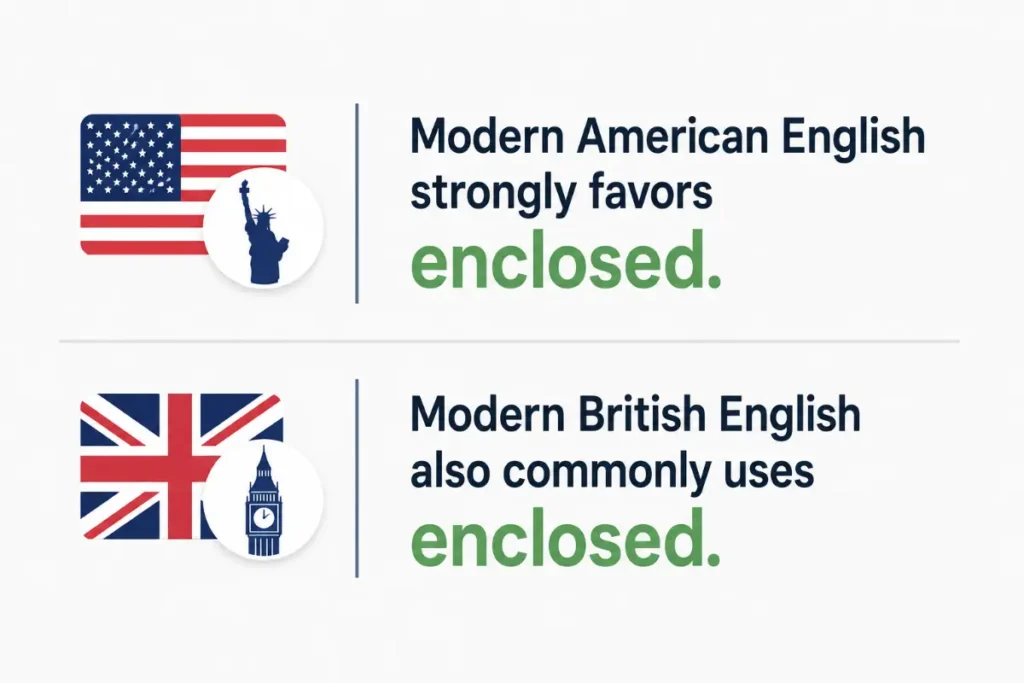
Modern American English strongly favors enclosed. Modern British English also commonly uses enclosed. Collins lists enclosed as the main form and records inclosed as a British English variant. So this isn’t a case where American English uses one spelling and British English uses another in the way you might see with some words such as color and colour. You may still encounter inclosed in older British writing or historical documents. That makes the distinction more about time and style than modern national spelling.
Common Mistakes
Using Inclosed In Modern Business Writing
A writer may see inclosed in an old document and assume it remains equally common today.
That can create an awkward sentence.
Less suitable:
The inclosed documents are ready for review.
Better:
The enclosed documents are ready for review.
The second version matches current standard usage.
Assuming Inclosed Is Always A Typo
This mistake goes in the opposite direction.
If you see inclosed in a historical document you shouldn’t automatically assume the writer made an error.
The spelling has historical evidence behind it. Dictionaries and historical texts confirm that it was used in earlier English.
The better interpretation is that it is an older variant.
Using Enclosed For Digital Attachments
This isn’t necessarily grammatically wrong but it can sound dated.
If you’ve attached a PDF to an email you might say:
Please see the attached PDF.
That sentence is more direct than:
Please see the enclosed PDF.
For a physical letter the second wording makes much more sense.
Confusing Enclosed With Included
The two words can overlap but they aren’t always interchangeable.
Included focuses on something being part of a group or package.
Enclosed often suggests that something has been physically placed inside or surrounded by something else.
The receipt is included in the report.
The receipt is enclosed with the letter.
The first sentence emphasizes membership.
The second emphasizes physical placement with the letter.
Confusing Enclosed With Encased
Encased usually suggests that something is tightly surrounded by a material or protective covering.
The artifact was encased in glass.
Enclosed has a broader meaning.
The artifact was enclosed in a display case.
The words can overlap but their imagery differs.
Memory Tips
The simplest memory trick is to connect enclosed with enclose.
If you know the verb is enclose then the past form is enclosed.
Enclose.
Enclosed.
Enclosing.
Encloses.
Another useful trick is to think of the word close inside enclose.
Something that is enclosed is closed in.
A garden enclosed by a fence is closed in.
The spelling becomes easier when the meaning gives you a visual clue.
Picture a box.
Something goes inside.
The box closes around it.
That is the basic idea behind enclosed.
Related Words
Several words sit close to enclosed in meaning.
Contained means held inside something.
The liquid is contained in the bottle.
Surrounded means having something on all sides.
The house is surrounded by trees.
Included means made part of something.
The price includes delivery.
These words overlap but each has its own focus.
Choosing the right one depends on what you want the reader to picture.
Real Life Examples
The enclosed garden gives the children a safe place to play.
The word describes a garden surrounded by a boundary.
Please review the enclosed agreement before signing.
The hotel has an enclosed swimming pool.
The word describes a pool located within a defined structure.
The package contains an enclosed instruction booklet.
The animals remain in an enclosed area during the night.
The phrase emphasizes the physical boundary around the area.
She enclosed a photograph with the letter.
Here enclosed is the past form of the verb enclose.
The enclosed porch stays comfortable during cold weather.
Here enclosed functions as an adjective.
The workers enclosed the balcony with glass.
This sentence uses enclosed as a verb.
The phrase describes a space surrounded by walls.
The application was returned with the required documents enclosed.
The word shows that the documents were included with the returned application.
When To Use Enclosed
Choose enclosed when you are writing for a modern audience.
It works well in academic writing.
Examples include enclosed spaces enclosed systems enclosed structures enclosed areas and enclosed containers.
The word is flexible because its central meaning remains easy to understand.
When To Use Inclosed
There are only a few situations where inclosed makes sense today.
You may reproduce a historical document exactly as written.
You may be studying older dictionaries or literature.
In those situations preserving the original spelling can matter.
For normal modern writing use enclosed.
This distinction lets you respect historical English without carrying an old spelling into current communication.
Why The Confusion Persists
The confusion comes from the fact that both forms have existed for a long time.
English didn’t always have one fixed spelling for every word.
Printing eventually encouraged greater consistency but variation continued across periods and regions.
The existence of older books containing inclosed can therefore make modern writers wonder if both forms remain equally acceptable.
Dictionary evidence gives a clearer answer.
Merriam Webster lists enclosed as the main form while acknowledging inclosed as a less common variant.
Collins similarly gives enclosed as the main form and records inclosed as a variant.
That means the safest modern choice is straightforward.
Write enclosed.
Grammar Notes For Enclose
The base verb enclose normally takes a direct object.
She enclosed the receipt.
They enclosed the documents.
The company enclosed a copy of the agreement.
The verb can also appear in passive structures.
The documents were enclosed with the letter.
The word can describe surrounding something.
A fence encloses the garden.
The walls enclose the courtyard.
The trees enclose the house.
It can also describe putting something inside.
Please enclose the completed form.
She enclosed a photograph with the card.
The company enclosed a return label in the package.
These different uses all connect to the same central idea of closing in or including.
Enclosed And Attached
Modern writers sometimes wonder if enclosed and attached mean the same thing.
They can overlap in communication but they aren’t identical.
Enclosed traditionally suggests something physically placed inside a letter package or envelope.
Attached is especially common for digital communication.
For example:
Please see the enclosed invoice.
This sounds natural in a physical letter.
Please see the attached invoice.
This sounds natural in an email.
The distinction is practical rather than complicated.
Use the word that matches the medium.
Enclosed And Included
Included is broader.
If a package contains a receipt you can say the receipt is included.
If the receipt is physically placed inside a letter you can say it is enclosed with the letter.
The two words can sometimes describe the same situation.
Their emphasis differs.
Included focuses on membership.
Enclosed focuses on containment or surrounding.
That small distinction can make your writing more precise.
Enclosed And Surrounded
These words also overlap.
The house is surrounded by trees.
The house is enclosed by a fence.
The first sentence focuses on things around the house.
The second suggests a boundary that closes the space in.
A fence can enclose a property.
Trees can surround a property.
The difference becomes clearer when you imagine a physical boundary.
Enclosed often carries the idea of being closed in.
Surrounded simply describes being on all sides.
Enclosed And Confined
Confined often suggests restriction.
The dog was confined to the yard.
Enclosed describes the physical condition.
The dog was kept in an enclosed yard.
The first sentence focuses on limitation.
The second focuses on the nature of the space.
This distinction matters in professional writing because the emotional tone changes.
Confined can sound restrictive.
Enclosed can sound neutral.
Professional Writing Tips
When writing a formal letter keep your wording direct.
Instead of using an unusual historical spelling use the modern standard form.
Write:
The enclosed documents provide the requested information.
Avoid:
The inclosed documents provide the requested information.
For email communication use attached when referring to a digital file.
When reproducing historical material preserve its original spelling if accuracy requires it.
Good editing isn’t about making every sentence sound formal. It’s about choosing language that fits the reader and situation.
Key Takeaways
- Enclosed is the standard modern spelling.
- Inclosed is an older or less common variant.
- Use enclosed in modern American English.
- Modern British English also commonly uses enclosed.
- Inclosed may appear in historical books documents and older dictionaries.
- Use enclosed for physical items included with letters and packages.
- Use attached more naturally for digital files in emails.
- Enclosed can function as a past participle or adjective.
- The pronunciation is approximately in KLOHZD.
Conclusion
Inclosed or Enclosed can be confusing because both forms have appeared in English. The modern choice is clear. Use enclosed when you mean surrounded contained or included with another item. Major dictionaries recognize enclosed as the main modern form while still recording inclosed as a less common variant.
The older spelling still has value when you’re reading historical material. It appears in older dictionaries and published works so seeing it in an old document doesn’t automatically mean the original writer made a mistake. For modern emails letters academic work business documents and everyday writing however enclosed is the clear choice.
If you remember only one rule remember this one. Write enclosed in modern English. Use inclosed only when the historical context makes the older spelling relevant. That simple choice will keep your writing current clear and natural.
Frequently Asked Questions
Is Enclosed The Correct Spelling?
Yes. Enclosed is the standard modern spelling. Major dictionaries use it as the main form and recognize inclosed as a less common variant.
Is Inclosed A Misspelling?
Not necessarily. Inclosed has a documented history in English and appears in older dictionaries and literature. In modern everyday writing however enclosed is the preferred form.
Should I Write Inclosed Or Enclosed?
Choose enclosed for modern writing. It is the form readers expect in American English and it is also the usual modern form in British English.
Does Enclosed Mean Included?
It can. Use enclosed when you put an item inside a letter, package, or envelope. The word can also describe something that a boundary surrounds or closes in.
Is Enclosed Used In American English?
Yes. Enclosed is standard in American English. It works in everyday writing as well as academic business legal and professional communication.
Is Inclosed Used In British English?
Historical and variant use exists in British English. Collins records inclosed as a British English variant but gives enclosed as the main form.
Can I Say Enclosed In An Email?
You can but attached is usually clearer when you mean a digital file. Enclosed sounds more natural for a physical letter or package.
What Is The Difference Between Enclosed And Included?
Enclosed often emphasizes something being physically inside or surrounded by something else. Included emphasizes that something forms part of a larger group or package.
What Is The Difference Between Enclosed And Attached?
Enclosed commonly refers to something physically placed inside a letter package or envelope. Attached is especially common for files sent electronically.
How Do You Pronounce Enclosed?
The American English pronunciation is approximately in KLOHZD. The main stress falls on the second syllable. Merriam Webster gives the pronunciation as /ɪnˈkloʊzd/.
Is Enclosed A Verb Or Adjective?
It can be both depending on the sentence. It can also function as an adjective when it describes something that is surrounded or contained.
Can I Use Inclosed In A Formal Letter?
For modern formal writing you should use enclosed. Use inclosed mainly when preserving historical wording or discussing historical spelling.

Confusing Words, Spelling & Word Choice
Claire Whitmore is a U.S.-based English editor who writes about commonly confused words, spelling differences, and word choice. Her work helps readers understand subtle distinctions between similar-looking words through simple definitions, practical examples, and modern usage guidance in both American and British English.