
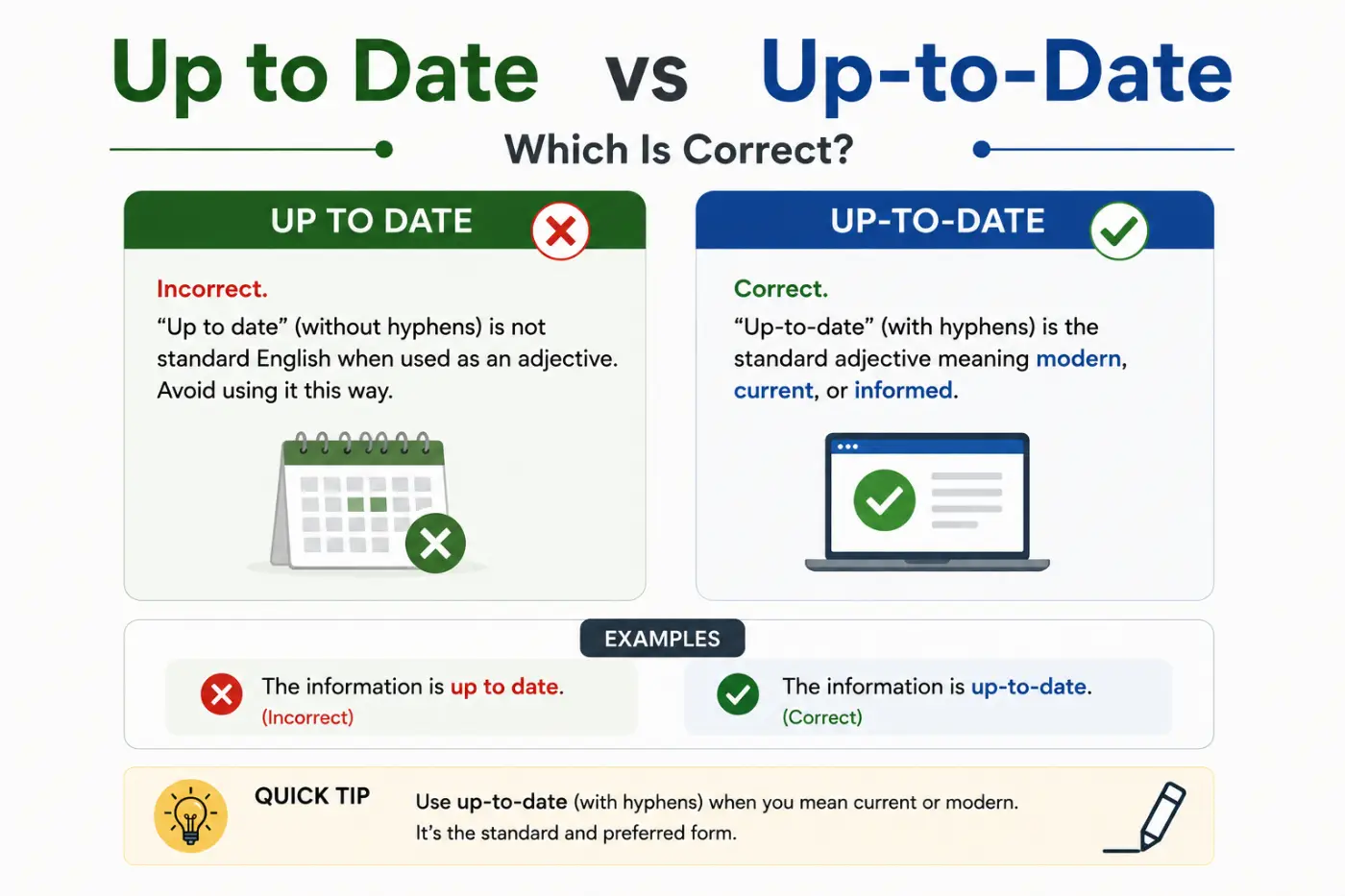
Up to Date vs Up-to-Date often confuses writers because the meaning stays the same while the punctuation changes. Both forms refer to something current or updated. The main difference comes from the grammatical position of the expression.
You normally write up-to-date when it directly describes a noun. You might say an up-to-date report or up-to-date information. When the expression follows a verb such as keep or bring you usually write up to date without hyphens.
This small punctuation difference can make a sentence look polished or awkward. The good news is that the rule becomes much easier once you focus on the job the phrase performs. This guide explains the difference with clear examples and practical rules you can use in school work professional writing emails reports and everyday English.
Short Answer
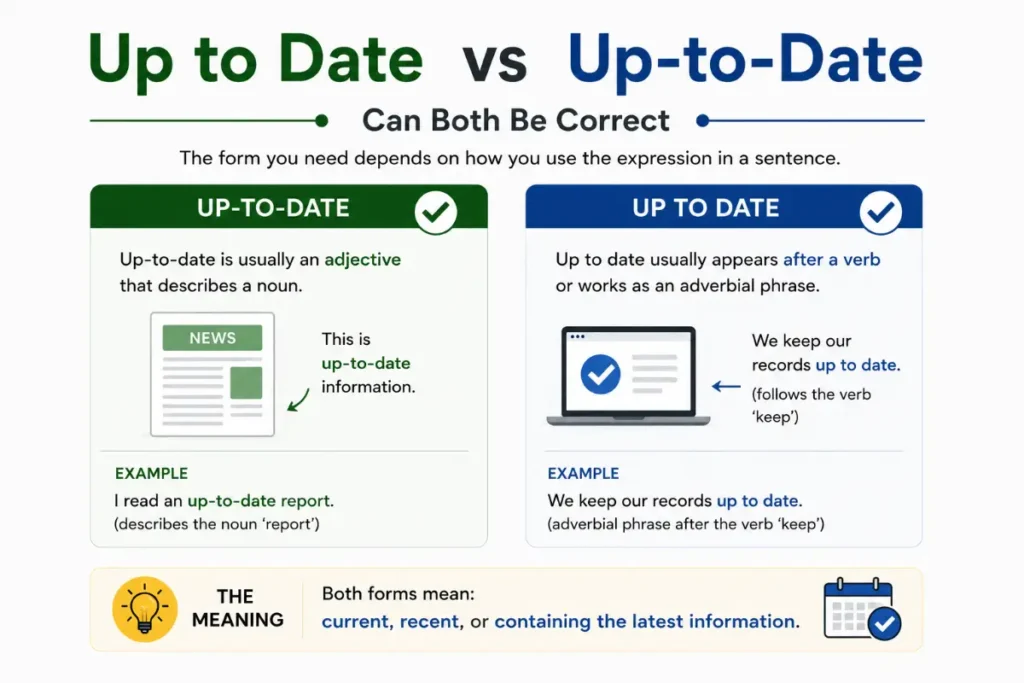
Up to Date vs Up-to-Date can both be correct. The form you need depends on how you use the expression in a sentence. Up-to-date is usually an adjective that describes a noun. Up to date usually appears after a verb or works as an adverbial phrase. The meaning is current recent or containing the latest information.
Table of Contents
- The Quick Rule.
- What Up To Date Means.
- What Up To Date Means Without Hyphens.
- When To Use Up To Date.
- When To Use Up To Date With Hyphens.
- The Grammar Rule Behind The Hyphens.
- Comparison Table.
- Examples In Real Sentences.
- Common Mistakes.
- Up To Date After Linking Verbs.
- Up To Date In Professional Writing.
- American And British English.
- Pronunciation And Stress.
- Word Origin And Development.
- Memory Tips.
- Related Expressions.
- Frequently Asked Questions.
- Key Takeaways.
- Conclusion.
The Quick Rule
The easiest rule is based on what comes immediately after the expression.
Use up-to-date when it comes directly before a noun and acts as an adjective.
For example:
She read an up-to-date report.
The adjective describes the report. The report contains current information.
Use up to date when it follows a verb or appears after the noun it describes.
For example:
She kept the report up to date.
Here the expression comes after the verb kept. It describes the condition of the report rather than sitting directly before the noun.
Another example makes the contrast even clearer.
We need an up-to-date report.
We need to keep the report up to date.
The first sentence uses the hyphenated adjective before report. The second uses the unhyphenated phrase after the verb keep.
That simple pattern solves most cases.
What Up To Date Means
The expression means current or containing the latest available information.
An up-to-date document contains information that reflects recent changes. An up-to-date schedule reflects the latest arrangements.
The phrase can also describe a person who knows about recent developments.
For example:
Maria stays up to date with changes in the law.
This means Maria makes an effort to learn about recent legal developments.
The expression can apply to information technology records knowledge schedules prices instructions and many other things.
Consider these examples.
The database is up to date.
The database contains the latest information.
We need an up-to-date database.
We need a database containing the latest information.
The meaning remains almost identical. The grammatical position changes.
What Up To Date Means Without Hyphens
The unhyphenated form up to date usually appears after a verb.
Common verbs include keep bring stay get remain and bring.
Consider these sentences.
Please keep your records up to date.
I need to bring my contact information up to date.
She stays up to date with industry news.
The software is now up to date.
His knowledge remains up to date.
In each example the phrase comes after the verb. It describes the current condition of something or someone.
This construction is extremely common in everyday American English.
You may hear a manager say that a spreadsheet needs to stay up to date. A teacher may ask students to keep their notes up to date. A doctor may recommend keeping vaccination records up to date.
The phrase works naturally after these verbs because it functions as a complement or adverbial phrase rather than as a compound adjective placed directly before a noun.
When To Use Up To Date
Use up to date without hyphens when the phrase comes after the noun or after a verb.
Here are several useful patterns.
After Keep
Keep your resume up to date.
The phrase describes the condition of the resume.
After Bring
Please bring the records up to date.
This means update the records so they contain current information.
After Stay
Try to stay up to date with the latest regulations.
The expression describes the state the person maintains.
After Get
I need to get up to date on the new policy.
The phrase describes the knowledge the speaker needs to gain.
After Be
The website is up to date.
The phrase follows the verb is and describes the website.
These patterns appear often in professional communication.
When To Use Up To Date With Hyphens
Use up-to-date when the entire expression directly modifies a noun before that noun.
For example:
We need up-to-date information.
She used an up-to-date textbook.
The company published an up-to-date report.
He gave us an up-to-date analysis.
The website provides up-to-date information.
The hyphens show that the words work together as one adjective before the noun.
This helps the reader understand that the phrase forms a single descriptive unit.
The same principle appears in many English expressions.
You might write a well-known author or a high-quality product. The hyphens connect words that work together before a noun.
The Grammar Rule Behind The Hyphens
Hyphens can help prevent confusion when several words combine to modify a noun.
In up-to-date information the three words work together as one adjective. The hyphens visually connect them.
Without the hyphens the reader could momentarily interpret the words separately.
The same idea applies to these examples.
An easy-to-use device.
A long-term solution.
A well-written report.
An up-to-date database.
However the hyphens usually disappear when the expression follows the noun or a linking verb.
The device is easy to use.
The solution is long term.
The report is well written.
The database is up to date.
This distinction is one of the most useful punctuation patterns in English compound modifiers.
Up to Date or Up-to-Date Comparison Table
| Form | Typical position | Function | Example |
|---|---|---|---|
| up-to-date | Before a noun | Adjective | We need up-to-date information. |
| up to date | After a verb | Complement or phrase | The information is up to date. |
| up to date | After keep | Describes maintained condition | Keep the information up to date. |
| up to date | After stay | Describes current knowledge | Stay up to date with the news. |
| up-to-date | Before a noun | Compound adjective | She used an up-to-date guide. |
The table shows why both forms exist. The choice depends mainly on grammatical position rather than meaning.
Examples In Real Sentences
Understanding the rule becomes easier when you see it in natural sentences.
Example One
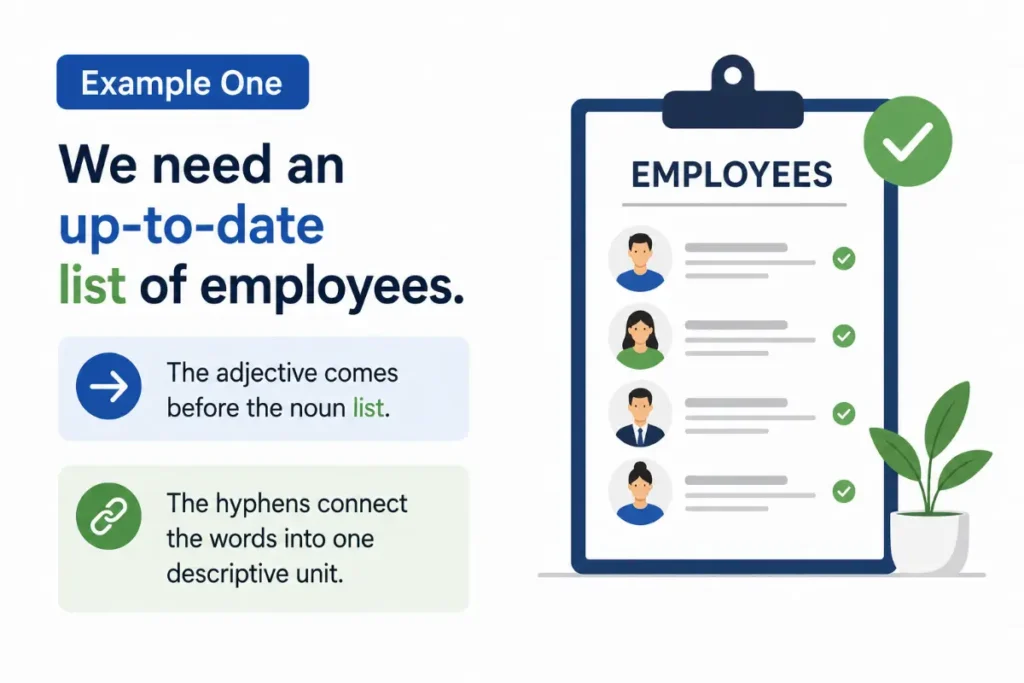
We need an up-to-date list of employees.
The adjective comes before the noun list. The hyphens connect the words into one descriptive unit.
Example Two
Please keep the employee list up to date.
The expression comes after keep. It describes the condition of the list.
Example Three
The information on this page is up to date.
The phrase follows the linking verb is. No hyphens are needed.
Example Four
The manager prepared an up-to-date sales report.
The compound adjective directly modifies report. The hyphens are appropriate.
Example Five
Our team works hard to stay up to date with market changes.
The phrase follows stay and describes the team’s current knowledge.
Example Six
We received an up-to-date safety guide.
The adjective appears before safety guide. The hyphens make the compound modifier clear.
Example Seven
You should bring your records up to date.
The phrase follows bring. It means you should update the records.
Example Eight
The company needs up-to-date customer information.
The adjective comes directly before customer information. The hyphens are correct.
Example Nine
Her knowledge of the subject is up to date.
The expression comes after is. The unhyphenated form is correct.
Example Ten
He bought an up-to-date dictionary.
The adjective directly modifies dictionary. The hyphenated form is standard.
Common Mistakes
Many writers make the same punctuation mistakes with this expression.
Mistake One
A common error is writing:
We need an up to date report.
The intended adjective comes before report. The preferred form is:
We need an up-to-date report.
The hyphens connect the words that modify report.
Mistake Two
Another common error is writing:
Please keep the records up-to-date.
In this position the expression follows keep. Standard usage normally leaves out the hyphens.
The better version is:
Please keep the records up to date.
Mistake Three
Some writers hyphenate the expression every time they use it.
That approach is easy to remember but grammatically inaccurate.
The hyphen isn’t part of the phrase in every position. Its use depends on how the expression functions in the sentence.
Mistake Four
Some writers remove the hyphens from every sentence.
That creates problems when the phrase directly modifies a noun.
For example:
We need up to date information.
The clearer standard form is:
We need up-to-date information.
Mistake Five
Writers sometimes confuse up to date with updated.
These words overlap in meaning but aren’t always interchangeable.
An updated report usually means someone changed or revised the report.
An up-to-date report means the report contains current information.
A report can be updated but still fail to be up to date if the latest information hasn’t been added.
Up To Date After Linking Verbs
One of the easiest ways to recognize the unhyphenated form is to look for a linking verb.
Common linking verbs include be remain seem appear look and stay.
Consider these examples.
The records are up to date.
The website remains up to date.
Her information seems up to date.
The schedule is up to date.
His knowledge stays up to date.
In these sentences the phrase describes a current state.
You aren’t placing the expression directly before a noun. Instead you are describing the subject after the verb.
This is why the hyphens normally disappear.
Up To Date In Professional Writing
Professional writing uses this expression frequently.
You may see it in business reports technical documentation academic writing customer service messages and workplace emails.
Correct punctuation helps readers move through professional writing quickly.
Consider this sentence:
Please review the up-to-date financial report before the meeting.
The hyphenated adjective makes the meaning clear.
Now compare it with:
Please make sure the financial report is up to date before the meeting.
The second sentence uses the unhyphenated form because the phrase follows is.
Both sentences are professional and natural.
The difference isn’t about formality. It is about grammar.
Up To Date In Academic Writing
Academic writers often need to describe current research information sources data and theories.
For example:
Researchers need access to up-to-date scientific literature.
The adjective comes before scientific literature so the hyphens are appropriate.
Now consider:
Students should keep their references up to date.
The phrase follows keep so the hyphens disappear.
Academic writing also benefits from precise word choice. If you mean recently revised then updated may be more precise. If you mean current and accurate for the present situation then up to date or up-to-date may be the better choice.
American And British English
The basic hyphenation rule is broadly consistent in American and British English.
Both varieties use up-to-date as a compound adjective before a noun.
Both also commonly use up to date after verbs and linking verbs.
You may notice differences in spelling and punctuation across different style guides. Those differences don’t normally change the central rule for this expression.
American writers can confidently use:
We need up-to-date information.
The information is up to date.
British writers can use the same structures.
This makes the expression easier for international readers because the core distinction remains stable.
Pronunciation And Stress
The phrase is usually pronounced with the main stress on date.
You can think of the rhythm as:
up to DATE.
The individual words remain recognizable in speech. The hyphens are purely a writing feature and don’t create a special spoken sound.
When used before a noun the expression still sounds like the same phrase.
For example:
an up-to-date report.
When used after a verb you hear:
the report is up to date.
The punctuation changes on the page but the basic pronunciation stays the same.
Word Origin And Development
The expression combines the ordinary words up to and date.
The word date has long been connected with a point in time. Over time the phrase up to date developed the meaning of being current or brought to the present point.
English often creates useful expressions by combining ordinary words in a way that produces a specific meaning.
Up to date is one of those expressions.
Its modern use is especially common when people discuss information records knowledge technology and changing circumstances.
As information becomes outdated quickly the phrase has become especially useful in professional and digital communication.
Memory Tips
A simple memory trick can help you remember the punctuation.
Think of the noun as a signpost.
If the expression comes directly before the noun then connect the words with hyphens.
For example:
up-to-date information.
If the expression comes after the verb then leave the words open.
For example:
The information is up to date.
Another useful trick is to ask yourself a quick question.
Am I describing a noun before it appears?
If the answer is yes then up-to-date is usually the right form.
Am I describing the condition of something after a verb?
If the answer is yes then up to date is usually the right form.
This small test works in most everyday situations.
Related Expressions
Several expressions have meanings close to up to date.
Current
Current means existing or valid at the present time.
For example:
We need current information.
This word is often shorter and more direct.
Updated
Updated means changed or revised so that newer information has been included.
For example:
The company released an updated policy.
This word focuses more strongly on the act of making a change.
Recent
Recent means happening or appearing not long ago.
For example:
We reviewed recent research.
Recent doesn’t always mean fully current.
Modern
Modern usually refers to something associated with the present or a recent period.
For example:
The school has a modern computer lab.
Modern doesn’t necessarily mean recently updated.
Current Information
Current information is information that remains relevant and accurate at the present time.
For example:
Always check the official source for current information.
The phrase is useful when precision matters.
The Difference Between Updated And Up To Date
Updated and up to date often overlap but they emphasize different ideas.
Updated focuses on a change.
Up to date focuses on the current state.
Imagine a company changes its employee handbook.
The handbook was updated.
If the handbook now includes all the latest policies then it is also up to date.
However a document can be updated without being completely current.
For example an editor might correct a spelling error today but leave several old statistics in the document.
The document was updated but it isn’t fully up to date.
This distinction matters in professional and technical writing.
The Difference Between Current And Up To Date
Current and up to date are also close in meaning.
Current often describes information that applies now.
Up to date emphasizes that something has been kept current.
Compare these examples.
We need current prices.
We need to keep the price list up to date.
The first sentence describes the prices. The second focuses on maintaining the list.
This subtle distinction can help you choose the stronger expression for your sentence.
Why Hyphens Matter
Hyphens aren’t decoration.
They can show readers that several words function together as one modifier.
Consider:
up-to-date information.
The hyphens tell the reader that up to date works as a single descriptive unit before information.
This principle appears across English.
You might write:
a full-time employee.
a high-quality product.
a well-known writer.
an up-to-date report.
After a linking verb the punctuation normally changes.
The employee is full time.
The product is high quality.
The writer is well known.
The report is up to date.
The pattern is remarkably consistent.
A Practical Editing Test
If you’re unsure which form to use in your own writing take one second to inspect the sentence.
Find the noun you want to describe.
If the expression comes immediately before that noun use the hyphenated form.
If the expression follows the noun or follows a verb use the open form.
For example:
She has an up-to-date resume.
She keeps her resume up to date.
The resume is up to date.
All three sentences express a similar idea but the grammar determines the punctuation.
This test is simple enough to use while proofreading an email or report.
How To Use The Phrase Naturally
Good writing isn’t only about punctuation. Word choice also matters.
Don’t use up to date when a more specific word gives the reader better information.
For example:
The report contains the latest sales figures.
This sentence may be stronger than:
The report is up to date.
The first sentence tells the reader exactly what makes the report current.
In other situations the expression is perfectly useful.
For example:
Please keep the customer records up to date.
That sentence clearly communicates an ongoing responsibility.
Strong writing uses the expression when it adds meaning rather than inserting it simply because it sounds formal.
Key Takeaways
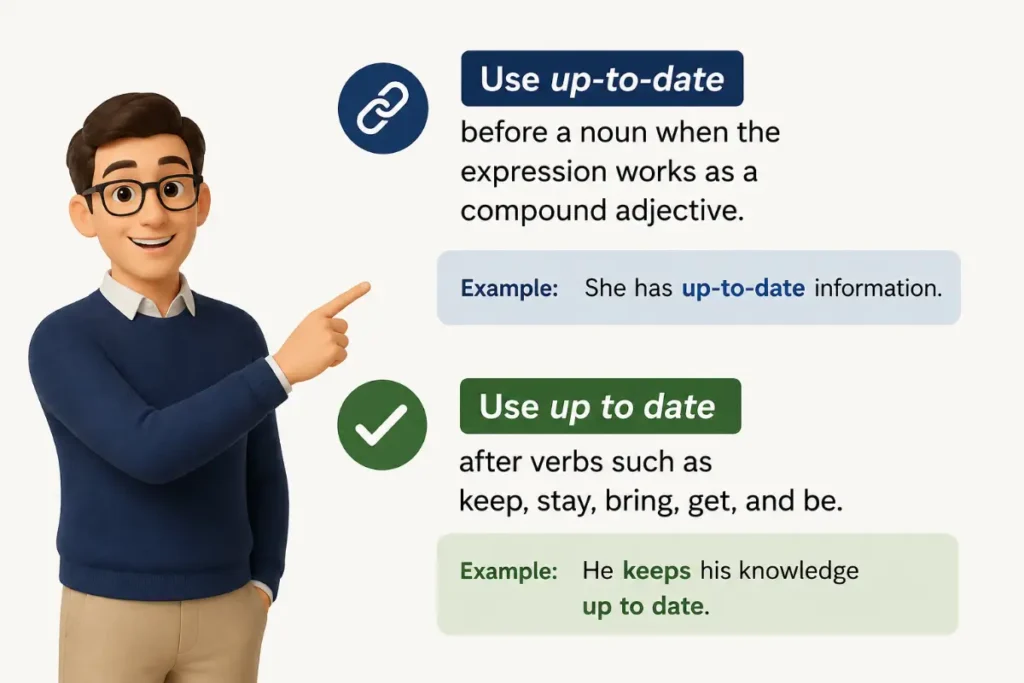
- Use up-to-date before a noun when the expression works as a compound adjective.
- Use up to date after verbs such as keep stay bring get and be.
- Write up-to-date information.
- Write keep the information up to date.
- The meaning usually stays the same while the grammatical position changes.
- Updated focuses on revision while up to date focuses on being current.
- American and British English generally follow the same basic punctuation pattern.
- The easiest test is to look at the position of the expression in the sentence.
Conclusion
Up to Date vs Up-to-Date becomes much easier once you stop treating the hyphen as part of the expression in every sentence. The key is grammatical position. Use up-to-date when the phrase directly modifies a noun before it. Use up to date when it follows a verb or describes something from a later position.
The difference may seem tiny but it reflects a useful English writing principle. Hyphens often connect words that work together as one modifier before a noun. Once the phrase moves after the noun or verb the connection usually disappears.
If you remember only one rule remember this simple pair. Write an up-to-date report but keep the report up to date. That pattern will help you make the right choice in emails reports essays business writing and everyday English with confidence.
Frequently Asked Questions
Is Up To Date Or Up To Date Correct?
Both forms are correct in the right grammatical position. Use the hyphenated form before a noun as a compound adjective. Use the unhyphenated form after a verb or when it describes a noun from a later position.
Should I Write Up To Date With Hyphens?
Use up-to-date when it directly modifies a noun. For example you can write up-to-date information. When the phrase follows a verb use up to date without hyphens.
Is The Website Up To Date Correct?
Yes. The website is up to date is correct because the phrase follows the linking verb is. You don’t need hyphens in this construction.
Is Up To Date Information Correct?
The standard form is up-to-date information. The expression directly modifies information so the words work together as a compound adjective.
Should I Say Keep It Up To Date Or Keep It Up To Date?
The standard form is keep it up to date. The phrase follows keep and describes the condition of it. Hyphens aren’t normally used in this position.
Is Up To Date An Adjective?
It can function as an adjective phrase. When it directly modifies a noun before that noun it is commonly written as the compound adjective up-to-date.
Is Up To Date Formal English?
Yes. The expression works well in casual conversation professional writing academic writing and technical communication. It isn’t restricted to formal English.
What Is The Difference Between Updated And Up To Date?
Updated focuses on something that has been changed or revised. Up to date focuses on something being current. A document can be updated without containing every piece of current information.
Do American And British Writers Use The Same Rule?
Yes. The main hyphenation pattern is generally the same in American and British English. Both varieties use up-to-date before a noun and up to date after a verb or linking verb.
Can Up To Date Describe A Person?
Yes. You can describe someone’s knowledge as up to date. For example you can say that a teacher stays up to date with changes in education.

Confusing Words, Spelling & Word Choice
Claire Whitmore is a U.S.-based English editor who writes about commonly confused words, spelling differences, and word choice. Her work helps readers understand subtle distinctions between similar-looking words through simple definitions, practical examples, and modern usage guidance in both American and British English.