
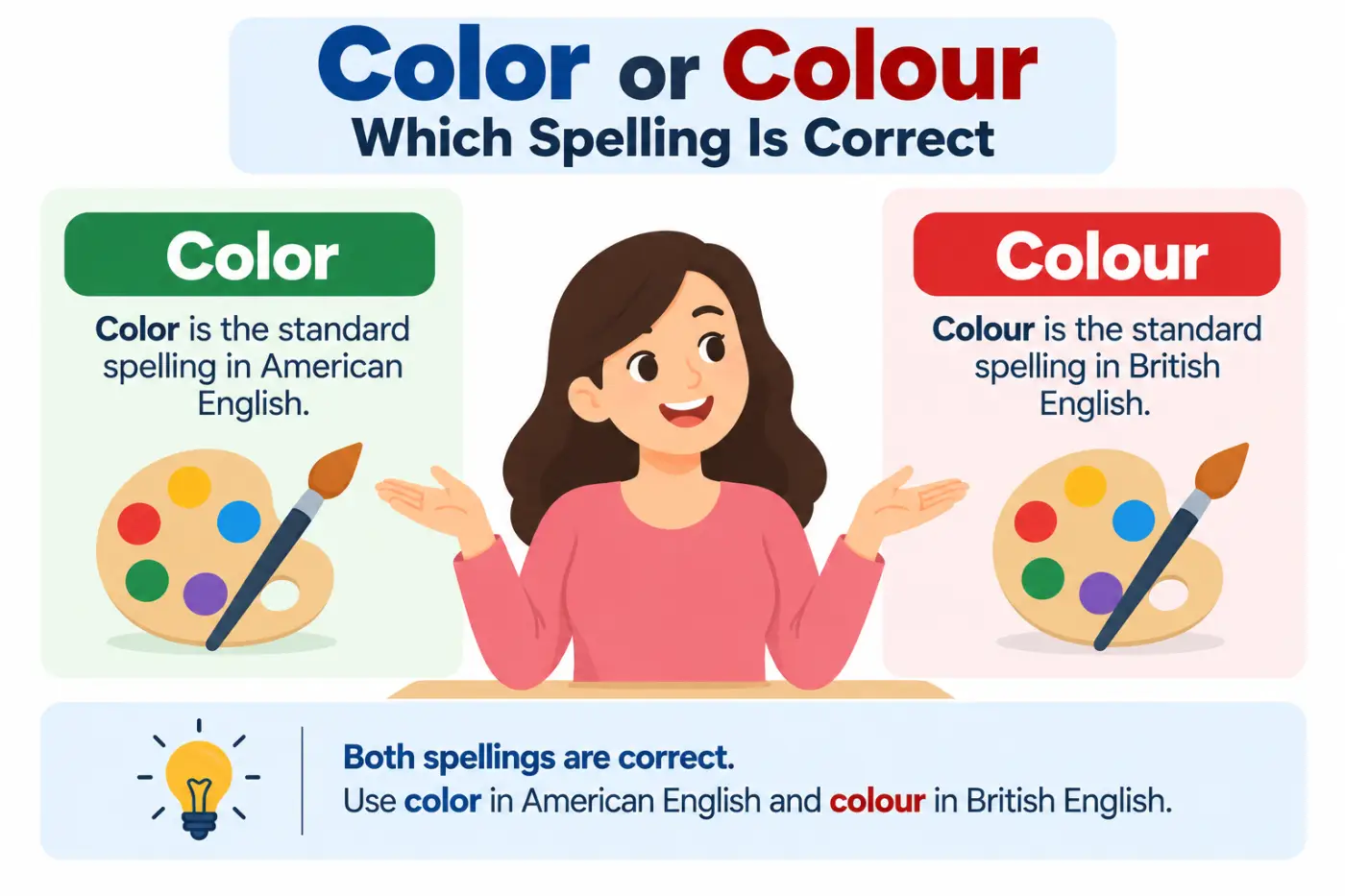
Color vs. Colour is a common spelling difference between American and British English. American writers generally use color, while British writers prefer colour. Both spellings are correct, so the choice depends on the variety of English you’re using.
The two words have the same meaning. They describe the visual quality we perceive when light reaches our eyes. They can also refer to tone, character, or emotional impression. Although the spelling changes, the pronunciation remains essentially the same.
The key is to follow regional spelling conventions and stay consistent throughout your writing. If you’re writing for an American audience, choose color. For British English, use colour. Canadian and Australian English also have their own spelling conventions, so check the relevant style guide when needed. Once you know your audience, choosing the correct form becomes simple.
Short Answer
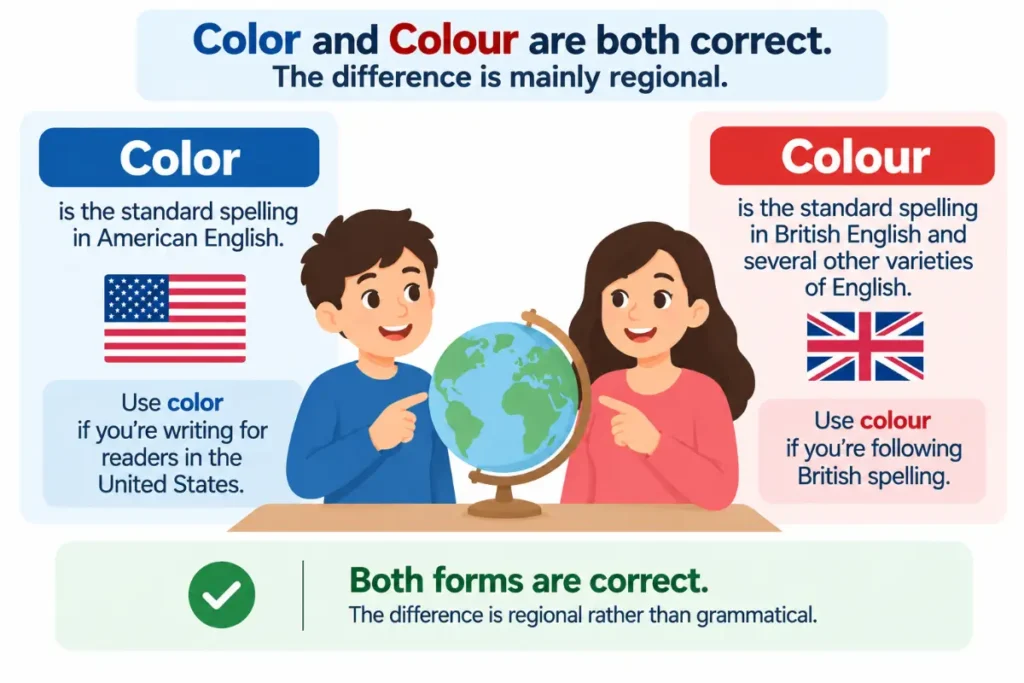
Color is the standard spelling in American English. Colour is the standard spelling in British English and several other varieties of English. Both forms are correct. The difference is mainly regional rather than grammatical. If you’re writing for readers in the United States use color. If you’re following British spelling use colour.
Table Of Contents
- What the two spellings mean.
- The main difference between the forms.
- American English usage.
- British English usage.
- Canadian English usage.
- Australian English usage.
- Pronunciation.
- Grammar and word forms.
- Examples in sentences.
- Common spelling mistakes.
- Why American English dropped the letter.
- Word origin and history.
- Formal and informal writing.
- How to choose the right spelling.
- Memory tips.
- Related spelling differences.
- Professional editing advice.
- Frequently asked questions.
- Key takeaways.
- Conclusion.
The Meaning Of Both Forms
The meaning stays the same in the two spellings.
Color and colour can refer to the appearance of an object created by the way it reflects or emits light.
For example:
The wall is a bright blue color.
The wall is a bright blue colour.
The meaning doesn’t change. Only the regional spelling changes.
The word can also have broader meanings. It can describe the character or quality of something.
For example:
Her stories added color to the discussion.
Her stories added colour to the discussion.
Again the meaning stays the same.
The word can also work as a verb.
American English uses color as both a noun and a verb.
British English uses colour as both a noun and a verb.
For example:
The artist colored the drawing.
The artist coloured the drawing.
Both sentences describe the same action.
The Main Difference
The key difference is regional spelling.
American English generally removes the u from several words that traditionally contain it in British English.
This pattern appears in words such as:
- Color and colour.
- Favor and favour.
- Honor and honour.
- Labor and labour.
- Neighbor and neighbour.
- Behavior and behaviour.
The pattern is useful because it helps you recognize a broader spelling system rather than treating each word as an isolated case.
Still you should avoid assuming that every word ending in our changes in American English. Some words have different histories and follow different rules.
The safest approach is to learn established spellings rather than applying the pattern mechanically.
American English Usage
American English uses color as the standard spelling.
You’ll see it in school writing newspapers books business documents websites product descriptions and everyday communication across the United States.
Examples include:
- What is your favorite color?
- The designer changed the color of the logo.
- The room needs more color.
- She colored the picture with markers.
- The colors looked brighter in natural light.
American English also forms related words without the u.
Colorful is the common American spelling.
Coloring is the common American spelling.
Colored is the common American spelling.
These forms follow the same American spelling pattern.
For a US audience consistency matters more than choosing one spelling as universally correct. If your article uses American English throughout then color is the natural choice.
British English Usage
British English generally uses colour.
This spelling appears in British schools newspapers books government publications and everyday writing.
Examples include:
- What is your favorite colour?
- The designer changed the colour of the logo.
- The room needs more colour.
- She coloured the picture with markers.
- The colours looked brighter in natural light.
British English also keeps the u in related forms.
Colourful is standard British spelling.
Colouring is standard British spelling.
Coloured is standard British spelling.
The important point is that British spelling doesn’t represent a different meaning. It reflects a different spelling convention.
Canadian English Usage
Canadian English can show both British and American influences.
In many contexts Canadian English uses colour and related forms such as colourful. At the same time Canadian English shares many spelling practices with American English.
This can make Canadian spelling look mixed when compared with either variety separately.
For professional writing in Canada the best approach is to follow the style guide or editorial standard used by your organization. A publication may have its own house style.
If you’re writing specifically for an American audience use color.
If you’re writing specifically for a British audience use colour.
Australian English Usage
Australian English generally uses colour.
For example:
The artist chose a deep red colour.
The room was decorated with bright colours.
The word therefore looks different from standard American spelling even though the meaning and pronunciation remain the same.
Australian English has its own vocabulary and usage preferences but its spelling system often retains forms that American English simplified.
Color or Colour In Different Varieties Of English
Color or Colour represents a regional spelling difference rather than a difference in grammar or meaning.
| English variety | Common spelling | Example |
|---|---|---|
| American English | color | The color is beautiful. |
| British English | colour | The colour is beautiful. |
| Canadian English | colour is common | The colour is beautiful. |
| Australian English | colour | The colour is beautiful. |
The table gives the broad pattern. Individual publications and organizations can set their own editorial standards.
The most important lesson is simple. Match the spelling to the English variety you’re using.
Pronunciation
The two spellings are pronounced essentially the same in standard English varieties.
The pronunciation does not normally change simply because the spelling contains an extra u.
The word has two syllables.
The main stress falls on the first syllable.
The pronunciation is commonly represented in IPA as:
/ˈkʌlər/ in many American pronunciations.
British pronunciation can vary by accent but the basic word remains recognizable across English varieties.
The extra u in the British spelling doesn’t create an additional spoken syllable.
This is one reason the spelling difference can cause confusion. You can hear someone say the word and still have no way to know which spelling they would use.
If you’re writing for an American audience the safest choice is color.
If you’re following British spelling use colour.
Grammar And Part Of Speech
The word can function as both a noun and a verb.
Color As A Noun
As a noun the word can identify a visual quality.
For example:
The color of the sky changed.
Here the word identifies a quality that we perceive visually.
It can also refer to a particular shade.
She chose a warm color for the walls.
It can also describe visual variety.
The painting needs more color.
The word can also appear in expressions involving character or atmosphere.
His description added color to the story.
In each case the noun carries a related but context specific meaning.
Color As A Verb
American English uses color as a verb.
For example:
She colored the picture.
The children colored their drawings.
He colored the map to show different regions.
The verb means to add or change color.
British English uses colour in the same grammatical role.
She coloured the picture.
The children coloured their drawings.
The grammatical function stays the same.
Plural Forms
The plural form is straightforward.
American English:
Colors.
British English:
Colours.
For example:
The artist used several colors.
The artist used several colours.
Related Forms
American English:
Colorful.
Colored.
Coloring.
Colorless.
British English:
Colourful.
Coloured.
Colouring.
Colourless.
The regional spelling pattern can therefore continue through several related words.
Sentence Examples
These examples show how the spelling works naturally in American English.
Everyday Conversation
- Blue is my favorite color.
The noun identifies a visual shade that the speaker prefers.
- What color is your new car?
The word refers to the appearance of the car.
- I love the color of these flowers.
The noun describes the flowers’ visual quality.
- That shirt comes in several colors.
The plural noun refers to different available shades.
School Writing
- The student used color to make the poster more attractive.
Here color describes visual variety in a school project.
- The artist mixed two colors to create a new shade.
The plural noun identifies the shades being combined.
- The teacher asked the class to color the map.
Here the word functions as a verb.
Workplace Writing
- The design team changed the color of the button.
The noun refers to a visual element in a design.
- Please use the approved brand colors in the presentation.
The plural noun identifies the official visual shades used by the organization.
Academic Writing
- Color can influence how people perceive a visual design.
The noun refers to a feature of visual presentation.
- The study examined differences in color perception.
The word appears in a compound expression describing visual perception.
Creative Writing
- The sunset filled the sky with color.
The word creates a vivid description of the scene.
- Autumn brought color to the quiet hills.
Here color suggests visual richness and variety.
British English Examples
- Blue is my favorite colour.
This uses the standard British spelling.
- The artist mixed several colours on the palette.
The plural form follows British spelling.
- She coloured the drawing with bright pencils.
The verb uses the British form.
Common Spelling Mistakes
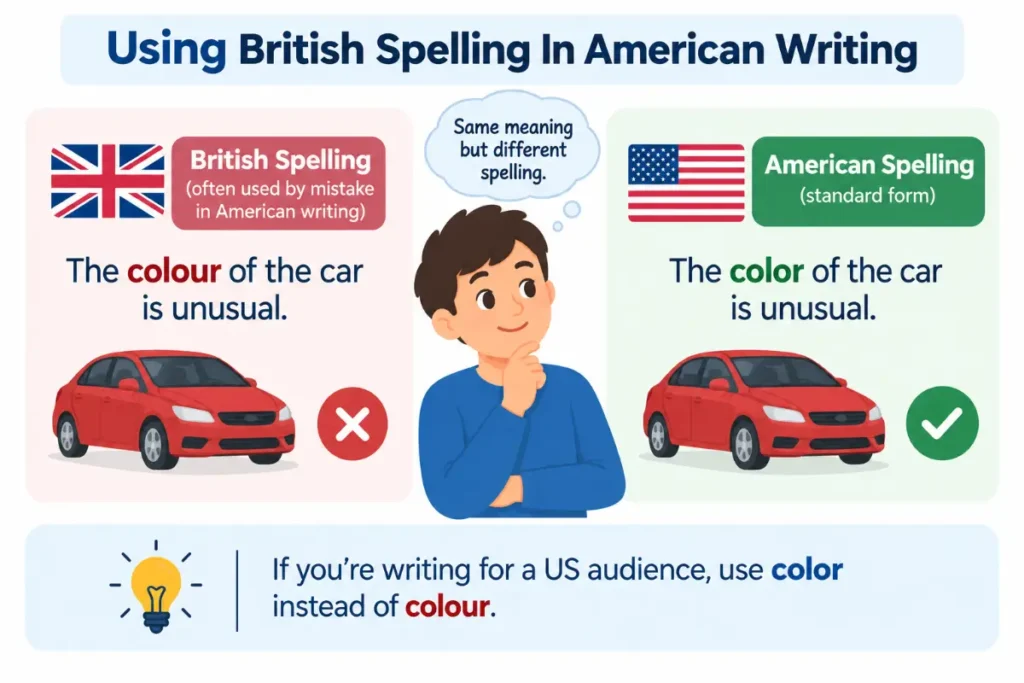
Using British Spelling In American Writing
A US writer may accidentally write:
The colour of the car is unusual.
For standard American English use:
The color of the car is unusual.
The British form isn’t inherently wrong. It simply doesn’t match standard American spelling.
Using American Spelling In British Writing
A British publication may expect:
The colour of the car is unusual.
If the article consistently follows British English then color may look out of place.
Again the issue is consistency.
Mixing Forms In One Document
A common editing problem occurs when writers switch between regional conventions.
For example:
The color of the walls matches the surrounding colours.
The mixed forms may distract readers.
Choose one spelling system and use it throughout the document unless you’re deliberately discussing regional differences.
Changing Related Words Inconsistently
A writer may use color but then write colourful.
For American English the consistent forms are:
Color.
Colorful.
Colored.
Coloring.
For British English the consistent forms are:
Colour.
Colourful.
Coloured.
Colouring.
Treating Colour As A Misspelling
This is a common mistake in American focused writing tools and documents.
Colour is not a misspelling in English generally.
It is the standard spelling in British English and several other varieties.
If your document targets the United States then a style checker may suggest color. That recommendation reflects the selected language variety.
Why American English Uses Color
The difference has a long history.
English spelling developed through several linguistic influences. French played a major role in the development of English vocabulary and spelling after the Norman Conquest.
The spelling with our became established in many words.
Later American English developed spelling preferences that favored shorter forms in several cases. The simplified or ending became standard in words such as color favor honor and labor.
No single person invented American spelling. It developed gradually through usage and editorial practice.
The influence of American lexicographers and educators helped establish these shorter spellings as standard in the United States.
The change also reflects a broader tendency in American English to simplify certain inherited spellings.
That doesn’t mean American English is simply British English with letters removed. The two varieties have developed independently in many areas including vocabulary pronunciation grammar and spelling.
Word Origin And History
The word has a long history connected with Latin and French.
English color and British colour ultimately trace back to Latin color.
The word passed through French before becoming established in Middle English.
Old French forms influenced the spelling used in English. The u in the British form reflects historical spelling traditions associated with French influence.
American spelling later favored the shorter or form.
This is why the two modern spellings look different even though they share the same basic ancestry.
The history also explains why the distinction appears in several related words.
The important point for modern writers is that neither form is historically accidental. Each belongs to a recognized spelling tradition.
Formal And Informal Writing
Both spellings are suitable for formal writing when they match the English variety you are using.
For an American academic paper use color.
For a British academic paper use colour.
The spelling itself doesn’t make the writing formal or informal.
Context and audience matter more.
A professional editor will normally check the document’s intended English variety before correcting regional spelling.
This is especially important for international companies. A company may serve readers in many countries while maintaining separate style standards for different markets.
How To Choose The Right Spelling
The easiest method is to identify your audience.
If your readers are primarily in the United States use color.
If your document uses favor rather than favour then color will probably fit the same American style.
This gives you a useful consistency test.
Don’t choose the spelling based on which one looks more correct. Both have legitimate roles in English.
When To Use Color
Use color when writing standard American English.
Common contexts include:
- School assignments.
- College papers.
- Business documents.
- Websites for US audiences.
- Marketing materials for the US market.
- Technical documents using American English.
- Everyday messages written in American English.
For example:
The designer selected a new color palette.
The company changed the color of its logo.
The student used color to highlight the main points.
These examples follow standard American spelling.
When To Use Colour
Use colour when following British English or another variety that uses this spelling.
Common contexts include:
- British school writing.
- British newspapers.
- UK business documents.
- Australian writing.
- Many Canadian contexts.
- Publications that specifically require British spelling.
For example:
The designer selected a new colour palette.
The company changed the colour of its logo.
The student used colour to highlight the main points.
The meaning remains identical.
Memory Tips
The easiest memory trick is to connect the shorter spelling with American English.
Think of color as the common US form.
Think of colour as the form used in British English.
You can also remember the related pairs.
American:
Color.
Favor.
Honor.
Labor.
Neighbor.
British:
Colour.
Favour.
Honour.
Labour.
Neighbour.
Another useful trick is to check the rest of your document.
If you’ve already written favorite then color will fit American spelling.
If you’ve written favourite then colour will usually fit British spelling.
Consistency is your best friend here.
Related Spelling Differences
This spelling difference belongs to a larger group of American and British variations.
Favor And Favour
American English uses favor.
British English uses favour.
The meaning is the same.
Honor And Honour
American English uses honor.
British English uses honour.
The meaning is the same.
Labor And Labour
American English uses labor.
British English uses labour.
The words have the same basic meaning.
Neighbor And Neighbour
American English uses neighbor.
British English uses neighbour.
Again the meaning does not change.
Behavior And Behaviour
American English uses behavior.
British English uses behaviour.
The difference follows the same broad spelling pattern.
Seeing these examples together makes the pattern much easier to remember.
Color Or Colour In Digital Writing
Digital writing has made regional spelling differences more visible.
A US reader may see colour on a British website. A British reader may see color on an American website.
Neither spelling should automatically be treated as an error.
Search engines and writing tools can recognize both forms but your own editorial goal still matters.
If you’re building content for a US audience then American spelling creates a consistent reading experience.
If you’re publishing for the UK then British spelling is usually the natural choice.
The same principle applies to software interfaces product descriptions educational materials and customer support content.
Color Or Colour In Education
Students often encounter both forms because English language materials come from many countries.
An American student should normally use color in school assignments unless the teacher or institution requests another style.
A British student should normally use colour.
Teachers may also teach both forms when explaining differences between English varieties.
The important lesson is that regional spelling isn’t the same as incorrect spelling.
A spelling can be standard in one variety and less appropriate in another.
That distinction is useful far beyond this particular word.
Color Or Colour In Professional Editing
Professional editors usually consider three things before changing a regional spelling.
First they identify the target audience.
Second they identify the organization’s style guide.
Third they check consistency across the entire document.
This matters because editing isn’t simply about changing words to match one preferred dictionary. Good editing also respects audience language and editorial standards.
Suppose an American company publishes an article for US customers. An editor will normally keep color.
Now suppose the same company creates a UK version of the article. The editor may change it to colour and adjust other regional spellings as needed.
The goal isn’t to make one form win.
The goal is to make the writing fit its audience.
Why Spell Checkers Can Cause Confusion
A spelling tool may flag colour when your software is set to American English.
That doesn’t mean the word is wrong.
It means the tool is applying an American language setting.
The same tool may accept colour when set to British English.
This is why language settings matter during proofreading.
If you’re writing a US document and the software is set to British English you may miss some American spelling differences.
If you’re writing for British readers while using an American English setting the opposite problem can happen.
Always check the document’s language setting when regional spelling matters.
Common Questions About The Two Forms
The two forms create a simple question with a surprisingly broad answer. Writers often want to know which spelling is correct but the better question is which English variety they are using.
For American English the answer is color.
For British English the answer is colour.
That distinction resolves most usage questions immediately.
Key Takeaways
- Color is standard American English.
- Colour is standard British English.
- Both forms have the same basic meaning.
- The pronunciation is essentially the same.
- The difference is mainly regional spelling.
- American English also uses colorful colored and coloring.
- British English commonly uses colourful coloured and colouring.
- Canadian English can show both British and American influences.
- Australian English generally uses colour.
- Neither form is universally wrong.
- Consistency matters when choosing a regional spelling.
- Your audience and style guide should guide the final choice.
Conclusion
Color and colour are two different spellings of the same word. The main difference lies in regional English conventions: American English uses color, while British English uses colour. Both spellings are correct and describe the same visual quality.
Since both forms are pronounced almost identically, you usually cannot tell which spelling is being used by listening alone. The best choice depends on your target audience and the type of English you are writing in. Use color for American English and colour for British English. Other varieties of English may follow their own spelling conventions.
A simple way to maintain consistency is to check other words in your text. If you use favor and honor, then color is likely the right choice. If your writing includes favour and honour, then colour will fit better. Following the same spelling style throughout your document makes your writing clearer and more consistent.
Frequently Asked Questions
Which spelling should I use in the USA?
Use color when writing for an American audience. It is the preferred spelling in American English.
Why does British English use colour?
British English retains the letter u in words such as colour, favour, and honour. American English generally omits it.
Is colour wrong in American English?
No. Colour is a recognized British spelling, but color is the standard choice for American English writing.
Do color and colour have the same meaning?
Yes. Both words refer to the visual appearance of an object, such as red, blue, green, or yellow. The only difference is regional spelling.
Is it colorful or colourful?
Both spellings are correct. Colorful is standard in American English, while colourful is standard in British English.
Should I use color or colour in academic writing?
Follow the spelling conventions required by your school, university, publisher, or style guide. Use one spelling consistently throughout your work.
What is the plural of color or colour?
The plural forms are colors in American English and colours in British English.
Is colored or coloured correct?
Both are correct. Americans generally write colored, while British writers generally use coloured.
How can I remember the difference between color and colour?
Remember that American English usually drops the u, giving you color. British English keeps the u, giving you colour.

Confusing Words, Spelling & Word Choice
Claire Whitmore is a U.S.-based English editor who writes about commonly confused words, spelling differences, and word choice. Her work helps readers understand subtle distinctions between similar-looking words through simple definitions, practical examples, and modern usage guidance in both American and British English.