
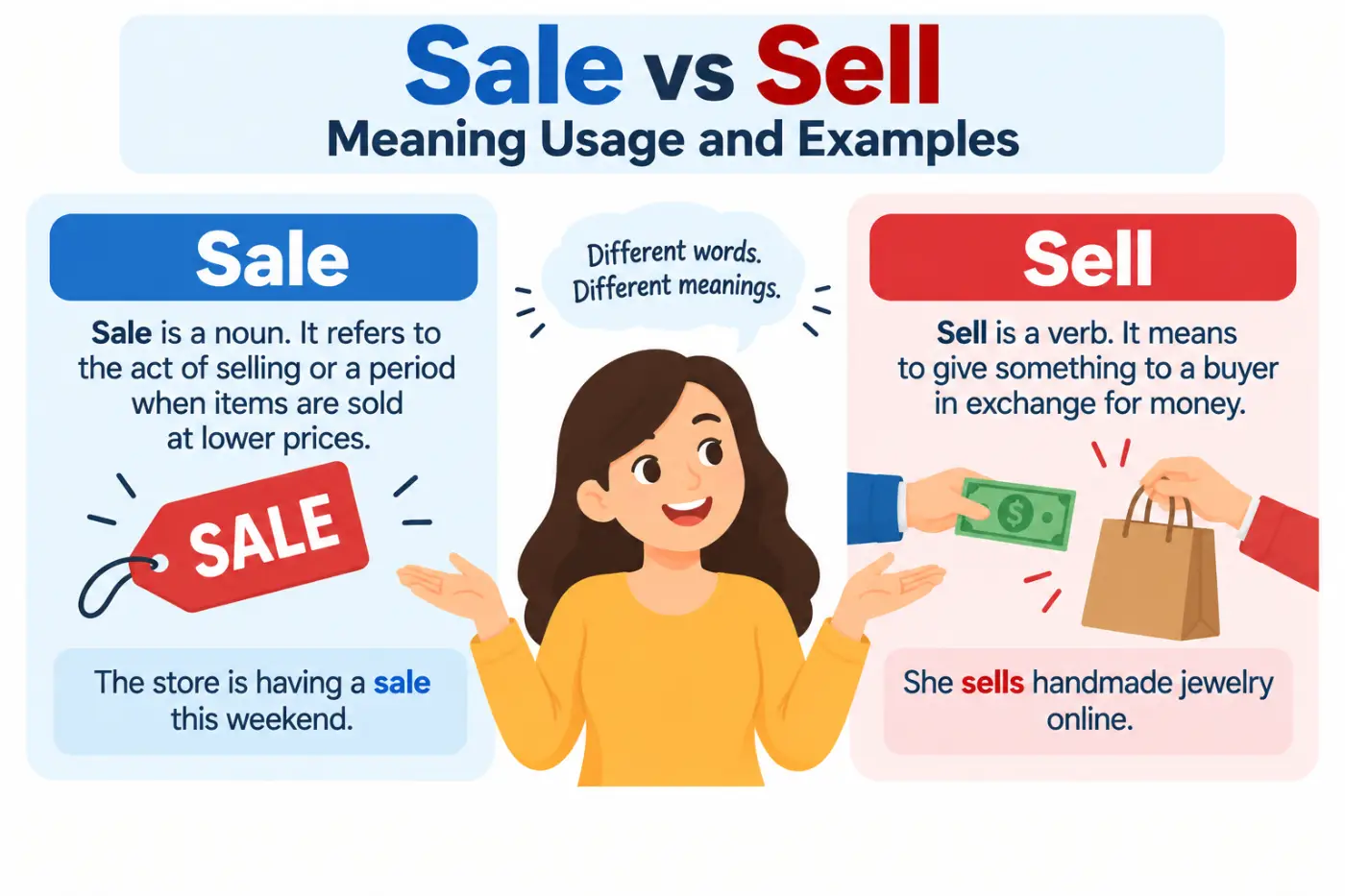
Sale vs sell can confuse even strong English speakers because both words come from the same word family and both relate to buying and selling. The difference becomes much easier once you look at how each word works in a sentence. Sale is generally a noun while sell is generally a verb.
Think about a store for a moment. A store can sell shoes. It can also have a sale. In the first sentence sell describes an action. In the second sentence sale names an event or commercial opportunity. That small grammar difference explains most of the confusion.
You’ll see these words everywhere in American English. They appear in advertisements business emails online stores conversations contracts news reports and everyday speech. This guide explains their meanings pronunciation grammar forms common mistakes and practical examples so you can choose the right word without second guessing yourself.
Short Answer
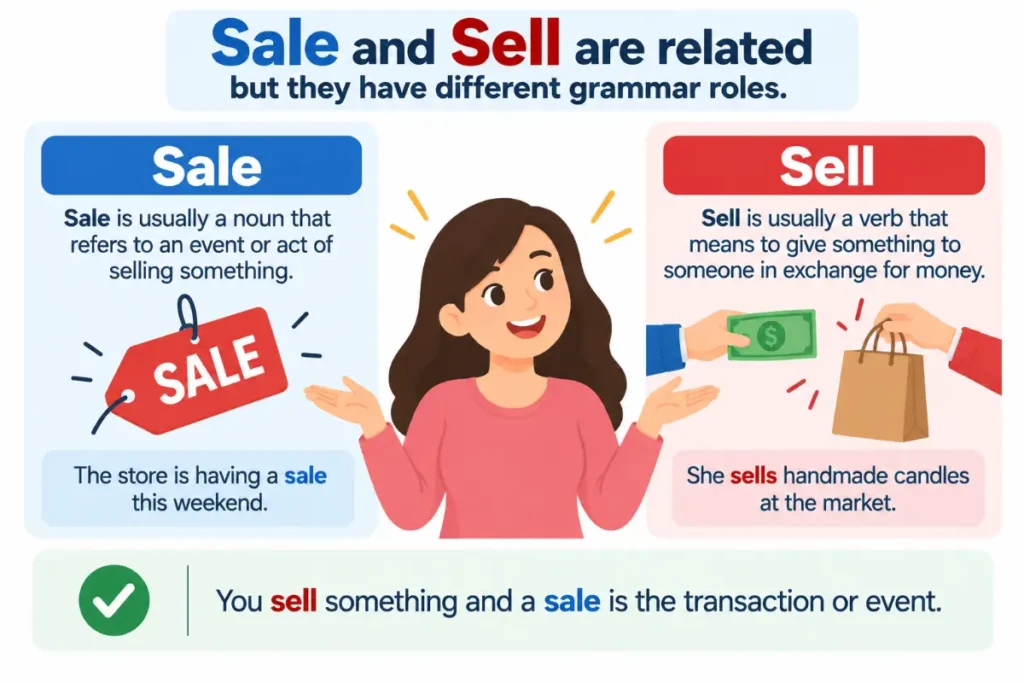
Sale and sell are related but they have different grammar roles. Sale is usually a noun that refers to an event or act of selling something. Sell is usually a verb that means to give something to someone in exchange for money. The key is simple: you sell something and a sale is the transaction or event.
What Sale Means
Sale is primarily a noun. It refers to the act of selling something or to an occasion when goods or services are offered for purchase.
The word has several common uses.
A store might advertise a sale because it has reduced prices.
The store is having a sale.
Here sale names an event.
The word can also refer to a completed transaction.
The sale of the house took several weeks.
In this sentence sale refers to the transaction involving the house.
Another common use appears in business and commerce.
The company reported strong sales this year.
Here sales means the number or value of products or services sold.
So sale can describe an event a transaction or commercial activity involving things being sold.
What Sell Means
Sell is primarily a verb. It describes the action of giving something to another person in exchange for money or another form of payment.
For example:
They sell fresh bread every morning.
The verb describes what the bakery does.
You can also use sell when talking about persuading someone to accept an idea or opportunity.
She sold me on the idea.
This doesn’t mean she literally exchanged an object for money. It means she persuaded me that the idea was worth accepting.
Sell can also describe a business activity more generally.
The company sells software to small businesses.
In this sentence sell identifies the commercial action.
The simplest distinction is therefore:
Sell describes an action.
Sale names the event or transaction.
Once you recognize that difference the two words become much easier to use.
Sale vs Sell In Simple Terms
The quickest way to understand the distinction is to look at the grammar.
Sale is normally a noun.
Sell is normally a verb.
Compare these sentences.
The store is having a sale.
The store sells clothing.
The first sentence names an event. The second describes an action.
You can also combine both words naturally.
The store will sell winter coats during its annual sale.
Here sell describes what the store will do. Sale describes the commercial event.
This pattern works in many situations.
A company sells products.
A company makes sales.
A customer buys something.
A sale takes place.
The words are connected but they cannot simply replace each other.
Comparison Table
| Feature | Sale | Sell |
|---|---|---|
| Main part of speech | Noun | Verb |
| Basic meaning | An act or event involving selling | To give something in exchange for money |
| Common use | A sale at a store | A store sells products |
| Past form | Sales or sale depending on context | Sold |
| Present participle | Not normally used as a verb | Selling |
| Third person form | Not applicable as a verb | Sells |
| Common phrase | On sale | Sell something |
| Commercial meaning | Transaction or promotional event | Commercial action |
| Example | The store has a sale. | The store sells shoes. |
The Main Grammar Difference
Grammar is the clearest way to separate the two words.
Sale Is A Noun
A noun names a person place thing idea event or concept. Sale fits this category because it can name an event or transaction.
For example:
The sale starts tomorrow.
The noun sale acts as the subject of the sentence.
You can also place an article before it.
The sale starts tomorrow.
A sale starts tomorrow.
You can use adjectives with it too.
The annual sale starts tomorrow.
The clearance sale starts tomorrow.
The private sale starts tomorrow.
These patterns show that sale behaves like a noun.
Sell Is A Verb
A verb describes an action or state. Sell describes the action of transferring something to a buyer in exchange for money.
For example:
They sell furniture.
The verb sell describes the action performed by they.
You can change its tense.
They sell furniture every day.
They will sell furniture next week.
The form changes according to tense and grammar. Sale doesn’t work this way because it isn’t the verb.
The Forms Of Sell
One reason learners get confused is that sell changes form in several ways.
Sell
This is the base form.
I sell books online.
They sell fresh vegetables.
Sells
Use sells with a third person singular subject in the present tense.
She sells handmade furniture.
The company sells office supplies.
Selling
This is the present participle and gerund form.
They are selling their old car.
Selling products online can be profitable.
Sold
Sold is both the simple past form and the past participle.
He sold his car last week.
The house was sold in June.
A useful point to remember is that the past form is sold rather than selled.
That mistake is common among English learners because many regular verbs form the past by adding ed. Sell is irregular.
When To Use Sale
Use sale when you need a noun.
You’ll commonly use it in four situations.
A Store Promotion
A business may reduce prices and advertise a sale.
The store is having a summer sale.
Everything is on sale this weekend.
A Commercial Transaction
Sale can describe the transaction itself.
The sale of the property was completed yesterday.
The contract covers the sale of the equipment.
Business Activity
Sales can refer to commercial results or revenue generated from selling.
The company increased its sales last quarter.
Her sales have improved this year.
A Public Offering Event
You may also see sale used in phrases connected with auctions or organized commercial events.
The art sale attracted hundreds of buyers.
The estate sale begins Saturday.
In each case sale functions as a noun.
When To Use Sell
Use sell when you need a verb describing an action.
You might use it when talking about a person business or organization offering something for money.
They sell fresh coffee.
I want to sell my old laptop.
The company sells products throughout the United States.
You can also use sell in persuasive contexts.
The presentation sold the idea to the investors.
She knows how to sell herself in an interview.
These meanings are connected to the central idea of persuading someone to accept or buy something.
Common Expressions With Sale
English has many familiar expressions involving sale.
On Sale
On sale usually means available for purchase at a reduced price.
These shoes are on sale.
Be careful with this phrase because it doesn’t always mean the same thing as simply being available for purchase. In American English it commonly suggests a temporary price reduction.
For Sale
For sale means that something is available for someone to buy.
The house is for sale.
My old bicycle is for sale.
A useful distinction is simple.
For sale means available to buy.
On sale often means offered at a lower price.
Sale Price
Sale price means the reduced price offered during a promotion.
The sale price is fifty dollars.
Final Sale
Final sale usually means an item cannot be returned or exchanged under the seller’s stated policy.
The jacket is marked final sale.
The exact return rules depend on the seller.
Clearance Sale
A clearance sale is a promotion designed to move products out of inventory.
The store is having a clearance sale.
Common Expressions With Sell
Sell also appears in many everyday expressions.
The concert tickets sold out quickly.
It can also mean that a person or organization has abandoned principles for money or advantage.
Critics accused him of selling out.
Sell Off
Sell off means to sell something quickly or in large quantities. It can also describe the disposal of assets.
The company plans to sell off several properties.
Sell For
Sell for introduces the price at which something is purchased.
The painting sold for ten thousand dollars.
Sell To
Sell to identifies the buyer.
The company sells software to hospitals.
Sell Something
This is one of the most basic patterns.
They sell fresh produce.
The verb takes a direct object.
Common Mistakes
Several errors appear again and again when people use these words.
Using Sale As A Verb
Incorrect:
The store sale shoes.
Correct:
The store sells shoes.
Sale is a noun. You need the verb sell or one of its forms.
Using Sell After An Article
Incorrect:
The sell starts tomorrow.
Correct:
The sale starts tomorrow.
An article such as the or a often signals that you need a noun. Since sale is the noun form the sentence works with it.
Writing Selled
Incorrect:
She selled her car.
Correct:
She sold her car.
Sell is an irregular verb. Its past form is sold.
Confusing For Sale With Sell
Incorrect:
The house is for sell.
Correct:
The house is for sale.
For sale is the established expression meaning that someone is offering an item for purchase.
Confusing On Sale With Sell
Incorrect:
These shoes are on sell.
Correct:
These shoes are on sale.
On sale is the standard phrase for a product offered at a reduced price.
Sale vs Sell In Business English
Business writing uses both words frequently.
Sale often appears when discussing transactions revenue performance and commercial events.
The sale generated significant revenue.
The sales team exceeded its target.
The company completed the sale of the property.
Sell appears when describing commercial activity.
The company sells products to retailers.
The business sells directly to consumers.
The company plans to sell the division.
This distinction matters in professional writing because replacing one with the other can change the grammatical structure of a sentence.
For example:
The company sale products.
This doesn’t work because the sentence needs a verb.
The company sells products.
That sentence is correct.
Now consider:
The company announced the sale of its building.
Here sale works because the sentence needs a noun.
Sale And Sales
The sale of the house was completed.
Sales often refers to multiple transactions or the overall activity of selling.
Sales increased this year.
A business might have several sales in one day.
You can also use sales as a business function.
She works in sales.
This means she works in the area of a business responsible for selling products or services.
The distinction between singular and plural depends on the intended meaning.
Sell And Sold
Sell is the present form.
Sold is the past form.
Compare these sentences.
I sell cars.
I sold a car yesterday.
The first describes a present activity or general habit. The second describes an action that happened in the past.
Sold also works as a past participle.
The car has been sold.
The tickets were sold within an hour.
This form appears with auxiliary verbs such as has have had and be forms in passive constructions.
Sale vs Sell In Everyday American English
American speakers use both words constantly.
You might hear someone say:
The store has a sale.
That means the store is running a promotional event.
You might also hear:
What do they sell?
That asks about the products or services offered by the business.
A customer might say:
Is this on sale?
The question asks if the item currently has a reduced price.
A homeowner might say:
Our house is for sale.
That means the owner is offering the house to buyers.
A person might also say:
I’m trying to sell my car.
That describes the action the person is taking.
These examples show how naturally the grammar distinction appears in ordinary speech.
Pronunciation Guide
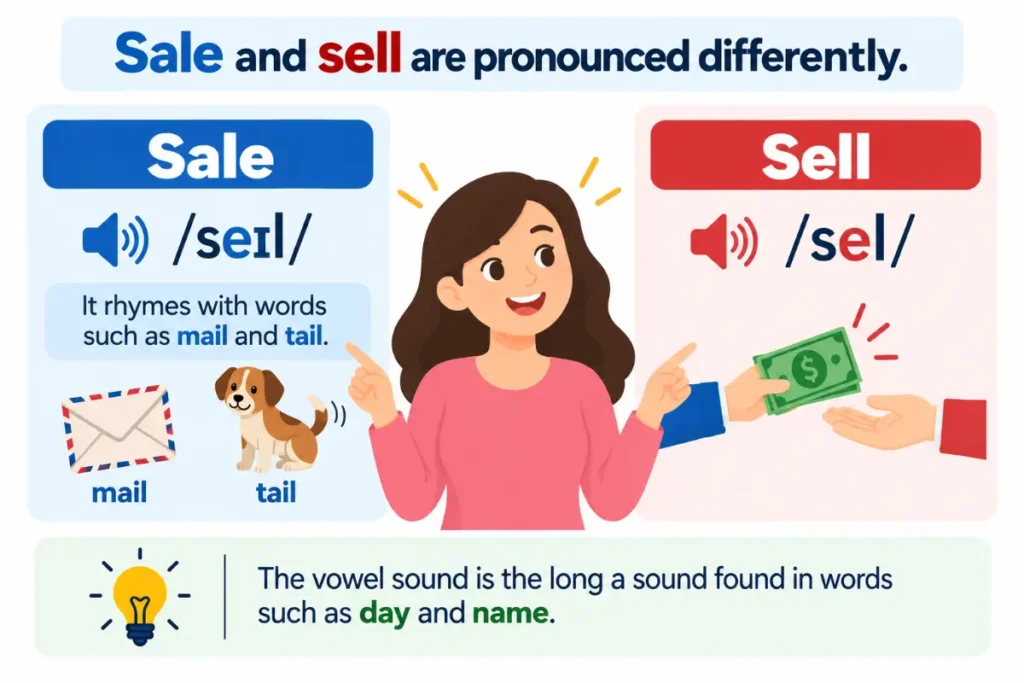
Sale and sell are pronounced differently.
It rhymes with words such as mail and tail.
The vowel sound is the long a sound found in words such as day and name.
Sell
Sell is pronounced /sɛl/.
It rhymes with words such as bell and tell.
The vowel sound is shorter and more open than the vowel in sale.
This pronunciation difference can help you keep the words apart when speaking.
Compare:
sale
sell
The beginning and ending sounds are similar. The main difference is the vowel.
A useful pronunciation practice is to say these pairs aloud:
sale and sell
mail and bell
tail and tell
The sound difference becomes easier to hear after a little practice.
Word Origin
Sale and sell belong to the same historical word family.
Their history reaches back to Old English and related Germanic forms. The modern words developed through centuries of changes in English spelling and pronunciation.
The connection between the two words explains why they look and sound similar. English often has related noun and verb forms that share a common historical base.
The exact modern grammar role is more useful for everyday learners than memorizing the historical details.
Think of the relationship this way.
Sell is the action.
Sale is the event or transaction connected with that action.
That simple relationship reflects the close connection between the words.
American And British English
There is no major spelling difference between American and British English for these words.
American speakers use sale and sell in the standard ways described above.
British speakers do the same.
Canadian and Australian English also follow the same basic distinction.
Some commercial expressions can vary slightly by region because businesses use different advertising language. The core grammar doesn’t change.
So you don’t need a separate American spelling rule for these two words.
Formal And Informal Usage
Both words are completely normal in formal and informal English.
You can use them in conversation.
I want to sell my car.
You can use them in a professional email.
The company plans to sell the property.
You can use sale in a formal report.
The sale was completed in June.
You can also use both words in academic writing when the topic involves economics business marketing or commerce.
The main concern isn’t formality. It’s grammar and meaning.
A Useful Way To Choose The Right Word
When you’re unsure which word to use ask yourself one question.
Am I naming an event or describing an action?
If you’re naming an event or transaction use sale.
The sale begins Friday.
If you’re describing the action use sell.
They sell furniture.
Another useful test is to look at the words around the blank.
If you see an article such as a or the you may need the noun sale.
The ___ begins tomorrow.
The correct answer is sale.
If the sentence needs an action you may need sell.
They ___ computers.
The correct answer is sell.
This quick grammar test works better than trying to rely on how the words sound.
Memory Tips
A simple memory trick can make the difference stick.
Think Noun And Verb
Remember:
Sale is a thing or event.
Sell is an action.
You can have a sale.
You can sell something.
Think Store
Imagine a clothing store.
The store sells clothes.
The store has a sale.
That one picture connects both words in your mind.
Remember For Sale
If you see the phrase for ___ the answer is usually sale.
The house is for sale.
The car is for sale.
The painting is for sale.
Remember On Sale
If something has a temporary discount use on sale.
The shoes are on sale.
The laptop is on sale.
The furniture is on sale.
These fixed expressions make the noun form easy to recognize.
Related Words
Understanding related vocabulary can make commercial English much easier.
Buy
Buy means to obtain something by paying for it.
I want to buy a new phone.
Purchase
Purchase is a more formal word for buy.
The company purchased new equipment.
Seller
A seller is a person or business that sells something.
The seller accepted the offer.
Buyer
A buyer is a person or organization that buys something.
The buyer signed the agreement.
Product
A product is something offered for sale.
The company launched a new product.
Price
Price refers to the amount of money required to buy something.
The price is too high.
Discount
A discount is a reduction in the usual price.
The store offers a ten percent discount.
Revenue
Revenue is money generated by a business through its activities. In many businesses sales contribute a major part of revenue.
The company reported higher revenue this year.
Sale vs Sell In Common Phrases
Learning phrases can make these words easier to remember than studying isolated definitions.
Here are several common patterns.
Have a sale
The store will have a sale next week.
Make a sale
The salesperson made a sale.
Close a sale
The representative closed the sale.
For sale
The house is for sale.
On sale
The shoes are on sale.
Sell something
They sell fresh fruit.
Sell to someone
The company sells directly to customers.
Sell for a price
The painting sold for five thousand dollars.
Notice how sale appears naturally as a noun in the first group while sell appears as a verb in the second group.
When Sale Means A Discount
One point deserves extra attention. Sale doesn’t always mean that every item is discounted.
In common retail advertising a sale usually suggests reduced prices or special offers. However the exact conditions depend on the business and the promotion.
For example a store may advertise a holiday sale and offer discounts on selected products only.
That means you shouldn’t automatically assume that every product in the store has a lower price.
The grammatical point stays the same. Sale is still a noun.
When Sell Has A Figurative Meaning
Sell doesn’t always involve physical products.
English speakers often use sell figuratively to describe persuasion.
He sold me on the idea.
This means he persuaded me to support the idea.
The word can also describe a person’s ability to present themselves effectively.
She knows how to sell herself during interviews.
Again the word retains its basic idea of persuading someone to accept something.
This figurative use is common in American English and appears in business communication everyday conversation and media.
Expert Editor Insight
An experienced editor usually checks the grammar around these words before thinking about spelling. If the sentence needs an action then sell or one of its forms is probably right. If the sentence names an event transaction or commercial concept then sale is usually the better choice. Another useful editing habit is to watch fixed phrases such as for sale and on sale because these expressions strongly signal the noun form. Spellcheck can catch some errors but it won’t always understand an incorrect word choice when both forms are valid English words.
Key Takeaways
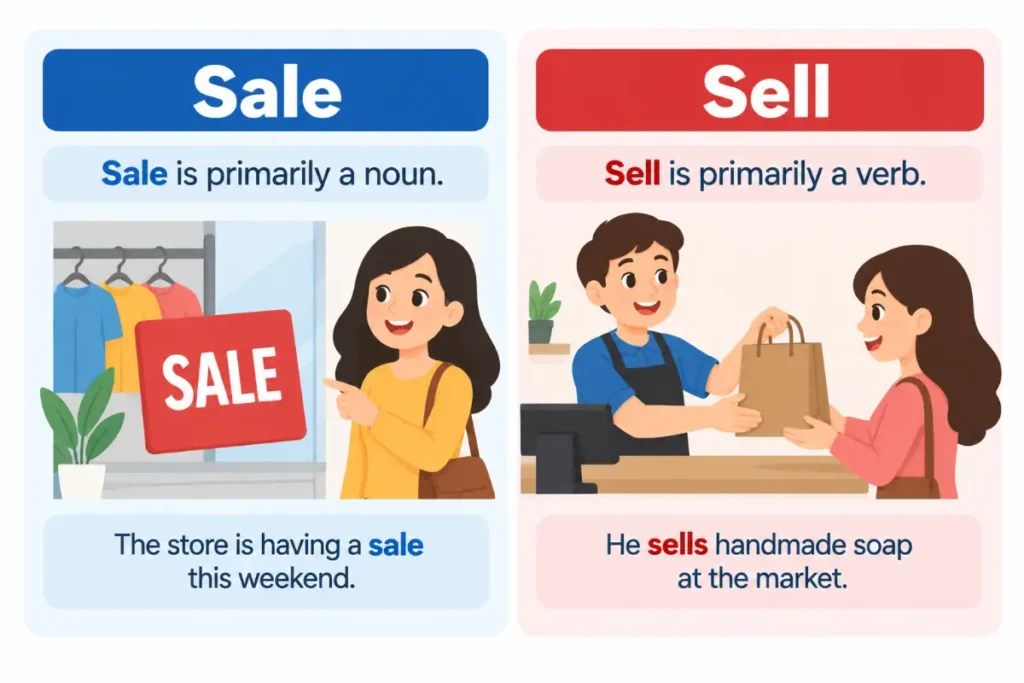
- Sale is primarily a noun.
- Sell is primarily a verb.
- A sale can refer to a commercial event or transaction.
- To sell means to offer or transfer something in exchange for money.
- The past tense of sell is sold.
- Use for sale when something is available to buy.
- Use on sale when an item is commonly offered at a reduced price.
- Use sales when talking about multiple transactions or commercial performance.
- Sale and sell are standard in American British Canadian and Australian English.
- When you’re unsure ask yourself if the sentence needs a noun or an action.
Conclusion
Sale vs sell becomes much easier once you focus on grammar. Sale is a noun that can describe a selling event a transaction or commercial activity. Sell is a verb that describes the action of offering something to a buyer for money. They belong to the same word family but they cannot normally replace each other.
The simplest memory trick is to connect each word with a familiar phrase. You have a sale but you sell something. You also say for sale and on sale. These patterns give you a quick mental shortcut when you’re writing.
When you’re unsure read the sentence and ask what job the word needs to perform. If you need an action choose sell or the correct form of that verb. If you need a noun choose sale. That small grammar check will prevent most mistakes.
FAQs
What is the difference between sale and sell?
Sale is generally a noun while sell is generally a verb. A sale can be an event transaction or commercial activity. Sell describes the action of giving something to a buyer in exchange for money. You can say the store has a sale and the store sells shoes. The words are related but they serve different grammatical roles.
Is it correct to say for sell?
No. The standard expression is for sale. It means that something is available for someone to buy. For example you can say the house is for sale or the car is for sale. The word sale works because the phrase needs a noun. Sell is a verb and doesn’t fit this fixed expression.
Is it correct to say on sell?
No. The standard phrase is on sale. It commonly means that an item is being offered at a reduced price. For example you can say these shoes are on sale this weekend. Using sell in this expression creates a grammar error because the phrase requires the noun form rather than the verb.
Is sale a noun or a verb?
Sale is a noun. It can refer to an event where products are offered for purchase a completed transaction or the activity of selling in a commercial context. For example the sale starts Friday uses sale as a noun. The word sell is the related verb that describes the action of selling something.
Is sell a noun or a verb?
Sell is primarily a verb. It describes the action of offering or transferring something to another person in exchange for money. You can say they sell cars or I want to sell my laptop. The related noun is sale. Sell also has figurative uses connected with persuasion and convincing someone to accept an idea.
What is the past tense of sell?
The past tense of sell is sold. You should not use selled in standard English. For example you can say I sold my car yesterday. Sold is an irregular past form and also works as a past participle in constructions such as the house has been sold.
How do you remember sale and sell?
Use a simple grammar connection. You sell something but you have a sale. Sell describes the action while sale names the event or transaction. You can also remember common phrases such as for sale and on sale. These patterns give you a quick clue when you’re writing and can help prevent common word choice mistakes.
Can sale and sell appear in the same sentence?
Yes. They often appear together because they describe related parts of the same commercial activity. For example a store can sell clothing during a holiday sale. In that sentence sell describes what the store does while sale identifies the promotional event. Using both words together can actually make the difference easier to understand.
Is sale used differently in British English?
The basic meaning and grammar remain the same in British English. British speakers use sale as a noun and sell as a verb just as American speakers do. Expressions such as for sale and on sale are also standard. Regional differences can appear in advertising style but there is no major grammatical distinction between these two words.
What does sold mean?
Sold is the past tense and past participle of sell. It describes an action that happened in the past or appears in perfect and passive constructions. For example I sold my bike yesterday uses sold as the past tense. The bike has been sold uses it as a past participle.

Confusing Words, Spelling & Word Choice
Claire Whitmore is a U.S.-based English editor who writes about commonly confused words, spelling differences, and word choice. Her work helps readers understand subtle distinctions between similar-looking words through simple definitions, practical examples, and modern usage guidance in both American and British English.