
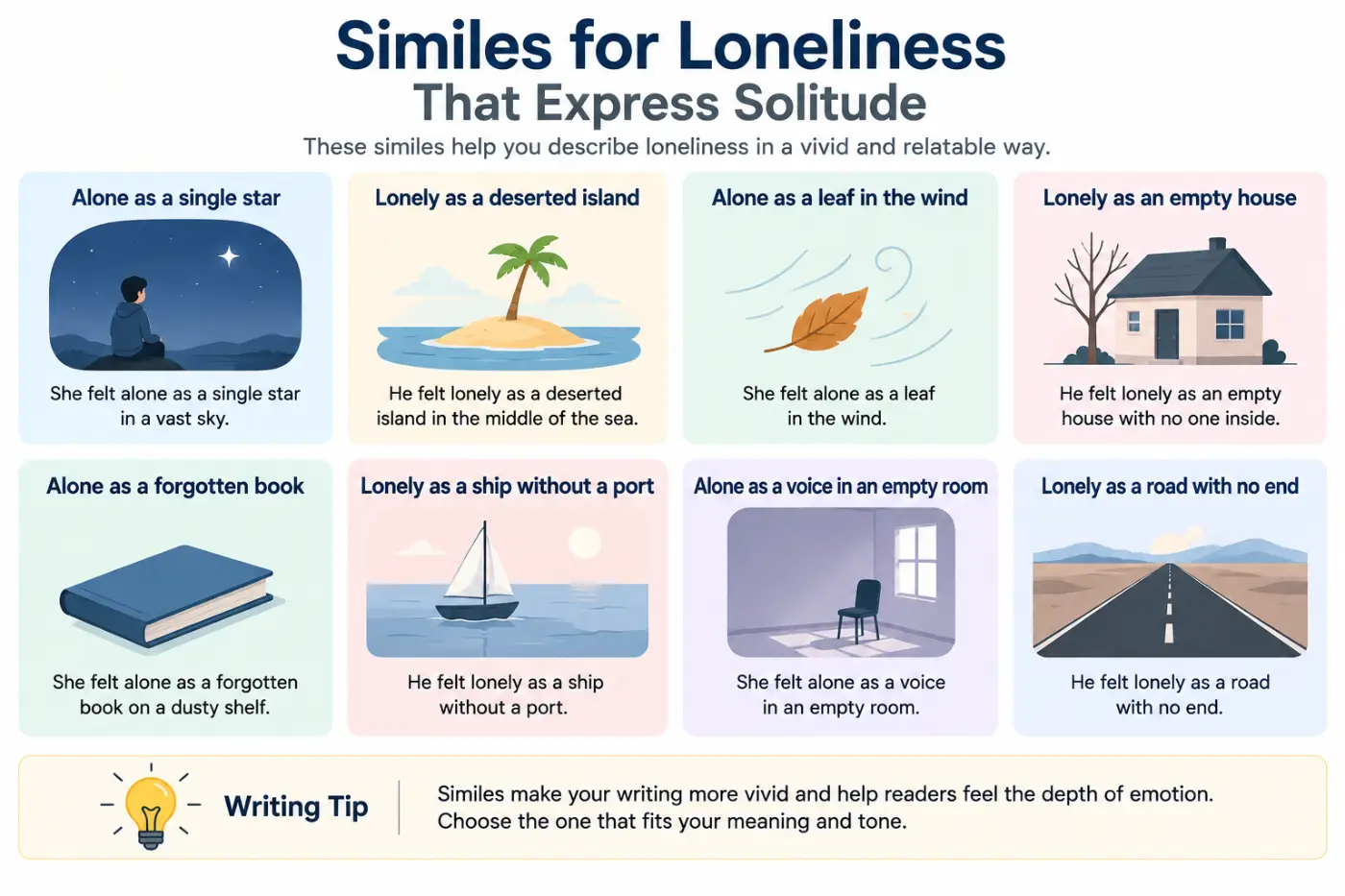
Similes for loneliness can give an invisible feeling a shape readers can see. Saying someone feels lonely tells us the emotion. Saying they feel like a single light glowing in an empty street creates a scene inside the reader’s mind. That small shift can make writing more emotional and memorable.
Loneliness doesn’t always look the same. Someone can feel lonely in an empty house. They can also feel lonely while surrounded by friends. Sometimes loneliness feels quiet and peaceful. At other times it feels heavy sharp or almost impossible to escape. The best comparison matches that particular kind of solitude.
This collection gives you more than 120 original examples grouped by emotional tone and writing purpose. You’ll find comparisons for quiet loneliness deep loneliness loneliness after loss loneliness in a crowd loneliness in relationships and many other situations. Each example includes a short explanation so you can understand why the image works and adapt the idea to your own writing.
Short Answer
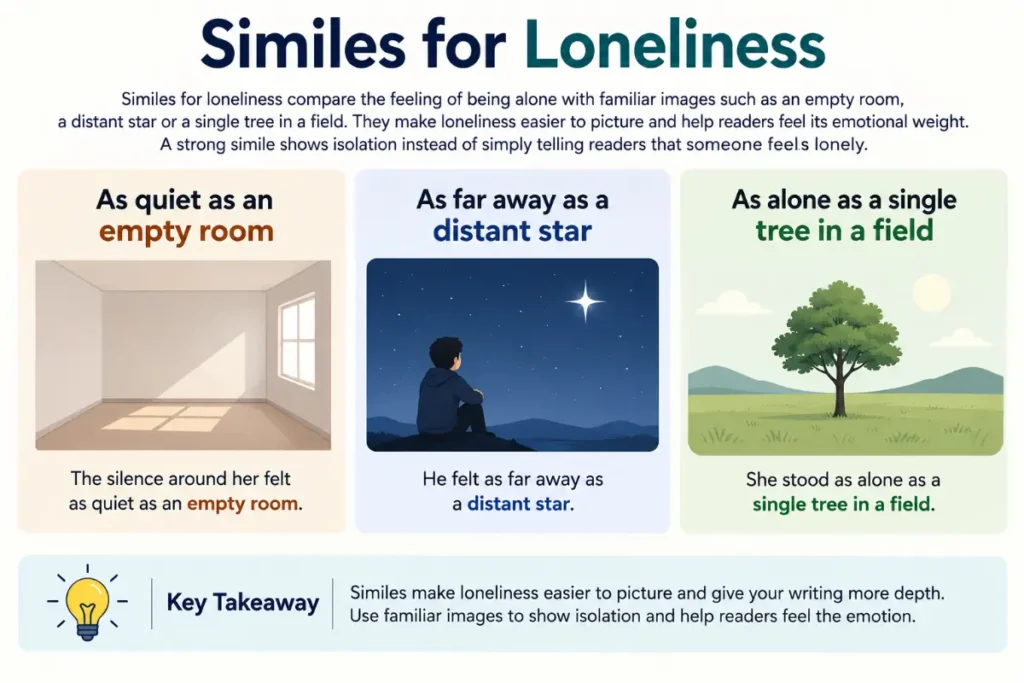
Similes for loneliness compare the feeling of being alone with familiar images such as an empty room a distant star or a single tree in a field. They make loneliness easier to picture and help readers feel its emotional weight. A strong simile shows isolation instead of simply telling readers that someone feels lonely.
Table Of Contents
- What an emotional simile does.
- How similes express loneliness.
- Similes for quiet loneliness.
- Similes for deep loneliness.
- Similes for loneliness in a crowd.
- Similes for loneliness after loss.
- Similes for loneliness at night.
- Similes for loneliness in relationships.
- Similes for loneliness and isolation.
- Similes for longing and missing someone.
- Similes for emotional emptiness.
- Similes for feeling forgotten.
- Similes for loneliness mixed with sadness.
- Similes for loneliness mixed with hope.
- Similes for loneliness in nature.
- Similes for loneliness in stories and poems.
- How to create your own similes.
- Common mistakes.
- Memory tips.
- Related grammar and usage notes.
- Frequently asked questions.
- Key takeaways.
- Conclusion.
What An Emotional Simile Does
A simile compares one thing with another. It often uses like or as to create that comparison.
For example:
She felt as lonely as a single star in a dark sky.
The writer doesn’t simply name the emotion. The comparison gives loneliness a visual quality. The reader can imagine one small point of light surrounded by darkness.
That is the main strength of a simile. It turns an abstract idea into something concrete.
Loneliness is especially suited to this kind of writing because you cannot physically see the emotion itself. You can see an empty chair. You can see a deserted road.
These physical details give writers material for emotional comparisons.
How Similes Express Loneliness
A strong loneliness comparison usually focuses on one of several qualities.
- Distance. A person may feel as far away as a distant island.
- Emptiness. Loneliness can resemble an empty room or abandoned house.
- Silence. It may feel like a hallway after everyone has gone home.
- Isolation. A lonely person may feel like a single tree surrounded by open land.
- Absence. Loneliness can resemble an empty chair where someone used to sit.
- Darkness. Night can represent loneliness when the emotion feels heavy or uncertain.
- Longing. A person may feel like someone waiting at a station for a train that never arrives.
The most effective comparison usually has a clear emotional connection. You don’t need an unusual object just to sound creative. A familiar image can carry tremendous emotional power when it fits the scene.
Similes For Quiet Loneliness
Some loneliness is not dramatic. It simply sits in the background like a low hum. These comparisons work well for peaceful scenes with an undercurrent of solitude.
- She felt like a quiet room after everyone had gone home. This suggests gentle but noticeable absence.
- His loneliness rested on him like evening mist. The feeling seems soft but difficult to escape.
- She was as alone as a lamp burning in an empty house. The image shows a small presence surrounded by silence.
- His solitude was like a book left open on an empty table. This suggests stillness and abandonment.
- She felt like the last window glowing on a dark street. The comparison creates a quiet sense of isolation.
- His loneliness settled like dust on an unused chair. The image suggests time passing without companionship.
- She sat as quietly as a bird on a deserted branch. The comparison emphasizes peaceful isolation.
- His silence stretched like a hallway after midnight. The image makes loneliness feel long and empty.
- She felt like a cup waiting on a table after the guests had left. This creates a sense of quiet aftermath.
- His solitude was as still as a pond before sunrise. The comparison focuses on calm isolation rather than pain.
Similes For Deep Loneliness
Deep loneliness can feel heavier and more consuming. These comparisons suit emotional scenes where the character struggles with isolation.
- Her loneliness was like an ocean with no shore. This suggests an overwhelming feeling with no clear escape.
- He felt as isolated as an island in a vast sea. The image emphasizes separation from others.
- Her loneliness pressed on her like a heavy ceiling. This presents isolation as something physically oppressive.
- His heart felt like an empty house in winter. The comparison combines emptiness with coldness.
- She carried loneliness like a stone beneath her coat. The image suggests a hidden burden that stays close.
- His solitude stretched before him like an endless road. This suggests loneliness that seems to have no end.
- She felt like a voice trapped inside a sealed room. The comparison communicates a desire to connect without being heard.
- His loneliness was as deep as a well without a bottom. This suggests emotional depth that feels impossible to measure.
- She moved through the day like a shadow without a person. The image suggests disconnection from ordinary life.
- His sadness and loneliness clung to him like wet clothes. The comparison shows an uncomfortable feeling that refuses to leave.
Similes For Loneliness In A Crowd
One of the most painful forms of loneliness happens when someone is surrounded by people but still feels disconnected.
- She felt like an empty chair at a crowded table. The image captures being present but emotionally excluded.
- He stood among them like a stranger at his own celebration. This shows loneliness despite being surrounded by familiar people.
- Her loneliness was like a quiet room hidden inside a noisy building. The contrast highlights emotional isolation.
- He felt as invisible as a shadow beneath bright lights. The image suggests being present but unnoticed.
- She moved through the crowd like a single boat among hundreds of ships. This emphasizes separation despite company.
- His silence was like a closed door in the middle of a busy hallway. The image suggests emotional separation.
- She felt like one cold window in a house full of warm rooms. This shows how loneliness can stand out even when others seem connected.
- He was as alone as a stranger waiting at a family reunion. The comparison highlights social disconnection.
- Her thoughts floated through the crowd like a leaf carried away from the riverbank. This suggests emotional distance.
- He felt like a muted instrument in the middle of an orchestra. The comparison shows someone who cannot fully participate.
Similes For Loneliness After Loss
Loss can create a particular kind of loneliness. The person is not simply alone. They notice the absence of someone who once filled part of their life.
- Her loneliness was like an empty chair where someone had always sat. The image makes absence visible.
- His home felt as empty as a theater after the final show. The comparison suggests a place once filled with life.
- She felt like a song missing its final note. The image communicates incompleteness.
- His memories echoed like footsteps in an abandoned house. The comparison shows how memories can make absence feel stronger.
- Her grief followed her like a shadow at sunset. The image suggests sadness that remains close.
- He felt as empty as a picture frame after the photograph is removed. The comparison focuses on something once filled now being vacant.
- Her silence stretched like a road leading away from home. This suggests emotional distance after separation.
- His heart felt like a room after the furniture has been carried away. The comparison communicates emptiness left behind.
- She carried the absence like a missing key in her pocket. The image suggests constantly noticing what is gone.
- His loneliness returned like winter after the last warm day. The comparison presents grief as something that comes back after temporary comfort.
Similes For Loneliness At Night
Night naturally creates images of darkness silence distance and stillness. These comparisons can work especially well in poetry and fiction.
- She felt like the only window still glowing at midnight. The image suggests a solitary presence.
- His loneliness was as dark as an empty street after midnight. The comparison creates a strong sense of isolation.
- She lay awake like a lighthouse surrounded by dark water. The image presents someone alone and awake while everything else seems distant.
- His thoughts moved like footsteps in an empty hallway. The comparison emphasizes silence and mental activity.
- She felt like a single star lost in a moonless sky. The image creates distance and vulnerability.
- His room felt as quiet as a closed library at night. The comparison emphasizes deep silence.
- Her loneliness hovered like fog beneath the streetlights. The image gives solitude a physical presence.
- He stared through the window like a traveler watching an empty station. The comparison suggests waiting and separation.
- Her heart felt like a porch light left on for someone who never came home. The image combines hope with loneliness.
- His night stretched like an empty road under a cloudless sky. This suggests a long period of solitude.
Similes For Loneliness In Relationships
You can feel lonely inside a relationship when emotional connection disappears. These comparisons help describe that experience without simply saying the relationship feels distant.
- She felt like a guest in her own relationship. The comparison suggests emotional displacement.
- His heart was like a locked room beside an open door. The image suggests that connection seems close but remains inaccessible.
- They lived together like two ships tied to different shores. The comparison shows physical closeness with emotional distance.
- She felt as alone as a person speaking into an empty phone line. The image suggests trying to connect without receiving a response.
- His affection faded like a photograph left in the sun. The comparison shows something gradually losing its strength.
- She felt like a song playing to someone wearing headphones. The image suggests communication that cannot reach the other person.
- Their conversations became like two roads that never met. The comparison communicates increasing emotional distance.
- He felt as invisible as a name written in disappearing ink. The image suggests feeling unnoticed by someone important.
- Her loneliness sat between them like an unopened letter. The comparison shows something important left unspoken.
- They stood beside each other like strangers sharing a bus stop. The image emphasizes physical closeness without emotional intimacy.
Similes For Loneliness And Isolation
Isolation can be physical emotional or social. These comparisons focus on separation from others.
- He felt like a tree standing alone in a field. The image suggests strength mixed with solitude.
- She was as isolated as a cabin in the mountains. The comparison creates physical distance.
- His loneliness surrounded him like a wall. The image shows isolation as something difficult to cross.
- She felt like a boat drifting without an anchor. This suggests both isolation and lack of direction.
- He stood apart like a lone fence post across an empty field. The comparison creates a stark image of solitude.
- Her thoughts became an island surrounded by silence. The image presents emotional separation.
- He felt as distant as a mountain seen from across a valley. The comparison emphasizes space between people.
- She lived inside her loneliness like a bird inside a closed cage. The image suggests isolation with a desire for freedom.
- His world felt like a road with no other travelers. The comparison communicates a lack of companionship.
- She felt like a single house surrounded by miles of empty land. The image emphasizes complete separation.
Similes For Longing And Missing Someone
Loneliness often comes with longing. You may not simply want company. You may want one particular person.
- She missed him like a shore misses the tide. The image suggests a natural pull toward someone absent.
- His longing stretched like a road toward a distant home. The comparison creates emotional distance.
- She waited like a letter waiting for an address. The image suggests a desire for connection without a clear path.
- His heart reached for her like a hand searching in the dark. The comparison shows longing and uncertainty.
- She felt like a song waiting for its singer. The image suggests something incomplete.
- His memories returned like waves to an empty beach. The comparison shows repeated thoughts of someone absent.
- She carried the memory like a photograph tucked inside a wallet. The image shows something precious kept close.
- His longing burned like a small lamp through the night. The comparison suggests a steady desire that continues.
- She felt as restless as a traveler waiting for a delayed train. The image captures anticipation and frustration.
- His loneliness pulled at him like the moon pulls the tide. The comparison presents longing as a powerful force.
Similes For Emotional Emptiness
Loneliness can create a feeling that something is missing inside.
- Her heart felt like an empty room. The image communicates emotional vacancy.
- His emotions were as hollow as a shell washed onto the beach. The comparison suggests emptiness after something has disappeared.
- She felt like a house with all the lights turned off. The image suggests an absence of emotional energy.
- His heart seemed like a dry well. The comparison communicates a lack of emotional nourishment.
- She moved through life like an empty suitcase. The image suggests carrying something that no longer feels filled with purpose.
- His thoughts echoed like sounds inside a vacant building. The image suggests emptiness and repetition.
- She felt as hollow as a tree after a storm. The comparison communicates damage and emotional emptiness.
- His smile was like a picture without a person behind it. The image suggests an outward appearance hiding inner emptiness.
- Her days felt like pages torn from a blank book. The comparison communicates a lack of meaningful connection.
- His heart was like a room with no furniture and no footsteps. The image emphasizes complete emptiness.
Similes For Feeling Forgotten
Sometimes loneliness comes from feeling unseen or forgotten.
- She felt like an old photograph left inside a drawer. The image suggests being remembered by no one.
- He felt as forgotten as a message buried at the bottom of an inbox. The comparison suggests being overlooked.
- Her name seemed like chalk washed from a sidewalk by rain. The image communicates fading from someone’s memory.
- He felt like a book left unopened on a dusty shelf. The comparison suggests being ignored despite having value.
- She stood like a sign no one stopped to read. The image shows being present but unnoticed.
- His voice seemed as faint as an old radio signal. The comparison suggests that others no longer hear him clearly.
- She felt like a forgotten key at the bottom of a drawer. The image suggests usefulness that has been overlooked.
- His memories faded like writing on an old postcard. The comparison suggests being gradually forgotten.
- She felt as invisible as a footprint after the rain. The image shows evidence of presence disappearing.
- He seemed like a forgotten song on an old recording. The comparison communicates distance from other people.
Similes For Loneliness Mixed With Sadness
Loneliness and sadness often overlap. These examples suit scenes where solitude carries emotional pain.
- Her loneliness fell over her like winter snow. The image suggests coldness and heaviness.
- His sadness followed him like a long shadow. The comparison shows an emotion that stays close.
- She felt like a flower growing in a forgotten corner. The image combines beauty with neglect.
- His heart sank like a stone dropped into deep water. The comparison communicates emotional heaviness.
- Her loneliness was as cold as an empty room in winter. The image gives sadness a physical quality.
- He cried like rain falling on an abandoned street. The comparison combines tears with emptiness.
- Her memories hurt like old photographs touched too often. The image suggests that remembering can deepen emotional pain.
- His sorrow stretched like a shadow across the afternoon. The comparison shows sadness occupying a large emotional space.
- She felt like a leaf separated from its tree. The image suggests loss of connection.
- His loneliness was like rain against a window with no one inside. The comparison emphasizes isolation and sadness.
Similes For Loneliness Mixed With Hope
Loneliness doesn’t always end in despair. Sometimes a person feels alone while still believing connection may return.
- Her hope was like a porch light glowing in an empty street. The image suggests waiting for someone to return.
- He held onto hope like a sailor holding a distant compass. The comparison communicates direction during isolation.
- Her loneliness was like winter waiting for spring. The image suggests that the present state may change.
- His heart kept glowing like a small candle in a dark room. The comparison presents hope as fragile but persistent.
- She waited like a flower reaching toward the first light of morning. The image suggests longing for better days.
- His hope stayed with him like a star visible before sunrise. The comparison suggests something small but reassuring.
- She carried faith like a lantern through a quiet forest. The image presents hope as guidance.
- His loneliness felt like a long night before dawn. The comparison suggests that isolation may not last forever.
- Her courage grew like a seed beneath the soil. The image suggests growth that cannot yet be seen.
- He held onto tomorrow like a traveler holding a ticket home. The comparison connects hope with the possibility of reunion.
Similes For Loneliness In Nature
Nature offers endless images for solitude because landscapes often contain quiet spaces and isolated objects.
- She stood alone like a tree on a hilltop. The image emphasizes visibility and separation.
- He felt like a cloud drifting across an empty sky. The comparison suggests movement without connection.
- Her loneliness was like a dry riverbed after summer. The image communicates absence and emptiness.
- He was as solitary as a wolf crossing a snowy field. The image suggests independence mixed with isolation.
- She felt like a shell left alone on the beach. The comparison gives loneliness a quiet coastal image.
- His thoughts drifted like leaves across a still pond. The image suggests solitude and gentle movement.
- Her heart felt like a field after harvest. The comparison suggests a place once full that now feels empty.
- He stood like a lighthouse on a distant cliff. The image presents someone separated from the world around them.
- She felt as alone as a bird on a winter branch. The image combines nature with quiet vulnerability.
- His loneliness spread like fog across a valley. The comparison suggests an emotion covering everything around him.
Similes For Loneliness In Stories And Poems
Writers often use loneliness to reveal character rather than simply describe a mood. These examples can work well in fiction poetry personal essays and reflective writing.
- She entered the room like a traveler arriving in a city where nobody knew her name. The comparison establishes immediate emotional distance.
- His loneliness was like an unwritten letter sitting beside him. The image suggests a desire to communicate.
- She walked through the town like a ghost passing through an old memory. The comparison gives her movement a distant quality.
- His heart felt like a theater with the lights on but no audience. The image combines emptiness with the appearance of life.
- She carried her silence like a secret inside her coat. The comparison suggests something private and protected.
- He felt as lost as a character written out of his own story. The image communicates disconnection from his own life.
- Her loneliness was like a door standing open to an empty room. The comparison suggests an opportunity for connection that remains unused.
- His memories moved through his mind like actors returning to an empty stage. The image suggests the past appearing after people have gone.
- She felt like a sentence waiting for someone to finish it. The comparison communicates incompleteness.
- His life seemed like a house with many rooms but no voices. The image presents physical space without emotional connection.
How To Create Your Own Similes
You don’t need a list of prepared comparisons every time you write. You can build your own.
Start with the exact type of loneliness.
Ask yourself what the loneliness feels like.
Does it feel:
- Heavy.
- Empty.
- Cold.
- Quiet.
- Distant.
- Invisible.
- Restless.
- Abandoned.
- Temporary.
- Overwhelming.
Once you identify that quality find something in the physical world that behaves in the same way.
If loneliness feels empty think about empty houses rooms chairs fields or containers.
If loneliness feels heavy think about stones backpacks rain clouds or weights.
The comparison becomes stronger because you aren’t choosing an object at random. You’re matching the physical quality of the object with the emotional quality of the feeling.
Start With A Plain Sentence
Write the emotion directly first.
She felt lonely.
Then ask what that loneliness resembles.
She felt like a single chair in an empty room.
Now add a detail if the scene needs more depth.
She felt like a single chair in an empty room after everyone else had gone home.
The third version creates a stronger sense of absence.
Match The Simile To The Character
A young child may compare loneliness with being left alone on a playground.
A traveler may compare it with waiting at an empty station.
A musician may compare it with playing to an empty hall.
A farmer may compare it with a single tree in a field.
The more closely the image fits the character the more natural it feels.
Match The Simile To The Mood
A peaceful scene may need a gentle image.
She felt like a quiet lake beneath the moon.
A painful scene may need something heavier.
Her loneliness pressed against her like a locked door.
A hopeful scene can combine isolation with light.
His hope was like a porch light waiting in the darkness.
The same emotion can produce very different images depending on the scene.
Common Mistakes
Choosing An Image That Has No Emotional Connection
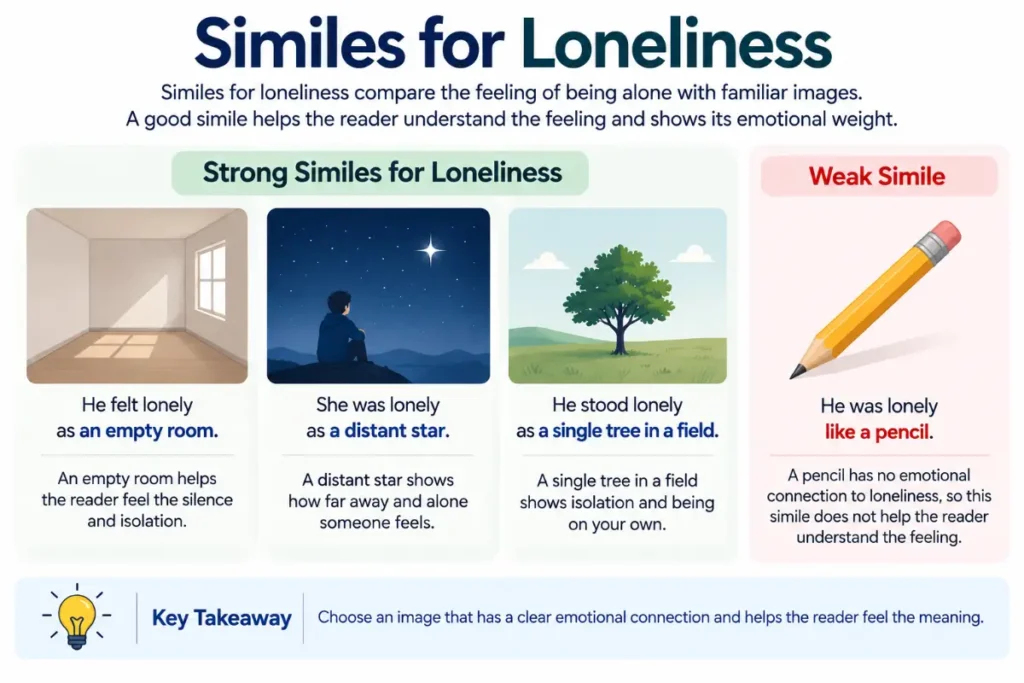
A simile should help the reader understand the feeling.
Weak:
He was lonely like a pencil.
There’s no clear reason for the comparison.
Stronger:
He was lonely like a single pencil left on an empty desk.
Now the image communicates separation and absence.
Making Every Simile Sad And Dark
Loneliness isn’t always despair.
Someone can feel lonely and peaceful at the same time. They can feel lonely and hopeful. They can even enjoy solitude while still recognizing that they are alone.
Using only dark images can make your writing emotionally flat.
Try different shades.
She felt like a quiet cabin beside a lake.
This suggests peaceful solitude.
He felt like a single light in a dark city.
This suggests lonely but hopeful solitude.
Using Too Many Similes
A paragraph filled with comparisons can lose its natural rhythm.
One carefully chosen image may create more impact than several weaker ones.
For example:
The room was quiet. She felt like a single lamp in an empty house.
That may be enough.
You don’t need to follow it with four more comparisons.
Explaining The Image Too Much
Trust the reader.
If you write:
She felt like an empty chair at a crowded table because she was surrounded by people but still felt alone.
The second part explains something the image already communicates.
A cleaner version is:
She felt like an empty chair at a crowded table.
Let the image do some of the work.
Using Clichés Without A Purpose
Some comparisons are familiar because they work. Still, predictable images may not suit every piece of writing.
If the scene calls for something personal try an image connected to the character’s experience.
Instead of a generic lonely island you might write:
He felt like the only suitcase left on a baggage carousel after midnight.
That image is more specific and can create a stronger sense of abandonment.
Memory Tips
You can remember the most useful emotional images by linking loneliness with a few core ideas.
Empty. Think of an empty chair an empty room or an abandoned house.
Distant. Think of an island a faraway star or a mountain across a valley.
Silent. Think of a closed library an empty hallway or a deserted street.
Forgotten. Think of an old photograph a dusty book or a message nobody reads.
Longing. Think of a train station a porch light or a road leading home.
Hopeful. Think of a candle a lantern or a light in a distant window.
A simple formula can also help:
Loneliness + physical quality + familiar image.
For example:
Loneliness + emptiness + empty chair.
That gives you:
Her loneliness felt like an empty chair at a crowded table.
The formula gives you a starting point while still leaving room for creativity.
Related Grammar And Usage Notes
A simile is a figure of speech. It makes a comparison rather than stating a literal fact.
For example:
He felt like a lonely bird.
The person is not literally a bird. The comparison communicates an emotional quality.
Using Like
The word like commonly introduces a simile.
She felt like a forgotten photograph.
His loneliness spread like fog.
The phrase after like provides the comparison.
Using As
You can also use as in a paired structure.
She was as lonely as a single star.
He felt as isolated as an island.
The structure compares the subject with another thing that shares the same quality.
Simile And Metaphor
A simile normally signals its comparison.
Her loneliness was like an empty room.
A metaphor states the comparison directly.
Her loneliness was an empty room.
Both forms can be effective. Similes often feel more explicit while metaphors can sound more direct.
Simile And Personification
A simile can also appear alongside personification.
For example:
Loneliness followed him like a shadow.
Loneliness is treated as something capable of following a person. The comparison creates a vivid emotional image.
Punctuation
A basic simile doesn’t require special punctuation.
She felt like a forgotten song.
If the comparison appears in a longer introductory phrase you may need punctuation based on the structure of the entire sentence.
Don’t add commas simply because a sentence contains a simile.
How To Use Similes In Different Types Of Writing
Creative Writing
In fiction a simile can reveal a character’s emotional state without directly explaining it.
Instead of:
Daniel felt lonely.
You could write:
Daniel sat beside the window like a forgotten passenger waiting for a train that had already left.
The comparison gives readers a scene and an emotional clue.
Poetry
Poetry often benefits from compact images.
Her loneliness was like rain on an empty roof.
The comparison is short but carries sound movement and atmosphere.
Personal Essays
A personal essay can use a simile to make an experience more relatable.
Moving to a new city felt like stepping into a crowded room where nobody knew my name.
The comparison connects a personal experience with a familiar social situation.
Speeches
A speaker can use an emotional comparison to make an idea memorable.
Loneliness can feel like standing in a crowd with a closed door around your heart.
The image gives listeners something concrete to remember.
School Assignments
Students can use similes to show emotion in descriptive writing.
I walked into the classroom with nerves fluttering like birds in a cage.
The comparison shows nervousness instead of simply naming it.
Why Original Images Matter
An original comparison doesn’t have to be complicated.
In fact simple images often work best because readers understand them immediately.
Consider:
She felt like the only cup left on the table after dinner.
It’s ordinary. That’s exactly why it works. Most readers understand the feeling of being left behind after everyone else has gone.
The strongest image often comes from an everyday experience rather than something grand.
Look around you.
An empty chair.
A dark window.
A forgotten coat.
A silent phone.
A single light.
A closed door.
A vacant playground.
A train leaving a station.
These ordinary objects can carry strong emotional meaning when you place them in the right sentence.
Key Takeaways
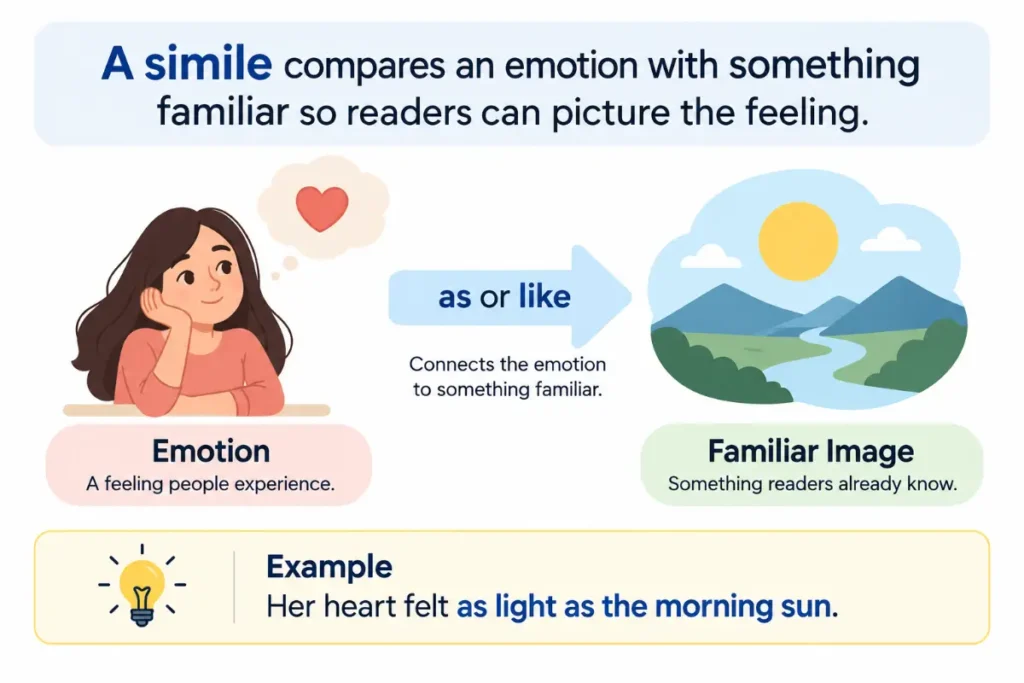
- A simile compares an emotion with something familiar so readers can picture the feeling.
- Loneliness can be shown through images of emptiness distance silence darkness absence and longing.
- An empty chair can represent someone who feels left out.
- A distant star can represent emotional separation.
- An abandoned house can represent deep emptiness.
- A porch light can represent loneliness mixed with hope.
- A crowded table can show the contrast between physical company and emotional isolation.
- An old photograph can represent memories and the feeling of being forgotten.
- A waiting train can represent longing for someone who is absent.
- Nature provides useful images for solitude because trees islands stars fields and quiet landscapes naturally suggest separation.
- The strongest comparison matches the specific emotional quality of the character.
- Originality matters but clarity matters more.
- One strong image can have more impact than a paragraph crowded with comparisons.
- Let the reader understand the emotion through the image instead of explaining every detail.
- Good similes show feelings rather than simply naming them.
Conclusion
Similes for loneliness help writers turn solitude into something readers can picture. An empty chair can represent absence. A distant star can suggest separation. A porch light can express lonely hope. These images work because they connect an invisible emotion with familiar experiences.
The best comparisons aren’t necessarily the most complicated. They’re the ones that fit the person scene and emotional mood. Quiet loneliness may need a soft image while deep isolation may need something darker and heavier. A lonely character can also feel hopeful which gives you room to use images of light growth and distance.
When you need to create your own comparison start with the feeling itself. Ask what the loneliness feels like and find something in the real world that behaves in the same way. Then build a simple sentence around that explanations. A clear image can say in a few words what several explanations cannot.
Frequently Asked Questions
What are similes for loneliness?
Similes for loneliness compare the feeling of being alone with familiar objects places people animals or experiences. Examples include feeling like an empty chair at a crowded table or feeling like a single star in a dark sky. The comparison makes loneliness easier to picture and gives the emotion more depth.
What is a good simile for loneliness?
A strong example is She felt like an empty chair at a crowded table. It works because the empty chair represents absence while the crowded table represents connection happening around the lonely person. The contrast makes the emotion especially clear.
What is a simile for feeling alone in a crowd?
He felt like a stranger at his own celebration is a useful comparison. It captures the strange experience of being physically surrounded by people while still feeling emotionally disconnected. Other useful images include an empty chair at a crowded table or a muted instrument in an orchestra.
Can loneliness have a positive simile?
Yes. Loneliness can sometimes describe peaceful solitude rather than emotional pain. For example She felt like a quiet cabin beside a still lake presents being alone as calm and restful. The emotional context determines if the comparison suggests sadness isolation peace or freedom.
What is a simile for missing someone?
A useful example is His heart reached for her like a hand searching in the dark. The image communicates longing and uncertainty. Other comparisons can involve empty chairs old photographs distant lights waiting trains or roads leading home.
What is a simile for deep loneliness?
Her loneliness was like an ocean with no shore suggests a feeling that is vast and difficult to escape. The image works because an ocean can seem enormous and endless. It creates a stronger sense of emotional depth than a simple statement such as She felt very lonely.
How do you write your own similes for loneliness?
Start by deciding what kind of loneliness you want to describe. Think about its physical quality. If it feels heavy use something heavy. If it feels quiet use an image connected with silence. Then connect the emotion and image with like or as.
Can a simile describe loneliness without using the word lonely?
Yes. This can make the writing more subtle. Instead of saying She was lonely you could write She sat beside the window like the only light left on in an empty building. The comparison communicates the feeling without naming it directly.
Are similes useful in academic writing?
They can be useful when an academic assignment involves reflection explanation or creative analysis. They are less appropriate in highly technical passages where literal precision matters more than imagery. In personal essays literary analysis and reflective writing a carefully chosen simile can make an abstract emotional idea clearer.
What is the difference between a loneliness simile and a metaphor?
A simile normally uses a comparison word such as like or as. For example Her loneliness was like an empty room is a simile. A metaphor makes the comparison directly by saying Her loneliness was an empty room. Both can describe emotion but they create slightly different effects.

Idioms, Expressions & Figurative Language
Mason Ellsworth is an American language writer with a passion for English expressions, figurative language, and everyday communication. He explains idioms, similes, popular phrases, and commonly misunderstood expressions in a straightforward, engaging style that helps readers improve both their writing and spoken English.