
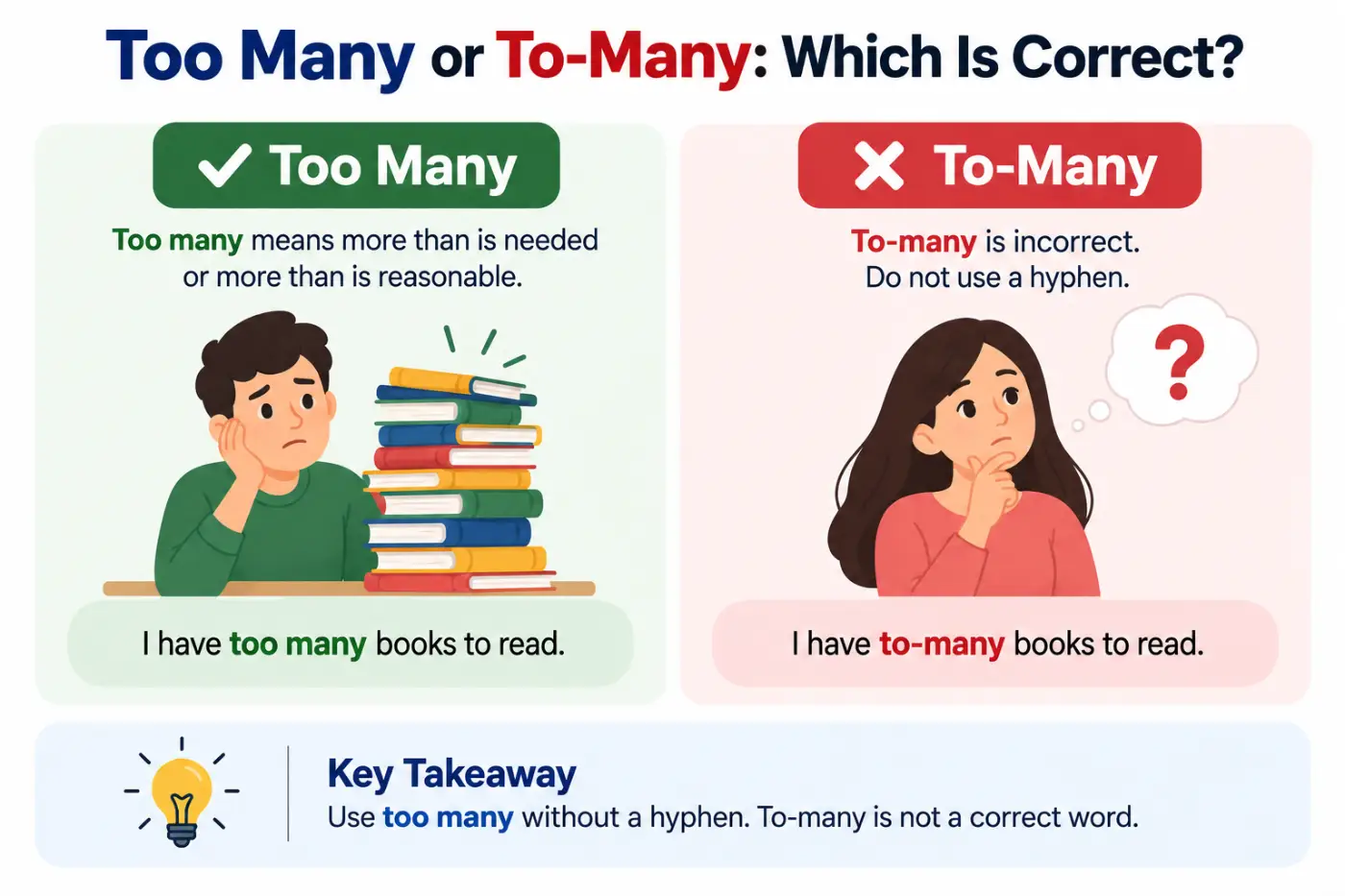
Too Many or To Many is a common English spelling and grammar question because to and too sound the same in ordinary speech. If you’re writing quickly it’s easy to type one when you mean the other. The correct phrase for an excessive number is too many.
The difference comes from grammar rather than pronunciation. Too is an adverb that can show excess. Many is a determiner or pronoun used with countable nouns. Together they create a phrase that means more people or things than are wanted or needed. For example you can say There are too many cars on this street.
To has a different job. It commonly shows direction or introduces an infinitive. That’s why to many can appear next to the word many in some sentences but it usually isn’t a fixed phrase. Once you understand what each word does the choice becomes much easier. This guide explains the difference with clear examples grammar rules common mistakes pronunciation tips and practical memory tricks.
Short Answer
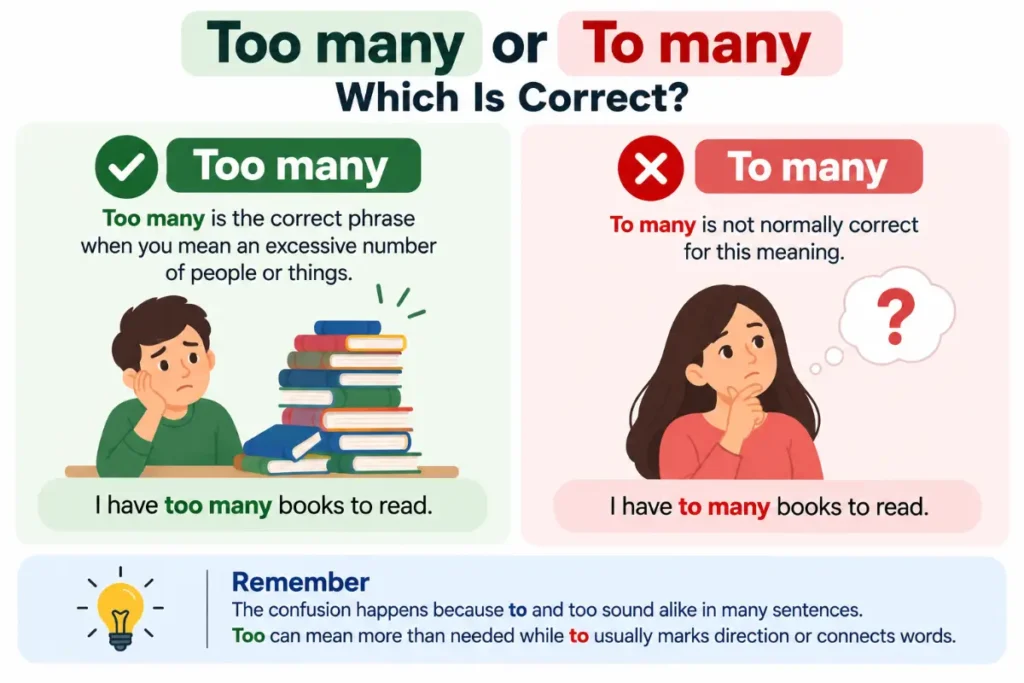
Too many is the correct phrase when you mean an excessive number of people or things. To many is not normally correct for this meaning. The confusion happens because to and too sound alike in many sentences. Remember that too can mean more than needed while to usually marks direction or connects words.
Table Of Contents
- What the phrase means.
- The difference between the two forms.
- When to use too many.
- When to use to many.
- Why the confusion happens.
- Grammar rules.
- Sentence examples.
- Common mistakes.
- Pronunciation.
- Word origins.
- Real life usage.
- Memory tips.
- Related expressions.
- Editing tips.
- Frequently asked questions.
- Key takeaways.
- Conclusion.
What Too Many Means
Too many means more people or things than are wanted needed appropriate or manageable.
The word too adds the idea of excess. The word many refers to a large number of countable things or people.
Consider this sentence:
There are too many people in the room.
The sentence doesn’t simply say that the room contains a large number of people. It says the number is excessive for the situation.
That distinction matters.
Compare these sentences:
There are many people in the room.
There are too many people in the room.
The first sentence tells you that a large number of people are present. The second tells you that the number has gone beyond a useful or acceptable limit.
The phrase can describe physical objects.
I bought too many books.
It can describe people.
Too many students missed the deadline.
It can describe events or actions when the noun is countable.
We’ve had too many meetings this month.
The central idea is always excess.
What To Means
To has several grammatical functions in English. It can show movement toward a place or person.
We walked to the store.
She sent the package to her brother.
It can also appear before a base verb to form an infinitive.
I want to leave.
He needs to study.
They decided to wait.
In these uses to does not mean excessive. It has a completely different grammatical role.
That’s why you cannot replace too with to in a sentence such as:
There are too many people here.
Changing the spelling produces:
There are to many people here.
That version doesn’t express the intended meaning.
The Difference Between The Two Forms
The simplest distinction is this:
Too many means an excessive number.
To many does not normally function as a phrase meaning an excessive number.
The two words sound alike in many varieties of English but they belong to different grammatical categories.
| Form | Main Function | Meaning | Example |
|---|---|---|---|
| Too many | Adverb plus quantity word | More than needed or wanted | There are too many cars outside. |
| To | Preposition or infinitive marker | Direction relationship or connection to a verb | We went to the store. |
| Many | Determiner or pronoun | A large number of countable things or people | Many students attended. |
This is why spelling alone isn’t enough. You need to identify the grammatical job of the word.
When To Use Too Many
Use too many when the number of countable items or people exceeds what is suitable.
Too Many With People
There are too many people at the door.
The speaker believes the number of people is excessive.
Too many employees arrived late.
The sentence suggests that the number of late employees is higher than acceptable.
I invited too many guests.
The speaker thinks the guest list has become larger than intended.
Too Many With Objects
You have too many shoes.
The speaker believes the number of shoes is excessive.
There are too many boxes in the hallway.
The boxes create a problem because there are more than the space can reasonably handle.
I put too many books in my bag.
The number of books makes the bag too heavy or crowded.
Too Many With Events
We’ve had too many meetings this week.
The speaker feels that the number of meetings is excessive.
There are too many tests this month.
The sentence suggests an unreasonable or difficult number of tests.
Too Many With Choices
There are too many options on the menu.
The speaker feels that the number of choices makes the decision difficult.
This use is especially common in everyday speech. People often use too many when several choices create inconvenience or confusion.
When To Many Can Be Correct
The phrase to many can appear in grammatical sentences but it does not normally act as a fixed expression meaning an excessive number.
For example:
This message is useful to many readers.
Here to is a preposition. The phrase to many readers means something like for many readers or in relation to many readers depending on context.
Another example is:
The decision was surprising to many people.
The word to connects the adjective surprising with the people who experienced that reaction.
Here the phrase isn’t saying that the number of people was excessive. It says that many people had the reaction.
This distinction is crucial.
Compare:
The decision was surprising to many people.
Too many people were surprised by the decision.
The first sentence says many people found the decision surprising.
The second says the speaker thinks the number of surprised people was excessive.
The spelling changes because the meaning changes.
Why The Confusion Happens
The main reason is pronunciation.
In most American English speech to and too are pronounced the same in normal connected speech. That makes them homophones.
When you hear:
There are too many cars.
you don’t hear the spelling. You hear the sound.
This becomes even harder when people type quickly. Since both words are common and familiar the wrong one may slip through without looking obviously strange.
There is also a visual reason for the mistake. To is one of the most frequently used words in English. Writers often type it automatically. When a sentence contains a phrase that sounds like too they may choose the shorter and more familiar spelling.
The best solution is to focus on meaning.
If the word means more than enough use too.
If the word expresses direction or introduces a verb use to.
Grammar Rules For Too Many
The phrase follows a straightforward grammar pattern.
Too Many Before A Plural Countable Noun
The most common pattern is:
too many + plural countable noun
Examples include:
too many books
too many emails
A countable noun can be counted individually. You can have one book two books or twenty books.
That is why many works naturally with these nouns.
Too Many Without A Noun
You can sometimes use too many without repeating the noun when the meaning is already clear.
I bought too many.
The listener understands that the speaker bought too many of something from the context.
For example:
How many cookies did you eat?
Too many.
The noun doesn’t need to be repeated.
Too Many Of
You can also use too many of before a determiner or pronoun.
Too many of the students were absent.
I’ve read too many of these books.
Too many of them arrived early.
The word of helps connect the quantity phrase with a specific group.
Too Many For
You can use too many for when explaining that a quantity exceeds what a person or place can reasonably handle.
There are too many people for this room.
That’s too many questions for one lesson.
We have too many tasks for one afternoon.
The phrase too many for often makes the limit clear.
Too Many To
Another useful structure is:
too many + noun + to + verb
For example:
There are too many boxes to carry at once.
I have too many emails to answer tonight.
She has too many assignments to finish today.
Here the first too expresses excess. The second to introduces the verb.
This is a good example of why the two words can appear close together without being interchangeable.
Too Many Versus Many
Many and too many are related but they don’t mean exactly the same thing.
Many people attended the event.
This simply says that a large number attended.
Too many people attended the event.
This says the number was excessive.
The speaker may think the venue was overcrowded or the event became difficult to manage.
The word too adds an evaluation. It tells the reader that the quantity has crossed a limit.
That limit may be physical.
There are too many chairs in this room.
It may be practical.
I have too many tasks today.
It may be social.
Too many people know about the surprise.
It may be subjective.
You ask too many questions.
The exact limit depends on context.
Too Many Versus Too Much
This is another useful distinction.
Use too many with plural countable nouns.
Use too much with uncountable nouns.
Compare:
There are too many bottles.
There is too much water.
Bottles can be counted.
Water is normally treated as an uncountable substance.
More examples include:
too many questions
too many mistakes
A quick grammar check is to ask if you can count the noun as separate units. If you can then too many will often be the correct choice.
Too Many Versus A Lot Of
A lot of simply indicates a large quantity. It doesn’t automatically suggest that the amount is excessive.
There are a lot of people here.
This may be neutral.
There are too many people here.
This signals a problem or unwanted excess.
That small difference can change the tone of a sentence.
If you’re writing professionally be careful about using too many because it often expresses judgment.
For example:
There are many applications this year.
sounds neutral.
There are too many applications this year.
suggests that the number creates a problem.
Sentence Examples
The following examples show natural uses in everyday American English.
- There are too many cars on this road. The speaker thinks traffic has reached an undesirable level.
- I have too many emails in my inbox. The number of emails feels difficult to manage.
- She bought too many snacks for the trip. The amount exceeded what was needed.
- There were too many people at the restaurant. The restaurant was more crowded than the speaker wanted.
- He made too many mistakes on the test. The number of mistakes was higher than acceptable.
- We have too many meetings this week. The speaker considers the meeting schedule excessive.
- You’re asking too many questions at once. The number of questions feels difficult to handle.
- There are too many choices on the website. The number of options makes selection harder.
- I packed too many clothes. The speaker brought more clothing than necessary.
- Too many students missed the assignment deadline. The number of students who missed it was considered excessive.
- She received too many messages during the meeting. The number of messages became a distraction.
- We invited too many guests. The guest list became larger than intended.
- There are too many boxes in the garage. The quantity creates a space problem.
- He has too many responsibilities right now. The number of duties feels unmanageable.
- Too many people tried to solve the same problem. The group had more participants than were useful for the task.
Each sentence uses too many because the writer wants to express excess rather than simply report a large number.
Common Mistakes
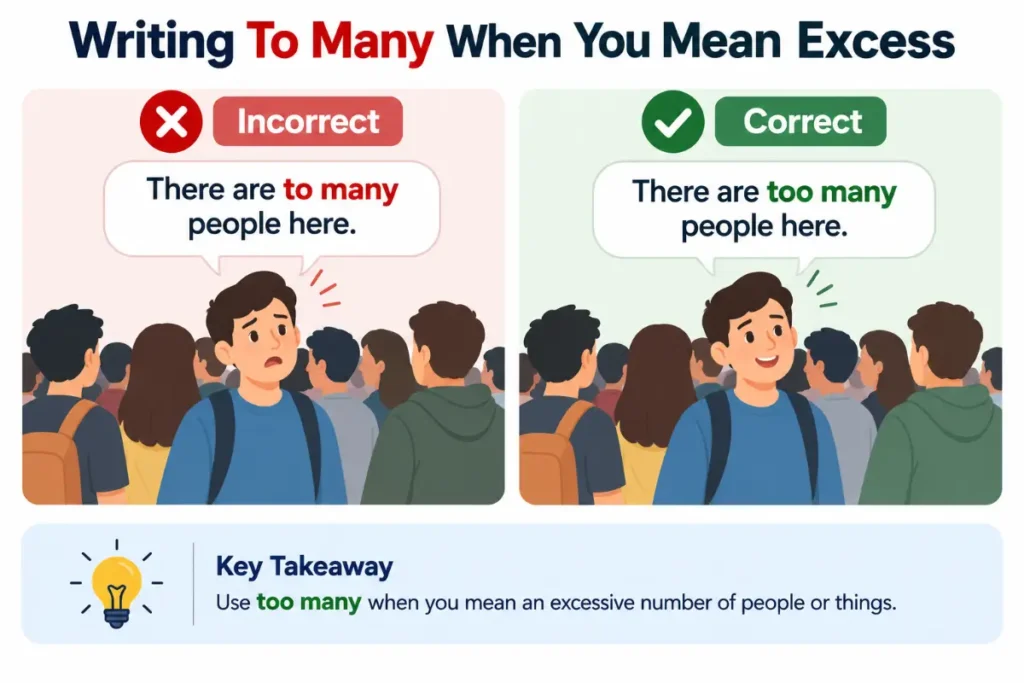
Writing To Many When You Mean Excess
Incorrect:
There are to many people here.
Correct:
There are too many people here.
The intended meaning is excessive quantity so too is required.
Using Too Many With An Uncountable Noun
Incorrect:
There is too many information in this report.
Correct:
There is too much information in this report.
Information is normally uncountable in standard English.
Using Too Much With A Plural Countable Noun
Incorrect:
There are too much questions.
Correct:
There are too many questions.
Questions are countable plural nouns.
Confusing Too With Two
Two refers to the number 2.
Too can mean also or excessively.
Compare:
I have two dogs.
I have too many dogs.
The words sound different in careful speech but can still cause spelling mistakes during fast writing.
Forgetting That Too Can Mean Also
The word too has another common meaning.
I want to come too.
Here too means also.
That meaning is different from the meaning in too many.
In too many the word means more than needed.
Pronunciation Guide
The words to and too are pronounced the same in many ordinary American English contexts.
Both commonly have the pronunciation represented by the IPA form /tuː/ when stressed or spoken clearly.
In connected speech to often has a weaker pronunciation such as /tə/. That reduced form is common in natural speech.
The important point for this grammar question is that pronunciation usually cannot help you decide between to and too.
You need to look at the meaning and grammatical function.
Too many contains the word that expresses excess.
To many uses to as a preposition in contexts where that relationship makes sense.
Word Origin
The two words have different histories.
To is an old English function word with roots reaching back to Old English. It has long served grammatical roles involving direction relationship and the infinitive.
Too developed from an Old English expression connected with the idea of addition or excess. Over time its uses developed into the modern meanings associated with also and more than needed.
That history helps explain why the spellings are different even though they sound alike in modern English.
You don’t need to memorize the etymology to use the words correctly. The grammatical distinction is much more useful in everyday writing.
American English Usage
American English uses too many as the standard expression for an excessive number.
Examples are common in everyday conversation professional communication school writing journalism and online communication.
There are too many people in the waiting room.
We have too many tasks to finish today.
The phrase is not informal slang. It is standard English.
To many can also appear in American English when to performs its normal grammatical function.
For example:
The change was confusing to many employees.
That sentence is grammatically standard because to many employees identifies the people who found the change confusing.
British English Usage
British English follows the same basic distinction.
Too many means an excessive number.
To many can appear when to has its normal grammatical role.
There is no major British versus American difference that changes this fundamental rule.
The key distinction is grammatical rather than regional.
Formal And Informal Usage
Too many works in both informal and formal writing.
Informal:
There are too many people here.
Formal:
The committee received too many applications to review within the available time.
The phrase itself isn’t casual. Its tone depends on the surrounding sentence.
In formal writing you may sometimes want to replace a subjective statement with a more precise description.
Instead of:
There are too many complaints.
You might write:
The number of complaints has increased beyond the department’s current capacity.
That version gives more specific information.
Still the original phrase is grammatically correct when the context supports it.
Real Life Usage
Daily Conversation
People use too many constantly in everyday speech.
I ate too many cookies.
You have too many bags.
There are too many people in here.
These sentences sound natural because they describe quantities that exceed a practical limit.
Workplace Communication
The phrase also works in professional settings.
We received too many requests to process them manually.
There are too many unresolved issues for one meeting.
The meaning remains the same but the context becomes more formal.
Academic Writing
Academic writers can use too many when discussing excessive quantities.
The survey contained too many questions for some participants to complete comfortably.
Too many variables can make the model difficult to interpret.
In academic writing precision matters. If possible explain why the quantity is excessive.
News Writing
Journalists may use the phrase when reporting concerns about high numbers.
Too many residents reported delays in receiving service.
The surrounding facts should clarify what makes the number significant.
Online Communication
Text messages and social posts frequently contain too many.
Too many notifications.
I have too many tabs open.
There are too many options.
These short expressions are common because the phrase quickly communicates frustration or excess.
Memory Tips
The easiest memory trick is to connect too with more than needed.
Think:
Too = excessive.
Then:
Too many = more than needed.
For example:
too many books = more books than needed.
too many people = more people than wanted.
You can also remember that two has a number meaning.
Two apples means exactly 2 apples.
Too many apples means an excessive number of apples.
Another useful trick is to remember that to often points somewhere or leads into a verb.
Go to school.
Want to leave.
Need to work.
When the word expresses excess it is too.
A Simple Editing Test
When proofreading a sentence containing to or too ask one question.
Does the word mean more than needed?
If yes use too.
For example:
There are ___ many people here.
Does the speaker mean an excessive number?
Yes.
So:
There are too many people here.
Now consider:
I went ___ the store.
Does to mean more than needed?
No.
It shows direction.
So:
I went to the store.
Try another:
I want ___ leave.
The word introduces the verb leave.
So:
I want to leave.
This test takes only a moment and catches many common spelling errors.
Related Expressions
Understanding nearby expressions makes the rule even clearer.
Too Much
Use too much with uncountable nouns.
There is too much noise.
Too Few
Use too few when an amount is smaller than needed.
There are too few chairs.
Too Little
Use too little with uncountable nouns.
There is too little time.
Many
Many means a large number but doesn’t necessarily suggest excess.
A Lot Of
A lot of means a large quantity and is usually neutral.
So Many
So many emphasizes a surprisingly large number.
Very Many
Very many is grammatically possible but less common in ordinary American English than other quantity expressions.
The choice depends on what you want to communicate. Too many expresses excess. So many often expresses surprise or emphasis. Many simply indicates a large number.
Too Many In Negative Sentences
The meaning can change depending on sentence structure.
Consider:
There aren’t too many people here.
This usually means the number of people is not excessive.
It doesn’t necessarily mean that there are very few people.
Similarly:
I don’t have too many questions.
This means the speaker doesn’t have an excessive number of questions.
This structure is common in everyday speech because people often use not too many to soften a statement.
For example:
There weren’t too many problems with the plan.
The speaker suggests that the problems were limited or manageable.
Too Many In Questions
You can also use the phrase in questions.
Are there too many people in the room?
The speaker is asking if the number has exceeded a suitable limit.
Did I ask too many questions?
The speaker wants to know if the number of questions was excessive.
Do we have too many meetings this week?
The question asks for an evaluation of the schedule.
Questions with too many are especially useful because the phrase often expresses a judgment that the speaker wants another person to confirm.
Too Many With Abstract Countable Nouns
The noun doesn’t have to be something physical.
You can use too many with abstract countable nouns.
There are too many problems with the plan.
He made too many excuses.
She asked too many questions.
The report contains too many errors.
Problems excuses questions and errors aren’t physical objects but they can be counted as individual units.
That makes many grammatically appropriate.
Why Spell Check May Not Catch The Error
Modern writing tools can identify many obvious spelling errors but to and too create a special problem.
Both words are correctly spelled English words.
If you write:
There are to many people here.
the word to itself isn’t misspelled.
The problem is that it’s the wrong word for the context.
This is called a contextual word choice error. The writer has selected a real English word but used it where another real word belongs.
That’s why proofreading should involve meaning rather than spelling alone.
Read the sentence and ask what the word is supposed to mean.
Professional Writing Tip
Editors often read confusing word pairs by function rather than appearance.
When you see to or too ask what role it plays.
If it introduces a verb use to.
She wants to study.
If it shows movement use to.
She went to school.
If it means also use too.
She came too.
If it means more than needed use too.
She bought too many books.
This four part check is simple enough to use during proofreading and powerful enough to prevent most mistakes.
Key Takeaways
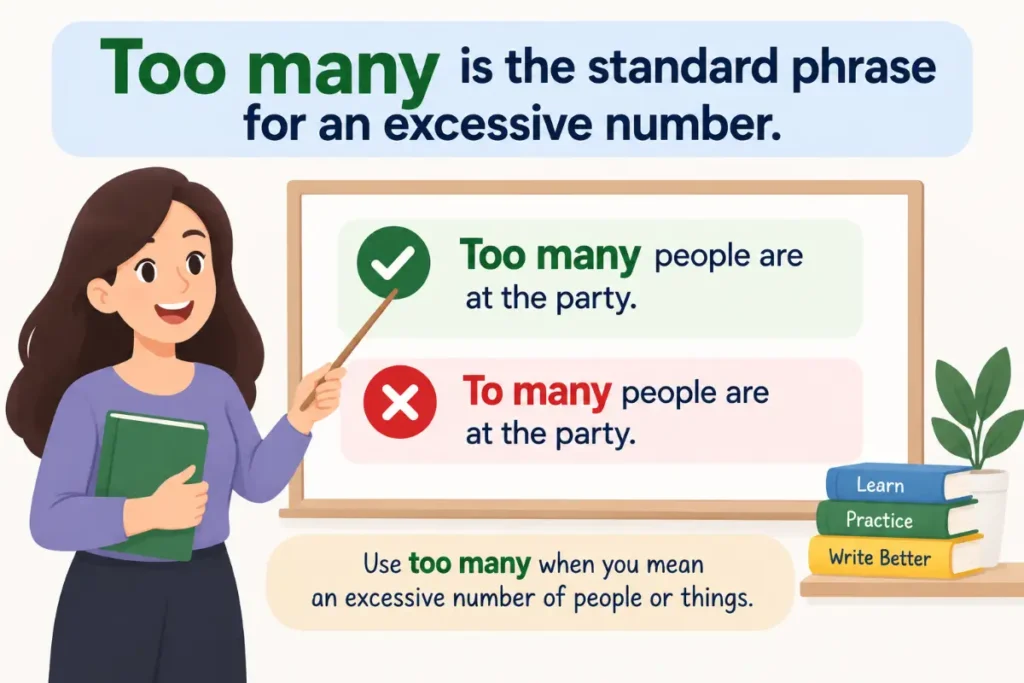
- Too many is the standard phrase for an excessive number.
- To and too have different grammatical functions even though they often sound alike.
- Use too many with plural countable nouns.
- Use too much with uncountable nouns.
- Many simply describes a large number while too many adds the idea of excess.
- To many can be correct in sentences where to functions as a preposition.
- The phrase too many works in casual conversation and formal writing.
- Pronunciation usually won’t help you distinguish the two words.
- Context and meaning provide the best way to choose the correct spelling.
- A quick editing test is to ask if the word means more than needed. If it does use too.
Conclusion
Too Many or To Many becomes much easier once you focus on meaning instead of sound. Use too many when you mean more people or things than are needed wanted or appropriate. The word too expresses excess while many works with plural countable nouns.
The word to has different grammatical jobs. It can show direction or introduce an infinitive and it can appear before many in sentences such as The decision was surprising to many people. That doesn’t make to many a substitute for too many.
For a quick proofreading trick ask if you can replace the phrase with more than needed. If that meaning fits use too many. This small habit can prevent one of the most common sound based word choice mistakes in English.
Frequently Asked Questions
Is too many or to many correct?
Too many is correct when you mean an excessive number. To many is not the standard phrase for that meaning. For example There are too many people here means there are more people than the speaker considers appropriate. The word too expresses excess while many identifies the large number.
Is to many ever correct?
Yes. To many can be grammatically correct when to functions as a preposition. For example The announcement was surprising to many people is standard English. Here to connects the adjective with the people who experienced the reaction. It does not express excessive quantity.
Why do people confuse to and too?
The main reason is pronunciation. In many American English contexts to and too sound the same. Both are also extremely common words. Fast typing can make the confusion worse because writers may choose the shorter familiar form without checking the sentence meaning.
What does too many mean?
Too many means more people or things than are wanted needed appropriate or manageable. For example I have too many emails means the number of emails has become excessive. The phrase normally appears with plural countable nouns such as books students questions cars tasks and problems.
What is the difference between many and too many?
Many describes a large number without necessarily judging it as excessive. Too many says the number has gone beyond a suitable limit. Compare Many people attended the event with Too many people attended the event. The second sentence suggests that the large attendance caused a problem or exceeded expectations.
Can too many be used without a noun?
Yes. You can use too many without repeating the noun when the context makes the meaning clear. For example someone might ask How many cookies did you eat? and you could answer Too many. The missing noun is understood from the previous question.
Should I use too many or too much?
Use too many with plural countable nouns. Use too much with uncountable nouns. Say too many questions because questions can be counted. Say too much information because information is normally treated as uncountable in standard English.
Are to and too homophones?
In many varieties of English they are homophones because they share the same pronunciation in common contexts. This means they sound alike but have different meanings and grammatical functions. Their spelling therefore depends on context. The listener may hear the same sound while the writer must choose the appropriate written form.
Can too many appear in formal writing?
Yes. Too many is standard English and can appear in formal writing. However formal writers sometimes replace it with a more precise description when the exact limit matters. For example instead of saying too many applications a report might state that the number of applications exceeded the team’s processing capacity.
How can I remember the difference?
Remember that too can mean more than needed. If you can replace the phrase with more than enough then too many is probably correct. Use to when it shows direction or introduces a verb. This simple meaning test is usually faster than trying to remember the spelling visually.

Confusing Words, Spelling & Word Choice
Claire Whitmore is a U.S.-based English editor who writes about commonly confused words, spelling differences, and word choice. Her work helps readers understand subtle distinctions between similar-looking words through simple definitions, practical examples, and modern usage guidance in both American and British English.