
Short Answer
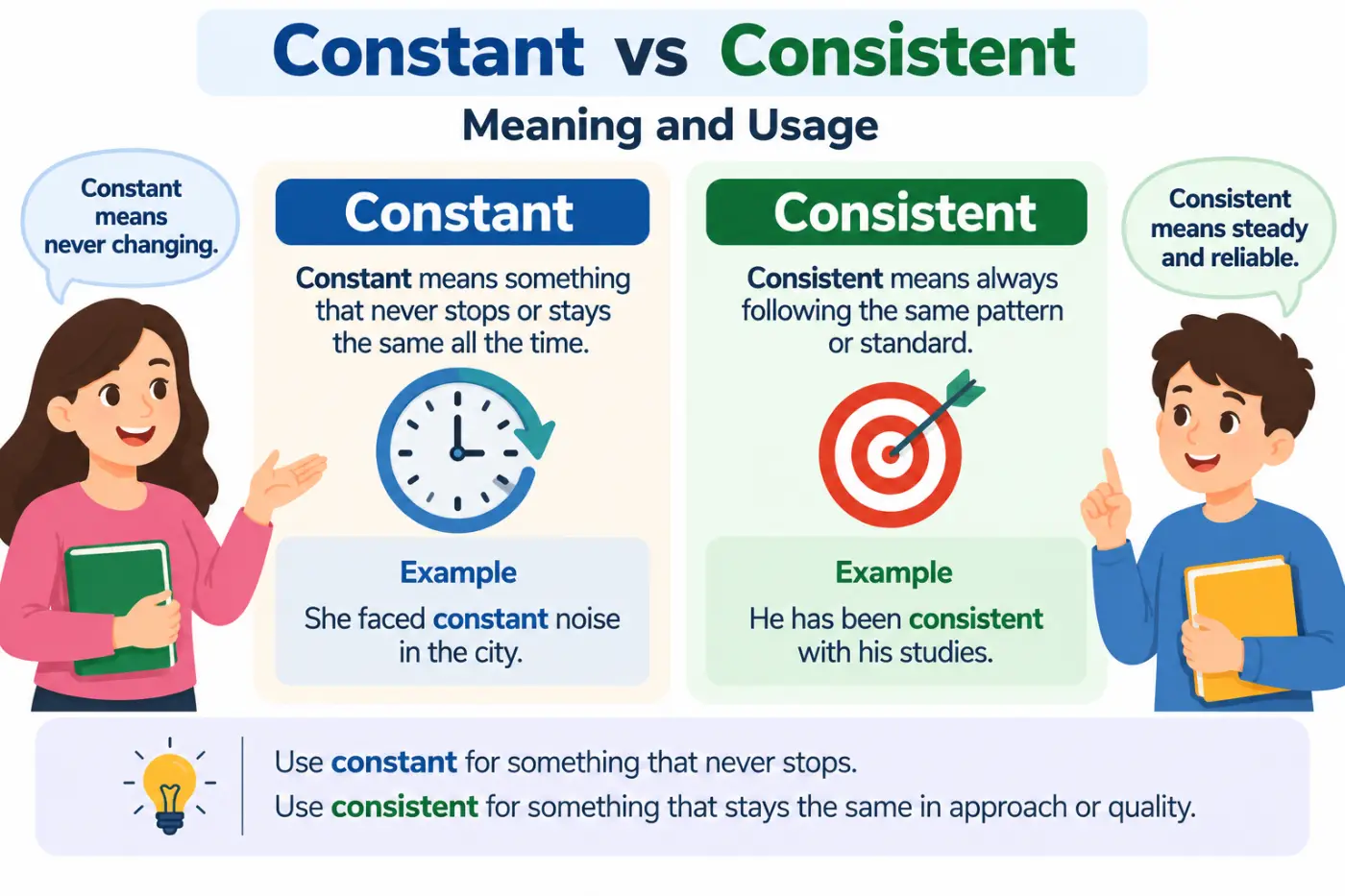
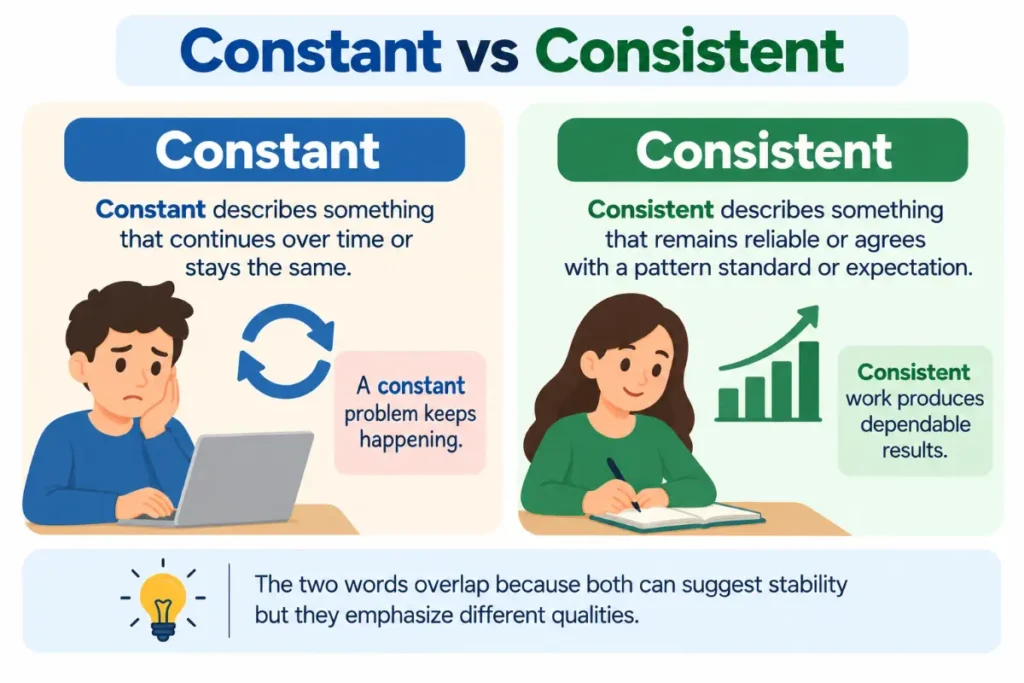
Constant describes something that continues over time or stays the same. Consistent describes something that remains reliable or agrees with a pattern standard or expectation. A constant problem keeps happening while consistent work produces dependable results. The two words overlap because both can suggest stability but they emphasize different qualities.
Table Of Contents
- The basic difference.
- Meaning of constant.
- Meaning of consistent.
- Constant vs Consistent in everyday English.
- How the words differ in context.
- Grammar and sentence patterns.
- Examples in natural sentences.
- Common mistakes.
- Pronunciation guide.
- Word origins.
- American and British usage.
- Similar words.
- Professional writing guidance.
- Memory tips.
- Frequently asked questions.
- Key takeaways.
- Conclusion.
The Basic Difference
The easiest way to understand the distinction is to focus on the question each word answers.
Constant asks whether something continues or stays unchanged.
Consistent asks whether something remains reliable or matches a pattern.
Consider these two sentences.
The rain was constant.
This means the rain continued for a long period with little or no interruption.
Her performance was consistent.
This means her performance remained reliably good or stayed within a similar range.
The words describe different aspects of stability.
Constant is about continuation or lack of change.
Consistent is about reliability or agreement with a pattern.
That difference becomes especially useful in professional writing because choosing one word instead of the other can change the meaning of a sentence.
Meaning Of Constant
Constant is an adjective that describes something that continues without stopping or something that remains unchanged.
It can describe physical conditions emotional states repeated events sounds problems movements or values.
For example:
The constant noise made it difficult to concentrate.
The noise continued for a long period.
She faced constant pressure at work.
The pressure kept occurring or remained present.
The temperature remained constant throughout the experiment.
Here constant means the temperature did not change.
The word can therefore express two closely connected ideas.
- Something keeps happening.
- Something stays the same.
The exact meaning depends on the context.
Constant As Continuing
When constant means continuing it often describes something that happens repeatedly or remains present.
Examples include:
constant rain
constant movement
These expressions emphasize persistence.
If someone says constant interruptions the focus is on the fact that interruptions keep occurring.
Constant As Unchanging
Constant can also describe something that remains fixed.
For example:
The speed remained constant.
This means the speed did not change.
The pressure must stay constant.
This means the pressure needs to remain at the same level.
This use appears often in mathematics science engineering and technical writing.
The word therefore has a broader meaning than simply frequent.
Something constant can continue continuously or remain unchanged.
Meaning Of Consistent
Consistent is an adjective that describes something reliable steady or compatible with a pattern or standard.
It often refers to behavior performance quality results decisions or information.
For example:
She delivers consistent results.
Her results are reliably good or similar over time.
His explanation was consistent with the evidence.
His explanation agreed with the available evidence.
The restaurant provides consistent service.
The quality of the service remains dependable.
Consistent therefore has several related meanings.
- Reliable over time.
- Similar in quality or behavior.
- In agreement with something else.
The third meaning is especially important.
You can say:
His statement was consistent with the facts.
This doesn’t mean his statement continued without stopping. It means his statement agreed with the facts.
That is a major difference between the two words.
Constant vs Consistent In Everyday English
The distinction becomes clearer when you compare ordinary situations.
Imagine a friend who calls you every day.
You might say:
She is a constant presence in my life.
The idea is that she remains there over time.
Now imagine a friend who always keeps promises.
You might say:
She is a consistent friend.
The focus is on dependable behavior.
The same person could be both.
Someone may remain in your life for years and also treat you with dependable kindness.
In that case the words describe two different qualities.
Constant emphasizes staying present.
Consistent emphasizes behaving reliably.
This distinction appears in relationships work school sports habits and everyday routines.
How The Words Differ In Context
Constant In Relationships
Constant can describe someone who remains loyal or present.
Her constant support helped me through a difficult year.
The support was always there.
He has been a constant source of encouragement.
The phrase suggests something dependable that remains present.
Here constant carries a sense of continuity.
Consistent In Relationships
Consistent focuses more on dependable behavior.
She is consistent in the way she treats people.
Her behavior follows a reliable pattern.
He gives consistent support to his team.
The support is dependable and steady.
The emphasis is not simply on duration. It is on reliability.
Constant At Work
Constant can describe ongoing demands or repeated events.
The constant emails made it hard to focus.
The emails kept arriving.
She worked under constant pressure.
The pressure remained present.
Consistent At Work
Consistent usually has a positive meaning in professional communication.
He produces consistent results.
She provides consistent customer service.
The team has shown consistent growth.
These sentences emphasize dependable performance.
A manager might value a consistent employee because that person can be trusted to maintain a reliable standard.
Constant In Science
Constant has a precise technical use when describing a quantity that does not change.
The experiment was conducted at a constant temperature.
The temperature stayed fixed.
The machine operates at a constant speed.
The speed does not change.
In this context constant means stable and unchanging.
Consistent In Science
Consistent can describe results that agree with each other or follow an expected pattern.
The results were consistent across several tests.
This means the results showed a similar pattern.
It does not necessarily mean every value was exactly identical.
That distinction matters.
Constant can imply sameness.
Consistent often allows reasonable variation as long as the overall pattern remains reliable.
A Clear Comparison
| Feature | Constant | Consistent |
|---|---|---|
| Core idea | Continuing or unchanged | Reliable or in agreement |
| Main focus | Continuity or stability | Reliability or pattern |
| Can describe something ongoing | Yes | Sometimes |
| Can describe something unchanged | Yes | Sometimes |
| Can describe quality | Less common | Very common |
| Can describe performance | Possible | Very common |
| Can mean agreement | Rarely | Yes |
| Common positive use | Constant support | Consistent performance |
| Common negative use | Constant noise | Consistent errors |
| Technical use | Fixed value or condition | Similar or compatible results |
The table shows why the words can overlap without being interchangeable.
When Constant Is The Better Choice
Use constant when you want to emphasize continuation or lack of change.
Here are common situations.
- Something keeps happening.
The constant interruptions slowed the meeting.
- Something remains present.
Her constant support gave him confidence.
- Something stays at the same level.
The machine maintained a constant speed.
- Something does not change.
The constant pressure affected the system.
The key idea is persistence or stability.
Ask yourself:
Does this thing keep happening or stay unchanged?
If the answer is yes then constant may be the stronger choice.
When Consistent Is The Better Choice
Use consistent when you want to emphasize reliability or agreement with a pattern.
Common examples include:
- Consistent performance.
- Consistent results.
- Consistent quality.
- Consistent behavior.
- Consistent effort.
- Consistent communication.
- Consistent growth.
- Consistent evidence.
For example:
She has shown consistent improvement.
This means her improvement has followed a steady and reliable pattern.
It doesn’t mean she improved every second without interruption.
Ask yourself:
Does this person or thing behave reliably or agree with an established pattern?
If yes then consistent is usually the better choice.
Grammar And Sentence Patterns
Both words are adjectives.
They usually appear before nouns or after linking verbs.
Constant Before A Noun
It commonly comes directly before a noun.
constant noise
constant change
Examples:
The constant noise distracted everyone.
She needed constant attention after the accident.
The adjective modifies the noun that follows it.
Constant After A Linking Verb
Constant can also appear after verbs such as be and remain.
The temperature remained constant.
His support was constant.
The pressure stayed constant.
Here the adjective describes the subject rather than directly modifying a noun.
Consistent Before A Noun
It also commonly appears before nouns.
consistent effort
consistent quality
Examples:
Her consistent effort paid off.
The company maintains consistent quality.
Consistent After A Linking Verb
Consistent can also follow linking verbs.
His performance remained consistent.
The results were consistent.
Her behavior has been consistent.
The structure is straightforward because both words function as adjectives.
Consistent With
One of the most important grammar patterns with consistent is consistent with.
This construction means that something agrees with or fits something else.
For example:
His explanation was consistent with the evidence.
The explanation matches the evidence.
Her actions were consistent with her stated goals.
Her actions fit what she said she wanted to achieve.
The results are consistent with earlier findings.
The new results agree with the earlier pattern.
This use has no direct equivalent with constant.
You would not normally say constant with the evidence to express agreement.
That makes consistent with a useful phrase to remember.
Constantly And Consistently
The adverbs constantly and consistently follow the same basic distinction.
Constantly means repeatedly or continually.
Consistently means reliably or in a steady pattern.
Compare:
He constantly checks his phone.
He checks it again and again.
They consistently arrive on time.
They reliably arrive on time.
The first sentence emphasizes frequency.
The second emphasizes dependable behavior.
This distinction is useful because the adverbs can appear in similar sentence structures.
Constantly Can Sound Negative
Constantly often suggests that something happens too much.
She constantly interrupts people.
The sentence implies repeated interruptions and may carry criticism.
The machine is constantly making noise.
Again the repetition may be unwanted.
Consistently Often Sounds Positive
Consistently often appears in praise.
She consistently meets her deadlines.
He consistently performs well.
The team consistently delivers high quality work.
But consistently can also describe something negative.
He consistently ignores the rules.
Here the behavior is reliable but undesirable.
So consistent does not automatically mean good.
It means predictable or dependable.
Real Life Examples
Daily Conversation
The constant rain ruined our plans.
The rain kept falling.
She is consistently kind to everyone.
Her kindness is reliable.
I get constant notifications on my phone.
The notifications keep arriving.
He consistently remembers important dates.
His behavior is dependable.
Workplace Communication
The constant changes made the project difficult to manage.
The changes kept occurring.
The team needs consistent communication.
The team needs communication that is reliable and steady.
Our customers complained about constant delays.
The delays happened repeatedly.
The company has maintained consistent service quality.
The quality has remained dependable.
Academic Writing
The constant temperature helped control the experiment.
The temperature remained unchanged.
The results were consistent with the original hypothesis.
The results agreed with the hypothesis.
Constant exposure to noise can affect concentration.
The exposure continued over time.
The researchers found consistent patterns across the data.
The data showed a reliable pattern.
Personal Writing
Her constant encouragement gave me the confidence to continue.
Her encouragement remained present.
His consistent effort eventually produced strong results.
His effort remained reliable over time.
The first sentence emphasizes ongoing support. The second emphasizes dependable effort.
News Writing
Residents complained about constant traffic in the area.
Traffic continued or occurred repeatedly.
Officials reported consistent progress on the project.
Progress followed a reliable pattern.
These choices help readers understand the nature of the situation rather than simply describing it as stable.

Ten Clear Example Pairs
The fastest way to master the distinction is to compare similar sentences.
Noise
Constant noise kept the students awake.
The noise continued.
Consistent noise made it easier to identify the source.
The noise followed a stable pattern.
Support
Her constant support helped me stay focused.
Her support remained present.
His consistent support helped me trust him.
His support was dependable.
Work
The constant demands of the job caused stress.
The demands kept coming.
His consistent work earned the manager’s trust.
His work was dependable.
Change
The constant changes confused the staff.
Changes kept happening.
The consistent changes followed the same pattern.
The changes were predictable and followed a pattern.
Results
The constant results were unusual.
This could suggest results that stayed unchanged but sounds less natural in many contexts.
The consistent results strengthened the conclusion.
The results repeatedly showed a similar reliable pattern.
This pair demonstrates an important point. Consistent is often the natural choice when discussing repeated test results.
Common Mistakes
Treating The Words As Exact Synonyms
The words overlap but they don’t have identical meanings.
A constant problem keeps happening.
A consistent problem may mean a problem that appears reliably or follows a pattern.
The second expression focuses more on predictability.
Using Constant For Reliable Performance
Writers sometimes say:
She gives constant results.
The intended meaning is often that she gives reliable results.
In that case consistent results is usually clearer.
Constant can suggest that the results never change at all which may not be what the writer means.
Using Consistent For Continuous Events
A writer may say:
The constant interruptions continued throughout the meeting.
This is natural because the interruptions kept happening.
If you write:
The consistent interruptions continued throughout the meeting.
The sentence can work but it shifts the meaning toward a predictable pattern of interruptions.
If your main point is that the interruptions would not stop then constant is stronger.
Confusing Consistent With Identical
Consistent does not always mean exactly the same.
A student can receive grades of 82 85 and 84 and still show consistent performance.
The numbers vary slightly but the overall level remains similar.
Constant would suggest something closer to no change.
Assuming Consistent Always Means Positive
Consistent describes reliability.
That reliability can be good or bad.
She consistently helps others.
Positive.
He consistently misses deadlines.
Negative.
The word itself doesn’t determine the value of the behavior.
Pronunciation Guide
The two words have different pronunciations.
Constant has two syllables and stress on the first syllable.
Consistent has three syllables and stress on the second syllable.
The first vowel in constant has the sound commonly heard in words such as con and confidence.
Consistent begins with a similar con sound and then moves into the stressed middle syllable.
For ordinary American speech the most useful distinction is the number of syllables and the stress pattern.
Constant has a compact two beat rhythm.
Consistent has three beats with the strongest stress in the middle.
If you are learning these words by listening then practicing the rhythm can help keep them separate.
Word Origins
Constant comes from Latin constans which carries the idea of standing firm or remaining steady. It entered English through French and developed meanings connected with stability permanence and continuity.
Consistent also has Latin roots. It comes from consistens and is connected with the idea of standing together or holding together. English developed the word around ideas such as agreement compatibility and reliable behavior.
The shared idea of stability helps explain why the words can feel similar.
Their modern meanings then moved in slightly different directions.
Constant emphasizes something that remains or continues.
Consistent emphasizes something that agrees fits together or behaves reliably.
Knowing the history can make the distinction easier to remember but you don’t need to memorize Latin roots to use the words correctly.
American And British Usage
Both words are standard in American English and British English.
There is no major spelling difference between the two varieties for these adjectives.
The meanings also remain essentially the same.
American writers use constant to describe ongoing conditions and fixed values.
They use consistent for dependable behavior similar results and agreement with facts or standards.
British writers use the same distinction.
For example:
constant pressure
consistent performance
constant change
consistent evidence
Regional pronunciation can vary slightly because accents differ but the core vocabulary distinction remains stable.
Formal And Informal Usage
Both words work well in formal and informal writing.
Constant appears frequently in professional technical academic and everyday communication.
Consistent is especially common in professional writing because reliability and agreement are important concepts in business research education and reporting.
For formal writing choose the word that expresses the exact relationship you mean.
Avoid replacing consistent with constant simply because constant sounds stronger.
Likewise avoid using consistent when your real meaning is that something never stops.
Precision matters more than intensity.
Similar Words And Related Terms
Several words can help clarify the difference.
Continuous
Continuous describes something that happens without interruption.
The machine produced a continuous sound.
This is close to one important meaning of constant.
Continual
Continual describes something that happens repeatedly often with short interruptions.
The continual interruptions made the meeting difficult.
It can overlap with constant but often allows breaks.
Steady
Steady describes something stable or regular.
She made steady progress.
Steady can overlap with consistent when discussing reliable development.
Reliable
Reliable means dependable.
He is a reliable employee.
This is closely related to consistent behavior.
Stable
Stable means unlikely to change suddenly.
The patient’s condition remained stable.
Stable can overlap with constant but usually suggests a condition that remains secure or controlled.
Regular
Regular describes something that happens at predictable times or intervals.
She takes regular breaks.
Regular focuses strongly on timing or frequency.
Persistent
Persistent describes something that continues despite difficulty or attempts to stop it.
The persistent noise became annoying.
Persistent can overlap with constant when describing unwanted conditions.
Uniform
Uniform describes something that remains the same throughout.
The mixture had a uniform texture.
Uniform is closer to constant in contexts involving sameness.
Constant And Consistent In Professional Writing
Professional writing benefits from precise word choice.
Suppose you are writing a performance review.
She provides constant results.
This sounds slightly unusual because results are normally evaluated for reliability rather than uninterrupted continuation.
A clearer sentence would be:
She provides consistent results.
Now consider a workplace problem.
The team faces constant interruptions.
This works because the interruptions keep occurring.
Replacing constant with consistent changes the emphasis.
The team faces consistent interruptions.
Now the sentence suggests the interruptions follow a predictable pattern.
Neither sentence is automatically wrong. The intended meaning determines the best choice.
This is a useful editing principle.
Don’t ask which word sounds more impressive.
Ask which word describes the actual situation.
Constant And Consistent In Academic Writing
Academic writing often uses both words but for different purposes.
Constant can describe controlled conditions.
The researchers maintained a constant temperature.
It can also describe something that continues over a period.
The participants experienced constant exposure to the stimulus.
Consistent can describe agreement among findings.
The results were consistent with the proposed explanation.
It can also describe patterns.
The researchers observed consistent behavior across the groups.
This distinction helps academic writing remain precise.
Constant often describes a condition that researchers hold steady.
Consistent often describes findings that agree or show a stable pattern.
Constant And Consistent In Personal Development
These words appear frequently when people talk about habits and progress.
Suppose someone exercises every week.
You could describe their effort as consistent.
That means they maintain a reliable habit.
You would usually not call the effort constant because nobody needs to exercise every moment without stopping.
This shows an important difference.
Constant can suggest uninterrupted continuation.
Consistent can describe repeated action over time with normal breaks.
That’s why phrases such as consistent effort and consistent practice are natural.
They describe habits that happen reliably rather than continuously.
Constant And Consistent In Relationships
The same distinction applies to friendship.
A constant friend may be someone who remains present through changing circumstances.
A consistent friend is someone whose behavior is dependable.
You might say:
Her constant presence made difficult years easier.
The focus is duration and continued presence.
You might also say:
Her consistent kindness made everyone feel welcome.
The focus is reliable behavior.
A strong relationship can have both qualities.
Someone can remain by your side and consistently treat you with care.
The words simply highlight different parts of that relationship.
How To Choose The Right Word
When you hesitate between these adjectives use a simple three question test.
- Does it keep happening?
If yes then constant may fit.
constant interruptions
- Does it stay unchanged?
If yes then constant may fit.
constant temperature
- Does it behave reliably or agree with a pattern?
If yes then consistent may fit.
consistent performance
This test handles most everyday situations.
There will always be contexts where words overlap but the central distinction remains useful.
A Simple Memory Trick
Think of constant as a clock that keeps ticking.
The focus is continuation.
Think of consistent as a worker who keeps meeting the same standard.
The focus is reliability.
You can also remember these short associations:
Constant means continuing.
Consistent means dependable.
Constant means unchanged.
Consistent means matching a pattern.
If you remember only one distinction remember this:
Constant is about staying or continuing. Consistent is about reliability or agreement.
That single idea will solve most usage questions.
Related Grammar And Usage Notes
The words often combine with different nouns.
The word Constant commonly appears with words that describe ongoing conditions.
constant pressure
constant noise
The word Consistent commonly appears with words connected to quality behavior and patterns.
consistent effort
consistent results
These combinations aren’t absolute rules but they reflect common usage.
You can use context to decide.
If the noun describes something that keeps happening then constant is often natural.
If the noun describes a quality or pattern that remains reliable then consistent is often the better choice.
Expert Editor Insight
An experienced editor checks the intended meaning before accepting either word. Constant usually signals continuation or sameness while consistent often signals dependable behavior or agreement with another fact or standard. One useful proofreading trick is to replace constant with ongoing and consistent with reliable. If the sentence keeps its intended meaning the choice is probably sound. If the meaning changes sharply then the original word deserves another look.
Key Takeaways
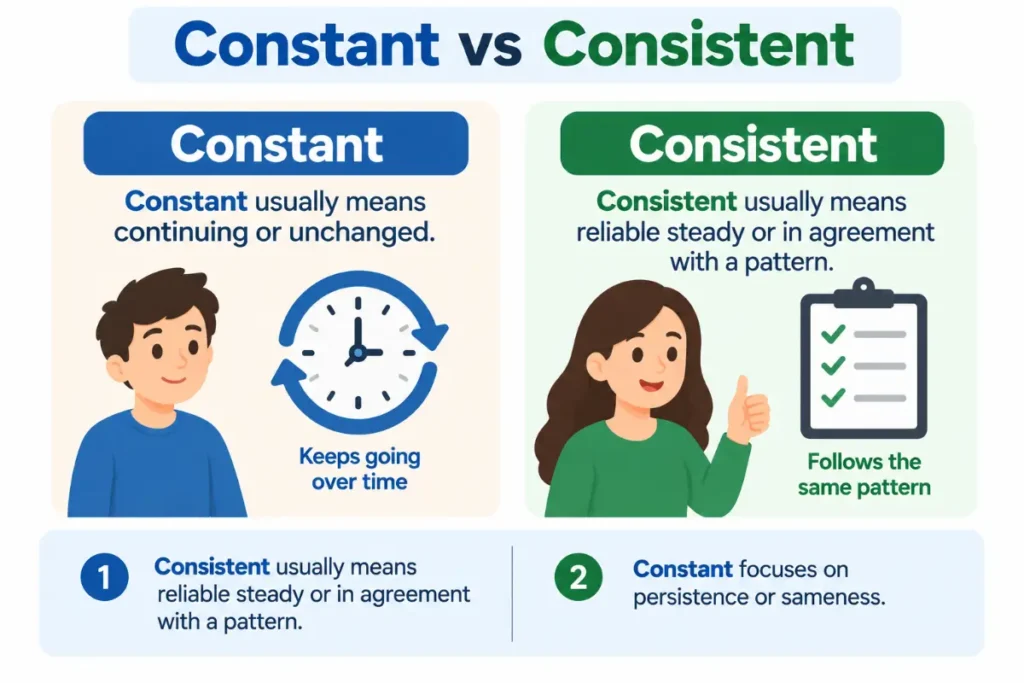
- Constant usually means continuing or unchanged.
- Consistent usually means reliable steady or in agreement with a pattern.
- Constant focuses on persistence or sameness.
- Consistent focuses on dependability or compatibility.
- Constant noise keeps happening.
- Consistent performance remains dependable.
- Constant temperature means the temperature does not change.
- Consistent results show a reliable pattern.
- Consistent with means compatible with or in agreement with something else.
- Constantly emphasizes repeated or continual action.
- Consistently emphasizes reliable repeated behavior.
- A simple memory trick is to connect constant with continuation and consistent with dependability.
Conclusion
Constant vs. Consistent becomes easier to understand when you focus on what each word describes. Constant usually refers to something that continues over time or remains unchanged. Consistent describes something that stays reliable or follows a pattern, standard, or expectation.
Think of constant as something that keeps going or stays the same. Think of consistent as something you can depend on. This distinction applies to everyday conversations, professional writing, academic work, personal development, and technical contexts.
When proofreading, ask yourself one simple question. Am I describing something that continues or remains unchanged? Use constant. Am I describing something reliable or in agreement with a pattern or standard? Use consistent. This simple test will help you choose the right word with confidence.
Frequently Asked Questions
What is the difference between constant and consistent?
Constant describes something that continues over time or remains unchanged. Consistent describes something that is reliable, follows a pattern, or agrees with a standard or fact. In short, constant emphasizes continuation or sameness, while consistent focuses on reliability or agreement. For example, a constant noise keeps occurring, whereas consistent performance means maintaining a reliable level of quality.
Is constant the same as consistent?
No. Although the words have some overlap, they are not exact synonyms. Constant generally means continuing or remaining unchanged, while consistent means reliable, steady, or compatible with something else. For example, constant interruptions happen repeatedly, while consistent results demonstrate a dependable pattern. The right word depends on the meaning you want to convey.
Which is better for describing good performance?
Consistent is usually the better choice. Consistent performance means performing reliably and maintaining a dependable standard. In contrast, constant performance may suggest that an activity continues without interruption or never changes, which is not usually the intended meaning. In employee reviews, academic work, sports, and similar contexts, consistent is generally more precise.
Can constant have a positive meaning?
Yes. Constant can describe valuable qualities such as support, loyalty, care, and friendship. For example, Her constant support helped me succeed presents continuity as something positive. However, constant can also describe unpleasant situations, such as constant noise or constant stress. The word itself is neutral, and its emotional tone depends on the noun it describes and the surrounding context.
Can consistent describe something negative?
Yes. Consistent means reliable or predictable, and that reliability can apply to unwanted behavior. For example, He consistently misses deadlines means that he repeatedly fails to meet them. The word does not automatically imply something positive; it simply indicates that a behavior follows a regular or predictable pattern.
Is consistent with grammatically correct?
Yes. Consistent with is a standard and widely used grammatical construction. It means that something agrees with, matches, or aligns with another fact, idea, pattern, or standard. For example, Her explanation was consistent with the evidence means that her explanation did not contradict the available evidence. This phrase is especially common in formal, academic, and professional writing.
What is a synonym for constant?
Depending on the context, synonyms for constant include continuous, ongoing, continual, persistent, unchanging, steady, and permanent. However, these words are not interchangeable in every sentence. Continuous emphasizes uninterrupted activity, persistent suggests something that continues despite difficulties or resistance, and unchanging highlights a lack of variation. Choose the synonym that best conveys your intended meaning.
What is a synonym for consistent?
Possible synonyms for consistent include reliable, steady, dependable, regular, uniform, compatible, and predictable. The best choice depends on the context. Reliable emphasizes trustworthiness, uniform highlights sameness, compatible indicates agreement, and steady often suggests stability over time. The word consistent is useful because it can express several of these ideas without being overly specific.
Is constant more negative than consistent?
Not inherently. Constant can sound negative when describing unwanted repetition, such as constant complaints or constant interruptions. However, it can also convey a positive meaning in phrases such as constant support and constant loyalty. Similarly, consistent often sounds positive in expressions such as consistent effort, but it can also describe undesirable habits. The overall tone depends on the context.
Can something be both constant and consistent?
Yes. Something can be both constant and consistent, although the words emphasize different qualities. For example, a machine may produce a constant sound while maintaining consistent output. Constant emphasizes that the sound continues or remains unchanged, while consistent highlights the reliability of the machine’s output. Both words can therefore describe different aspects of the same situation.

English Grammar & Usage
Nathan Holloway is an American grammar writer and language researcher who specializes in English grammar, sentence structure, verb usage, and common writing mistakes. He enjoys breaking down confusing grammar rules into practical explanations with clear examples, making English easier for students, professionals, and everyday writers.