
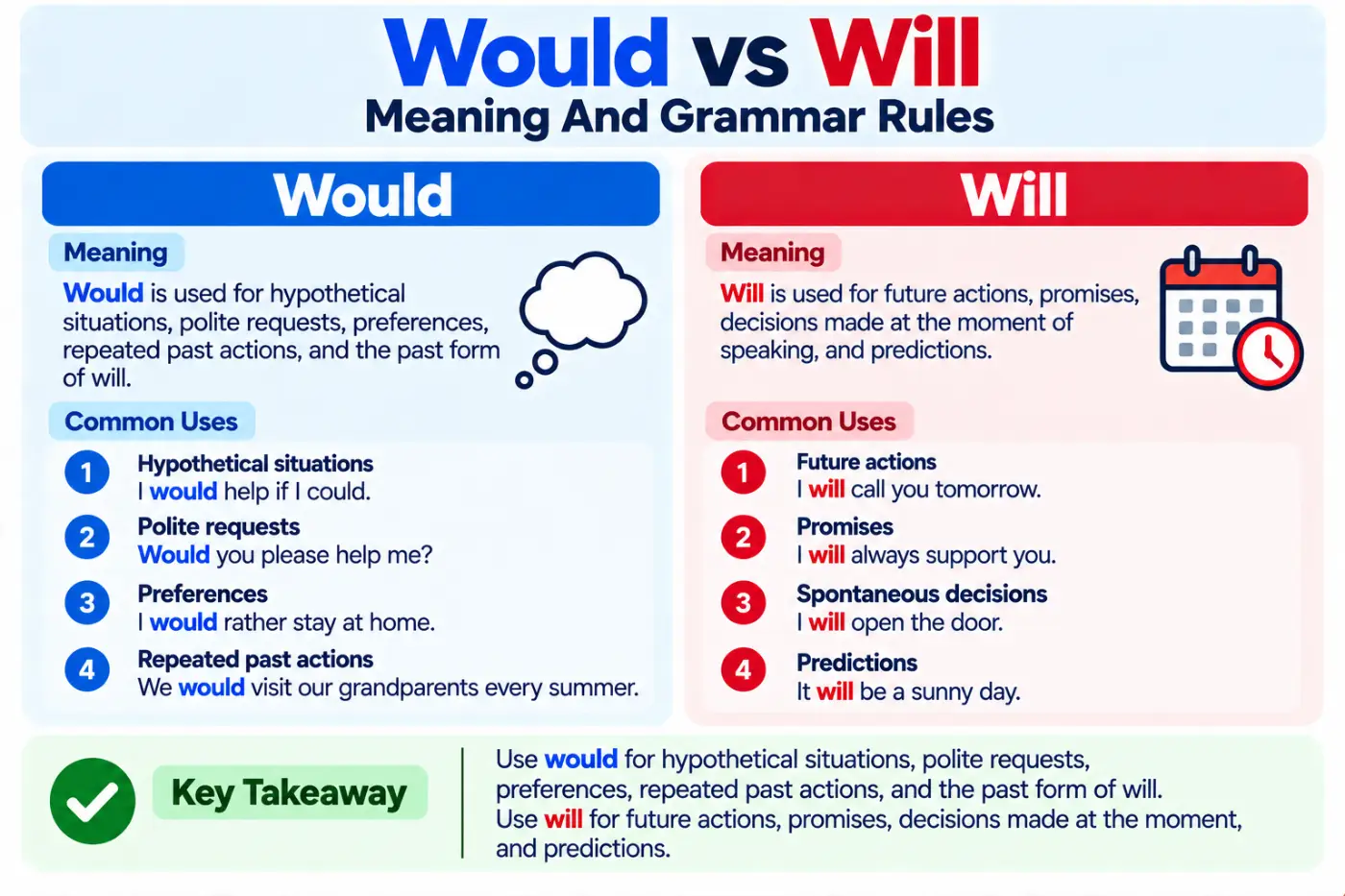
Would vs will can confuse English learners because both words are modal verbs that talk about actions, intentions, expectations, and conditions. They often appear in similar sentences, but they do not carry the same meaning. A small change from will to would can shift a sentence from a real future plan to an imagined situation or from a direct request to a more polite one.
The easiest way to understand the difference is to focus on the speaker’s perspective. Will commonly points forward from the present. Would often creates distance from the present by showing a condition, a past viewpoint, politeness, or something imagined. Once you recognize that difference, many confusing sentences become much easier to understand.
This guide explains the grammar behind would vs will with clear rules, practical examples, common mistakes, pronunciation notes, and memory tips. The goal isn’t simply to memorize two definitions. You should be able to look at a sentence and understand why one modal verb fits better than the other.
Table Of Contents
- What Will Means.
- What Would Means.
- The Main Difference Between Would And Will.
- Will For Future Actions.
- Would For Hypothetical Situations.
- Would For Polite Requests.
- Will And Would For Offers And Willingness.
- Will And Would In Conditional Sentences.
- Will And Would For Reported Speech.
- Would For Repeated Past Actions.
- Will And Would For Preferences.
- Will And Would In Questions.
- Will And Would In Professional Writing.
- Pronunciation Of Will And Would.
- Common Mistakes.
- Memory Tips.
- Related Grammar Notes.
- Real Life Examples.
- Frequently Asked Questions.
- Key Takeaways.
- Conclusion.
What Will Means
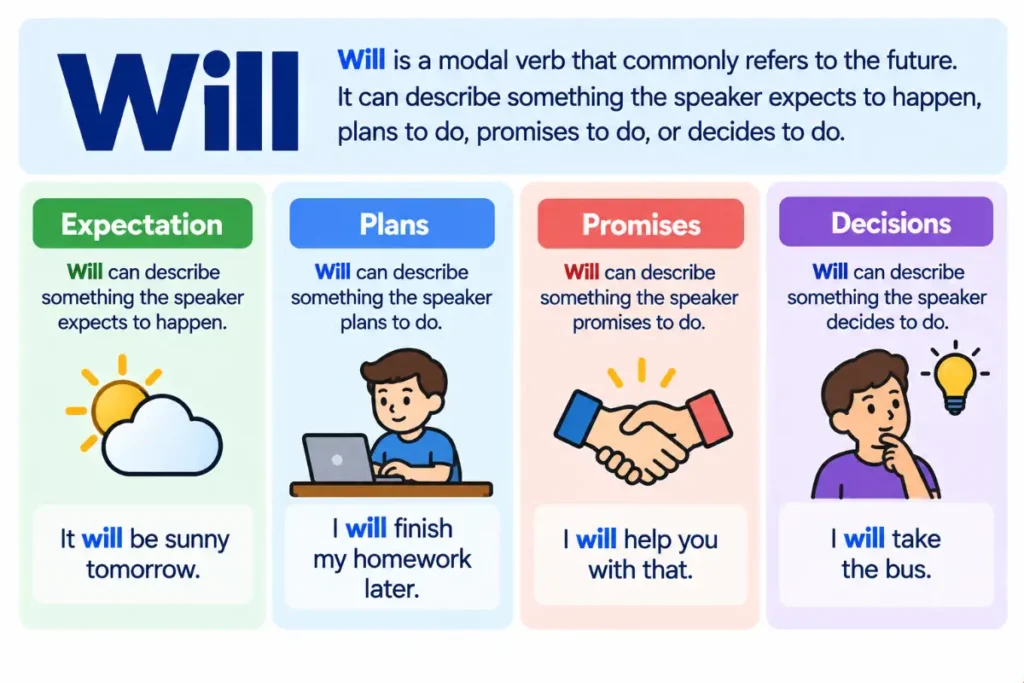
Will is a modal verb that commonly refers to the future. It can describe something the speaker expects to happen, plans to do, promises to do, or decides to do.
For example:
- I will call you tonight.
This sentence expresses a future action. The speaker says that the call will happen later.
- She will arrive at six.
The speaker expects her arrival at six.
- I will help you with the project.
The speaker offers or promises help.
- We will finish the work tomorrow.
The sentence expresses a future expectation or plan.
Will can also express willingness.
- I will carry the bags.
The speaker willingly agrees to carry them.
Will can express a strong prediction.
- That restaurant will be busy tonight.
The speaker expects the restaurant to have many customers.
Will can also appear in questions about someone’s willingness.
- Will you help me?
The question asks if the person is willing to help.
The important point is that will usually connects the speaker’s current viewpoint with a future action, decision, expectation, or willingness.
What Would Means
Would has several uses. It can describe hypothetical situations, polite requests, preferences, past habits, reported speech, and future actions viewed from a past perspective.
For example:
- I would travel more if I had more money.
The sentence describes an imagined situation. The speaker does not say that the trip is definitely going to happen.
- Would you open the window?
This is a polite request.
- She said she would call me.
The original statement referred to a future action from a past viewpoint.
- When I was young, I would visit my grandparents every summer.
Here would describes a repeated action in the past.
- I would rather stay home.
This expresses a preference.
Would therefore has a wider range of meanings than many learners first realize. It doesn’t simply mean the past form of will.
The Main Difference Between Would And Will
The central difference becomes easier when you think about distance.
Will usually presents an action as future or expected from the speaker’s current viewpoint. Would often creates some kind of distance.
That distance can come from several sources.
- A hypothetical condition.
I will buy the car.
I would buy the car if I had enough money.
The first sentence presents the purchase as a real future intention. The second presents it as a conditional possibility.
- Politeness.
Will you pass the salt?
Would you pass the salt?
Both sentences ask for the salt. The second sounds more polite and less direct.
- Past viewpoint.
He says he will come.
He said he would come.
The first sentence reports his current statement. The second reports something he said in the past.
- Past habit.
When we lived there, we would walk by the lake every evening.
Would places the repeated action inside a past period.
A useful mental shortcut is this.
Will often points forward from now. Would often adds distance through condition, politeness, past perspective, preference, or habit.
Will For Future Actions
Will is one of the most common ways to talk about future actions.
Use it when you make a decision at the moment of speaking.
For example:
- The phone is ringing. I will answer it.
The speaker makes the decision at that moment.
- I am tired. I will take a short break.
The decision happens as the speaker talks.
Will can also express promises.
- I will never forget your help.
The speaker makes a promise.
- I will send the document tonight.
The speaker commits to a future action.
Will can express predictions too.
- The weather will improve tomorrow.
The speaker predicts a future change.
- You will enjoy this book.
The speaker predicts the listener’s reaction.
Will also appears in offers.
- I will drive you home.
The speaker offers to provide transportation.
In everyday American English, will is common when the speaker sees the future action as real or expected.
Would For Hypothetical Situations
Would commonly appears when the speaker talks about an imagined situation.
Consider this pair.
I will buy a larger house.
I would buy a larger house if I could afford it.
The first sentence expresses a future intention. The second depends on an unreal or uncertain condition.
Would often works with if clauses.
- If I had more free time, I would read more books.
- If she knew the answer, she would tell us.
- If we lived closer, we would visit more often.
- If he studied harder, he would improve his grades.
In each example, the action depends on a condition.
The condition may be unlikely, unreal, or simply imagined. Would makes the relationship clear.
This is one of the most important grammar patterns to learn because it appears constantly in everyday speech and writing.
Would For Polite Requests
Would can make a request sound more polite.
Compare these sentences.
Will you help me?
Would you help me?
Both are grammatically correct. The second usually sounds softer and more courteous.
You can also use would in questions such as:
- Would you close the door?
- Would you mind waiting here?
- Would you please send me the file?
- Would you like some coffee?
The last example is especially common in everyday English.
Would you like some coffee?
This doesn’t mean the person is asking about a past preference. It is a polite way to offer something.
Will you have some coffee?
This has a different meaning and can sound less natural in many situations.
Would also works well in professional communication because it can soften requests without making the message unclear.
For example:
Would you please review the attached document?
This sounds polite and direct at the same time.
Will And Would For Offers And Willingness
Will can show willingness to do something.
For example:
I will help you.
This means the speaker agrees or intends to help.
Would can express willingness in a conditional situation.
I would help you if I had enough time.
The speaker wants to help but presents a condition that prevents the action.
This difference matters.
Consider these examples:
- I will help you tomorrow.
The speaker expects to help tomorrow.
- I would help you tomorrow if I weren’t working.
The speaker presents the help as conditional.
- I will go with you.
The speaker agrees to go.
- I would go with you if I could.
The speaker would like to go but gives a condition that prevents the action.
Will sounds more definite. Would often introduces a condition or distance.
Will And Would In Conditional Sentences
Conditional sentences provide one of the clearest ways to understand would vs will.
The first conditional commonly uses will in the result clause.
For example:
If it rains, we will stay home.
The condition is presented as a realistic future possibility.
Another example is:
If you study tonight, you will feel more prepared tomorrow.
The speaker views the condition as possible and the result as a future consequence.
The second conditional commonly uses would.
If it rained tomorrow, we would stay home.
This structure usually presents a more hypothetical or less likely situation.
Another example is:
If I had a million dollars, I would buy a house by the ocean.
The speaker imagines a situation that isn’t true at present.
A useful pattern is:
If + present form + will + base verb.
If I finish early, I will call you.
And:
If + past form + would + base verb.
If I finished early, I would call you.
The choice depends on the type of condition and the speaker’s meaning.
One common mistake is putting will directly after if in a normal first conditional.
Incorrect:
If I will have time, I will call you.
Correct:
If I have time, I will call you.
The word will normally belongs in the main result clause in this type of conditional sentence.
Would And Will In Reported Speech
Would can represent a future action from a past viewpoint.
Look at the direct statement:
I will call you tomorrow.
Now imagine someone reports that statement later.
She said she would call me the next day.
The original speaker used will because the call was future at that time. The reporter uses would because the statement is now being viewed from the past.
Here are more examples.
- Direct speech: He said, I will finish the work.
Reported speech: He said he would finish the work.
- Direct speech: Maria said, I will visit next week.
Reported speech: Maria said she would visit the following week.
- Direct speech: They said, We will help.
Reported speech: They said they would help.
This change is often called backshifting. The tense moves backward because the reporting verb is in the past.
The important idea is perspective. Would does not simply mean that the future action failed to happen. It shows that the action was future relative to a past point.
Would For Repeated Past Actions
Would can describe actions that happened repeatedly in the past.
For example:
When I was a child, my father would read to me every night.
The action happened again and again during a past period.
Another example:
Every summer, we would visit our cousins.
The visits were repeated.
When she lived in Chicago, she would walk to work every morning.
Again, the sentence describes a repeated past habit.
Would works especially well when the sentence establishes a clear past period.
For example:
When we lived in the countryside, we would sit outside after dinner.
The phrase when we lived in the countryside gives the reader the past setting needed to understand the repeated action.
Used this way, would often feels more narrative than used to.
Compare:
When I was young, I used to play outside every evening.
When I was young, I would play outside every evening.
Both can describe a repeated past activity. Used to can also describe past states.
For example:
I used to know him.
Would usually doesn’t work naturally for that meaning because knowing someone is a state rather than a repeated action.
Will And Would For Preferences
Would often appears when you express a preference.
The most common structure is would rather.
For example:
I would rather stay home tonight.
This means staying home is the speaker’s preferred choice.
You can compare two options.
I would rather drink tea than coffee.
She would rather walk than take the bus.
They would rather wait until tomorrow.
Would also appears in would like.
I would like a glass of water.
I would like to speak with the manager.
Would like is a polite way to express a desire or request.
Compare:
I want some water.
I would like some water.
Both communicate a desire, but the second sounds more polite and formal.
In professional settings, would like often creates a courteous tone without adding unnecessary words.
Will And Would In Questions
Both modal verbs can appear in questions, but they create different meanings.
Will you come with us?
This can ask about a future action or willingness.
Would you come with us?
This can ask about a hypothetical situation or make the request sound more polite.
Context determines the exact meaning.
Consider:
Would you come with us if we paid for your ticket?
The condition makes the hypothetical meaning clear.
Now consider:
Would you come with us?
This could be a polite invitation or a question about a hypothetical choice.
Will you come with us?
This usually asks about an actual future plan or decision.
Would you like to join us?
This is a standard polite invitation.
Will you join us?
This sounds more direct and can focus on the person’s decision.
Neither form is automatically correct in every situation. The intended meaning controls the choice.
Will And Would In Professional Writing
Professional writing often uses both modal verbs.
Will works well when you communicate a definite future action.
For example:
We will send the revised report tomorrow.
The sentence makes a clear commitment.
Would works well for polite requests.
For example:
Would you please review the revised report?
This asks the reader to take an action without sounding unnecessarily forceful.
Would can also help present hypothetical outcomes.
For example:
This change would reduce processing time.
The sentence describes an expected result under a proposed condition.
Compare:
This change will reduce processing time.
This statement sounds more certain.
This change would reduce processing time.
This statement can sound more conditional or tied to a proposed plan.
The choice should match the level of certainty you intend to communicate. Strong professional writing doesn’t use would simply to sound formal. It uses the word when the grammar and meaning call for it.
Pronunciation Of Will And Would
Will and would have different vowel sounds.
Will is pronounced with a short vowel sound similar to the vowel in fill.
Would has a sound similar to the vowel in good.
The final consonant in both words is pronounced clearly in careful speech, although connected speech can make modal verbs sound less prominent.
Learners sometimes confuse would with wood because the two words have the same pronunciation in standard American English.
That means these sentences sound different only because the surrounding words create different meanings:
I will call you.
I would call you.
The difference is grammatical as well as phonetic.
Would also has a silent l. You should not pronounce the l as a separate sound.
Common Mistakes
Many mistakes with these modal verbs come from treating would as a simple past version of will. English grammar doesn’t work that way.
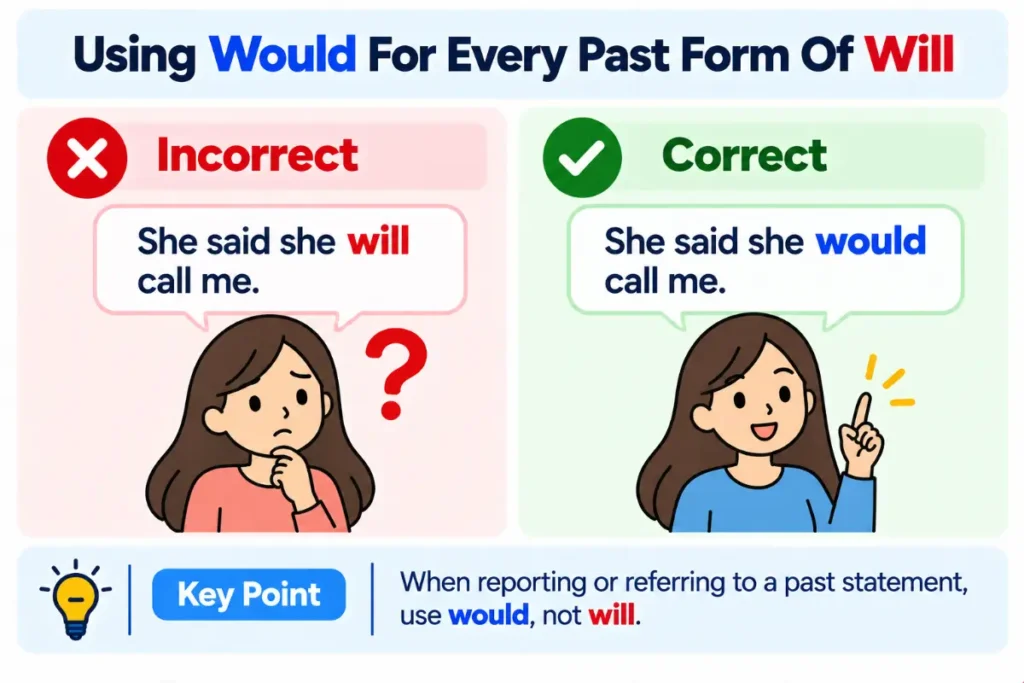
Using Would For Every Past Form Of Will
Incorrect:
She said she will call me.
This can be correct in a context where the speaker’s statement remains current. But when the reporting perspective is clearly in the past, would is usually the expected form.
More natural:
She said she would call me.
The sentence presents the call as future from her past point of view.
Using Will In A Normal If Clause
Incorrect:
If I will have time, I will visit you.
Correct:
If I have time, I will visit you.
The normal first conditional uses the present form after if and will in the main clause.
Using Would For A Definite Future Plan
Incorrect:
I would meet you tomorrow.
This sentence sounds incomplete or conditional without additional context.
Better:
I will meet you tomorrow.
Use would when the action depends on a condition or has another reason for distance.
For example:
I would meet you tomorrow if I weren’t traveling.
Confusing Would Like With Will Like
These expressions have different meanings.
I would like some coffee.
This means I want some coffee.
You will like this coffee.
This predicts that you will enjoy the coffee.
The first expresses a present desire. The second predicts a future reaction.
Using Would With Every Polite Request
Would often makes requests polite, but it isn’t required for every request.
You can say:
Can you help me?
Could you help me?
Would you help me?
All three can be polite. Their level of directness and exact meaning can vary with context and tone.
Good writing focuses on the relationship and situation rather than forcing one modal verb into every request.
Memory Tips
You don’t need to memorize dozens of isolated rules. A few simple ideas can help you choose the right word quickly.
Think About Real Future Action
Use will when you describe something you expect or intend to happen.
I will call you tonight.
Think of will as pointing forward from the present.
Think About Distance
Use would when the sentence creates distance from a straightforward future statement.
That distance may come from a condition, politeness, a past viewpoint, a preference, or a repeated past action.
Remember The If Pattern
If the sentence describes a realistic future condition, you will often see will in the result.
If I finish early, I will call you.
If the sentence presents a hypothetical condition, would commonly appears in the result.
If I had more time, I would call you.
Remember Reported Speech
Will can become would when a future statement gets reported from a past viewpoint.
He says he will come.
He said he would come.
Remember Polite Requests
Would often softens requests.
Would you help me?
Would you like some tea?
Remember Preferences
Would often appears with rather and like.
I would rather stay home.
I would like some water.
These patterns make the difference easier to remember than a long grammar definition.
Related Grammar Notes
Modal verbs have some special grammar rules.
After will and would, use the base form of the verb.
Correct:
I will go.
I would go.
Incorrect:
I will goes.
I would went.
Do not add to after will or would.
Correct:
She will arrive soon.
She would arrive soon.
Incorrect:
She will to arrive soon.
She would to arrive soon.
Modal verbs do not take s for third person singular subjects.
Correct:
He will come.
She would help.
Incorrect:
He wills come.
She woulds help.
The same rule applies to negative forms.
Will becomes will not or won’t.
Would becomes would not or wouldn’t.
Examples:
I won’t forget.
She wouldn’t agree.
These forms are common in everyday American English.
Will and would also work with passive structures.
The package will be delivered tomorrow.
The package would be delivered if we placed the order today.
The first sentence describes a future event. The second makes the delivery conditional.
They can also appear with perfect forms.
I will have finished the work by Friday.
I would have finished the work if I had started earlier.
The second sentence describes an unreal past result.
This distinction becomes useful in advanced conditional grammar.
Real Life Examples
The best way to build confidence is to see these modal verbs in ordinary situations.
At Home
I will clean the kitchen tonight.
This expresses a future intention.
I would clean the kitchen if I had more time.
This makes the action conditional.
Would you close the window?
This is a polite request.
At Work
I will send the report before lunch.
This communicates a clear commitment.
I would send the report now if I had the final numbers.
The action depends on receiving the numbers.
Would you review this paragraph?
This is a polite professional request.
While Shopping
I will take this one.
The speaker makes a choice.
I would take the blue one if it were cheaper.
The preference depends on a condition.
Would you like a receipt?
This is a polite offer.
While Making Plans
We will meet at the restaurant at seven.
The speaker describes a definite plan.
We would meet at seven if everyone were available.
The plan depends on a condition.
Would you like to come with us?
This is a polite invitation.
Talking About Childhood
When I was young, I would visit my grandparents every weekend.
The sentence describes a repeated past action.
My parents would cook dinner while I did my homework.
Again, the action happened repeatedly during a past period.
Talking About Reported Statements
James says he will call later.
The reporting verb is present, so will remains natural.
James said he would call later.
The reporting verb is past, so would represents the future from that earlier viewpoint.
Would And Will In American English
American English uses both modal verbs in the same major grammatical patterns found across standard English.
In everyday American conversation, will is extremely common for future plans, predictions, promises, and willingness.
Would is especially common in polite requests, hypothetical statements, preferences, reported speech, and past habits.
There isn’t a separate American rule that changes the basic distinction. Some expressions can vary by region, social setting, or personal style, but the core grammar remains stable.
For American writers, the best approach is simple. Choose the modal verb that communicates the intended relationship between the speaker, the action, the condition, and the time frame.
Formal And Informal Usage
Will works naturally in both casual and formal English.
I will send the email tonight.
Would also works in both settings.
Would you please send the email?
In casual speech, contractions are common.
I’ll call you later.
I’d help if I could.
I won’t forget.
I wouldn’t do that.
In formal writing, writers may choose the full forms for emphasis or style.
I will review the document tomorrow.
I would appreciate your response.
The difference isn’t simply formal versus informal. Meaning should come first.
Would And Will With Predictions
Both words can appear when speakers talk about possible outcomes, but they don’t always express the same level of certainty.
For example:
The new schedule will save time.
This sounds like a confident prediction about an actual plan.
The new schedule would save time if everyone followed it.
This describes a result that depends on a condition.
The distinction is useful in reports, proposals, business communication, and academic writing.
Compare:
This policy will reduce costs.
This policy would reduce costs if the company changed its current process.
The second sentence clearly connects the predicted result to a condition.
Would And Will With Promises
Will commonly makes direct promises.
I will be there.
I will help you.
I will keep your secret.
Would doesn’t normally replace will in a simple promise.
I would be there.
This usually sounds incomplete unless context provides a condition or another special meaning.
For example:
I would be there if I could.
Now the conditional meaning is clear.
This distinction helps you avoid using would simply because it sounds softer. A promise usually needs the direct force of will.
Would And Will With Invitations
Would you like to come to dinner?
This is one of the most common invitation patterns in English.
Would you like some dessert?
This offers something politely.
Will you come to dinner?
This can also be an invitation, but it sounds more direct and can focus more strongly on the person’s decision.
Will you have dessert?
This can sound like a direct question about a future choice.
The situation and tone matter. English speakers often use would in invitations because it creates a courteous and welcoming tone.
A Clear Comparison
| Use | Will | Would |
|---|---|---|
| Future action | I will call tonight. | Usually not used for a simple future action. |
| Prediction | It will rain tomorrow. | It would rain if the conditions changed. |
| Hypothetical result | Usually not the main choice. | I would go if I had time. |
| Polite request | Will you help me? | Would you help me? |
| Offer | I will carry that. | I would help if I could. |
| Preference | Usually not used for this meaning. | I would rather stay home. |
| Reported future | He says he will come. | He said he would come. |
| Past repeated action | Usually not used for this meaning. | We would visit every summer. |
| Present desire | Usually not used for this meaning. | I would like some coffee. |
| Conditional result | If I study, I will improve. | If I studied, I would improve. |
The table shows the main patterns, but context always matters. Modal verbs can express several related meanings, so you should consider the entire sentence rather than one word in isolation.
When Both Can Work
Some sentences can use either modal verb, but the meaning changes.
Consider:
Will you help me?
Would you help me?
The first can sound like a direct question about willingness or a future action. The second sounds more polite or can refer to a hypothetical situation.
Another example:
I will buy the house.
I would buy the house.
The first expresses a future decision or intention. The second normally needs context that makes the conditional meaning clear.
For example:
I would buy the house if the price were lower.
This is why replacing one modal with the other can change more than the tone. It can change the entire message.
A Simple Decision Method
When you are unsure which word to choose, ask yourself a few questions.
- Am I talking about a real future action or expectation?
Use will.
- Am I imagining a condition or unreal situation?
Use would.
- Am I making a polite request or invitation?
Would often fits naturally.
- Am I reporting something someone said in the past about the future?
Would often replaces the original will.
- Am I describing a repeated action from the past?
Would can work when the context clearly establishes the past habit.
- Am I expressing a preference with rather or a polite desire with like?
Would is usually the natural choice.
This method helps you choose based on meaning rather than memorization.
Key Takeaways
- Will commonly expresses future actions, predictions, promises, decisions, and willingness.
- Would commonly expresses hypothetical situations, polite requests, preferences, reported future actions, and repeated past actions.
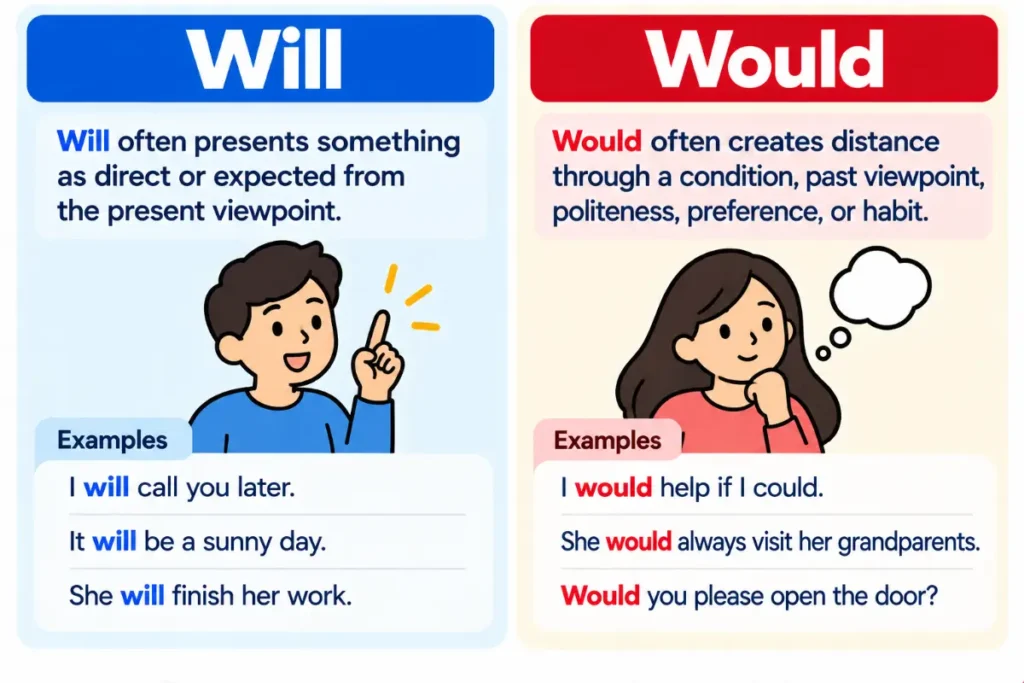
- Will often presents something as direct or expected from the present viewpoint.
- Would often creates distance through a condition, past viewpoint, politeness, preference, or habit.
- Use will in the result clause of a common first conditional.
- Use would in the result clause of a common second conditional.
- Use would when reporting a future statement from a past viewpoint.
- Use would for repeated past actions when the context clearly establishes a past period.
- Use would like for polite desires and requests.
- Use would rather to express a preference.
- Do not treat would as a simple replacement for will in every past sentence.
- Choose the modal that matches the meaning you want the reader or listener to understand.
Conclusion
Understanding would vs will becomes much easier once you stop treating the two words as simple interchangeable forms. Will generally points toward a real or expected future action, decision, promise, prediction, or willingness. Would often adds distance by introducing a condition, a past viewpoint, politeness, a preference, or a repeated past action.
The most useful rule is to focus on meaning before tense. Ask yourself what the speaker is trying to communicate. If the sentence describes a direct future action, will often fits. If it describes an imagined result, a polite request, a past viewpoint, or a preference, would often fits naturally.
With regular practice, would vs will stops feeling like a confusing grammar problem and becomes a matter of recognizing familiar patterns. Pay attention to conditional sentences, reported speech, polite requests, and expressions such as would like and would rather. Those patterns give you a strong foundation for using both modal verbs accurately and naturally.
Frequently Asked Questions
Is would the past tense of will?
Would is historically related to will and often functions as its past form in reported speech. However, would has many uses that aren’t simple past forms of will. It can express hypothetical situations, polite requests, preferences, and repeated past actions.
What is the easiest way to remember would and will?
Think of will as a direct step toward the future. Think of would as creating distance through a condition, politeness, past perspective, preference, or repeated past action.
Can I use would for future plans?
You can use would for a future action when the action is conditional or viewed from a past perspective. For a straightforward future plan, will is usually clearer.
Should I use will or would after if?
The answer depends on the conditional structure. A realistic future condition commonly uses a present form after if and will in the result clause. A hypothetical condition commonly uses a past form after if and would in the result clause.
Is would more polite than will?
Would often sounds more polite in requests and invitations. For example, Would you help me? sounds softer than Will you help me? The exact tone still depends on context and delivery.
Can would describe past habits?
Yes. Would can describe repeated actions in the past when the context clearly establishes the past period. For example, When we were children, we would play outside every evening.
Is would like the same as will like?
No. Would like usually expresses a present desire or polite request. Will like usually predicts that someone will enjoy something in the future.
Why does will change to would in reported speech?
Would can represent the future from a past point of view. For example, He says he will come becomes He said he would come when the reporting verb changes from present to past.
Which is correct in a polite request?
Both can be correct. Would you help me? often sounds softer and more polite. Will you help me? sounds more direct and can still be perfectly polite in the right context.
Can would and will appear in the same sentence?
Yes. They can appear together when they perform different grammatical functions.
For example:
If you will listen carefully, I would explain the problem.
However, this sentence has a special structure and meaning. In ordinary first conditional sentences, use the standard pattern instead.
If you listen carefully, I will explain the problem.

English Grammar & Usage
Nathan Holloway is an American grammar writer and language researcher who specializes in English grammar, sentence structure, verb usage, and common writing mistakes. He enjoys breaking down confusing grammar rules into practical explanations with clear examples, making English easier for students, professionals, and everyday writers.