
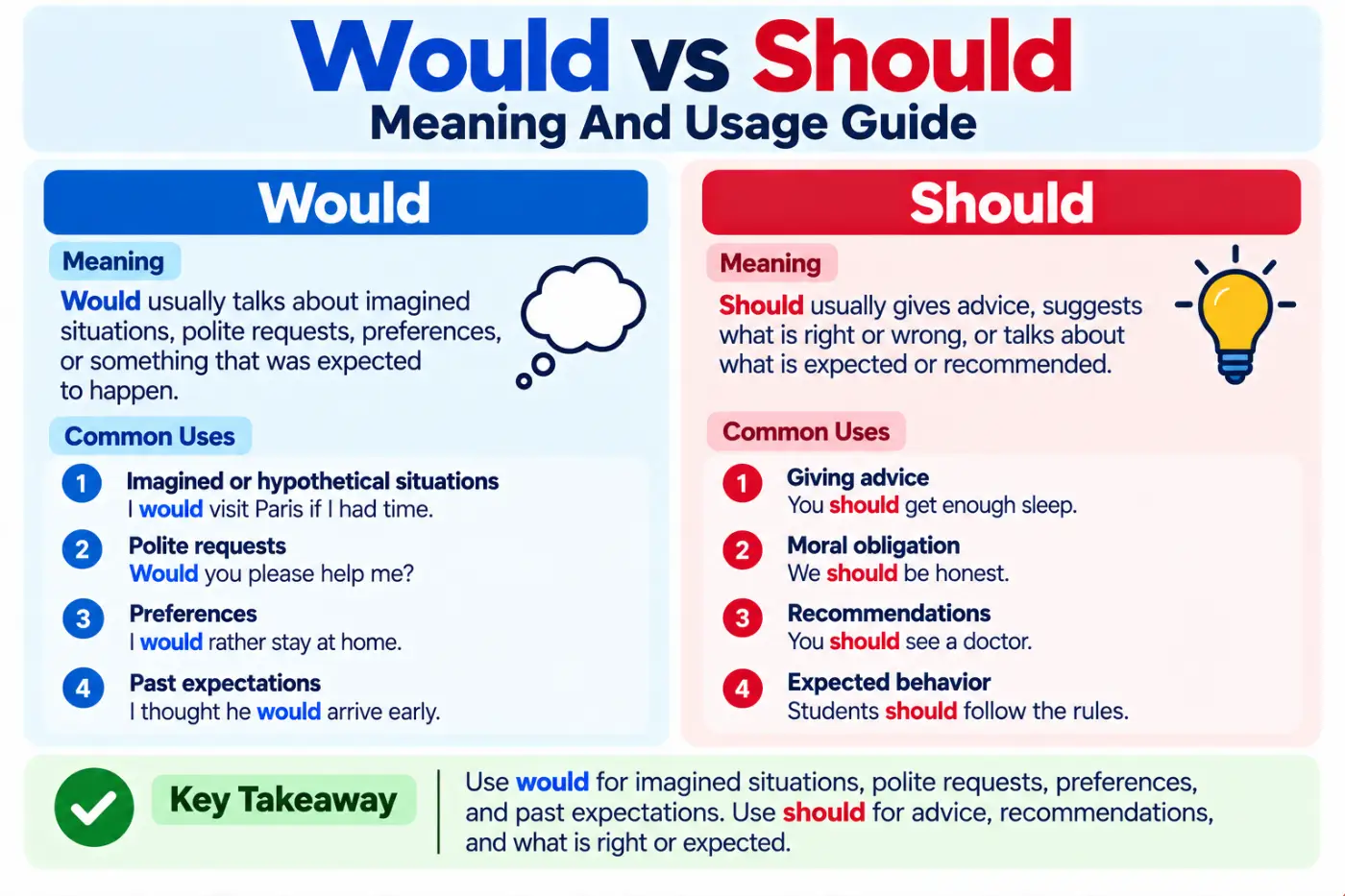
Would vs should can confuse learners because both words work as modal verbs and often appear before the base form of another verb. They can also appear in polite conversations and conditional sentences. Still their meanings are quite different. Once you understand the job each word performs the choice becomes much easier.
Think of would as a word that often looks at an imagined situation a condition a preference or a past habit. Think of should as a word that often points toward advice expectation responsibility or a reasonable outcome. These basic ideas cover a large part of everyday English.
The key is to focus on what you want the sentence to communicate. If you are talking about something that could happen under a condition you may need would. If you are telling someone what you think is sensible or expected you may need should. The sections below show how these meanings work in real sentences.
Short Answer
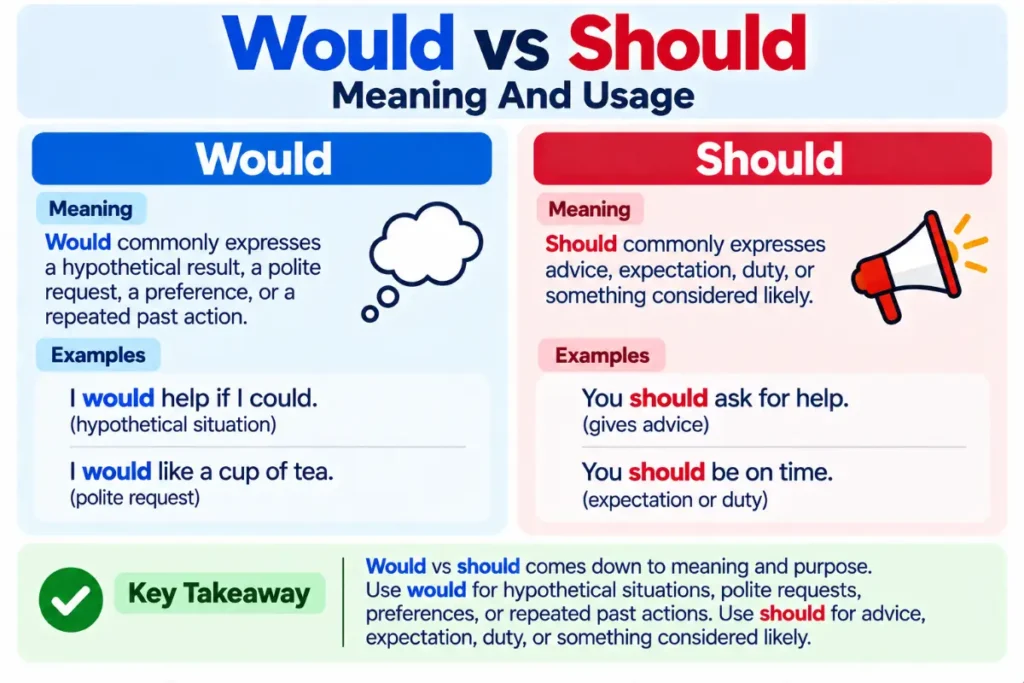
Would vs should comes down to meaning and purpose. Would commonly expresses a hypothetical result a polite request a preference or a repeated past action. Should commonly expresses advice expectation duty or something considered likely. Compare these examples: I would help if I could and You should ask for help. The first describes a hypothetical situation. The second gives advice.
Table Of Contents
- What Would Means.
- What Should Means.
- The Main Difference Between Would And Should.
- Would For Hypothetical Situations.
- Would For Polite Requests.
- Would For Preferences.
- Would For Past Habits.
- Should For Advice.
- Should For Expectations.
- Should For Duty And Responsibility.
- Should For Likely Results.
- Would And Should In Conditional Sentences.
- Would Have And Should Have.
- Would Like And Should Like.
- Would You And Should You.
- Would Or Should In Questions.
- Would Or Should For Advice.
- Would Or Should For Polite Language.
- Common Mistakes.
- Real Life Examples.
- Memory Tips.
- Related Grammar Notes.
- Key Takeaways.
What Would Means
Would is a modal verb with several common uses. Its meaning depends heavily on the sentence around it.
One of its most important uses appears in conditional sentences. In this use would describes a result that depends on a condition.
For example:
I would travel more if I had more vacation time.
The speaker is not saying that they currently travel more. The sentence describes an imagined result based on a condition.
Would also appears in polite requests.
Would you open the window?
This sentence asks someone to open the window in a polite way.
Another common use shows preference.
I would rather stay home tonight.
Here would rather expresses the speaker’s preference.
Would can also describe repeated actions in the past.
When we were children we would visit our grandparents every Sunday.
This tells us about a repeated past habit.
Would also appears in reported speech.
She said she would call me later.
The original statement may have been something like I will call you later. After reporting that statement from a past viewpoint English often changes will to would.
What Should Means
Should is another modal verb but it usually carries a different idea.
The most common use of should is to give advice.
You should get some rest.
The speaker believes resting is a sensible choice.
Should can also express duty or responsibility.
You should check your work before submitting it.
The sentence suggests that checking the work is the responsible thing to do.
Should can describe an expected event.
The package should arrive tomorrow.
This does not guarantee that the package will arrive tomorrow. It means the speaker expects that result based on the available information.
Should can also express a reasonable conclusion.
The restaurant should be open by now.
The speaker believes the restaurant is probably open because the expected opening time has arrived.
Should can sometimes express an emotional or formal reaction.
How should I know?
This question can express frustration or emphasize that the speaker has no reason to know the answer.
The Main Difference Between Would And Should
The clearest way to understand the difference is to compare their core meanings.
| Word | Common Meaning | Example |
|---|---|---|
| Would | Hypothetical result | I would go if I had time. |
| Would | Polite request | Would you help me? |
| Would | Preference | I would rather wait. |
| Would | Past habit | We would play outside after school. |
| Should | Advice | You should call your doctor. |
| Should | Responsibility | You should follow the rules. |
| Should | Expectation | She should arrive soon. |
| Should | Likely result | The answer should be correct. |
The two words can both make language sound polite. That similarity sometimes causes confusion.
Compare these questions:
Would you help me?
Should you help me?
The first asks for help. The second asks if helping is the correct or expected action.
That difference is important. The sentence meaning changes because the modal verb changes.
Would For Hypothetical Situations
Would commonly describes an imagined situation.
I would buy that house if I had enough money.
The speaker imagines buying the house but gives a condition that prevents or limits the action.
Another example is:
He would move to California if he found the right job.
The sentence describes a possible choice connected to a condition.
Would often appears in the main clause of the second conditional.
If I won the lottery I would buy a new house.
The condition uses the simple past form won while the result uses would buy.
This structure helps speakers talk about situations that are unreal imaginary unlikely or simply dependent on another condition.
Would For Polite Requests
Would is common in polite requests.
Would you pass the salt?
Would you wait here for a moment?
Would you mind closing the door?
These sentences ask someone to do something without sounding as direct as an imperative.
Compare:
Close the door.
Would you close the door?
The first is a direct command. The second is a polite request.
Would also appears in offers and invitations.
Would you like some coffee?
Would you like to join us for dinner?
In these examples would helps create a polite conversational tone.
Would For Preferences
Would appears in several expressions that communicate preferences.
The most common is would rather.
I would rather stay home.
She would rather walk than take the bus.
They would rather wait until tomorrow.
Would rather means that one option is preferred over another.
You can also use would like to express a desire.
I would like to speak with the manager.
We would like to order now.
Would like is especially common in polite conversations.
Compare:
I want some water.
I would like some water.
Both communicate a desire but the second sounds more polite.
Would For Past Habits
Would can describe repeated actions that happened in the past.
Every summer we would visit the lake.
My grandfather would tell us stories after dinner.
When I was young I would ride my bike to school.
In these examples would describes repeated behavior rather than a single event.
This use is similar to used to.
We would visit the lake every summer.
We used to visit the lake every summer.
Both sentences describe a repeated past activity.
However would does not normally describe a past state.
For example:
I used to live in Chicago.
This is natural.
I would live in Chicago.
This does not normally express the same past state.
Would works naturally with repeated actions such as visiting playing walking calling or telling.
Should For Advice
Should is one of the most useful words for giving advice.
You should drink more water.
You should talk to your teacher.
She should get some rest.
The speaker is not necessarily giving an order. Instead the speaker is saying that an action seems sensible or beneficial.
Should can make advice sound less forceful than a direct command.
Compare:
Call your mother.
You should call your mother.
The first sentence gives a direct instruction. The second presents the action as advice.
You can also use should not or shouldn’t for advice against an action.
You shouldn’t stay up so late.
You shouldn’t ignore that warning.
Shouldn’t means that the speaker thinks the action is unwise or inappropriate.
Should For Expectations
Should can describe something that the speaker expects to happen.
The train should arrive in ten minutes.
Your order should be ready soon.
He should be home by now.
The speaker expects the event based on normal conditions or available information.
Should does not guarantee the result.
If you say:
The train should arrive at six.
You are expressing an expectation.
If you say:
The train will arrive at six.
You make a stronger statement about the future.
This distinction matters in professional communication because should can communicate a reasonable expectation without presenting it as absolute certainty.
Should For Duty And Responsibility
Should can also express a sense of responsibility.
Employees should follow company policies.
Drivers should obey traffic laws.
Students should complete their assignments on time.
These sentences can describe expected behavior.
Should is usually softer than must.
Compare:
You must wear a seat belt.
You should wear a seat belt.
Must presents a stronger requirement. Should usually presents advice or an expected standard.
In some contexts should can still sound firm. The exact strength depends on the speaker’s tone and the situation.
Should For Likely Results
Should can express a reasonable prediction.
The medicine should start working soon.
The package should arrive today.
This method should solve the problem.
The speaker expects the result but leaves room for uncertainty.
This makes should useful when you have a reasonable basis for your expectation but cannot guarantee the outcome.
For example:
The meeting should finish by three.
The speaker expects the meeting to finish by three based on the planned schedule.
That does not mean the meeting definitely will finish by three.
Would And Should In Conditional Sentences
Would and should can both appear in conditional sentences but they perform different jobs.
Consider this example:
If I had more time I would learn Spanish.
Would introduces the imagined result.
Now consider:
If you have time you should learn Spanish.
Should gives advice connected to the condition.
The first sentence focuses on what the speaker would do.
The second sentence tells someone what the speaker thinks they ought to do.
Another pair makes the difference even clearer.
If I were you I would talk to her.
If you are worried you should talk to her.
The first sentence uses would to describe the action the speaker imagines taking in another person’s position.
The second uses should to recommend an action.
Would Have And Should Have
Would have and should have both refer to past situations but their meanings differ.
Would have commonly describes an unreal past result.
I would have helped you if I had known.
The speaker says that help did not happen because the condition was not met.
Should have commonly expresses regret criticism or a better action that was expected in the past.
I should have called you earlier.
The speaker believes calling earlier would have been the better choice.
Compare:
I would have called you if I had your number.
I should have called you yesterday.
The first describes a hypothetical past result.
The second expresses regret about a past action.
This difference is one of the most useful distinctions to remember.
Would Like And Should Like
Would like is a common and natural expression for wants and preferences.
I would like a cup of coffee.
She would like to speak with you.
Should like exists but has a different meaning and is much less common in everyday American English.
In formal or older styles should can sometimes express a personal expectation or feeling.
However everyday speakers usually choose other forms.
For example:
I would like to meet you.
is natural and common.
A learner should not replace would like with should like simply because both words can appear before a verb.
Would You And Should You
Would you and should you create different questions.
Would you come with me?
This asks about willingness.
Should you come with me?
This asks about correctness or advisability.
The first question focuses on what someone is willing to do.
The second focuses on what someone ought to do.
Consider another example.
Would you tell him?
This is a polite request.
Should you tell him?
This asks if telling him would be the right decision.
The difference is small in form but large in meaning.
Would Or Should In Questions
When choosing between would and should in a question ask yourself what you are actually asking.
Use would when you want to ask about willingness preference or a hypothetical response.
Would you help me?
Would you buy this car?
Would you rather stay home?
Use should when you want to ask about advice duty or the correct action.
Should I call her?
Should we leave now?
Should he apologize?
These questions often appear in everyday conversations.
For example:
Should I send the email now?
The speaker wants advice.
Would you send the email now?
This can ask about another person’s likely choice or willingness depending on context.
Would Or Should For Advice
When you give advice use should in most ordinary situations.
You should talk to your manager.
You should save a copy of the document.
You shouldn’t ignore the problem.
Would normally does not replace should when you simply want to recommend an action.
For example:
You should take an umbrella.
This gives advice.
You would take an umbrella.
This usually means something different. It may describe a hypothetical situation or someone’s typical choice depending on context.
If you want to tell someone what seems sensible use should.
Would Or Should For Polite Language
Both words can contribute to polite language but they do it in different ways.
Would often makes requests offers and invitations polite.
Would you like some tea?
Would you mind waiting here?
Should can appear in polite advice.
You should probably speak with your supervisor.
The word probably makes the advice softer.
Should can also appear in polite questions.
Should I bring anything?
This asks for guidance.
Would you like something is different from should you take something.
Would you like some dessert?
asks about preference.
Should you have dessert?
asks if having dessert is advisable.
The context determines the intended meaning.
Common Mistakes
Using Would For Direct Advice
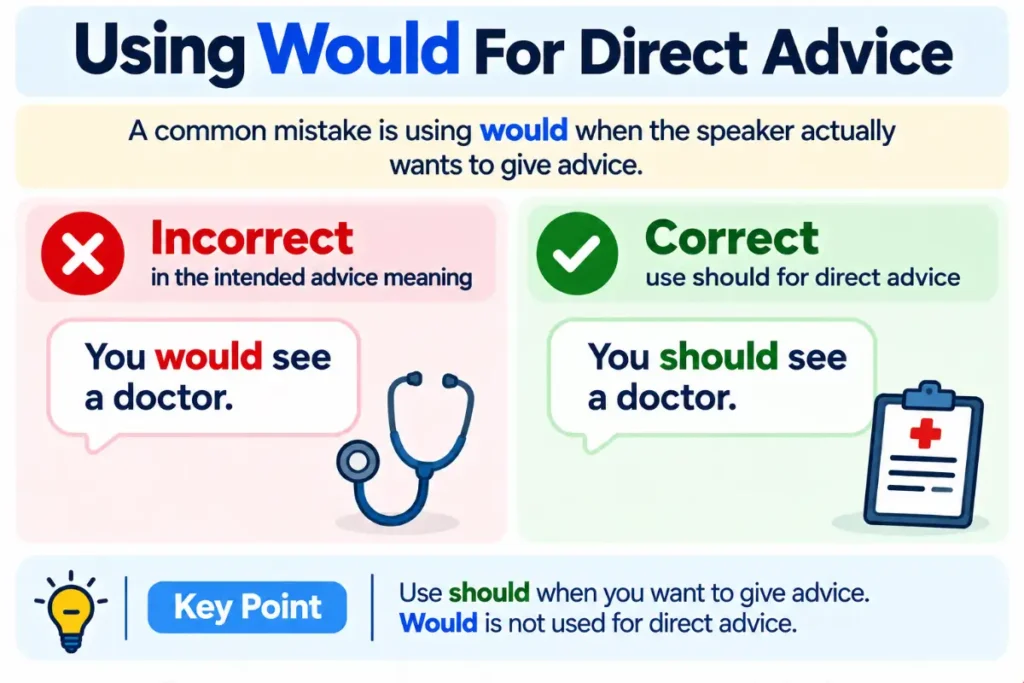
A common mistake is using would when the speaker actually wants to give advice.
Incorrect in the intended advice meaning:
You would see a doctor.
Better:
You should see a doctor.
The second sentence clearly recommends an action.
Using Should For Hypothetical Results
Another mistake occurs when learners describe an imagined result.
Incorrect for the intended hypothetical meaning:
If I had enough money I should buy that house.
Better:
If I had enough money I would buy that house.
Would introduces the imagined result.
Confusing Would Have And Should Have
These forms are easy to mix up.
I would have studied harder if I had known about the test.
This describes a hypothetical past result.
I should have studied harder for the test.
This expresses regret or criticism about the past.
The difference comes from the speaker’s purpose.
Using Should To Mean Will
Should does not always mean will.
The bus should arrive soon.
This means the speaker expects the bus to arrive soon.
It does not guarantee that the bus will arrive.
If you need to communicate certainty you may need a stronger form.
Treating Would As A Past Form Of Will In Every Sentence
Would sometimes works as the past form of will in reported speech.
He said he would call.
But would has many other uses.
It can express hypothetical situations preferences polite requests and past habits.
So context matters.
Real Life Examples
At Work
I would join the meeting if I weren’t traveling.
The speaker describes a hypothetical situation.
You should send the report before noon.
The speaker gives advice or an expected responsibility.
Would you review this document?
The speaker makes a polite request.
The client should respond by Friday.
The speaker expresses an expectation.
At Home
I would cook dinner if we had more groceries.
This describes a hypothetical result.
You should get some sleep.
This gives advice.
Would you like some tea?
This asks about preference.
The kids should be home soon.
This expresses an expectation.
At A Restaurant
I would like the chicken please.
This expresses a polite preference.
Would you like dessert?
This asks about another person’s preference.
Should we order another appetizer?
This asks for advice or agreement about a possible action.
At School
You should review your notes before the exam.
This gives advice.
I would study more if I had another day.
This describes a hypothetical situation.
Would you help me with this question?
This makes a polite request.
The teacher should arrive soon.
This expresses an expectation.
How Would And Should Change The Meaning
Small changes in modal verbs can completely change a sentence.
Consider:
I would go.
This often suggests an imagined situation or an implied condition.
I should go.
This suggests that going is the right or responsible action.
Now compare:
Would you call him?
This usually sounds like a request.
Should you call him?
This asks if calling him is advisable.
Another pair shows the difference between expectation and hypothetical possibility.
The package should arrive today.
The speaker expects delivery.
The package would arrive today if the weather improved.
The speaker describes a result that depends on a condition.
These differences are small on the page but significant in conversation.
Pronunciation Of Would And Should
Would and should both contain silent letters.
Would is commonly pronounced with the vowel sound found in good followed by a final d sound.
Should has the same general vowel sound but begins with the sh sound.
The spelling can mislead English learners because the written forms contain letters that speakers do not pronounce.
Learning these words as complete sounds rather than trying to pronounce every letter can make spoken English easier.
Both words usually have weak forms in natural speech. Native speakers often say them quickly when they appear in ordinary sentences.
For example:
I would like some water.
You should call her.
The modal verbs usually receive less stress than the main words.
Formal And Informal Usage
Would and should work in both everyday and formal English.
Would is common in polite customer service language.
Would you like a receipt?
Would you mind waiting a moment?
Should appears frequently in professional recommendations.
You should review the contract before signing it.
It also appears in formal instructions and policies.
Employees should report safety concerns to their supervisor.
The level of formality depends more on the complete sentence and context than on the modal verb itself.
American English Usage
American English uses would and should in the same major ways described above.
In everyday American speech should is especially common for advice.
You should try this restaurant.
You should talk to your teacher.
Would is extremely common in polite requests.
Would you like some coffee?
Would you mind helping me?
American speakers also use would frequently in hypothetical statements.
I would do it if I had the chance.
These patterns are natural and standard in American English.
A Simple Test For Choosing The Right Word
When you are unsure between the two words ask yourself what idea you want to express.
If you mean advice ask yourself:
Am I telling someone what seems sensible?
If yes use should.
You should call your parents.
If you mean a hypothetical result ask:
Am I imagining what would happen under a condition?
If yes use would.
I would call them if I had their number.
If you mean willingness or a polite request would often fits.
Would you help me?
If you mean expectation should often fits.
She should arrive soon.
This simple test solves many common cases.
Memory Tips
A good memory trick is to connect each word with its strongest everyday idea.
Would means imagined or preferred.
Think about sentences such as:
I would go if I could.
I would rather stay home.
Would you like some coffee?
Should is easier to connect with advice and expectation.
You should rest.
You should call him.
The bus should arrive soon.
Another useful trick is to remember the difference between would do and should do.
Would do often describes what someone would do in an imagined situation.
Should do often describes what someone ought to do.
Compare:
I would leave if I were you.
I should leave now.
The first sentence imagines a situation. The second describes what the speaker thinks is the right action.
Related Grammar Notes
Would and should belong to the group of modal verbs. Modal verbs help speakers communicate ideas such as possibility advice ability permission obligation prediction and willingness.
Other common modal verbs include can could may might must and will.
Modal verbs normally appear before the base form of a verb.
She should go.
He would help.
They might stay.
Do not add to after would or should when using an ordinary base verb.
Correct:
I would go.
You should study.
Incorrect:
I would to go.
You should to study.
There are special expressions that contain to after the modal phrase.
For example:
I would like to go.
Here like comes after would and to go follows the verb like.
Similarly:
You should try to sleep.
The to belongs to the verb phrase try to sleep rather than directly following should.
Would And Could
Would and could can both appear in hypothetical sentences but they have different roles.
I would buy the car if I had enough money.
Would describes the imagined result.
I could buy the car if I had enough money.
Could describes ability or possibility.
The distinction becomes clear when you compare the meanings.
Would answers the idea of what would happen.
Could answers the idea of what would be possible.
Would And Could In Polite Requests
Both words can make requests sound polite.
Would you help me?
Could you help me?
Both are natural.
Could often emphasizes ability or possibility while would often focuses on willingness.
In many everyday situations the difference is small.
The same pattern appears here:
Would you open the window?
Could you open the window?
Both can function as polite requests.
Would And Might
Would and might also appear in hypothetical situations.
I would go if I had time.
I might go if I had time.
The first describes the imagined result more directly.
The second emphasizes possibility.
Compare:
If I had a free weekend I would visit Boston.
This presents visiting Boston as the imagined choice.
If I had a free weekend I might visit Boston.
This presents visiting Boston as one possible choice.
The speaker’s level of commitment changes.
Would And Will
Would and will are closely connected but they do not always express the same meaning.
I will help you.
This can express a decision or promise.
I would help you if I could.
This expresses a hypothetical situation.
Would also appears in reported speech.
She said she would help me.
Understanding the condition and time reference usually makes the choice clear.
Should And Must
Should and must can both communicate obligation but their strength differs.
You should wear a helmet.
This gives advice or communicates an expected standard.
You must wear a helmet.
This expresses a stronger requirement.
In rules and official instructions must often sounds more forceful.
Should can be more flexible and conversational.
The speaker’s intention determines the best choice.
Should And Ought To
Should and ought to often communicate similar ideas.
You should apologize.
You ought to apologize.
Both can express advice or duty.
Should is much more common in modern American English.
Ought to is still correct but can sound more formal or less common in casual conversation.
When Would And Should Appear Together
Would and should can appear in the same sentence when they serve different purposes.
I would go if you think I should.
Here would describes the imagined action while should appears inside the condition about the appropriate choice.
Another example is:
I would help if I should ever get the chance.
In this structure the two modal verbs do different grammatical jobs.
Do not assume that two modal verbs appearing close together must have similar meanings.
The surrounding words determine each modal’s role.
Common Sentence Patterns
Learning useful patterns can make these modal verbs easier to use.
Would Patterns
I would + base verb.
I would go.
I would help.
I would stay.
Would you + base verb?
Would you help me?
Would you wait?
I would rather + base verb.
I would rather stay.
I would rather walk.
I would like to + base verb.
I would like to speak with her.
Should Patterns
You should + base verb.
You should rest.
You should study.
Should I + base verb?
Should I call him?
Should we leave?
You should not + base verb.
You should not worry.
You should not ignore it.
Subject + should + base verb.
The package should arrive soon.
She should know the answer.
These patterns cover many common situations in everyday English.
Common Questions Learners Ask
Is Would More Polite Than Should
Would often sounds more polite when making requests.
Would you help me?
Should usually asks for advice or communicates an expectation.
Should I help him?
The two words serve different purposes.
Can Would And Should Be Used Together
Yes. They can appear in the same sentence when they perform different grammatical roles.
I would do it if I thought I should.
Would describes the imagined action. Should expresses what the speaker considers appropriate.
Is Should A Past Form Of Shall
Historically should developed as the past form of shall. Modern English uses should for several meanings including advice expectation and duty.
You should learn its modern functions instead of treating it simply as a past form.
Is Would Always Conditional
No. Would can appear in conditional sentences but it has several other uses.
It can express polite requests preferences past habits and reported speech.
Is Should Always Advice
No. Should can also express expectation likelihood duty and reasonable conclusions.
The doctor should arrive soon.
Here should expresses expectation rather than advice.
Can I Use Would For Advice
Usually no. If your goal is to recommend an action use should.
You should get some rest.
Would usually requires another meaning such as a hypothetical situation or preference.
Can Should Express Certainty
Should usually expresses expectation rather than absolute certainty.
The package should arrive tomorrow.
The speaker expects that result but does not guarantee it.
Which Is More Common In American English
Both are very common. Their frequency depends on the situation because they perform different grammatical functions.
Should appears often in advice and expectation. Would appears often in hypothetical statements requests preferences and reported speech.
Key Takeaways
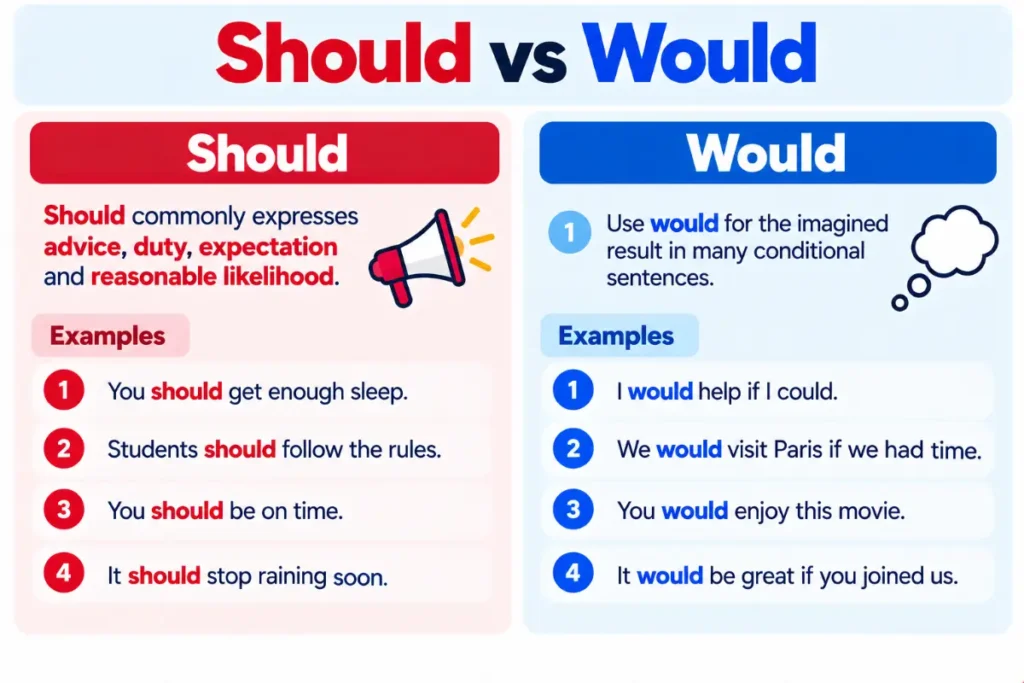
- Would commonly expresses hypothetical results preferences polite requests past habits and reported speech.
- Should commonly expresses advice duty expectation and reasonable likelihood.
- Use would for the imagined result in many conditional sentences.
- Use should when you tell someone what seems sensible.
- Use would in polite requests such as Would you help me?
- Use should in advice questions such as Should I call her?
- Would have often describes an unreal past result.
- Should have often expresses regret or a better action in the past.
- Should does not always mean certainty. It often expresses a reasonable expectation.
- Context determines the exact meaning of both modal verbs.
Conclusion
Understanding would vs should becomes much easier when you focus on meaning instead of memorizing isolated grammar rules. Would commonly points to an imagined result a preference a polite request or a repeated action in the past. Should commonly points to advice responsibility expectation or a reasonable conclusion.
The simplest memory rule is useful in everyday writing and conversation. Would often answers the idea of what someone would do in an imagined situation. Should often answers the idea of what someone ought to do. Compare I would leave if I had a car with I should leave now. The first sentence imagines a condition. The second expresses what seems like the right action.
Once you recognize that difference you can choose the correct modal verb with much more confidence. Pay attention to the purpose of the sentence first. Then choose the word that matches the meaning. That approach works far better than trying to memorize every possible sentence pattern.
Frequently Asked Questions
What Is The Difference Between Would And Should?
The main difference is meaning. Would commonly expresses hypothetical situations preferences polite requests and repeated past actions. Should commonly expresses advice responsibility expectation and reasonable likelihood.
Should I Use Would For Hypothetical Situations?
Yes. Would commonly introduces the result in hypothetical conditional sentences.
If I had more money I would travel more.
The condition creates the imagined situation while would describes the result.
Should I Use Should For Advice?
Yes. Should is the most natural choice for ordinary advice.
You should talk to your teacher.
The sentence tells someone what the speaker thinks is sensible.
Can Would Express A Preference?
Yes. Would appears in expressions such as would rather and would like.
I would rather stay home.
I would like some coffee.
Can Should Express An Expectation?
Yes. Should often expresses something that the speaker expects to happen.
The package should arrive tomorrow.
The speaker expects delivery but does not guarantee it.
What Is The Difference Between Would Have And Should Have?
Would have commonly describes a hypothetical past result.
I would have gone if I had known.
Should have commonly expresses regret criticism or a better action that was expected.
I should have called earlier.
Is Would More Polite Than Should?
Would often makes requests sound polite. Would you pass the salt? Should normally has another purpose such as giving advice or asking for guidance. Should I pass the salt?
What Is The Easiest Way To Remember Would And Should?
Remember would with imagined situations and preferences. Remember should with advice and expectations. I would go if I could. You should go if you have time. These two patterns capture a major part of the difference.

English Grammar & Usage
Nathan Holloway is an American grammar writer and language researcher who specializes in English grammar, sentence structure, verb usage, and common writing mistakes. He enjoys breaking down confusing grammar rules into practical explanations with clear examples, making English easier for students, professionals, and everyday writers.