
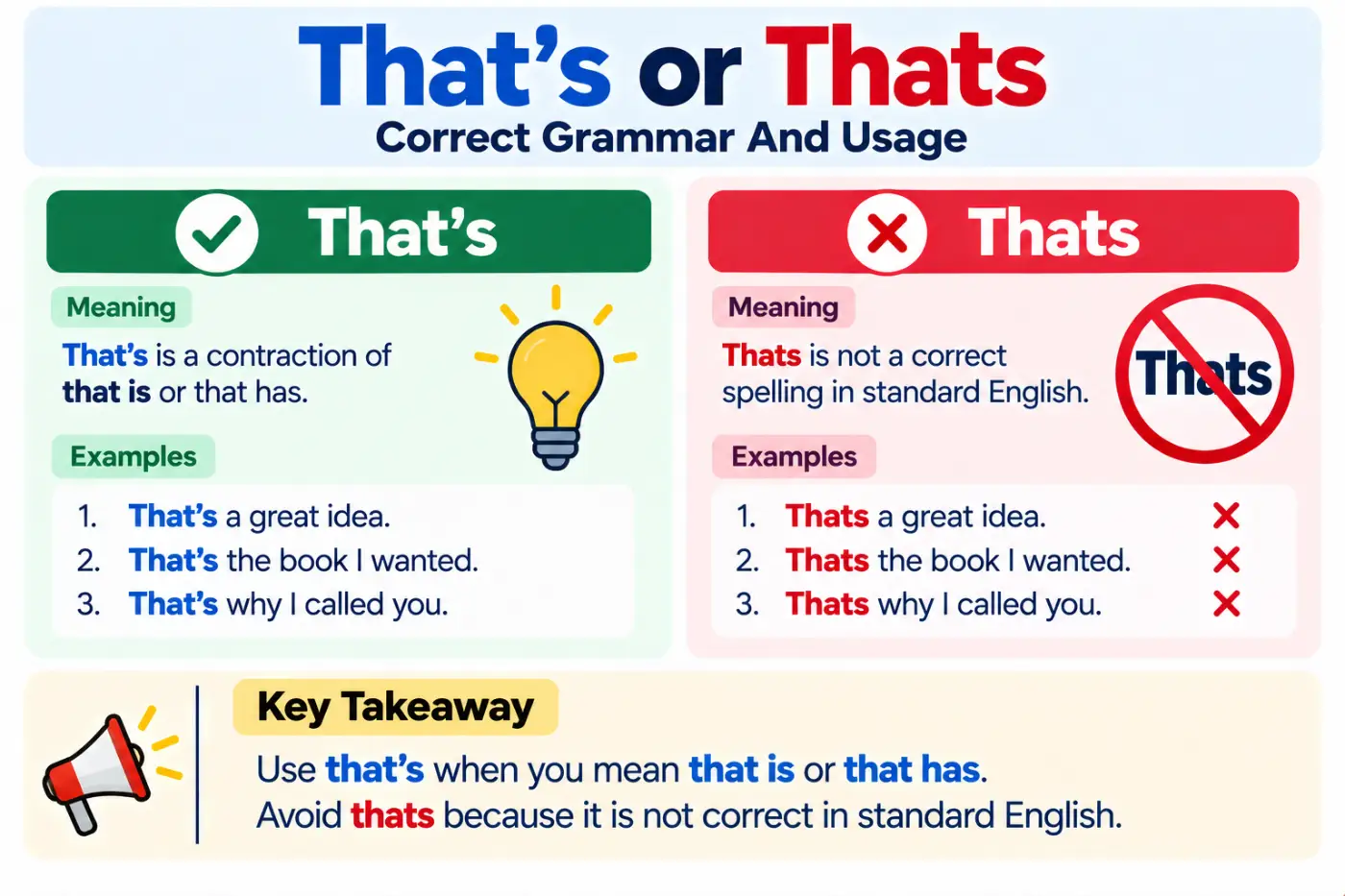
That’s or thats is a common English grammar question because the two forms look almost identical. The correct standard form is that’s when you mean that is or that has. The apostrophe matters because it shows that letters have been omitted to create a contraction.
The confusion often appears in quick messages, social media posts, comments, and informal writing. People may leave out the apostrophe while typing quickly, but that doesn’t make the spelling standard. There is also another source of confusion because that’s can represent two different phrases. It can mean that is or that has depending on the words that follow it.
For example, That’s my book means That is my book. That’s been a difficult week means That has been a difficult week. This article explains the difference, grammar rules, pronunciation, punctuation, examples, formal usage, common mistakes, and easy ways to remember the correct form. You’ll also learn why the apostrophe isn’t optional in careful English.
Short Answer
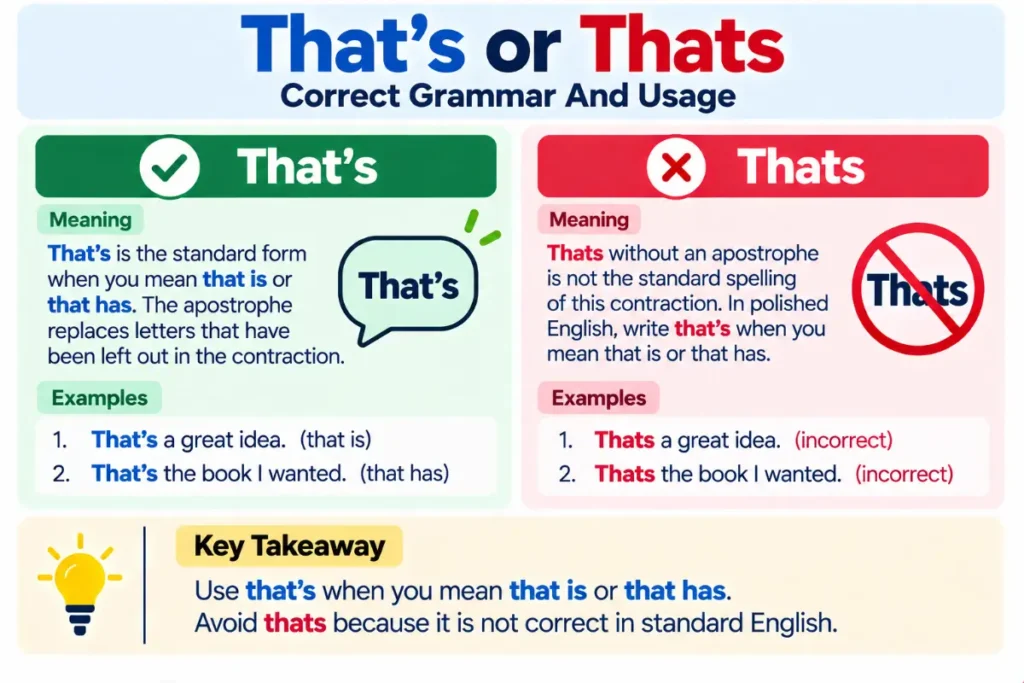
That’s is the standard form when you mean that is or that has. The apostrophe replaces letters that have been left out in the contraction. Thats without an apostrophe is not the standard spelling of this contraction. In polished English, write that’s when you mean that is or that has.
Table Of Contents
- What The Two Forms Mean
- How The Apostrophe Changes The Word
- The Two Meanings Of The Contraction
- How To Tell Which Meaning Is Intended
- Grammar Rules
- Examples In Everyday English
- Examples In Formal Writing
- Common Mistakes
- Pronunciation Guide
- Word History
- American And British Usage
- Related Grammar Points
- Memory Tips
- Expert Editor Insight
- FAQs
- Key Takeaways
- Conclusion
What The Two Forms Mean
The first thing to understand is that the two written forms do not have equal status in standard English.
That’s is a standard contraction. It combines that with either is or has.
That’s cold.
This means:
That is cold.
Here the apostrophe marks the missing letter and creates the contraction.
Consider another example:
That’s happened before.
This means:
That has happened before.
The second form, thats, normally appears when someone has simply left out the apostrophe. In ordinary standard English, it isn’t the accepted spelling of the contraction.
This distinction is easy to miss because apostrophes don’t change the way most speakers pronounce the word. In speech, that’s sounds like a single natural unit. The difference becomes visible mainly in writing.
The Apostrophe Has A Job
An apostrophe in a contraction isn’t decoration. It shows that part of a word or phrase has been omitted.
Several familiar contractions work this way.
I am becomes I’m.
You are becomes you’re.
It is becomes it’s.
They are becomes they’re.
That is becomes that’s.
That has becomes that’s.
The apostrophe gives the reader a visual clue. It tells us that the short form represents a longer grammatical expression.
Without the apostrophe, the reader may still understand the sentence from context. However, standard written English keeps the apostrophe because it reflects the structure of the contraction.
This is why proofreading matters. A missing apostrophe may not stop someone from understanding your message, but it can make writing look careless or unfinished.
The Two Meanings Of That’s
One of the most useful facts about this contraction is that it can represent two different phrases.
That Is
The most common expansion is that is.
That’s beautiful.
That is beautiful.
That’s my car.
That is my car.
That’s exactly what I meant.
That is exactly what I meant.
The contraction is especially common in conversation because English speakers naturally shorten frequently used expressions.
That Has
The same written form can also mean that has.
That’s been a difficult month.
That has been a difficult month.
That’s happened before.
That has happened before.
That’s changed everything.
That has changed everything.
The grammar after the contraction usually helps you identify this meaning.
When the next word is a past participle, the contraction may represent that has.
For example:
That’s broken.
Depending on context, this can mean that is broken or that has broken. The surrounding sentence determines the intended meaning.
How To Tell Which Meaning Is Intended
A useful editing test is to expand the contraction.
Take the sentence:
That’s my favorite song.
Replace that’s with that is.
That is my favorite song.
The sentence works perfectly. Therefore, that’s means that is.
Now consider:
That’s been a strange day.
Try that is.
That is been a strange day.
That doesn’t work.
Try that has.
That has been a strange day.
Now the meaning is clear.
This expansion test is one of the most reliable ways to understand contractions.
If the expanded sentence works with that is, use the contraction as a shorter version of that is.
If the expanded sentence works with that has, the contraction represents that has.
Grammar Rules
The contraction can appear in several parts of a sentence.
At The Beginning
That’s what I wanted.
That’s the problem.
That’s why I called.
Here the contraction introduces a statement.
In The Middle
I think that’s the right answer.
She said that’s enough.
We know that’s true.
The contraction sits naturally inside the sentence.
After A Verb Of Thinking Or Speaking
I know that’s difficult.
He said that’s not possible.
They believe that’s the best choice.
This structure is common because that’s can introduce information being identified or described.
With A Past Participle
That’s happened before.
That’s changed since last year.
That’s been difficult for everyone.
In these examples, the contraction can represent that has.
In Questions
That’s your brother, right?
That’s the same restaurant we visited last week, isn’t it?
In conversational English, speakers often use the contraction naturally in confirmation questions.
That’s Versus Its
A different grammar issue often causes confusion here.
Its shows possession.
The dog wagged its tail.
It’s is normally a contraction of it is or it has.
It’s cold.
It’s been raining.
The same basic distinction applies to that’s.
That’s contains an apostrophe because it represents a contraction.
Its does not contain an apostrophe because it is a possessive determiner.
Understanding this pattern can make apostrophe rules much easier.
That’s Versus Thats
The spelling difference is only one character, but the grammatical difference is clear.
| Form | Standard English | Meaning | Example |
|---|---|---|---|
| That’s | Yes | That is or that has | That’s my phone. |
| Thats | No as the standard contraction | Usually an omitted apostrophe | Thats my phone. |
The second sentence is easy to understand, but standard edited English would normally change it to:
That’s my phone.
The apostrophe tells the reader that the form is a contraction.
Why People Leave Out The Apostrophe
There are several practical reasons.
First, typing speed can lead people to omit punctuation. Apostrophes are small marks and are easy to skip on a phone keyboard.
Second, speech doesn’t reveal the apostrophe. People hear the same basic sound whether the word is written correctly or incorrectly.
Third, informal digital writing often uses reduced punctuation. Text messages and casual comments may contain missing apostrophes, commas, or periods.
Fourth, learners may not realize that the apostrophe represents omitted letters. If someone learns the contraction as one sound rather than as a combination of words, the spelling rule can be less obvious.
These factors explain the mistake without changing the standard rule.
Common Mistakes
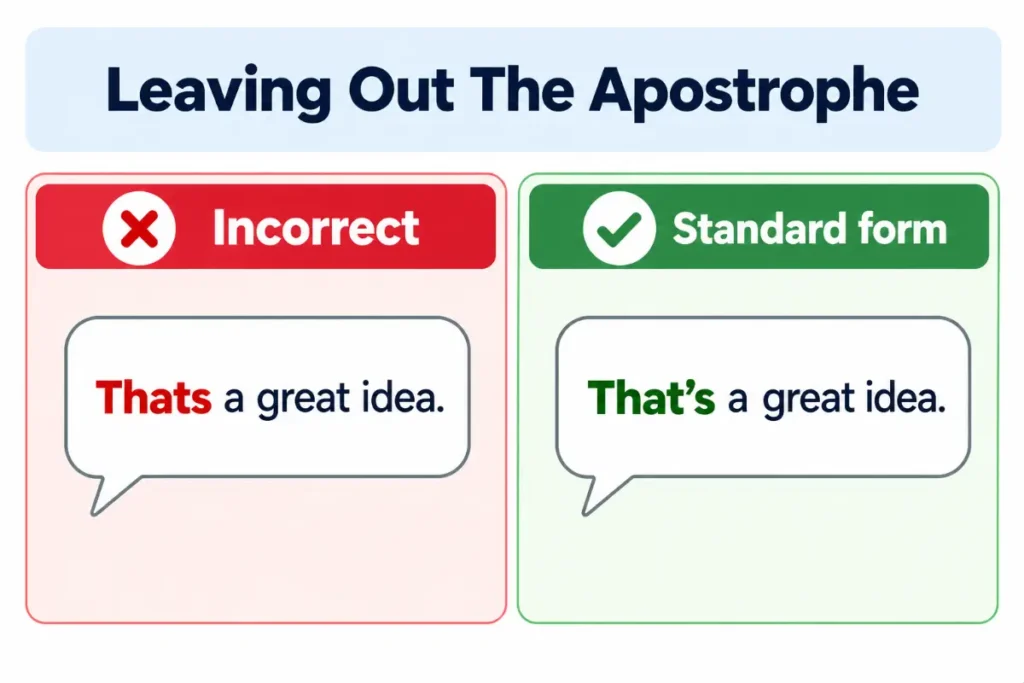
Leaving Out The Apostrophe
Incorrect:
Thats a great idea.
Standard form:
That’s a great idea.
The writer has used the contraction but omitted the apostrophe.
Confusing That’s With That
That and that’s are not interchangeable.
I know that you are tired.
I know that’s true.
In the first sentence, that introduces a clause. In the second, that’s means that is or that has.
Confusing That’s With Thats In Formal Writing
A missing apostrophe may be overlooked in a quick message, but professional writing should use standard punctuation.
A report, school assignment, application, email, or published article should use the correct contraction.
Expanding The Wrong Meaning
Sometimes writers know that’s can mean two things but expand it incorrectly.
That’s been helpful.
The correct expansion is:
That has been helpful.
Not:
That is been helpful.
The structure of the following verb tells you which expansion works.
Confusing That’s With Whose
That’s is a contraction.
Whose is a possessive or interrogative word.
That’s the house we visited.
Whose house is that?
The words have different grammatical roles.
Real Life Examples
Daily Conversation
That’s my seat.
I think that’s a good idea.
That’s been a long day.
The first two examples use that is. The third uses that has.
Text Messages
That’s fine with me.
That’s what I was thinking.
That’s been on my mind all day.
In casual messages, people may type the same expressions without the apostrophe. The intended meaning usually remains clear, but the standard written form still includes the apostrophe.
Workplace Communication
That’s the version we approved.
I think that’s the best option for the client.
That’s been the main issue since the project began.
These sentences sound natural in professional communication while remaining conversational.
Academic Writing
The evidence suggests that’s not the only possible explanation.
The study shows that’s been a recurring problem.
In formal academic writing, some editors may prefer the expanded form that is or that has when a more formal tone is desired. The contraction itself isn’t grammatically wrong.
Social Communication
That’s such a beautiful photo.
That’s exactly what I wanted to say.
That’s been one of my favorite memories.
These examples show how naturally the contraction appears in everyday written English.
Examples With That Is
Understanding the expanded form helps you recognize the grammar.
- That’s my new laptop.
Expansion: That is my new laptop.
- That’s a difficult question.
Expansion: That is a difficult question.
- That’s exactly what happened.
Expansion: That is exactly what happened.
- That’s the restaurant I mentioned.
Expansion: That is the restaurant I mentioned.
- That’s why I called you.
Expansion: That is why I called you.
In each sentence, the contraction replaces that is.
Examples With That Has
Now consider examples where the contraction represents that has.
- That’s been a great experience.
Expansion: That has been a great experience.
- That’s changed since we moved.
Expansion: That has changed since we moved.
- That’s happened several times.
Expansion: That has happened several times.
- That’s already started.
Expansion: That has already started.
- That’s never happened before.
Expansion: That has never happened before.
The past participle after the contraction often makes the meaning clear.
When The Expanded Form Is Better
The contraction is grammatically correct, but the full form can sometimes be more suitable.
Formal writing may favor:
That is the main concern.
over:
That’s the main concern.
This isn’t a strict grammar requirement. It’s a matter of tone and style.
Academic, legal, technical, or highly formal documents sometimes avoid contractions to maintain a more formal register.
In conversation, personal emails, general web writing, and friendly communication, contractions are often natural.
The best choice depends on the audience and purpose.
Formal And Informal Usage
The contraction is common in everyday American English.
People use it naturally in conversation:
That’s great.
That’s enough.
That’s true.
That’s what I mean.
In formal writing, both the contraction and the expanded form can be grammatically correct. However, the full form can sound more deliberate.
Compare:
That’s the primary concern.
That is the primary concern.
The second version has a slightly more formal tone.
Neither is automatically better. Good editing considers the reader, purpose, and overall style.
Pronunciation Guide
That’s is normally pronounced with a voiced th sound followed by a vowel sound and an s sound.
The IPA pronunciation is commonly represented as /ðæts/ in American English.
The sound is essentially the same as the spoken contraction represented by that is or that has in ordinary connected speech.
The apostrophe doesn’t create a separate sound.
This is why learners may not notice the spelling difference when they hear the word. The written apostrophe carries grammatical information that isn’t directly audible.
A common pronunciation mistake involves replacing the voiced th sound with the unvoiced sound found in words such as think. In standard pronunciation, the beginning of that’s uses the voiced sound.
Put your fingers lightly against your throat and say the beginning of that. You should feel vibration. That vibration helps distinguish the sound from the one in think.
Word Origin
That is one of the oldest and most useful grammatical forms in English. That developed from older Germanic forms and has served as a demonstrative, relative, and conjunction in different grammatical contexts throughout the history of English.
The contraction developed through the normal tendency of English speakers to shorten frequently used combinations in speech.
The apostrophe became a conventional way of showing omitted letters in written contractions.
The form that’s therefore reflects a long standing feature of English. Speakers naturally shorten common expressions, while writers use punctuation to show what has been omitted.
American English Usage
American English uses that’s constantly in conversation and informal writing.
Examples include:
That’s amazing.
That’s my point.
That’s what I heard.
That’s been happening for months.
The contraction is fully familiar to American speakers.
In professional American writing, the choice depends on the level of formality. Business emails often use contractions because they sound direct and natural. Formal reports, academic papers, and legal documents may use expanded forms more often.
The important distinction is not American spelling versus British spelling. The standard contraction uses the apostrophe in both varieties.
British English Usage
British English also uses that’s as the standard contraction of that is and that has.
The core grammar doesn’t change.
That’s a good idea.
That’s been a difficult problem.
British writers may vary in how often they use contractions depending on the type of writing. Formal documents may use fewer contractions while everyday communication uses them freely.
The spelling remains the same.
Australian And Canadian English
Australian English and Canadian English also use that’s as the standard contraction.
There is no major regional spelling difference that turns thats into an accepted standard alternative.
Style can differ across publications, schools, workplaces, and individual writers. The underlying grammar remains consistent.
Apostrophes In Contractions
Apostrophes have several jobs in English, but contractions are one of the most important.
They show missing letters.
Do not becomes don’t.
Cannot becomes can’t.
I will becomes I’ll.
She is becomes she’s.
That is becomes that’s.
That has becomes that’s.
The apostrophe therefore provides information about the word’s structure.
A common mistake is to think punctuation can be ignored because the meaning is obvious. In casual communication, readers may understand the sentence anyway. In edited writing, punctuation helps establish standard grammar and consistency.
That’s In Questions
The contraction works naturally in questions.
That’s your new car?
That’s the answer?
That’s what you meant?
These can function as confirmation questions or expressions of surprise depending on tone.
It can also appear in longer questions.
Is that’s the problem?
This sentence is incorrect.
The correct version is:
Is that the problem?
This example highlights an important point. You cannot insert that’s simply because you see a form of is in the sentence.
The grammar determines the correct structure.
That’s And That Is In Clauses
Another useful distinction involves the word that as a clause marker.
I know that you’re tired.
Here that introduces the clause you’re tired.
You cannot replace it with that’s.
I know that’s you’re tired.
That sentence is incorrect because it combines two different grammatical structures.
However:
I know that’s true.
is correct because that’s means that is.
This difference is especially useful for advanced learners.
Compare:
I think that she is right.
I think that’s right.
The first sentence uses that as a conjunction.
The second uses that’s as a contraction meaning that is.
Related Grammar Points
Its And It’s
Its is possessive.
The company changed its policy.
It’s means it is or it has.
It’s a good policy.
It’s been changed.
Your And You’re
Your shows possession.
Your phone is ringing.
You’re means you are.
You’re very kind.
Their And They’re
Their shows possession.
Their house is large.
They’re means they are.
They’re at home.
These pairs show the same general principle. Apostrophes often signal contractions, while possessive determiners usually do not use them.
Memory Tips
A simple memory trick can save you a lot of proofreading time.
Ask yourself:
Can I replace it with that is or that has?
If yes, write the contraction with an apostrophe.
For example:
That’s beautiful.
Replace it:
That is beautiful.
It works.
Therefore the apostrophe belongs there.
Try:
That’s been helpful.
Replace it:
That has been helpful.
It works again.
Now consider:
Thats been helpful.
The problem becomes obvious once you recognize that the contraction needs its apostrophe.
Another useful trick is to remember that the apostrophe marks missing letters. In that’s, the apostrophe stands between that and the shortened form of is or has.
A Fast Editing Test
When proofreading, use this three step check.
- Find every occurrence of that’s or its unpunctuated version.
- Expand the contraction to that is or that has.
- If the expanded version makes sense, keep the apostrophe.
This method works especially well when editing essays and professional documents.
For example:
That’s the answer.
That is the answer.
Correct.
Then:
That’s changed everything.
That has changed everything.
Correct.
Finally:
That’s my friend.
That is my friend.
Correct.
The process takes only a few seconds.
Why Search And Spellcheck Can Be Misleading
Modern spellcheckers may recognize both forms in certain contexts because digital systems often prioritize understanding user intent. A system may infer that a missing apostrophe was simply a typing error.
That doesn’t mean the unpunctuated form is standard.
Search engines can also understand informal or misspelled queries. If someone searches for the form without an apostrophe, the search system may still understand the intended phrase.
Search interpretation and standard grammar are different things.
For polished writing, use the conventional contraction with the apostrophe.
Professional Writing Tip
If you’re writing a school assignment, professional email, application, article, or report, don’t rely on the fact that your reader can understand a missing apostrophe.
Small punctuation marks influence how polished writing looks.
A sentence such as:
Thats the final version.
is understandable.
A sentence such as:
That’s the final version.
follows standard punctuation and looks finished.
The correction is tiny, but the result is cleaner.
Common Questions About Meaning
One reason this word creates so many questions is that the contraction can represent two different grammatical structures.
That’s nice.
That is nice.
That’s happened.
That has happened.
The first expresses a state or identity.
The second expresses an action or event connected to the present.
The context usually makes the intended expansion obvious.
If you’re unsure, expand the word. This is faster and more reliable than guessing from pronunciation.
Expert Editor Insight
An experienced editor treats the apostrophe as part of the grammar rather than an optional decoration. Native speakers often use this contraction automatically, but fast typing can remove the apostrophe in informal messages. In professional editing, the first check is simple: expand the form to that is or that has. If the sentence works, the contraction is appropriate. Grammar tools can catch missing apostrophes, but context remains important because punctuation choices sometimes depend on sentence structure and style.
Key Takeaways
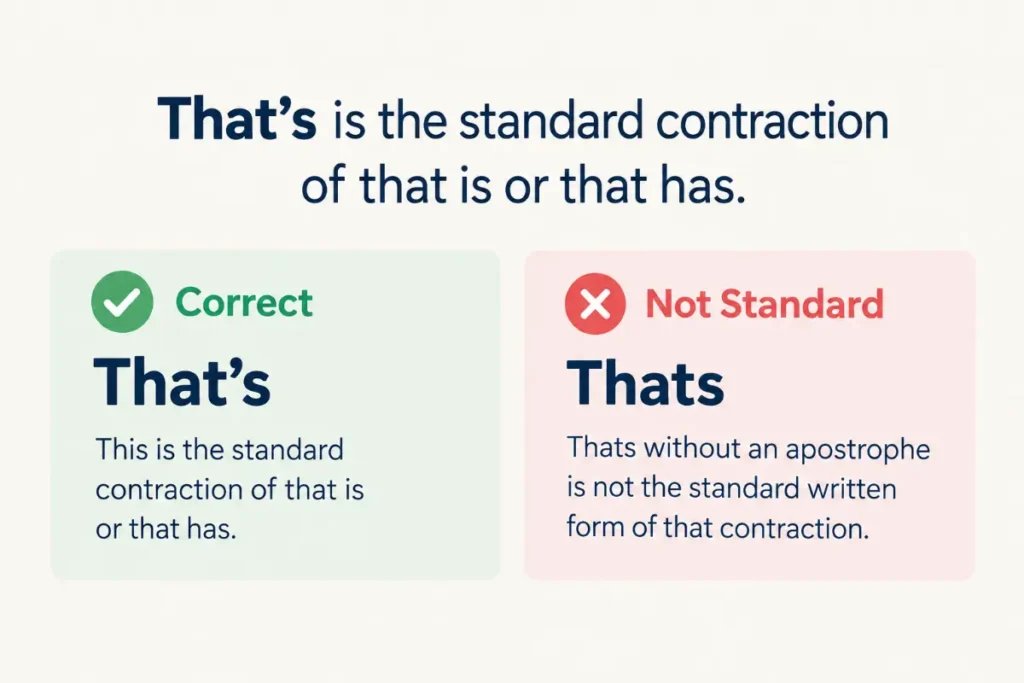
- That’s is the standard contraction of that is or that has.
- Thats without an apostrophe is not the standard written form of that contraction.
- The apostrophe shows that letters have been omitted.
- You can identify the meaning by expanding the contraction.
- That’s my book means That is my book.
- That’s been difficult means That has been difficult.
- The contraction is common in American English and other major varieties of English.
- Formal writing may use that is or that has instead for a more formal tone.
- The pronunciation usually doesn’t reveal the missing letters, so spelling and punctuation need separate attention.
- If you’re unsure, replace the contraction with that is or that has. The version that makes grammatical sense gives you the answer.
Conclusion
That’s or thats has a simple answer once you understand the role of the apostrophe. That’s is the standard form when you mean that is or that has. The apostrophe marks the letters omitted from the original expression. Thats without the apostrophe may appear in fast or informal typing, but it isn’t the standard form for polished English.
The contraction is useful in everyday conversation, emails, messages, articles, and many other forms of writing. Its exact meaning depends on context. That’s my phone means that is my phone, while that’s been helpful means that has been helpful.
The easiest proofreading trick is to expand the word. If that is or that has fits the sentence, keep the apostrophe. That quick test can prevent one of the most common small punctuation mistakes in English.
FAQs
Is thats a correct English word?
As a standard form of the contraction, thats is not correct. The standard written form is that’s when you mean that is or that has. You may see the unpunctuated version in text messages, comments, informal posts, or typing errors. The meaning is usually clear, but polished English should include the apostrophe.
What does that’s mean?
That’s normally means either that is or that has. The correct expansion depends on the sentence. For example, That’s my bag means That is my bag. That’s been difficult means That has been difficult. Replacing the contraction with both possible expansions is a quick way to identify its meaning.
Which is correct that’s or thats?
That’s is the standard form when you need the contraction of that is or that has. The apostrophe shows that part of the original phrase has been omitted. Thats without the apostrophe is generally a punctuation error in standard English. For school, work, professional communication, and edited content, use that’s.
Can that’s mean that has?
Yes. That’s can represent that has. For example, That’s been a difficult week means That has been a difficult week. This use often appears before a past participle such as been, happened, changed, started, or finished. Context determines the meaning, so expanding the contraction is a useful way to check it.
Can that’s mean that is?
Yes. That’s commonly means that is. Examples include That’s my car, That’s a good idea, and That’s the problem. In each sentence, you can replace that’s with that is and keep the same basic meaning. This is one of the most common uses of the contraction in everyday American English.
Should I use that’s in formal writing?
You can use that’s in formal writing because it is a standard English contraction. However, some formal styles prefer expanded forms such as that is and that has. Academic, legal, and highly formal documents may therefore use fewer contractions. The choice depends on the required style, audience, and overall tone.
Why do people write thats without an apostrophe?
People often omit the apostrophe because they type quickly, especially on phones. The pronunciation doesn’t reveal the punctuation, so the mistake can be easy to miss. Informal digital writing also contains many shortened or unpunctuated forms. Even so, standard written English uses the apostrophe when the word represents that is or that has.
How do I remember the correct spelling?
Ask yourself if you can expand the word to that is or that has. If you can, use the apostrophe. Another useful reminder is that the apostrophe marks missing letters. In that’s, it shows that part of is or has has been omitted. This simple test works in both casual and formal writing.
Is that’s pronounced differently from that is?
In natural speech, that’s and the phrase that is often sound very similar because English speakers commonly reduce and connect words. The apostrophe is a written punctuation mark rather than a pronunciation marker. That’s can also represent that has, and the surrounding words usually reveal which meaning is intended.
Can I use thats in texting?
People may understand thats in a text message, but it isn’t the standard written form of the contraction. If you’re writing casually, the missing apostrophe may not cause confusion. For schoolwork, professional messages, applications, published writing, and other polished communication, use that’s with the apostrophe.

English Grammar & Usage
Nathan Holloway is an American grammar writer and language researcher who specializes in English grammar, sentence structure, verb usage, and common writing mistakes. He enjoys breaking down confusing grammar rules into practical explanations with clear examples, making English easier for students, professionals, and everyday writers.