
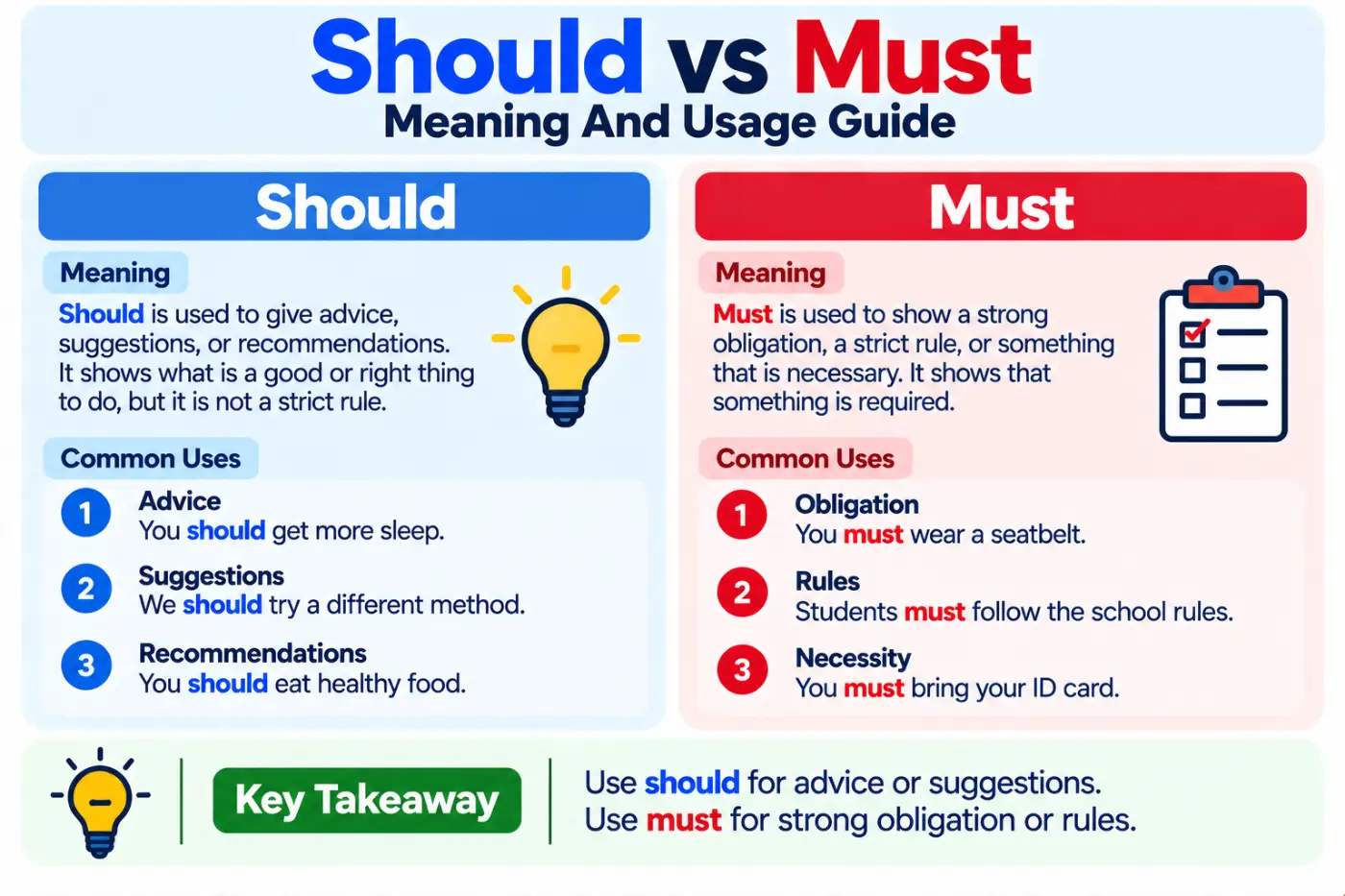
Should vs must often confuses English learners because both modal verbs can talk about actions that need to happen. The difference lies mainly in strength and meaning. Should usually tells someone what is advisable or expected. Must usually tells someone what is necessary or required.
The choice becomes easier when you focus on the speaker’s intention. If you want to give advice without presenting the action as an absolute requirement use should. If you want to show a strong obligation a rule or a necessity use must. This small difference can change the force of an entire sentence.
Both words are modal verbs. They work with the base form of another verb and do not take ordinary verb endings. You say She should leave and She must leave. You do not say She should leaves or She must leaves. Once you understand that basic pattern the more subtle differences become much easier to handle.
Short Answer
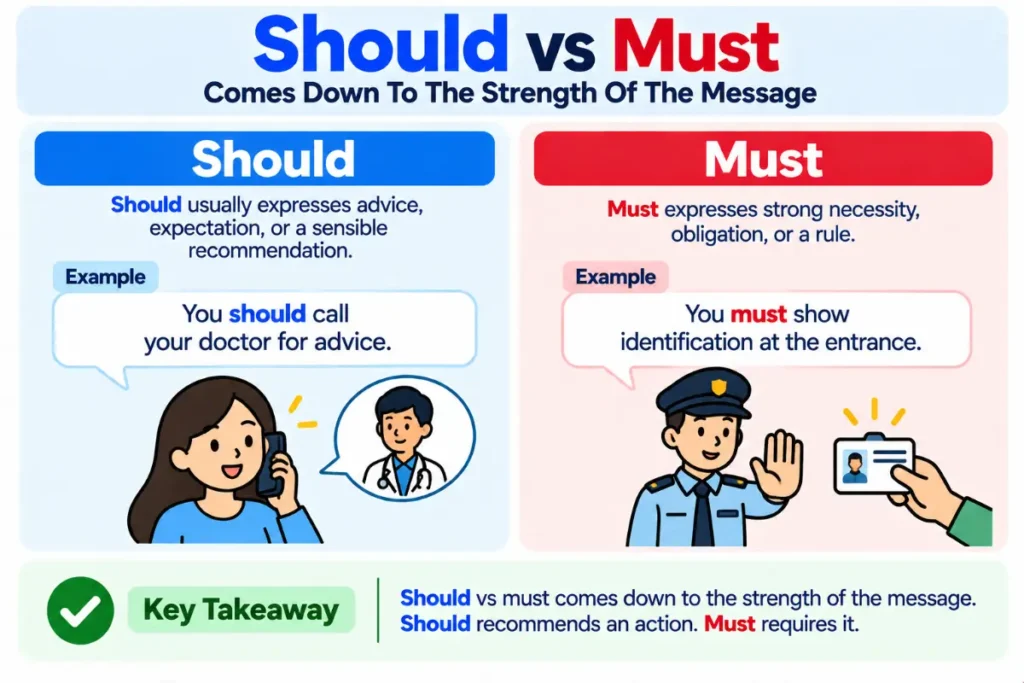
Should vs must comes down to the strength of the message. Should usually expresses advice expectation or a sensible recommendation. Must expresses strong necessity obligation or a rule. For example you can say You should call your doctor for advice. You must show identification at the entrance. The first sentence recommends an action. The second requires it.
Table Of Contents
- What should means.
- What must means.
- The main difference between should and must.
- How strong should sounds.
- How strong must sounds.
- Should for advice.
- Should for expectations.
- Should for responsibility.
- Must for obligation.
- Must for rules.
- Must for strong conclusions.
- Negative forms.
- Questions with should and must.
- Should and must in professional writing.
- Should and must in everyday conversation.
- Common mistakes.
- Memory tips.
- Related grammar notes.
- Frequently asked questions.
- Key takeaways.
- Conclusion.
What Should Means
Should is a modal verb that commonly expresses advice recommendation expectation duty or a likely result. It tells the reader or listener that something is a good idea or that something is expected to happen.
Consider these examples.
You should get some rest.
This sentence gives advice. The speaker thinks resting is a sensible action but does not necessarily have the authority to require it.
You should check your email before the meeting.
The speaker recommends checking the email because doing so would probably help.
The train should arrive soon.
Here should does not express advice. It expresses an expectation. Based on the schedule or available information the speaker expects the train to arrive soon.
That second use matters because should can describe something that the speaker expects without giving anyone an instruction.
Should can also express a sense of duty.
We should help our neighbors.
This sentence suggests that helping neighbors is the right or responsible thing to do. It does not usually sound like a strict command.
The meaning of should depends heavily on context. A manager might say You should submit the report today as friendly advice. In another context the same sentence could communicate a firm expectation.
Still the usual force of should remains lower than must.
What Must Means
Must is a modal verb that expresses strong necessity obligation or requirement. It can show that an action is required by a rule a situation a speaker or a strong personal sense of duty.
You must wear a seat belt.
The sentence presents wearing a seat belt as a requirement.
Employees must complete the form before Friday.
The sentence communicates an obligation.
I must remember to call my mother.
Here must expresses strong personal necessity. The speaker feels that making the call is important and necessary.
Must can also express a strong conclusion based on evidence.
The lights are on. They must be home.
The speaker does not mean that someone ordered the people to stay home. Instead the available evidence makes being home seem highly likely.
That use separates must from simple obligation. Context tells you which meaning applies.
The Main Difference Between Should And Must
The central difference involves the strength of the message.
Should usually means something is advisable expected or appropriate. Must usually means something is necessary required or strongly certain.
Compare these sentences.
You should wear a jacket.
You must wear a jacket.
The first sentence offers advice. The speaker thinks a jacket would be a good idea. The second sentence presents the jacket as necessary.
Now consider a workplace example.
You should finish the report today.
You must finish the report today.
The first sentence can sound like a recommendation or expectation. The second sentence sounds like a direct requirement.
The distinction becomes even clearer with rules.
Visitors should sign in at the front desk.
Visitors must sign in at the front desk.
The first version can suggest a preferred procedure. The second version establishes a requirement.
This does not mean should always sounds weak or must always sounds harsh. Tone depends on the situation the speaker’s relationship with the listener and the surrounding words.
A teacher can use must in a neutral way when explaining a classroom rule. A parent can use should in a serious way when giving important advice.
How Strong Should Sounds
Should usually sits in the middle between a casual suggestion and a strict command.
For example.
You should drink more water.
This sounds like health advice.
You should talk to your manager about the problem.
This sounds like a sensible recommendation.
You should arrive by nine.
This sentence can have more force in a workplace setting because it may communicate an expectation.
The context can therefore increase the practical strength of should. A manager who says You should have the report ready by nine may expect the report at nine even though the sentence does not use must.
Should can also soften instructions.
You should keep your receipt.
This can sound more polite than You must keep your receipt.
That softer tone makes should useful in customer service professional communication and ordinary conversation.
Still you should not automatically replace must with should. If something is genuinely required a weaker modal can make the meaning unclear.
How Strong Must Sounds
Must carries a stronger sense of necessity.
You must submit the application before the deadline.
The sentence tells the reader that missing the deadline is not presented as an acceptable option.
You must follow the safety instructions.
The sentence establishes a clear requirement.
Must can also show urgent personal need.
I must finish this tonight.
Here the speaker emphasizes personal determination or necessity.
The strength of must makes it useful for rules instructions warnings and formal requirements.
For example.
Guests must present identification.
Students must complete the exam independently.
Drivers must stop at a red light.
These sentences communicate requirements rather than suggestions.
In ordinary conversation must can sometimes sound more forceful than the speaker intends. If you want to make a recommendation rather than issue an order should often fits better.
Should For Advice
One of the most common uses of should is giving advice.
You should save some money each month.
You should speak with a qualified professional.
Each sentence recommends an action.
The speaker believes the action is sensible but does not necessarily control the listener’s decision.
Should also works well when the advice comes from experience.
You should read the instructions before assembling the furniture.
You should compare the prices before buying anything.
These sentences sound natural because should allows the speaker to recommend an action without turning the advice into a command.
For polite advice you can also use expressions such as You might want to or I think you should. These forms can soften the message further.
Should For Expectations
Should can describe something that you expect to happen.
The package should arrive tomorrow.
The doctor should call later.
The meeting should finish by three.
In these examples should does not tell someone what to do. It expresses an expectation based on information or circumstances.
The package should arrive tomorrow means the speaker expects the package tomorrow.
The meeting should finish by three means the speaker expects the meeting to end by that time.
This use appears frequently in everyday American English.
It can also express an expected result.
The medicine should help with the pain.
The new system should make the process easier.
The changes should improve response time.
These sentences describe expected outcomes rather than direct obligations.
Should For Responsibility
Should can also express moral or social responsibility.
We should treat people with respect.
We should help when we can.
These statements describe what the speaker considers right or responsible.
The strength depends on context. A person discussing personal values may use should because the sentence expresses a principle. A formal policy might use must instead because the organization wants to establish a binding requirement.
This distinction helps explain why both modal verbs can appear in discussions about responsibility.
You should tell the truth.
You must tell the truth.
The first sentence can sound like moral advice. The second sounds much stronger and can suggest an absolute requirement.
Must For Obligation
Must commonly expresses obligation.
You must submit the form before the deadline.
You must pay the fee before registration.
The speaker presents the action as necessary.
The source of the obligation can vary. A government rule may create it. A workplace policy may create it. A teacher may create it within a classroom. A person may also impose the obligation on themselves.
I must finish this project tonight.
The speaker is not necessarily ordering themselves in a literal sense. The sentence communicates a strong personal need or decision.
Must can therefore describe both external and internal obligation.
Must For Rules
It is especially common when a sentence states a rule.
Visitors must remain behind the marked line.
Passengers must keep their belongings with them.
Employees must wear identification badges.
These sentences leave little room for interpretation. The action is required.
This is one reason signs and official instructions often use must.
You must stop here.
You must show identification.
The language is direct because the purpose is to communicate a requirement clearly.
Should can appear in guidelines where the writer wants to recommend a practice without presenting it as an absolute rule.
You should keep your account information secure.
You should review your settings regularly.
The distinction between guidelines and requirements is important in professional writing.
Must For Strong Conclusions
Must has another important use. It can express a strong conclusion based on evidence.
She must be tired after working all night.
The store must be closed because the lights are off.
They must know about the change already.
In these sentences must does not mean an obligation.
She must be tired means the speaker strongly concludes that she is tired.
The store must be closed means the speaker draws a strong conclusion from the evidence.
This use can confuse learners because the same modal verb can communicate necessity or deduction.
Compare these two sentences.
You must leave now.
You must be tired.
The first sentence expresses an obligation.
The second sentence expresses a strong conclusion.
The words after must and the surrounding context reveal the intended meaning.
Negative Forms
The negative forms create one of the most important differences between should and must.
Should not usually means something is unwise or not recommended.
You should not skip breakfast.
You should not ignore the warning.
The action is discouraged.
Must not has a much stronger meaning. It usually means something is prohibited.
You must not enter this room.
You must not share confidential information.
The action is forbidden.
This distinction is crucial.
Should not means it is a bad idea.
Must not means you are not allowed to do it.
Compare these examples.
You should not drive when you are exhausted.
This gives strong safety advice.
You must not drive this vehicle without authorization.
This establishes a prohibition.
Do not confuse must not with the idea that something is not necessary. For lack of necessity English usually uses do not have to or do not need to.
You must not leave.
This means you are prohibited from leaving.
You do not have to leave.
This means leaving is unnecessary.
The meanings are almost opposite.
Questions With Should And Must
Should commonly appears in questions when someone asks for advice.
Should I call her?
These questions ask for guidance.
Must can appear in questions when someone asks about a requirement.
Must I complete the form today?
These questions ask if something is required.
In modern American English must can sound formal in many questions. Speakers often use do I have to or do we have to in ordinary conversation.
Do I have to attend the meeting?
Do we have to submit this today?
These forms often sound more natural in casual American speech.
Must still appears regularly in formal writing rules instructions and certain professional contexts.
Should And Must In Professional Writing
Professional writing requires careful control of tone.
Use should when you are making a recommendation.
Employees should review their contact information regularly.
Use must when you are establishing a requirement.
Employees must complete security training before accessing the system.
This difference helps readers understand the status of an instruction.
A policy writer should not use should when the organization intends to create a strict requirement. Doing so can make the rule appear optional.
Likewise a writer should not use must for every suggestion. Too many strong commands can make ordinary guidance sound unnecessarily severe.
Good professional writing matches the modal verb to the intended force.
Consider these examples.
Managers should review the report before the meeting.
This sounds like recommended practice.
Managers must review the report before approving the request.
This sounds like a required step.
The difference is small in wording but large in practical meaning.
Should And Must In Everyday Conversation
In casual conversation should is very common.
You should try that restaurant.
You should get some sleep.
These sentences give friendly recommendations.
Must also appears in everyday speech.
I must get going.
I must remember that.
You must see this movie.
The last example is especially interesting. You must see this movie often functions as a strong recommendation rather than a literal command. The speaker means that the movie is extremely worth seeing.
Context matters.
You must call the police.
This usually communicates strong necessity.
You must try this dessert.
This can function as enthusiastic encouragement.
The same modal verb can therefore carry different shades of meaning.
Should And Must In American English
Both should and must are standard in American English.
Should appears very frequently in everyday speech for advice expectations and responsibility.
Must remains common for strong necessity formal requirements prohibitions and strong conclusions. In casual American conversation speakers often use have to instead of must for external obligations.
For example.
I have to leave now.
I must leave now.
Both sentences communicate necessity. The second can sound more formal or more forceful depending on the context.
For external obligations American speakers frequently use have to.
I have to work tomorrow.
She has to submit the form today.
You have to show identification.
Must is still natural in many situations.
You must be joking.
You must not enter.
The choice depends on meaning tone and context.
Formal And Informal Usage
Should works comfortably in both formal and informal English.
You should contact the office.
You should take a break.
Must is also correct in both settings but often carries more authority.
You must provide accurate information.
You must submit the application.
Have to often sounds more conversational for everyday obligations.
I have to go.
I have to finish this tonight.
We have to leave early.
That does not make must incorrect in casual speech. It simply means American English offers several ways to express necessity.
Common Mistakes
Using Must For Every Recommendation
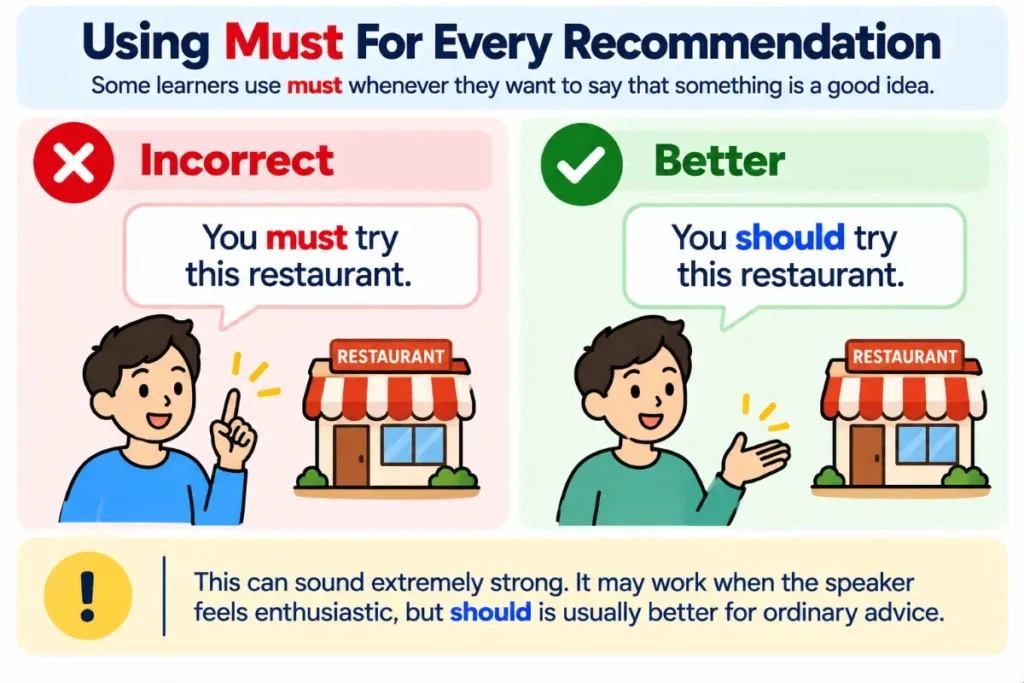
Some learners use must whenever they want to say that something is a good idea.
You must try this restaurant.
This can sound extremely strong. It may work when the speaker feels enthusiastic but should is usually better for ordinary advice.
You should try this restaurant.
This clearly presents the idea as a recommendation.
Treating Should As A Strict Requirement
Should can communicate a strong expectation but it does not normally carry the same force as must.
You should submit the form today.
You must submit the form today.
If the form is genuinely required today the second sentence communicates that requirement more clearly.
Confusing Must Not With Do Not Have To
This is one of the most serious grammar mistakes.
You must not use your phone here.
This means phone use is prohibited.
You do not have to use your phone.
This means using it is unnecessary.
The two structures do not mean the same thing.
Adding An Infinitive To Must
After must use the base form of the verb.
You must leave.
Not You must to leave.
The same pattern applies to should.
You should leave.
Not You should to leave.
Modal verbs take the base form of the following verb.
Adding S To The Main Verb
Do not add s after should or must.
She should go.
She must go.
Not She should goes.
Not She must goes.
The modal verb carries the grammatical role and the following verb stays in its base form.
Using To After Should
Should is followed directly by the base verb.
You should study.
You should call.
Do not say You should to study.
This simple pattern will prevent many common errors.
How To Choose The Right Modal Verb
Start by asking what you want the sentence to communicate.
If you are giving advice use should.
You should talk to your teacher.
If you are stating a requirement use must.
You must complete the form.
If you are expressing an expectation use should.
The package should arrive today.
If you are making a strong conclusion use must.
She must be at work.
If you are describing a prohibition use must not.
You must not enter.
If something is simply unnecessary use do not have to.
You do not have to stay.
This method works because it focuses on meaning rather than memorizing isolated grammar rules.
Memory Tips
A simple memory trick can help.
Think of should as a strong suggestion.
Think of must as a requirement.
You should means this is a good idea.
You must means this is necessary.
Should points toward the sensible path.
Must puts a firm sign in front of the path.
Another useful test is to ask yourself if the listener has a real choice.
If the sentence gives advice and the listener can reasonably choose another action use should.
If the sentence communicates a rule or unavoidable requirement use must.
This test will not solve every possible example but it works well in everyday writing and conversation.
Related Grammar Notes
Should and must belong to the group of English modal verbs. Other common modal verbs include can could may might will would and shall.
Modal verbs share several important features.
They do not take s in the third person singular.
She should leave.
He must leave.
They usually take the base form of the following verb.
She should go.
He must work.
They do not normally use do for ordinary positive or negative structures.
You should not worry.
She must not leave.
Must is also unusual because English often replaces it with have to when talking about obligation in certain tenses.
I have to work tomorrow.
I will have to work tomorrow.
English does not normally use must as a regular past tense form for obligation. Had to usually expresses past necessity.
I had to leave early.
This means leaving early was necessary in the past.
For advice about the past English commonly uses should have followed by a past participle.
You should have called me.
She should have studied more.
These sentences describe an action that was advisable but did not happen or did not happen as expected.
Must have followed by a past participle can express a strong conclusion about the past.
She must have forgotten.
They must have left already.
Again context determines the meaning.
Real Life Examples
At Work
You should check the report before sending it.
The speaker recommends checking it.
You must check the report before sending it.
The speaker establishes checking it as a requirement.
At School
Students should review their notes before the test.
The teacher gives advice.
Students must bring their identification cards.
The teacher states a requirement.
At Home
You should clean the kitchen tonight.
The sentence can sound like a request or recommendation.
You must clean the kitchen tonight.
The sentence sounds like a firm requirement.
While Traveling
You should arrive at the airport early.
The speaker recommends arriving early.
You must show your passport at the border.
The speaker describes a requirement.
In Health Advice
You should rest if you feel exhausted.
The sentence gives advice.
You must follow the prescribed instructions.
The sentence communicates a strong requirement in a particular context.
The examples show why the surrounding situation matters. The modal verb does not work alone. Meaning comes from the modal verb plus the verb that follows it plus the context.
A Closer Look At Tone
Grammar and tone work together.
Should often sounds cooperative.
You should check this section again.
The speaker is guiding the listener.
Must sounds more authoritative.
You must check this section again.
The speaker presents the action as necessary.
That difference can matter in emails instructions policies and customer communication.
If a manager wants to encourage a good practice the manager might write.
You should review the updated procedure before the meeting.
If the company requires the review the manager might write.
You must review the updated procedure before the meeting.
The second sentence removes much of the optional feeling.
Good writers choose the modal that matches the intended level of authority.
When Should Can Sound Strong
Should does not always sound gentle.
A parent might say You should apologize to your sister.
A manager might say You should have told me about the problem earlier.
A doctor might say You should stop smoking.
These sentences can carry serious weight even though they use should.
The reason is context. The relationship between speakers and the seriousness of the situation can strengthen the message.
Should can also communicate disappointment.
You should have known better.
This sentence does not merely offer casual advice. It can express criticism.
Similarly should have can describe something that was expected or advisable in the past.
You should have called earlier.
The speaker expected a call or believes a call would have been appropriate.
When Must Can Sound Friendly
Must does not always sound harsh.
You must come visit us sometime.
You must see the new exhibit.
These sentences often express strong enthusiasm rather than formal obligation.
The listener is not literally being ordered to visit or eat cake.
The speaker uses must to emphasize how strongly they recommend the experience.
This is a good reminder that modal verbs carry meaning through context. A dictionary definition gives you the core meaning but real communication adds tone.
Should Have And Must Have
Should have and must have create another useful contrast.
You should have called me.
This usually means calling would have been the right or expected action.
You must have called me.
This usually means the speaker strongly concludes that the person called.
The two structures can therefore look similar while expressing very different ideas.
Compare these examples.
She should have arrived by now.
The speaker expected her to arrive by now.
She must have arrived by now.
The speaker strongly concludes that she has arrived.
This distinction is especially important in formal writing because a small modal change can alter the writer’s intended meaning.
Professional Writing Tips
When writing policies use must for genuine requirements.
When writing recommendations use should.
Avoid using must simply to make a sentence sound authoritative. Strong wording works best when the situation truly requires it.
Also consider your audience. A customer facing message may need a softer tone. A safety instruction may need unmistakable language.
Compare these sentences.
You should wear protective equipment.
You must wear protective equipment.
The first recommends the practice. The second makes the requirement clear.
Neither sentence is automatically better. The correct choice depends on the intended meaning.
Key Takeaways
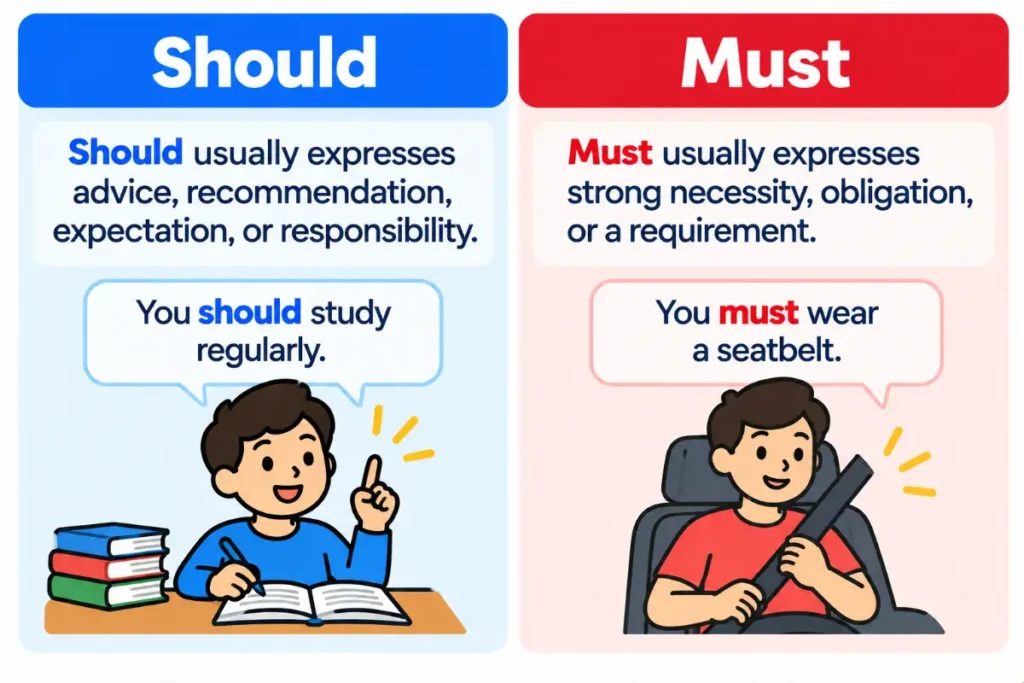
- Should usually expresses advice recommendation expectation or responsibility.
- Must usually expresses strong necessity obligation or a requirement.
- Should often gives the listener some choice.
- Must usually presents the action as necessary.
- Should not normally means something is not recommended.
- Must not normally means something is prohibited.
- Do not have to means something is unnecessary or optional.
- Should can express an expected result.
- Must can express a strong conclusion based on evidence.
- Both should and must are modal verbs followed by the base form of another verb.
- Have to often sounds more conversational than must when expressing everyday external obligations in American English.
- Context determines the exact force and tone of both modal verbs.
Conclusion
Should vs must becomes much easier when you focus on the purpose of the sentence. Use should when you want to give advice express an expectation or describe something as appropriate. Use must when you need to communicate strong necessity a requirement or a firm conclusion based on evidence.
The most useful distinction is simple. Should generally points toward the sensible choice while must signals a stronger need. You should call your friend means calling is advisable. You must call your friend means the situation makes the call necessary. Context can change the tone but the basic difference remains clear.
Once you learn this contrast you can make your writing more precise. Choose should for recommendations and expectations. Choose must for genuine requirements and strong conclusions. Pay special attention to the negative forms because must not means prohibited while do not have to means optional. These small distinctions make a big difference in clear English.
Frequently Asked Questions
Is should stronger than must
No. Must normally expresses a stronger obligation or necessity. Should usually expresses advice an expectation or a recommended action.
Can should and must mean the same thing
They can overlap in some contexts but they usually differ in strength. Should often presents an action as advisable while must presents it as necessary.
Is should vs must mainly about strength
Strength is the main difference in many sentences but it is not the only difference. Should can express expectations while must can express strong conclusions based on evidence.
Is must more formal than should
Not necessarily. Both are used in formal and informal English. Must often sounds more forceful while should commonly sounds less demanding.
Should I use must for rules
Yes. Must is often appropriate when a sentence states a genuine requirement or prohibition.
Can I use should for a rule
You can use should when the rule functions as a recommendation or preferred practice. If the action is mandatory must usually communicates the intended meaning more clearly.
What is the difference between must not and do not have to
Must not means something is prohibited. Do not have to means something is unnecessary or optional.
Can should express the future
Yes. Should can describe an expected future event.
The package should arrive tomorrow.
The speaker expects the package to arrive tomorrow.
Can must express probability
Yes. Must can express a strong conclusion based on evidence.
The lights are on so they must be home.
Here must does not express an obligation.
Is should vs must important in professional writing
Yes. The choice can affect how readers interpret a policy instruction recommendation or requirement. Writers should match the modal verb to the intended level of obligation.

English Grammar & Usage
Nathan Holloway is an American grammar writer and language researcher who specializes in English grammar, sentence structure, verb usage, and common writing mistakes. He enjoys breaking down confusing grammar rules into practical explanations with clear examples, making English easier for students, professionals, and everyday writers.