
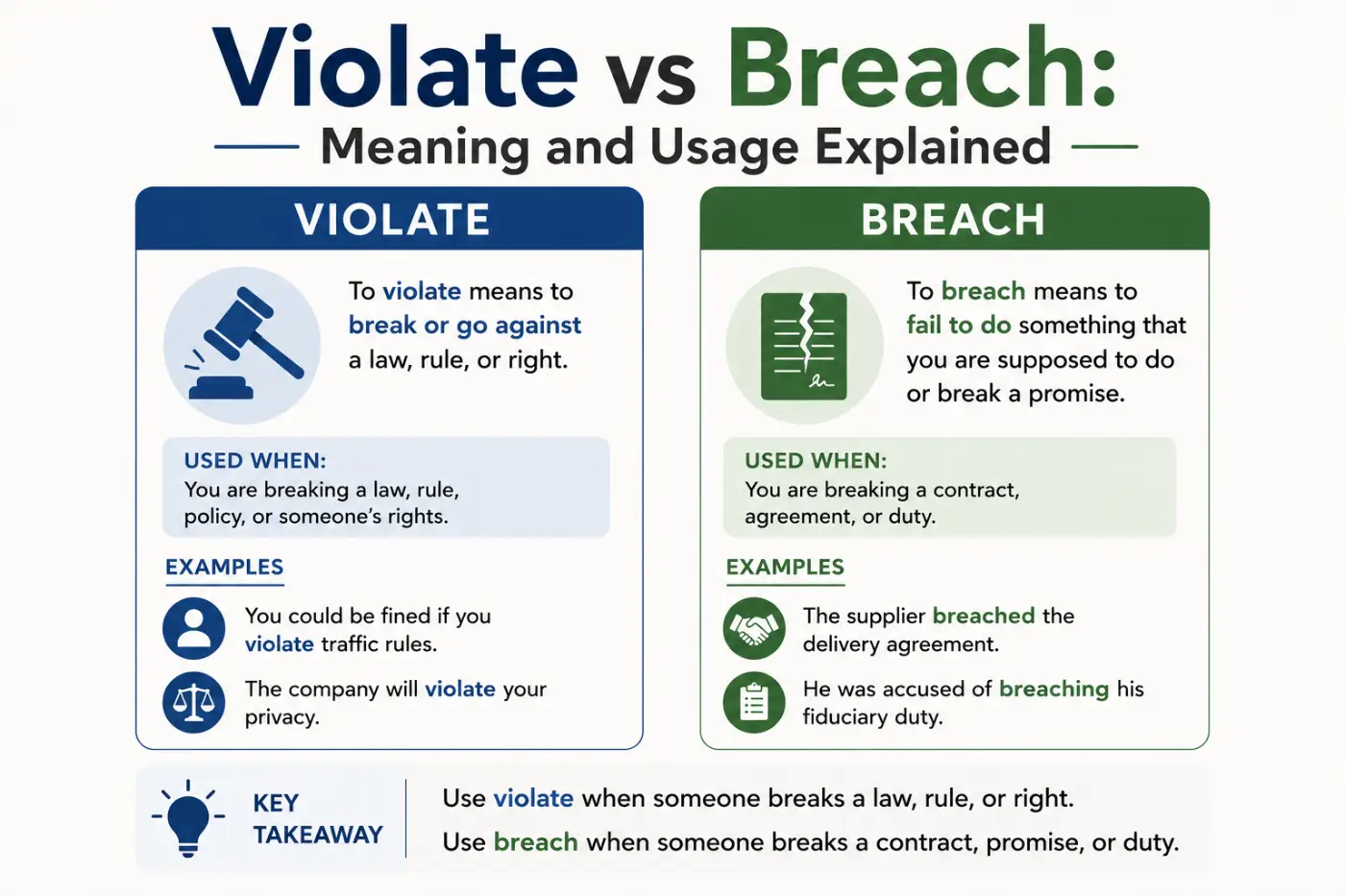
Violate vs Breach is a useful comparison because both words can describe a failure to follow something that should be respected. You might violate a law or someone’s rights. You might breach a contract or an obligation. In some situations either word can work but the choice can change the tone and meaning of a sentence.
The two verbs overlap because both involve crossing a boundary. Still each word has its own typical patterns. Violate often focuses on breaking a rule law principle right or personal boundary. Breach commonly focuses on breaking an agreement duty trust or obligation. Breach also has meanings that violate does not share such as a gap in a wall or a security breach.
The distinction matters in legal writing business communication journalism academic work and everyday English. Choosing the right verb can make a sentence more precise and can prevent a reader from misunderstanding what happened. This guide explains the difference in plain American English. You’ll learn what each word means how the grammar works where each word fits best and how to choose between them naturally.
Table Of Contents
- Short answer
- Meaning of violate
- Meaning of breach
- The main difference
- Comparison table
- Grammar and sentence patterns
- Legal usage
- Contracts and agreements
- Privacy rights and personal boundaries
- Security and technology
- Everyday English
- Pronunciation
- Word origins
- Common mistakes
- Real life examples
- Memory tips
- Related words
- Professional editing advice
- FAQs
- Key takeaways
- Conclusion
The Meaning Of Violate
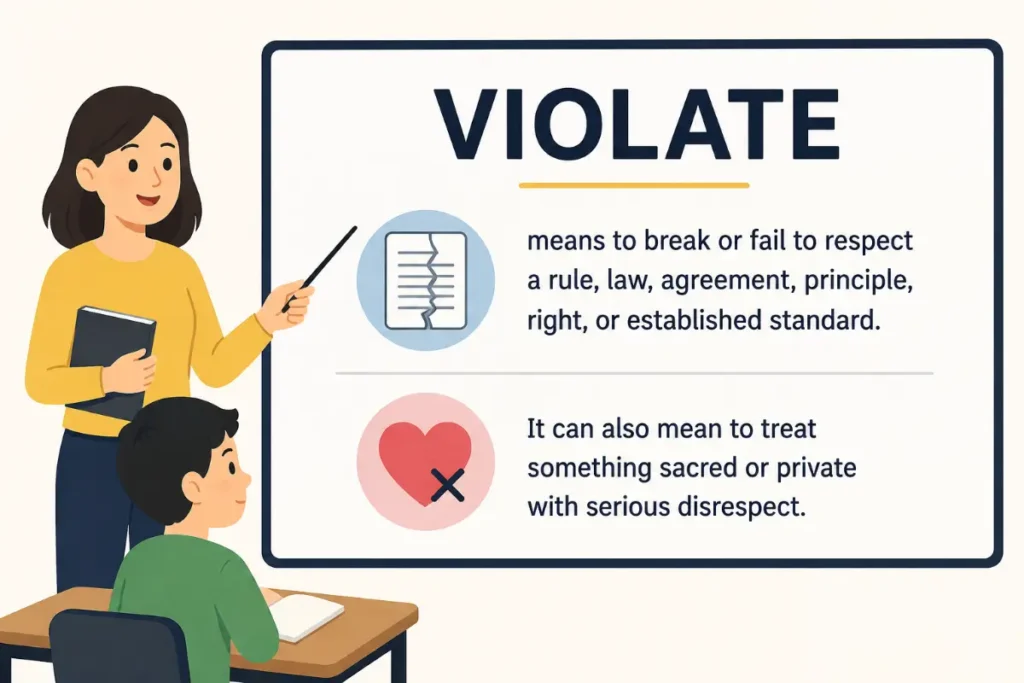
Violate means to break or fail to respect a rule law agreement principle right or established standard. It can also mean to treat something sacred or private with serious disrespect.
The word often carries a strong sense of wrongdoing. If someone violates a law they break that law. If someone violates another person’s rights they fail to respect those rights.
Consider these examples.
She violated the law.
The company violated the agreement.
The action violated his privacy.
The policy prohibits conduct that violates employee rights.
The common idea is that a boundary or standard exists and someone crosses it.
Violate can also describe physical or personal intrusion.
For example:
Someone violated the privacy of the family.
The soldiers violated the sanctuary.
This use can sound more serious or formal than ordinary words such as break or disturb.
The word is therefore especially common in legal writing formal reports journalism and discussions involving rights or ethical standards.
The Meaning Of Breach
Breach means to break a law agreement duty promise or obligation. As a noun it can also mean the act of breaking something or an opening in a physical barrier.
For example:
The company breached the contract.
The employee breached his duty of confidentiality.
The landlord breached the agreement.
The company suffered a data breach.
The first three examples involve failure to honor an obligation. The fourth uses breach as a noun to describe a security incident.
Breach has a strong connection with agreements and duties. That makes it especially useful in legal and professional contexts.
The noun form is extremely common.
A breach of contract means a failure to meet the obligations established by a contract.
A breach of trust means that someone failed to respect the confidence placed in them.
The word can also describe a physical gap.
For example:
The floodwater broke through a breach in the wall.
This physical meaning is separate from the legal meaning but comes from the same basic idea of breaking through a boundary.
The Main Difference
The simplest distinction is this.
Violate usually emphasizes breaking a rule law right principle or personal boundary.
Breach usually emphasizes breaking an agreement duty obligation trust or security.
The distinction isn’t absolute. English contains many areas where the words overlap.
For example both can appear in discussions of laws.
A person can violate a law.
A person can also breach a legal duty.
The nouns differ in their most natural patterns.
You normally say:
Violation of the law.
Breach of contract.
Violation of rights.
Breach of duty.
Violation of privacy.
Breach of confidentiality.
These combinations are called collocations. They are word combinations that English speakers commonly use together. Learning these patterns can be more useful than memorizing a single definition.
Comparison Table
| Feature | Violate | Breach |
|---|---|---|
| Core meaning | Break or fail to respect a rule law right principle or boundary | Break an agreement duty obligation trust or security |
| Common part of speech | Verb | Verb and noun |
| Common noun form | Violation | Breach |
| Common legal use | Violate a law or right | Breach a contract or duty |
| Common business use | Violate company rules or policies | Breach an agreement or confidentiality duty |
| Security use | Can describe violating security rules | Commonly describes a security breach |
| Personal boundaries | Common | Possible but less typical |
| Physical meaning | Can describe intrusion into something sacred or private | Can mean a gap or opening in a barrier |
| Tone | Often serious or formal | Often legal professional or technical |
| Typical phrase | Violate someone’s rights | Breach a contract |
The table shows why replacing one word with the other can sometimes sound unnatural even when the general idea remains understandable.
Grammar And Sentence Patterns
Understanding the grammar makes the distinction easier.
Violate As A Verb
Violate is a transitive verb. That means it normally takes a direct object.
You violate something.
For example:
He violated the rule.
They violated the law.
The company violated the policy.
She violated his privacy.
You generally don’t say simply he violated when you mean that he broke a specific rule. The object tells the reader what was broken or disrespected.
Breach As A Verb
Breach can also function as a transitive verb.
For example:
They breached the contract.
The company breached its duty.
The employee breached confidentiality.
The organization breached the agreement.
Again the word normally takes an object.
Breach As A Noun
Breach is especially common as a noun.
For example:
There was a breach of contract.
The court considered the breach serious.
The company reported a security breach.
The breach of confidentiality caused concern.
The noun pattern is one reason breach appears so frequently in legal and business writing.
Violation As A Noun
The noun form of violate is violation.
For example:
The company was accused of a policy violation.
The court considered the violation serious.
The report identified several violations.
The phrase violation of is especially common.
Violation of the law.
Violation of policy.
Legal Usage
Legal writing is one of the areas where the difference matters most.
Violate often appears with laws rights rules and legal protections.
For example:
The defendant violated the law.
The agency violated the individual’s constitutional rights.
The company violated federal regulations.
Breach commonly appears with contracts duties obligations and certain legal relationships.
For example:
The company breached the contract.
The employee breached a contractual obligation.
The defendant breached a duty owed to the claimant.
These patterns aren’t rigid legal formulas for every situation. Legal language depends on the specific rule contract statute or duty involved. Still the common collocations provide a strong guide for ordinary writing.
Violation Of Rights
Rights are commonly described as something that can be violated.
For example:
The policy was criticized as a violation of privacy rights.
The court considered the action a violation of his rights.
This wording emphasizes the failure to respect a protected right.
Breach Of Contract
Contracts are commonly described in terms of breach.
For example:
The buyer claimed that the seller had breached the contract.
The parties disagreed about the alleged breach of contract.
Here breach highlights the failure to perform an obligation created by the agreement.
Breach Of Duty
Breach is also common with duty.
For example:
The lawyer was accused of breaching a professional duty.
The claim involved an alleged breach of duty.
The phrase focuses on an obligation that a person or organization was expected to fulfill.
Contracts And Agreements
If you are writing about contracts the noun breach is often the natural choice.
A contract creates obligations for the parties involved. If one party fails to perform an obligation that failure may be described as a breach of contract.
For example:
The supplier breached the contract by failing to deliver the goods.
The customer claimed a breach of the agreement.
The parties are negotiating after the alleged breach.
Violate can also appear in discussions about agreements but it often sounds less precise when the intended idea is contractual nonperformance.
For example:
The company violated the contract.
This sentence is understandable. However breach the contract is a more established legal and professional collocation.
That distinction is valuable for business writing. If you are describing a contract dispute then breach will often sound more natural and precise.
Privacy Rights And Personal Boundaries
Violate is especially useful when the subject involves privacy rights dignity or personal boundaries.
For example:
The company violated customers’ privacy.
The photographer was accused of violating the family’s privacy.
The policy may violate individual rights.
These sentences emphasize intrusion or failure to respect something that should remain protected.
Breach can also work in privacy contexts when the focus is on confidentiality or an obligation.
For example:
The employee breached confidentiality.
The disclosure was described as a breach of privacy.
The choice depends on what you want to emphasize.
If you focus on the act of disrespecting or infringing a right then violate can be the stronger choice.
If you focus on the failure of a duty or protection then breach may fit better.
Security And Technology
Modern English frequently uses breach in discussions of cybersecurity.
You will often see expressions such as:
Data breach.
Security breach.
Network breach.
Breach of security.
These expressions describe unauthorized access or a failure in a security system.
For example:
The company reported a data breach.
Investigators are examining the security breach.
Customer information was exposed after the breach.
Violate can still appear in technology contexts.
For example:
The employee violated the company’s security policy.
Someone violated the access rules.
The distinction is useful.
A person can violate a security rule.
A system can suffer a security breach.
The first sentence focuses on breaking a rule. The second focuses on the security failure itself.
Everyday English
In casual conversation people often use break instead of either violate or breach.
For example:
You broke the rules.
He broke the agreement.
They broke the law.
However violate and breach become useful when you need a more specific or formal tone.
You might say:
He violated the rules.
The company violated the law.
They breached the agreement.
The contract was breached.
The choice often depends on context.
Breach tends to sound more formal than break. Violate can also sound formal and serious.
If you are chatting with a friend you may simply say someone broke a rule. If you are writing a report you may need a more precise term.
Formal And Informal Usage
Both words appear in formal English but they have different strengths.
Violate is common in formal discussions of laws policies rights regulations ethics and personal boundaries.
Breach is especially common in legal business contractual and technical contexts.
For casual writing neither word is always necessary.
Instead of:
You violated our agreement.
A friend might say:
You broke our agreement.
Instead of:
You breached the rule.
A speaker might say:
You broke the rule.
The more formal words are useful when precision matters. Good writing isn’t about making every sentence sound official. It’s about choosing the word that communicates the intended idea clearly.
Pronunciation
Violate is pronounced with three syllables.
The IPA pronunciation is commonly represented as /ˈvaɪəleɪt/.
An easy guide is:
VY uh late
The stress falls on the first syllable.
Breach has one syllable.
Its IPA pronunciation is /briːtʃ/.
An easy guide is:
breech
The vowel sound is similar to the vowel in see and tree.
One useful spelling reminder is that breach ends with the sound represented by ch. It does not rhyme with words such as reach only by accident. In fact reach and breach do rhyme in standard English.
Word Origins
Violate comes through French from Latin roots connected with treating something improperly or breaking a rule or sacred protection. Its history helps explain why the word developed strong associations with laws rights dignity and things regarded as protected.
Breach has Germanic roots and is related to the idea of breaking or breaking through. Its physical meaning involving an opening or gap connects naturally with its later abstract meanings.
The historical paths are different even though the modern words overlap in some contexts.
You don’t need etymology to choose the right word. The most useful guide remains modern usage and collocation.
Common Mistakes
Using Breach For Every Rule
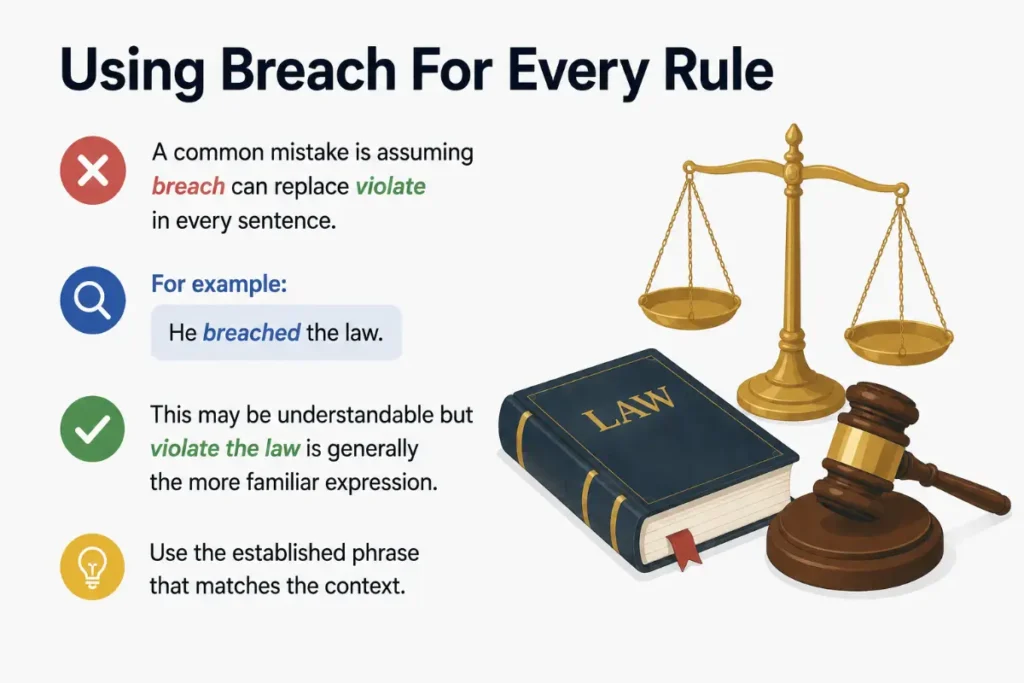
A common mistake is assuming breach can replace violate in every sentence.
For example:
He breached the law.
This may be understandable but violate the law is generally the more familiar expression.
Use the established phrase that matches the context.
Using Violate For Every Contract
Another mistake is using violate whenever a contract is involved.
The company violated the contract.
This isn’t impossible but breached the contract is generally the more natural expression in legal and business writing.
Confusing Breach And Break
Breach and break overlap but they aren’t identical.
Break is a broad everyday word.
Breach has a more specific formal meaning involving failure to honor an agreement obligation or security requirement.
Confusing Violate And Violation
Violate is a verb.
Violation is a noun.
Correct:
They violated the policy.
The action was a violation of the policy.
Don’t use the noun where the verb belongs.
Confusing Breach And Breached
Breach can be both a noun and a verb.
As a noun:
The breach caused serious problems.
As a verb:
The company breached the agreement.
The surrounding grammar tells you which function the word has.
Real Life Examples
Example One
The employee violated the company’s safety rules.
This sentence focuses on the rules. The employee failed to follow a standard established by the company.
Example Two
The company breached its agreement with the supplier.
Here the focus is a formal agreement. Breach sounds natural because the sentence concerns an obligation created by an agreement.
Example Three
The website violated the user’s privacy.
The sentence focuses on privacy as something that deserves protection.
Example Four
The organization reported a security breach.
Here breach is a noun describing a security failure.
Example Five
The tenant breached the lease.
A lease is a formal agreement. Breach is therefore a natural choice.
Example Six
The policy may violate federal law.
The object is law. Violate is the standard choice for this kind of sentence.
Example Seven
The employee breached the duty of confidentiality.
The focus is a specific professional obligation. Breach works naturally.
Example Eight
The journalist was accused of violating someone’s privacy.
This sentence focuses on intrusion into another person’s protected private space.
Example Nine
The company investigated the alleged breach of contract.
The phrase breach of contract identifies a contractual dispute.
Example Ten
The new policy could violate employee rights.
Rights are commonly paired with violate because the word emphasizes infringement.
Memory Tips
A simple memory trick can help.
Think of violate as crossing a rule or right.
Think of breach as breaking an agreement or barrier.
That gives you useful mental pairings.
Violate a law.
Violate a rule.
Breach confidentiality.
Breach security.
This isn’t an absolute rule but it is a strong practical guide.
Another helpful trick is to remember that breach has a physical meaning involving an opening.
A wall can have a breach.
A security system can have a breach.
A contract can have a breach.
The common idea is something being broken or opened.
Violate doesn’t have that same physical gap meaning.
A Better Way To Choose Between Them
When you’re unsure which word to use ask yourself what has been broken.
If the answer is a law rule right principle or personal boundary then violate will often fit.
If the answer is a contract agreement duty obligation trust or security system then breach will often fit.
Then look at the noun pattern.
Violation of rights sounds natural.
Breach of contract sounds natural.
Violation of privacy sounds natural.
Breach of duty sounds natural.
These combinations can guide you faster than trying to compare dictionary definitions word by word.
You should also consider tone. Both words can sound formal but breach has a particularly strong presence in legal business and cybersecurity language.
Related Words
Infringe
Infringe means to break or limit a law right agreement or established rule. It is especially common with rights.
For example:
The policy may infringe on individual rights.
Break
Break is the broad everyday alternative.
For example:
He broke the rules.
It is less formal than violate or breach in many contexts.
Disobey
Disobey means to fail to follow an instruction rule or authority.
For example:
The child disobeyed the teacher.
It usually focuses on refusing or failing to follow a command.
Violation
Violation is the noun related to violate.
For example:
The incident was a serious violation of policy.
Breached
Breached is the past tense and past participle of breach.
For example:
The company breached the agreement.
Infringement
Infringement is the noun form related to infringe.
It often appears in discussions of rights intellectual property and legal restrictions.
Contravene
Contravene means to conflict with or go against a law rule or principle. It is more formal than everyday words such as break.
Violation Of Privacy
This phrase describes an action that improperly intrudes on someone’s private life or information.
These related terms are not perfect substitutes. Their normal collocations and shades of meaning matter.
The Difference Between Violate And Infringe
Violate and infringe can overlap when discussing rights.
For example:
The policy violated her rights.
The policy infringed on her rights.
Both sentences can communicate a similar idea but the grammar differs.
Violate commonly takes a direct object.
Violate her rights.
Infringe commonly appears with on.
Infringe on her rights.
This is a useful distinction for polished writing.
The Difference Between Breach And Infringe
Breach is strongly associated with agreements and duties.
The company breached the contract.
Infringe is often associated with rights.
The policy infringed on their rights.
There can be overlap but the normal collocations make one word sound more natural than the other in a given sentence.
Why Context Matters More Than A Single Definition
Dictionary definitions are useful but they don’t always tell you which word sounds most natural beside another word.
Imagine these sentences.
The company violated the contract.
The company breached the contract.
Both are understandable. The second is more conventional in formal contract language.
Now consider:
The company violated consumer rights.
The company breached consumer rights.
The first is more natural because rights commonly pair with violate.
This is why strong vocabulary isn’t just about knowing definitions. You also need to know how words behave around other words.
Native speakers develop these patterns through years of exposure. Writers can learn them deliberately by paying attention to common combinations.
Professional Editing Advice
An editor should first identify the object of the verb. Ask what exactly was broken or disrespected. If the object is a law rule right or personal boundary then violate will often be the better choice. If the object is a contract duty agreement or confidentiality obligation then breach will usually sound more precise.
Also check the level of formality. A casual message may simply need break. A legal document may require breach or violate because those words carry more specific meanings. The goal isn’t to choose the most formal word. The goal is to choose the word that matches the relationship between the action and the thing affected.
Why These Words Are Easy To Confuse
The confusion comes from their shared central idea.
Both words can describe crossing a boundary.
A rule creates a boundary around acceptable behavior.
A contract creates a boundary around agreed obligations.
A right creates a boundary around protected interests.
A security system creates a boundary around protected information.
English uses different words to describe these different types of boundaries.
Violate often focuses on the act of breaking or disregarding a protected standard.
Breach often focuses on breaking an obligation or breaking through a protective boundary.
Once you start thinking about the type of boundary involved the choice becomes much easier.
Violate Vs Breach In Professional Writing
Violate vs Breach becomes especially important in professional writing because precision affects how readers interpret a statement.
Consider a company report.
The employee violated the company’s policy.
This clearly describes failure to follow a policy.
Now consider:
The employee breached the confidentiality agreement.
This identifies a specific contractual obligation.
The difference may seem small but it gives the reader more information.
Professional writing benefits from this kind of precision. A precise verb can eliminate the need for several extra words.
That is why legal writers business professionals editors and journalists often pay close attention to these collocations.
When Break Is Better
Not every sentence needs violate or breach.
Sometimes break is the strongest choice.
For example:
You broke your promise.
She broke the rule.
They broke the agreement.
These sentences are perfectly clear in everyday English.
A writer should not automatically replace simple words with formal vocabulary. If the audience is general and the context is casual then break may sound warmer and more natural.
Use violate or breach when their specific meanings or formal tone add value.
Good writing isn’t a contest to see who can sound most official.
When Violate Is The Better Choice
Choose violate when the sentence focuses on a law rule right principle regulation policy or personal boundary.
Common patterns include:
Violate the law.
Violate a rule.
These combinations are familiar and natural.
When Breach Is The Better Choice
Choose breach when the sentence focuses on a contract agreement duty obligation confidentiality trust or security failure.
Common patterns include:
Breach a contract.
Breach an agreement.
These patterns are especially useful in professional and legal writing.
Key Takeaways
- Violate and breach both describe breaking something that should be respected or followed.
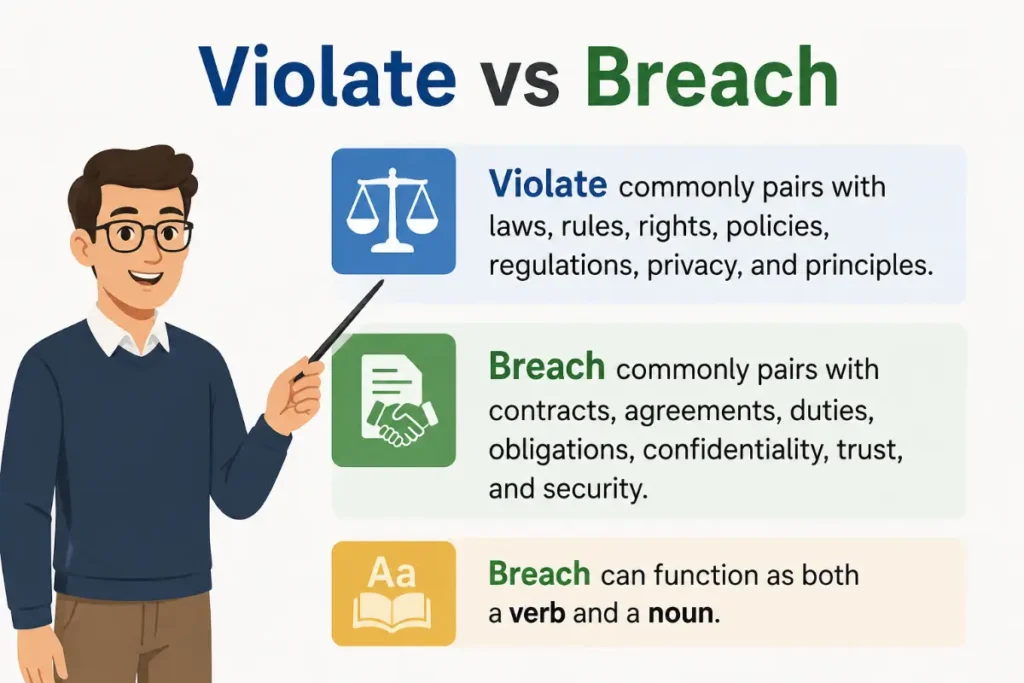
- Violate commonly pairs with laws rules rights policies regulations privacy and principles.
- Breach commonly pairs with contracts agreements duties obligations confidentiality trust and security.
- Breach can function as both a verb and a noun.
- Violate is a verb while violation is its noun form.
- Breach also has a physical meaning involving an opening or gap.
- Break is often the better choice in casual conversation.
- The best word depends on the object and context rather than a simple rule that works every time.
Conclusion
Violate vs Breach becomes much easier once you focus on what has been broken. Use violate for laws rules rights regulations policies principles and personal boundaries. Use breach for contracts agreements duties obligations confidentiality trust and security failures.
The words overlap in some contexts but their common word combinations provide a reliable guide. You violate a law and breach a contract. You violate someone’s privacy and breach a duty and You can also use break in casual situations when a simpler word sounds more natural.
The best editing tip is to look at the object first. Ask yourself what the person or organization failed to respect. That one question will usually point you toward the stronger word.
FAQs
What Is The Main Difference Between Violate And Breach?
The main difference is the type of thing being broken. Violate commonly refers to breaking a law rule right principle or personal boundary. Breach commonly refers to breaking a contract agreement duty obligation trust or security protection. The words can overlap but their usual collocations make one more natural than the other in many sentences.
Is It Better To Say Violate A Contract Or Breach A Contract?
Breach a contract is generally the more natural phrase in formal legal and business English. You can encounter violate a contract and readers will understand it but breach a contract is the established collocation for describing failure to meet contractual obligations. Use breach when you want precise professional wording for a contract dispute.
Can You Violate A Law?
Yes. Violate a law is a standard and widely understood expression. It means to break or fail to comply with a law. You can also talk about violating regulations rules or policies. The noun form is violation. For example the company violated the law and the conduct resulted in a legal violation.
Can You Breach A Law?
Breach can appear with legal duties and obligations but breach a law is generally less natural than violate a law in ordinary English. Breach is more strongly associated with contracts agreements duties confidentiality and security. The most natural choice depends on the exact legal concept being described.
Can You Violate Someone’s Rights?
Yes. Violate someone’s rights is a standard expression. The phrase emphasizes that a protected right has been infringed or disregarded. You can also use violation of rights as a noun phrase. For example the organization was accused of violating workers’ rights.
What Does Breach Mean In Cybersecurity?
In cybersecurity breach usually refers to unauthorized access to protected systems or information or a failure of security that exposes protected data. Common expressions include data breach and security breach. In this context breach is often used as a noun. For example the company reported a security breach.
Is Breach More Formal Than Violate?
Both words can sound formal. Breach has especially strong associations with legal business contractual and cybersecurity language. Violate is also common in formal contexts involving laws rights policies regulations and privacy. Neither word is automatically more formal in every sentence. The context and the noun that follows usually matter more.
What Is The Noun Form Of Violate?
The noun form is violation. For example you can say a violation of the law a violation of privacy or a policy violation. Violate functions as a verb while violation functions as a noun. The related adjective forms include violated and violative although violative is much less common in everyday English.
Is Breach A Verb Or A Noun?
Breach can be both a verb and a noun. As a verb you can say the company breached the contract. As a noun you can say the company committed a breach of contract. It can also describe a physical opening or gap and is widely used as a noun in cybersecurity.
Can Violate And Breach Be Used Interchangeably?
Sometimes they can communicate a similar general idea but they shouldn’t be treated as perfect synonyms. English speakers expect certain combinations. Violate a law and violate someone’s rights sound natural. Breach a contract and breach a duty sound natural. Choosing the usual collocation makes your writing clearer and more idiomatic.
What Is The Difference Between A Violation And A Breach?
A violation commonly describes an act that breaks a law rule right policy or standard. A breach commonly describes a failure to honor an agreement duty obligation or security protection. Both nouns can describe wrongdoing but the surrounding context usually determines which one is the better fit.
What Is A Simple Way To Remember The Difference?
Think of violate as crossing a rule or protected right. Think of breach as breaking an agreement or protective boundary. You violate laws rules rights and privacy. You breach contracts agreements duties confidentiality and security. This isn’t an absolute grammar rule but it is a useful memory guide for everyday writing.

Confusing Words, Spelling & Word Choice
Claire Whitmore is a U.S.-based English editor who writes about commonly confused words, spelling differences, and word choice. Her work helps readers understand subtle distinctions between similar-looking words through simple definitions, practical examples, and modern usage guidance in both American and British English.