
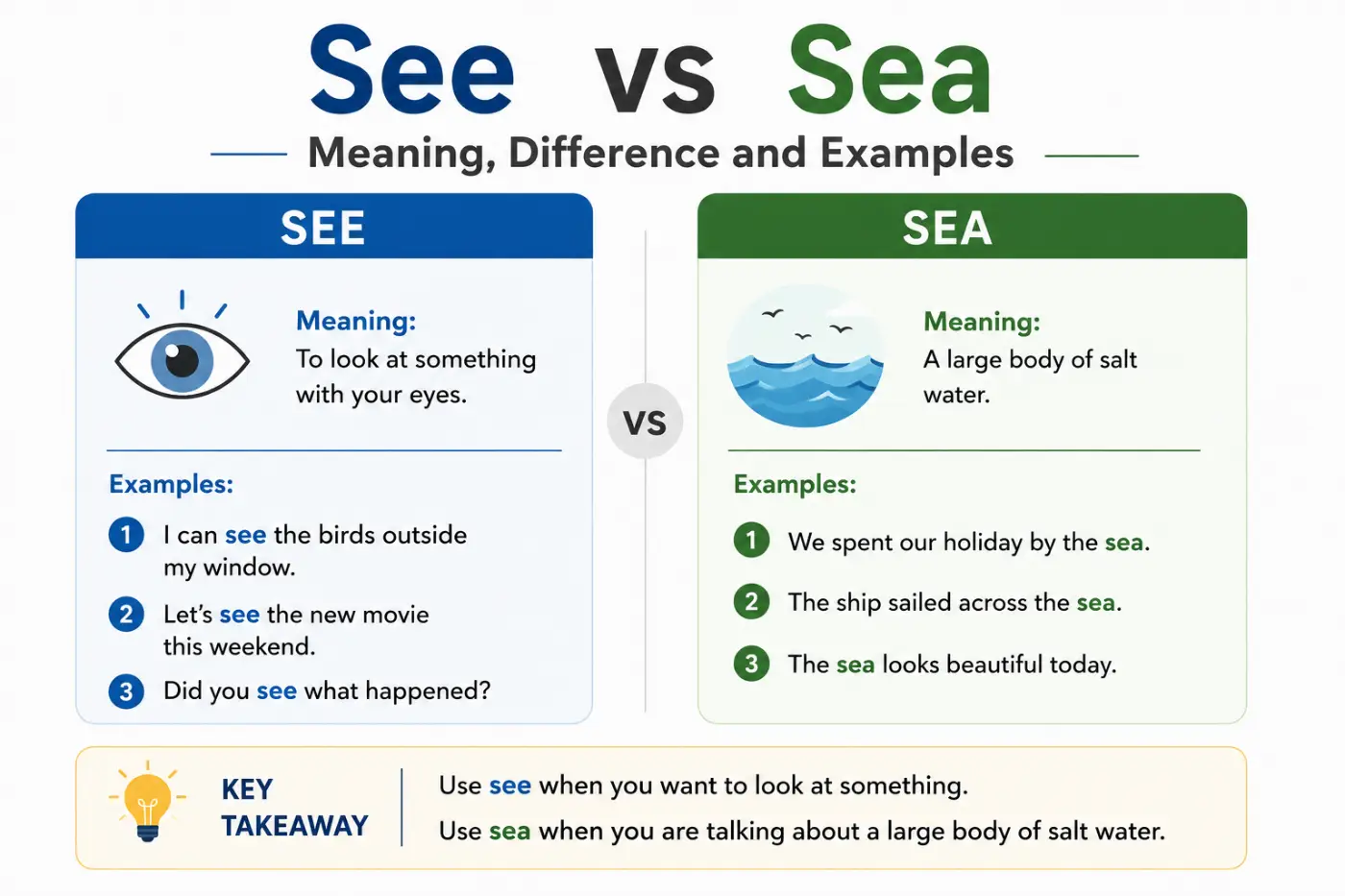
See vs Sea can be confusing because both words sound exactly the same when spoken. If someone says “I can see the sea” aloud you hear the same /siː/ sound twice even though the words have different meanings and spellings. That is the heart of the problem. English contains many homophones that sound alike but work differently in writing. See relates mainly to sight perception and understanding. Sea refers to water and geography.
The easiest way to keep them apart is to connect see with your eyes and sea with the ocean. You see a boat. A boat sails on the sea. That simple mental picture can prevent a surprisingly common spelling mistake.
These words also behave differently in a sentence. See is usually a verb while sea is a noun. Once you understand that grammatical difference you can usually choose the right spelling without stopping to think. The following guide explains their meanings pronunciation grammar history common mistakes and everyday uses. It also gives you practical examples and memory tricks that make the distinction stick.
Short Answer
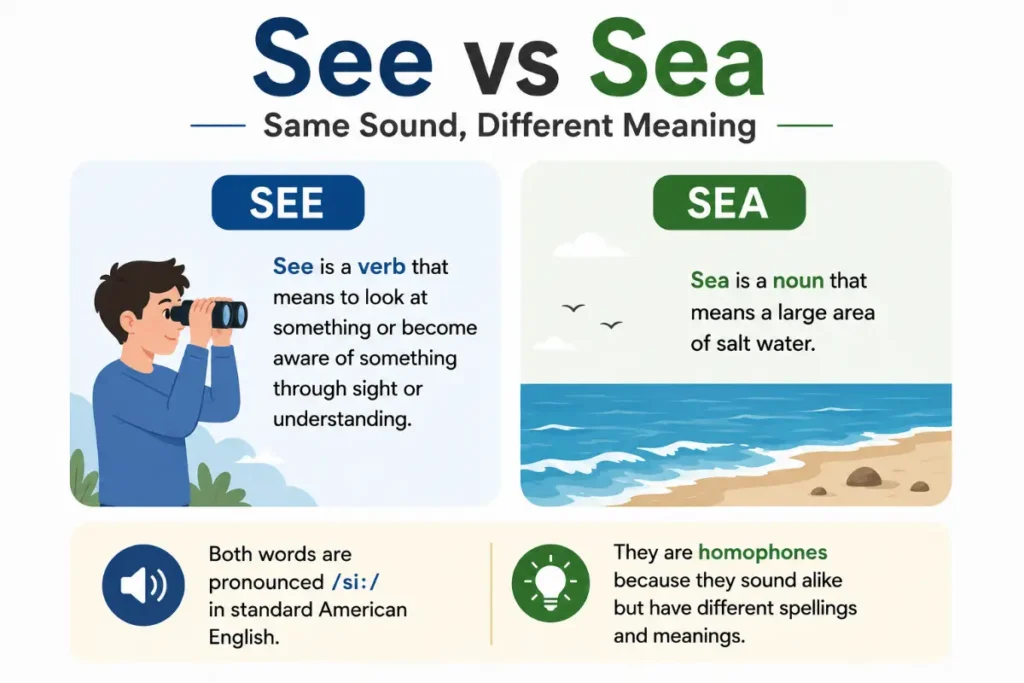
See is a verb that means to look at something or become aware of something through sight or understanding. Sea is a noun that means a large area of salt water. Both words are pronounced /siː/ in standard American English. They are homophones because they sound alike but have different spellings and meanings.
Table Of Contents
- What see means.
- What sea means.
- The main difference between the words.
- How the words work in grammar.
- Pronunciation and homophones.
- Examples in everyday English.
- Common mistakes.
- Memory tips.
- Related words and expressions.
- American and British usage.
- Professional writing advice.
- Frequently asked questions.
- Key takeaways.
- Conclusion.
What See Means
See is primarily a verb. Its basic meaning relates to noticing something with your eyes.
For example:
I can see the mountains.
She saw a bird outside.
Can you see that sign?
In each sentence the word describes visual perception.
However see has a much wider meaning than simply using your eyes. English speakers also use it to describe understanding an idea hearing from someone or meeting someone.
Consider these examples.
I see what you mean.
I need to see the doctor.
We’ll see you tomorrow.
The first two examples use see to mean understand. The third can mean visiting or consulting a person. The fourth refers to meeting someone again.
This makes see a highly flexible English verb.
See As A Verb Of Sight
The most basic use involves vision.
I can see the moon.
She saw a man near the entrance.
We could see the stadium from the road.
Here see describes visual awareness.
See As A Verb Of Understanding
English speakers often use see to mean understand.
Now I see why you were upset.
I see what you’re saying.
I see the problem.
This use is especially common in conversation.
It doesn’t mean the person is literally looking at something. Instead the speaker has mentally understood an idea.
See As A Verb For Meeting
See can also refer to spending time with someone or visiting someone.
I’m going to see my parents this weekend.
She sees her doctor every year.
I saw an old friend at the store.
Again the meaning depends on context.
See In Future Expressions
See often appears in expressions connected with the future.
We’ll see what happens.
I’ll see you tomorrow.
Let’s see how it goes.
In these sentences see can express waiting for information or meeting someone later.
What Sea Means
Sea is a noun. It refers to a large body of salt water that is generally connected with an ocean.
For example:
The sea was calm this morning.
They sailed across the sea.
We watched the sunset over the sea.
Unlike see sea is not an action. It names a thing or geographical feature.
That difference gives you a useful grammar clue. If you need a word that describes an action involving sight or understanding use see. If you need a noun referring to salt water use sea.
Sea As A Common Noun
Sea can refer generally to a large body of salt water.
The sea was rough.
They went swimming in the sea.
The boat disappeared into the sea.
Sea In Geographical Names
Sea also appears in names of specific bodies of water.
Examples include the Mediterranean Sea and the Caribbean Sea.
When sea forms part of a recognized geographical name it is normally capitalized as part of that proper name.
Sea In Figurative Language
English also uses sea in figurative expressions.
A sea of people filled the stadium.
The desert looked like a sea of sand.
In these examples there is no literal body of water. Sea creates an image of something spreading widely across an area.
That figurative use is common in both conversation and creative writing.
The Main Difference Between The Words
The central difference is simple.
See is mainly a verb. Sea is a noun.
See connects to sight perception understanding and sometimes meeting.
Sea connects to salt water geography and figurative descriptions of something that appears vast or widespread.
Consider this sentence:
I can see the sea.
Both words appear together and the meaning becomes obvious.
I can see the sea.
The first word describes what your eyes do. The second names the body of water you’re looking at.
This sentence is also a useful memory device because it places the two words side by side while giving each a clear job.
See And Sea In Grammar
Understanding grammar makes these words much easier to separate.
See As A Verb
See can appear in several verb forms.
The base form is see.
The past tense is saw.
The past participle is seen.
The present participle is seeing.
Examples include:
I see the problem.
I saw the problem yesterday.
This irregular pattern is worth remembering because see does not form its past tense by simply adding ed.
Sea As A Noun
Sea is a noun.
It can appear as a singular noun.
The sea is beautiful.
It can also follow determiners and adjectives.
The blue sea looked peaceful.
A rough sea can make sailing dangerous.
The word can appear in compound expressions as well.
Sea water.
Sea life.
Seafood.
Sea breeze.
These expressions all relate to the meaning of sea rather than the verb see.
Articles With Sea
Because sea is a noun it can appear with articles.
The sea looked calm.
A sea of people surrounded the stage.
We could see the sea from our hotel.
The choice depends on the meaning and sentence structure.
See does not work in the same way because it is normally a verb.
Pronunciation And Homophones
Both see and sea are pronounced /siː/ in standard American English.
They have one syllable.
An easy pronunciation guide is see with a long ee sound.
Because they sound identical they are called homophones.
Homophones are words that have the same pronunciation but different meanings and spellings.
Other familiar English homophone pairs include:
- Two and too.
- Right and write.
- Their and there.
- Hear and here.
- Flower and flour.
- New and knew.
- Pair and pear.
- One and won.
See and sea belong to the same group.
Pronunciation alone cannot tell you which spelling to use. You need to understand the meaning and grammatical role.
That is why someone can pronounce both words perfectly and still write the wrong one.
Why These Words Are Easy To Confuse
The confusion comes from sound.
When someone says “sea” you cannot see the spelling in their voice. You only hear /siː/. The listener has to use context to understand the intended meaning.
For example:
I can see the boat.
The boat is on the sea.
When spoken aloud both target words sound the same. On the page their meanings become immediately clear.
This is one reason homophones can cause spelling mistakes. The brain hears one sound while writing requires a choice between multiple spellings.
Context usually provides the answer.
If the sentence involves looking noticing understanding or meeting then see is likely the correct word.
If the sentence involves salt water a coast sailing waves or geography then sea is likely the correct word.
See Vs Sea In Everyday Sentences
The following examples show how naturally these words appear in normal English.
- I can see the ocean from my window.
- The sea looks beautiful at sunset.
- Did you see the message I sent?
- We spent the afternoon beside the sea.
- I can see a boat in the distance.
- The fishermen went out to sea early.
- She wants to see the new movie.
- The sea was unusually calm today.
- I saw dolphins near the shore.
- The children played near the sea.
These sentences demonstrate an important point. See and sea may sound identical but their grammatical jobs make them easy to distinguish once they appear in context.
Real Life Examples
Everyday Conversation
See is extremely common in casual speech.
Did you see that?
I’ll see you later.
I see what you mean.
Let me see.
These expressions are part of normal American conversation.
Sea appears naturally in conversations about travel nature weather geography and recreation.
The sea is really calm today.
We walked beside the sea.
Have you ever sailed the sea?
Workplace Writing
See appears frequently in workplace communication.
Please see the attached report.
I’ll see you at the meeting.
Let’s see what the client says.
In the first example see is part of a common instruction. In the second it refers to meeting someone.
Sea is less common in office writing unless the subject involves travel geography shipping climate science or another related field.
The research examines changes in sea levels.
The company operates several sea routes.
Academic Writing
See is often used in academic writing when directing readers to information.
See the previous section for more details.
Researchers can also use see in discussions of observation.
The researchers could see a clear pattern in the results.
Sea commonly appears in academic fields such as geography marine science environmental studies and climate research.
Sea levels have changed over time.
The study examines sea temperatures near the coast.
Creative Writing
Both words can create strong images.
She could see the moon reflected on the sea.
The sea stretched beyond the horizon.
He stood quietly and watched the sea.
These examples combine visual perception with the natural world. That makes the pair particularly useful in descriptive writing.
Common Mistakes
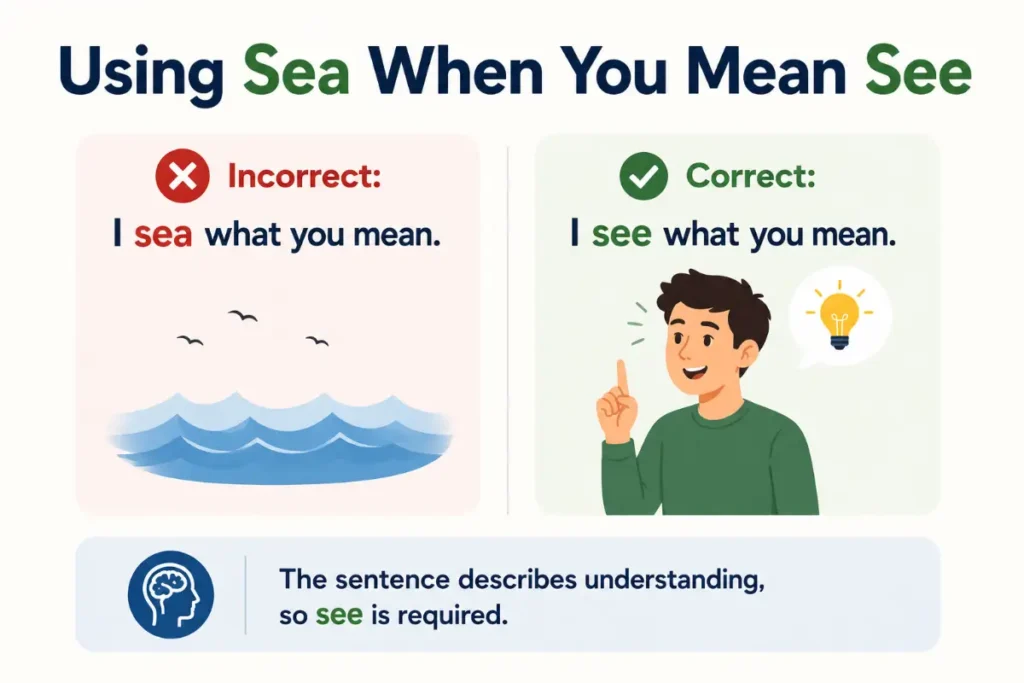
Using Sea When You Mean See
Incorrect:
I sea what you mean.
Correct:
I see what you mean.
The sentence describes understanding so see is required.
Using See When You Mean Sea
Incorrect:
The boat disappeared into the see.
Correct:
The boat disappeared into the sea.
The sentence refers to salt water so sea is correct.
Confusing Them In Text Messages
Fast typing can make homophones especially troublesome.
Someone may type:
I can sea it.
The intended word is clearly see.
Text messages are informal but the same mistake can cause problems in professional communication.
Confusing Sea With See In School Writing
Students sometimes rely on sound instead of meaning. This can produce sentences such as:
We could see the see from the beach.
The second word should be sea.
Reading the sentence slowly and asking what each word means can quickly expose the error.
Forgetting That See Is A Verb
See often describes an action.
I see the car.
She saw the accident.
They have seen the results.
Sea names something.
The sea is cold.
The grammar itself can therefore help you choose the spelling.
Memory Tips
The easiest memory trick is to connect each word with a visual idea.
See has eyes.
The word see relates to seeing something.
Sea has water.
The word sea refers to a large body of salt water.
You can also remember the sentence:
I see the sea.
This short sentence puts both words together and gives each one a clear meaning.
Another useful trick is to think about related words.
See is connected with seeing and sight.
Sea is connected with seaside and seashore.
If you can replace the word with look at or understand then see may be correct.
If you can replace it with ocean or salt water then sea may be correct.
These replacement tests work well when you’re writing quickly.
A Simple Context Test
When you’re unsure which spelling to choose pause for a second and ask what the word is doing.
If it describes an action involving your eyes or understanding use see.
If it names salt water use sea.
For example:
I can ___ the mountain.
Can you replace the blank with look at?
Yes.
So the answer is see.
Now consider:
The boat is sailing across the ___.
Can you replace the blank with ocean?
Yes.
So the answer is sea.
This method works because it focuses on meaning rather than sound.
Related Words
Several words connect closely with see.
Look
Look means direct your eyes toward something.
Watch
Watch usually suggests paying attention to something over a period of time.
We watched the game.
Notice
Notice means become aware of something.
I noticed a strange sound.
Observe
Observe is more formal and often suggests careful attention.
The scientist observed the behavior.
Sight
Sight is a noun connected with the ability to see or something that is seen.
The mountain was an amazing sight.
Ocean
Ocean refers to one of the very large bodies of salt water on Earth.
The Atlantic Ocean is vast.
Coast
Coast refers to land beside the sea.
They live near the coast.
Shore
Shore refers to land along the edge of a sea lake or other body of water.
We walked along the shore.
These words can help build a stronger mental connection between the two homophones.
Common Expressions With See
See appears in many fixed expressions.
See You Later
This is a common informal way to say goodbye.
See you later.
Let Me See
This often means give me a moment to think or look.
Let me see what I can find.
I See
This can mean I understand.
I see what you mean.
See For Yourself
This means examine something personally.
Go and see for yourself.
We’ll See
This can mean the result is not known yet.
We’ll see what happens.
Learning these expressions helps you recognize see quickly in everyday writing.
Common Expressions With Sea
Sea also appears in many established expressions.
At Sea
At sea can mean physically on the ocean.
The sailors were at sea for several weeks.
It can also have a figurative meaning of being confused.
I’m completely at sea with this problem.
Out To Sea
This means on the open ocean or moving away from land.
The ship headed out to sea.
By Sea
By sea describes travel or transportation across water.
The goods were transported by sea.
Sea Level
Sea level refers to the average level of the ocean surface and serves as a reference point in geography.
The town sits only a few meters above sea level.
Sea Life
Sea life refers to plants and animals that live in marine environments.
The area is home to diverse sea life.
These expressions make sea easy to recognize when the subject involves oceans or marine environments.
American And British Usage
The spelling of see and sea is the same in American and British English.
Both varieties pronounce the words as homophones.
Both use see as a verb and sea as a noun.
For example:
American English: I can see the sea.
British English: I can see the sea.
There is no important regional spelling difference between these words.
This is useful for writers because you don’t need to choose a regional form. The same spelling works in standard English across major varieties.
The pronunciation may have subtle differences among individual speakers and accents but the words remain homophones in standard varieties of English.
Formal And Informal Usage
See is suitable for virtually every level of English.
You can use it in casual conversation.
I’ll see you later.
You can use it in professional writing.
Please see the attached document.
You can use it in academic writing.
See Table 2 for additional results.
Sea is also neutral in register.
It works in casual conversation.
The sea looks beautiful.
It works in professional and academic contexts.
The study examines sea temperatures.
Neither word is inherently informal.
The context determines the tone.
See In Professional Editing
Editors pay close attention to homophones because spelling mistakes can change meaning without changing pronunciation.
A spell checker may catch some mistakes but it cannot always determine what you intended. If you write “I can sea the problem” a basic spelling system may flag sea as unusual in that context. More advanced grammar tools may use surrounding words to suggest see.
Still the strongest editing habit is human judgment.
Read the sentence for meaning.
Ask what role the word plays.
If it describes sight or understanding use see.
If it refers to salt water use sea.
This approach is especially useful because context matters more than pronunciation.
See And Sea In A Single Sentence
One of the best ways to understand these words is to use them together.
I can see the sea from my room.
She could see the sea from the hill.
We watched the boats on the sea.
He went to the beach to see the sea at sunset.
The first word in these examples describes visual perception. The second identifies the body of water.
You can create your own sentences using the same pattern. This gives you a practical way to remember the spelling instead of relying on memorization alone.
A Closer Look At See
See has a surprisingly large semantic range.
It can mean physical vision.
I see a bird.
It can mean understanding.
I see your point.
It can mean meeting someone.
I’ll see my friend tomorrow.
It can mean visiting a professional.
She needs to see a doctor.
It can mean examining something.
See page five.
It can express uncertainty about a future result.
We’ll see.
Because of this flexibility you will encounter see in almost every area of English.
A Closer Look At Sea
Sea has a narrower basic meaning but appears in many contexts.
It can refer to a geographical body of water.
The sea surrounds the island.
It can refer generally to ocean water.
The ship is out at sea.
It can appear in scientific and environmental language.
Sea temperatures are rising.
It can work figuratively.
A sea of faces looked back at him.
The word therefore remains useful far beyond descriptions of beaches.
How To Choose The Right Word Quickly
When writing quickly you don’t need to stop and analyze the entire sentence.
Use a simple three step check.
- Ask if the word describes seeing or understanding something.
If yes use see.
- Ask if the word names a body of salt water.
If yes use sea.
For example:
I ___ what you mean.
The word means understand so use see.
Now:
We sailed across the ___.
The word names salt water so use sea.
This takes only a few seconds and can prevent a distracting spelling error.
Key Takeaways
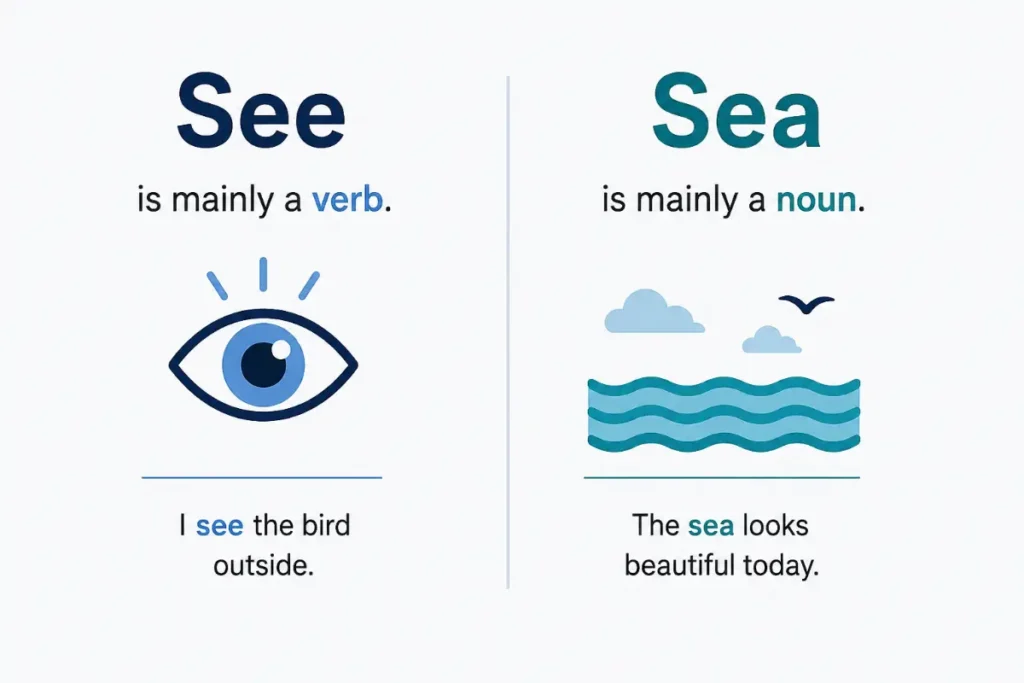
- See is mainly a verb.
- Sea is a noun.
- See relates to sight understanding and sometimes meeting someone.
- Sea refers to a large body of salt water and can also have figurative uses.
- Both words are pronounced /siː/ in standard American English.
- See and sea are homophones.
- The words have different spellings because they have different meanings and histories.
- The easiest memory trick is to connect see with eyes and sea with water.
- The sentence I can see the sea is a useful way to remember both spellings.
- Context is the best way to choose the correct word when speaking cannot show the spelling.
Conclusion
See vs Sea becomes simple once you focus on meaning instead of sound. See is mainly a verb connected with sight understanding and meeting someone. Sea is a noun that refers to a large body of salt water. Both words sound alike but their spellings and grammatical roles are different.
The easiest memory trick is to connect see with your eyes and sea with water. If you can replace the word with look at or understand then see is probably right. If you can replace it with ocean or salt water then sea is the better choice.
When you’re unsure write the sentence I can see the sea. It gives you both spellings and their meanings in one clear picture.
FAQs
What Is The Difference Between See And Sea?
The main difference is meaning and grammar. See is primarily a verb connected with sight understanding or meeting someone. Sea is a noun referring to a large body of salt water. They sound the same but have different spellings and meanings. This makes them homophones.
Is See A Verb Or A Noun?
See is mainly a verb. It can describe visual perception as in I see the car. It can also mean understand as in I see your point. The word has several other verb uses including meeting someone and examining information.
Is Sea A Verb Or A Noun?
Sea is a noun. It names a large body of salt water. You can use it as the subject or object of a sentence. For example The sea is calm uses sea as the subject. We crossed the sea uses it as the object.
Are See And Sea Pronounced The Same?
Yes. In standard American English both are pronounced /siː/. They contain the same long ee sound and normally have one syllable. Their identical pronunciation is why they are classified as homophones. Their spelling and meaning provide the distinction in written English.
How Can I Remember The Difference Between See And Sea?
Connect see with your eyes and sea with water. You see something with your eyes. You sail on the sea. Another useful memory sentence is I can see the sea. It uses both words correctly and makes their different meanings easy to remember.
Can See Mean Understand?
Yes. See commonly means understand in conversational English. For example I see what you mean does not describe physical vision. It means I understand your point. This use is extremely common in spoken American English and also appears in informal and professional writing.
Can Sea Be Used Figuratively?
Yes. Sea can have figurative meanings. A sea of people means a large crowd that seems to spread across an area. A sea of sand can describe a huge area covered by sand. These expressions use the size and appearance of the sea to create a strong image.
Is See Used Differently In American And British English?
The basic uses and spelling are the same in American and British English. Both varieties use see as a verb and sea as a noun. Both words are also pronounced alike in standard forms of each variety. Minor accent differences do not change their basic status as homophones.
Is The Sea The Same As The Ocean?
The words overlap but they are not always exact equivalents. Ocean usually refers to one of the major divisions of the world’s salt water. Sea often refers to a smaller body of salt water that is partly enclosed by land. However everyday speech sometimes uses the terms more loosely.
Why Do People Confuse See And Sea?
People confuse them because they sound exactly the same. When you hear the word there is no spelling clue telling you which form the speaker intends. Writing requires you to use context. If the meaning involves sight or understanding choose see. If it involves salt water choose sea.
Can See And Sea Appear Together?
Yes. They can easily appear in the same sentence. For example I can see the sea from my window. See describes the act of looking or perceiving. Sea identifies the body of water. Using both together is one of the easiest ways to remember the difference.
Which Word Should I Use In Formal Writing?
Use see when you mean looking understanding meeting or examining something. Use sea when you mean a large body of salt water. Both words are standard and appropriate for formal writing. The key is choosing the spelling that matches the meaning of your sentence.

Confusing Words, Spelling & Word Choice
Claire Whitmore is a U.S.-based English editor who writes about commonly confused words, spelling differences, and word choice. Her work helps readers understand subtle distinctions between similar-looking words through simple definitions, practical examples, and modern usage guidance in both American and British English.