
Similes for being mad can turn a plain description of anger into something readers can see and feel. Saying someone was angry tells us the emotion. Saying someone was as mad as a hornet gives us a much stronger picture.
A good simile uses words such as like or as to compare one thing with another. Writers often compare anger with fire storms explosions boiling water wild animals and other powerful images because these things naturally suggest heat movement pressure or loss of control.
Not every angry person feels the same kind of anger. Someone might be mildly irritated. Another person might be furious. Someone else might be quietly seething while trying hard to stay calm. The best comparison should match the emotional intensity and the situation.
This collection gives you more than a long list of random comparisons. It groups the expressions by mood and intensity so you can choose language that fits your sentence. You’ll find descriptions for mild annoyance intense rage explosive anger silent resentment workplace frustration arguments and creative writing.
Short Answer
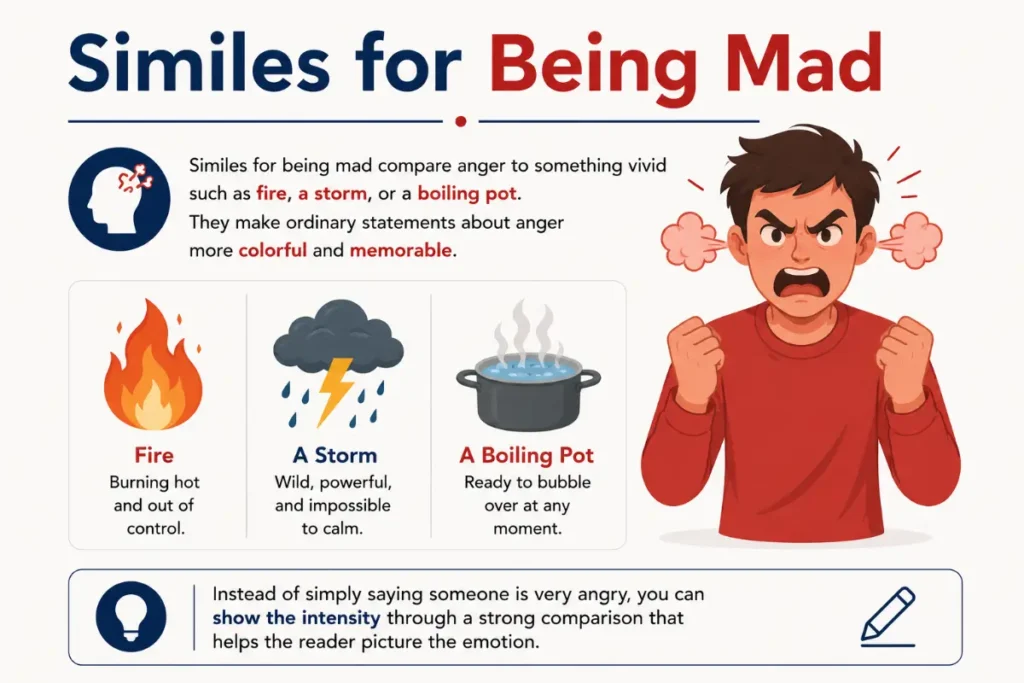
Similes for being mad compare anger to something vivid such as fire a storm or a boiling pot. They make ordinary statements about anger more colorful and memorable. Instead of simply saying someone is very angry you can show the intensity through a strong comparison that helps the reader picture the emotion.
What A Simile For Anger Does
A simile compares one thing with another to create a clearer mental picture. When the subject is anger the comparison gives the emotion a physical shape.
Consider these two sentences.
He was very angry.
He was as mad as a hornet.
The first sentence gives you information. The second creates an image.
That difference matters in storytelling and everyday communication. Anger is an invisible emotion. Readers cannot see anger itself. They can see a red face clenched fists a storm or a boiling pot. A well chosen comparison connects the invisible feeling with something familiar.
Similes can also show intensity.
A person who is as annoyed as a buzzing fly sounds mildly irritated.
A person who is like a volcano ready to erupt sounds far more dangerous and intense.
The comparison changes the emotional temperature of the sentence.
How To Choose The Right Comparison
The strongest simile isn’t always the most dramatic one. Your comparison should fit the situation.
If a child is annoyed because someone took their favorite pencil you probably don’t want to describe the child as a volcano exploding across a city. That image is far too strong.
For a serious betrayal you might need something heavier.
He was like a storm trapped inside a room.
That comparison suggests powerful emotion that has nowhere to go.
Think about four things before choosing an expression.
Intensity. Decide how angry the person is.
Behavior. Consider if the person is shouting crying glaring or staying silent.
Setting. A workplace scene usually needs more restraint than a fantasy novel.
Purpose. Decide if you want the comparison to sound funny serious dramatic poetic or conversational.
A good simile should feel natural in its sentence. If the comparison pulls attention away from the meaning it may be doing too much.
Similes For Mild Anger
Mild anger is closer to irritation frustration or annoyance than rage. These comparisons work well when someone is bothered but still in control.
Like A Mosquito In Your Ear
She was annoyed like a mosquito buzzing beside her ear.
The comparison suggests persistent irritation rather than serious rage.
Like A Splinter Under The Skin
He was irritated like a splinter buried under his skin.
The image suggests a small problem that keeps bothering someone.
Like A Sour Lemon
She looked as sour as a lemon after the argument.
This creates a playful image of displeasure.
Like A Cat With A Wet Paw
He was as annoyed as a cat with a wet paw.
The comparison gives mild anger a humorous quality.
Like A Fly At The Picnic
She was irritated like a fly at a picnic.
The image suggests restless annoyance.
Like A Pebble In A Shoe
He carried his frustration like a pebble in his shoe.
This shows an irritation that stays present throughout the day.
Like A Door That Would Not Open
She was as frustrated as someone pushing a locked door.
The comparison focuses on helpless frustration.
Like A Toothache
He was irritated like someone dealing with a stubborn toothache.
The feeling is unpleasant and persistent without suggesting explosive rage.
Like A Cloud Blocking The Sun
She was as gloomy as a cloud blocking the afternoon sun.
This works for anger mixed with disappointment.
Like A Bee Trapped In A Jar
He was restless like a bee trapped in a jar.
The image suggests agitation and discomfort.
Similes For Strong Anger
Strong anger needs stronger images. These comparisons work well when someone has moved beyond simple irritation.
Like A Fire Under Dry Leaves
Her anger spread like fire under dry leaves.
The image suggests anger that grows quickly.
Like A Thunderstorm
He was as angry as a thunderstorm rolling across the valley.
The comparison gives the emotion force and movement.
Like A Kettle About To Boil
She was like a kettle about to boil.
This suggests rising pressure and anger that may soon become obvious.
Like A Volcano Before An Eruption
He stood there like a volcano before an eruption.
The image suggests powerful anger waiting to break out.
Like A Furnace
Her temper burned like a furnace.
The comparison emphasizes heat and intensity.
Like A Wildfire
His anger spread like a wildfire through the room.
This suggests that one person’s anger affects everyone nearby.
Like Lightning In A Dark Sky
Her anger flashed like lightning in a dark sky.
The comparison works especially well for sudden anger.
Like A Drum Beating Inside His Chest
His anger pounded like a drum inside his chest.
This connects emotion with physical sensation.
Like A River After Heavy Rain
His frustration surged like a river after heavy rain.
The image suggests growing force that becomes difficult to control.
Like A Furnace With No Door
She was burning with anger like a furnace with no door.
This creates an image of heat with no easy escape.
Similes For Explosive Rage
Sometimes anger doesn’t simmer. It erupts. These comparisons are useful for fiction dramatic scenes and vivid descriptions.
Like A Volcano Blowing Its Top
He exploded like a volcano blowing its top.
The image clearly suggests sudden and overwhelming anger.
Like A Firecracker In A Closed Room
Her temper went off like a firecracker in a closed room.
The comparison emphasizes noise and sudden intensity.
Like A Dam Breaking
His anger burst out like a dam breaking.
This suggests emotion that has been held back for a long time.
Like A Cannon Going Off
She shouted like a cannon going off beside him.
The comparison focuses on sudden force and volume.
Like A Storm Breaking Through The Clouds
His rage hit the room like a storm breaking through the clouds.
This gives the anger a dramatic arrival.
Like A Rocket Launch
Her anger shot upward like a rocket launch.
The comparison works for anger that rises extremely quickly.
Like A Match Dropped On Gasoline
The insult made him explode like a match dropped on gasoline.
The image suggests that a small trigger caused a huge reaction.
Like A Boiler Bursting
He finally lost his temper like a boiler bursting under pressure.
The comparison emphasizes pressure that has built over time.
Like A Dam Flooding A Valley
Her rage poured out like a dam flooding a valley.
This presents anger as powerful and difficult to contain.
Like A Wild Horse Breaking Loose
He charged into the argument like a wild horse breaking loose.
The comparison suggests a loss of restraint.
Similes For Quiet Anger
Not every angry person raises their voice. Some people become quiet. Their anger may actually feel stronger because they are holding it inside.
Like A Volcano Beneath Ice
He was like a volcano buried beneath ice.
The comparison shows intense emotion hidden beneath a calm surface.
Like A Storm Beyond The Horizon
She carried anger like a storm waiting beyond the horizon.
This suggests something powerful that has not arrived yet.
Like Embers Beneath Ash
His resentment glowed like embers beneath ash.
The image suggests anger that remains alive beneath apparent calm.
Like A Closed Pressure Cooker
She was like a pressure cooker with the lid locked tight.
This is useful for someone trying hard to contain their anger.
Like Thunder Without Rain
He was like thunder waiting for the rain to fall.
The comparison creates tension and anticipation.
Like A Snake Coiled In Grass
Her anger sat like a snake coiled in the grass.
The image suggests quiet danger.
Like Ice Covering A Fire
He looked calm like ice covering a fire.
This contrast makes the hidden anger easy to picture.
Like A Match Waiting For A Spark
She was like a match waiting for a spark.
The comparison suggests that one more problem could trigger an outburst.
Like A Dark Cloud Holding Rain
He carried his frustration like a dark cloud holding rain.
This works well for restrained emotion.
Like A Sleeping Volcano
She was like a sleeping volcano beneath the surface.
The comparison suggests that the anger is quiet but not gone.
Similes For Anger In Everyday Life
Everyday anger usually needs language that sounds natural rather than overly poetic. These examples can work in conversation and casual writing.
Like A Grumpy Bear
He was as mad as a grumpy bear after being woken up.
The comparison is familiar and slightly humorous.
Like A Cat That Had Been Cornered
She looked as angry as a cat that had been cornered.
This suggests defensiveness and irritation.
Like A Hornet
He was as mad as a hornet when he saw the damage.
This is a classic informal comparison for anger.
Like A Boiling Pot
She was like a boiling pot after hearing the news.
The image suggests anger building quickly.
Like A Storm Cloud
He walked around like a storm cloud all afternoon.
This suggests a bad mood that affects the atmosphere around the person.
Like A Bear With A Sore Tooth
She was as cranky as a bear with a sore tooth.
The unusual image gives the sentence humor.
Like A Dog Guarding Its Food
He reacted like a dog guarding its food.
The comparison suggests defensiveness and possessiveness.
Like A Bee With Its Nest Disturbed
She was as angry as a bee whose nest had been disturbed.
This works for sudden defensive anger.
Like A Child Who Lost A Game
He sulked like a child who had just lost a game.
The comparison focuses on frustration rather than rage.
Like A Driver Stuck In Traffic
She was as frustrated as a driver trapped in rush hour traffic.
This works well for ordinary everyday annoyance.
Similes For Anger In Creative Writing
Creative writing gives you more freedom. You can make the comparison unusual as long as the image remains clear.
Like A Red Sun At Midnight
His anger burned like a red sun at midnight.
The strange image creates an intense and unsettling mood.
Like A Wolf Behind A Locked Gate
She was like a wolf behind a locked gate.
The comparison suggests power held in check.
Like A Storm Inside A Bottle
He carried a storm inside a bottle.
The image suggests powerful emotion trapped inside.
Like A River Choking On Its Own Current
Her rage moved like a river choking on its own current.
This gives anger a sense of internal struggle.
Like A Blacksmith Striking Iron
His frustration hit like a blacksmith striking hot iron.
The comparison suggests repeated force.
Like A Furnace Beneath The Floor
Her anger felt like a furnace burning beneath the floor.
The emotion seems hidden but impossible to ignore.
Like A Red Wolf In A Cage
He paced like a red wolf trapped in a cage.
The comparison creates tension and restlessness.
Like A Match Burning At Both Ends
Her patience disappeared like a match burning at both ends.
This suggests that restraint is running out quickly.
Like A Sea During A Hurricane
His mind churned like a sea during a hurricane.
The comparison focuses on emotional chaos.
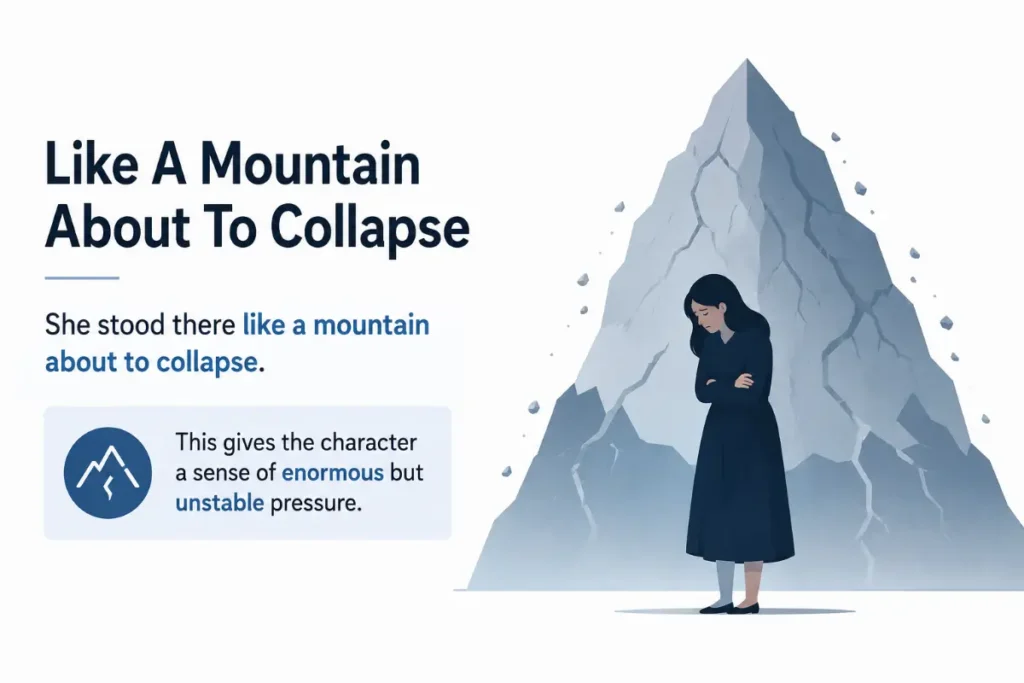
Like A Mountain About To Collapse
She stood there like a mountain about to collapse.
This gives the character a sense of enormous but unstable pressure.
Similes For Anger At Work
Workplace anger usually needs a more controlled tone. The following comparisons can describe frustration without making the language sound childish.
Like A Pressure Gauge Rising
His frustration rose like a pressure gauge reaching the red zone.
The comparison shows that the situation is becoming difficult to manage.
Like A Computer Running Too Hot
She felt as frustrated as a computer running too hot.
The image suggests overload.
Like A Meeting That Would Never End
He was as irritated as someone trapped in a meeting that would never end.
This creates a familiar workplace image.
Like A Printer Jammed At The Worst Moment
She was as frustrated as a printer that jams before a deadline.
The comparison adds humor to workplace irritation.
Like A Clock Moving Too Slowly
He was as impatient as a clock that seemed to move backward.
This works for frustration caused by delay.
Like A Battery Near Empty
Her patience was like a battery near empty.
The comparison suggests that she has very little tolerance left.
Like A Deadline Closing In
His frustration felt like a deadline closing in.
The comparison connects anger with pressure.
Like A Warning Light
Her irritation flashed like a warning light on a dashboard.
This suggests that others should pay attention before the situation gets worse.
Like A Machine Under Too Much Load
He was like a machine carrying more load than it could handle.
The comparison describes accumulated pressure.
Like A Storm In An Office Window
Her anger felt like a storm pressing against the office window.
This gives restrained workplace anger a vivid image.
Similes For Anger In Relationships
Arguments between friends partners or family members often involve hurt as well as anger. These comparisons can capture that mixture.
Like A Door Slamming In The Wind
Her anger hit like a door slamming in the wind.
The image suggests sudden emotional force.
Like A Wound Touched Again
His resentment returned like a wound touched again.
This works when an old hurt causes fresh anger.
Like A Match Near Dry Grass
Their argument felt like a match near dry grass.
The comparison suggests that little is needed to start another fight.
Like Two Storms Colliding
Their anger met like two storms colliding.
This works well when both people are furious.
Like A Rope Pulled Too Tight
Her patience was like a rope pulled too tight.
The image suggests that one more problem could cause a break.
Like A Glass About To Crack
His patience felt like a glass about to crack.
This shows fragile emotional control.
Like A Fire Fed With Wood
Her resentment grew like a fire fed with wood.
The comparison suggests that repeated problems make anger stronger.
Like Thunder Between Two Mountains
Their argument echoed like thunder between two mountains.
This works especially well in dramatic storytelling.
Like A Storm Behind Closed Curtains
He kept his anger like a storm behind closed curtains.
The comparison shows hidden emotion.
Like A Bridge Under Heavy Weight
Their relationship felt like a bridge under heavy weight.
The image suggests that continued anger could damage the relationship.
Similes For Anger In Children
Children often express anger openly. Comparisons can make descriptions vivid while keeping the tone age appropriate.
Like A Red Balloon
He became as mad as a red balloon ready to pop.
The image is simple and easy to understand.
Like A Little Volcano
She was like a little volcano after losing the game.
This suggests intense but temporary anger.
Like A Stormy Cloud
He looked like a stormy cloud with legs.
The playful comparison suits a child.
Like A Firecracker
She burst into anger like a firecracker.
The image suggests sudden energy.
Like A Grumpy Bear
He was as grumpy as a bear after missing his nap.
The comparison works for mild childhood anger.
Like A Kettle
She was like a kettle starting to boil.
This shows anger gradually building.
Like A Lion Cub
He roared like an angry lion cub.
The comparison makes the anger vivid without making it frightening.
Like A Balloon Filled Too Full
She was like a balloon filled too full.
The image suggests that she may soon lose control.
Like A Thundercloud
He sat like a thundercloud after being told no.
This gives the child a moody appearance.
Like A Firecracker With A Short Fuse
She was like a firecracker with a very short fuse.
The comparison suggests that she becomes angry quickly.
Similes For Anger In School
School situations often involve frustration disappointment competition and arguments.
Like A Pencil Snapped In Half
He was as frustrated as a pencil snapped in half.
The image suggests sudden frustration.
Like A Test With No Answers
She felt as angry as a student facing a test with no answers.
This focuses on helplessness.
Like A Locker Door Slamming
His anger sounded like a locker door slamming shut.
The comparison gives the emotion an audible quality.
Like A Bell Ringing Too Loud
She was as irritated as a school bell ringing beside her.
This works for sharp annoyance.
Like A Soccer Ball Kicked Against A Wall
His frustration bounced like a soccer ball kicked against a wall.
The comparison suggests restless energy.
Like A Pencil Scratching Paper
Her irritation grated like a pencil scratching across paper.
This emphasizes an unpleasant feeling.
Like A Student Waiting For The Final Bell
He was as impatient as a student waiting for the final bell.
The emotion is frustration mixed with anticipation.
Like A Chalkboard Screech
Her anger felt like a chalkboard screeching across the room.
The image suggests an unpleasant emotional reaction.
Like A Backpack Filled With Bricks
He carried his frustration like a backpack filled with bricks.
This shows emotional weight.
Like A Classroom After A Fire Alarm
The students were as agitated as a classroom after a fire alarm.
The comparison creates a picture of sudden disorder.
Similes For Physical Signs Of Anger
Anger often changes the way a person looks or moves. These comparisons focus on visible signs.
Like Fire In His Eyes
He looked like he had fire in his eyes.
This suggests intense anger.
Like Steam From A Kettle
Steam seemed to rise from her like a boiling kettle.
The image exaggerates visible frustration for effect.
Like A Red Flag
His face looked like a red flag in the wind.
This suggests obvious anger.
Like A Coiled Spring
She stood like a coiled spring ready to release.
The comparison focuses on physical tension.
Like A Fist Made Of Stone
His hands were tight like fists made of stone.
This shows physical tension.
Like A Bow Pulled Tight
His body looked like a bow pulled tight.
The image suggests controlled pressure.
Like A Drum Under Heavy Hands
His heart pounded like a drum under heavy hands.
This connects anger with a racing heartbeat.
Like A Flame Behind Glass
Her eyes seemed like flames behind glass.
The comparison suggests controlled but visible emotion.
Like A Wire Pulled Tight
His jaw looked tight like a wire pulled too hard.
This captures physical tension.
Like A Lion Ready To Roar
He looked like a lion ready to roar.
The image suggests power and aggression.
Similes For Anger That Feels Like Fire
Fire is one of the strongest images for anger because it suggests heat growth movement and destruction.
Like A Spark In Dry Grass
Her anger began like a spark in dry grass.
Like A Flame Growing Taller
His frustration rose like a flame growing taller.
Like Burning Coal
She carried resentment like burning coal in her hands.
Like A Campfire Fed All Night
His anger burned like a campfire fed all night.
Like A Furnace At Full Heat
She was as angry as a furnace running at full heat.
Like A Match In A Dark Room
The insult struck his temper like a match in a dark room.
Like Embers In The Wind
Her old resentment glowed like embers in the wind.
Like A Fire Behind A Wall
His anger was like a fire burning behind a wall.
Like Dry Wood Catching Flame
Her frustration spread like dry wood catching flame.
Like A Torch In A Cave
His rage burned like a torch in a dark cave.
These comparisons work especially well in fiction because they give an abstract emotion a clear visual identity.
Similes For Anger That Feels Like A Storm
Storm imagery works because anger can arrive suddenly build in pressure and eventually break.
Like Thunder Before Rain
His anger sounded like thunder before rain.
Like Lightning Across The Sky
Her frustration flashed like lightning across the sky.
Like A Hurricane At Sea
He was as furious as a hurricane at sea.
Like Dark Clouds Gathering
Her resentment gathered like dark clouds over a field.
Like Rain Against Windows
His complaints fell like heavy rain against windows.
Like Wind Before A Storm
She paced like wind before a storm.
Like Waves During A Gale
His emotions crashed like waves during a gale.
Like Thunder Rolling Through Mountains
Her anger rolled like thunder through mountains.
Like A Storm Trapped Indoors
He carried a storm trapped inside him.
Like Lightning Looking For Ground
Her temper moved like lightning looking for ground.
Storm comparisons are especially useful when anger develops gradually or changes the mood of an entire scene.
Similes For Anger That Feels Like Pressure
Pressure imagery works well when someone has been patient for a long time.
Like A Balloon Near Its Limit
He was like a balloon near its limit.
Like A Boiler Under Pressure
She was like a boiler under pressure.
Like A Spring Pulled Too Far
His patience was like a spring pulled too far.
Like A Bottle Filled To The Top
Her anger was like a bottle filled to the top.
Like A Dam Holding Back Water
He was like a dam holding back a flood.
Like A Wire About To Snap
Her patience was like a wire about to snap.
Like A Lid On Boiling Water
His calmness was like a lid on boiling water.
Like A Balloon About To Burst
She was as tense as a balloon about to burst.
Like A Wall Under Heavy Pressure
His patience stood like a wall under heavy pressure.
Like A Bridge Carrying Too Much Weight
Her emotional control was like a bridge carrying too much weight.
These comparisons are useful because they show that anger often builds instead of appearing from nowhere.
Similes For Anger That Feels Like A Wild Animal
Animals can represent instinctive reactions and strong emotion. They work especially well in fiction.
Like A Lion Defending Its Territory
He was like a lion defending its territory.
Like A Wolf Cornered By Hunters
She reacted like a wolf cornered by hunters.
Like A Bear Protecting Its Cubs
He became as angry as a bear protecting its cubs.
Like A Snake Ready To Strike
Her anger waited like a snake ready to strike.
Like A Bull Seeing Red
He charged into the argument like a bull seeing red.
Like A Hawk Protecting Its Nest
She fought back like a hawk protecting its nest.
Like A Dog Guarding Its Yard
He reacted like a dog guarding its yard.
Like A Tiger Behind Bars
She looked like a tiger behind bars.
Like A Horse Breaking Its Reins
His temper broke loose like a horse breaking its reins.
Like A Fox Caught In A Trap
He paced like a fox caught in a trap.
Animal comparisons can add energy to a sentence but should match the character and context. A serious scene may call for a powerful animal image while a humorous scene may benefit from something more playful.
Similes For Being Mad
The phrase similes for being mad covers many shades of anger. The important distinction is intensity. Mad can mean mildly annoyed in casual American English or extremely angry depending on context.
For mild anger you might use a comparison such as:
She was as annoyed as a fly trapped in a window.
For stronger anger:
He was like a storm ready to break.
For explosive anger:
She erupted like a volcano.
For hidden anger:
He was like embers beneath ash.
For humorous anger:
She was as mad as a cat with wet paws.
The best choice depends on what you want the reader to feel. A simile should not simply say that someone is angry. It should show the kind of anger involved.
How To Use These Similes Naturally
A simile should support the sentence rather than overpower it.
Compare these examples.
He was angry like a volcano.
He stood silent at the table like a volcano waiting to erupt.
The second sentence gives the comparison a reason to exist. It connects the image with the character’s behavior.
You can also place the simile after a physical detail.
Her fists tightened like ropes pulled under pressure.
Now the reader sees the action and understands the emotional meaning.
Another useful technique is to connect the comparison with the cause of anger.
After hearing the accusation he burned like dry wood catching fire.
The trigger and emotional reaction appear together.
Avoid adding a dramatic comparison to every sentence. If every line contains a volcano a storm a fire or an explosion the imagery quickly loses its impact. One strong comparison can do more work than five weak ones.
Common Mistakes
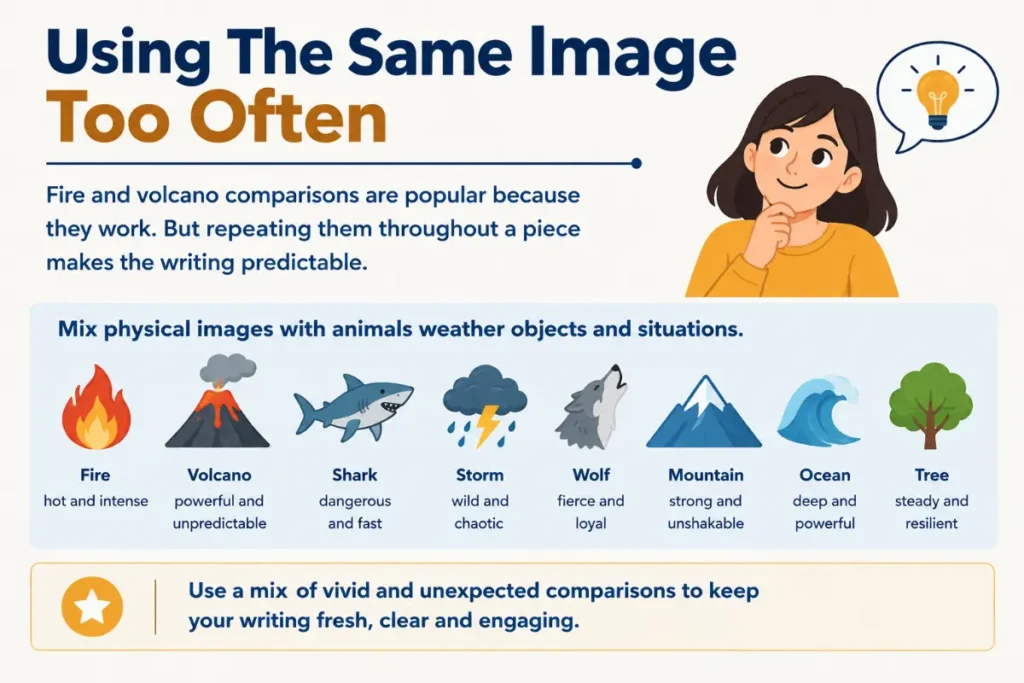
Using The Same Image Too Often
Fire and volcano comparisons are popular because they work. But repeating them throughout a piece makes the writing predictable.
Mix physical images with animals weather objects and situations.
Choosing An Image That Is Too Strong
A mildly annoyed person probably isn’t best described as an exploding volcano.
Match the intensity of the comparison with the emotion.
Mixing Too Many Images
Avoid combining several unrelated comparisons in one sentence.
For example:
He was a volcano like a storm like a wild bull.
That sentence creates confusion instead of a clear picture.
Choose one strong image.
Using A Simile Without A Clear Connection
A comparison should help the reader understand the emotion.
If the image has no obvious connection with anger the reader may stop and wonder what you mean.
Forcing Formal Language
A simile doesn’t need complicated words to sound intelligent.
Simple images are often the most powerful.
She was like a storm waiting to break.
That sentence is clear and memorable.
Memory Tips
If you need to remember how to create an effective anger simile think about the emotion as a physical force.
Fire works for heat and growing intensity.
Storms work for emotional chaos.
Pressure works for anger that builds.
Wild animals work for instinctive or defensive anger.
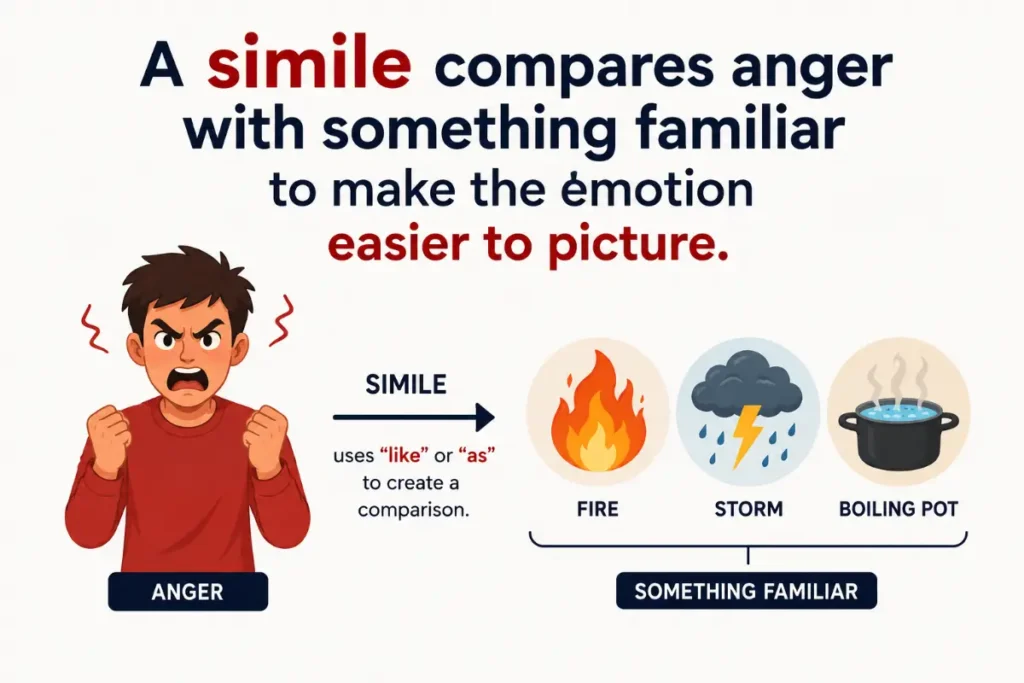
Boiling water works for rising frustration.
Explosions work for sudden rage.
Ice covering fire works for controlled anger.
Embers work for old resentment that hasn’t disappeared.
This gives you a simple creative toolbox. When you need a new comparison ask yourself what the anger feels like physically.
Is it hot?
Is it growing?
The answer can lead you to a fresh simile.
Related Expressions
English has many expressions connected with anger that aren’t technically similes.
Lose your temper means to become very angry.
Blow your top means to become extremely angry.
See red means to become very angry.
Fume means to remain visibly or intensely angry.
Seethe means to feel strong anger that is often kept inside.
Boil with anger compares anger with something heated and can function as figurative language.
Have steam coming out of your ears is a humorous expression for obvious anger.
Be hot under the collar means to be angry or upset.
These expressions can work alongside similes. A writer might say:
He was furious and looked like a volcano ready to erupt.
The direct expression tells us the emotion while the simile creates the picture.
Key Takeaways
- A simile compares anger with something familiar to make the emotion easier to picture.
- Words such as like and as commonly introduce similes.
- Fire is useful for describing heat and growing anger.
- Storms are useful for describing emotional chaos and powerful rage.
- Pressure comparisons work well for anger that has been building.
- Animal comparisons can suggest instinctive defensive or aggressive reactions.
- Quiet anger often works better with images such as embers ice pressure or a sleeping volcano.
- Mild frustration needs a softer comparison than explosive rage.
- The best simile matches the situation and emotional intensity.
- Strong writing uses imagery selectively instead of filling every sentence with comparisons.
Conclusion
The best similes for being mad don’t simply tell readers that someone is angry. They show how that anger feels by connecting it with something vivid and familiar. Fire can represent heat. A storm can represent chaos. Pressure can represent frustration that has been building. An animal can suggest instinctive or defensive anger.
The key is to match the image with the emotion. Use a gentle comparison for mild annoyance and a powerful one for rage. For quiet resentment choose an image that suggests something hidden beneath the surface.
A strong simile should make the reader picture the emotion without making the sentence feel forced. Choose one clear image and let it do the work.
FAQs
What are the best similes for being mad?
Some of the strongest choices compare anger with fire storms pressure or dangerous animals. Examples include being like a volcano ready to erupt like a storm about to break or like a pressure cooker reaching its limit. The best choice depends on the intensity of the anger and the tone of your writing.
What is a good simile for someone who is very angry?
A strong option is like a volcano ready to erupt. It suggests that the person has powerful anger building beneath the surface and may soon lose control. Other useful choices include like a dam breaking like a wildfire or like a storm crashing across the sky.
What is a simile for quiet anger?
A good comparison for quiet anger is like embers beneath ash. The image suggests that the anger isn’t visible on the surface but remains active underneath. Other useful choices include like a volcano beneath ice like a storm beyond the horizon or like a match waiting for a spark.
What is a funny simile for being mad?
A playful option is as mad as a cat with a wet paw. It gives the reader a clear image while keeping the mood light. Other humorous choices include as grumpy as a bear after missing a nap or as frustrated as a driver stuck in traffic.
What simile describes anger building up?
Like a kettle about to boil works very well because it shows anger increasing gradually. Other choices include like a balloon filling too far like a wire pulled tight or like a dam holding back rising water. These comparisons show that the emotion develops over time instead of appearing instantly.
Can similes describe different levels of anger?
Yes. A simile can show anything from mild irritation to extreme rage. A person might be as annoyed as a buzzing fly for mild frustration or like a volcano erupting for intense anger. Choosing an image that matches the emotional level makes the writing more believable.
Are similes for being mad useful in creative writing?
Yes. They can make an invisible emotion easier for readers to picture. Instead of simply telling readers that a character is angry you can show the emotion through fire storms pressure animals or physical tension. The comparison can also reveal something about the character’s mood and personality.
How do I create my own simile for anger?
Start by identifying the feeling behind the anger. Think about heat pressure noise movement or danger. Then choose something that produces a similar effect. For example anger that keeps growing might become like water rising behind a dam. Anger that stays hidden might become like a fire beneath cold ashes.

Idioms, Expressions & Figurative Language
Mason Ellsworth is an American language writer with a passion for English expressions, figurative language, and everyday communication. He explains idioms, similes, popular phrases, and commonly misunderstood expressions in a straightforward, engaging style that helps readers improve both their writing and spoken English.