
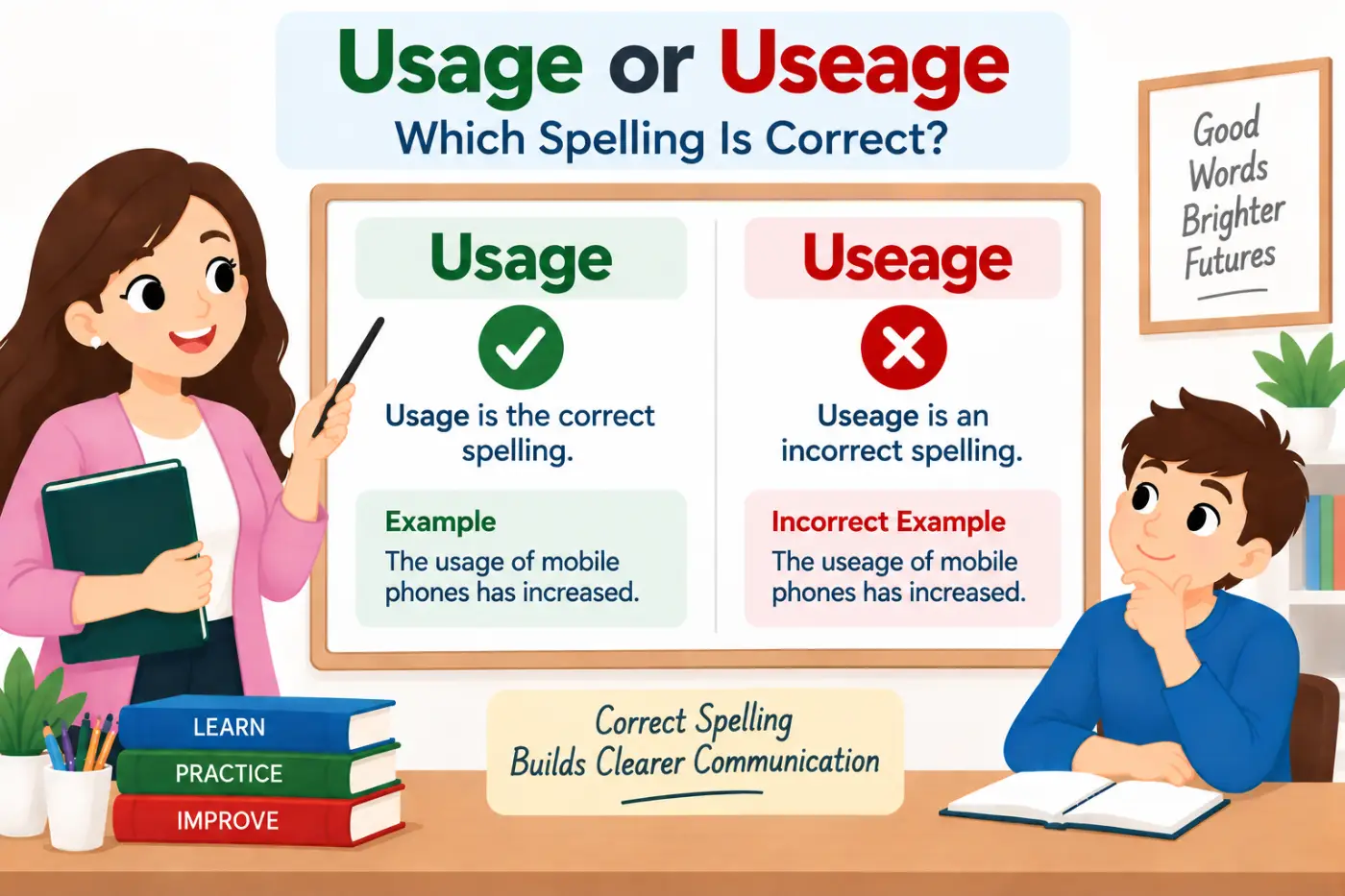
usage or useage is a common spelling question because the incorrect form looks perfectly reasonable at first glance. The correct spelling is usage. Useage is a misspelling that often appears because people naturally connect the word with the verb use and assume that the extra vowel should remain in the written form.
The confusion becomes easier to understand once you look at how English builds words. Usage comes from the verb use but it does not keep the full spelling of use before the noun ending. The word developed through a longer historical path, and modern English settled on usage as the standard form. That means the missing e in usage isn’t an error. It is part of the established spelling.
This guide explains the difference between the two forms, the meaning of usage, its pronunciation, grammar, history, and common patterns. You’ll also see natural examples from everyday English, academic writing, professional communication, and language study. Most importantly, you’ll get a simple memory trick that makes this spelling much easier to remember.
Short Answer
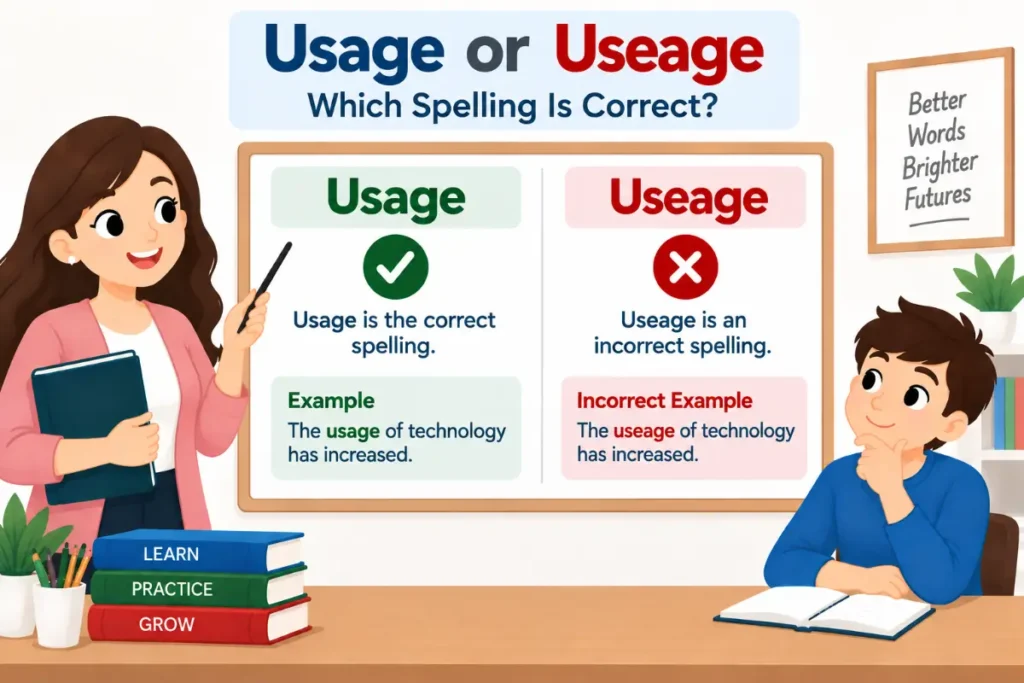
Usage is the correct spelling. Useage is a common spelling mistake and is not the standard form used in modern English. Usage is a noun that can mean the way a word or phrase is used, the act of using something, or a customary practice. If you’re writing an essay, email, article, report, or other formal text, use usage.
Table Of Contents
- Quick Answer
- Meaning Of The Two Forms
- Why The Spelling Causes Confusion
- Key Differences
- Which Form Should You Use
- How To Use The Word Correctly
- Sentence Examples
- Common Spelling Mistakes
- Pronunciation Guide
- Word Origin
- Regional Usage
- Grammar And Part Of Speech
- Usage In Different Contexts
- Related Words And Expressions
- Memory Tips
- Expert Editor Insight
- FAQs
- Key Takeaways
- Conclusion
Quick Answer
Usage is the standard spelling. Useage is not the accepted spelling of the noun in standard modern English.
You use usage when talking about how something is used, especially how language is used. For example, you can discuss English usage, word usage, grammar usage, or the usage of a particular expression.
Comparison Table
| Form | Status | Meaning | Part Of Speech | Pronunciation | Formality | Common Contexts | Example |
|---|---|---|---|---|---|---|---|
| Usage | Correct standard form | The way something is used or a customary way of using something | Noun | YOO sij | Neutral and formal | Grammar, language, technology, business, everyday writing | Modern usage favors this expression. |
| Useage | Incorrect standard spelling | Intended to mean usage | Noun form used as a misspelling | Usually intended as YOO sij | Nonstandard | Typing errors, spelling mistakes, unedited writing | Useage should be corrected to usage. |
The difference is only one letter, but that letter matters. English spelling often preserves established word forms rather than simply combining every visible letter from a related word.
Meaning Of The Two Forms
Meaning Of The Incorrect Form
Useage is generally a misspelling of usage.
It does not have a separate standard meaning in ordinary English. When someone writes useage, the intended word is almost always usage.
For example, someone might write:
The useage of this phrase has changed.
The standard version is:
The usage of this phrase has changed.
The mistake is understandable because the writer can see the word use inside usage. The brain naturally wants to preserve the familiar spelling of the verb before adding an ending. That instinct works for some words but not for this one.
You may occasionally encounter unusual forms in names, usernames, titles, or other personal creations. Such cases don’t establish a standard spelling rule. In normal English writing, use usage.
Meaning Of The Correct Form
Usage is a noun with several closely related meanings.
The most common meaning concerns the way a word, expression, grammatical form, or language structure is used.
For example:
English usage changes over time.
Here usage refers to the way people actually use English.
The word can also refer to a customary or accepted way of using something.
The usage of this software varies between departments.
In this sentence, the focus is on how the software is used.
Usage can also describe the amount or pattern of use in some contexts.
Water usage increased during the summer.
Here the word refers to how much water people use rather than language.
This distinction is useful because usage isn’t limited to grammar books. It can describe language, resources, products, systems, tools, and many other things.
Why The Spelling Causes Confusion
The main reason people make this mistake is simple. They see use and expect the spelling to remain unchanged.
That seems logical.
Use plus age might appear to produce useage.
But English doesn’t always build nouns by simply attaching an ending to the complete visible form of a verb. Historical development, pronunciation, and established spelling patterns all influence the final word.
The noun usage developed through French from Latin roots related to use. Modern English eventually established the spelling usage without the extra e.
There is also a pronunciation issue. Usage is commonly pronounced with a sound similar to YOO sij. The spelling doesn’t make the connection between the sound and the written form obvious to every learner.
Another factor is analogy. English contains many words in which a familiar base seems to remain intact when an ending is added. Writers may therefore create useage by analogy even though standard English uses usage.
This is a classic example of a spelling error that feels logical.
The writer isn’t making a random mistake. They are applying a pattern that works in other situations to a word that follows a different established pattern.
Key Differences
- Spelling. Usage is spelled U S A G E. Useage incorrectly inserts an extra e after the s.
- Standard status. Usage is the standard English form. Useage is generally treated as a spelling error.
- Meaning. Usage has established meanings involving the way something is used or customary practice. Useage normally has no independent meaning.
- Grammar. Usage is a noun. It can function as the subject or object of a sentence.
- Pronunciation. The standard form is commonly pronounced YOO sij. Adding an extra e doesn’t create a useful pronunciation distinction.
- Formality. Usage works comfortably in casual speech, academic writing, professional communication, and technical writing.
- Context. The word is especially common when discussing language, grammar, style, technology, resources, and habits.
- Regional usage. American and British English use the same standard spelling.
The important point is that this isn’t a case of two legitimate words with different meanings. In normal English, one is the established word and the other is an incorrect spelling.
Which Form Should You Use
Use usage.
That is the form you should choose in school assignments, professional emails, academic papers, articles, reports, documentation, and other polished writing.
The spelling follows the established historical form of the word rather than a simple modern formula based on use plus an ending.
This is a good example of why spelling should sometimes be learned through word families rather than by adding letters mechanically.
Think about these related forms:
Use.
Used.
Useful.
Usage.
They are connected in meaning but they don’t all preserve exactly the same spelling pattern.
A dictionary will list usage as the standard noun. That dictionary based approach is useful because it distinguishes established vocabulary from forms that people may create naturally but that aren’t standard.
Professional editors also look at actual context. If a document contains useage, the correction is straightforward unless the writer is referring to a proper name or specialized label.
For ordinary English, there is no need to hesitate.
Write usage.
How To Use The Word Correctly
Usage can appear in several common grammatical patterns.
Talking About Language
This is probably the context most learners encounter.
Modern English usage changes over time.
The teacher explained proper punctuation usage.
The article discusses common word usage.
In these examples, usage refers to how language forms are used by speakers and writers.
Talking About A Product Or System
The word can describe how people use a tool or system.
The company tracks customer usage.
Software usage increased after the update.
This meaning is especially common in business and technology.
Talking About Resources
Usage can also describe consumption.
Electricity usage fell during the spring.
The city is monitoring water usage.
Here the word focuses on the amount or pattern of use.
Talking About Customary Practice
Usage can mean an accepted or customary practice.
By common usage, the expression has taken on a new meaning.
This sense is particularly useful in discussions about language, law, tradition, and established practice.
Talking About Grammar
Language teachers often use usage to distinguish how people use a form from the basic grammatical structure itself.
For example, a sentence might be grammatically possible but unusual in modern usage.
That distinction matters because grammar and usage are related but not identical.
Grammar describes the rules and structures of a language. Usage describes how speakers and writers actually use those forms in real communication.
Sentence Examples
Here are ten natural examples that show the standard word in different settings.
- English usage changes as speakers adopt new expressions.
This sentence refers to how people use the English language.
- The teacher explained the correct usage of the word.
Here the word refers to the proper way to use a particular term.
- Mobile data usage increased during the holiday season.
In this example, usage refers to the amount of data consumed.
- The report examines common usage patterns among young adults.
The sentence focuses on recurring ways something is used.
- The software company monitors customer usage to improve its service.
Here usage means how customers use the software.
- Modern usage accepts several forms that were once considered unusual.
This example discusses changing language conventions.
- Water usage dropped after the new conservation rules were introduced.
The word describes resource consumption.
- The editor corrected several problems involving punctuation and word usage.
Here usage refers specifically to how words are employed.
- The expression has become common through everyday usage.
The sentence suggests that repeated use helped establish the expression.
- Clear documentation can help users understand proper system usage.
Here the noun describes the correct way to use a system.
Notice that the meaning shifts slightly with context. In language writing it often means how words and expressions are used. In business or technology it may refer to frequency or amount of use. The basic idea remains the same.
Common Spelling Mistakes
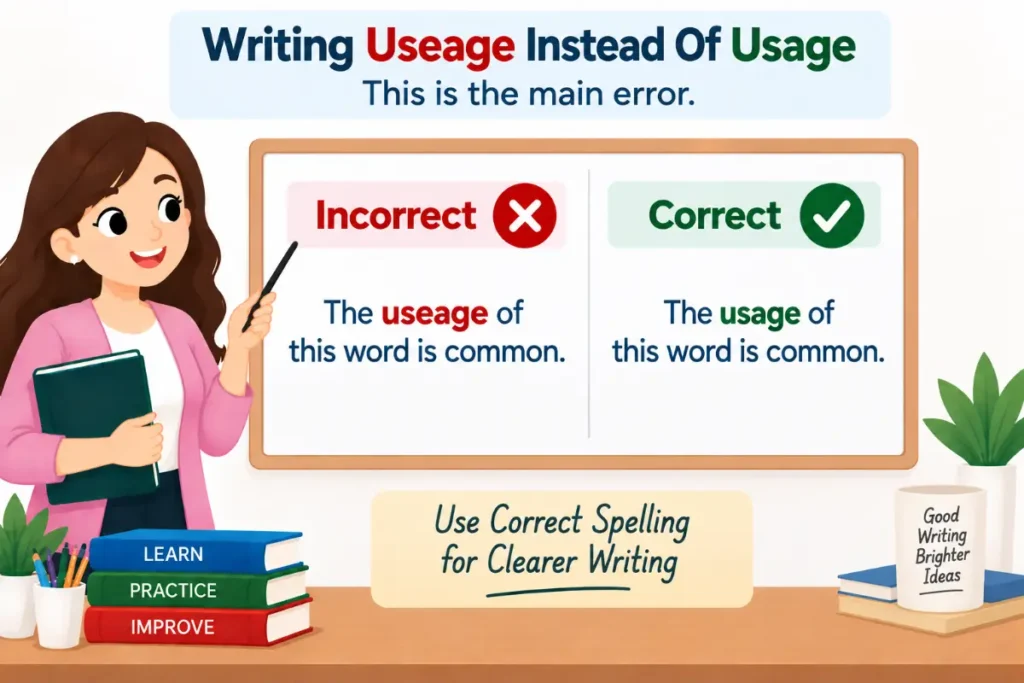
Writing Useage Instead Of Usage
This is the main error.
Incorrect: The useage of this word is common.
Correct: The usage of this word is common.
The writer usually adds the extra e because they are thinking directly from the spelling of use.
Adding An Extra E Automatically
Some writers assume that every word related to use should visibly contain the complete word use.
That isn’t how every English derivative works.
Usage has its own established spelling. Memorizing that form is more reliable than trying to construct it each time.
Confusing Usage With Use
Use and usage are related but they aren’t interchangeable.
Use can function as a verb or noun.
Usage is a noun.
Compare these sentences:
I use this tool every day.
My usage of this tool has increased.
The first sentence describes an action. The second describes the pattern or manner of use.
Confusing Usage With Usability
Usability means how easy or practical something is to use.
Usage means the act, manner, amount, or pattern of using something.
A product can have high usage but poor usability if people use it often despite finding it difficult.
That distinction becomes important in technology, product design, and business writing.
Treating Every Common Form As Standard
Seeing a spelling repeatedly online doesn’t automatically make it standard.
People make predictable typing mistakes, especially with familiar words. The form useage is understandable and recognizable, but standard writing calls for usage.
Pronunciation Guide
The standard pronunciation is commonly represented in IPA as /ˈjuːsɪdʒ/.
An easy American English guide is:
YOO sij.
The first syllable receives the main stress.
You can think of it as two main sound parts:
YOO + sij.
The final sound is similar to the sound at the end of words such as message and village.
The spelling may look more complicated than the pronunciation sounds. That’s another reason some writers rely on the visual connection with use and accidentally add an extra e.
A good way to learn the word is to connect the sound directly with its standard written form.
Usage.
Not:
Useage.
There is no need to pronounce the extra e because the standard word doesn’t contain it.
Word Origin
Usage has a long history connected with the idea of using something.
The English word developed through French from Latin usus, a noun related to use and practice. The Latin verb uti means to use.
The word entered English through historical language development and became established as usage.
This history helps explain why the modern spelling cannot be predicted simply by taking the English verb use and attaching age.
English vocabulary contains many words whose modern spellings reflect older forms rather than a simple modern construction.
That’s common in English because the language has borrowed vocabulary from several major language sources over many centuries.
The historical connection between use and usage is still obvious in meaning. Both words describe the idea of using something. Their spellings simply developed into different modern forms.
For learners, the practical lesson is more useful than memorizing every stage of the word’s history. Remember that usage is an established noun with its own spelling.
Regional Usage
American English
American English uses usage as the standard spelling.
The word appears frequently in discussions of grammar, language, technology, business, consumer behavior, and resource consumption.
For example:
English usage changes over time.
Customer usage increased this year.
The spelling remains usage in both formal and informal American English.
British English
British English also uses usage.
There is no major British spelling variant that adds an extra e to produce useage.
British dictionaries and style resources use usage when referring to the standard noun.
Australian English
Australian English follows the same spelling.
Usage appears in educational writing, professional communication, journalism, technical documentation, and everyday discussion.
The alternative form is not a recognized Australian spelling difference.
Canadian English
Canadian English also uses usage as the standard form.
There is no meaningful regional distinction that makes useage acceptable in Canadian English.
The same spelling therefore works across the major English varieties discussed here.
Grammar And Part Of Speech
Usage is a noun.
It can describe the way something is used.
The usage of the term has changed.
It can also refer to an amount or level of use.
Energy usage increased last month.
It can describe a customary practice.
The expression is accepted in modern usage.
The word can also appear before another noun as part of a noun phrase.
Usage patterns.
Usage guidelines.
These combinations are common in professional and technical writing.
Usage And Use
The distinction between use and usage is worth understanding.
Use can be a verb.
We use the software every day.
Use can also be a noun.
The use of this software is widespread.
Usage is also a noun but often emphasizes the manner, pattern, amount, or convention of use.
Software usage increased last year.
The usage of the word has changed.
The words overlap but they are not always interchangeable.
Usage And Grammar
Usage and grammar are closely connected but they describe different things.
Grammar concerns the structure of language. Usage concerns how speakers and writers actually use language.
A form can be grammatically possible yet uncommon in current usage. Conversely, a form may appear frequently in everyday speech even though traditional style guides have criticized it.
This is why serious language discussions often distinguish grammar from usage rather than treating them as exactly the same thing.
Usage In Formal Writing
The word itself is completely appropriate in formal writing.
You can use it in academic papers, professional reports, style guides, educational material, technical documents, and editorial discussions.
The key is to choose the correct spelling.
If you write useage in a formal document, readers may interpret it as a simple spelling mistake. The meaning will probably remain clear, but the error can weaken the appearance of care and accuracy.
Usage In Different Contexts
Everyday Conversation
In casual conversation, people often talk about usage without realizing they are using a specialized language term.
The usage of that phrase sounds strange to me.
My phone usage has gone up.
The first example concerns language. The second concerns technology.
Workplace Communication
Usage is common in professional settings.
The report includes customer usage data.
Please review the software usage guidelines before the meeting.
The word works naturally because it can describe measurable behavior as well as established practices.
Academic Writing
Academic writers frequently use usage when discussing language or behavior.
The study examines language usage among university students.
The researchers analyzed changes in word usage over time.
Academic writing benefits from this noun because it allows writers to describe patterns of use precisely.
Technical Writing
Technical documents often use the term to describe systems and products.
The dashboard displays monthly usage.
Users can review their account usage from the settings page.
In this context, usage often refers to frequency, quantity, or activity.
Journalism
News writing can use the word when discussing language, technology, resources, or consumer behavior.
Changing language usage has attracted attention from educators.
Household energy usage fell during the summer.
The meaning depends on the subject being reported.
Usage And Language Change
Language usage is not frozen in place.
Words change meaning. Expressions become popular. Older forms disappear. New forms enter everyday speech. Some forms move from informal speech into more widely accepted writing.
That doesn’t mean every new spelling becomes standard.
This distinction is important when discussing usage. A form can be common without being the preferred spelling in edited English.
For example, people may repeatedly type useage because it feels logical. That repeated error doesn’t create a second standard spelling.
Language change normally involves broader patterns of real use across a speech community and over time. A single spelling mistake or a recurring typo is not enough to establish a new standard.
This is one reason editors rely on dictionaries, established style guides, field specific terminology, and actual context when making language decisions.
How Editors Evaluate Spelling
Professional editing involves more than asking which form looks familiar.
An editor may consider several questions.
- Is the form recognized in established dictionaries?
- Does it have a distinct meaning?
- Is it used consistently by educated native speakers?
- Is it a regional variant?
- Does the context involve a specialized field?
- Could the form be a proper name or branded term?
- Is the difference simply a typing mistake?
For usage and useage, the answer is generally straightforward. Usage is the established noun. Useage is normally an error.
This approach also prevents a common editorial mistake: assuming that every unfamiliar form must be wrong. Good editors investigate before changing specialized vocabulary.
In this case, however, the evidence points clearly toward usage for standard English.
Memory Tips
The easiest memory trick is to stop thinking of the word as use plus age.
Instead, memorize the noun as its own word.
Usage.
You can also connect it with other familiar words that end in age.
Language.
Message.
Passage.
Usage.
Another useful trick is to remember the sound.
YOO sij.
The standard spelling begins with use but doesn’t preserve a second e after the s.
You can also create a short mental sentence:
Correct usage matters.
That sentence connects the word with the meaning most people encounter when they first learn it.
For proofreading, use a simple visual check. If you see useage, look at the middle of the word. The extra e is the giveaway.
Related Words And Expressions
Use
Use can be a verb or noun. It refers to the act of using something or the purpose for which something is used.
Used
Used is commonly the past tense and past participle of use. It can also function as an adjective in some contexts.
Useful
Useful is an adjective meaning helpful or practical.
User
User is a noun for someone who uses something.
Usability
Usability describes how easy or effective something is to use.
Utilization
Utilization is a more formal noun referring to the act or degree of using something. In some professional contexts it overlaps with usage but can sound more technical.
Application
Application can refer to the practical use of something. It also has several other meanings, including a request for something and a software program.
Practice
Practice can refer to a customary or repeated way of doing something. In language discussions, it can overlap with the idea of usage but has a broader meaning.
These related words are useful because they show the larger semantic family surrounding use. They also demonstrate why context matters. Two words can be closely related without being interchangeable.
Common Questions About The Spelling
Why Is The Extra E Wrong?
The extra e comes from the mistaken idea that the noun should preserve the complete spelling of use.
English doesn’t always work that way.
The standard noun developed into usage, not useage. The spelling is established by long term English usage and dictionary convention.
So the missing e isn’t something that needs to be fixed. It is actually part of the correct form.
Is Useage Ever Acceptable?
For ordinary standard English, useage should be corrected to usage.
A proper name or specially created label could theoretically use any spelling. If you are copying an official name exactly, preserve that name. Outside such unusual cases, use usage.
Is Usage Only A Grammar Word?
No.
Usage is strongly associated with language and grammar, but the word has a broader meaning.
You can talk about electricity usage, water usage, software usage, customer usage, and data usage.
The central idea remains the same: the manner, amount, or pattern of using something.
Expert Editor Insight
An experienced editor will normally correct useage to usage without changing the meaning of the sentence. The error is common because writers naturally connect the noun with the familiar spelling of use, but standard English has established a shorter form. Editors also check context because usage can refer to language conventions, resource consumption, or patterns of behavior. My practical tip is to memorize the phrase proper usage. Once the correct spelling becomes visually familiar, the extra e starts to look as out of place as an extra chair at a small table.
Key Takeaways
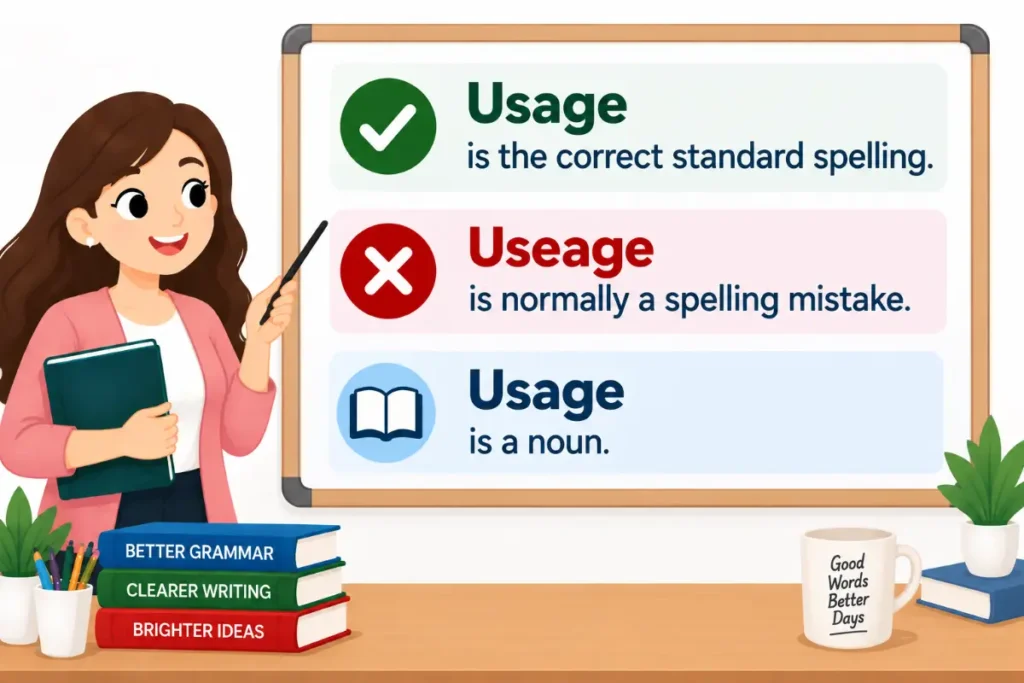
- Usage is the correct standard spelling.
- Useage is normally a spelling mistake.
- Usage is a noun.
- It can describe how a word or expression is used.
- It can also describe the amount, pattern, or manner of using something.
- Usage is common in grammar, education, technology, business, and everyday English.
- The extra e in useage comes from the mistaken idea that the full spelling of use must remain unchanged.
- American, British, Australian, and Canadian English use usage as the standard form.
- The easiest memory trick is to learn usage as a complete word rather than constructing it from use plus an ending.
- In polished writing, choose usage.
Conclusion
usage or useage has a simple answer. Usage is the correct spelling, while useage is normally a misspelling. The standard noun can describe the way something is used, a customary language practice, or the amount and pattern of use in areas such as technology and resources.
The confusion happens because the word is closely related to use. Writers often expect the complete spelling of the familiar verb to remain unchanged, but English has established usage as the standard noun form. The pronunciation also doesn’t make the spelling especially obvious.
The best memory trick is to learn usage as one complete word. If you’re proofreading and see useage, remove the extra e. That small check will keep your writing accurate and polished.
FAQs
Is useage a correct spelling?
No. Useage is generally considered a misspelling of usage in standard English. The correct noun is usage. It can refer to the way something is used, a customary practice, or the amount or pattern of use. The extra e appears because writers often connect the spelling too closely with the verb use.
What does usage mean?
Usage is a noun that describes the way something is used. In language discussions it often means the way words, phrases, or grammatical forms are used by speakers and writers. In other contexts it can refer to the amount or pattern of using something, such as electricity usage, data usage, or software usage.
Which is correct usage or useage?
The correct form is usage. Useage is a common spelling mistake rather than a standard alternative. The word usage has an established spelling that does not contain an extra e after the s. If you’re writing an academic paper, professional email, article, report, or other formal text, choose usage.
Why do people spell usage as useage?
People often write useage because they mentally build the noun from the verb use and assume the full spelling should remain before the ending. That approach feels logical but doesn’t match the established spelling. Pronunciation also gives little help because the standard word sounds roughly like YOO sij. Memorizing usage as a complete word is the easiest solution.
How do you pronounce usage?
Usage is commonly pronounced /ˈjuːsɪdʒ/ in American English. An easy approximation is YOO sij. The first syllable receives the main stress. The final sound resembles the ending found in words such as message. The extra e in the misspelled form doesn’t represent a separate sound because it isn’t part of the standard spelling.
Is usage a noun or a verb?
Usage is a noun. It can refer to the manner, amount, pattern, or customary practice of using something. The related word use can function as both a noun and a verb. For example, you can say We use the system every day, while usage describes the pattern or amount of that use.
Can usage refer to grammar?
Yes. Usage is frequently used in discussions of grammar and language. It can describe how speakers and writers actually use words, expressions, punctuation, or grammatical structures. The term can also help distinguish real language practice from a purely theoretical grammar rule. For example, a language guide might discuss the usage of a particular verb or expression.
Is usage appropriate in formal writing?
Yes. Usage is fully appropriate in formal writing. It appears naturally in academic research, professional reports, language guides, technical documents, journalism, and educational material. The main concern is spelling. Use usage rather than useage. The correct form is clear, established, and suitable for both formal and informal communication.

Confusing Words, Spelling & Word Choice
Claire Whitmore is a U.S.-based English editor who writes about commonly confused words, spelling differences, and word choice. Her work helps readers understand subtle distinctions between similar-looking words through simple definitions, practical examples, and modern usage guidance in both American and British English.