
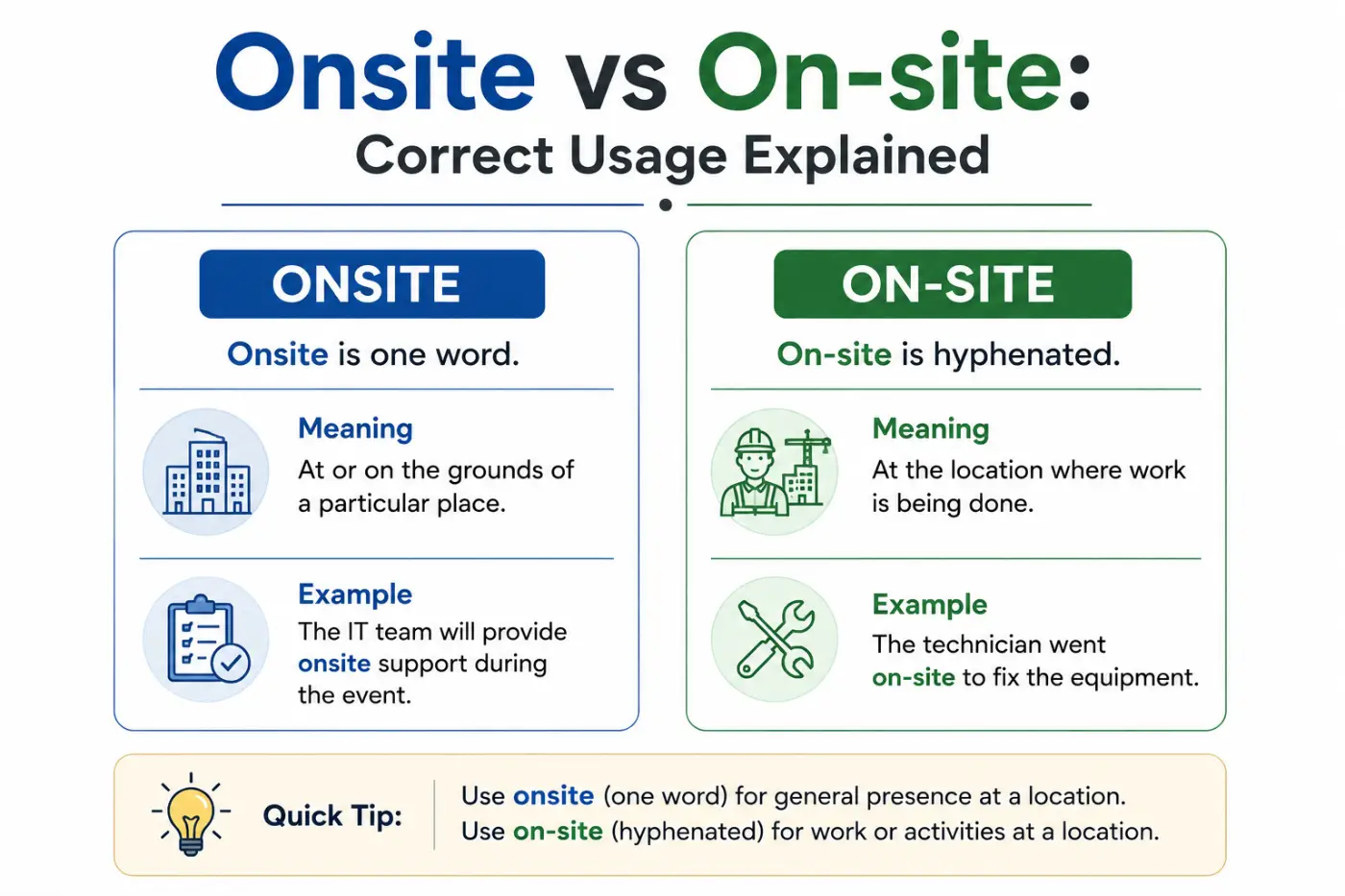
The choice between onsite or on site often looks like a tiny spelling question, but grammar is doing most of the work here. The two forms are closely related, yet they don’t always fit in the same place in a sentence. If you’re writing an email, report, job description, school paper, or business document, choosing the right form can make your sentence sound much more polished.
The easiest rule is this. Use on site when the phrase acts as an adverb and means at the location. Use onsite when it works as an adjective before a noun and describes something connected with that location. For example, you can say The engineer is on site. You can also say The company provides onsite training.
The confusion exists because English often turns common phrases into compound adjectives over time. That process has happened with many familiar expressions. In this guide, you’ll learn the difference, see how native speakers use both forms, understand the grammar behind the choice, and learn a few practical tricks that make the decision almost automatic.
Short Answer
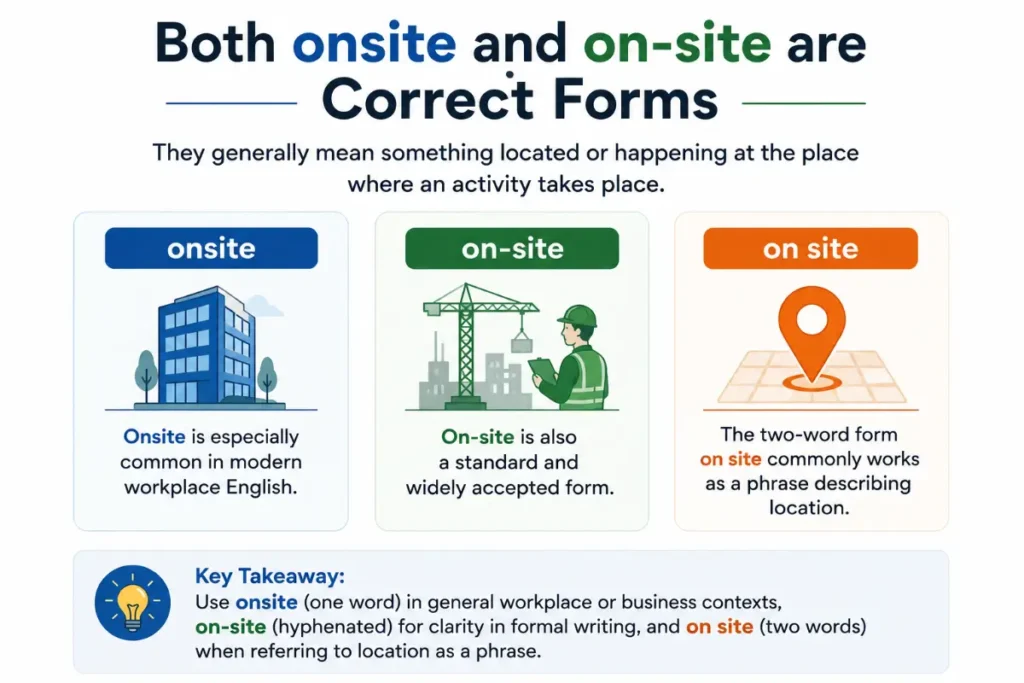
Onsite and on site can both be correct, but they usually serve different grammatical purposes. On site is the traditional phrase used when you mean at a particular location. Onsite is an adjective that describes something located at or provided at that location. In many modern contexts, especially American business English, onsite is also widely used before a noun.
Table Of Contents
- Quick answer.
- Meaning of each form.
- The main grammatical difference.
- Comparison table.
- When to use on site.
- When to use onsite.
- Examples in everyday English.
- Common mistakes.
- Grammar and punctuation.
- American and British usage.
- Word formation and history.
- Similar expressions.
- Professional writing guidance.
- Memory tips.
- FAQs.
- Key takeaways.
- Conclusion.
Quick Answer
The simplest distinction is grammatical.
Use on site when you mean that someone or something is physically at a particular location.
The technician is on site.
Use onsite when the word describes a noun.
The technician provides onsite support.
There is one important wrinkle. Modern dictionaries and style practices recognize onsite as an adjective and in some contexts also as a noun or adverb. Still, on site remains a very natural choice when you are describing location rather than modifying another noun.
That means the forms aren’t simply a correct spelling and an incorrect spelling. They can both be legitimate depending on the sentence.
Comparison Table
| Form | Main Function | Meaning | Typical Position | Example | Formality | Common Context |
|---|---|---|---|---|---|---|
| On site | Adverbial phrase | At the location | Usually after the verb | The engineer is on site. | Neutral | Workplaces construction services events |
| Onsite | Adjective | Located at or provided at the location | Usually before a noun | We offer onsite training. | Neutral to professional | Business education healthcare services |
| Onsite | Noun in some usage | The physical workplace or location | After articles or prepositions | Employees can work onsite. | Professional | Employment workplace communication |
The table shows why treating this as a simple spelling battle can lead you astray. Grammar and position matter more than the number of spaces.
Meaning And Definition
Meaning Of On Site
On site is a prepositional phrase that normally means at the place where an activity is happening.
For example:
The repair team is on site.
This means the repair team has arrived at the location where the repair work is taking place.
The phrase can refer to many kinds of locations. It can describe a construction project, workplace, school, factory, event venue, research facility, customer location, or another specific place.
Consider these examples.
The doctor is on site today.
The contractor arrived on site early.
Security officers remained on site overnight.
In each case, on site tells you where someone is.
The phrase can also describe something happening at the location.
The company will provide support on site.
Here the meaning is similar to providing support at the physical location.
This form is especially natural when the phrase comes after a verb and answers the question where.
Where is the technician?
The technician is on site.
Where will the training happen?
The training will happen on site.
That simple question can help you choose the form.
Meaning Of Onsite
Onsite is primarily an adjective meaning located at a particular place or provided at that place.
It commonly appears directly before a noun.
The company offers onsite training.
The hospital has an onsite pharmacy.
We need onsite technical support.
The adjective tells you something about the noun that follows it.
Onsite training means training provided at the location.
Onsite services means services delivered at the location.
The adjective has become especially common in American workplace language. You’ll see it in job descriptions, service agreements, company websites, training materials, and internal communication.
Onsite As A Workplace Term
Modern professional English has expanded the use of onsite beyond simple adjective placement.
You may hear or read:
Employees can work onsite three days a week.
In this sentence, onsite functions adverbially. It describes where employees work.
You may also see:
The company has an onsite team.
Here onsite clearly functions as an adjective.
This newer usage is common enough that readers generally understand it without difficulty. Still, style preferences can vary. In formal documents, consistency matters more than forcing one form into every sentence.
The Main Grammatical Difference
The most useful distinction is not spelling. It is function.
If the phrase tells you where an action happens, on site is often the clearest choice.
If the word describes a noun, onsite is usually the natural choice.
Compare these sentences.
The consultant is on site.
The consultant provides onsite advice.
In the first sentence, the phrase tells us where the consultant is. In the second, onsite describes the type of advice.
Another pair makes the difference even clearer.
The nurse works on site.
The hospital has onsite nurses.
The first sentence focuses on location. The second describes nurses who work at the facility.
This is a classic example of English moving from a phrase to a compound modifier. Language users often combine words when they become a familiar unit before a noun.
You can think of the pattern this way.
On site tells you where.
Onsite tells you what kind.
That isn’t an absolute rule for every modern use, but it’s an excellent practical guide.
When To Use On Site
Use on site when you want to emphasize physical presence at a particular location.
This is especially natural after verbs such as arrive, remain, work, stay, meet, operate, inspect, live, and be.
The engineer arrived on site at eight.
The workers remained on site until sunset.
Our manager will be on site tomorrow.
The photographer stayed on site for six hours.
The phrase also works well when answering a location question.
Where is the supervisor?
She is on site.
Where will the inspection happen?
It will happen on site.
This construction is clear because the phrase behaves like other location phrases such as at the office, in the building, or at the facility.
There is no need to force the closed spelling simply because it looks shorter.
On Site After A Verb
One of the strongest patterns is verb plus on site.
The technician arrived on site.
The team worked on site.
The director met the staff on site.
The workers stayed on site.
The inspector remained on site.
These sentences sound natural because the phrase identifies the location associated with the action.
On Site At The End Of A Sentence
The phrase often appears near the end of a sentence.
The contractor will inspect the equipment on site.
We can discuss the problem on site.
The team completed the installation on site.
This position is common in ordinary American English.
On Site With A Specific Location
You can also combine the phrase with a specific noun.
The engineer is on site at the new warehouse.
The crew is on site at the construction project.
The consultant will meet us on site at the facility.
This makes the physical meaning especially clear.
When To Use Onsite
Use onsite when it functions as an adjective describing a noun.
This is common in professional writing.
We provide onsite training.
The company offers onsite repairs.
The school has onsite counseling.
The business needs onsite support.
The adjective can describe people, services, facilities, activities, equipment, and events.
Onsite Training
Onsite training means training delivered at the relevant physical location.
The company offers onsite training for new employees.
This differs from online training, which takes place through digital communication.
Onsite Support
Onsite support means assistance provided at the customer’s location or another specified workplace.
Our technicians provide onsite support.
The phrase is common in technology, maintenance, healthcare, and business services.
Onsite Staff
Onsite staff are employees or workers who are present at the location.
The event requires additional onsite staff.
Here the adjective clearly modifies staff.
Onsite Services
Onsite services are services delivered at a particular location.
The company provides onsite cleaning services.
The word tells the reader where the service is delivered.
Examples That Show The Difference
The easiest way to understand the distinction is to compare pairs.
Example One
The technician is on site.
The technician provides onsite repairs.
The first sentence tells you the technician’s location. The second describes the repairs as services delivered at the location.
Example Two
The trainer is on site.
The company offers onsite training.
The first sentence tells you where the trainer is. The second describes the training program.
Example Three
The nurse works on site.
The clinic has onsite nurses.
The first sentence describes the nurse’s work location. The second uses onsite to describe the nurses.
Example Four
The manager will be on site tomorrow.
The manager will lead an onsite meeting.
The first sentence gives a location and time. The second describes the meeting.
Example Five
The repair team arrived on site.
The company arranged onsite maintenance.
Again, the first phrase answers where. The second modifies a noun.
Sentence Examples
Here are ten natural examples using both forms.
- The technician is on site and ready to begin the inspection.
The phrase identifies the technician’s physical location.
- We provide onsite support for customers who need immediate assistance.
Onsite describes the type of support provided.
- The construction crew arrived on site before sunrise.
The phrase follows arrived and tells us where the crew went.
- The company offers onsite training for new employees.
Onsite modifies training and tells us where the training occurs.
- Our manager will be on site during the afternoon.
The phrase describes the manager’s location.
- The hospital has an onsite pharmacy for patients and staff.
Onsite describes the pharmacy and indicates that it is located at the hospital.
- The inspector remained on site until the work was complete.
The phrase explains where the inspector remained.
- We need onsite technical assistance during the installation.
Onsite modifies technical assistance.
- The event coordinator will be on site throughout the weekend.
The phrase identifies the coordinator’s location.
- The school provides onsite counseling for students.
Onsite describes the counseling service.
These examples show why the choice depends on grammar rather than personal spelling preference.
Common Mistakes
Using Onsite After Every Verb
The engineer arrived onsite.
Many readers will understand this sentence and some modern style systems accept this usage. However, on site is still the traditional and very clear form for this adverbial construction.
A polished version is:
The engineer arrived on site.
If your organization has a specific style guide that prefers onsite in such constructions, follow that guide consistently.
Using On Site Before A Noun
Another common mistake is writing:
We offer on site training.
This form appears in real writing, but onsite is usually cleaner when the expression works as a compound adjective before the noun.
Preferred:
We offer onsite training.
The closed form makes the compound modifier easy to recognize.
Treating The Forms As Completely Interchangeable
They overlap in meaning, but their grammatical roles can differ.
The manager is on site.
The manager leads an onsite team.
Replacing one with the other without considering sentence structure can make the sentence less natural.
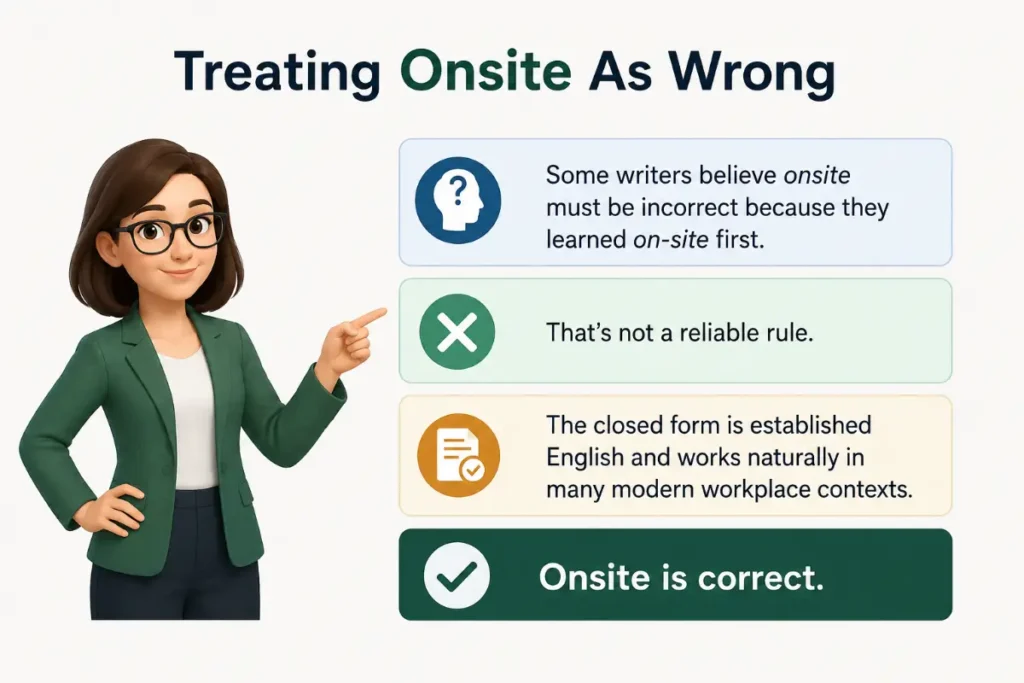
Assuming One Form Is Always Wrong
This is the biggest mistake.
On site is not an outdated spelling that must always be replaced.
Onsite is not simply a typo.
Both forms have legitimate uses. The surrounding words determine which form fits best.
Inconsistent Style Within One Document
A professional document can look careless if it switches between forms without a reason.
For example, a company might use onsite training in one section and on site training in another section.
Pick the form that fits the grammar and then apply your preferred style consistently.
Grammar And Punctuation
The phrase on site contains a preposition and a noun.
On functions as the preposition.
Site functions as the noun.
Together they form a prepositional phrase that can act adverbially.
The engineer is on site.
The phrase identifies location.
Onsite is generally an adjective.
The engineer provides onsite support.
The adjective modifies support.
Does Onsite Need A Hyphen?
Usually no.
When onsite appears as a single established adjective, it is written as one word.
Onsite training.
Onsite services.
You should not normally write on site support simply because the phrase is being used before a noun.
However, English compound modifiers can sometimes behave differently depending on the style guide and the words involved. For this particular term, the closed form onsite is well established.
Does On Site Need A Hyphen?
No.
The normal phrase is on site with two words.
You don’t need to connect the words with a hyphen.
The engineer is on site.
What About Capitalization?
Neither form normally needs capitalization unless it begins a sentence or appears in a proper name.
The technician is on site.
We offer onsite support.
If a company uses Onsite as part of a formal product or department name, that becomes a proper naming issue rather than an ordinary grammar rule.
American English
American English commonly uses both forms.
On site remains natural when describing physical presence.
The contractor is on site.
Onsite is especially common as an adjective in business and workplace writing.
The company provides onsite support.
American professional English has also expanded onsite into workplace expressions such as onsite employees, onsite work, and onsite services.
This means American readers generally recognize the closed form without difficulty.
For polished US writing, the best approach is to pay attention to grammatical function rather than assuming that one spelling should replace the other everywhere.
British English
British English also uses both forms, although style preferences can differ between publications and organizations.
The phrase on site is well established when describing location.
The team is on site.
The adjective onsite is also used in modern English.
The company provides onsite training.
Some British style guides and publications may show a preference for open compounds in certain contexts. That doesn’t mean American usage is wrong. It simply reflects the fact that compound spelling can vary across editorial traditions.
The safest approach is to follow the style convention of the publication or organization you’re writing for.
Australian English
Australian English uses the same basic distinction.
On site works naturally as a location phrase.
The inspector is on site.
Onsite also appears as an adjective.
The company offers onsite services.
There is no major Australian rule that turns one form into the only correct choice.
Canadian English
Canadian English likewise uses both forms in appropriate contexts.
The construction team is on site.
The company offers onsite training.
Canadian professional writing may follow either local or organizational style preferences. Grammar remains the most useful guide.
Formal And Informal Usage
Both forms can appear in professional writing.
On site is often the clearer choice when location matters.
The supervisor will be on site tomorrow.
Onsite works especially well in business terminology.
The supervisor will conduct an onsite inspection.
In formal writing, clarity should come first. If the reader might pause to interpret the construction, choose the form that makes the grammatical relationship obvious.
This is especially useful in contracts, policies, reports, instructions, and technical documents.
In casual communication, people often use the forms more loosely.
I’ll be onsite tomorrow.
That sentence is widely understandable and common in workplace communication.
For a formal report, however, you may prefer:
I’ll be on site tomorrow.
The difference is subtle but useful. Formal editing often favors the clearest grammatical structure over the shortest possible form.
Word Origin And Development
The phrase on site is built from two ordinary English words.
On is an old English preposition with a long history of expressing position, contact, or location.
Site comes through French from Latin situs, related to the idea of position or location.
The phrase therefore has a straightforward literal meaning. Something that is on site is at the relevant place or location.
The closed adjective onsite reflects a common process in English word formation. Frequent combinations can become fixed compounds, especially when they repeatedly occur before nouns.
English contains many examples of this process. Words that began as separate combinations can become established compounds as speakers use them repeatedly.
The development of onsite fits that broader pattern.
The important point for modern writers is not the exact moment the spelling changed. The practical issue is that onsite has become an established adjective while on site remains a normal location phrase.
Related Expressions
Understanding nearby expressions can make the distinction even easier.
Off Site
Off site generally means away from the main location.
The team held an off site meeting.
In modern editing, you may also see offsite used as an adjective.
The company organized an offsite retreat.
This creates a useful parallel with onsite.
On Location
On location means at the place where an event or activity is happening.
The film crew worked on location.
This expression is especially common in film, photography, journalism, and field work.
At The Workplace
This phrase directly identifies the workplace as the location.
Employees can receive training at the workplace.
It is less compact than onsite but can be clearer for general audiences.
In Person
In person means physically present rather than communicating remotely.
The consultant will meet with us in person.
This expression focuses on physical interaction rather than the specific location.
Remote
Remote describes work or services performed away from the usual workplace.
The company offers both remote and onsite positions.
This contrast has become common in employment language.
Online
Online refers to activity conducted through the internet.
The company offers online and onsite training.
The contrast is simple and useful because the two terms describe different delivery methods.
Field Work
Field work refers to work carried out outside a laboratory, office, or other controlled setting.
Researchers conducted field work at several locations.
The expression overlaps with onsite work but has a more specific meaning in many academic and professional contexts.
In House
In house means provided or performed within an organization rather than by an outside provider.
The company has an in house legal team.
This expression can resemble onsite in some business contexts but focuses on organizational ownership or internal provision rather than physical location.
Memory Tips
A good memory trick is to ask one question.
Am I telling the reader where something happens or describing a noun?
If you’re answering where, choose on site.
The technician is on site.
If you’re describing a noun, onsite is usually the better choice.
The technician provides onsite support.
Another trick is to look at the word that follows.
If a noun comes immediately after the expression, the closed adjective is often appropriate.
Onsite training.
Onsite support.
If the phrase comes after a verb and tells you where someone or something is, the open form is often the natural choice.
The workers are on site.
The inspector arrived on site.
This method won’t solve every possible editorial question, but it handles the vast majority of everyday cases.
Professional Writing Tips
A few habits can make your writing cleaner.
- Think about grammar first. Don’t start by asking which spelling looks right. Ask what job the expression is doing.
- Use on site for location. If someone is physically present at a place, the open form is usually clear and natural.
- Use onsite before nouns. The closed adjective works well in phrases such as onsite training, onsite support, and onsite services.
- Keep your style consistent. If you’re preparing a report or company document, follow the preferred spelling used throughout the document.
- Consider your audience. General readers usually understand both forms, but clear grammar makes professional writing easier to read.
- Don’t confuse spelling with meaning. These forms are closely related but their grammatical roles can differ.
- Check the surrounding words. The words immediately before and after the expression often reveal which construction works best.
Real Life Usage
Workplace Communication
The manager will be on site tomorrow morning.
The company provides onsite technical support.
The first sentence identifies the manager’s location. The second describes a type of service.
Construction
The contractor arrived on site at seven.
The project includes onsite safety training.
Construction language uses both forms constantly because workers need to describe both physical presence and services performed at a project location.
Education
The instructor will be on site during the workshop.
Students can receive onsite academic support.
Again, the location phrase and adjective perform different jobs.
Healthcare
The physician is on site today.
The facility has onsite medical services.
The first sentence describes presence. The second describes services available at the facility.
Events
The coordinator will be on site throughout the event.
The organizers hired onsite security staff.
The difference remains consistent across industries.
Expert Editor Insight
An experienced editor doesn’t treat this as a simple spelling contest. The first question is always grammatical function. If the expression answers where, the open phrase on site is often the cleanest choice. If it modifies a noun, onsite is usually the natural compound adjective. Modern usage has also made onsite common in some adverbial workplace expressions, so an editor should avoid calling every closed form incorrect. The best professional habit is to check the sentence as a whole, then follow the style guide used by the publication or organization.
Key Takeaways
- On site is commonly used as a location phrase meaning at the relevant place.
- Onsite is usually an adjective meaning located at or provided at a particular place.
- The easiest practical distinction is that on site often tells you where while onsite often tells you what kind.
- Use on site in sentences such as The engineer is on site.
- Use onsite in expressions such as onsite training, onsite support, and onsite services.
- Modern workplace English also uses onsite in some adverbial constructions such as I work onsite.
- American British Australian and Canadian English all recognize these related forms.
- For professional writing, grammar and context matter more than simply counting words.
Conclusion
The choice between onsite or on site depends mainly on grammar and context. On site is the natural open phrase when you’re describing physical location, while onsite commonly works as an adjective before a noun. That gives you a simple foundation for choosing the right form.
You’ll often write The technician is on site but The company provides onsite support. Modern workplace English also uses onsite in some constructions where older style would traditionally use the two word phrase. This means neither form should be labeled universally right or wrong.
The best editing tip is to ask what job the expression is doing. If it tells you where something happens, on site is usually clear. If it describes a noun, onsite is usually the cleaner choice. Follow your publication or workplace style guide when one exists.
FAQs
Is onsite or on site correct?
Both can be correct. On site is commonly used as an adverbial phrase meaning at a particular location. Onsite is usually an adjective describing something located at or provided at that location. For example, The technician is on site uses the phrase to identify location, while onsite training uses the closed form to describe the training.
Is onsite one word or two words?
Onsite is normally written as one word when it functions as an adjective. For example, onsite support and onsite training are standard constructions. On site remains a two word phrase when it functions as a location expression. The choice depends on grammatical function, so you shouldn’t automatically replace every instance of on site with the closed form.
Should I write on site training or onsite training?
Onsite training is generally the cleaner choice when the expression directly modifies training. The word onsite acts as an adjective and describes training provided at a particular location. On site training can appear in informal writing, but the closed form makes the compound relationship easier to recognize. For polished professional writing, onsite training is usually the better construction.
Is it correct to say I am onsite?
Yes. I am onsite is common in modern workplace communication and is widely understood. However, I am on site is also completely natural and can be preferable when you want to emphasize physical location. The choice can depend on house style. In formal writing, consistency matters more than forcing one construction into every sentence.
What is the difference between on site and onsite?
The traditional grammatical distinction is that on site functions as a location phrase while onsite usually functions as an adjective. The first tells you where someone or something is. The second describes a noun connected with that location. For example, The engineer is on site focuses on location, while onsite engineering support describes a type of support.
Is onsite formal English?
Yes. Onsite is appropriate in professional and formal English, particularly as an adjective. You’ll see it in business documents, workplace communication, service descriptions, technical writing, and job advertisements. It can also appear in modern workplace usage as an adverb. For highly formal documents, use the spelling that fits your organization’s style guide and apply it consistently.
Is on site hyphenated?
No. The normal location phrase is written as two separate words: on site. The adjective is normally written as one word: onsite. A hyphen is not normally needed for either form. The important distinction is therefore between the open phrase and the closed compound rather than between a hyphenated and unhyphenated version.
Which form is better for American English?
For American English, both forms are useful. On site is especially clear when describing physical location, while onsite is common as an adjective before nouns such as training, support, services, and staff. Modern American workplace language also uses onsite in some adverbial constructions. Choose based on grammar, context, and the style standard you’re following.
Can onsite describe a person?
Yes. Onsite can describe a person who works or is present at a particular location, especially in professional language. For example, a company might refer to onsite staff or onsite employees. In those expressions the word describes the people. If you simply want to state where someone is, the phrase on site is often more natural.
Can I use on site at the end of a sentence?
Yes. On site can naturally appear at the end when it identifies the location of an action or state. For example, The technicians completed the repair on site. The phrase tells the reader that the repair happened at the relevant physical location. This placement is common and grammatically straightforward.

Confusing Words, Spelling & Word Choice
Claire Whitmore is a U.S.-based English editor who writes about commonly confused words, spelling differences, and word choice. Her work helps readers understand subtle distinctions between similar-looking words through simple definitions, practical examples, and modern usage guidance in both American and British English.