
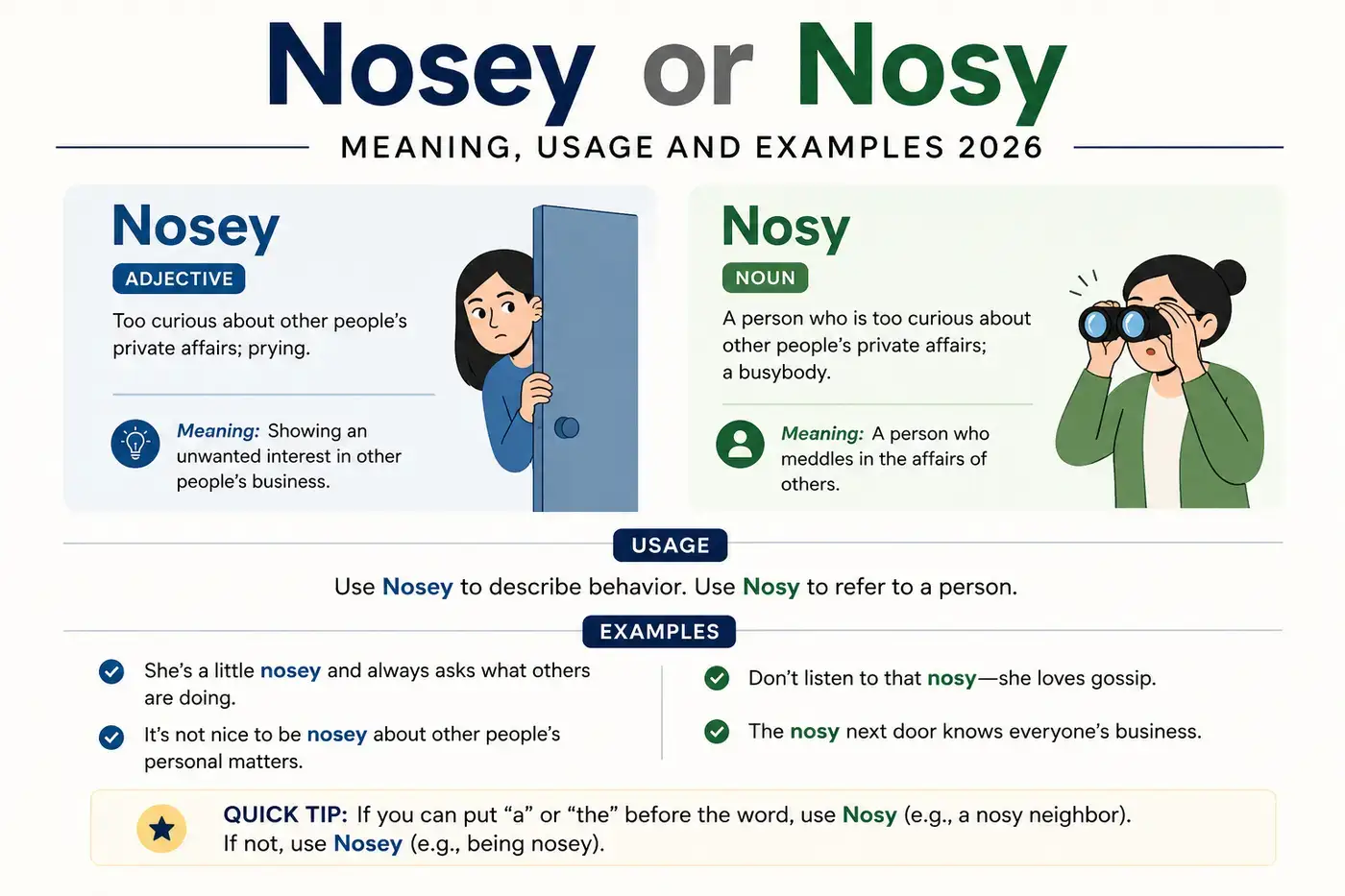
The spelling question nosy or nosey doesn’t have the same simple answer as many common word comparisons. Both forms are recognized English words. The main difference is preference and regional usage rather than one spelling being completely wrong.
In American English, nosy is the usual spelling. In British English, nosey is also widely used and may feel more natural to many British readers. Both forms have the same basic meaning and are pronounced the same way. They describe someone who is too interested in other people’s business or asks questions that feel overly personal.
The confusion comes from the word’s connection with nose. Since a nosy person is figuratively sticking their nose into other people’s affairs, some writers naturally expect the spelling to keep the full word nose. That produces nosey. Others use the shorter form nosy, which has become especially common in American English. Understanding this small difference helps you choose the spelling that fits your audience.
Short Answer
Nosy and nosey are both legitimate English spellings. Nosy is the more common spelling in American English and is generally the best choice for US readers. Nosey is also established, especially in British English. Both forms describe someone who is overly interested in other people’s private affairs.
Table of Contents
- Quick Answer
- What Nosy Means
- What Nosey Means
- The Main Difference
- Which Spelling Should You Use
- Pronunciation
- Examples In Sentences
- Common Spelling Mistakes
- Why Both Spellings Exist
- Word Origin
- American And British Usage
- Formality And Tone
- Grammar And Word Forms
- Related Words And Expressions
- Memory Tips
- Real Life Usage
- Expert Editor Insight
- FAQs
- Key Takeaways
- Conclusion
Quick Answer
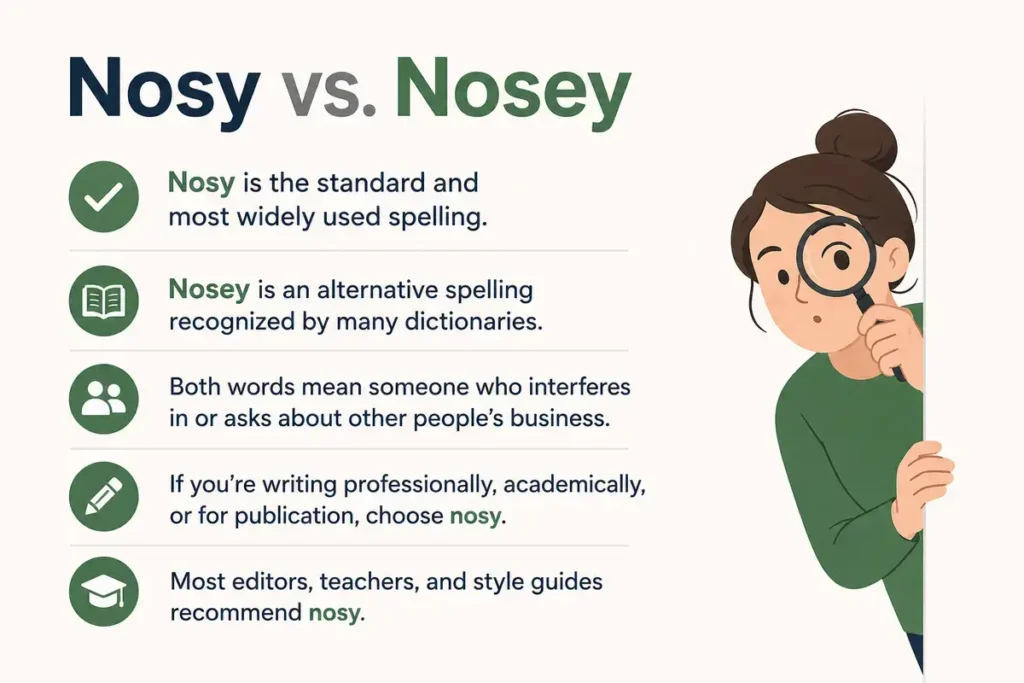
Both nosy and nosey are accepted spellings of the adjective meaning too curious about other people’s private matters. For an American audience, nosy is usually the better choice because it is the more common US spelling. British English commonly uses nosey as well. Neither form changes the basic meaning or pronunciation.
The choice therefore depends mainly on audience and style. If you’re writing for a US website, school assignment, business audience, or general American readership, choose nosy. If your audience follows British English, nosey is a perfectly reasonable choice.
Comparison Table
| Feature | Nosy | Nosey |
|---|---|---|
| Basic meaning | Too interested in other people’s private affairs | Too interested in other people’s private affairs |
| Part of speech | Adjective | Adjective |
| Pronunciation | Same as nosey | Same as nosy |
| American English | More common | Used but less common |
| British English | Used | Commonly used |
| Formality | Informal | Informal |
| Related noun | Nosiness | Noseyness is less common and usually avoided |
| Example | My neighbor is very nosy. | My neighbor is very nosey. |
The important point is that this is not a simple correct versus incorrect spelling pair. Both forms have a place in English. The practical question is which one best fits your audience.
What Nosy Means
Nosy is an adjective that describes someone who shows too much curiosity about other people’s private lives, conversations, activities, or personal information.
If someone keeps asking questions that don’t really concern them, you might describe that person as nosy.
For example:
My neighbor is always asking about my personal life. She can be very nosy.
The word usually carries a negative meaning. Calling someone nosy suggests that the person has crossed a social boundary or is paying attention to matters that aren’t really their business.
Still, the tone can vary. Friends sometimes use the word playfully.
You’re being nosy again.
In that situation, the speaker may not be genuinely angry. The word can sound teasing depending on the relationship and tone of voice.
Nosy can describe questions, behavior, people, curiosity, or actions.
He asked a nosy question.
That was a pretty nosy thing to ask.
She has a nosy neighbor.
The basic idea remains the same. Someone is showing more curiosity than the situation comfortably calls for.
What Nosey Means
Nosey has the same basic meaning as nosy. It describes someone who is excessively curious about other people’s personal affairs.
For example:
The nosey neighbor wanted to know where we were going.
The spelling with the extra e makes the relationship with the noun nose more visible. That connection is one reason the form feels intuitive to many writers.
Nosey is not simply a careless misspelling of nosy. It has established use, particularly in British English. It appears in dictionaries and ordinary written English, so calling it wrong would give readers misleading advice.
The two spellings generally behave the same way grammatically.
She’s nosy.
She’s nosey.
Both sentences mean that she is overly curious about other people’s business.
The difference is mainly spelling preference rather than meaning.
The Main Difference
The central difference between the two forms is regional preference and spelling convention.
- Nosy is more common in American English. If your audience is mainly in the United States, this is usually the natural choice.
- Nosey is common in British English. British writers may prefer the version that keeps the connection with nose more visible.
- Both have the same meaning. Neither spelling changes the basic idea of excessive curiosity.
- Both have the same pronunciation. The extra e does not create a different sound.
- Both are adjectives. You can use either form to describe a person, question, comment, behavior, or action.
- Both are informal. The word can sound playful among friends but can also sound critical or insulting.
- Neither spelling is automatically an error. Your choice should depend on the English variety and the style of the publication.
This is a useful example of how English spelling can vary without changing meaning. Not every spelling difference represents a difference in definition.
Which Spelling Should You Use
If you’re writing for a primarily American audience, nosy is the safest and most natural choice.
That includes US school assignments, websites, blogs, business communication, social media, product descriptions, and general educational content.
If you’re writing specifically for a British audience, nosey is a natural choice and is widely understood.
If your audience includes people from several English speaking countries, either spelling can work. The most important thing is consistency. Don’t switch between nosy and nosey randomly within the same document unless you’re discussing the spelling difference itself.
For example, this looks inconsistent:
My neighbor is very nosy. Her nosey questions annoy everyone.
For a US audience, keep the spelling consistent:
My neighbor is very nosy. Her nosy questions annoy everyone.
For a British audience, you could consistently use:
My neighbor is very nosey. Her nosey questions annoy everyone.
Professional editors generally care more about consistency than forcing one regional preference onto every audience.
Pronunciation
Nosy and nosey are pronounced the same way.
The common pronunciation is approximately:
NOH zee
The IPA is commonly represented as:
/ˈnoʊzi/
The word has two syllables.
NOH zee
The stress falls on the first syllable.
The first part sounds like the word no. The second part sounds like zee in American English.
The spelling difference does not create a pronunciation difference. The extra e in nosey is primarily a spelling feature.
This makes the pair an interesting example of English orthography. Two written forms can look slightly different while having the same sound and meaning.
If you’re learning English, don’t try to pronounce nosey as if it contained an extra syllable. It doesn’t.
Examples In Sentences
Here are natural examples with the American spelling.
- My neighbor is friendly but sometimes a little nosy.
This sentence describes someone who is generally pleasant but asks too many personal questions.
- That was a nosy question to ask at dinner.
Here the adjective describes the question rather than the person asking it.
- Don’t be so nosy about their relationship.
The speaker is telling someone to stop asking about a private matter.
- My coworker keeps asking where I’m going after work. It’s getting nosy.
The word describes behavior that has become too personal.
- I wasn’t trying to be nosy. I was just curious.
This example shows the difference between ordinary curiosity and curiosity that may cross a social boundary.
- The nosy reporter kept asking the actor about his private life.
The word describes intrusive questioning.
- Her little brother is naturally nosy and wants to know everything.
The tone here is more playful than harsh.
- Please don’t read my messages. That’s nosy.
The adjective describes an unwanted invasion of privacy.
- He gave me a nosy look when I walked into the room.
The behavior suggests unusual interest in what someone else was doing.
- I asked one personal question, so I hope I didn’t sound nosy.
This sentence shows how speakers often use the word when they’re worried about crossing a social boundary.
The same sentences can use nosey without changing the basic meaning.
My neighbor is friendly but sometimes a little nosey.
That was a nosey question to ask at dinner.
Don’t be so nosey about their relationship.
The choice is mainly a matter of spelling preference.
Common Spelling Mistakes
Assuming Nosey Is Always Wrong
This is probably the biggest mistake in explaining the pair.
Nosey is an established spelling. It isn’t simply an accidental version created by people who don’t know how to spell nosy.
For American writing, nosy is usually preferable. But British English commonly uses nosey.
Assuming Nosy Is A Typo
The reverse mistake also occurs. Some writers assume that nose must remain intact because the word comes from the idea of sticking your nose into someone else’s affairs.
That reasoning explains the spelling but doesn’t make nosy incorrect.
Nosy is a well established spelling, especially in American English.
Switching Forms Within One Article
Inconsistent spelling can make an article look poorly edited.
For example:
The nosy neighbor asked several nosey questions.
Unless you’re deliberately showing the two forms, pick one spelling and stick with it.
Confusing The Word With Curious
Curious and nosy overlap but they aren’t identical.
Curious is often neutral or positive.
She was curious about how the machine worked.
Nosy usually suggests that the curiosity is inappropriate or intrusive.
She was nosy about her coworker’s salary.
That difference matters when choosing the right adjective.
Assuming The Word Is Appropriate In Every Setting
Nosy is an informal adjective. It works well in conversation and casual writing, but a formal report may need more precise language.
Instead of writing:
The manager was nosy about the employee’s personal life.
A formal document might say:
The manager asked intrusive questions about the employee’s personal life.
The second sentence sounds more neutral and professional.
Why Both Spellings Exist
The spelling difference becomes easier to understand once you look at the relationship between the adjective and the noun nose.
The idea behind the word is metaphorical. A person who is nosy is imagined as putting their nose into matters that don’t concern them.
English speakers have formed adjectives from nouns in different ways over time. In this case both nosy and nosey developed as established spellings.
The shorter spelling drops the e before the y.
Nose plus y can suggest nosey.
Nos plus y gives nosy.
Both forms have survived.
This is not unusual in English. Spelling conventions can compete for a long time before one becomes more dominant in a particular variety of the language.
American English often favors shorter forms in some word families while British English can preserve forms that look slightly different. That doesn’t create a universal rule. It simply helps explain why regional preferences can develop.
The important lesson is that spelling should be judged by established usage rather than by appearance alone.
Word Origin
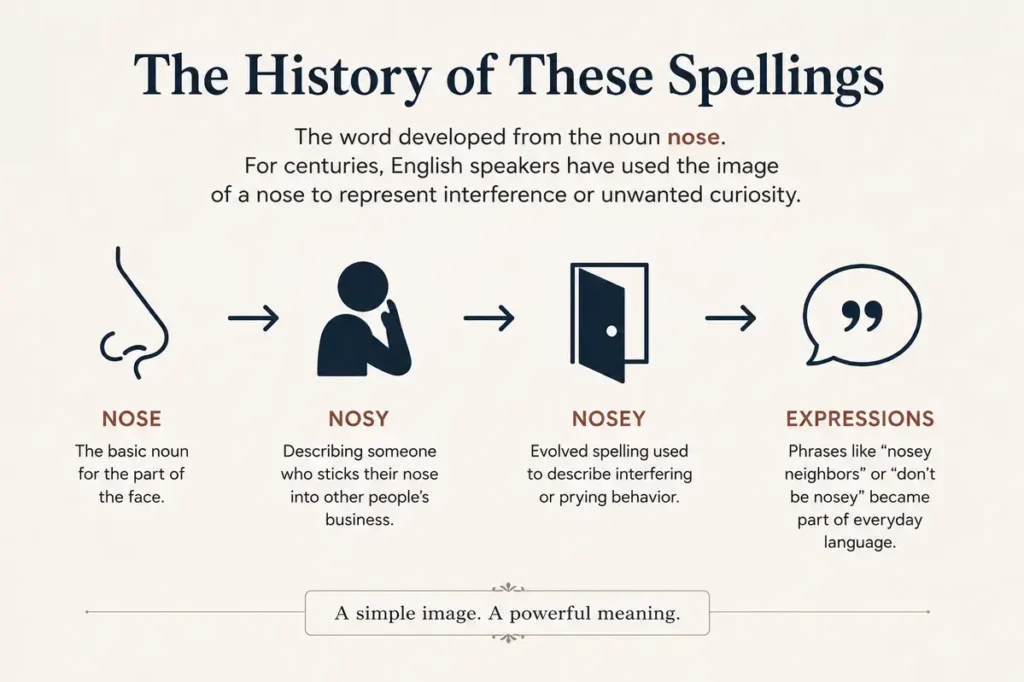
The word is related to nose, both literally and figuratively.
The figurative idea is easy to picture. Someone who interferes in other people’s affairs is imagined as putting their nose into places where it doesn’t belong.
The adjective developed from this familiar image of intrusive curiosity.
The word belongs to a broader group of English expressions that use body parts metaphorically to describe behavior.
For example, English has the expression stick your nose into something, meaning to interfere in something that isn’t your business.
It also has keep your nose out of something, which means to avoid interfering in another person’s affairs.
These expressions help explain why the word feels so closely connected with the physical noun nose.
The spelling history is less important for everyday use than the practical point: both nosy and nosey have become established forms.
British And American Usage
American English
American English generally favors nosy.
A US writer is more likely to see or use phrases such as:
My neighbor is nosy.
That’s a nosy question.
Don’t be so nosy.
The shorter spelling fits common American usage and is the best default for US focused content.
British English
British English commonly uses nosey.
A British writer may naturally write:
He’s being nosey.
That was a nosey question.
She has a nosey neighbor.
Nosy also exists in British English, so the difference isn’t absolute. The two forms can be understood easily by British readers.
Australian English
Australian English uses both forms. The choice can depend on the writer, publication, and influence of broader British or international usage.
There is no strong reason to treat one form as impossible in Australian English.
Canadian English
Canadian English can also use both spellings. For a Canadian publication, consistency and the publication’s house style are useful guides.
Formality And Tone
Both forms are generally informal.
Calling someone nosy or nosey can be playful but it can also sound judgmental.
Compare these sentences:
You’re being nosy.
You’re being curious.
They don’t carry exactly the same emotional weight.
Curious can sound neutral. Nosy suggests that the person’s interest has gone too far.
The word can also describe a question.
That’s a nosy question.
This doesn’t necessarily mean the question is offensive. The speaker may simply feel that the question is too personal.
Tone matters greatly.
A friend might say:
You’re so nosy.
The comment may be teasing.
A stranger might say:
Why are you asking such nosy questions?
That sounds more confrontational.
In formal writing, alternatives such as intrusive, overly inquisitive, or excessively personal can sometimes communicate the idea more precisely.
Grammar And Word Forms
Nosy and nosey are adjectives.
They can appear before a noun.
She has a nosy neighbor.
That was a nosy question.
They can also appear after a linking verb.
My neighbor is nosy.
His questions were nosy.
The comparative form is usually nosier and the superlative is nosiest.
For example:
My sister is nosier than I am.
He’s the nosiest person in the office.
The spelling changes because the final y becomes i before the comparative and superlative endings.
The related noun is nosiness.
Her nosiness annoyed everyone.
This word refers to the quality or behavior of being nosy.
You may also encounter phrases built around the word.
Nosy neighbor.
Nosy question.
The word generally describes unwanted curiosity rather than healthy interest.
Related Words And Expressions
Curious
Curious means interested in learning or knowing something. It can be completely positive.
I’m curious about how it works.
Inquisitive
Inquisitive means eager to ask questions or gain information. It can be positive or negative depending on context.
She’s an inquisitive student.
Intrusive
Intrusive describes behavior that interferes with someone’s privacy or personal space.
The reporter asked intrusive questions.
Meddlesome
Meddlesome describes someone who interferes in matters that don’t concern them.
His meddlesome behavior caused problems.
Pry
To pry means to try to discover private information that someone doesn’t want to share.
Stop prying into their personal lives.
Snoopy
Snoopy can mean overly curious about other people’s affairs. It is closely related in meaning to nosy.
She was snoopy about her sister’s messages.
Busybody
A busybody is a person who interferes in other people’s affairs or takes too much interest in them.
Everyone knows that he’s a busybody.
Stick Your Nose Into
This expression means to interfere in something that isn’t your business.
I wish he’d stop sticking his nose into our family matters.
These words and expressions overlap, but they aren’t perfect substitutes. Nosy focuses especially on excessive curiosity about other people.
Memory Tips
The easiest way to remember the difference is to think about your audience.
For American English remember:
Nosy is the usual US choice.
For British English remember:
Nosey is a common British choice.
If you’re not writing for a specific regional audience, either spelling can work. Just keep your choice consistent.
Another memory trick uses the word nose itself.
If you want the spelling that visibly preserves the noun nose, choose nosey.
If you want the shorter American form, choose nosy.
There is no need to memorize a complicated grammar rule. This is mainly a spelling preference.
You can also remember the meaning through the metaphor behind the word. A nosy person is figuratively sticking their nose into someone else’s business.
That image makes the word easy to recall.
Real Life Usage
Daily Conversation
You’re being nosy again.
Those are pretty nosey questions.
Both sentences sound natural. The spelling can vary by regional preference.
Workplace Communication
A coworker may be described as nosy if they repeatedly ask personal questions.
My coworker keeps asking about my dating life. It’s getting a little nosy.
In a professional setting, however, it may be better to describe the behavior directly rather than label the person.
The questions were overly personal.
That phrasing sounds more neutral.
School Writing
In an informal school assignment, either spelling may appear depending on the variety of English being used.
In formal academic writing, however, words such as intrusive or excessively inquisitive may be more appropriate when describing behavior.
Social Media
The word is very common in casual online communication.
Why are people so nosy?
Don’t be nosey. It’s none of your business.
Online writing often reflects the writer’s regional spelling habits.
Storytelling
The word works well in dialogue because it sounds natural and expressive.
You’re a nosy little thing, aren’t you?
He had a nosey habit of reading other people’s letters.
In fiction, the choice can also help match a character’s regional voice.
Nosy And Curious Are Not The Same
One of the most useful distinctions is between nosy and curious.
Curiosity is not automatically a bad thing. A curious person may want to understand science, history, people, places, or ideas.
Nosiness usually involves a social boundary.
Imagine that your friend tells you they bought a new car.
You might ask:
What kind did you buy?
That’s ordinary curiosity.
Now imagine asking:
How much did you pay?
How much money do you make?
Why can’t you afford a better car?
Those questions may feel nosy because they move into private territory.
The dividing line is often not the question itself but the context, relationship, tone, and level of privacy involved.
That’s why nosy carries more judgment than curious.
When To Avoid The Word
There are situations where you may want a more neutral or professional expression.
If you’re writing a workplace complaint, for example, calling someone nosy may sound emotional.
Instead of:
My supervisor was nosy about my personal problems.
You could write:
My supervisor asked several questions about matters unrelated to my work.
That version gives the reader specific information without using a judgmental label.
In academic writing, precise descriptions are often stronger.
Instead of:
The interviewer was nosy.
You might write:
The interviewer asked questions that extended beyond the participant’s stated area of consent.
The best word depends on the purpose of the writing.
Expert Editor Insight
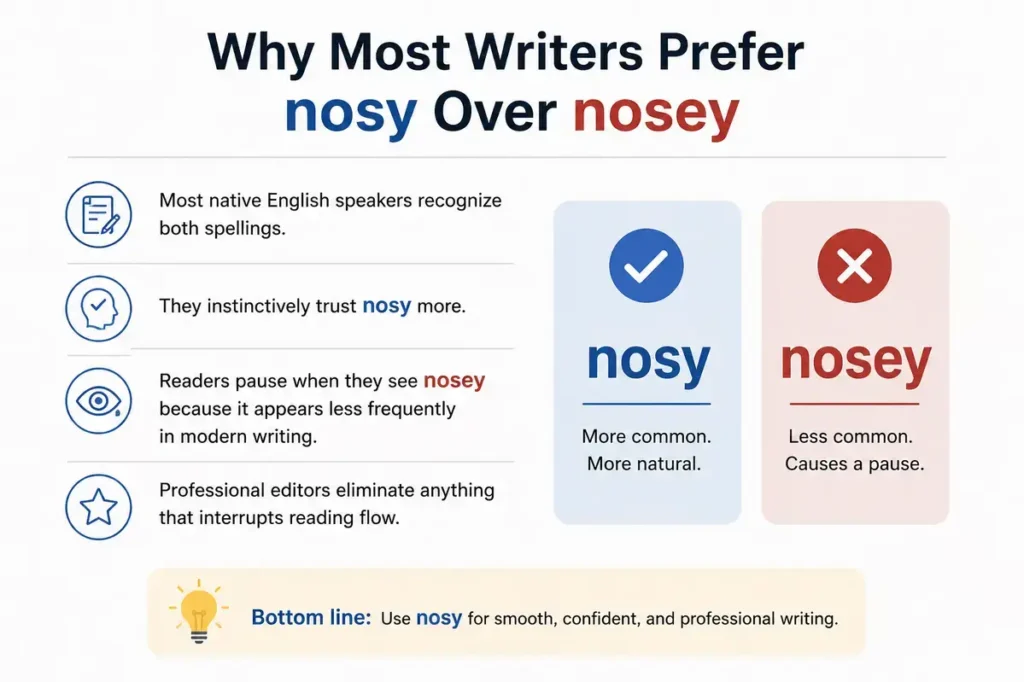
An experienced editor would not mark nosey as simply wrong, because it is an established spelling. For American English, I would normally choose nosy because it is the more natural US form. For British English, nosey is entirely reasonable. The bigger editorial issue is tone. Both words are informal and can sound judgmental, so a professional writer should consider alternatives such as intrusive or overly inquisitive when precision and neutrality matter. The best practical rule is to choose the regional spelling that matches your audience and then use it consistently.
Key Takeaways
- Nosy and nosey are both established English spellings.
- Both forms mean overly curious about another person’s private affairs.
- Nosy is generally the preferred spelling for American English.
- Nosey is especially common in British English.
- Both forms are adjectives.
- Both forms have the same basic pronunciation.
- Both forms are generally informal.
- Curious is broader and more neutral than nosy.
- Intrusive can be a better choice in formal writing.
- The most important editorial rule is to choose one spelling that fits your audience and use it consistently.
Conclusion
The question of nosy or nosey has a useful answer because both spellings are legitimate. Nosy is the usual choice for American English, while nosey is especially common in British English. Neither spelling changes the meaning or pronunciation, so the real difference is regional preference and style.
Both words describe excessive curiosity about another person’s private affairs. They can sound playful between friends but can also feel critical when used seriously. If you need a more formal expression, intrusive or overly inquisitive may communicate the idea with greater neutrality.
For US writing, my practical recommendation is simple: choose nosy and stay consistent. If you’re writing for British readers, nosey is a natural option. The key is not to treat a regional spelling preference as a spelling error.
FAQs
Is nosy or nosey correct?
Both nosy and nosey are accepted English spellings. They have the same basic meaning and pronunciation. Nosy is generally more common in American English, while nosey is especially common in British English. For a US audience, nosy is usually the better default. Neither spelling should automatically be labeled incorrect.
Is nosey a British spelling?
Nosey is commonly used in British English, but it isn’t exclusively British. The form also appears in other varieties of English. American English tends to favor nosy, while British writing often uses nosey. The two forms have the same meaning, so the distinction is mainly one of regional spelling preference rather than definition.
What does nosy mean?
Nosy describes someone who is too interested in other people’s private affairs. It often refers to someone who asks personal questions, watches what others are doing, or tries to discover information that doesn’t concern them. The word is usually negative but can sound playful when friends use it with each other.
Is nosy informal?
Yes. Nosy is generally an informal adjective. It works naturally in conversation, casual writing, dialogue, social media, and friendly communication. In formal documents, a more neutral term such as intrusive, overly inquisitive, or excessively personal may work better. The right choice depends on how strongly you want to judge the behavior.
Are nosy and curious synonyms?
They are related but not exact synonyms. Curious usually means interested in learning or knowing something and can have a positive or neutral meaning. Nosy suggests that someone’s curiosity has crossed a social boundary. A curious student may ask many questions about science, while a nosy neighbor may ask private questions about someone’s personal life.
How do you pronounce nosy and nosey?
Both spellings are normally pronounced the same way: approximately NOH zee. The common IPA representation is /ˈnoʊzi/. They have two syllables with the strongest stress on the first syllable. The extra e in nosey does not create an additional sound or syllable.
Why are there two spellings?
The two spellings developed around the same connection with the word nose and the idea of putting your nose into other people’s affairs. English allows spelling variants to survive over time. Nosy became especially common in American English, while nosey remains widely used in British English and elsewhere.
Which spelling should I use in American English?
Use nosy as your default in American English. It is the more common US spelling and will look natural to most American readers. Nosey is still understandable and established, but it may feel more British or less familiar to some US readers. In professional content, consistency matters more than switching between forms.

Confusing Words, Spelling & Word Choice
Claire Whitmore is a U.S.-based English editor who writes about commonly confused words, spelling differences, and word choice. Her work helps readers understand subtle distinctions between similar-looking words through simple definitions, practical examples, and modern usage guidance in both American and British English.