
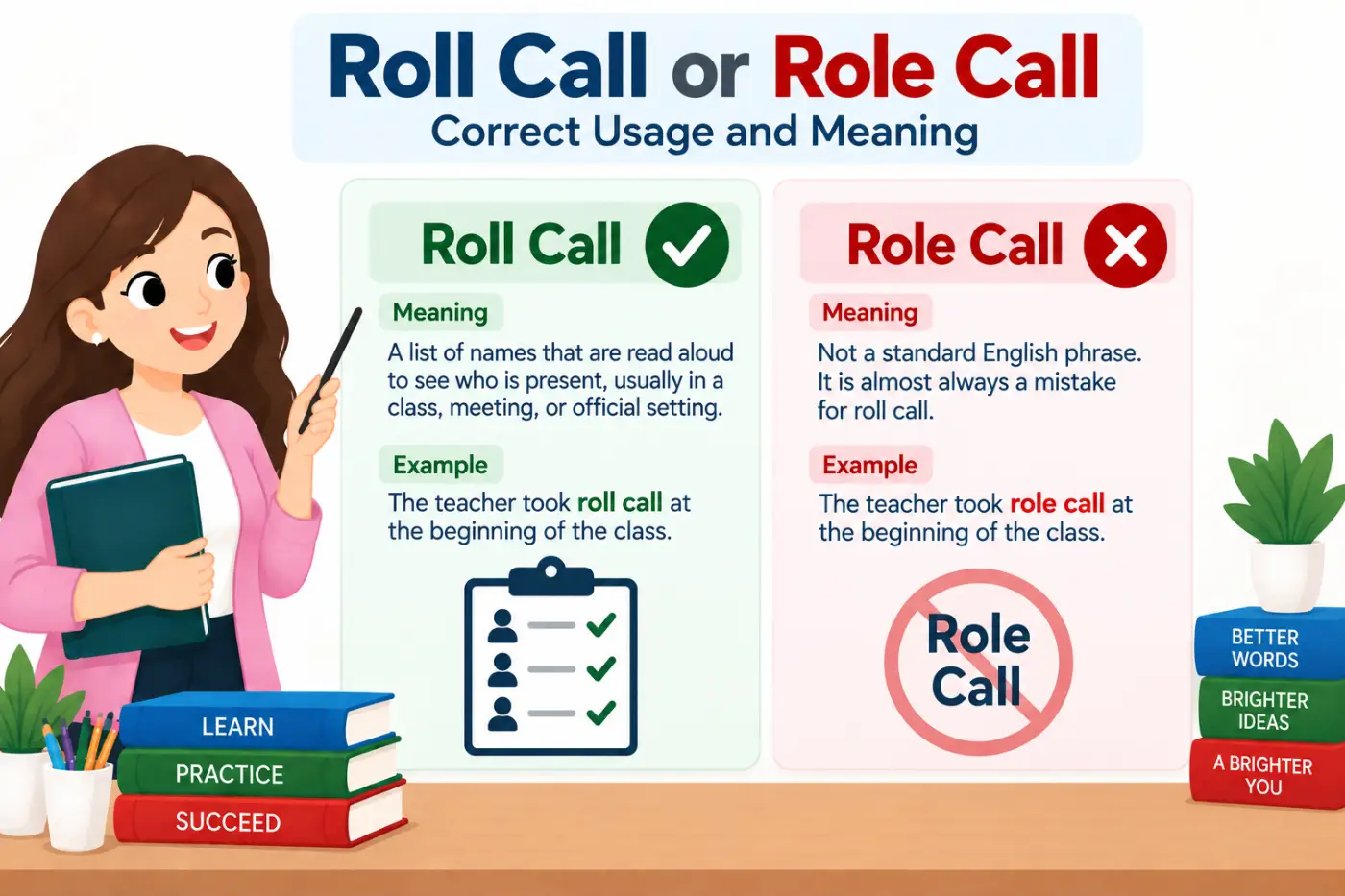
roll call or role call can be confusing because the two phrases sound exactly the same in ordinary American English. If you’re talking about a teacher checking attendance or a group leader confirming who is present the correct expression is roll call. The word roll refers to a list of names while role refers to a function or part that someone performs.
This is a classic homophone problem. English contains many words that sound alike but have different spellings and meanings. Since you can’t hear the difference between roll and role the correct choice depends entirely on the meaning you want to express. That makes this mistake especially common in emails school writing workplace messages and quick online searches.
The good news is that the distinction is easy once you connect each word with its meaning. This guide explains the difference between the two phrases their origins grammar pronunciation common mistakes and natural examples. You’ll also learn a simple memory trick that can help you choose the right form without having to stop and think about it every time.
Short Answer
Roll call is the standard expression when you mean calling the names of people to check who is present. Role call is generally incorrect for this meaning. The confusion comes from the words sounding alike even though roll and role have different meanings and histories.
Table of Contents
- Quick Answer
- Meaning of Roll Call
- Meaning of Role Call
- The Main Difference
- Why Roll Call Is Correct
- Comparison Table
- Examples in Sentences
- Common Mistakes
- Pronunciation Guide
- Word Origin
- American and British Usage
- Grammar and Usage Rules
- Real Life Examples
- Related Words and Expressions
- Memory Tips
- Professional Writing Advice
- FAQs
- Key Takeaways
- Conclusion
Meaning of Roll Call
Roll call is a noun phrase that means the process of reading or calling a list of names to find out who is present.
A teacher might conduct roll call at the beginning of class. A military officer might conduct roll call to check which members of a unit are present. A meeting organizer might also take roll call before a meeting begins.
The word roll in this expression refers to a list or register of names. Historically a roll could mean a written list or record. That meaning survives in expressions such as a roll of members or the honor roll.
Consider this sentence.
The teacher took roll call before starting the lesson.
The teacher is checking the attendance list. That is exactly the situation where the phrase belongs.
You can also say:
The coach took roll call before practice.
Here the coach wants to know which players have arrived.
The expression can describe both the action and the scheduled procedure.
Roll call begins at nine o’clock.
We have roll call every morning.
She was absent during roll call.
All three sentences use the phrase naturally.
Meaning of Role Call
Role call is generally not the standard expression for checking attendance.
The word role means a function position responsibility or character that someone has in a particular situation.
For example:
Her role is to manage the project.
He played the role of the detective in the movie.
Everyone has an important role on the team.
None of these meanings involves reading a list of names.
This explains the basic error. Someone hears the phrase roll call and thinks of the familiar word role because both words have the same pronunciation. But the intended meaning requires the word roll.
There can be unusual contexts in which someone could deliberately write role call as a creative expression. A writer might invent it to describe calling out people’s roles rather than their names. That would be a special stylistic use rather than the standard phrase for attendance.
For normal writing the rule is simple.
Use roll call for attendance.
Use role when talking about someone’s function position character or responsibility.
The Main Difference
The difference between these two forms is based on meaning.
- Roll can refer to a list or register of names. That is why roll call refers to checking attendance.
- Role refers to a function responsibility character or part played by someone.
- Roll call is an established English phrase.
- Role call is not the standard expression for attendance.
- Both words are pronounced the same in standard American English which makes the mistake easy to make when writing from memory.
The simplest comparison is this.
Roll means a list.
Role means a function.
When a teacher calls names from a list the word you need is roll.
When you describe what someone does in a group the word you need is role.
That one distinction solves most cases.
Why Roll Call Is Correct
The phrase comes from the older meaning of roll as a written list or register.
English has used roll in the sense of a list for centuries. You can still see that meaning in expressions such as membership roll and honor roll.
A roll is not limited to something that physically rolls. English has several meanings for the same word. In this case the relevant meaning is a formal list of names.
That makes the phrase logical.
Roll call means calling the names on a roll.
The expression therefore has nothing to do with the word role.
Role has a different historical path and meaning. It refers to a part played by a person and is commonly associated with responsibilities social functions and characters in performances.
The two words eventually became homophones in modern English. Their pronunciation merged while their spelling and meanings remained different.
This is a familiar pattern in English. Words can share a pronunciation without sharing a meaning.
Comparison Table
| Expression | Meaning | Part of Speech | Correct for Attendance | Common Context | Example |
|---|---|---|---|---|---|
| Roll call | Calling names from an attendance list | Noun phrase | Yes | School military meetings events | The teacher took roll call. |
| Role | A function responsibility or character | Noun | No | Work teams theater social situations | Her role is to lead the group. |
| Role call | Usually a mistaken form of roll call | Noun phrase | No | Spelling and usage errors | The writer corrected role call to roll call. |
| Roll | A list or register in this expression | Noun | Yes as part of the phrase | Attendance records membership records | The names are on the roll. |
Examples in Sentences
Examples With Roll Call
- The teacher took roll call before the first lesson.
This means the teacher checked which students were present.
- We have roll call every morning at eight.
The phrase describes a regular attendance procedure.
- The captain called roll before the ship left port.
Here roll call confirms which people are present.
- I arrived just before roll call ended.
The sentence describes arriving during the attendance check.
- The coach asked an assistant to handle roll call.
The assistant is responsible for checking attendance.
- Everyone must be present for roll call.
This sentence makes attendance the central issue.
- The meeting started after roll call.
The attendance check happened before the main event.
- She missed roll call because her train was delayed.
The phrase identifies the attendance check she missed.
- The instructor completed roll call in a few minutes.
This describes the action of checking names.
- Students stood quietly while the teacher conducted roll call.
The sentence gives a natural classroom context.
Examples With Role
- Her role is to organize the event.
Here role means responsibility.
- He plays the role of a doctor in the movie.
Here role means a character portrayed by an actor.
- Everyone has a role to play on the team.
The word describes each person’s contribution.
- My role in the project changed after the meeting.
Here role refers to a person’s position or responsibility.
- The manager explained my role clearly.
The manager explained what the person was expected to do.
These examples show why role cannot normally replace roll in the attendance phrase.
Common Mistakes
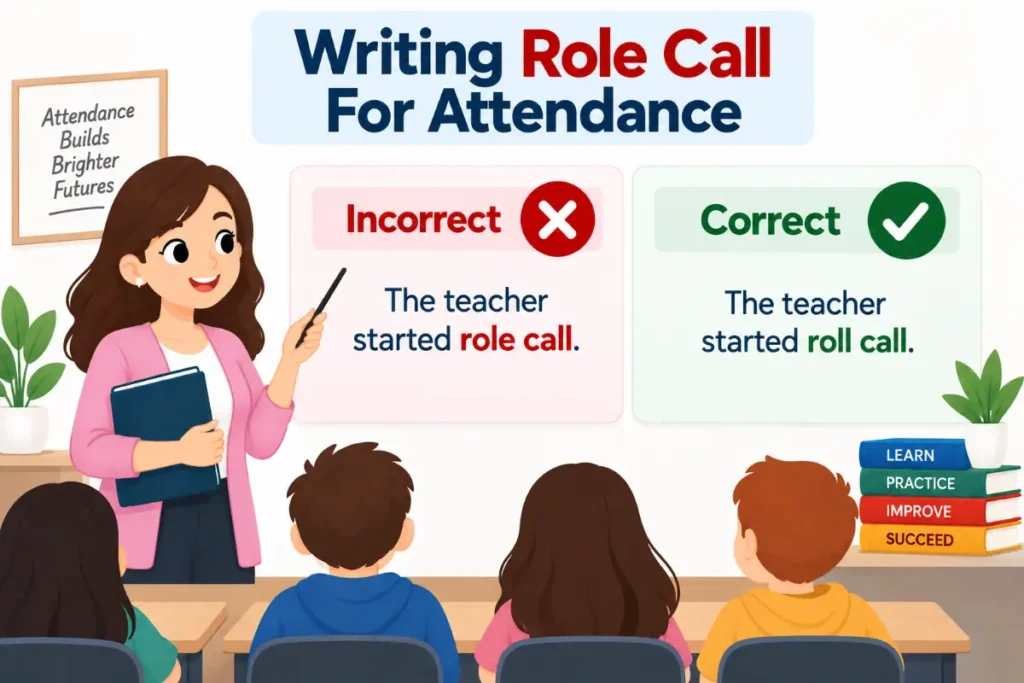
Writing Role Call For Attendance
Incorrect: The teacher started role call.
Correct: The teacher started roll call.
The mistake happens because role and roll sound alike.
Confusing Roll With Role
Incorrect: What is your roll in the company?
Correct: What is your role in the company?
Here the intended meaning is responsibility or position so role is needed.
Using Roll When You Mean Role
This error works in the opposite direction.
Incorrect: She has an important roll on the team.
Correct: She has an important role on the team.
A team member has a role rather than a roll.
Assuming Pronunciation Will Help
It won’t.
In standard American English roll and role are homophones. You cannot reliably determine the spelling from the sound alone.
That means context has to guide your choice.
Relying On Spellcheck Alone
A spelling tool may not catch every homophone error because both roll and role are legitimate English words. If you type role call a basic spelling checker may recognize both words individually.
This is why proofreading requires attention to meaning rather than spelling alone.
A word can be spelled correctly and still be wrong for the sentence.
Pronunciation Guide
Roll and role have the same standard pronunciation in American English.
The IPA pronunciation is commonly represented as:
/roʊl/
The sound is similar to the word whole with an r at the beginning.
The phrase is pronounced naturally as:
roll call
Because roll and role sound alike you cannot hear the spelling difference.
This is the defining feature of a homophone.
Other familiar homophones include:
there and their
to and too
right and write
flower and flour
The same basic problem occurs here. Your ears hear one sound while your writing needs one of two different spellings.
The best way to learn the distinction is to connect each spelling with a meaning rather than a sound.
Roll connects with a list.
Role connects with a function.
Word Origin
The word roll has a long history in English and is connected with the idea of something rolled or a written document that was rolled up. Over time the word developed several meanings including a list or register.
The meaning of roll as a list is the key to understanding the phrase.
A written record of names could be called a roll. Calling the names from that record naturally became known as roll call.
The word role has a different history. It entered English through French and ultimately traces back to a word associated with a written part or script for an actor. From there it developed into the modern idea of a character played by an actor and later a function or position performed by a person.
The two words therefore have different origins even though their modern pronunciations are identical.
That historical difference gives you another reason not to treat them as interchangeable.
American and British Usage
American English
In American English roll call is the standard expression for checking attendance.
You’ll commonly see it in schools military settings government meetings formal organizations and other situations where people need to confirm who is present.
For example:
The teacher took roll call at the start of class.
The spelling remains the same in ordinary American writing.
British English
British English also uses roll call for an attendance check.
The meaning and spelling are essentially the same. There is no major British spelling change that turns roll call into role call.
British speakers may also use attendance register or simply register depending on the setting.
Australian English
Australian English follows the same general distinction. Roll call can refer to the process of checking attendance while role refers to a person’s function or responsibility.
The pronunciation does not provide a reliable clue because the two words remain homophones.
Canadian English
Canadian English also uses roll call as the established phrase for checking attendance.
The distinction between roll and role follows the same basic rule found in American and British English.
There is therefore no meaningful regional spelling difference here. The problem is a homophone issue rather than an American versus British spelling issue.
Grammar and Usage Rules
Roll call functions as a noun phrase.
It can act as the subject of a sentence.
Roll call begins at nine.
It can also appear as the object of a verb.
The teacher took roll call.
The expression commonly appears with verbs such as take, call, conduct, and complete.
Take Roll Call
This is a common construction.
The teacher took roll call.
It means the teacher checked attendance.
Call Roll
You may also hear call roll in some settings.
The instructor called roll before the test.
The meaning is still an attendance check.
Conduct Roll Call
This construction sounds somewhat more formal.
The officer conducted roll call before departure.
It emphasizes the process.
At Roll Call
The phrase can also identify the time or setting.
He was absent at roll call.
This means he was not present when attendance was checked.
Roll Call As A Compound Noun
Roll call is normally written as two words.
Example
Roll call begins at ten.
It is not normally written as one word.
The expression has become a fixed phrase even though each word retains its own spelling and meaning.
Real Life Examples
Daily Conversation
Did you make it to roll call this morning?
This could be said by a student discussing attendance.
I was late and missed roll call.
The speaker explains that they arrived after attendance was taken.
Workplace Communication
Please make sure everyone is present before roll call begins.
This could fit a meeting or organized event.
We’ll start the meeting immediately after roll call.
The sentence clearly separates attendance from the main meeting.
Academic Writing
The instructor recorded attendance during roll call.
This is suitable for a discussion of classroom procedures.
Students who arrive after roll call must report to the office.
The phrase works naturally in a formal school policy.
News Writing
Officials conducted roll call before the emergency response team left the building.
This describes an organized group checking its members.
The organization released its annual roll call of participating members.
Here the phrase can also be used more broadly for a listed group.
Literature And Storytelling
At roll call he discovered that two soldiers were missing.
The phrase helps establish a scene involving an organized group.
The teacher paused during roll call when she noticed an unfamiliar name.
Here the phrase becomes part of the story rather than simply an attendance procedure.
Roll And Role Beyond The Phrase
Understanding the individual words makes the phrase much easier to remember.
Roll
Roll can have many meanings.
It can describe movement.
The ball began to roll down the hill.
It can refer to a list.
Her name appears on the membership roll.
It can describe a cylindrical shape.
He rolled the paper into a tube.
It can also describe movement such as a rolling wave or a rolling vehicle.
The list meaning is the one that matters in roll call.
Role
Role has a much narrower core idea.
It can mean a person’s function.
My role is to answer customer questions.
It can describe a position in a group.
She has an important role on the committee.
It can also mean a character in a play movie or story.
He played the role of a detective.
Once you know these meanings the phrase becomes logical.
Why This Homophone Causes So Many Errors
Homophones create a special kind of spelling problem because pronunciation gives you no useful distinction.
If someone says:
I have to take roll call.
You hear the correct phrase but you don’t see the spelling.
If someone says:
My role is to take attendance.
The word role has a completely different meaning but it sounds the same.
This is why writers sometimes choose the wrong spelling even when they understand the phrase perfectly.
Typing also makes the problem worse. When people write quickly they often choose the spelling that looks familiar or appears first in their mental vocabulary.
Context solves the problem.
Ask yourself one question.
Am I talking about a list of names or a function?
If you mean a list of names use roll.
If you mean a function responsibility or character use role.
That simple question is more useful than trying to hear a difference that isn’t there.
Memory Tips
The easiest memory trick is:
Roll call uses a roll of names.
Imagine a teacher holding a list of students. That list is the roll. The teacher calls the names from the roll.
Now compare it with role.
Role means what someone does.
Your role at work might be manager teacher driver editor or assistant.
Your roll is not your function.
Another useful memory sentence is:
Names go on a roll. People have roles.
That line separates the two meanings in a way that is easy to recall.
You can also connect roll with other expressions involving lists.
Honor roll.
Membership roll.
Attendance roll.
These examples reinforce the list meaning.
Then connect role with words such as:
Job.
Function.
Responsibility.
Character.
Once you build those mental connections the spelling choice becomes almost automatic.
Professional Writing Advice
From an editing perspective this is a classic example of why proofreading must consider meaning. Both roll and role are correctly spelled words so a simple spellchecker may not recognize that role call is wrong in an attendance context. A professional editor looks at the phrase as a whole and asks what the writer intends to say. The best practical tip is to replace the phrase mentally with calling names from a list. If that is the intended meaning then roll is the word you need.
Related Words And Expressions
Attendance
Attendance means being present at a place or event. It is closely connected with roll call because checking attendance is usually the purpose of the process.
Register
A register can mean an official list of names. In some settings people use register instead of roll call.
Attendance List
This is a plain language alternative that clearly describes a list of people who should be present.
Honor Roll
An honor roll is a list recognizing people for achievement or high performance. It reinforces the list meaning of roll.
Membership Roll
A membership roll is a list of members belonging to an organization.
Role
Role means a person’s function position responsibility or character.
Responsibility
Responsibility describes something a person is expected to do. It connects naturally with role.
Function
Function refers to the purpose or job performed by a person or thing. It is one of the clearest synonyms for the central meaning of role.
These related terms help show why roll and role belong to different semantic groups even though they sound alike.
Key Takeaways
- Roll call is the standard phrase for checking attendance.
- Role call is generally incorrect when you mean an attendance check.
- Roll can mean a list or register of names.
- Role means a function responsibility position or character.
- Roll and role are homophones in standard American English.
- Pronunciation cannot tell you which spelling to choose.
- Context determines the correct spelling.
- A simple memory trick is that names go on a roll while people have roles.
Conclusion
roll call or role call has a clear answer when you’re talking about attendance. The correct expression is roll call because roll can mean a list or register of names. Role refers to a function responsibility position or character so role call does not normally express the idea of checking attendance.
The two words sound the same which explains why the mistake is so common. Your ears cannot tell you which spelling belongs on the page. You need to focus on meaning instead. If someone is calling names from a list use roll. If you’re describing what a person does use role.
A simple memory trick can make the choice effortless. Names go on a roll and people have roles. Remember that distinction and you’ll have a reliable way to avoid this homophone mistake in school work professional writing and everyday communication.
FAQs
Is role call correct for attendance?
No. The standard phrase for checking who is present is roll call. The word roll refers to a list or register of names. Role has a different meaning and refers to a function responsibility position or character. Because roll and role sound the same it’s easy to confuse them in writing, but they are not interchangeable in this expression.
Why is it called roll call?
It is called roll call because a roll can mean a written list or register of names. When someone calls the names from that list the process is called roll call. The word roll has nothing to do with physical rolling in this expression. Its meaning as a list explains why the spelling uses roll rather than role.
What is the difference between roll and role?
Roll has many meanings including a list or register. Role means a function responsibility position or character. In roll call the relevant meaning of roll is a list of names. In a sentence such as She has an important role the word describes her function. The two words sound alike but their meanings and spellings are different.
Is roll call one word or two?
Roll call is normally written as two words. It functions as a fixed noun phrase meaning the process of calling names to check attendance. Writing it as one word is not the standard form. In ordinary school workplace military and organizational writing use the two word expression roll call when referring to attendance.
Can roll call be used outside school?
Yes. Roll call is not limited to classrooms. It can be used in military organizations meetings teams emergency response groups and other organized settings where people need to confirm attendance. The basic meaning stays the same. Someone checks a list of names to determine who is present.
What is another word for roll call?
Depending on the setting you can use attendance check attendance list or taking attendance. In some British contexts register may also express a similar idea. However these alternatives are not always exact replacements. Roll call specifically suggests calling or checking names from a list while taking attendance can describe the broader process.
How do you remember roll call instead of role call?
Think of roll as a list of names. A teacher calls names from a roll. Then think of role as a job function or responsibility. A person has a role in a team or organization. The memory sentence Names go on a roll and people have roles captures the distinction in a simple way.
Is roll call formal or informal?
Roll call is neutral and can work in both ordinary and formal contexts. You might hear it in a classroom or see it in an official organizational procedure. The phrase itself is not overly formal. Your surrounding vocabulary determines the overall tone. In a casual setting you can also say taking attendance.

Confusing Words, Spelling & Word Choice
Claire Whitmore is a U.S.-based English editor who writes about commonly confused words, spelling differences, and word choice. Her work helps readers understand subtle distinctions between similar-looking words through simple definitions, practical examples, and modern usage guidance in both American and British English.