
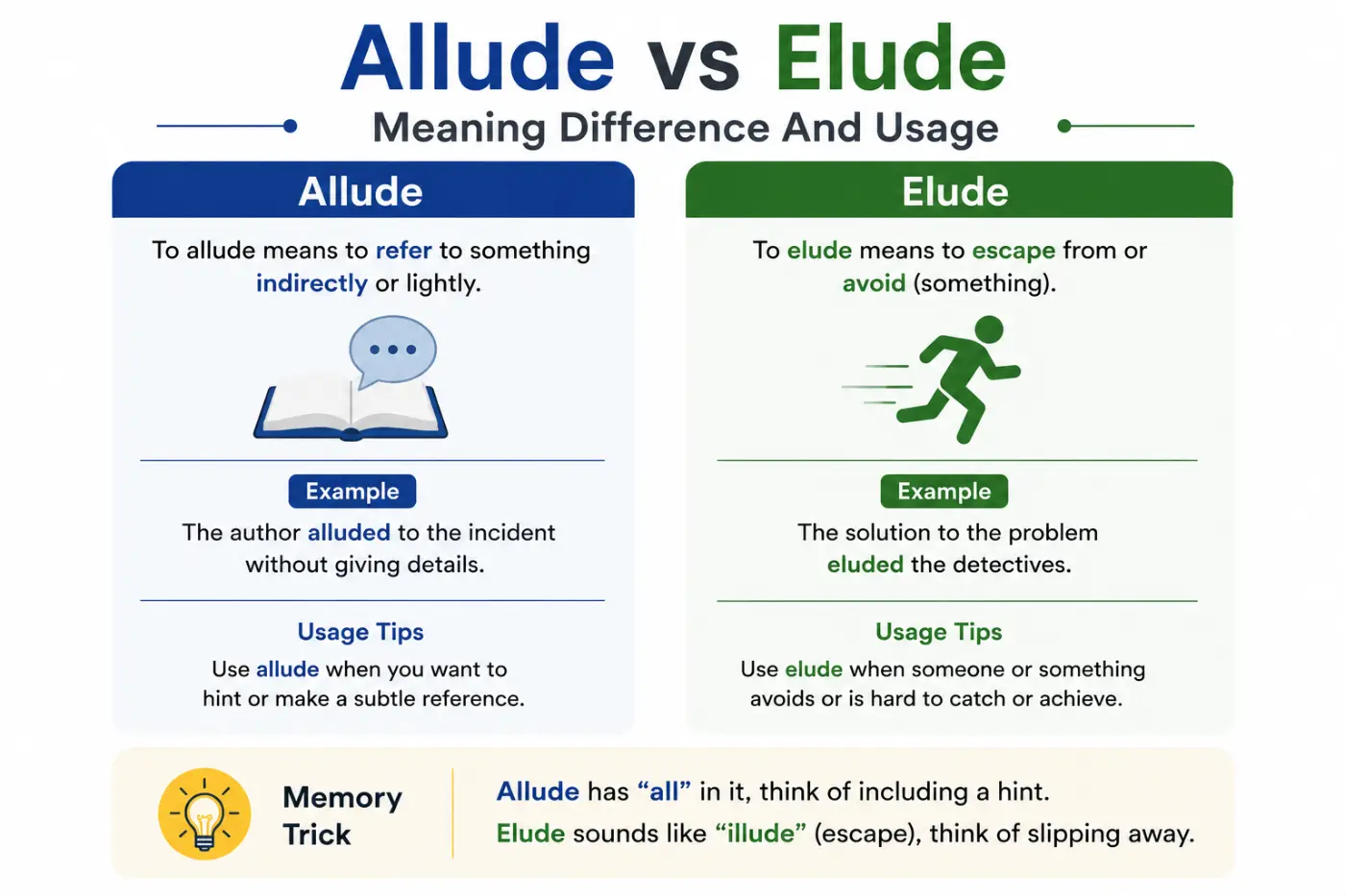
Allude vs Elude is a classic English word confusion because the two verbs look and sound remarkably similar. They differ by only one letter, yet they describe completely different ideas. Allude means to refer to something indirectly, while elude means to escape from something or remain difficult to grasp. Mixing them up can change the meaning of an otherwise perfectly clear sentence.
The confusion makes sense because both words have a similar pronunciation and both come from older French and Latin language roots. They also appear in formal writing more often than in casual conversation. That means you may recognize them when reading but still hesitate when it’s time to use one in your own sentence.
Once you connect each word with its core idea, the distinction becomes much easier. This guide explains their meanings, grammar, pronunciation, origins, regional usage, common mistakes, sentence patterns, and memory tricks. You’ll also see how native speakers use each word and how a professional editor can quickly spot the difference.
Short Answer
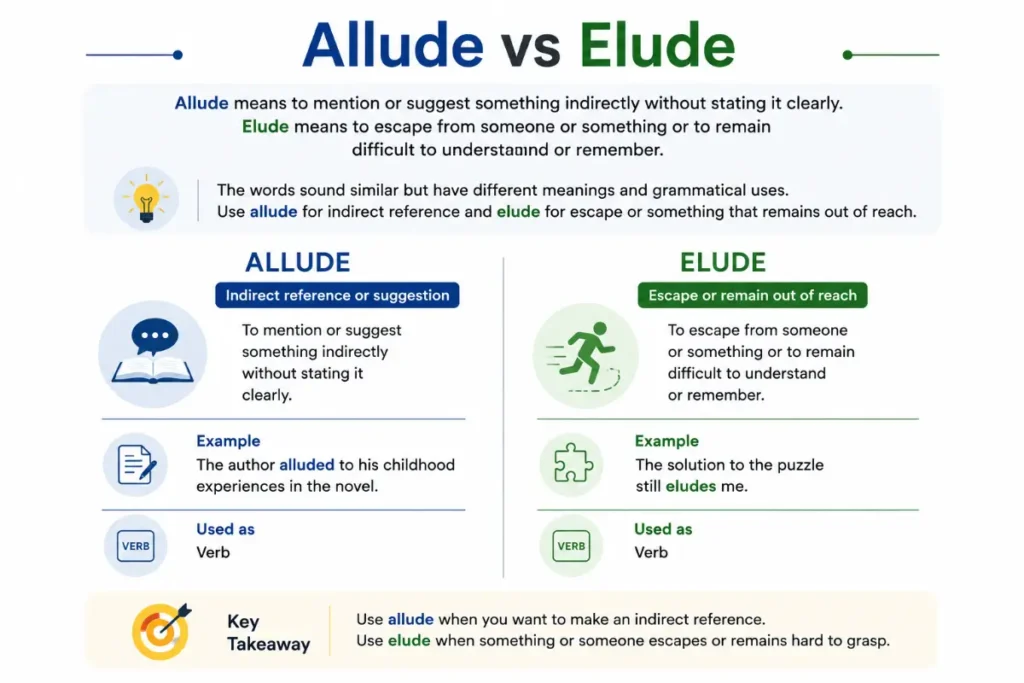
Allude means to mention or suggest something indirectly without stating it clearly. Elude means to escape from someone or something or to remain difficult to understand or remember. The words sound similar but have different meanings and grammatical uses. Use allude for indirect reference and elude for escape or something that remains out of reach.
Table Of Contents
- The Basic Difference.
- Allude Meaning And Definition.
- Elude Meaning And Definition.
- Allude vs Elude In Plain English.
- Comparison Table.
- How To Use Allude Correctly.
- How To Use Elude Correctly.
- Grammar Patterns And Sentence Structure.
- Pronunciation Guide.
- Word Origin And Etymology.
- American And British Usage.
- Formal And Informal Usage.
- Real Life Examples.
- Common Mistakes.
- Related Words And Expressions.
- Memory Tips.
- Expert Editor Insight.
- Key Takeaways.
- FAQs.
- Conclusion.
The Basic Difference
The easiest way to separate these words is to focus on their central meanings.
Allude means to refer to something indirectly.
Elude means to escape from something or remain difficult to achieve, understand, identify, or remember.
Consider these two sentences:
The speaker alluded to the disagreement.
The suspect eluded the police.
In the first sentence, the speaker refers to the disagreement without explaining it directly.
In the second sentence, the suspect escapes the police.
The meanings are completely different.
A useful mental picture is this:
Allude points toward an idea.
Elude moves away from a threat or stays out of reach.
That simple contrast covers most everyday uses.
Allude Meaning And Definition
Allude is a verb meaning to mention or refer to something indirectly.
When you allude to something, you don’t explain it fully. You expect the listener or reader to understand the reference from context.
For example:
The author alluded to a difficult childhood.
The sentence doesn’t tell us exactly what happened during the childhood. It simply hints at it.
Another example is:
She alluded to problems at work but didn’t give any details.
The speaker referred to the problems without discussing them directly.
This indirect quality is the heart of the word.
You can think of allude as a subtle verbal nod. Instead of pointing directly at something, you give the reader enough information to recognize what you’re talking about.
Common Meaning Of Allude
The most common definition is to refer to something indirectly.
For example:
The politician alluded to recent criticism.
The teacher alluded to an upcoming change.
The novel alludes to several historical events.
In every example, the subject refers to something without providing a complete explanation.
Allude Usually Takes To
A very common grammatical pattern is:
allude to something.
For example:
The article alludes to the economic crisis.
He alluded to his previous experience.
She alluded to a conversation we had earlier.
The preposition to is an important part of the normal construction.
You wouldn’t normally write:
He alluded the problem.
You would write:
He alluded to the problem.
This small grammar point is worth remembering because it helps distinguish correct usage.
Elude Meaning And Definition
Elude is a verb with several related meanings.
Its original and most concrete meaning is to escape from someone or something.
For example:
The suspect eluded the police.
The criminal eluded capture.
The fox eluded the hunters.
In each sentence, someone or something successfully avoids being caught.
The word also has a broader figurative meaning. Something can elude you when you can’t find it, understand it, remember it, or achieve it.
For example:
The answer eluded me.
Sleep eluded him all night.
The perfect solution continued to elude the researchers.
In these sentences, nobody is physically running away. Instead, the desired thing remains out of reach.
Elude As Escape
The physical meaning is straightforward.
The thief eluded the guards.
The driver eluded the pursuing officers.
The animal eluded its pursuers.
The subject avoids being caught.
Elude As Remain Out Of Reach
The figurative use is extremely common in educated writing.
For example:
The meaning of the poem eluded me.
The cause of the problem eluded investigators.
A peaceful night’s sleep eluded her.
The championship continued to elude the team.
Here, elude suggests that something remains difficult to obtain, understand, discover, or experience.
This broader meaning makes the word especially useful in journalism, academic writing, literature, and professional communication.
Allude vs Elude In Plain English
If you want a quick rule, remember this:
Allude means hint.
Elude means escape or remain out of reach.
Imagine that you’re talking about a secret.
If you allude to the secret, you hint at it.
If the secret eludes you, you can’t discover it.
Now imagine a police chase.
If a suspect eludes the police, the suspect gets away.
If a witness alludes to the suspect, the witness makes an indirect reference.
The words may sound similar, but their actions point in opposite directions.
Allude brings an idea into the conversation indirectly.
Elude keeps a person or idea beyond your grasp.
Comparison Table
| Word | Part Of Speech | Core Meaning | Common Pattern | Example | Main Idea |
|---|---|---|---|---|---|
| allude | Verb | Refer to something indirectly | allude to something | She alluded to the problem. | Hint |
| elude | Verb | Escape or remain out of reach | elude someone or something | The suspect eluded the police. | Escape |
| allusion | Noun | An indirect reference | make an allusion to | The poem contains an allusion to mythology. | Indirect reference |
| elusive | Adjective | Difficult to find or understand | elusive answer | The solution remained elusive. | Hard to grasp |
| allusive | Adjective | Indirect or suggestive | allusive language | His allusive comments caused confusion. | Indirect |
| elusion | Noun | The act of escaping or avoiding | elusion of capture | The elusion of the guards surprised everyone. | Escape |
The table shows an important family connection.
Allude connects with allusion.
Elude connects with elusive.
Learning the related forms gives you another way to keep the words apart.
How To Use Allude Correctly
The most common structure is allude to.
For example:
The speaker alluded to the controversy.
The writer alluded to an earlier chapter.
The professor alluded to a famous experiment.
The actor alluded to his retirement plans.
Each sentence contains an indirect reference.
Allude In Conversation
You can use the word in everyday speech, although people often choose simpler phrases such as hint at, mention, or refer to.
For example:
He alluded to some personal problems.
This sounds more formal than:
He hinted at some personal problems.
Both sentences communicate a similar idea.
Allude In Academic Writing
Academic writers often use allude when discussing texts and ideas.
For example:
The author alludes to classical mythology throughout the novel.
The researcher alludes to earlier studies in the introduction.
The article alludes to several historical debates.
Here, the word works well because academic writing frequently discusses indirect references.
Allude In Literature
Literary writing uses allude and allusion frequently.
For example:
The poem alludes to Greek mythology.
The novel alludes to several biblical stories.
The author alludes to Shakespeare without directly naming him.
The writer expects readers to recognize the reference.
How To Use Elude Correctly
Elude can describe physical escape.
For example:
The prisoner eluded the guards.
The animal eluded its pursuers.
The suspect eluded capture.
It can also describe an abstract thing that remains out of reach.
For example:
The answer eluded me.
A clear explanation eluded the speaker.
Success continued to elude the athlete.
Elude With People
When someone escapes another person or group, elude often takes the person or group as its object.
The suspect eluded the police.
The runner eluded his opponents.
The fugitive eluded the authorities.
The basic idea is successful avoidance.
Elude With Abstract Nouns
This is where many advanced uses appear.
The solution eluded the scientists.
The reason for the failure eluded the investigators.
A good night’s sleep eluded me.
The meaning of the sentence eluded him.
In these examples, the subject isn’t escaping in a literal sense. The desired thing simply remains difficult to obtain or understand.
Grammar Patterns And Sentence Structure
Both words are verbs, but their grammatical patterns differ.
The Pattern For Allude
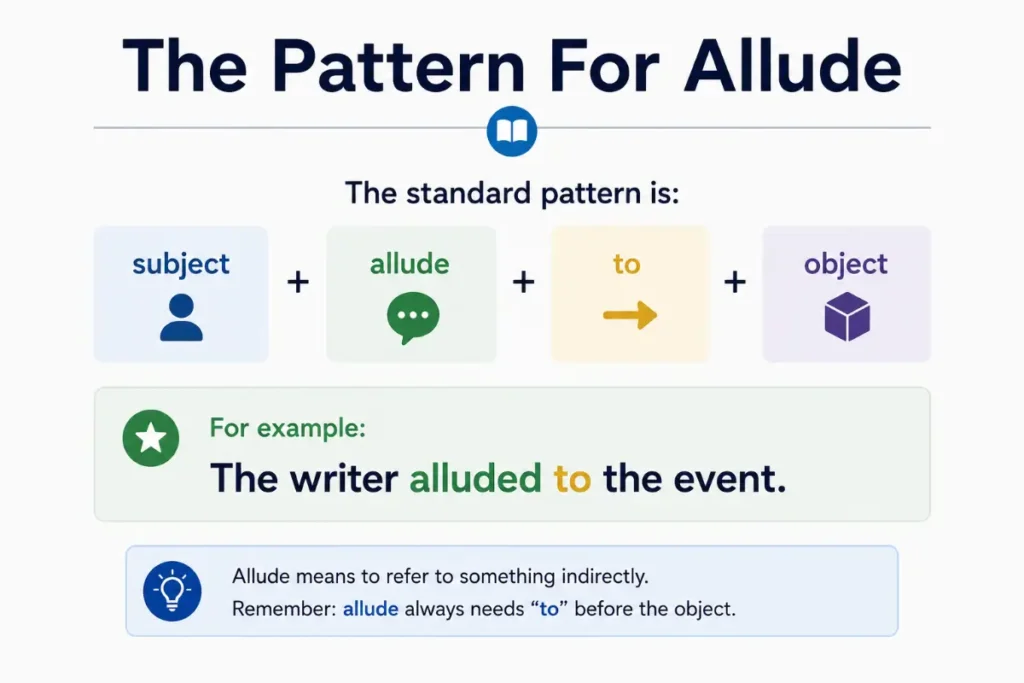
The standard pattern is:
subject plus allude plus to plus object.
For example:
The writer alluded to the event.
The manager alluded to future changes.
The speaker alluded to an earlier disagreement.
The word to matters.
The Pattern For Elude
The common pattern is:
subject plus elude plus object.
For example:
The suspect eluded the police.
The answer eluded me.
The solution eluded the researchers.
Notice that elude doesn’t normally need to before its object.
This gives you a useful grammar test.
If you’re trying to say that someone indirectly referred to something, use allude to.
If you’re trying to say that something escaped or remained out of reach, use elude.
Pronunciation Guide
The two words are close in pronunciation.
Allude is commonly pronounced:
uh LOOD
The second syllable receives the main stress.
The IPA pronunciation is commonly represented as /əˈluːd/.
Elude is commonly pronounced:
ih LOOD
Again, the second syllable receives the main stress.
The IPA pronunciation is commonly represented as /ɪˈluːd/.
The final sound is the same in both words.
The main difference occurs in the first vowel sound.
This small pronunciation difference isn’t always obvious in rapid speech, which contributes to the confusion.
The related nouns also follow recognizable patterns.
Allusion is pronounced approximately:
uh LOO zhuhn
Elusive is pronounced approximately:
ih LOO siv
Hearing these families together can make the distinction easier to remember.
Word Origin And Etymology
The histories of allude and elude are closely related.
Both words ultimately trace back to Latin.
Allude comes from Latin alludere, meaning to play with or make a reference to. The Latin word combines elements associated with playing or directing oneself toward something. Over time, the meaning developed toward making an indirect reference.
Elude comes from Latin eludere, meaning to escape, avoid, or evade. The word carries the idea of escaping from something through cleverness or avoidance.
The related Latin roots help explain why the English words look alike.
Their histories share a connection, but their meanings developed in different directions.
This is a good reminder that similar spelling doesn’t guarantee similar meaning. English contains many word pairs that look closely related while performing very different jobs.
American And British Usage
Both allude and elude are standard in American and British English.
There is no major regional spelling difference between the two forms.
American writers use:
allude.
elude.
British writers use:
allude.
elude.
The pronunciation can vary slightly by speaker and accent, but the distinction between the words remains the same.
This means you don’t need to choose one form based on your audience’s country. Instead, choose based on meaning.
That’s useful because some English word pairs require a regional choice, while this pair requires a semantic choice.
If you mean indirect reference, use allude.
If you mean escape or something remaining out of reach, use elude.
Formal And Informal Usage
Both words are standard and appropriate in formal writing.
However, allude and elude can sound more formal than simpler alternatives.
In casual conversation, someone might say:
She hinted at the problem.
A more formal version is:
She alluded to the problem.
Likewise:
I couldn’t figure out the answer.
A more formal version might be:
The answer eluded me.
Neither word is outdated. Both remain useful in modern English. The difference is mainly one of precision and register.
If your audience prefers plain language, hint at may be easier than allude to.
If you want concise and polished writing, allude can be an excellent choice.
Real Life Examples
Everyday Conversation
She alluded to a surprise but wouldn’t tell me what it was.
The answer completely eluded me.
The first sentence means she hinted at the surprise.
The second means the speaker couldn’t figure out the answer.
Workplace Writing
The manager alluded to changes that may affect the department.
The cause of the technical problem continued to elude the team.
The first sentence describes an indirect reference.
The second describes something the team couldn’t identify.
Academic Writing
The researcher alludes to earlier studies in the final section.
The reason for the unusual result eluded the researchers.
The first sentence refers indirectly to earlier research.
The second says the researchers couldn’t determine the reason.
Journalism
The mayor alluded to a possible policy change during the interview.
The suspect eluded authorities for several days.
The first sentence describes an indirect statement.
The second describes successful avoidance.
Literature
The poet alludes to ancient mythology throughout the collection.
The deeper meaning of the poem may elude readers on a first reading.
The first sentence concerns literary reference.
The second concerns difficulty understanding meaning.
Common Mistakes
Using Elude When You Mean Allude
Incorrect:
The speaker eluded to the problem.
Correct:
The speaker alluded to the problem.
The first sentence uses the wrong verb. A person cannot normally elude to an idea when the intended meaning is refer indirectly.
Using Allude When You Mean Elude
Incorrect:
The suspect alluded the police.
Correct:
The suspect eluded the police.
The suspect escaped the police, so elude is the appropriate verb.
Forgetting To Use To After Allude
Incorrect:
The author alluded the historical event.
Correct:
The author alluded to the historical event.
Allude to is the normal construction.
Adding To After Elude
Incorrect:
The answer eluded to me.
Correct:
The answer eluded me.
Elude normally takes a direct object.
Confusing Allusion With Illusion
This is another common word pair.
An allusion is an indirect reference.
An illusion is a false appearance or misleading perception.
For example:
The novel contains an allusion to Greek mythology.
The magician created an illusion of floating.
These words sound somewhat alike but have unrelated meanings.
Confusing Elude With Evade
Elude and evade can overlap when discussing escape.
However, evade often emphasizes deliberately avoiding something, such as a question, responsibility, or threat.
For example:
He evaded the question.
The suspect evaded the police.
Elude often emphasizes successfully remaining out of reach.
The suspect eluded the police.
The distinction isn’t absolute, but understanding the emphasis can help you choose the sharper word.
Related Words And Expressions
Allusion
An allusion is an indirect reference.
For example:
The poem contains an allusion to Greek mythology.
The noun is directly connected to allude.
Allusive
Allusive means indirect or suggestive.
For example:
His allusive comments left everyone guessing.
Elusive
Elusive means difficult to find, catch, understand, or achieve.
For example:
The elusive answer finally became clear.
This is one of the best vocabulary connections for remembering elude.
Elusion
Elusion refers to the act of escaping or avoiding.
It is much less common than elusive.
Evade
Evade means to avoid or escape something.
For example:
She evaded the question.
Hint
A hint is an indirect suggestion.
For example:
He hinted that something was wrong.
Hint is often a simpler everyday alternative to allude to.
Refer
Refer can mean to mention or direct attention toward something.
For example:
The report refers to several earlier studies.
This can overlap with allude, but refer doesn’t necessarily imply an indirect or subtle mention.
Allude And Allusion
One of the strongest ways to remember allude is to connect it with allusion.
An allusion is an indirect reference.
Therefore:
If a writer makes an allusion, the writer alludes to something.
For example:
The author alludes to Shakespeare.
The novel contains an allusion to Shakespeare.
The two forms describe the same basic concept from different grammatical angles.
The first is a verb.
The second is a noun.
This relationship is much stronger than trying to memorize the spelling alone.
Elude And Elusive
The same strategy works with elude and elusive.
If something is elusive, it is difficult to catch, find, understand, or achieve.
Therefore:
The answer eludes me.
The answer is elusive.
The meanings are closely connected.
This gives you a powerful vocabulary shortcut.
Think:
allude and allusion belong together.
elude and elusive belong together.
Once these families are stored together in your memory, the spelling becomes less fragile.
How Context Reveals The Correct Word
When you’re unsure, don’t stare at the spelling. Look at the action in the sentence.
Ask yourself:
Is someone making an indirect reference?
If yes, choose allude.
Is someone or something escaping?
Choose elude.
Is something difficult to understand or obtain?
Elude may be the right choice.
For example:
The speaker ___ to the scandal.
The meaning is indirect reference.
Answer:
The speaker alluded to the scandal.
Now:
The meaning of the message ___ me.
The meaning remains difficult to understand.
Answer:
The meaning of the message eluded me.
Context does most of the work.
Memory Tips
The simplest memory trick is:
Allude equals allusion.
Both begin with allu.
If you’re talking about an indirect reference, think allude.
Another useful trick is:
Elude equals elusive.
Both begin with elu.
If something is hard to catch, find, understand, or achieve, think elude.
You can also remember the final sounds.
Both words end in lude, so the first vowel sound carries the main distinction.
Allude points toward a reference.
Elude slips away.
Picture a speaker giving a subtle hint. That’s allude.
Picture a runner escaping a pursuer. That’s elude.
The mental images make the difference stick.
Professional Writing Tips
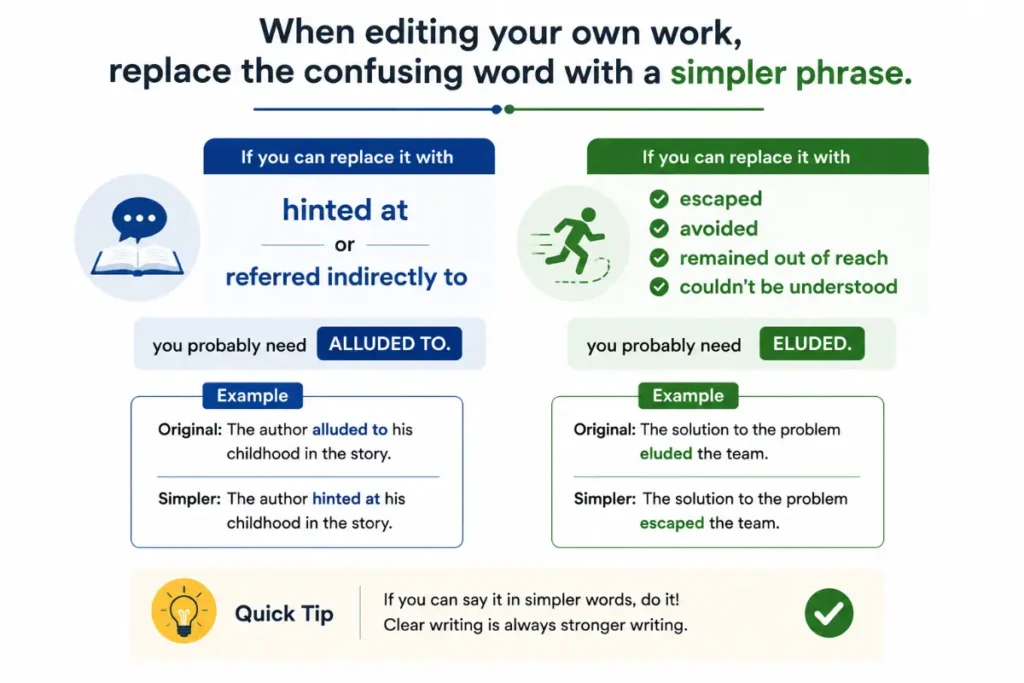
When editing your own work, replace the confusing word with a simpler phrase.
If you can replace it with hinted at or referred indirectly to, you probably need alluded to.
If you can replace it with escaped, avoided, remained out of reach, or couldn’t be understood, you probably need eluded.
For example:
The writer alluded to the issue.
Try the replacement:
The writer hinted at the issue.
The meaning stays intact.
Now:
The answer eluded me.
Try:
I couldn’t find the answer.
Again, the basic meaning stays intact.
This substitution test works quickly because it focuses on meaning rather than spelling.
Expert Editor Insight
A professional editor looks at the verb and its object before worrying about pronunciation or spelling. If the sentence describes an indirect reference, allude to is the natural construction. If it describes escape, avoidance, or something remaining beyond reach, elude is the better choice. The related nouns and adjectives also provide strong clues. Allusion belongs with allude, while elusive belongs with elude. Keeping these word families together is more reliable than memorizing the two verbs in isolation.
Key Takeaways
- Allude means to refer to something indirectly.
- Elude means to escape from something or remain difficult to catch, understand, find, or achieve.
- The normal grammar pattern is allude to something.
- Elude normally takes a direct object without to.
- Allusion is the noun related to allude.
- Elusive is the adjective related to elude.
- Both words are standard in American and British English.
- The words are similar in pronunciation but different in meaning.
- Use allude for hints and indirect references.
- Use elude for escape and things that remain out of reach.
Conclusion
Allude vs Elude becomes much easier when you connect each word with its central idea. Allude means to refer to something indirectly, so you normally say allude to an idea, event, person, or problem. Elude means to escape or remain out of reach, so you can say that a suspect eluded the police or that an answer eluded you.
The spelling difference is small, but the meaning difference is significant. Think of allusion when you see allude, and think of elusive when you see elude. That word family connection gives you a reliable shortcut whenever the two verbs start to blur together.
When you’re editing a sentence, ask one simple question. Is the subject giving an indirect reference, or is something escaping or remaining difficult to reach? If it’s an indirect reference, choose allude. If it’s escape or something beyond your grasp, choose elude.
FAQs
What Is The Difference Between Allude And Elude?
Allude means to refer to something indirectly, often by hinting at it rather than stating it directly. Elude means to escape from someone or something or to remain difficult to find, understand, remember, or achieve. A writer can allude to an idea, while an answer can elude a person.
Is It Allude To Or Elude To?
The correct expression for an indirect reference is allude to. For example, The author alluded to the historical event is correct. Elude normally takes a direct object, so you would say The answer eluded me, not The answer eluded to me. Remember that allude to means refer indirectly.
Is Allude The Same As Hint?
They have closely related meanings, but they aren’t identical in every context. Allude means to refer to something indirectly, while hint can mean to give a subtle clue or suggestion. For example, She alluded to the problem means she referred to it indirectly. She hinted that there was a problem emphasizes the clue or suggestion.
What Does Elude Mean In Simple English?
In simple English, elude means to get away from something or remain difficult to reach. A suspect can elude the police by escaping. An answer can elude you when you can’t figure it out. Sleep can elude you when you can’t fall asleep. The word therefore works for both physical escape and abstract things that stay out of reach.
How Do You Remember Allude And Elude?
Connect each word with a related word. Allude goes with allusion, which means an indirect reference. Elude goes with elusive, which means difficult to catch, find, understand, or achieve. You can also remember the core ideas as allude equals hint and elude equals escape. This simple contrast works in most situations.
Can Elude Mean Avoid?
Yes. Elude can describe successfully avoiding or escaping someone or something. For example, The suspect eluded the police means the suspect avoided capture. However, evade is often more natural when the emphasis is on deliberately avoiding a question, responsibility, or obligation. The two verbs overlap, but context determines the stronger choice.
What Is The Noun Form Of Allude?
The noun related to allude is allusion. An allusion is an indirect reference to a person, event, text, idea, or other subject. For example, The poem contains an allusion to Greek mythology means the poem indirectly refers to Greek mythology. This word family is an excellent memory aid for distinguishing allude from elude.
What Is The Adjective Form Of Elude?
The common adjective related to elude is elusive. It describes something that is difficult to catch, find, understand, identify, or achieve. For example, The researchers searched for the elusive answer means the answer remained difficult to discover. Remembering elude and elusive together makes the meaning of the verb easier to recall.
Are Allude And Elude Pronounced The Same?
They are very similar but aren’t exactly the same. Allude is commonly pronounced approximately uh LOOD, while elude is commonly pronounced approximately ih LOOD. Both place the main stress on the second syllable and share the final lood sound. Their close pronunciation is one reason writers and speakers sometimes confuse them.
Can Allude Be Used In Formal Writing?
Yes. Allude is fully appropriate in formal writing. It frequently appears in academic essays, literary criticism, journalism, professional analysis, and serious discussion. It can also appear in everyday conversation, although simpler phrases such as hint at or refer to may sound more natural in casual speech. The word itself isn’t outdated or incorrect.
Is Elude Always About Physical Escape?
No. Elude has an important figurative meaning. An answer can elude you, meaning you can’t understand or discover it. Sleep can elude you, meaning you can’t get to sleep. Success can elude an athlete, meaning the athlete repeatedly fails to achieve it. The common idea is that something remains beyond your reach.
Can Allude And Elude Be Used In The Same Sentence?
Yes, and doing so can actually make the difference between them easier to understand. For example, The speaker alluded to the problem, but the solution continued to elude the team. The first verb means the speaker referred indirectly to the problem. The second means the team couldn’t find the solution. Their meanings remain distinct even in one sentence.

Confusing Words, Spelling & Word Choice
Claire Whitmore is a U.S.-based English editor who writes about commonly confused words, spelling differences, and word choice. Her work helps readers understand subtle distinctions between similar-looking words through simple definitions, practical examples, and modern usage guidance in both American and British English.