
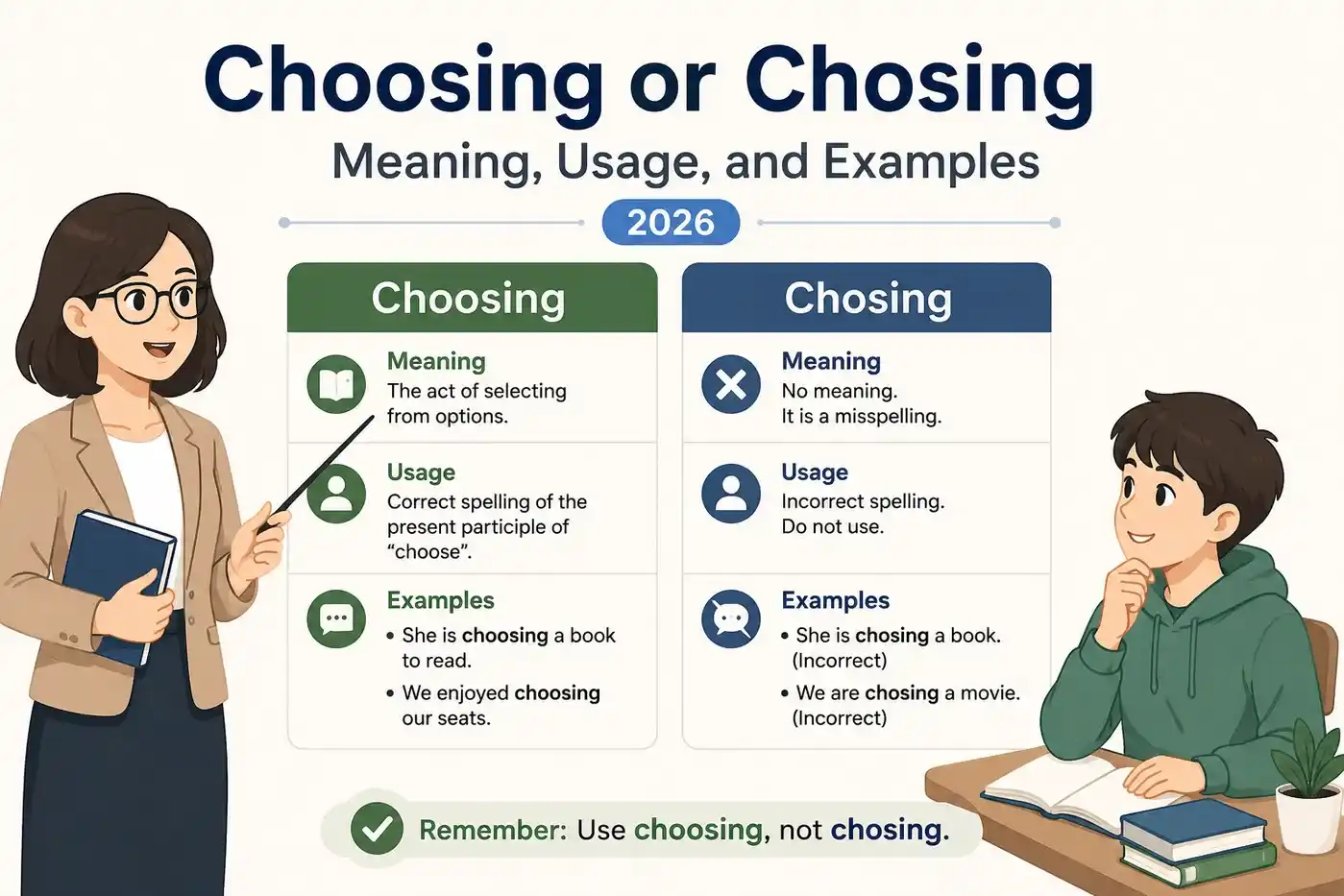
Choosing or chosing is a common spelling question because the word changes form when you add ing to choose. The correct form is choosing. The spelling chosing is incorrect in standard English. The confusion makes sense at first glance. Many English verbs ending in a silent e lose that final e before they take ing. For example choose becomes choosing.
The tricky part is that the two o letters stay exactly where they are. This small spelling detail matters in school writing. It matters in professional emails. It also matters in everyday messages when you want your writing to look polished.
The verb choose means to select something from available options or to decide on a particular course of action. Once you connect choosing directly to choose the spelling becomes much easier to remember.
Short Answer
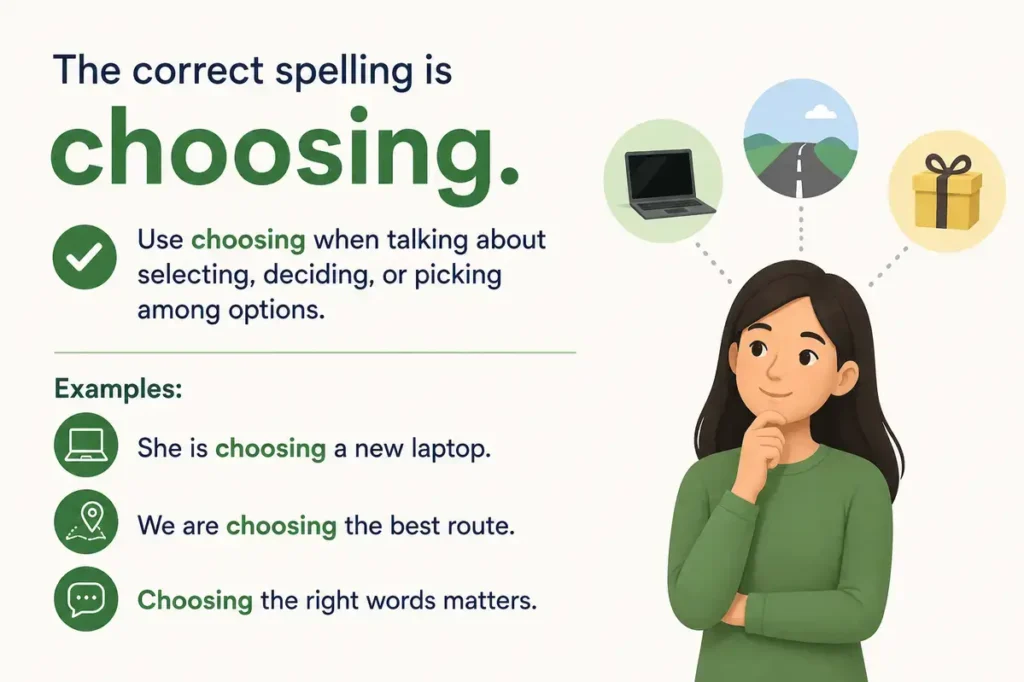
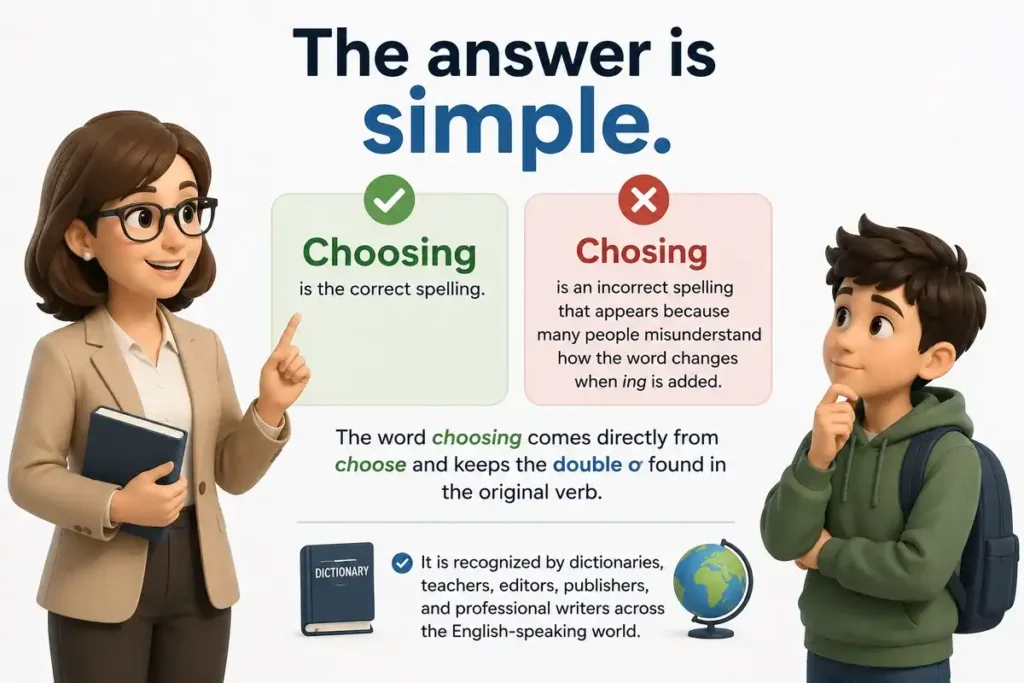
Choosing is the correct spelling. Chosing is a common spelling mistake and should not be used in standard English. Choosing is the present participle and gerund form of choose. It means selecting something or deciding between available options. The spelling keeps both o letters from choose and removes only the final silent e before adding ing.
Table Of Contents
- The correct spelling.
- What choosing means.
- Why chosing is incorrect.
- How choose becomes choosing.
- Choosing as a verb.
- Choosing as a gerund.
- Choosing compared with choose.
- Choosing compared with chose.
- Choosing compared with chosen.
- Pronunciation of choosing.
- Examples in everyday English.
- Common spelling mistakes.
- American and British English usage.
- Formal and informal usage.
- Memory tips.
- Related words.
- Professional writing advice.
- Frequently asked questions.
- Key takeaways.
- Conclusion.
The Correct Spelling
The correct spelling is choosing.
The incorrect spelling is chosing.
Merriam Webster identifies choosing as the present participle of choose. Its dictionary entry gives the forms choose. chose. chosen. and choosing.
The spelling pattern looks like this.
Choose → choosing
Notice the important detail. The final e disappears. The two o letters remain.
That gives us:
C H O O S I N G
Not:
C H O S I N G
This distinction is easy to miss because the pronunciation doesn’t make the spelling especially obvious.
If you’re writing a sentence such as I am choosing a new laptop then choosing is the only standard spelling.
What Does Choosing Mean
Choosing means selecting something from available options. It can also mean making a decision. The decision may involve two choices or many possible choices.
For example:
I am choosing a new phone.
The speaker is deciding which phone to select.
Consider another example.
She is choosing a dress for the wedding.
Here choosing describes an action that is happening during the decision process. Choosing can describe simple decisions such as selecting dinner. It can also describe major decisions such as selecting a career.
The meaning stays connected to the basic idea of making a selection. Merriam Webster defines choose as selecting freely and after consideration. It also gives decide and prefer as related meanings. That is why choosing often appears with words such as option. course. career. color. food. school. college. candidate. plan. and location.
Why Chosing Is Incorrect
Chosing is incorrect because it removes one of the o letters from choose.
The base verb is choose.
When the ing form is created the final e is removed.
That produces:
Choose → choos → choosing
The internal oo remains.
A common mistake is to think that the word should become chosing because choose changes to chose in the past tense.
But chose and choosing are different grammatical forms.
Consider these examples.
I choose the blue shirt.
I have chosen the blue shirt already.
Each form has a different grammatical role.
The spelling mistake often happens when a writer remembers chose and then tries to build the ing form from that spelling.
That approach leads to chosing.
The safer approach is to start with the base verb choose.
How Choose Becomes Choosing
The spelling process is simple once you look at each letter.
Start with:
Choose
Remove the final silent e.
Choos
Add ing.
Choosing
The two o letters never disappear.
This pattern is worth remembering because the same basic spelling idea appears in many English verbs.
Consider these examples.
Use becomes using.
Lose becomes losing.
Make becomes making.
Write becomes writing.
Take becomes taking.
Choose becomes choosing.
The final silent e is removed before ing is added in these examples.
However English spelling has many exceptions and different patterns. You shouldn’t assume that every verb behaves exactly the same way. The safest habit is to learn the standard form of each word.
For choose the correct form is clear.
Choose → choosing
The double o stays.
Choosing As A Verb
Choosing can function as the present participle of choose.
It commonly appears with a form of the verb be to describe an action in progress.
For example:
I am choosing a restaurant.
The person is currently deciding which restaurant to select.
She is choosing a new computer.
The decision is still being made.
They are choosing their seats.
The action is happening at the moment being discussed.
This use is especially common in the present progressive tense.
The basic structure is:
Subject + be + choosing + object
Examples include:
He is choosing a book.
We are choosing a new team leader.
They are choosing a place for dinner.
You are choosing the right option.
The form choosing tells us that the action is ongoing.
Choosing As A Gerund
Choosing can also function as a gerund.
A gerund is an ing form that works as a noun.
For example:
Choosing a career takes time.
In this sentence choosing isn’t describing what a person is doing at this exact moment. Instead it names the activity of selecting a career.
Another example is:
Choosing the right words can improve your writing.
Here choosing functions as the subject of the sentence.
The sentence talks about the activity of selecting appropriate words.
This distinction helps you understand why choosing can appear in many different sentence structures.
Consider these examples.
Choosing wisely can save money.
She enjoys choosing new books.
They talked about choosing a new location.
He is thinking about choosing a different course.
In each example the word describes the activity of making a selection.
Choosing Compared With Choose
Choose is the base form of the verb.
Choosing is the ing form.
Use choose when the grammar of the sentence calls for the base verb.
For example:
I choose the blue option.
You can also use choose after certain helping verbs.
I will choose tomorrow.
She can choose any seat.
They should choose carefully.
Use choosing when the action is ongoing or when the word functions as a gerund.
For example:
I am choosing a new laptop.
Choosing a laptop can take time.
The difference becomes clear when you compare the sentence structures.
Choose describes the basic action.
Choosing describes the ongoing action or the activity itself.
Choosing Compared With Chose
Chose is the simple past form of choose.
Choosing is the present participle or gerund form.
Compare these sentences.
I chose the red car yesterday.
I am choosing a red car today.
The first sentence describes a completed decision in the past.
The second sentence describes an action that is happening now.
This difference explains another reason people sometimes write chosing.
The spelling of chose looks shorter than choose. A writer may incorrectly assume that choosing should be built from chose.
It isn’t.
The correct relationship is:
Choose → chose → chosen → choosing
Learning these forms together makes the spelling much easier.
Choosing Compared With Chosen
Chosen is the past participle of choose.
Choosing describes an ongoing action or the activity of selecting.
Chosen normally describes something that has already been selected.
Compare these sentences.
I am choosing a winner.
I have chosen a winner.
The first sentence means the selection process is still happening.
The second sentence means the selection has been completed.
Chosen can also work as an adjective.
She was the chosen candidate.
The chosen route was shorter.
They accepted the chosen design.
The distinction is useful because choosing and chosen may appear in similar contexts while performing different grammatical jobs.
Pronunciation Of Choosing
Choosing is pronounced roughly like CHOO zing.
Merriam Webster gives the pronunciation as /ˈchü ziŋ/.
The first part sounds like the word choo in many familiar expressions.
The second part sounds like zing.
The pronunciation doesn’t sound like the spelling chosing in a way that reliably tells you how to write the word. That is one reason spelling memory matters.
A good way to say the word is:
CHOO zing
The word has two syllables.
choosing
CHOO zing
The first syllable carries the main stress.
Choosing Or Chosing In Real Life
The correct form appears in many ordinary situations.
Here are some natural examples.
- I am choosing a gift for my sister.
The speaker is deciding which gift to buy.
- We are choosing a restaurant for dinner.
The group is deciding which restaurant to visit.
- She spent an hour choosing a dress.
She took time to select one dress from several possibilities.
- Choosing the right college can feel overwhelming.
The sentence treats choosing as the activity of selecting a college.
- They are choosing between two apartments.
They have two main options and are deciding which one to select.
- He had trouble choosing a name for the puppy.
He found it difficult to make the decision.
- I enjoy choosing books for my weekend reading.
Choosing describes an activity the speaker enjoys.
- She is carefully choosing her words.
She is selecting her words with care.
- We are choosing a new logo for the company.
The group is deciding which logo to use.
- Choosing healthy meals doesn’t have to be difficult.
The word choosing functions as a gerund and names an activity.
In every example the spelling stays the same.
Common Spelling Mistakes
The most common mistake is writing chosing instead of choosing.
For example:
Incorrect: I am chosing a new car.
Correct: I am choosing a new car.
Another mistake is writing chooseing.
Incorrect: She is chooseing a dress.
Correct: She is choosing a dress.
The final e should disappear before ing is added.
A third mistake happens when writers confuse choosing with chose.
Incorrect: I am chose a new laptop.
Correct: I am choosing a new laptop.
Another mistake involves chosen.
Incorrect: I am chosen a new laptop.
Correct: I am choosing a new laptop.
Or:
I have chosen a new laptop.
The right form depends on the grammar of the sentence.
Why The Mistake Is So Common
The word looks unusual because it contains oo followed by s and then ing.
Many learners expect the spelling to become shorter when the final e disappears.
That expectation is reasonable. But the two o letters belong to the core spelling of choose.
Think of the word as having two parts.
CHOO S + ING
The final e is removable.
The oo is not.
Another source of confusion is the past form chose.
The forms look different:
Choose.
Chose.
Chosen.
Choosing.
English has many irregular verbs with several forms that don’t follow one simple visual pattern. Learning each form as part of the same word family is more reliable than trying to create every form from memory.
American And British English Usage
American English uses choosing.
British English also uses choosing.
There is no standard American spelling that changes choosing to chosing.
The same spelling is used in major English varieties.
That means you don’t need to worry about a regional spelling difference here.
If you’re writing for an American audience then choosing is correct.
If you’re writing for a British audience then choosing is also correct.
The same applies to formal academic writing. business writing. school assignments. websites. applications. and everyday communication.
The spelling doesn’t change based on the level of formality.
Formal And Informal Usage
Choosing is appropriate in every standard form of English writing.
You can use it in a text message.
You can use it in a professional report.
The only form you should avoid in standard writing is chosing.
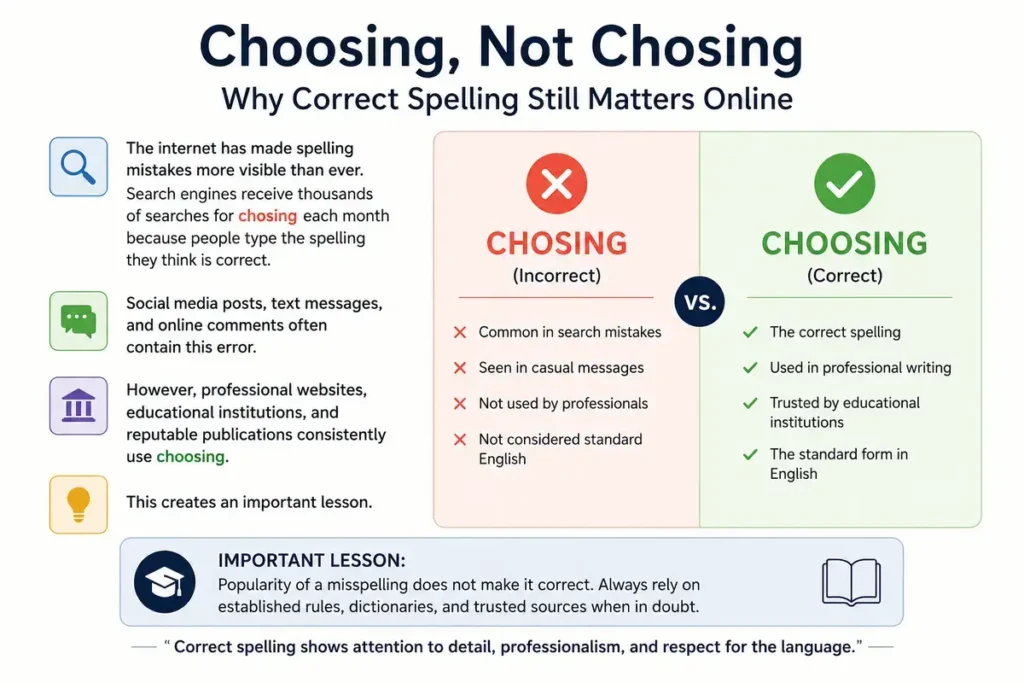
Even though readers may understand what you mean when you write chosing the spelling still looks like an error.
Professional writing benefits from small details like this. A single missing letter may seem minor but repeated spelling mistakes can make otherwise strong writing look careless.
Choosing And Similar Words
Choosing has several close synonyms.
Selecting means picking one option from a group.
Picking is common in everyday conversation.
Deciding focuses more strongly on reaching a conclusion.
Opting means deciding to take one particular option.
Preferring means liking one option more than another.
For example:
I am choosing the blue shirt.
I am opting for the blue shirt.
These sentences can overlap in meaning but they don’t always carry exactly the same tone.
Choosing is one of the most flexible words because it can describe both simple selections and serious decisions.
Merriam Webster lists selecting. picking. naming. taking. electing. preferring. and opting for among related words.
Choosing Between And Choosing From
Choosing often appears with between and from.
Use choosing between when you are comparing specific alternatives.
For example:
I am choosing between two colleges.
She is choosing between the red dress and the blue dress.
They are choosing between two job offers.
Use choosing from when you are selecting from a larger collection.
For example:
We are choosing from ten restaurants.
She is choosing from several designs.
Customers can choose from many options.
Both patterns are natural and common.
The difference is mainly about how the available options are presented.
Choosing Carefully
The phrase choosing carefully means making a selection with attention and thought.
For example:
You should be careful when choosing a password.
She spent time choosing the right words.
Choosing carefully can help you avoid mistakes.
The phrase often appears in advice because choosing involves judgment.
You may choose carefully when selecting a school. a career. a house. a product. a partner. or even a word.
The object changes but the basic idea stays the same.
Memory Tips
The easiest memory trick is to remember that choose keeps its two o letters when it becomes choosing.
Think of this pattern:
CHOOSE
Remove only the final e.
CHOOS
Add ing.
CHOOSING
You can also remember the phrase:
Choose keeps both o letters.
Another useful comparison is:
Choose → choosing
Lose → losing
Use → using
The spelling pattern becomes more familiar when you see several examples together.
A final trick is to connect choosing with the sound choo.
The beginning of choosing sounds like choo.
That can remind you that the word starts with choo rather than cho.
A Quick Spelling Test
If you aren’t sure how to spell the word then start with choose.
Ask yourself what happens when you add ing.
Remove the final e.
Keep the oo.
Add ing.
You get choosing.
This quick mental test takes only a few seconds.
It can prevent the most common spelling mistake before it reaches your final sentence.
You can also replace choosing with selecting.
For example:
I am choosing a new phone.
I am selecting a new phone.
If the meaning works with selecting then choosing is likely the word you need.
This method helps with meaning. The spelling still needs to follow the correct form of choose.
Professional Writing Tips
Spelling mistakes are easier to prevent than to repair later.
When writing professionally keep an eye on words that change form.
Choose is one of those words.
If you are writing a report then use choosing.
If you are writing instructions then use choosing.
Don’t change the spelling simply because the tone is casual.
A casual sentence can still use correct spelling.
For example:
I’m choosing pizza tonight.
That’s perfectly natural.
A more formal sentence might be:
The committee is choosing a supplier for the project.
Both sentences use the same spelling.
Word Origin
The history of choose is surprisingly old.
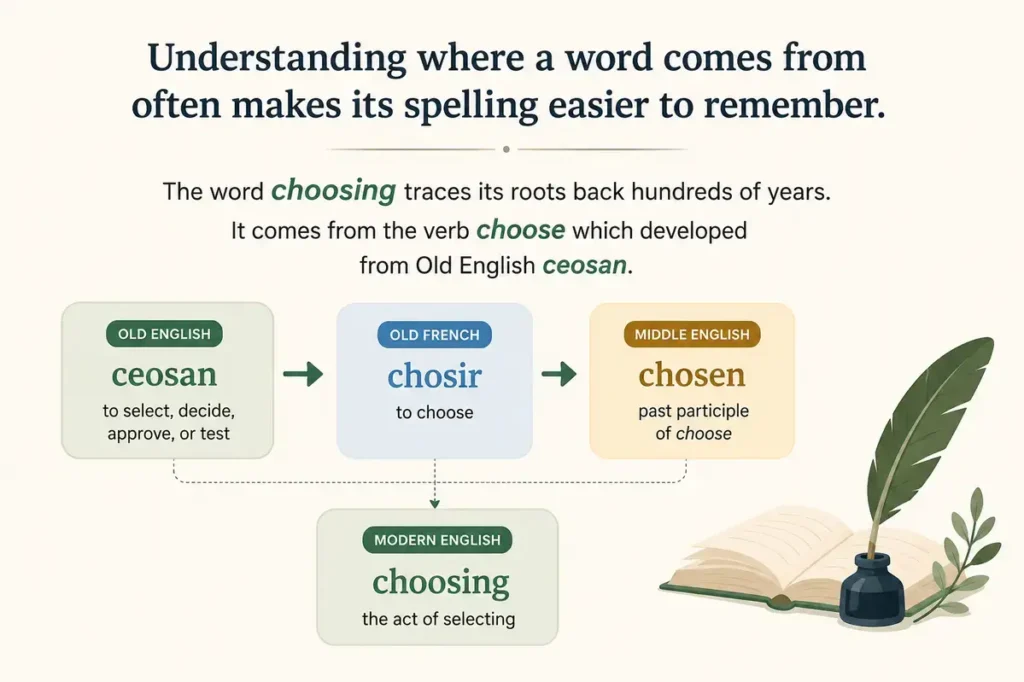
Merriam Webster traces choose to Middle English chosen and further to Old English cēosan. The dictionary also gives a first known use before the twelfth century.
That long history helps explain why the verb has several irregular forms.
Choose.
Chose.
Chosen.
Choosing.
The modern form choosing developed from the established verb choose rather than from the past tense chose.
You don’t need to study the history to spell the word correctly. Still it helps explain why English can have several forms that look different while belonging to the same verb family.
Choosing In Everyday Expressions
The word appears in many common expressions.
Choosing wisely means making a good decision.
Choosing carefully means selecting something after giving it proper thought.
Picking and choosing means selecting only the things you want.
For example:
She spent the afternoon choosing carefully.
We are choosing between two plans.
Customers can choose from a wide range of products.
He has a habit of picking and choosing his responsibilities.
These expressions sound natural in everyday American English.
When Choosing Means Making A Decision
Choosing doesn’t always involve physically selecting an object.
You can choose an action.
You can choose a career.
For example:
She is choosing to study at home.
Here the person isn’t selecting an object from a shelf. She is deciding to take a particular action.
This broader meaning makes choose one of the most useful decision words in English.
When Choosing Means Selecting An Object
Choosing can also describe a very physical selection.
For example:
He is choosing a shirt.
She is choosing a book.
We are choosing a table.
They are choosing a color.
I am choosing a dessert.
In these examples the speaker has several possible objects and needs to select one. The word remains the same.
When Choosing Means Selecting A Person
You can also choose a person.
For example:
The committee is choosing a new chairperson.
The coach is choosing the starting players.
The voters are choosing their representative.
The manager is choosing a team leader.
In these sentences choosing means selecting a person for a role or position. This usage is closely connected to the dictionary meaning of choose as selecting or deciding on someone.
When Choosing Means Preferring
Choose can also express preference.
For example:
I choose tea over coffee.
She chooses simple designs.
He chooses quality over quantity.
In these sentences choosing may involve a repeated preference rather than one single decision. The meaning remains connected to selecting one option instead of another.
Key Takeaways
- Choosing is the correct spelling.
- Chosing is incorrect in standard English.
- Choosing comes from the verb choose.
- The final e in choose disappears before ing is added.
- The two o letters stay in the word.
- Choosing can function as a present participle.
- Choosing can also function as a gerund.
- Chose is the simple past form of choose.
- Chosen is the past participle.
- American English and British English both use choosing.
- Choosing works in formal and informal writing.
- The easiest memory rule is simple. Keep the oo and remove only the final e.
Conclusion
The answer to Choosing or Chosing is clear. Choosing is the correct spelling and chosing is incorrect in standard English. The word comes from choose. When you add ing you remove the final e but keep both o letters. Remember this simple pattern: Choose → choosing That small spelling rule can save you from one of the most common mistakes involving this verb. If you’re writing about selecting something. making a decision. or deciding between options then choosing is the form you want.
Once you connect choosing with choose the spelling becomes easy to recognize. The two o letters stay put. Only the final e steps aside. Use choosing confidently in everyday writing. schoolwork. professional communication. and formal English.
Common Questions About Choosing
Is Choosing Or Chosing Correct?
Choosing is correct. Chosing is a spelling mistake. The correct form keeps both o letters from choose and removes only the final e before adding ing.
Why Does Choosing Have Two O Letters?
Choosing comes from choose. The final e is removed before ing is added but the two o letters remain. The result is choosing.
Is Chosing A Word?
Chosing isn’t the standard spelling of the English word. Standard writing should use choosing.
How Do You Spell Choosing?
The correct spelling is C H O O S I N G.
The easiest way to remember it is to start with choose. Remove the final e. Then add ing.
What Is The Past Tense Of Choose?
The simple past tense is chose.
For example:
She chose the blue dress.
Merriam Webster lists chose as the past form of choose.
What Is The Past Participle Of Choose?
The past participle is chosen.
For example:
She has chosen the blue dress.
Is Choosing A Gerund?
Choosing can function as a gerund when the ing form works as a noun.
For example:
Choosing the right school takes time.
It can also function as a present participle.
For example:
She is choosing a school.
Is Choosing Used In American English?
Yes. Choosing is the standard spelling in American English. British English also uses choosing.
Is Chosing An American Spelling?
No. Chosing isn’t a standard American spelling. It is a misspelling of choosing.
Can I Use Choosing In Formal Writing?
Yes. Choosing is appropriate in formal and informal writing. You can use it in academic work. business writing. professional communication. and everyday conversation.
What Is The Difference Between Choose And Choosing?
Choose is the base form of the verb. Choosing is the present participle or gerund form.
For example:
I choose carefully.
I am choosing carefully.
What Is The Difference Between Chose And Choosing?
Chose is the simple past form.
Choosing is the present participle or gerund form.
For example:
I chose a book yesterday.
I am choosing a book now.

Confusing Words, Spelling & Word Choice
Claire Whitmore is a U.S.-based English editor who writes about commonly confused words, spelling differences, and word choice. Her work helps readers understand subtle distinctions between similar-looking words through simple definitions, practical examples, and modern usage guidance in both American and British English.