
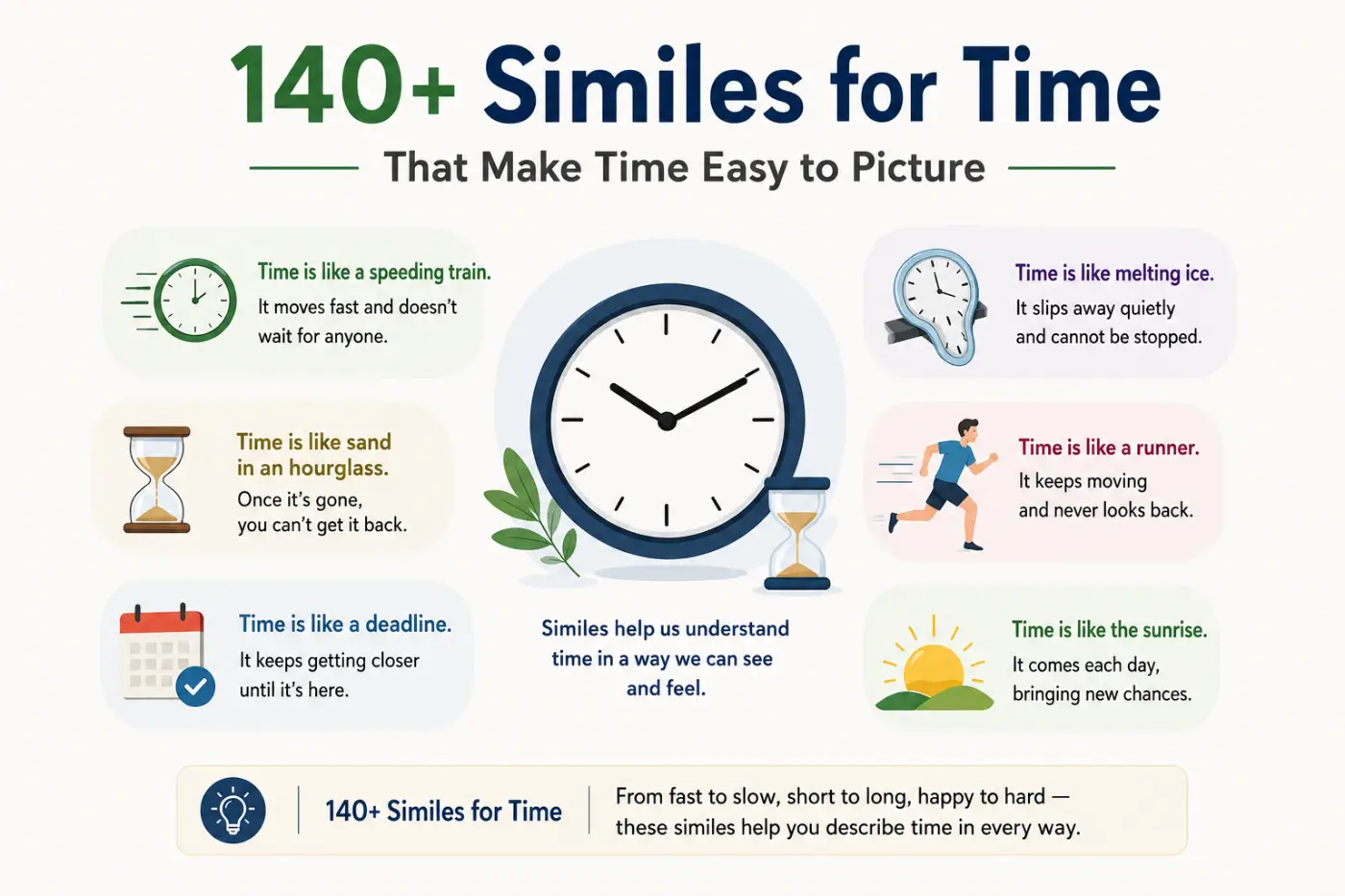
Similes for Time help writers describe an experience that everyone understands but no one can see or touch. Time can fly like an arrow, crawl like a snail, or slip away like sand through your fingers. These creative comparisons turn an abstract idea into something readers can picture, making descriptions more vivid, emotional, and memorable.
Time can feel different depending on the situation. Five minutes may seem as long as an hour when you’re waiting for important news, while an entire afternoon can disappear like a flash when you’re having fun. A simple statement tells readers how time passes, but a well chosen simile helps them feel its speed, weight, and emotional impact.
This collection features 120 original similes for time, organized by meaning and mood. You’ll discover comparisons for fast and slow time, childhood, aging, waiting, memories, deadlines, changing seasons, happiness, sadness, and many other situations. Each example includes a short explanation to help you understand its meaning and use it naturally in stories, poems, essays, and everyday writing.
Short Answer
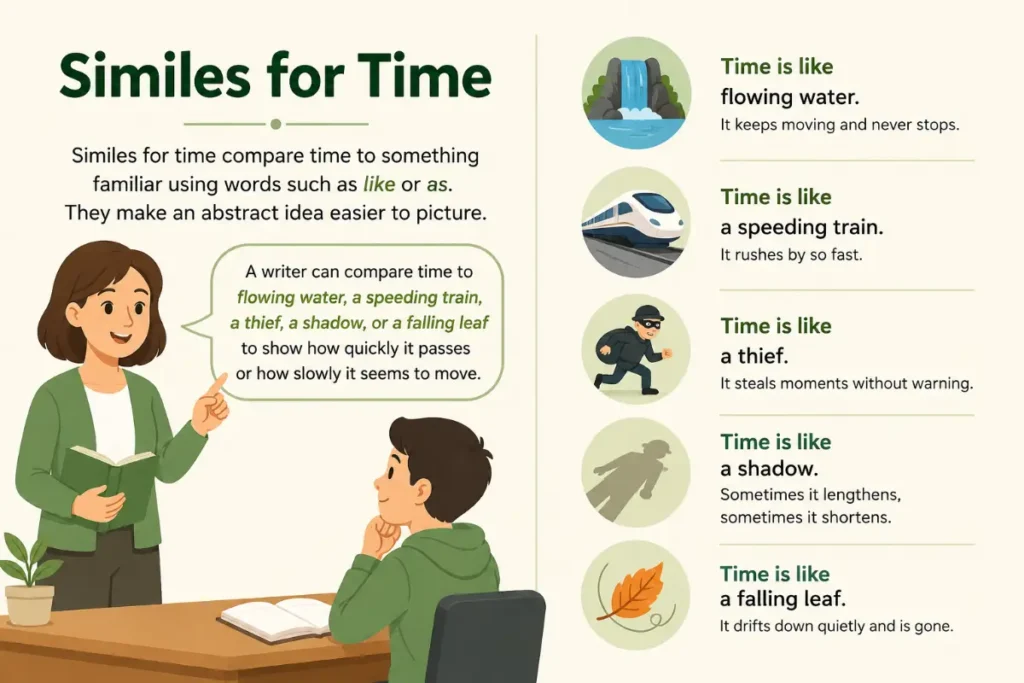
Similes for Time compare time to something familiar using words such as like or as. They make an abstract idea easier to picture. A writer can compare time to flowing water, a speeding train, a thief, a shadow, or a falling leaf to show how quickly it passes or how slowly it seems to move.
Table Of Contents
- What A Simile For Time Means
- Why Writers Compare Time
- How To Create A Strong Time Simile
- Fast Time Similes
- Slow Time Similes
- Time And Nature
- Time And Water
- Time And Travel
- Time And Light
- Time And Everyday Objects
- Time And Childhood
- Time And Aging
- Time And Waiting
- Time And Memories
- Time And Happiness
- Time And Sadness
- Time And Deadlines
- Time And Change
- Time And Seasons
- Time And Life
- Common Mistakes
- Memory Tips
- Related Usage Notes
- FAQs
- Key Takeaways
- Conclusion
What A Simile For Time Means
A simile compares one thing with another to make an idea clearer or more vivid. The comparison often uses like or as.
For example:
Time moved like a river.
This sentence compares time with a river. It does not claim that time literally is a river. Instead, it suggests continuous movement.
A simile can also express emotional experience.
The afternoon passed like a dream.
The comparison suggests that the afternoon felt pleasant, unreal, or difficult to remember clearly.
Time is especially suitable for similes because it is abstract. We experience time constantly but cannot hold it in our hands. Comparisons give that invisible idea a physical shape.
Why Writers Compare Time
Writers compare time for several reasons.
First, comparisons make abstract ideas easier to understand. Readers can picture a river, train, shadow, candle, leaf, or road much more easily than they can picture time itself.
Second, similes add emotion. Time can feel gentle, cruel, generous, impatient, heavy, or fleeting depending on the comparison.
Third, similes improve storytelling. A plain sentence tells the reader something happened. A vivid comparison helps the reader feel it.
Compare these two sentences:
The years passed quickly.
The years slipped past like pages turning in a strong breeze.
The first sentence gives information. The second creates an image.
A good comparison should support the meaning rather than decorate the sentence for no reason. The strongest examples usually connect time with movement, nature, objects, emotions, or familiar experiences.
How To Create A Strong Time Simile
Start by deciding how time feels in your sentence.
If time feels fast, choose something associated with speed. A racing train or falling stone can work.
If time feels slow, choose something associated with gradual movement. A crawling snail or melting snowbank can work.
If time feels precious, compare it with something valuable or limited.
If time feels connected to memory, compare it with photographs, old letters, fading footprints, or distant echoes.
Then make the comparison clear.
Time raced like a horse across an open field.
The comparison works because a horse suggests speed and freedom.
Avoid comparisons that sound forced. You don’t need an unusual image just to be creative. A familiar comparison with a clear emotional connection often works better.
Fast Time Similes
These comparisons show time moving quickly. They work well when describing exciting events, busy days, vacations, childhood years, or moments that seem to disappear before you can enjoy them.
- Time flew like a sparrow startled from a tree. This suggests sudden and rapid movement.
- Time raced like a horse across an open field. The image emphasizes speed and freedom.
- Time vanished like smoke in a strong wind. The comparison suggests something disappearing almost instantly.
- Time flashed by like lightning across a summer sky. This creates a strong sense of sudden movement.
- Time sped like a bicycle rolling downhill. The image suggests increasing speed with little resistance.
- Time slipped past like a fish beneath clear water. The comparison suggests something quick that is difficult to catch.
- Time rushed like rainwater down a steep street. The image creates a feeling of unstoppable movement.
- Time sprinted like an athlete chasing the finish line. This gives time an urgent and energetic quality.
- Time darted by like a rabbit startled by footsteps. The comparison suggests sudden and unpredictable speed.
- Time disappeared like a match flame in the wind. The image emphasizes how quickly a moment can vanish.
Slow Time Similes
These examples work when minutes seem unusually long. They are useful for scenes involving boredom, pain, waiting, loneliness, or deep thought.
- Time crawled like a snail crossing a garden path. The comparison suggests extremely slow movement.
- Time dragged like a heavy suitcase across rough ground. The image makes time feel difficult and tiring.
- Time moved like cold honey from a spoon. The comparison suggests thick and reluctant movement.
- Time crept like a shadow across an empty room. The image creates a quiet and gradual feeling.
- Time stretched like warm taffy between two hands. The comparison suggests that each moment feels longer than expected.
- Time crawled like a tired insect across a dusty floor. The image gives the passage of time a weary quality.
- Time moved like a frozen stream waiting for spring. The comparison suggests almost complete stillness.
- Time trudged like a traveler carrying a heavy pack. The image makes time seem exhausting.
- Time lingered like the last guest at an empty party. The comparison suggests reluctance to leave.
- Time crept forward like dawn behind thick clouds. The image suggests gradual progress that is difficult to notice.
Time And Nature
Nature offers some of the strongest images for describing time. Trees grow, leaves fall, rivers move, flowers bloom, and clouds change. These natural processes give writers a rich vocabulary for expressing time.
- Time moved like a river through a quiet forest. The comparison suggests steady and continuous movement.
- Time fell like autumn leaves from an old tree. The image connects time with gradual loss.
- Time grew like a tree adding rings beneath its bark. The comparison suggests quiet accumulation.
- Time drifted like clouds across a wide blue sky. The image creates a calm sense of movement.
- Time bloomed like a spring flower after winter. This suggests growth and renewal.
- Time faded like flowers at the end of summer. The comparison emphasizes gradual decline.
- Time flowed like a mountain stream after rain. The image suggests energy and constant movement.
- Time changed like a shoreline shaped by waves. The comparison focuses on slow transformation.
- Time settled like snow over a sleeping field. The image suggests quiet accumulation.
- Time moved like sunlight across a forest floor. The comparison emphasizes gradual change that can be hard to notice.
Time And Water
Water works especially well because it moves continuously. It can rush, drip, freeze, evaporate, or disappear. Each form gives the comparison a different feeling.
- Time flowed like a river toward the sea. The image suggests movement toward an unavoidable destination.
- Time rushed like water through a broken dam. This creates a strong sense of speed.
- Time dripped like water from a leaky faucet. The comparison makes each moment feel slow and noticeable.
- Time slipped away like water between open fingers. The image suggests that time cannot be held.
- Time rolled like waves toward a distant shore. The comparison suggests repeated and steady movement.
- Time evaporated like a puddle beneath the summer sun. The image emphasizes disappearance.
- Time froze like a pond beneath winter ice. The comparison suggests a moment that feels completely still.
- Time trickled like a narrow stream through dry land. The image suggests slow but continuous movement.
- Time crashed forward like a wave against the rocks. The comparison gives time power and force.
- Time disappeared like a drop of rain into a rushing river. The image suggests how one moment becomes part of a much larger flow.
Time And Travel
Travel creates natural images of distance, movement, roads, trains, flights, and destinations. These comparisons are useful for describing long periods or rapid change.
- Time raced like a train leaving the station. The image suggests speed and a sense that the moment cannot be recovered.
- Time rolled like a car along an empty highway. The comparison creates steady forward motion.
- Time traveled like a plane crossing the ocean. The image suggests covering a great distance quickly.
- Time moved like footsteps along a winding road. The comparison suggests steady progress.
- Time sped like a train through a dark tunnel. The image emphasizes speed and limited awareness of passing moments.
- Time wandered like a traveler without a map. The comparison suggests uncertainty.
- Time marched like soldiers along a distant road. The image gives time a firm and unstoppable quality.
- Time journeyed like a ship crossing calm seas. The comparison suggests peaceful and steady passage.
- Time disappeared like a station left behind by a moving train. The image emphasizes moments that cannot be revisited.
- Time moved like headlights along a dark highway. The comparison suggests a continuous sequence of moments appearing and disappearing.
Time And Light
Light changes constantly. Dawn arrives, shadows move, candles burn down, and daylight fades. These images can make time feel delicate or temporary.
- Time passed like sunlight through a window. The comparison suggests quiet and steady movement.
- Time faded like evening light across the hills. The image creates a gentle sense of ending.
- Time flickered like a candle flame in a quiet room. The comparison suggests fragile moments.
- Time burned like a candle at midnight. The image suggests that time is gradually being used.
- Time vanished like a beam of sunlight behind a cloud. The comparison emphasizes sudden disappearance.
- Time glowed like the last light of sunset. The image creates a peaceful feeling around passing moments.
- Time shifted like shadows across a wall. The comparison suggests slow and continuous change.
- Time sparkled like morning light on fresh snow. The image gives time a bright and hopeful quality.
- Time dimmed like a lamp running out of oil. The comparison suggests gradual decline.
- Time flashed like a camera light in a dark room. The image suggests an instant that arrives and disappears quickly.
Time And Everyday Objects
Ordinary objects can make abstract ideas feel familiar. These examples are useful for essays, stories, speeches, and casual writing.
- Time turned like pages in a well read book. The comparison suggests a sequence of experiences.
- Time slipped like sand through an open hand. The image emphasizes how difficult time is to hold.
- Time ticked like a quiet clock in an empty room. The comparison makes each passing moment noticeable.
- Time unfolded like a letter opened after many years. The image suggests discovery and gradual revelation.
- Time broke apart like an old photograph. The comparison connects time with fading memories.
- Time spun like a coin on a table. The image suggests movement that eventually comes to an end.
- Time melted like an ice cube on a warm plate. The comparison suggests gradual disappearance.
- Time snapped shut like a closing book. The image suggests a period ending suddenly.
- Time rolled like marbles across a wooden floor. The comparison gives time a quick and scattered quality.
- Time vanished like ink beneath spilled water. The image suggests memories or moments becoming difficult to recover.
Time And Childhood
Childhood often feels slow while we live through it and incredibly fast when we remember it. These comparisons capture that strange contrast.
- Childhood passed like a kite carried by a summer wind. The image suggests freedom and speed.
- The years slipped away like crayons worn down by constant drawing. The comparison connects time with childhood activity.
- Childhood disappeared like bubbles floating across a sunny yard. The image suggests beauty that lasts only briefly.
- The days rolled by like toy cars across a bedroom floor. The comparison creates a playful image.
- Childhood faded like chalk drawings after summer rain. The image connects growing up with gradual disappearance.
- The years flew like paper airplanes across a schoolyard. The comparison captures youthful energy.
- Childhood moved like a bicycle racing down a familiar street. The image suggests freedom and speed.
- The seasons changed like pages in a colorful storybook. The comparison suggests a childhood filled with distinct memories.
- The years vanished like birthday candles after one deep breath. The image emphasizes how quickly childhood seems to disappear.
- Childhood drifted away like a balloon released into a blue sky. The comparison suggests something beautiful moving beyond reach.
Time And Aging
Time and aging are closely connected. These similes can describe maturity, change, memory, and the quiet passage of years.
- Age gathered like rings inside an old tree. The image suggests gradual growth and accumulated experience.
- The years settled like dust on an old photograph. The comparison connects aging with memory.
- Time marked the face like rain marks stone. The image suggests slow but lasting change.
- The years passed like footsteps across fresh snow. The comparison suggests that every moment leaves a trace.
- Age arrived like winter after a long autumn. The image presents aging as a natural transition.
- Time shaped him like waves shape a smooth stone. The comparison suggests gradual influence.
- The years folded like pages in a well worn journal. The image connects age with accumulated memories.
- Time softened her memories like sunlight fades old fabric. The comparison suggests gradual change in how the past feels.
- Age grew like branches reaching higher each spring. The image presents growth as natural and continuous.
- The years disappeared like footprints washed from the beach. The comparison emphasizes how quickly physical traces of the past can vanish.
Time And Waiting
Waiting can completely change our perception of time. A few minutes can feel enormous when we are anxious or excited.
- Waiting made time crawl like a snail on wet stone. The comparison emphasizes extreme slowness.
- The minutes stretched like a long road with no signs. The image suggests uncertainty and frustration.
- Time dragged like a tired dog behind its owner. The comparison creates a feeling of reluctant movement.
- Each minute felt like a stone in a heavy pocket. The image makes time feel burdensome.
- The clock moved like a turtle crossing an empty field. The comparison emphasizes frustrating slowness.
- The afternoon stretched like an endless hallway. The image suggests a feeling of distance.
- Each second hung like a raindrop from a roof. The comparison creates suspense.
- Time waited like a locked door. The image suggests something that refuses to move forward.
- The minutes crawled like ants across a blank page. The comparison gives waiting a slow and restless quality.
- Time stood like a guard outside a closed gate. The image suggests delay and anticipation.
Time And Memories
Memories connect the present with the past. These similes can help writers describe nostalgia, forgotten moments, and the way old experiences return.
- Memories returned like birds to an old tree. The comparison suggests familiar experiences coming back.
- Time faded like an old photograph left in sunlight. The image suggests memories becoming less clear.
- The past lingered like perfume in an empty room. The comparison suggests something unseen but still present.
- Old memories surfaced like shells after a receding tide. The image suggests forgotten moments becoming visible again.
- Time blurred like rain across a window. The comparison suggests unclear memories.
- The past echoed like footsteps in an empty hallway. The image gives memory a distant and haunting quality.
- Memories drifted like leaves across a quiet pond. The comparison suggests gentle movement through the mind.
- Time folded like an old letter kept in a drawer. The image connects time with preserved memories.
- Childhood memories glowed like photographs in morning light. The comparison gives the past a warm quality.
- The past slipped away like a dream after waking. The image suggests memories that are difficult to hold onto.
Time And Happiness
Happy moments often feel short. These comparisons work well for celebrations, friendships, vacations, family gatherings, and meaningful experiences.
- Happy hours flew like birds across a bright sky. The comparison suggests freedom and speed.
- Time danced like sunlight on a summer lake. The image gives passing moments an energetic quality.
- The afternoon passed like music at a favorite concert. The comparison suggests pleasure and speed.
- The weekend vanished like a balloon into the clouds. The image captures the disappointment of fun ending quickly.
- Time sparkled like sunlight on fresh water. The comparison gives the moment brightness and energy.
- The evening slipped by like a favorite song. The image suggests something enjoyable ending too soon.
- The vacation disappeared like footprints beneath a rising tide. The comparison captures how quickly a wonderful experience can end.
- The hours floated like feathers on a warm breeze. The image creates a light and peaceful feeling.
- Time flew like confetti after a celebration. The comparison suggests energy and joyful movement.
- The afternoon melted like ice cream on a sunny day. The image captures a pleasant period disappearing quickly.
Time And Sadness
Sadness can make time feel heavy and slow. These comparisons work well in reflective writing and emotional storytelling.
- Time crawled like a wounded bird along the ground. The image suggests painful and difficult movement.
- The hours hung like dark clouds over an empty house. The comparison creates a heavy emotional mood.
- Time moved like rain down a cold window. The image suggests loneliness and quiet sadness.
- The days dragged like a shadow at sunset. The comparison suggests a slow decline.
- Time felt like a long winter without sunlight. The image conveys emotional heaviness.
- The minutes fell like cold stones into a silent room. The comparison makes each moment feel heavy.
- The evening stretched like a road through thick fog. The image suggests uncertainty and loneliness.
- Time lingered like an unanswered letter. The comparison connects waiting with emotional pain.
- The weeks faded like flowers left without water. The image suggests gradual loss.
- Time moved like a tired river beneath a gray sky. The comparison creates a slow and melancholy mood.
Time And Deadlines
Deadlines change the emotional experience of time. A relaxed week can suddenly feel like a race when an important task approaches.
- Time raced like a runner toward the finish line. The comparison creates urgency.
- The deadline approached like a storm on the horizon. The image suggests something unavoidable drawing closer.
- The final hours vanished like pages torn from a notebook. The comparison emphasizes limited time.
- Time ran like sand through a broken hourglass. The image suggests that the available time is disappearing quickly.
- The clock chased us like a dog after a moving car. The comparison creates pressure and urgency.
- The deadline came like a train already leaving the station. The image suggests that there is little opportunity left.
- The minutes escaped like birds from an open cage. The comparison emphasizes loss of control.
- Time moved like a race car around the final turn. The image creates a strong sense of speed.
- The remaining hours shrank like ice beneath the summer sun. The comparison suggests that available time is disappearing.
- The deadline stood like a wall getting closer. The image makes the approaching limit feel unavoidable.
Time And Change
Time constantly brings change. These comparisons work well for personal growth, relationships, communities, technology, and life transitions.
- Time changed the town like rain changes a stone wall. The comparison suggests gradual transformation.
- The years reshaped him like waves reshape a cliff. The image emphasizes powerful long term change.
- Time turned old habits like soil turns fallen leaves into earth. The comparison suggests transformation into something new.
- Change arrived like spring after a long winter. The image presents transformation as hopeful.
- Time altered the landscape like wind moves desert sand. The comparison suggests gradual movement.
- The years changed friendships like sunlight changes the color of fabric. The image suggests subtle transformation.
- Time softened anger like rain cools hot pavement. The comparison presents healing through gradual change.
- Time reshaped dreams like a sculptor shapes clay. The image suggests that experience influences ambition.
- The years rearranged memories like cards being shuffled. The comparison suggests that our understanding of the past can change.
- Time changed everything like a river changes the shape of its banks. The image emphasizes steady transformation.
Time And Seasons
Seasons offer a natural framework for describing time. Spring suggests beginnings. Summer can suggest fullness. Autumn often suggests change. Winter can suggest endings or rest.
- Time moved like spring flowers opening one by one. The comparison suggests gradual beginnings.
- The year turned like autumn leaves in the wind. The image suggests transition.
- Time faded like summer light at the end of August. The comparison creates a gentle sense of ending.
- The months passed like winter clouds across the mountains. The image suggests steady movement.
- Time returned like spring after winter. The comparison emphasizes renewal.
- The seasons changed like pages in a nature book. The image gives time a clear sequence.
- The year slipped away like snow beneath warm sunlight. The comparison suggests gradual disappearance.
- Time grew like a garden through the seasons. The image suggests development and change.
- The months drifted like autumn leaves along a quiet road. The comparison creates a calm sense of passage.
- The year unfolded like a field changing color from spring to winter. The image connects time with visible transformation.
Common Mistakes
Using A Metaphor Instead Of A Simile
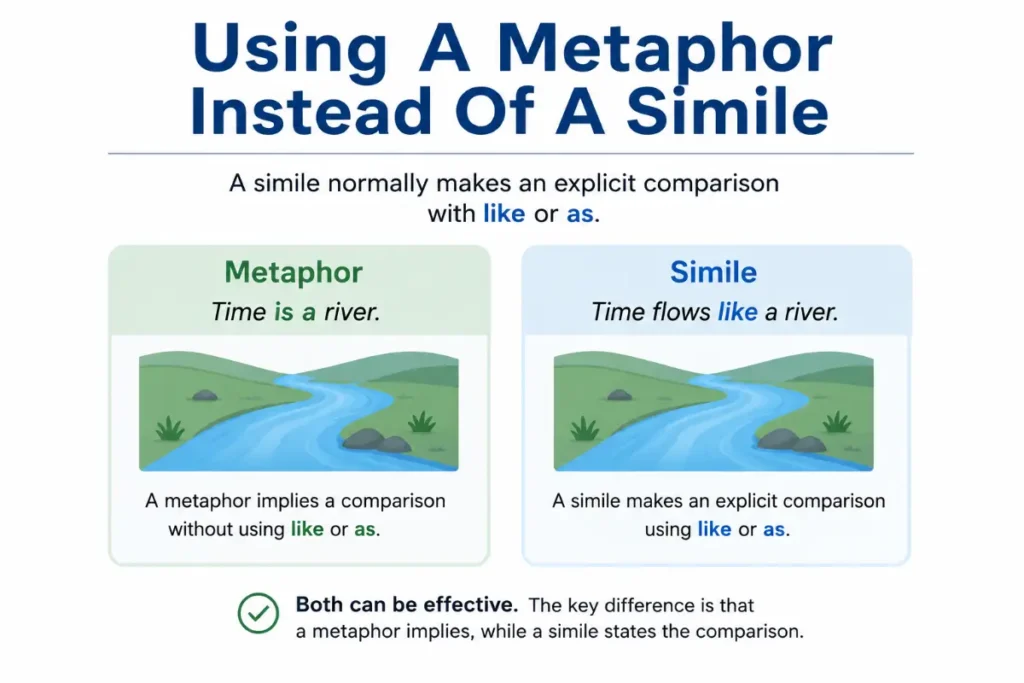
A simile normally makes an explicit comparison with like or as.
Time is a river is a metaphor.
Time flows like a river is a simile.
Both can be effective. The key difference is the grammatical structure.
Choosing A Weak Comparison
A comparison should add something meaningful.
Time is like a thing.
This tells the reader almost nothing.
Time moved like water slipping through my fingers creates a much clearer image.
The best comparison gives the reader a quality such as speed, slowness, loss, beauty, pressure, or change.
Mixing Two Comparisons
Avoid combining unrelated images in one sentence.
Time raced like a snail flying down a railroad track.
The images fight each other. A snail suggests slowness while flying suggests speed.
Choose one clear idea.
Time crawled like a snail across a garden path.
Or:
Time raced like a train leaving the station.
Using The Same Comparison Too Often
Time flies is familiar and useful but it is also very common. If you’re writing creatively, try a fresher image when the context allows it.
Instead of repeating the same phrase, consider the emotional meaning you need.
Time can slip, drift, crawl, race, melt, fade, flow, or linger.
The right verb can make a familiar idea feel fresh.
Forcing Creativity
Not every sentence needs a poetic comparison.
In a formal report, simple language may work better.
The deadline is approaching.
In a story, a vivid comparison may be more effective.
The deadline approached like a storm gathering beyond the hills.
Good writing comes from choosing the right level of imagery for the situation.
Memory Tips
The easiest way to remember strong comparisons is to connect them with the feeling you want to express.
For fast time, think of movement.
A racing train.
A falling stone.
A rushing river.
For slow time, think of resistance.
A crawling snail.
Melting ice.
Thick honey.
For disappearing time, think of things that cannot be held.
Smoke.
Water.
Sand.
A fading shadow.
For aging, think of things that accumulate or change slowly.
Tree rings.
Weathered stone.
Old photographs.
For memories, think of things that return or fade.
Echoes.
Leaves.
Photographs.
Dreams.
This method makes it easier to create your own comparisons instead of memorizing long lists.
Related Usage Notes
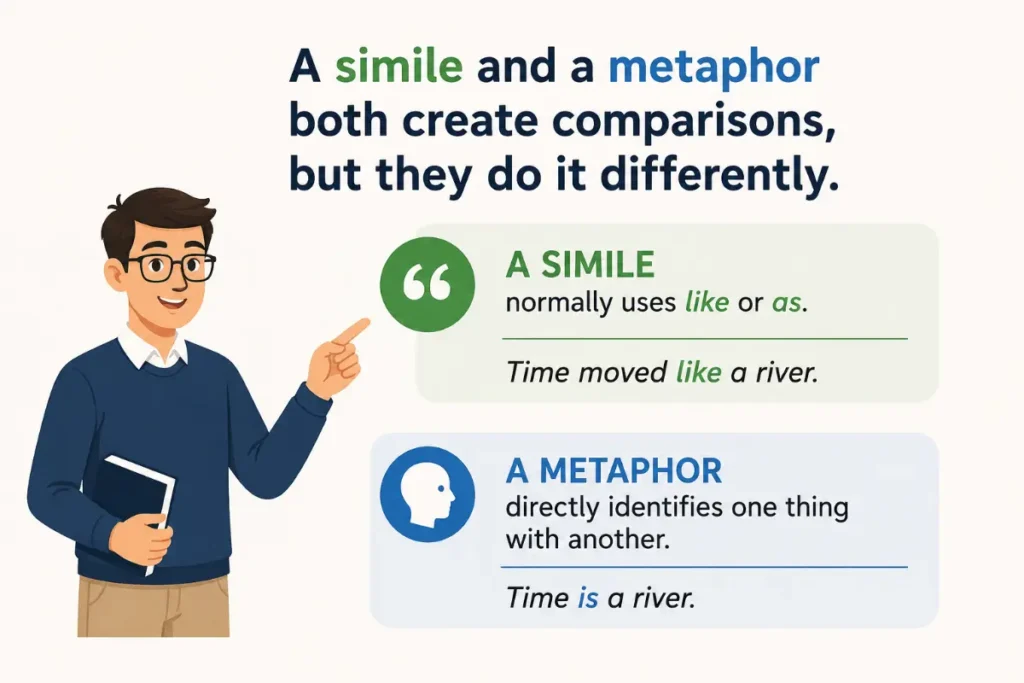
A simile and a metaphor both create comparisons, but they do it differently. A simile normally uses like or as. Time moved like a river. A metaphor directly identifies one thing with another. Time was a river carrying us forward. Personification is another useful technique. It gives human qualities to something that is not human. Time whispered through the empty room. This sentence does not simply compare time with another object. It gives time the human ability to whisper. These techniques can appear together in creative writing. Time raced like a horse and refused to wait for anyone. The first part uses a simile. The second part gives time a human quality. Understanding these differences helps writers choose the right device for the effect they want.
Key Takeaways
- A simile compares one thing with another using words such as like or as.
- Time works especially well with similes because it is abstract and difficult to visualize.
- Fast time can be compared with racing trains, flying birds, rushing water, and falling objects.
- Slow time can be compared with snails, thick honey, melting ice, and long roads.
- Nature provides powerful images through rivers, leaves, clouds, flowers, sunlight, and seasons.
- Travel images can make time feel like movement toward a destination.
- Light and candles can show time fading or being gradually used.
- Childhood comparisons often emphasize how quickly life changes.
- Aging comparisons can show growth, experience, and gradual transformation.
- Waiting comparisons work best when they make minutes feel unusually long.
- Memory comparisons can connect time with photographs, echoes, dreams, and fading images.
- Strong similes should clarify an idea rather than simply decorate a sentence.
- Avoid mixing images that suggest opposite meanings unless the contradiction is deliberate.
- Choose comparisons based on the emotion and message of the sentence.
- The most memorable comparisons often use simple images that readers already understand.
Conclusion
Similes for time make an invisible experience easier to picture and feel. Time can race like a train, drift like a cloud, crawl like a snail, fade like the evening light, or slip away like water through open fingers. Each comparison creates a different mood and helps readers connect with the moment.
The best simile depends on the feeling you want to express. Use images of speed to describe excitement or fleeting moments, slow movement to convey boredom or sadness, and photographs or echoes to represent memories.
A simple writing trick is to identify how time feels before choosing a comparison. Think about something in the real world that behaves in a similar way, then use that connection to create a vivid image. This approach can transform an ordinary sentence into something readers remember.
FAQs
What is a simile for time?
A simile for time compares time with something familiar using words such as like or as. For example, Time flowed like a river compares the passage of time with moving water. This image helps readers understand an abstract idea through something they can picture. Similes can also express feelings about time, such as how quickly it passes, how slowly it moves, or how precious each moment can be.
What is the best simile for time passing quickly?
A strong example is Time flew like a sparrow startled from a tree. It suggests that time passes suddenly and disappears before we can catch it. Other examples include Time raced like a horse across an open field and Time vanished like smoke in the wind. The best simile depends on the mood you want to create and the message you want to share.
What is a good simile for time passing slowly?
Time crawled like a snail along a garden path is a simple and effective simile for slow moving time. It helps readers imagine how long a moment can feel during boredom or an uncomfortable wait. You could also write Time dripped like cold honey from a spoon or The minutes stretched like an endless road. These comparisons make slow time feel more vivid.
What is a simile for time in childhood?
Childhood can be compared to something beautiful that disappears quickly. For example, Childhood floated away like bubbles in a sunny yard suggests that childhood is joyful but temporary. Other comparisons involving kites, balloons, birthday candles, and paper airplanes can express the same feeling. These images work well in poems, personal essays, and stories about growing up.
Can a simile describe time as something valuable?
Yes. A simile can present time as something precious that deserves care and attention. For example, Time is like a handful of coins, with each one worth something. This comparison suggests that every moment has value. Another example is Time is like water in a small cup, slowly running out. It reminds readers that time is limited and cannot always be recovered.
How do you write your own simile about time?
Start by deciding how you want to describe time. It might feel fast, slow, peaceful, exciting, painful, or precious. Next, choose a familiar object or experience that shares that quality. Finally, connect the two ideas using like or as.
For example, if time feels fast, you could write, Time rushed like water through a broken dam. If it feels peaceful, you might say, Time drifted like a boat on a quiet lake. Choose an image that matches the feeling you want readers to experience.
Are time flies and time is like a river similes?
Time flies is generally considered a metaphor or idiomatic expression because it describes time as flying without using like or as. In contrast, Time is like a river is a simile because it directly compares time with a river using like. Both expressions describe the passage of time, but they use different forms of figurative language.
Can I use these comparisons in academic writing?
Yes, but similes should serve a clear purpose. In academic and professional writing, direct language is usually better for explaining facts, presenting evidence, and discussing research. However, a suitable comparison can make an introduction, speech, reflective essay, or presentation more engaging. For example, comparing time with a river may help introduce a discussion about change, history, or human experience.
What are common images used to describe time?
Writers often compare time with rivers, clocks, trains, roads, shadows, candles, sand, falling leaves, clouds, and changing seasons. Each image creates a different impression. A river suggests constant movement, while a candle suggests that time is limited. A photograph can represent memories, and a shadow can suggest something gradually changing or disappearing. Choosing the right image helps communicate the intended meaning.
Why do writers use similes for time?
Writers use similes because time is an abstract idea that people cannot see or touch directly. Comparing it with something familiar makes it easier to imagine and understand. For example, Time raced like a train suggests speed and urgency, while Time melted like ice in the sun suggests gradual disappearance. These comparisons make writing more expressive and help readers connect with the feelings behind the words.

English Grammar & Usage
Nathan Holloway is an American grammar writer and language researcher who specializes in English grammar, sentence structure, verb usage, and common writing mistakes. He enjoys breaking down confusing grammar rules into practical explanations with clear examples, making English easier for students, professionals, and everyday writers.