
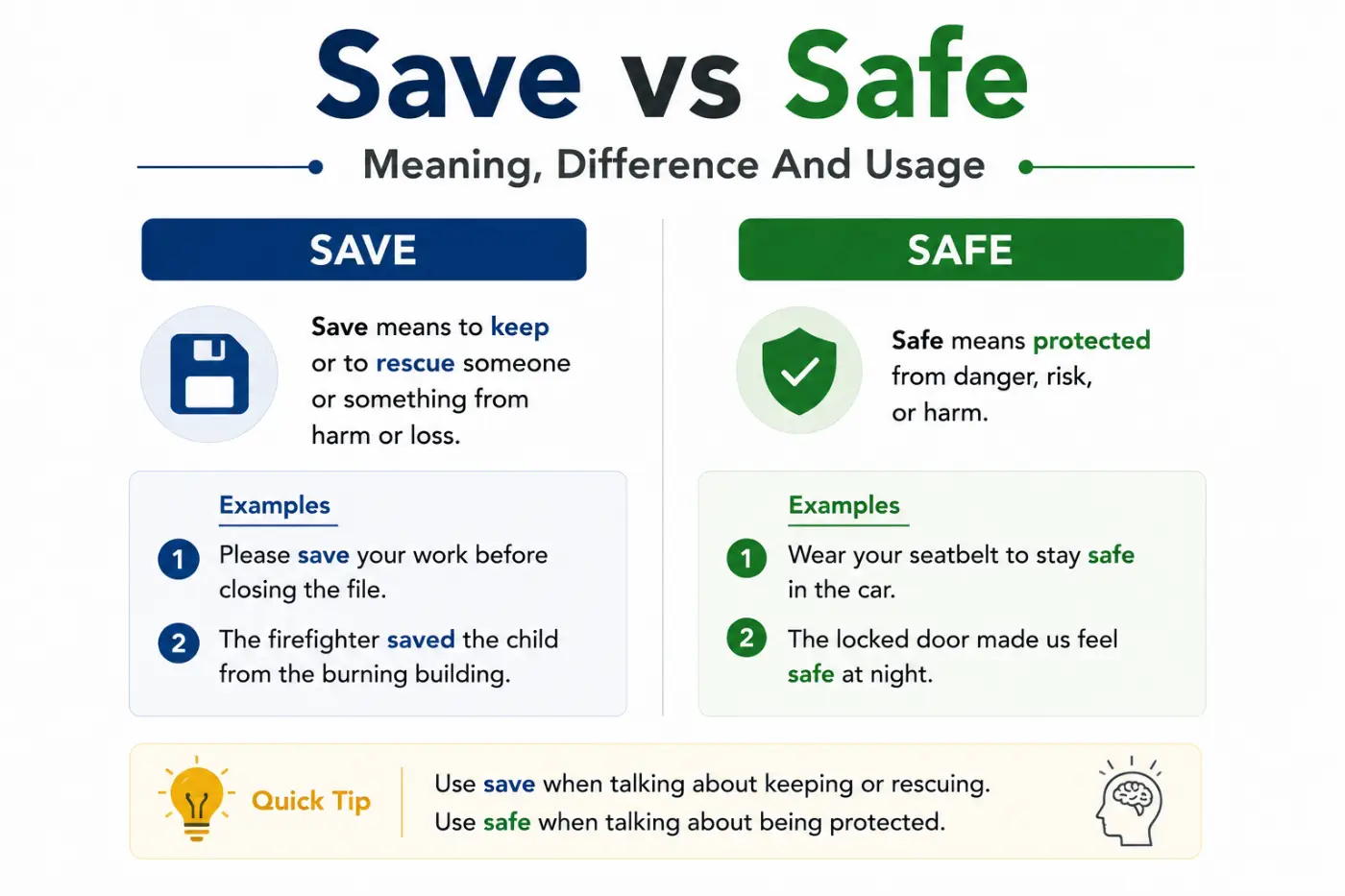
Save vs Safe can be confusing because the two words look and sound similar but they do different jobs in a sentence. Save usually tells us about an action. Safe usually describes a condition or state. For example you can save a document and keep it for later. You can also make sure the document is safe from being lost.
The difference becomes even clearer in everyday sentences. You might say I saved the file or The children are safe. You would not normally replace one word with the other because they carry different meanings and grammatical functions.
Both words are extremely common in American English. Save can refer to protecting something storing information rescuing someone keeping money or avoiding an unwanted result. Safe usually refers to freedom from danger injury damage or risk. It can also describe something reliable or unlikely to cause harm. This guide explains the difference in plain English. You’ll learn how each word works as well as how to pronounce it when to use it in formal writing and which mistakes to avoid.
Short Answer
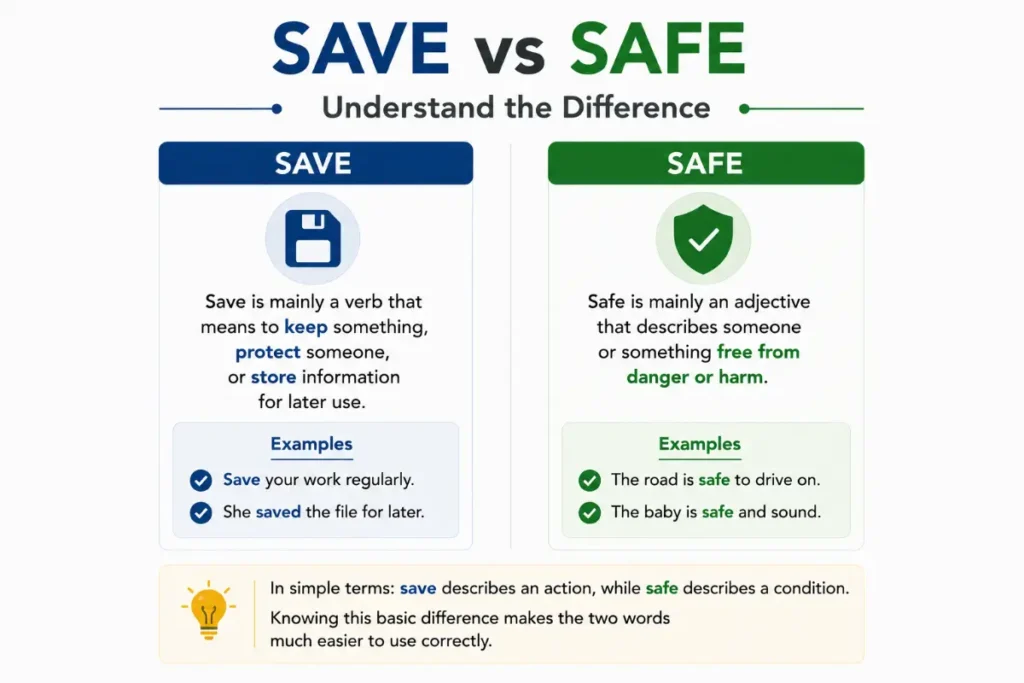
Save is mainly a verb that means to keep something protect someone or store information for later use. Safe is mainly an adjective that describes someone or something free from danger or harm. In simple terms save describes an action while safe describes a condition. Knowing this basic difference makes the two words much easier to use correctly.
Table of Contents
- The basic difference.
- What save means.
- What safe means.
- Save vs Safe in grammar.
- Comparison table.
- Common meanings of save.
- Common meanings of safe.
- Pronunciation.
- Real life examples.
- Common mistakes.
- Memory tips.
- Related words and expressions.
- Formal and informal usage.
- American and British English.
- Expert editor insight.
- Frequently asked questions.
- Key takeaways.
- Conclusion.
The Basic Difference
The simplest way to remember the difference is this.
Save is usually an action.
Safe is usually a condition.
When you save something you do something to keep it available or protect it from loss. When something is safe it is protected from danger or harm.
Consider these examples.
I saved the file.
The file is safe.
In the first sentence saved describes an action. In the second sentence safe describes the condition of the file.
Here is another example.
The lifeguard saved the swimmer.
The swimmer is safe.
The lifeguard performed an action. The swimmer is now in a protected condition.
This distinction works in many everyday situations. You can save money and You can keep your money safe. You can save a person and You can make sure that person is safe.
The words often appear together because saving something can help make it safe. However they are not interchangeable.
What Save Means
Save has several meanings in English. Its exact meaning depends on the context.
The most common use is as a verb meaning to keep something rather than lose it.
For example:
Please save this document.
Here save means to store the document so you can use it later.
Save can also mean to protect someone from danger.
The firefighter saved the child.
In this sentence save means rescue or protect from serious harm.
Another common meaning involves money.
I’m saving money for a new car.
Here save means to keep money instead of spending it.
Save can also mean to prevent something unwanted.
The umbrella saved us from getting soaked.
The extra time saved the team from missing the deadline.
The word can even mean to reserve something for later.
Save me a piece of cake.
In this sentence save means keep a portion for another person.
Because save has several meanings it is one of those English words that needs context. The surrounding words tell you exactly what the speaker means.
What Safe Means
Safe is mainly an adjective.
It describes a person place thing or situation that is free from danger or serious risk.
For example:
The children are safe.
The road is safe.
Your information is safe.
The word can describe physical security.
The hikers reached a safe place.
It can also describe something that is unlikely to cause harm.
This medicine is safe for adults.
Safe can describe a person who has avoided danger.
Everyone got home safe.
In standard formal writing the phrase got home safely is often preferred because safely is an adverb. However safe is very common in everyday American speech after verbs such as get arrive and return.
Safe can also mean reliable or unlikely to produce an unwanted result.
That is a safe choice.
This is a safe investment.
The meaning depends on context but the central idea remains protection from danger risk or harm.
Save vs Safe In Grammar
The grammatical difference is one of the most useful clues.
Save is commonly a verb.
Safe is commonly an adjective.
That means they usually appear in different positions and perform different jobs.
Consider these sentences.
I saved my work.
My work is safe.
Saved tells us what someone did. Safe tells us the condition of the work.
Another example makes the distinction even clearer.
The doctor saved his life.
He is now safe.
The first sentence contains an action. The second describes a state.
Save As A Verb
Save can be used in many verb structures.
I save money every month.
She saves her files regularly.
They saved the injured man.
We are saving for a house.
He saved the document.
The past tense is saved.
The present participle is saving.
The third person singular form is saves.
Examples include:
She saves everything carefully.
He saved the file.
They are saving money.
Safe As An Adjective
Safe describes a noun or follows a linking verb.
The child is safe.
This building is safe.
That road looks safe.
We found a safe place.
You can also use safe after verbs such as feel.
I feel safe here.
The adjective can describe physical security emotional security or freedom from danger.
Comparison Table
| Feature | Save | Safe |
|---|---|---|
| Main part of speech | Verb | Adjective |
| Core meaning | Keep protect rescue store or reserve | Free from danger or harm |
| Common question | What do you do | What is something like |
| Example | Save the file | The file is safe |
| Related adverb | Safely can be used for safe | Safely |
| Past form | Saved | No past form because it is usually an adjective |
| Common contexts | Money files people time resources | People places objects decisions situations |
| Opposite ideas | Spend lose waste abandon | Dangerous unsafe risky |
| Common expression | Save money | Stay safe |
The table shows the central distinction. Save generally describes something being done. Safe generally describes a condition.
Common Meanings Of Save
Save Information
One of the most familiar uses appears in computers and digital devices.
Save the document before closing the program.
Here save means store the information so it can be accessed later.
You can save a file. Save a photo. Save a presentation.
The opposite idea is losing information.
Save Money
Save commonly refers to keeping money instead of spending it.
I’m saving money for college.
She saves part of every paycheck.
They saved enough for a vacation.
This meaning is common in personal finance.
The noun savings comes from this use.
For example:
My savings are growing.
Save A Person
Save can mean rescue someone from danger.
The lifeguard saved the swimmer.
The doctors saved his life.
The rescue team saved several hikers.
This use often carries a strong sense of protection or rescue.
Save Time
Save can mean avoid wasting time.
Taking the train will save us an hour.
This shortcut saved me a lot of time.
Here the word does not mean storing something. It means preventing a resource from being used unnecessarily.
Save Space
Save can also mean use less physical or digital space.
These boxes can save space in the closet.
Compressing the images can save storage space.
Save Something For Later
This use means keeping something so you can use it at another time.
Save some food for your brother.
I’ll save this article for later.
She saved the message so she could read it again.
Save A Seat
Save can mean reserve a place for someone.
Can you save me a seat?
I saved a chair for my friend.
This is common in everyday conversation.
Save Someone From Something
This structure means protect someone from an unwanted result.
The umbrella saved us from the rain.
His quick decision saved the company from a major loss.
The word often appears with from in this meaning.
Common Meanings Of Safe
Safe From Danger
The most basic meaning of safe is freedom from danger.
The children are safe.
Everyone is safe now.
The building is safe after the inspection.
Safe Place
A safe place is somewhere that provides protection from danger.
We found a safe place to wait.
The hikers moved to a safe place during the storm.
Safe Person
Safe can describe someone who does not present a threat.
The child feels safe with her parents.
The dog is safe around children.
Safe Choice
Safe can describe an option that carries little risk.
Taking the earlier flight is the safe choice.
This is a safe option for beginners.
The meaning does not necessarily involve physical danger. It can involve uncertainty or risk.
Safe To Use
Safe often appears with to plus a verb.
This water is safe to drink.
The equipment is safe to use.
The road is safe to cross.
This structure tells us that an action can be performed without serious danger.
Save vs Safe In Everyday Sentences
The difference becomes easier when you compare paired sentences.
Saving A Person And Keeping The Person Safe
The firefighter saved the child.
The child is safe now.
Saved describes the rescue. Safe describes the result.
Saving A File And Keeping The File Safe
I saved the file.
The file is safe on my computer.
Saved refers to storing the information. Safe describes its protected condition.
Saving Money And Keeping Money Safe
I save money every month.
I keep my money safe in a bank account.
Save describes the act of setting money aside. Safe describes protection from loss or theft.
Saving Time And Staying Safe
The shortcut saved us time.
The driver kept everyone safe.
The two verbs describe different actions and the adjective describes a condition.
These paired examples reveal why the words cannot simply replace one another.
Pronunciation Guide
Save and safe are easy to confuse in writing because they differ by only one letter.
Save is pronounced /seɪv/.
Safe is pronounced /seɪf/.
Both words have one syllable.
They share the same long a sound. The important difference comes at the end.
Save ends with the v sound.
Safe ends with the f sound.
You can practice the contrast with these pairs.
Save.
Safe.
Save.
Safe.
The final consonant changes the word completely.
The pronunciation difference can help you remember the spelling. If the final sound is a v sound you likely mean save. If the final sound is an f sound you likely mean safe.
Why Save And Safe Are Easy To Mix Up
English contains many words that differ by just one letter or one sound. Save and safe are a good example.
The visual difference is small.
Save.
Safe.
The meanings are very different even though the words look almost identical.
Another reason for confusion is that their meanings can appear in the same situation.
For example you might save a child and then make sure the child is safe.
You might save a file and then check that the file is safe from being deleted.
You might save money and keep that money safe.
Because the concepts are connected the words can appear close together in natural speech.
That connection can make the confusion stronger. However the grammar gives you a reliable clue.
If you need an action word use save.
If you need a describing word use safe.
Common Mistakes
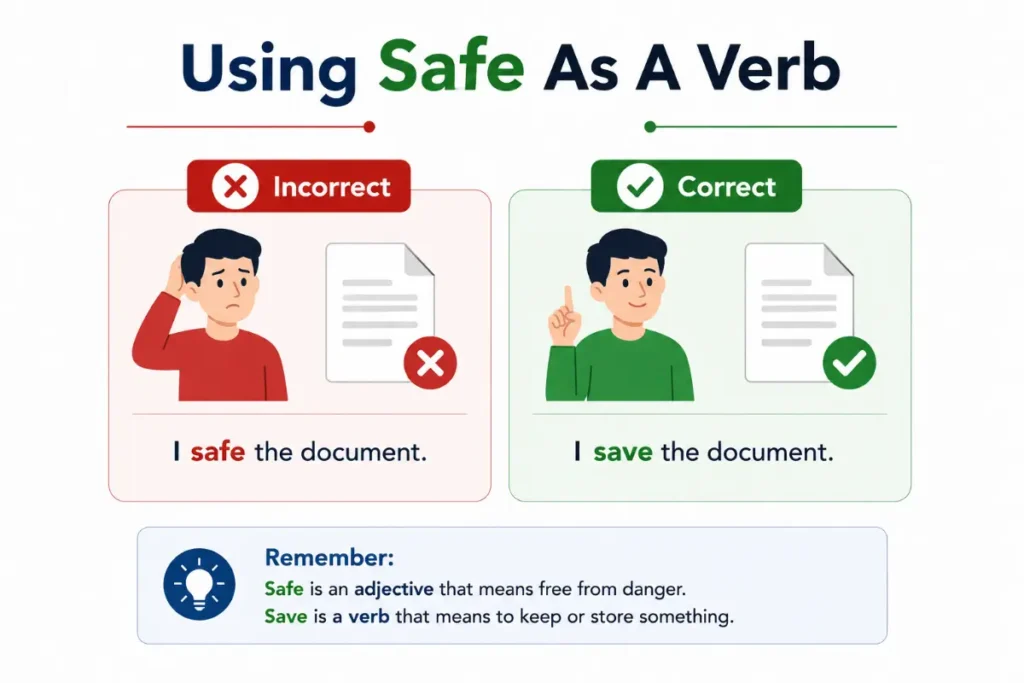
Using Safe As A Verb
Incorrect:
I safe the document.
Correct:
I save the document.
Safe is not the standard verb for storing a document.
Using Save As An Adjective
Incorrect:
The children are save.
Correct:
The children are safe.
The sentence needs an adjective to describe the condition of the children.
Confusing Save With Safely
Save and safely perform completely different grammatical jobs.
I saved the file.
She drove safely.
Saved is a verb form. Safely is an adverb.
Writing Safe Instead Of Save In Technology
Incorrect:
Please safe the document.
Correct:
Please save the document.
Computer software uses save as the standard verb for storing information.
Writing Save Instead Of Safe
Incorrect:
The children are save.
Correct:
The children are safe.
After the linking verb are the sentence needs an adjective describing the children.
Memory Tips
A simple memory trick can make the difference stick.
Think Action And Condition
Save is an action.
Safe is a condition.
You save something.
Something is safe.
That is the most useful rule to remember.
Remember The Last Sound
Save ends with v.
Safe ends with f.
If you hear the v sound think save.
If you hear the f sound think safe.
Connect Save With Storage
Think about the save button on your computer.
You click save to keep information.
That gives you a strong mental connection between save and keeping something.
Connect Safe With Protection
Think of a safety sign.
Safe relates to protection from danger.
That connection makes the adjective easier to recognize.
Use A Simple Sentence Pair
I save my work.
My work is safe.
If you remember those two sentences you can often work out which word belongs in a new sentence.
Related Grammar And Usage Notes
Save And Rescue
Save can mean rescue.
The nurse saved the patient.
Rescue often focuses specifically on removing someone from danger. Save has a broader range of meanings.
For example you can save a file but you cannot normally rescue a file in the same everyday sense.
Safe And Secure
Safe and secure are closely related.
The children are safe.
The building is secure.
Safe usually focuses on freedom from danger or harm. Secure often focuses on protection from unauthorized access movement theft or attack.
The exact distinction depends on context.
Safe And Safely
Safe is an adjective.
Safely is an adverb.
The child is safe.
The child crossed the street safely.
The first sentence describes the child. The second describes how the child crossed.
This distinction matters in formal writing.
Save And Savings
Savings is related to the financial meaning of save.
I save money each month.
My savings are growing.
The verb describes the action. The noun refers to money that has been saved.
Safe And Safety
Safety is the noun form related to safe.
The workers are safe.
Worker safety is important.
Safe describes a condition. Safety refers to protection from danger or the state of being protected.
Formal And Informal Usage
Both words are standard in formal and informal American English.
Save is common in professional writing.
Please save the document before closing the application.
The company plans to save resources by reducing waste.
The treatment could save lives.
Safe is also common in formal writing.
The equipment must be safe for public use.
The building was declared safe.
Employees should have a safe working environment.
There is no reason to avoid either word in professional writing.
The important point is accuracy. Using a simple correct word is better than choosing a more complicated word that does not fit the sentence.
American And British English
American English and British English use save and safe in essentially the same standard ways.
The spelling does not change between these varieties.
Americans write save.
British writers also write save.
Americans write safe.
British writers also write safe.
The basic meanings and grammatical roles remain the same.
Some expressions can differ between varieties of English but that does not create a meaningful spelling difference for these two words.
If you are writing for an American audience you can confidently use the standard forms explained here.
Real Life Usage Examples
Everyday Conversation
- Can you save me a seat?
This means reserve a seat for the speaker.
- Are the children safe?
This asks if the children are free from danger.
- I need to save some money.
This means keep money instead of spending it.
- Don’t worry. Everyone is safe.
This tells someone that nobody is in danger.
Workplace Writing
- Please save the updated report before leaving.
Save means store the latest version.
- The workers are safe inside the building.
Safe describes their condition.
- This change could save the company money.
Save means prevent unnecessary spending.
- The new system is safe to use.
Safe describes the system as free from serious danger.
School Writing
- Students should save their work regularly.
Save means store the work.
- The laboratory must be safe for students.
Safe describes the laboratory.
- Reading the instructions can save time.
Save means prevent time from being wasted.
- The teacher made sure everyone was safe.
Safe describes the students after protection was provided.
Online Communication
- Save this message so you can find it later.
Save means keep it for future use.
- Your account information should remain safe.
Safe means protected from harm or unauthorized access.
- I saved the photo to my phone.
Save means store the photo.
- Keep your personal information safe.
Safe describes the desired condition of the information.
Related Words And Expressions
Several words connect naturally with these two terms.
Protect
Protect means keep someone or something from harm.
The helmet protects your head.
Rescue
Rescue means save someone from danger.
The team rescued the hikers.
Secure
Secure means protect something or make it firmly established.
Please secure the door.
Danger
Danger is the possibility of harm.
The storm created serious danger.
Risk
Risk refers to the possibility of an unwanted result.
The decision carries some risk.
Safety
Safety is the condition of being protected from danger.
Everyone’s safety matters.
Safely
Safely is the adverb form of safe.
They arrived safely.
Savings
Savings refers to money that has been saved.
Her savings helped pay for the house.
These related words can help you understand the wider meaning network around save and safe without treating the words as interchangeable.
Save As A Preposition
There is another use of save that advanced learners should know.
Save can function as a preposition meaning except.
For example:
Everyone came save John.
This use is grammatically established but sounds formal or old fashioned to many modern American English speakers.
In ordinary conversation most people would say:
Everyone came except John.
This meaning has nothing to do with saving money storing a file or rescuing someone.
It is useful to recognize the construction when reading older literature or formal writing but it is not the most natural choice for everyday American English.
Save In Sports
Save also has a special meaning in sports.
In baseball a save is a statistical achievement credited to a relief pitcher under specific game conditions.
For example:
The pitcher recorded a save.
In soccer and other sports a save can describe a goalkeeper stopping a shot that might otherwise result in a goal.
For example:
The goalkeeper made an excellent save.
These meanings are specialized but very common within sports contexts.
Safe also appears in sports.
In baseball a runner can be safe when they reach a base before being legally tagged or forced out.
For example:
The runner was safe at second.
This creates an interesting contrast because both words have established sports meanings.
Save In Technology
Modern technology gives save one of its most familiar meanings.
When you create a document you may need to save it.
When you work on a presentation you may save the file.
The word refers to storing information so that the changes remain available.
Common expressions include:
Save the file.
Save the image.
This meaning is so common that save has become part of everyday computer vocabulary.
Safe can also appear in technology.
For example:
Keep your password safe.
Your files are safe.
Make sure your account is safe.
In these sentences safe means protected.
Save In Finance
Financial English uses save frequently.
People save money for emergencies education travel retirement and major purchases.
For example:
I’m saving for a house.
She saves part of her income.
They saved enough money for college.
The related noun savings refers to money that someone has accumulated.
For example:
I used my savings to buy a car.
Safe can also appear in financial discussions but it has a different meaning.
A safe investment is generally understood as one that carries relatively low risk compared with more uncertain investments.
The word does not mean that financial loss is impossible. Context matters.
Safe In Health And Everyday Life
Safe often describes things that do not create unreasonable danger.
For example:
Is this food safe to eat?
Is it safe to drive now?
The word can also describe conditions.
The roads are safe now.
The area is safe during the day.
The children are safe at home.
These examples show how broad the adjective can be. It can relate to physical health environmental conditions personal security or general risk.
Professional Editing Tip
When editing a sentence that contains save or safe first identify the grammatical job the word needs to perform.
If the sentence needs an action use save or another appropriate verb.
If the sentence needs a word describing a person thing place or situation use safe.
For example:
Please save the report.
The report is safe.
The first sentence asks someone to perform an action. The second describes the report.
This quick grammar check is often more reliable than looking only at spelling. Similar looking words can have completely different functions.
Key Takeaways
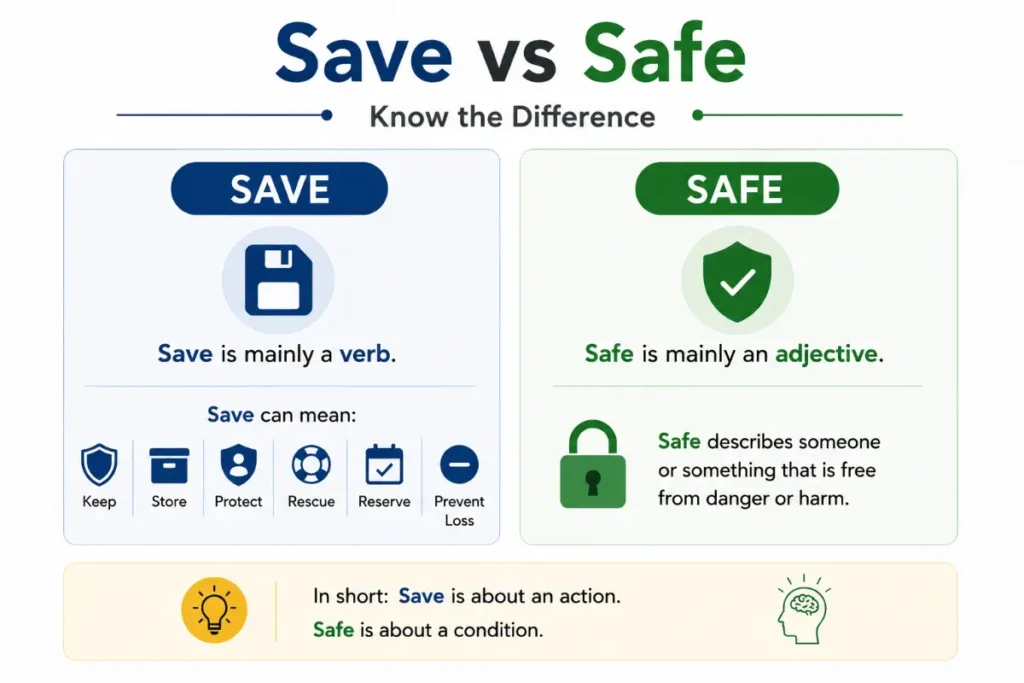
- Save is mainly a verb.
- Safe is mainly an adjective.
- Save can mean keep store protect rescue reserve or prevent loss.
- Safe describes freedom from danger harm or excessive risk.
- You save a file but a file can be safe.
- You save money but you can keep your money safe.
- A firefighter can save someone and the person can then be safe.
- Save is pronounced /seɪv/.
- Safe is pronounced /seɪf/.
- The final sound is an easy way to distinguish the words when speaking.
- Save and safe have the same standard spellings in American and British English.
- The fastest grammar check is to ask if the sentence needs an action or a condition.
Conclusion
Save vs Safe becomes much easier once you focus on the job each word performs. Save is mainly a verb that describes an action such as storing a file saving money protecting someone or preventing a loss. Safe is mainly an adjective that describes a person thing place or situation that is free from danger or serious risk.
A useful memory trick is simple. You save something. Something is safe. You can save a document and keep that document safe. You can save a person and make sure that person is safe.
When you’re unsure which word belongs in a sentence check the grammar first. If you need an action choose save. If you need a description of protection or security choose safe. That small test will help you choose the right word with confidence.
FAQs
What Is The Difference Between Save And Safe?
Save is mainly a verb that describes an action such as keeping protecting storing or rescuing something. Safe is mainly an adjective that describes a condition free from danger or harm. You can save a person and then that person can be safe. The words may appear in related situations but they do not perform the same grammatical job.
Is Save A Verb Or An Adjective?
Save is most commonly a verb. It can mean keep something for later protect someone from harm store information reserve something or prevent an unwanted result. It can also have other grammatical uses in specific contexts. For example I saved the document uses save as a verb.
Is Safe A Verb Or An Adjective?
Safe is most commonly an adjective. It describes someone or something that is protected from danger harm or excessive risk. For example The children are safe uses safe as an adjective. The related adverb is safely and the related noun is safety.
Can Save And Safe Be Used In The Same Sentence?
Yes. The two words can easily appear together because their meanings can be connected. For example The firefighter saved the child and made sure the child was safe. Save describes the rescue action while safe describes the condition of the child after the rescue.
Why Do People Confuse Save And Safe?
People often confuse the words because they look almost identical and have similar pronunciation. They differ mainly in their final consonant sound. Their meanings can also occur in related situations. Someone can save a person and make that person safe. Remembering action versus condition makes the difference easier to recognize.
What Is The Difference Between Safe And Safely?
Safe is an adjective while safely is an adverb. Safe describes a person or thing. Safely describes how an action happens. For example The children are safe uses the adjective. The children crossed the road safely uses the adverb. Choosing the correct form depends on the grammatical role needed by the sentence.
Is Safe A Synonym For Secure?
Safe and secure can have similar meanings but they are not identical in every context. Safe often focuses on freedom from danger or harm. Secure can emphasize protection from theft unauthorized access movement or other threats. For example The child is safe and The account is secure are both natural but focus on different kinds of protection.
What Is A Synonym For Save?
The best synonym depends on the meaning. Protect can work when save means prevent harm. Rescue can work when save means remove someone from danger. Store can work when save means keep digital information. Reserve can work when save means keep something for later. Preserve can work when save means keep something from being damaged or lost.
Is Save Used In American English?
Yes. Save is a standard and extremely common word in American English. It appears in everyday conversation professional writing education finance technology sports and many other areas. Its meaning changes according to context but its standard spelling remains save.
Is Safe Used In British English?
Yes. Safe is standard in British English as well as American English. The spelling and core meanings are essentially the same. Regional differences do not turn save into safe or safe into save. The distinction between the two words remains consistent across major English varieties.

Confusing Words, Spelling & Word Choice
Claire Whitmore is a U.S.-based English editor who writes about commonly confused words, spelling differences, and word choice. Her work helps readers understand subtle distinctions between similar-looking words through simple definitions, practical examples, and modern usage guidance in both American and British English.