
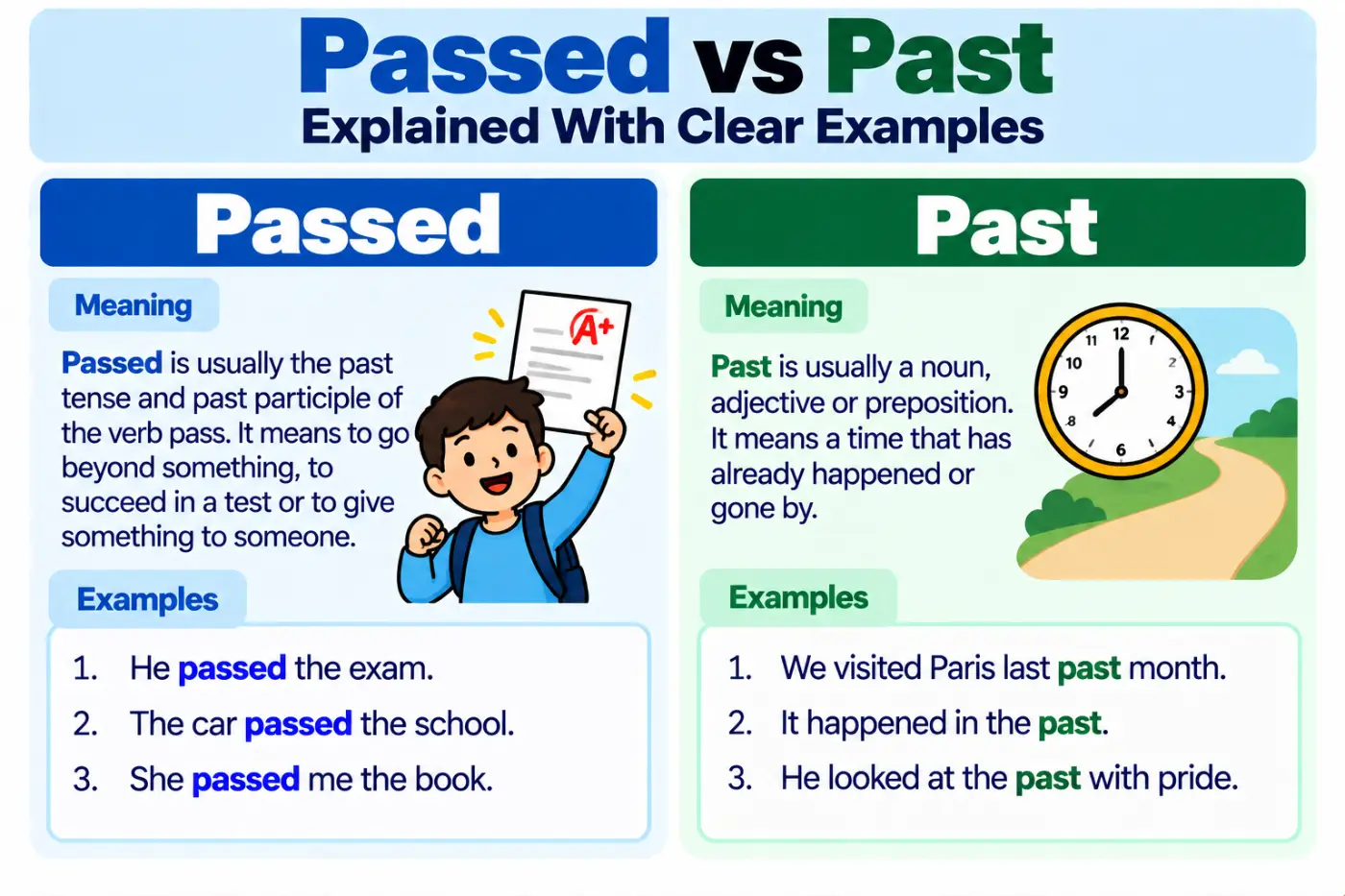
Passed vs past is a common English confusion because the two words sound alike in standard American English but perform very different jobs in a sentence. Passed is a form of the verb pass while past can work as a noun adjective preposition or adverb. The spelling changes because the grammar changes.
The easiest way to understand the difference is to look at the action in the sentence. If someone moved beyond a person gave an object to another person succeeded in an exam or experienced time going by as an action then passed may be the right choice. If you are talking about an earlier period time beyond a point or something located farther along a route then past is often the right word.
This distinction becomes much easier once you stop treating the words as interchangeable. They may sound the same in ordinary speech but they aren’t the same part of speech. Think of passed as an action word and past as a word connected with time position or a point that has already been crossed.
Short Answer
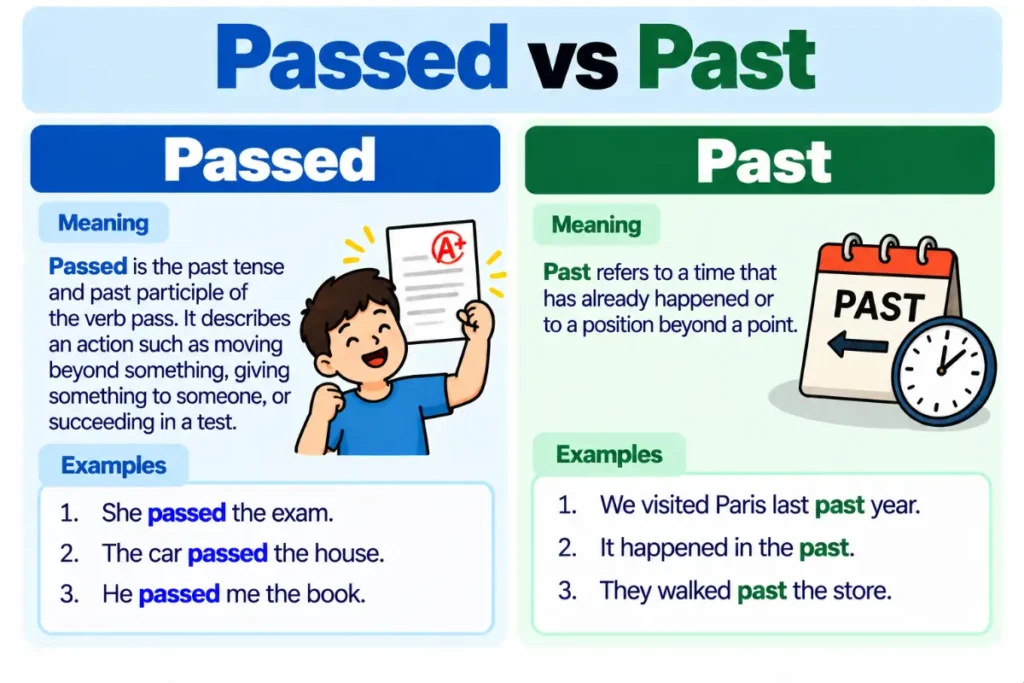
Passed is the past tense and past participle of the verb pass. It describes an action such as moving beyond something giving something to someone or succeeding in a test. Past refers to a time that has already happened or to a position beyond a point. If you can replace the word with pass or passed then passed is usually correct. If you mean an earlier time or a point beyond something then past is usually correct.
Table of Contents
- The basic difference.
- What passed means.
- What past means.
- Passed as a verb.
- Past as a noun.
- Past as an adjective.
- Past as a preposition.
- Past as an adverb.
- Passed vs past in common sentences.
- How to choose the correct word.
- Pronunciation and spelling.
- Common mistakes.
- Memory tips.
- Related grammar notes.
- Real life examples.
- Key takeaways.
- Frequently asked questions.
- Conclusion.
The Basic Difference
The central difference is grammatical.
Passed is a verb form. It is the past tense and past participle of pass. The verb pass has several meanings. It can mean to move beyond something to hand something to another person to succeed in a test to spend time or to move from one state or stage to another.
Past is not the past tense of pass. It can function as a noun adjective preposition or adverb. Its meanings commonly relate to an earlier time a position beyond something or a point that has already been reached.
| Word | Main grammatical role | Common meaning | Example |
|---|---|---|---|
| Passed | Verb | Moved beyond or succeeded | She passed the car. |
| Past | Noun | Earlier time | We can’t change the past. |
| Past | Adjective | Earlier or previous | He learned from past mistakes. |
| Past | Preposition | Beyond a point or later than a time | We walked past the store. |
| Past | Adverb | From one side to another or beyond | The train went past. |
The important point is simple. Passed describes something someone or something did. Past usually describes time position or a point beyond something.
What Passed Means
Passed is the past tense and past participle of pass. It can describe an action that happened before now or a completed action connected to the present.
For example:
She passed the exam.
Here passed describes an action. She took the exam and achieved the required result. The word is a verb.
Consider another example:
The runner passed me near the finish line.
Again passed describes an action. The runner moved ahead of the speaker.
Passed can also describe transferring something.
He passed the salt to his sister.
The action is giving or handing the salt to another person.
The word can also describe movement through or beyond a place.
We passed the old bridge before sunset.
In this sentence passed means that we moved beyond the bridge.
Passed also appears in expressions related to time.
Three hours passed before the doctor arrived.
Here passed is still a verb. It describes time moving from one point to another.
The verb pass has many meanings so context matters. Oxford lists meanings connected with movement and also with succeeding in a test. Its American English entry gives passed as the past simple form of pass.
What Past Means
Past usually connects an idea with an earlier time or a position beyond something.
For example:
I learned a lot from my past.
Past is a noun here. It refers to earlier events or experiences.
You can also use past as an adjective.
She regrets some past decisions.
Past describes the decisions. The decisions belong to an earlier time.
Past can work as a preposition.
We walked past the library.
Here past introduces the place that we moved beyond.
It can also describe time.
It was past midnight when we arrived.
In this sentence past means later than midnight.
Past can also function as an adverb.
The car drove past.
The word tells us that the car moved beyond the speaker or a particular point.
Oxford lists past as a noun adjective preposition and adverb. It also gives meanings connected with earlier time and movement beyond a point.
Passed As a Verb
Passed is always closely connected with the verb pass. This gives you a powerful way to identify it.
Ask yourself if the sentence describes an action.
If the answer is yes then passed may be the correct word.
She passed her driving test.
The action is succeeding in the test.
The bus passed our house.
The action is moving beyond the house.
He passed the message to his manager.
The action is transferring the message.
Time passed quickly.
The action is time moving forward.
They passed through the security gate.
The action is moving through the gate.
In each sentence passed functions as a verb.
One useful test is to change the sentence to the present tense. If passed becomes pass or passes then you are dealing with the verb.
She passed the exam.
She passes the exam.
The bus passed the station.
The bus passes the station.
He passed the ball.
He passes the ball.
This test works because passed is a verb form. Cambridge identifies passed as both the past simple and past participle form of pass.
Past As a Noun
Past can refer to the time before the present.
For example:
The past cannot be changed.
Here past is a noun. It refers to everything that happened before now.
Other examples include:
We should learn from the past.
She doesn’t like talking about her past.
His past shaped many of his decisions.
They left their past behind.
The past can also refer to someone’s earlier life history or experiences.
The detective wanted to know about his past.
This doesn’t mean the detective wanted to know about a physical place. It means the detective wanted information about earlier events in the person’s life.
Oxford defines the past as the time that has gone by and also uses it to describe a person’s earlier life or the history of a place or group.
This use is easy to remember because past often answers a simple question.
When did it happen?
If the answer points to a time before now then past may fit.
Past As an Adjective
Past can describe something connected with an earlier time.
For example:
She visited her past employers.
This means employers from an earlier period of her career.
He made the same mistake in past years.
Past describes the years.
They discussed past events.
Past describes events that happened before now.
The company has learned from past failures.
Again past describes something connected with an earlier period.
Oxford lists past as an adjective meaning gone by in time or belonging to an earlier period.
Past can also describe a period that has just ended.
The past month has been busy.
The past year brought several changes.
In these examples past refers to a period leading up to the present.
Past As a Preposition
Past is commonly used as a preposition when something moves beyond a person place or point.
For example:
We drove past the school.
She walked past me without saying anything.
The dog ran past the gate.
He went past the office on his way home.
In each sentence past introduces a point or place that the subject moves beyond.
Past can also refer to time.
It was past noon when we left.
The meeting continued past five o’clock.
We stayed there past midnight.
Here past means later than the stated time.
Oxford gives both meanings. Past can indicate movement to the other side of something and can also mean later than a particular time.
This is one of the most useful distinctions in everyday American English.
Compare these sentences:
The car passed the house.
The car drove past the house.
Both sentences describe movement. The first uses passed as the main verb. The second uses drove as the main verb and past as a preposition.
That small grammatical difference explains why the spelling changes.
Past As an Adverb
Past can also work as an adverb when it describes movement beyond a point.
For example:
The train went past.
The runner moved past.
She walked past without stopping.
They drove past quickly.
In these sentences past does not introduce a noun directly. It tells us where or how the movement continued.
Oxford gives examples of past used as an adverb for movement from one side of something to another and for time passing.
You can think of this use as a shorter form of an idea such as moved beyond or went by.
Passed vs Past In Common Sentences
The difference becomes much clearer when the words appear in similar sentences.
| Sentence | Correct word | Reason |
|---|---|---|
| She passed the test. | Passed | It is a verb describing success. |
| She walked past the test center. | Past | It shows movement beyond a place. |
| We passed the store. | Passed | Passed is the main verb. |
| We walked past the store. | Past | Walked is the main verb. |
| The past few days were busy. | Past | It describes an earlier period. |
| Two days passed quickly. | Passed | Passed is the verb describing time. |
| He passed me on the road. | Passed | It describes an action. |
| He walked past me. | Past | It shows movement beyond the speaker. |
| We can’t change the past. | Past | It refers to earlier time. |
| The meeting continued past noon. | Past | It means later than noon. |
Notice the pattern.
When the sentence needs an action word from pass then use passed.
When the sentence needs a word related to earlier time or movement beyond a point then use past.
How To Choose The Correct Word
You don’t need to memorize dozens of rules. A few quick questions can usually solve the problem.
Ask If It Is An Action
If the word describes something that happened then passed may be correct.
She passed the ball.
He passed the exam.
The car passed us.
Time passed quickly.
Each sentence contains an action.
Try The Present Tense Test
Replace passed with pass or passes.
She passed the store.
She passes the store.
The sentence still works. That tells you passed is a form of pass.
Now consider:
She walked past the store.
Changing past to pass does not work.
She walked pass the store.
That sentence is incorrect. The correct sentence needs past because past is showing the position beyond the store.
Ask If You Mean Earlier Time
If you are talking about time that has already happened then past may be correct.
The past few years have taught me a lot.
He doesn’t talk about his past.
We should learn from past mistakes.
These examples all refer to an earlier period.
Ask If You Mean Beyond A Point
If something moves beyond a place or person then past often works after another movement verb.
She walked past the window.
The truck drove past us.
The child ran past the teacher.
The key is that walked drove and ran already carry the action. Past adds the idea of movement beyond a point.
Pronunciation And Spelling
Passed and past are homophones in standard American English. That means they have the same pronunciation but different spellings and meanings. Oxford identifies them as homophones and gives the same pronunciation for the two words in its dictionary entries.
This creates a problem in speech because you cannot rely on sound alone.
You have to use context.
If someone says:
I passed the store.
You hear a sound that could also be written as past. The grammar and meaning tell you which spelling belongs on the page.
The same issue appears in:
I walked past the store.
The speaker’s pronunciation does not give you the spelling. The sentence structure does.
For American English the words are pronounced the same in ordinary speech. The spelling difference therefore matters most when you write.
The pronunciation of the base verb pass is also important. The final sound changes when the past ending is added. Cambridge gives passed as the past simple and past participle of pass.
Common Mistakes
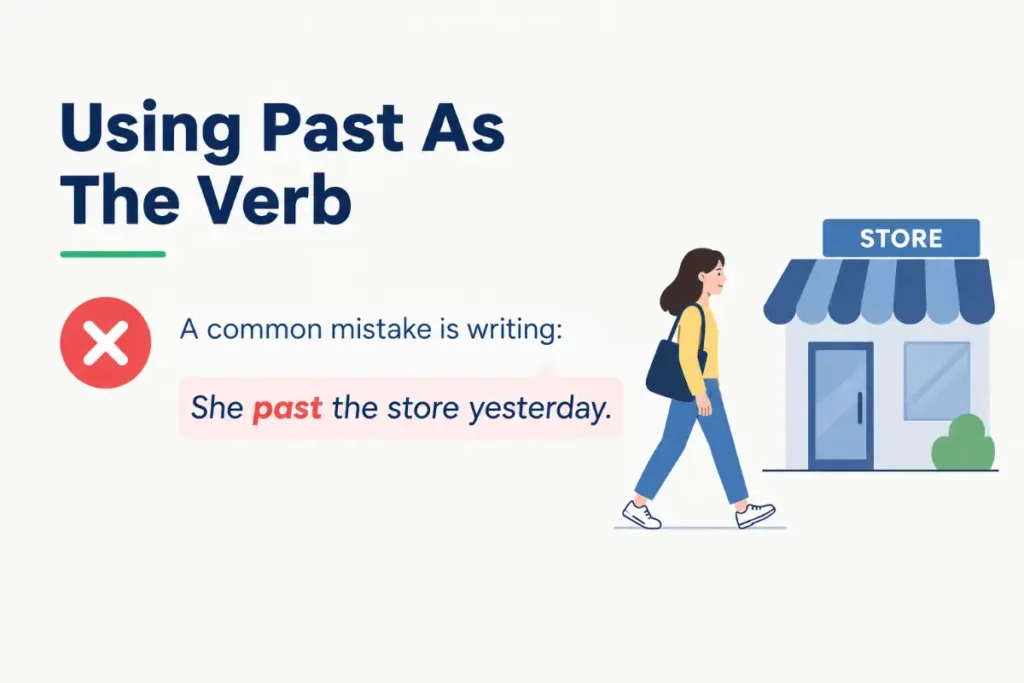
Using Past As The Verb
A common mistake is writing:
She past the store yesterday.
The correct sentence is:
She passed the store yesterday.
Passed is needed because the sentence requires a verb.
Using Passed For A Place Beyond Something
Another common mistake is:
We walked passed the bank.
The correct sentence is:
We walked past the bank.
Walked is already the verb. Past shows the place beyond which we moved.
Using Passed For Earlier Time
This sentence is incorrect:
In passed years people used different methods.
The correct version is:
In past years people used different methods.
Past describes the earlier years.
Using Past For Exam Success
This sentence is incorrect:
I past my exam.
The correct version is:
I passed my exam.
Passing an exam is an action expressed by the verb pass.
Oxford lists pass as a verb meaning to achieve the required standard in an exam or test.
Confusing Passed Away With Past Away
The correct expression is passed away.
For example:
Her grandfather passed away peacefully.
Passed is the verb form here.
Past away is incorrect.
Confusing Passed With Past In Time Expressions
Consider these two sentences:
Three hours passed.
The meeting continued past three hours.
The first sentence uses passed as a verb describing time moving forward.
The second uses past to show that the meeting continued beyond a time period.
The grammar determines the spelling.
Memory Tips
A simple memory trick can make this distinction stick.
Remember Passed Has A Verb Connection
Passed comes from pass.
Pass means an action.
You can pass a test.
You can pass a person.
All of these ideas involve an action.
Remember Past Connects With Earlier Time
Past often points backward in time.
Past experiences.
The past.
If the idea points to something that has already happened then past is often the word you need.
Remember Movement Patterns
Look at these pairs:
She passed the house.
She walked past the house.
He passed me.
He ran past me.
The first sentence in each pair uses passed as the verb.
The second uses past after another movement verb.
This is one of the fastest ways to see the difference.
Related Grammar Notes
Understanding passed and past also helps with several other English grammar patterns.
Pass And Passed
Pass is the base form.
Passed is the past simple and past participle form.
Examples include:
I pass the store every morning.
I have passed the store many times.
The second and third examples use passed because the verb form changes according to the grammar. Cambridge explains that main verbs have different basic forms and that the past form is used for past simple constructions.
Past And Present
Past does not mean past tense every time.
It can describe a time period.
The past was different.
It can describe an earlier event.
Past mistakes can teach useful lessons.
It can describe movement.
We walked past the house.
It can describe a time on the clock.
It was past midnight.
So don’t assume that past always refers to grammar.
Passed And Have Passed
Passed can follow have or has because it is also the past participle of pass.
For example:
I have passed the exam.
She has passed the checkpoint.
They have passed the deadline.
In these examples passed remains a verb.
Passed And Had Passed
Passed can also appear after had.
For example:
By the time we arrived the train had passed the station.
Here had passed is a past perfect verb phrase.
The word past would not work in that position.
Real Life Examples
The best way to master confusing words is to see them in ordinary situations.
School And Exams
I studied all weekend and passed the exam.
The verb passed describes success.
The exam was a thing of the past after graduation.
Here past refers to an earlier period.
Driving
The car passed my truck on the highway.
Passed describes the action of overtaking or moving beyond.
We drove past the gas station.
Past identifies the location we moved beyond.
Work
She passed the information to her manager.
Passed describes transferring information.
Her past experience helped her solve the problem.
Past describes earlier experience.
Travel
We passed several small towns during the trip.
Passed describes movement beyond those towns.
We drove past the old courthouse.
Past shows the position of the courthouse in relation to our route.
Time
Several minutes passed before anyone answered.
Passed is the verb describing time.
It was already past midnight when we finished.
Past means later than midnight.
Relationships
He wants to leave the past behind.
Past is a noun referring to earlier experiences.
She passed the message to her friend.
Passed is a verb describing an action.
Formal And Informal Usage
Both words are standard in formal and informal American English.
Passed appears in everyday conversation professional writing academic writing news writing and formal documents.
Past has an equally broad range of uses.
You can use past in simple conversation.
We walked past the restaurant.
You can use it in professional writing.
The company learned from past experience.
You can use it in academic writing.
Researchers examined past trends.
You can use it in formal writing.
The agreement refers to past events.
There is no general rule that limits either word to formal or informal English. The important issue is choosing the form that matches the meaning and grammar.
American English Usage
The distinction between passed and past is standard in American English.
American English uses past for movement beyond a point.
For example:
She walked past the library.
Past also appears in American time expressions.
It is half past two.
It was past midnight.
Oxford’s American English entries specifically include past as a word used for time and position and list passed as the past form of pass.
There is no major American English spelling difference between passed and past. The same core distinction applies across standard English.
Word Origin
The two words are historically connected. Oxford notes that past developed as a variant connected with the past participle of pass.
That historical connection helps explain why the words look and sound so similar.
Modern English treats them differently in grammar.
Passed remains a form of the verb pass.
Past developed into a broader word that can function as a noun adjective preposition and adverb.
Knowing the history can be interesting but you don’t need to remember the etymology to use the words correctly.
Grammar gives you the more useful shortcut.
A Simple Decision Test
When you are unsure which spelling to use ask yourself three questions.
- Am I describing an action performed by someone or something?
If yes then passed may be correct.
- Am I talking about an earlier time or previous experience?
If yes then past may be correct.
Try the test with these sentences.
They ___ the finish line.
The correct answer is passed because the word is the verb.
They ran ___ the finish line.
The correct answer is past because ran is the verb and past shows movement beyond the point.
She learned from ___ mistakes.
The correct answer is past because the word describes earlier mistakes.
Two hours ___ before the meeting started.
The correct answer is passed because passed is the verb describing time.
Once you see the grammar this way the spelling becomes much easier.
Key Takeaways
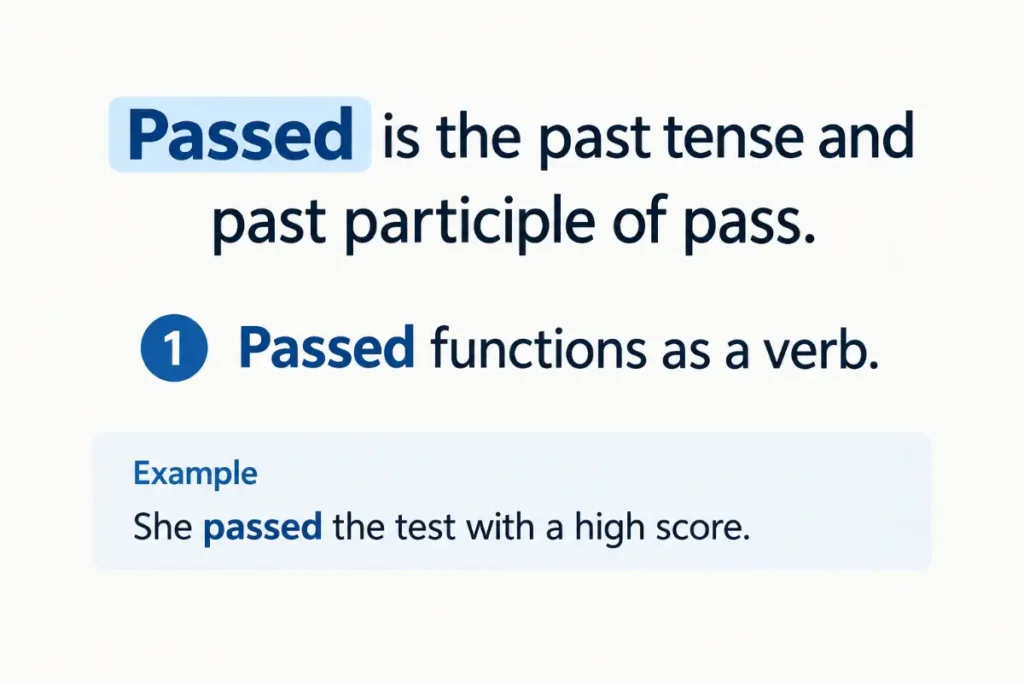
- Passed is the past tense and past participle of pass.
- Passed functions as a verb.
- Past can function as a noun adjective preposition or adverb.
- Past commonly refers to earlier time.
- Past can also mean beyond a person place or point.
- Passed and past sound alike in standard American English.
- Use passed for actions such as passing a test moving beyond something or giving something to another person.
- Use past for earlier time such as past years past mistakes or the past.
- Use past after movement verbs when it shows movement beyond something.
- If you can replace the word with pass or passes then passed is likely the correct choice.
Conclusion
Passed vs past becomes much easier once you focus on grammar instead of pronunciation. Passed is the verb form that comes from pass while past usually refers to earlier time or something beyond a particular point. The two words sound alike but their roles in a sentence are different.
Use passed when you describe an action such as passing an exam moving beyond something or giving something to another person. Use past when you refer to earlier experiences past events or movement beyond a place after another verb. This simple distinction covers most everyday uses.
When in doubt test the sentence. If you need an action from the verb pass then choose passed. If you mean an earlier time or movement beyond a point then choose past. Once that pattern becomes familiar you won’t need to guess at the spelling again.
Frequently Asked Questions
Is passed or past correct?
Both words are correct but they have different grammatical jobs. Passed is a form of the verb pass. Past usually refers to earlier time or a position beyond something. The sentence determines which word you need.
Is passed the past tense of pass?
Yes. Passed is the past simple form of pass and it is also the past participle. For example I passed the exam uses the past simple while I have passed the exam uses the past participle.
Is past a verb?
Usually no. Past can function as a noun adjective preposition or adverb. It is not the past tense form of pass. The verb form is passed.
Is it walked past or walked passed?
The correct form is walked past. Walked is the verb and past shows movement beyond a person place or point. For example She walked past the store.
Is it passed the store or past the store?
Both can be correct depending on the sentence. You can say We passed the store because passed is the verb. You can also say We walked past the store because walked is the verb and past shows the position beyond the store.
Is it passed the test or past the test?
Passed the test is correct when you mean someone succeeded in the test. For example I passed the test. Pass is a verb meaning to achieve the required standard in an exam or test.
Is it in the passed or in the past?
The standard expression is in the past. For example We lived there in the past. Past is a noun referring to an earlier time.
Is it past experience or passed experience?
Past experience is the standard expression when you mean experience gained earlier in life or work. For example Her past experience helped her solve the problem.
Is it time passed or time past?
Both can appear in English but they have different grammatical patterns. Time passed uses passed as the verb and means that time went by. Time past is found in more specialized or older constructions. In everyday American English time passed is the natural choice for describing time going by.
Why do passed and past sound the same?
They are homophones in standard American English. Their pronunciation is the same in ordinary speech even though their spellings and grammatical roles differ.
How can I remember the difference between passed and past?
Remember that passed comes from pass and functions as a verb. Past often points to an earlier time or something beyond a point. If you can turn the word into pass or passes then passed is likely correct.
Can past describe a place?
Yes. Past can describe movement beyond a place. For example We walked past the bank. It can also refer to a place that lies farther along a route. Oxford lists this use as a preposition.

Confusing Words, Spelling & Word Choice
Claire Whitmore is a U.S.-based English editor who writes about commonly confused words, spelling differences, and word choice. Her work helps readers understand subtle distinctions between similar-looking words through simple definitions, practical examples, and modern usage guidance in both American and British English.