
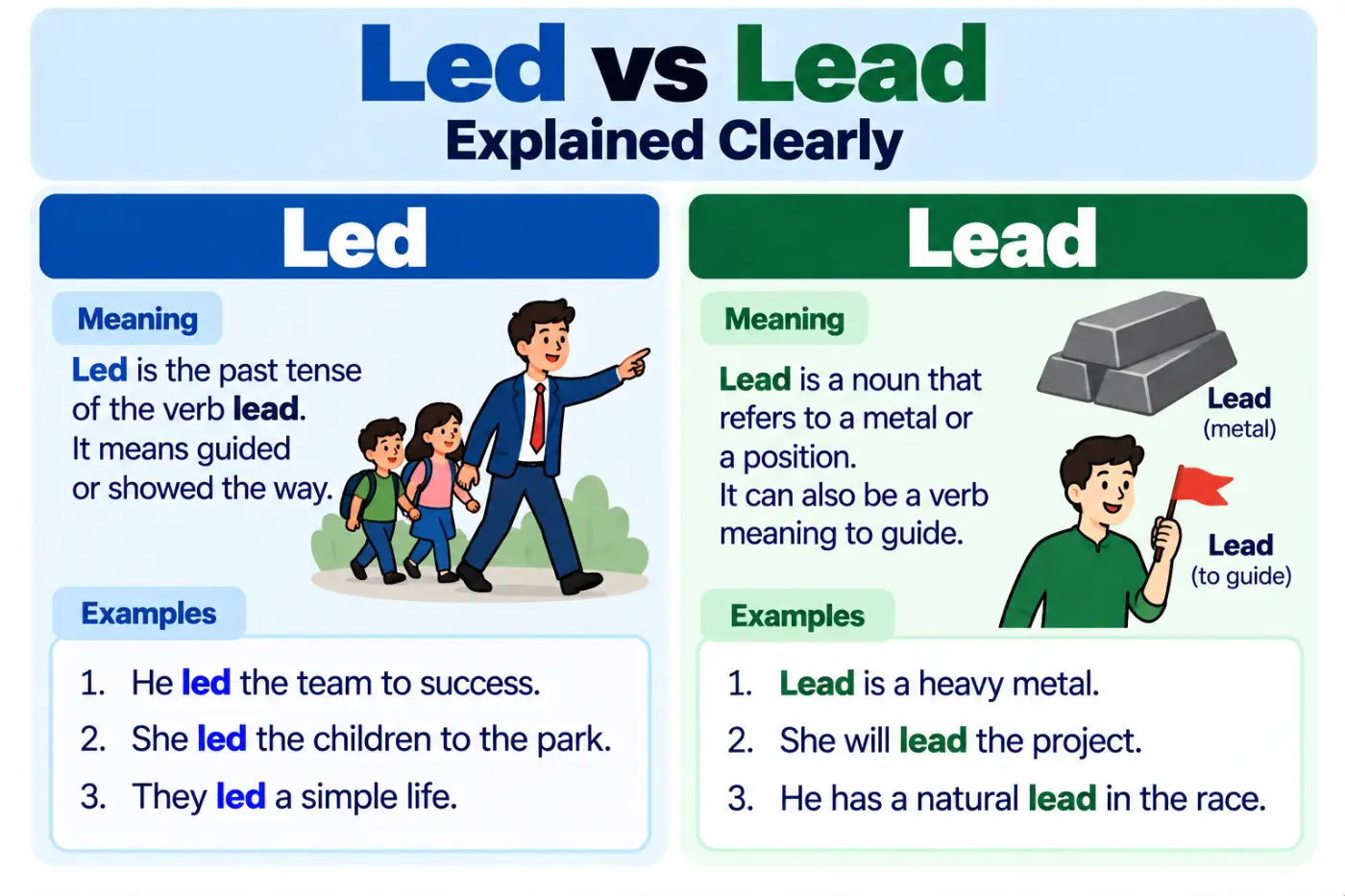
Led vs lead causes confusion because English uses the same spelling lead for two different pronunciations. One form means to guide or direct and sounds like leed. The other refers to the metal lead and sounds like led. The spelling led has one main pronunciation and works as the past tense and past participle of the verb lead.
The key to choosing the correct word is to look at meaning and grammar before looking at pronunciation. If you are talking about guiding a person, directing a team, or being in front of others, you need lead in the present tense and led for past actions. If you are talking about the metal, lead has a different pronunciation and a different meaning.
This guide explains the difference in plain English. You will learn how each word works, how to pronounce it, why lead has two sounds, how to use each form in sentences, and how to avoid the mistakes that often appear in emails, schoolwork, reports, and everyday writing.
Short Answer
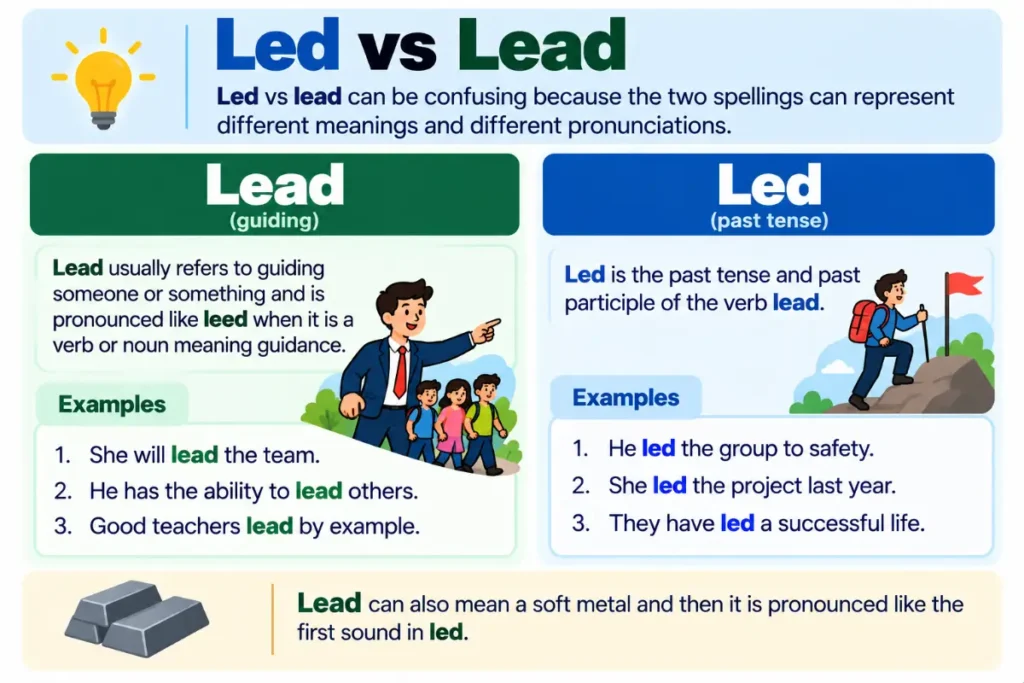
Led vs lead can be confusing because the two spellings can represent different meanings and different pronunciations. Lead usually refers to guiding someone or something and is pronounced like leed when it is a verb or noun meaning guidance. Led is the past tense and past participle of that verb. Lead can also mean a soft metal and then it is pronounced like the first sound in led.
Table of Contents
- The basic difference.
- What lead means as a verb.
- What led means.
- What lead means as a noun.
- How to pronounce each word.
- Why lead has two pronunciations.
- Lead as a present tense verb.
- Led as a past tense verb.
- Lead as a metal.
- Common sentence patterns.
- Common mistakes.
- Memory tips.
- Related grammar notes.
- Professional writing tips.
- Key takeaways.
- Frequently asked questions.
- Conclusion.
Led vs lead in plain English
Led vs lead is easiest to understand when you separate the verb from the metal and then check the time of the action.
The Basic Difference
The easiest way to understand the words is to separate them by function.
- Lead as a verb usually means to guide, direct, or cause someone or something to move toward a result. In this use, it is pronounced like leed.
- Led is the past tense and past participle of lead when lead means to guide or direct. It is pronounced like the word red with an l at the beginning.
- Lead as a noun can mean guidance, control, an advantage, a clue, or a position at the front. In these uses, it is usually pronounced like leed.
- Lead can also mean the chemical element and metal. In this meaning, it is pronounced like led.
The biggest grammar rule is simple. If the action is happening now or is presented as a general fact, use lead. If the guiding action happened in the past, use led.
For example, compare these sentences.
- Maria will lead the meeting tomorrow. The action is in the future, so lead is correct.
- Maria led the meeting yesterday. The action happened in the past, so led is correct.
- The pipe contains lead. Here the word refers to the metal, so the pronunciation changes.
This distinction becomes much easier once you stop treating the spellings as random forms. Grammar controls one part of the choice, while meaning controls another.
What Lead Means As A Verb
Lead is an irregular verb. Its basic meaning is to guide or direct someone or something.
You can lead a person, a group, a team, a project, an organization, or even an animal. You can also lead someone toward a place, result, decision, or conclusion.
Consider these examples.
- The coach will lead the team during practice. Lead describes the coach guiding the team.
- She leads a small research group. Leads is the present tense form used with she.
- The road leads to the town center. Here lead describes where a road goes.
- Good planning can lead to better results. Lead means cause something to produce a particular result.
- His evidence may lead investigators to the answer. Lead describes movement toward a conclusion.
The verb can also describe influence. A person does not always physically move anyone. A manager can lead through decisions and direction. A teacher can lead students toward an answer. A discovery can lead scientists toward a new explanation.
The present forms follow normal subject patterns.
- I lead the discussion.
- You lead the discussion.
- We lead the discussion.
- They lead the discussion.
- He leads the discussion.
- She leads the discussion.
- It leads to a different result.
The important point is that lead stays in its base form with I, you, we, and they. With he, she, and it, the form becomes leads.
What Led Means
Led is the past tense and past participle of the verb lead when the meaning involves guiding or directing.
Unlike many regular past tense verbs, lead does not become leaded. English uses the irregular form led.
For example.
- The teacher led the class through the exercise. The teaching happened in the past.
- She led the project last year. Her leadership took place during a completed period.
- The guide led us through the forest. The guide directed the group in the past.
- Their research led to an important discovery. The research produced a result in the past.
- He had led the team for five years before he retired. Led follows had because the sentence uses the past perfect tense.
Led can also appear after forms of have.
- I have led several meetings.
- She has led the department since January.
- They had led the campaign for months.
In these sentences, led is a past participle. It does not change to lead after have or had.
This is a common point of confusion. Writers sometimes choose lead because they recognize the base verb. The correct form depends on the grammar of the sentence.
What Lead Means As A Noun
Lead is not only a verb. It can also function as a noun.
As a noun, lead can mean an advantage or a position ahead of someone else.
For example.
- The runner has a ten second lead. The runner is ahead of the other competitors.
- Our team took the lead in the second half. The team moved into the front position.
- The company has a strong lead in the market. The company is ahead of its competitors in a particular area.
Lead can also mean guidance or direction.
- The manager took the lead on the project. The manager accepted responsibility for directing the work.
In journalism and investigation, a lead can mean a useful piece of information that may help someone discover more.
- The detective followed a new lead. The lead was a clue that could help the investigation.
In theater and film, the lead can mean the main character or performer.
- She played the lead in the school production. Lead refers to the main role.
These noun uses usually use the pronunciation that sounds like leed.
How To Pronounce Each Word
Led vs lead can sound confusing because the spelling does not tell you which pronunciation to use. Pronunciation is one of the most confusing parts of this topic because lead has two accepted pronunciations.
When lead means to guide or direct, it is pronounced /liːd/. The vowel sound is the long e sound found in words such as need and feed.
When led is used as the past tense of that verb, it is pronounced /lɛd/. The vowel sound is the same sound found in red and bed.
When lead refers to the metal, it is also pronounced /lɛd/.
So the three important forms look like this in sound.
- Lead meaning guide. /liːd/.
- Led meaning guided in the past. /lɛd/.
- Lead meaning the metal. /lɛd/.
This creates an interesting pattern. Lead and led look different but can sound the same when lead means the metal. Lead and led also belong to the same verb family when lead means guide.
If you are speaking rather than writing, context usually tells listeners which meaning you intend.
Why Lead Has Two Pronunciations
The spelling lead represents two different words that developed through the history of English. They happen to have the same written form even though their meanings and sounds are different.
This is called a heteronym. A heteronym is a word that is spelled the same as another word but has a different pronunciation and meaning.
The verb lead is pronounced with the long e sound. The metal lead is pronounced with the short e sound.
English contains many words with unusual relationships between spelling and sound. This is one reason English pronunciation can feel unpredictable to learners.
You do not need to memorize the history of these words to use them correctly. It is enough to connect each meaning with its sound.
Think of two separate words hiding under the same spelling.
Lead meaning guide belongs with words such as leader and leadership.
Lead meaning metal belongs with words such as lead poisoning and lead pipe.
The surrounding words usually make the meaning clear.
Lead As A Present Tense Verb
Use lead when the action is happening now, occurs regularly, or describes a general fact.
For example.
- I lead the training sessions every Monday. The sentence describes a regular activity.
- She leads the marketing team. The sentence describes her current role.
- Strong evidence can lead to a better decision. The sentence states a general relationship.
- This path leads to the main entrance. The sentence describes the path.
- He wants to lead the discussion. Lead follows wants to because the phrase uses the base form after to.
That last example is especially useful. After to in an infinitive, use lead rather than led.
Correct: She wants to lead the group.
Incorrect: She wants to led the group.
The same rule applies after modal verbs.
- We can lead the meeting.
- You should lead the discussion.
- They will lead the project.
- He might lead the team.
After can, should, will, and might, use the base form lead.
Led As A Past Tense Verb
Use led when the verb lead describes a completed action in the past.
For example.
- She led the meeting yesterday.
- He led the team during the final match.
- The guide led us to the museum.
- Their decision led to unexpected costs.
- The teacher led the students through the lesson.
Time words often make the choice obvious. Words such as yesterday, last week, last year, earlier, before, and in 2024 can signal a past action.
However, you do not always need a past time word. The grammar of the sentence can show that the action happened before the current moment.
For example.
She led the team for five years.
The sentence does not need yesterday or last year. The verb led already places the action in the past.
With have, has, and had, led remains the past participle.
- She has led the department since 2022.
- He had led the group before the new manager arrived.
- They have led several successful projects.
These structures are worth memorizing because they appear often in professional writing.
Lead As A Metal
Lead is also the name of a chemical element. Its chemical symbol is Pb and its atomic number is 82.
In this meaning, lead is pronounced like led.
The metal has been known and used for thousands of years. It is dense and relatively soft, and it has appeared in products such as batteries, weights, pipes, and some older paints.
Modern safety guidance treats exposure to lead as a serious health concern, especially for children. That factual meaning is separate from the verb lead.
Examples include.
- The old paint may contain lead. The word refers to the metal.
- The battery contains lead. Again, the noun names the chemical element.
- The workers tested the soil for lead. The sentence refers to the substance.
This is the meaning that causes the pronunciation surprise. A reader sees lead but must use the pronunciation associated with led.
Context does the heavy lifting.
Common Sentence Patterns
Learning common sentence structures can make the distinction almost automatic.
When lead means guide, these patterns are common.
- Lead someone through something.
Example: The instructor led the students through the process. The past form is led because the instruction happened before now.
- Lead someone to something.
Example: The clues led the investigators to the missing document. The clues pointed them toward a result in the past.
- Lead to something.
Example: Poor planning can lead to delays. The base form appears after can.
- Take the lead.
Example: Our team took the lead early in the game. Lead is a noun meaning the front position.
- Lead the way.
Example: You lead the way and I will follow. Lead is a verb because it describes guiding someone.
- Be led by someone.
Example: The group was led by an experienced guide. Led is the past participle in a passive construction.
These patterns give you useful mental anchors. Instead of memorizing isolated spellings, connect the form to the structure around it.
Common Mistakes
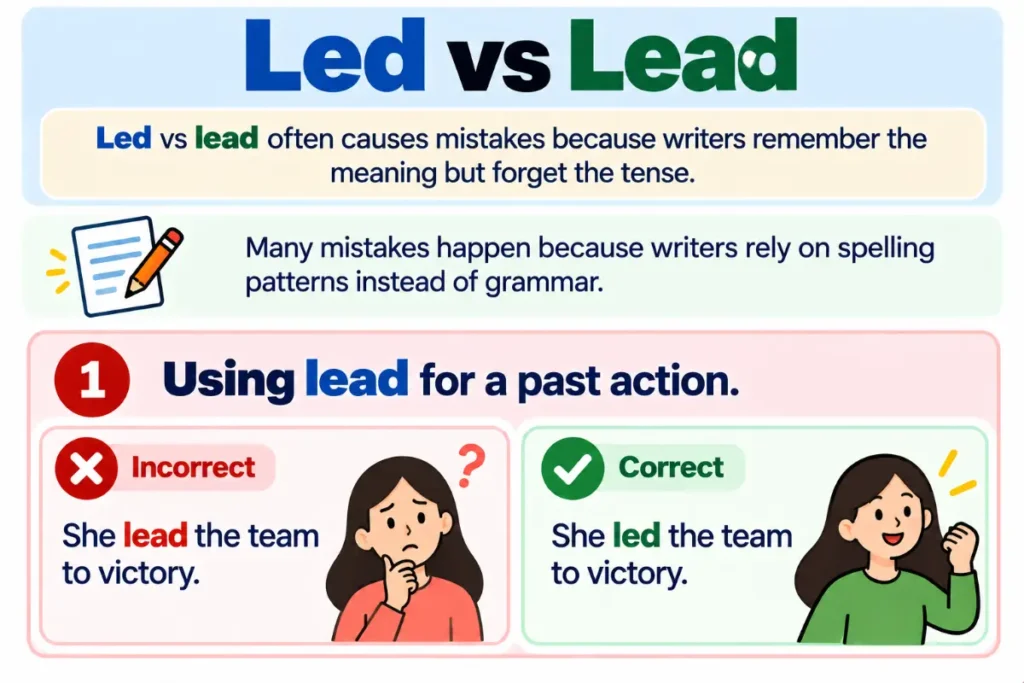
Led vs lead often causes mistakes because writers remember the meaning but forget the tense. Many mistakes happen because writers rely on spelling patterns instead of grammar.
- Using lead for a past action.
Incorrect: She lead the meeting yesterday.
Correct: She led the meeting yesterday.
The time reference tells us that the action happened in the past.
- Using led after to.
Incorrect: He wants to led the team.
Correct: He wants to lead the team.
The infinitive uses the base form after to.
- Using led after a modal verb.
Incorrect: They will led the project.
Correct: They will lead the project.
Modal verbs such as will and can are followed by the base form.
- Writing leaded as the past tense.
Incorrect: The manager leaded the group.
Correct: The manager led the group.
Lead is irregular, so its past form is led.
- Confusing the metal with the verb.
In a sentence about a chemical substance, lead can have the pronunciation of led.
For example, The paint contains lead.
The sentence does not mean that the paint guides anything. It refers to the metal.
- Assuming spelling always reveals pronunciation.
English spelling does not always provide a perfect pronunciation guide. Lead is a classic example.
The surrounding meaning matters.
Memory Tips
A simple memory trick can save you a lot of mistakes.
Think of lead as the action of guiding.
If you are doing it now, you lead.
If you did it before, you led.
For example.
Now: I lead the team.
Past: I led the team.
You can also connect led with red. Both words have the same vowel sound.
If you see lead in a sentence about a metal, think of the sound in red.
Another useful trick is to remember the word leader. A leader leads. A leader does not ledd.
For past actions, picture the leader who already finished the job. That leader led the team.
These small mental connections work better than trying to memorize a complicated grammar chart.
Related Grammar Notes
Lead belongs to a group of irregular verbs that change form in ways that do not follow the standard ed pattern.
Other familiar examples include.
- Go becomes went.
- Take becomes took.
- Write becomes wrote.
- Give becomes gave.
- Lead becomes led.
The form led can also appear in passive sentences.
For example.
The project was led by Sarah.
Here was led creates a passive structure. Sarah performed the leadership role, but the sentence focuses on the project.
Led can also appear as an adjective in some contexts.
For example.
The led discussion focused on the main issue.
However, this use is less common than the verb form and can sound formal or awkward depending on the sentence. In most everyday writing, it is clearer to use a phrase such as discussion led by the manager.
Another useful point is the difference between lead and leader.
Lead can be a verb or noun.
Leader is a noun for a person who guides or directs others.
Leadership is the quality or practice of leading.
These words belong to the same word family and can help reinforce the correct spelling.
Professional Writing Tips
Led vs lead deserves extra attention in professional writing because a one letter difference can change the tense of a sentence. Professional writing often uses lead and led in reports, resumes, business documents, academic papers, and project summaries.
Pay special attention to tense when describing past responsibilities.
For example.
I led a team of twelve employees.
This sentence clearly describes a completed or past leadership responsibility.
For a current role, use lead.
I lead a team of twelve employees.
The difference is only one letter, but the meaning changes because the tense changes.
Resume writers sometimes use both forms in the same section.
For example.
I currently lead a customer support team and previously led a regional training project.
The first form describes a current responsibility. The second describes an earlier responsibility.
In formal reports, lead to is also common.
The analysis led to several recommendations.
The new policy may lead to lower costs.
Notice how the verb changes with tense. The first sentence describes a past result. The second describes a possible future result.
When editing your work, look for every instance of lead and ask one simple question. Is this describing guidance now, guidance in the past, or the metal?
That quick check catches most errors.
Lead And Led In American English
American English uses the same basic distinction between lead and led described above.
The verb lead has the long e pronunciation. The past tense led has the short e pronunciation. The metal lead also has the short e pronunciation.
British English follows the same core distinction.
There is no major American versus British spelling difference for these forms. The important issue is meaning, tense, and pronunciation.
That makes this pair easier than some English words that change spelling across regions.
For example, you do not need a different American spelling of led. You simply need to choose the form that matches the sentence.
Lead And Led In Everyday Speech
In conversation, listeners usually understand lead from context.
If someone says, I will lead the group, the meaning is clear from the grammar.
If someone says, The old pipe contains lead, the surrounding words make the metal meaning clear.
Speech can still create confusion when a sentence is short or removed from context.
For example, the spoken form of lead meaning metal sounds like led. If you only hear the word by itself, you cannot always know which meaning the speaker intends.
Written English has the opposite problem. Readers can see the spelling but must use context to identify the intended pronunciation.
That is why this word pair is useful for English learners. It shows how spelling, pronunciation, grammar, and meaning can work together.
How To Choose The Correct Word
Led vs lead becomes simple when you use a quick meaning and tense check. When you are unsure, use this simple process.
- Identify the meaning.
Ask if the word refers to guiding or directing. If it does, you are dealing with the verb lead or its past form led.
- Check the tense.
If the action is present, habitual, future after a modal, or used after to, use lead.
After can, will, should, might, must, and similar modal verbs, use lead.
After have, has, or had, use led when the verb means guided.
- Check the noun meaning.
If the word refers to the metal, use lead.
- Read the sentence aloud.
Pronunciation can help confirm the meaning, especially when you are reading a sentence about the metal.
This process takes only a few seconds once you practice it.
Real Life Examples
Led vs lead appears often in school writing, business communication, sports reports, and everyday conversation. The best way to make the rule stick is to see it in different situations.
School
The teacher leads the class every morning.
This describes a current or regular action.
The teacher led the class yesterday.
This describes a completed past action.
Business
She will lead the new department.
The word follows will, so the base form is required.
She led the department before moving to another role.
The leadership happened in the past.
Sports
The team leads by five points.
Lead is a present tense verb describing the current score.
The team led by five points at halftime.
Led describes the earlier state of the game.
Travel
This road leads to the airport.
Lead describes the direction of the road.
The guide led us to the airport.
Led describes what the guide did in the past.
Science
The sample contains lead.
Lead refers to the metal.
Researchers tested the material for lead.
Again, the word names the chemical element.
Daily Life
Her advice may lead to a better decision.
Lead follows may.
His advice led to a better decision.
Led shows that the result occurred in the past.
These examples show why one spelling cannot be judged in isolation. The sentence around the word gives you the answer.
Similar Words That Can Cause Confusion
Lead and led are not the only English words that confuse writers.
- Read and read have the same spelling but different pronunciations in different tenses.
- Wind can refer to moving air or the act of turning something around an object. The pronunciation changes with meaning.
- Tear can refer to a drop from the eye or the act of ripping something. The pronunciation changes.
- Bow can refer to a gesture of bending forward or a weapon used to shoot arrows. The pronunciation can change.
These examples show a larger feature of English. Spelling alone does not always determine pronunciation.
Lead is especially tricky because the past tense led looks different from the present form lead, while the metal lead keeps the same spelling as the verb.
A Quick Test
Try filling in each blank with lead, led, or lead as the metal.
- She will lead the meeting tomorrow.
- He led the team last season.
- The old paint may contain lead.
- Good habits can lead to better results.
- They have led several successful projects.
The answers are already shown in the completed sentences above.
The first and fourth examples use the verb in its base form. The second uses the past tense. The third refers to the metal. The fifth uses the past participle after have.
If you can explain why each answer works, you understand the core rule.
Key Takeaways
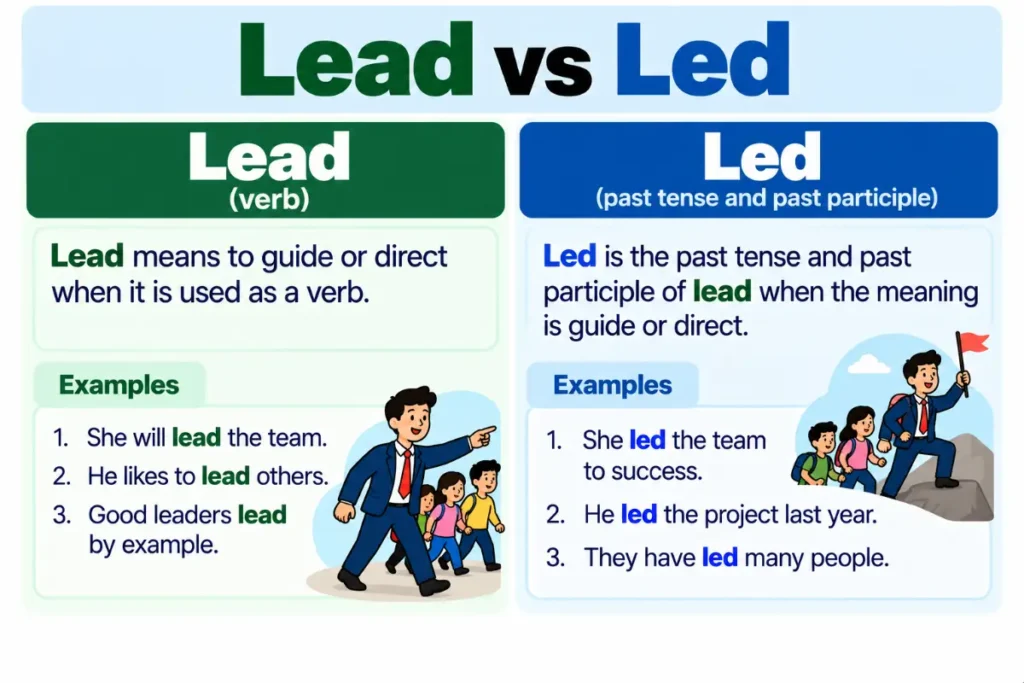
- Lead means to guide or direct when it is used as a verb.
- Led is the past tense and past participle of lead when the meaning is guide or direct.
- Lead can also be a noun meaning an advantage, clue, guidance, or main role.
- Lead can refer to the metal with the chemical symbol Pb.
- Lead meaning guide is pronounced /liːd/.
- Led is pronounced /lɛd/.
- Lead meaning the metal is also pronounced /lɛd/.
- Use lead after modal verbs such as can, will, should, and might.
- Use lead after to when forming an infinitive.
- Use led after have, has, and had when the verb means guide or direct.
- The surrounding meaning usually makes the correct form clear.
- Remember the simplest pattern. Lead now. Led before.
Conclusion
Led vs lead becomes much easier once you separate meaning from spelling. Lead is the base form of the verb that means to guide or direct, while led is the past tense and past participle of that verb. Lead can also refer to the metal, and that meaning uses the same short vowel sound found in led.
The fastest way to choose the right form is to check the grammar first. Use lead for the base verb and for present actions. Use led for past actions and after have, has, or had. If the sentence refers to the metal, use lead and pronounce it like led.
Keep one simple rule in mind. Lead means guide in the present form. Led means guided in the past. Lead can also mean the metal. Once these three ideas are clear, this common English spelling and pronunciation problem becomes much easier to handle accurately.
Frequently Asked Questions
Is led the past tense of lead?
Yes. Led is the past tense and past participle of lead when lead means to guide or direct.
For example, She led the team yesterday is correct because the action happened in the past.
Is lead and led the same word?
They are forms connected to the same verb when lead means guide or direct. Lead is the base form, while led is the past tense and past participle.
Lead also has a separate meaning as the metal.
Why is lead pronounced differently?
Lead has two different meanings that developed with different pronunciations. The verb meaning guide uses the long e sound. The noun meaning the metal uses the short e sound.
Is lead pronounced like led?
Sometimes. Lead meaning the metal is pronounced like led. Lead meaning guide has a different pronunciation with the long e sound.
Which is correct for past tense lead or led?
Led is correct for the past tense.
For example, He led the team last year.
Lead is the present form.
For example, He leads the team now.
Is leaded a word?
Leaded exists in some specialized uses, but it is not the normal past tense of lead meaning guide. In ordinary English, the past tense is led.
Can lead be a noun?
Yes. Lead can be a noun meaning an advantage, a clue, guidance, or the main role in a production. It can also name the metal.
What is the difference between lead and led?
The main difference is grammar and meaning. Lead is the base form of the verb meaning guide, while led is its past tense and past participle. Lead can also name the metal, which has the same pronunciation as led.
How do you remember lead and led?
Use the simple memory rule lead now and led before. You can also connect led with red because they share the same vowel sound.
Is lead the same in American and British English?
The core spelling and meaning distinction is the same in American and British English. The verb lead, its past form led, and the metal lead follow the same basic pattern.
What is the past participle of lead?
The past participle is led.
For example, She has led the team for several years.
What is the pronunciation of lead as a verb?
When lead means guide or direct, it is pronounced /liːd/.
What is the pronunciation of lead as a metal?
When lead refers to the chemical element, it is pronounced /lɛd/.

Confusing Words, Spelling & Word Choice
Claire Whitmore is a U.S.-based English editor who writes about commonly confused words, spelling differences, and word choice. Her work helps readers understand subtle distinctions between similar-looking words through simple definitions, practical examples, and modern usage guidance in both American and British English.