
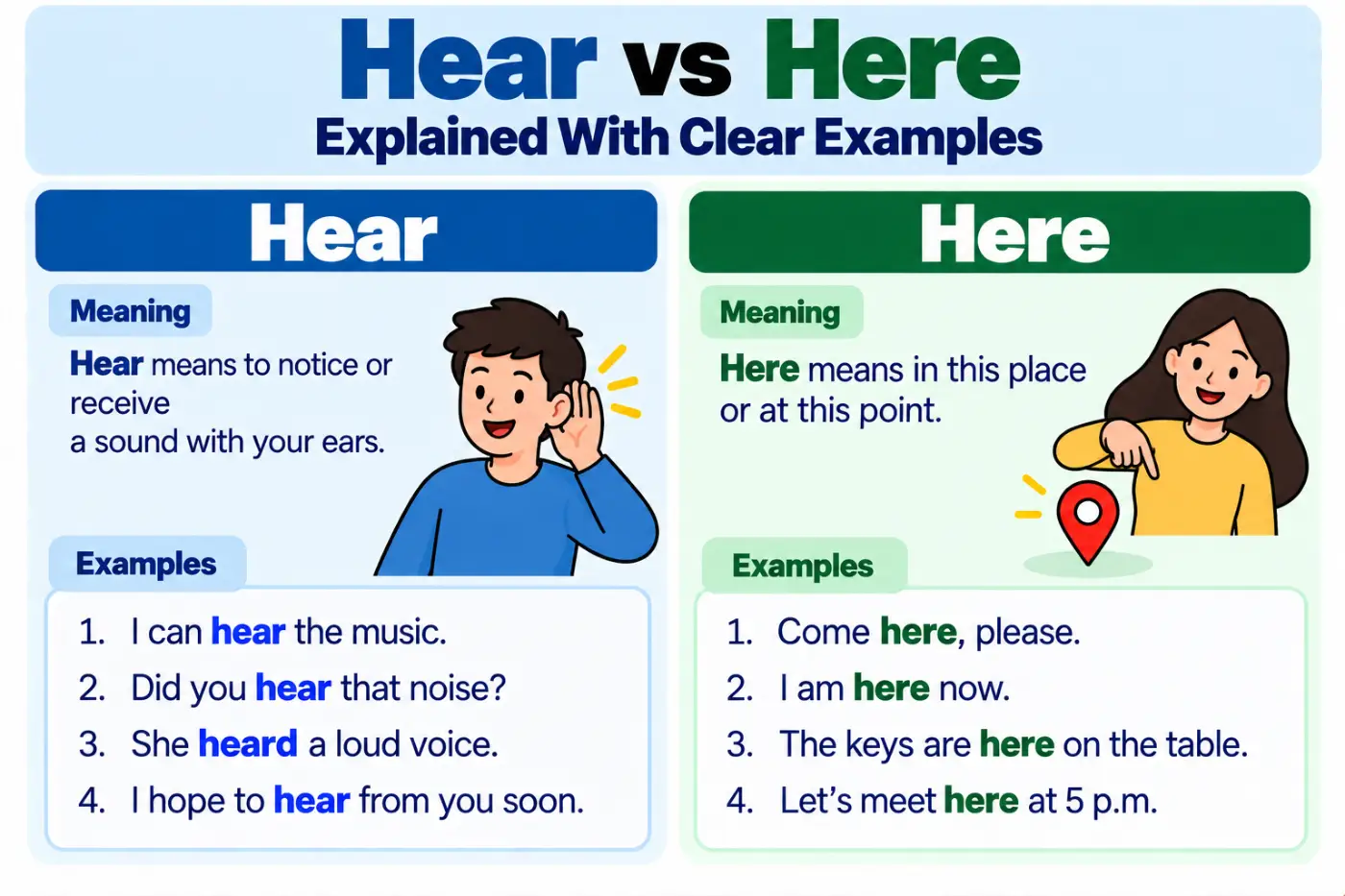
Hear vs here can be confusing because both words have the same pronunciation in standard American English. When you say them aloud you can’t hear a spelling difference. You have to use the meaning and context to choose the correct word.
Hear is connected to sound and listening. It usually works as a verb. You can hear music. You can hear someone speaking. Here is connected to location or a particular point in a discussion. You can sit here. Come here. The answer is here.
The easiest way to remember the difference is to connect hear with your ears and here with a place. If the sentence involves receiving a sound then hear is normally the right choice. If the sentence points to a location or a specific point then here is the correct word.
Short Answer
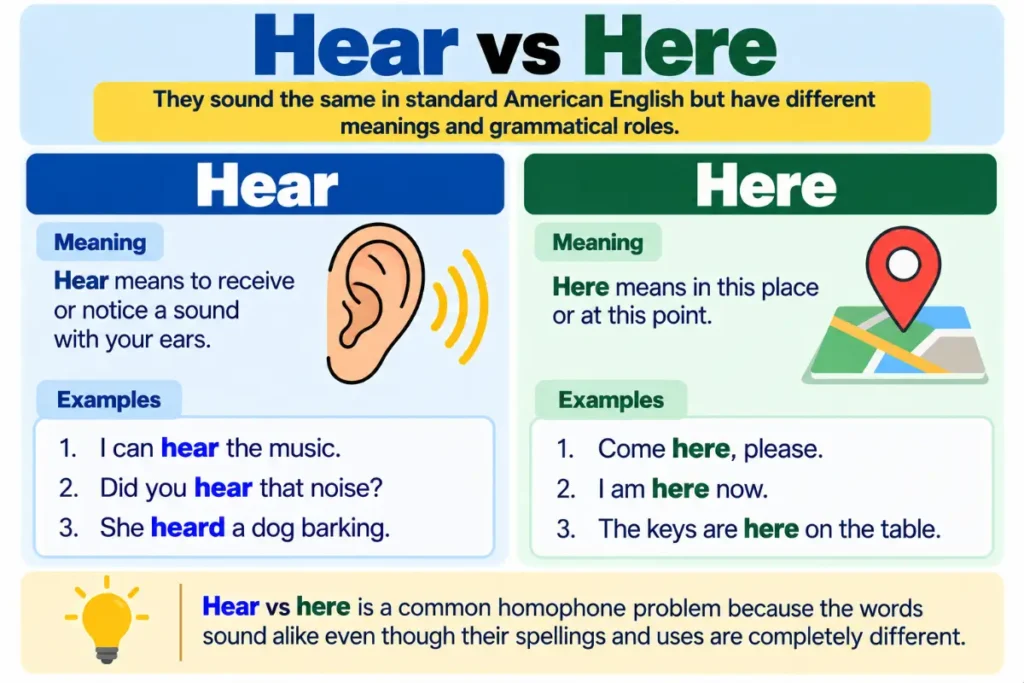
Hear means to receive or notice a sound with your ears. Here means in this place or at this point. They sound the same in standard American English but have different meanings and grammatical roles. Hear vs here is a common homophone problem because the words sound alike even though their spellings and uses are completely different.
Table of Contents
- What hear means.
- What here means.
- Hear vs here explained.
- How to use hear correctly.
- How to use here correctly.
- Pronunciation of hear and here.
- Grammar rules for hear.
- Grammar rules for here.
- Common expressions with hear.
- Common expressions with here.
- Real life examples.
- Common mistakes.
- Hear and here in questions.
- Hear and here in professional writing.
- Hear and here in American English.
- Memory tips.
- Related words.
- Key takeaways.
- Frequently asked questions.
- Conclusion.
What Hear Means
Hear is a verb that refers to receiving sound through your ears. It can describe a simple physical experience or the act of paying attention to spoken information.
For example, if someone speaks to you and sound reaches your ears, you hear that person. You don’t always have to make a deliberate effort. Hearing can happen naturally.
Consider this sentence.
I can hear the rain.
The sentence tells us that the speaker notices the sound of rain. The word hear describes the person’s experience of sound.
Hear can also describe understanding or receiving information through listening.
I heard the news this morning.
In this example, heard is the past tense of hear. The person received information through listening or communication.
The word can also appear in situations involving opinions, arguments, cases, or formal proceedings.
The judge will hear the case tomorrow.
Here, hear has a more specialized meaning. It refers to listening to and considering a case or argument.
So hear has several related uses. At its core, the word connects to listening, sound, or receiving information through the ears.
What Here Means
Here is an adverb that usually refers to a particular place. It can point to the speaker’s current location or to a location that the speaker has identified.
For example.
Come here.
The speaker is telling someone to come to the speaker’s location.
The keys are here.
This sentence tells us that the keys are in the location being discussed.
Here can also refer to a point in a conversation, explanation, argument, or process. In that use, it doesn’t describe a physical location.
Here is where the problem begins.
The word here points to a particular point in the discussion. It works almost like saying this is the point where the problem begins.
Here can also introduce information.
Here is the answer.
In these sentences, here helps direct attention to something that is being presented.
Hear Vs Here Explained
The basic difference in hear vs here is simple.
Hear relates to sound or listening. Here relates to location or a point.
| Word | Main meaning | Usual grammatical role | Example |
|---|---|---|---|
| Hear | Receive or notice sound | Verb | I can hear music. |
| Here | In this place or at this point | Adverb | Your bag is here. |
A useful test is to ask what the sentence is talking about.
If the sentence involves sound then choose hear.
If the sentence points to a place then choose here.
Compare these examples.
I can hear you.
I can see you here.
The first sentence refers to sound. The second sentence refers to location.
The spelling changes because the words have different histories and meanings. Their identical pronunciation makes them homophones.
How To Use Hear Correctly
Hear normally functions as a verb. It can describe an ability, an experience, an action, or the receipt of information.
Hear As An Ability
Use hear to describe someone’s ability to perceive sound.
I can hear the birds.
Can you hear me?
She can’t hear the television.
These sentences describe the ability to notice sound.
The opposite form often uses can’t or cannot.
I can’t hear you clearly.
This means the speaker is unable to perceive the other person’s voice clearly.
Hear As An Experience
Hear can describe a sound that someone notices.
I heard a loud noise.
We heard thunder during the storm.
They heard someone knocking at the door.
The past tense is heard rather than heared.
That distinction matters because learners sometimes try to form the past tense by adding ed. The correct forms are hear, heard, heard.
Hear As Receiving Information
Hear can also mean to receive news or information.
I heard that you got a new job.
We heard the announcement this morning.
Have you heard the latest news?
The sound connection is still present in the history of the meaning because information was traditionally received through spoken communication.
Hear In Formal Contexts
Hear can have a formal meaning related to listening to a case or argument.
The court will hear the case next week.
The committee heard testimony from several witnesses.
In these sentences, hear doesn’t simply mean noticing a sound. It means listening to information and considering it as part of a formal process.
How To Use Here Correctly
Here usually refers to a location.
Here For A Physical Place
Use here when pointing to a place.
Please sit here.
Your phone is here.
I live here.
The store is right here.
In each example, here points to a location.
Here For A Point In Time
Here can sometimes refer to a point in a process or situation rather than a physical place.
We are here at the final stage.
At this point, the word here refers to the current stage of the process.
Here For A Point In An Explanation
It can also direct attention to a particular idea.
Here is the main problem.
Here is why the plan failed.
The word points to information rather than a physical location.
Here To Introduce Something
It often appears before a noun phrase when someone presents something.
Here is your coffee.
Here is the information you requested.
Notice the agreement in these examples. Here is normally followed by a singular noun phrase. Here are normally introduces a plural noun phrase.
Pronunciation Of Hear And Here
Hear and here are homophones in standard American English. This means they normally have the same pronunciation even though they have different spellings and meanings.
The pronunciation can vary slightly across English accents. Still, American speakers generally pronounce both words with the same core sound.
This creates the main spelling challenge. If you only hear the word, you can’t determine its spelling from pronunciation alone.
Context provides the answer.
If someone says, I can hear the music, the meaning makes the spelling clear.
If someone says, Come here, the location makes the spelling clear.
When learning these words, don’t try to memorize the sound difference because there usually isn’t one. Instead, connect each spelling with its meaning.
Grammar Rules For Hear
Hear is generally a verb.
It can appear in several common grammatical forms.
| Form | Example |
|---|---|
| Base form | I hear music. |
| Third person singular | She hears music. |
| Present participle | They are hearing the announcement. |
| Past tense | I heard the noise. |
| Past participle | I have heard that story. |
The most important irregular form is heard.
You should say.
I heard the news.
Not.
I heared the news.
Hear can also follow modal verbs.
I can hear you.
She might hear us.
They should hear the announcement.
After a modal verb such as can, could, might, may, should, or will, use the base form hear.
Grammar Rules For Here
Here is usually an adverb of place.
It can describe location without directly modifying a noun.
I am here.
Your shoes are here.
Stay here.
Come here.
Here can also appear in constructions that introduce something.
Here are the results.
The form of the verb depends on the noun or noun phrase that follows.
Here is the answer.
Here are the answers.
This pattern is common in both conversation and writing.
Common Expressions With Hear
Hear appears in many familiar English expressions.
Hear From Someone
To hear from someone means to receive communication from that person.
I haven’t heard from Sarah yet.
This usually means the speaker hasn’t received a message, call, email, or other communication.
Hear About Something
To hear about something means to learn information about it.
I heard about the new restaurant from my brother.
Hear Of Something
To hear of something usually means to know that something exists.
I’ve heard of that company.
The expression doesn’t necessarily mean that the speaker knows detailed information about it.
Hear Someone Out
To hear someone out means to listen to what the person has to say before making a judgment or decision.
Please hear me out before you decide.
This expression emphasizes giving someone a fair chance to explain.
Hear From You
Hear from you commonly appears in business and personal communication.
I hope to hear from you soon.
The phrase means the writer hopes to receive a response.
Common Expressions With Here
Here also appears in many common phrases.
Come Here
It directs someone toward the speaker’s location.
Come here for a minute.
Right Here
Right here emphasizes a particular location.
The answer is right here.
Here And There
Here and there means in various places or occasionally.
We saw small shops here and there along the road.
Here We Go
It can indicate that something is starting.
Here we go again.
It can also express that a familiar situation is happening again.
Here You Go
It is a common conversational phrase used when giving something to someone.
Here you go. Your receipt.
It is especially common in everyday American English.
Here And Now
Here and now refers to the present situation or current moment.
We need to deal with the problem here and now.
Real Life Examples
Real examples make the distinction easier because they show how context determines the correct word.
Example One
Can you hear that noise?
The sentence asks about someone’s ability to perceive a sound. Hear is correct because the sentence concerns listening.
Example Two
Please wait here.
The sentence tells someone to remain in a particular place. Here is correct because the sentence concerns location.
Example Three
I couldn’t hear the speaker.
The sentence refers to difficulty receiving sound. Hear is correct.
Example Four
Your coat is here.
The sentence identifies the location of the coat. Here is correct.
Example Five
Did you hear what she said?
The sentence asks if someone received spoken information. Hear is correct.
Example Six
She left her bag here.
The sentence identifies where she left the bag. Here is correct.
Example Seven
I heard a strange sound outside.
The speaker noticed a sound. Heard is the past tense of hear.
Example Eight
We are here to help.
Here refers to the current situation or purpose rather than simply a physical spot. The phrase commonly means that the speakers are present and ready to provide help.
Example Nine
I haven’t heard from him yet.
Hear means receive communication from someone. The sentence doesn’t refer to a physical place.
Example Ten
Put the box here.
Here identifies the location where the speaker wants the box placed.
Common Mistakes
The most common mistake is choosing the word based on pronunciation. Since hear and here sound alike, listening alone doesn’t solve the spelling problem.
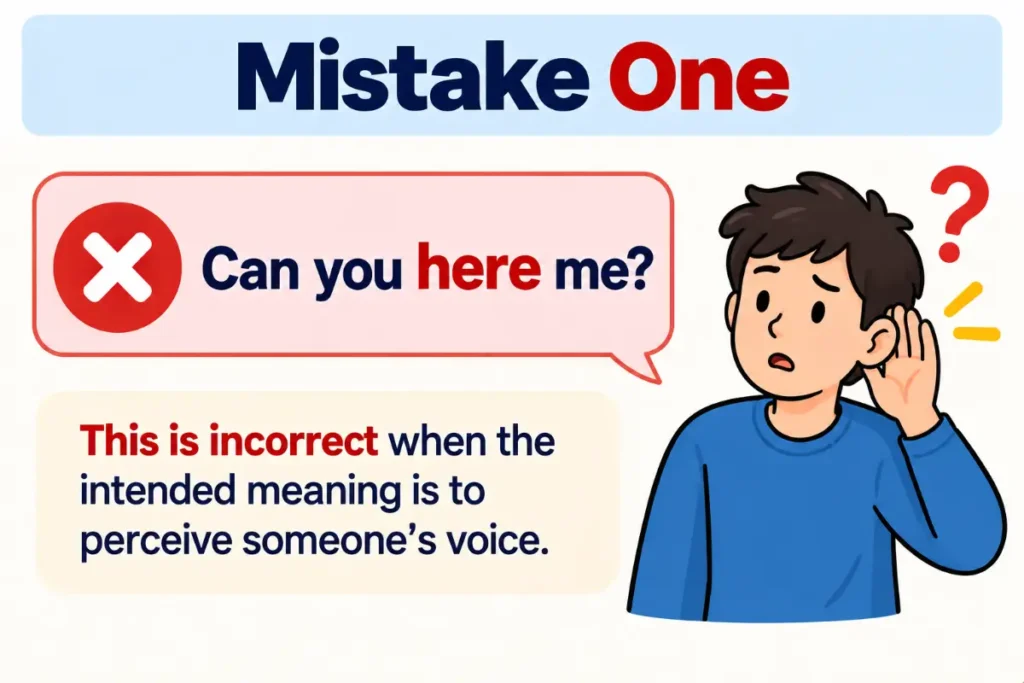
Mistake One
Can you here me?
This is incorrect when the intended meaning is to perceive someone’s voice.
Correct form.
Can you hear me?
Mistake Two
Come hear.
This is incorrect when the speaker means come to this place.
Correct form.
Come here.
Mistake Three
I am hear to help.
This is incorrect.
Correct form.
I am here to help.
The phrase refers to being present for a purpose.
Mistake Four
I can’t here you.
This is incorrect.
Correct form.
I can’t hear you.
The sentence concerns sound.
Mistake Five
Please stay hear.
This is incorrect.
Correct form.
Please stay here.
The sentence concerns location.
Hear And Here In Questions
Both words appear frequently in questions.
Hear commonly appears in questions about sound or communication.
Can you hear me?
Did you hear that?
Have you heard the news?
When will we hear from them?
Here appears in questions about location or direction.
Are you here?
Is your brother here?
Where is the nearest restroom?
Can I leave this here?
A simple context check usually resolves the spelling.
Ask yourself if the question concerns sound or location.
Sound points to hear.
Location points to here.
Hear And Here In Professional Writing
Both words are common in professional communication. Correct spelling matters because a spelling error can distract the reader and make a sentence harder to understand.
Hear often appears in workplace communication related to meetings, communication, reports, announcements, and discussions.
For example.
I look forward to hearing from you.
We heard the client’s concerns during the meeting.
Here commonly appears when directing attention to information or a location.
Here are the documents you requested.
The relevant information is provided here.
The correct word depends entirely on meaning. Professional writing doesn’t change the basic distinction.
Hear And Here In American English
Hear and here are both standard English words in American English. Their meanings remain distinct even though they sound alike.
American English speakers commonly use here in everyday expressions such as here you go, come here, right here, and here we are.
Hear is also extremely common in everyday speech.
I can’t hear you.
Did you hear that?
I heard about it yesterday.
The words aren’t different because of American English spelling. The same basic distinction applies across major English varieties.
Some accents can produce small differences in pronunciation. Those accent differences don’t change the spelling rule.
Why Hear And Here Are Easy To Confuse
The problem comes from homophones.
A homophone is a word that has the same pronunciation as another word but a different meaning and often a different spelling.
Examples include.
- Hear and here.
- See and sea.
- To and two.
- Right and write.
- Their and there.
- Buy and by.
These pairs can create spelling mistakes because spoken English doesn’t always reveal the spelling.
The solution is to connect the word with its meaning instead of its sound.
For hear, think about ears and sound.
For here, think about a place.
That mental connection is more useful than trying to force yourself to hear a difference that isn’t normally there.
Memory Tips
A good memory trick can make the distinction almost automatic.
Think About Your Ears
Hear contains the letters h e a r. Connect hear with your ears.
You hear with your ears.
That simple association works well because both concepts are connected to listening.
Think About A Place
Here contains the word pattern that can remind you of location.
Here means in this place.
You can point to a place and say here.
Use The Sound Test
Ask yourself if the sentence makes sense with the idea of sound.
If it does, use hear.
I can hear the music.
If the sentence makes sense with the idea of location, use here.
The music is here.
Remember The Question
When you’re unsure, ask yourself one question.
Am I talking about sound or place?
Sound means hear.
Place means here.
This quick test works in most everyday situations.
Related Words
Understanding related words can strengthen your grasp of this homophone pair.
Hearing
Hearing is the ability or process of perceiving sound.
Her hearing is excellent.
It can also refer to a formal session where evidence or arguments are considered.
The committee held a hearing.
Heard
Heard is both the past tense and past participle of hear.
I heard a noise.
I have heard that story before.
Hearable
Hearable means capable of being heard. It is much less common in everyday conversation than audible.
Hereabouts
Hereabouts means in this general area. It is less common in everyday American English but remains a valid word.
Hereafter
Hereafter means from this point forward or in the future. It can also refer to life after death in religious or philosophical contexts.
Hereby
Hereby means by this statement or action. It is common in formal or legal writing.
The parties hereby agree to the terms.
These related forms show that here can appear as part of longer expressions while keeping its connection to location, position, or reference.
Similar Homophones
Learning other homophones can help you recognize the pattern behind this spelling issue.
See and sea sound alike but have different meanings. See relates to vision while sea refers to a large body of salt water.
Right and write sound alike. Right can describe correctness or direction while write refers to producing words or symbols.
There and their also sound alike in many varieties of English. There commonly refers to location while their indicates possession.
To and two are another familiar pair. To often functions as a preposition or part of an infinitive while two refers to the number 2.
These examples reinforce an important spelling lesson. English spelling often requires you to use context.
Professional Writing Tips
Writers can avoid this mistake by proofreading for meaning rather than pronunciation.
When you see hear or here in your draft, briefly check its role.
If it describes listening or receiving sound, hear is appropriate.
If it identifies a place or point, here is appropriate.
Reading your work aloud can help with rhythm and grammar, but it won’t always expose this specific error because the two words normally sound the same.
Instead, read the sentence for meaning.
For example.
I am hear to answer your question.
Reading it aloud may not reveal the problem.
Looking at the meaning does.
The intended sentence is.
I am here to answer your question.
The speaker is describing presence at a particular point or place. That makes here the correct choice.
When Hear And Here Appear Together
The two words can appear in the same sentence.
I can hear you from here.
This sentence is useful because it contains both words and shows the distinction perfectly.
Hear refers to receiving the person’s voice.
Here refers to the speaker’s location.
Another example is.
Can you hear me from here?
Again, hear concerns sound while here identifies the speaker’s position.
Using both words together can be a useful practice exercise because it forces you to apply both meanings in one sentence.
Quick Practice
Choose hear or here in each sentence.
- Can you ___ the birds outside?
- Please wait ___.
- I couldn’t ___ what she said.
- Your keys are ___.
- Did you ___ that noise?
- Come ___ and look at this.
- I hope to ___ from you soon.
- The answer is ___ on the page.
- We ___ a loud crash last night.
- Can I leave my bag ___?
The answers are.
- Hear.
- Here.
- Hear.
- Here.
- Hear.
- Here.
- Hear.
- Here.
- Heard.
- Here.
The key is meaning. Sentences about sound use hear or one of its forms. Sentences about location use here.
Key Takeaways
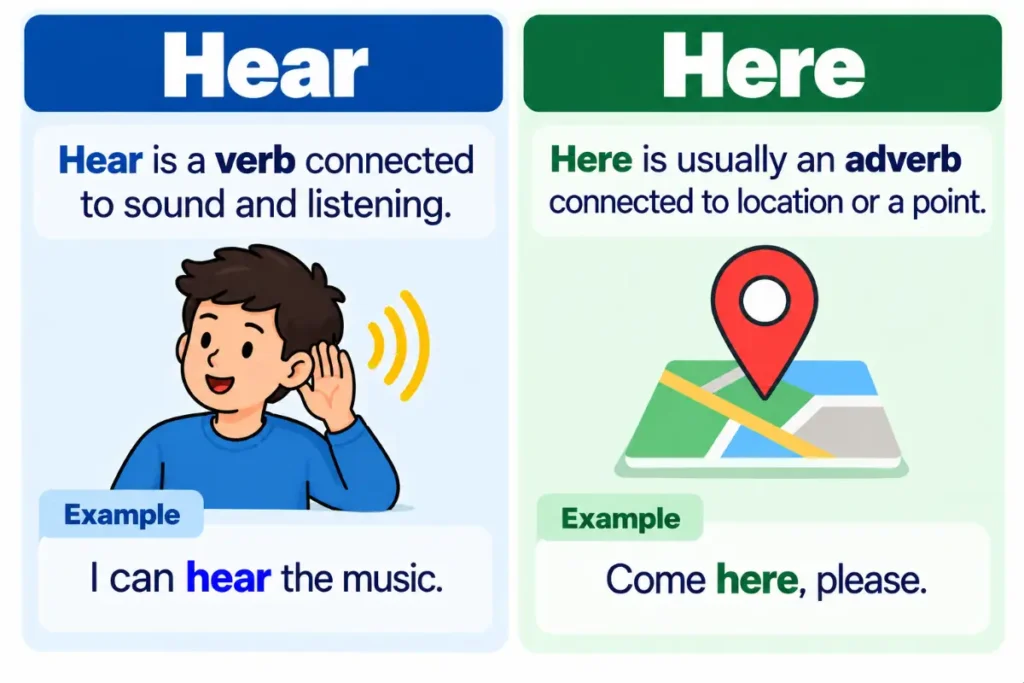
- Hear is a verb connected to sound and listening.
- Here is usually an adverb connected to location or a point.
- Hear and here are homophones in standard American English.
- They generally have the same pronunciation but different spellings.
- Hear can become heard in the past tense.
- Here often appears in expressions such as here is, here are, come here, and here you go.
- Use hear when the sentence involves receiving or noticing sound.
- Use here when the sentence identifies a place or point.
- Context is the best way to choose the correct spelling.
- A useful memory trick is to connect hear with ears and here with a place.
Conclusion
Hear vs here becomes much easier once you connect each word with its core meaning. Hear relates to sound, listening, and receiving information through hearing. Here usually points to a place or a particular point in a discussion or situation.
The two words sound alike in standard American English, so pronunciation can’t usually tell you which spelling to choose. Instead, look at the meaning of the sentence. If you are talking about something reaching your ears, use hear. If you are pointing to a place or point, use here.
A simple memory trick can keep the difference fresh. Think of your ears when you see hear and think of a location when you see here. Once that connection becomes automatic, this common homophone mistake becomes much easier to avoid.
Frequently Asked Questions
Is hear or here correct?
Both hear and here are correct English words. The correct choice depends on meaning. Use hear for sound or listening. Use here for a place or point.
What is the difference between hear and here?
The main difference in hear vs here is meaning and grammatical function. Hear is a verb connected to sound. Here is usually an adverb that refers to location or a particular point.
Are hear and here pronounced the same?
Yes. In standard American English, hear and here are normally pronounced the same. They are homophones. Some regional accents can produce small pronunciation differences.
Is hear a verb?
Yes. Hear is primarily a verb. It describes receiving or noticing sound. It can also mean receiving information or listening to a case in a formal setting.
Is here a verb?
No. Here is usually an adverb. It commonly refers to a particular place. It can also point to a specific point in a discussion, situation, or process.
What is the past tense of hear?
The past tense of hear is heard. The past participle is also heard. For example, you can say I heard the news and I have heard the news.
How can I remember the difference between hear and here?
Connect hear with ears because you hear with your ears. Connect here with a place because here points to a location. This simple association can help you remember the spelling.
Can hear and here appear in the same sentence?
Yes. For example, I can hear you from here. Hear refers to sound while here refers to the speaker’s location.
Why do people confuse hear and here?
People confuse them because they normally sound the same. Since spoken pronunciation doesn’t reveal the spelling, writers must use context and meaning to select the correct word.
Is here always about a physical place?
No. Here can also refer to a point in an explanation, process, argument, or situation. For example, here is where the problem starts uses here to identify a particular point rather than simply a physical location.
Is hear always related to sound?
Hear is strongly connected to sound and listening, but it can also mean receiving information or listening to a formal case. These meanings still relate to the basic idea of receiving something through listening.
Which is correct I can hear you or I can here you?
I can hear you is correct. The sentence describes the ability to receive someone’s voice. Here would be incorrect because the sentence doesn’t refer to a location.

Confusing Words, Spelling & Word Choice
Claire Whitmore is a U.S.-based English editor who writes about commonly confused words, spelling differences, and word choice. Her work helps readers understand subtle distinctions between similar-looking words through simple definitions, practical examples, and modern usage guidance in both American and British English.