
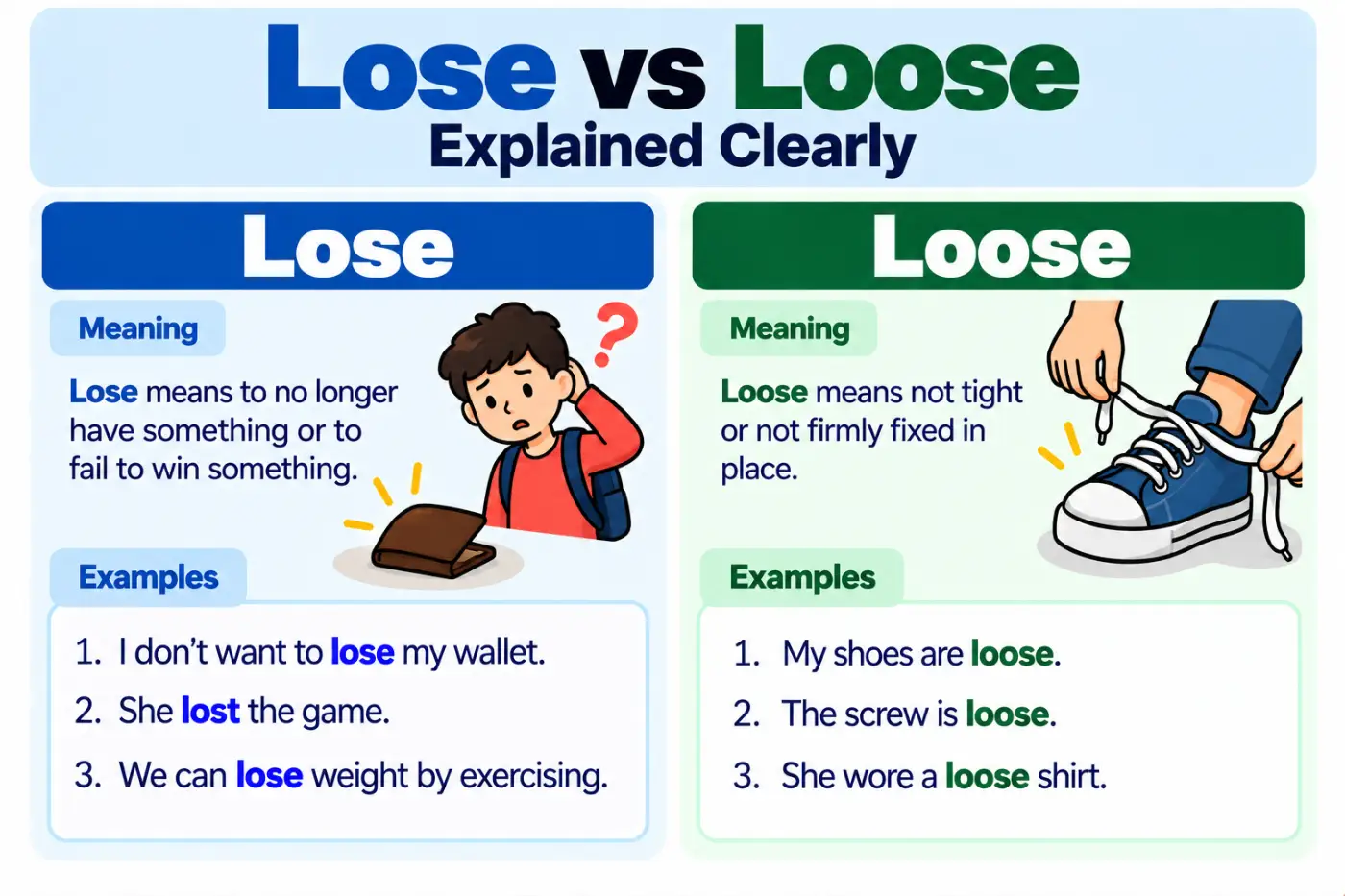
Lose vs loose becomes much easier once you connect each word with its main idea. Use lose for the act of no longer having something or failing to win. Use loose for something that is not tight secure or firmly fixed. The spelling difference is small but the meanings are far apart.
Many people confuse these words because they contain the same letters in a similar order. They also appear often in everyday speech and writing. You might need to say that you lost your keys or that your shoelaces are loose. Choosing the wrong word can change the meaning of the sentence completely.
The good news is that you don’t need a complicated grammar rule to remember the difference. Think of lose as an action and loose as a condition. Once that basic connection becomes familiar you can spot the correct word much faster.
Short Answer
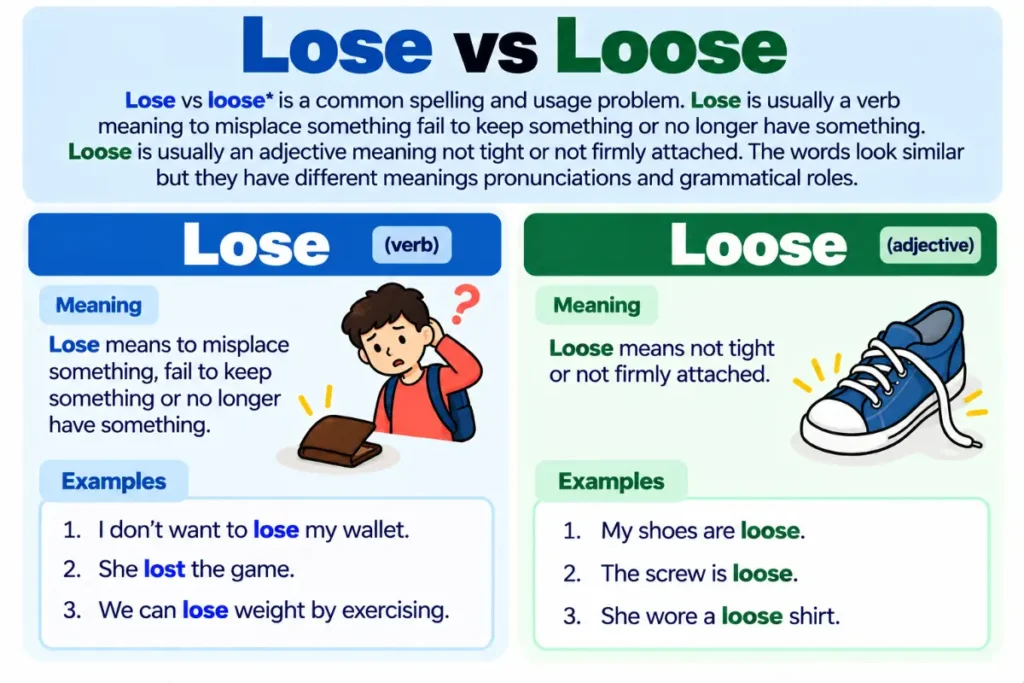
Lose vs loose is a common spelling and usage problem. Lose is usually a verb meaning to misplace something fail to keep something or no longer have something. Loose is usually an adjective meaning not tight or not firmly attached. The words look similar but they have different meanings pronunciations and grammatical roles.
Table Of Contents
- What lose means.
- What loose means.
- The main difference between lose and loose.
- Lose as a verb.
- Loose as an adjective.
- Lose in common expressions.
- Loose in common expressions.
- How to pronounce lose and loose.
- Why people confuse these words.
- Common mistakes with lose and loose.
- Real life examples.
- Memory tips.
- Related usage notes.
- Professional writing tips.
- Frequently asked questions.
- Key takeaways.
- Conclusion.
What Lose Means
Lose is most commonly a verb. It describes an action or result involving something that is no longer available to you. It can refer to misplacing an object losing possession of something failing to win or experiencing a reduction.
For example:
- I don’t want to lose my keys.
- She may lose her phone at the airport.
- Our team could lose the game.
- He lost his wallet yesterday.
- Try not to lose your focus.
In each sentence the word describes something that happens. A person can lose an object. A team can lose a competition. Someone can lose concentration. A person can also lose time money weight patience or an opportunity.
The past tense of lose is lost. The past participle is also lost.
- Present: I lose my keys sometimes.
- Past: I lost my keys yesterday.
- Past participle: I have lost my keys.
The word can also describe a failure to win.
- We don’t want to lose this match.
- They lost the final game.
- The company could lose the contract.
It can also describe something becoming unavailable.
- She lost her job.
- He lost his confidence.
- They lost contact with their friends.
The central idea remains the same. Something has slipped away from possession control success attention or connection.
What Loose Means
Loose is most commonly an adjective. It describes something that isn’t tight firmly attached or closely controlled.
Consider these examples:
- My shoes are loose.
- The screw is loose.
- She wore a loose shirt.
- One of the fence boards is loose.
- The dog got loose from the yard.
The first four examples describe a physical condition. The shoes aren’t tight. The screw isn’t firmly fixed. The shirt isn’t close fitting. The board isn’t securely attached.
Loose can also describe something that isn’t strict or tightly controlled.
- The rules are fairly loose.
- They followed a loose schedule.
- The group has a loose connection.
- The story is based on a loose interpretation of the original idea.
Loose can also appear as a verb in less common contexts. As a verb it can mean to release something or set something free. This use is much less common in everyday American English than the adjective.
For most everyday writing the easiest rule is simple. If you’re describing something that isn’t tight or secure use loose.
The Main Difference Between Lose And Loose
The clearest difference is grammatical as well as semantic.
| Word | Common role | Main meaning | Example |
|---|---|---|---|
| Lose | Verb | Misplace fail to keep or fail to win | Don’t lose your keys. |
| Loose | Adjective | Not tight or not firmly fixed | My shoelace is loose. |
There is also an important pronunciation difference.
Lose has a sound that ends like the sound in choose.
Loose has a sound that ends like the sound in moose.
This pronunciation difference can help you remember the spelling.
Think of these examples:
- I don’t want to lose my keys.
- My keys are not loose.
The first sentence describes an action involving possession. The second word would describe something that isn’t secure or tight.
Another useful pair is:
- Don’t lose the rope.
- The rope is loose.
In the first sentence someone might accidentally misplace the rope or fail to keep hold of it. In the second sentence the rope isn’t tight.
Lose As A Verb
Lose has several common meanings. Understanding them gives you a stronger command of the word.
Lose Something
The most familiar use involves misplacing or no longer having something.
- I always lose my sunglasses.
- She lost her passport.
- Don’t lose the receipt.
- He lost his wallet on the bus.
Here lose means that the person no longer knows where the item is or no longer has it.
Lose A Competition
Lose can describe the opposite of winning.
- Our team lost the game.
- They lost the championship.
- I hate to lose.
- The player lost the match.
This use is especially common in sports and competitions.
Lose Weight
Lose is also common when talking about a reduction in body weight.
- He wants to lose weight.
- She lost five pounds.
- The doctor suggested ways to help him lose weight.
Notice that the correct expression is lose weight. The word loose doesn’t fit here.
Lose Time
You can lose time when something causes you to waste or miss available time.
- We lost an hour because of traffic.
- Don’t lose valuable time.
- The delay caused us to lose time.
Lose Focus
It can describe a failure to maintain attention.
- I started to lose focus during the meeting.
- She didn’t want to lose concentration.
- The student lost focus after several hours of studying.
Lose Control
This expression means to stop controlling a situation or yourself.
- He began to lose control of the car.
- She didn’t want to lose control of the situation.
- Try not to lose control of your emotions.
Lose Interest
This means to stop being interested in something.
- I started to lose interest in the show.
- He lost interest in the project.
- Children may lose interest if the lesson becomes repetitive.
These examples show why lose is so flexible. It can describe physical possession as well as abstract things such as focus interest control confidence and time.
Loose As An Adjective
It describes a condition rather than an action in most everyday uses.
Loose Clothing
It can describe clothing that doesn’t fit tightly.
- She prefers loose clothing.
- He wore a loose jacket.
- The shirt feels loose around the shoulders.
- These pants are too loose.
The opposite is tight.
If clothing fits close to the body you can call it tight. If it has plenty of extra space you can call it loose.
Loose Parts
Loose can describe something that isn’t firmly attached.
- The door handle is loose.
- I found a loose screw.
- One tile has become loose.
- The shelf is loose.
This meaning is especially useful when describing repairs or safety problems.
Loose Rules
Loose can also describe rules that aren’t strict.
- The school has loose rules about clothing.
- The club follows a loose set of guidelines.
- The schedule is fairly loose.
In these sentences loose doesn’t describe physical space. It describes a lack of strict control.
Set Something Loose
The phrase set loose means to release something.
- The animal was set loose in the field.
- They set the birds loose.
- The children were finally set loose after the event.
The word loose still connects to the idea of freedom or lack of restraint.
Lose In Common Expressions
Lose appears in many everyday expressions. Learning these phrases can make the distinction easier.
Lose Your Mind
This informal expression can mean becoming extremely upset excited or confused.
- I thought I was going to lose my mind during the delay.
- She nearly lost her mind when she saw the damage.
The expression is common in casual conversation.
Lose Your Temper
This means to become angry.
- Try not to lose your temper.
- He lost his temper during the argument.
Lose Track Of Something
This means to stop knowing where something is or what is happening with it.
- I lost track of time.
- She lost track of the conversation.
- We lost track of how many people had arrived.
Lose Touch
This means to stop communicating regularly with someone.
- We lost touch after college.
- I don’t want to lose touch with my old friends.
Lose Your Way
This means to become unable to find the correct route.
- We lost our way in the forest.
- I lost my way while driving downtown.
These expressions reinforce the basic idea of something slipping away from your control or awareness.
Loose In Common Expressions
It also appears in useful everyday expressions.
Loose Change
Loose change means small coins carried separately rather than kept in a wallet or organized container.
- I found some loose change in my pocket.
- She keeps loose change in a jar.
At A Loose End
This expression describes having nothing useful or planned to do. It is more common in British English than American English.
American speakers may instead say that they have nothing to do or don’t know what to do next.
Cut Loose
Cut loose can mean to become free from restrictions or to behave in a more relaxed way.
- After finishing the exam they decided to cut loose and celebrate.
- He wanted to cut loose for the weekend.
Loose Cannon
A loose cannon is a person who may act unpredictably and create problems because they aren’t easy to control.
- The manager considered him a loose cannon.
- Nobody knew what the loose cannon would do next.
This expression is informal and often carries a negative meaning.
How To Pronounce Lose And Loose
Pronunciation is one of the best ways to separate these words.
Lose is pronounced with a voiced z sound at the end.
Loose ends with an unvoiced s sound.
The difference is subtle but meaningful.
A helpful comparison is:
- Lose rhymes with choose.
- Loose rhymes with goose.
- Lose has the same final sound heard in words such as news.
- Loose has the same final sound heard in words such as juice.
The vowel sound is also slightly different in many standard American English pronunciations. Lose generally has a sound like the vowel in choose. Loose has a similar long vowel but ends with the unvoiced s sound.
Listening carefully to the final consonant can help. If you say the word with a clear z sound you are likely saying lose. If the final consonant sounds like s you are saying loose.
Why People Confuse These Words
There are several reasons these words cause trouble.
First the spellings are extremely similar. Only one extra letter separates them.
Second both words appear frequently in everyday English. You can lose things and you can have loose things.
Third the words can be difficult to distinguish when someone speaks quickly. The final consonant changes but the difference may not be obvious to every listener.
Fourth spelling mistakes can become habits. Once someone repeatedly writes loose when they mean lose the incorrect form can start to look normal.
English has many word pairs that create this kind of confusion. Small spelling differences can represent completely different meanings.
The solution isn’t memorizing a long grammar lesson. Instead connect each word with a clear mental picture.
Imagine a missing wallet when you think of lose.
Imagine a loose shoelace when you think of loose.
Those two pictures are easy to remember and give you a fast check while writing.
Common Mistakes With Lose And Loose
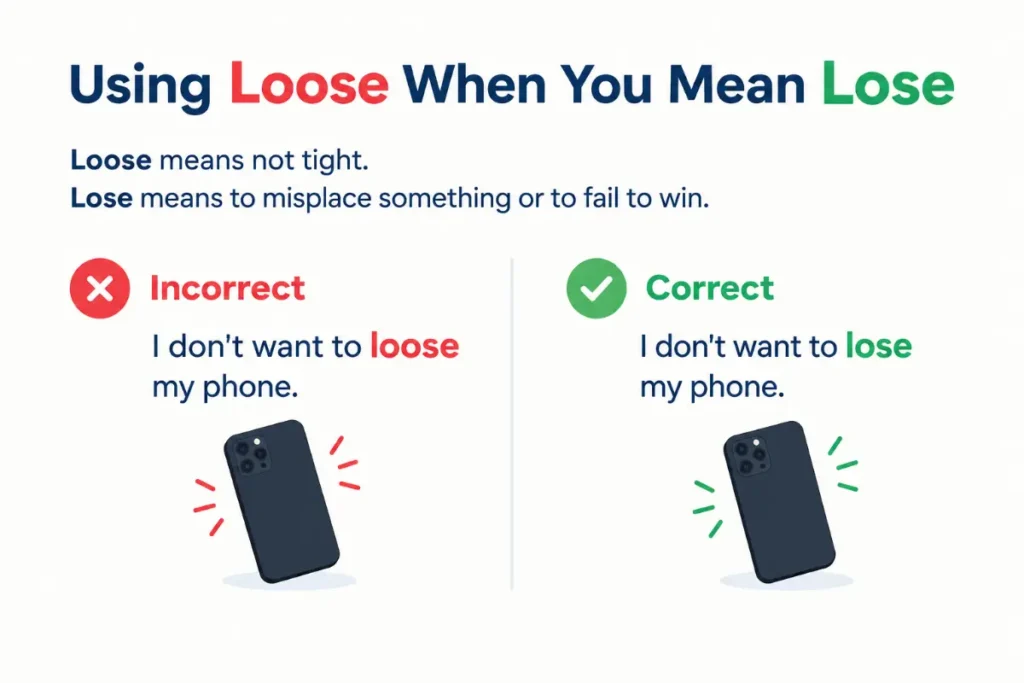
Using Loose When You Mean Lose
Incorrect: I don’t want to loose my phone.
Correct: I don’t want to lose my phone.
The sentence describes the possibility of no longer having the phone. It doesn’t describe a phone that isn’t tight or secure.
Using Lose When You Mean Loose
Incorrect: My shoes are lose.
Correct: My shoes are loose.
The sentence describes shoes that aren’t tight enough. Loose is the adjective you need.
Mixing Up Lose Weight
Incorrect: I want to loose weight.
Correct: I want to lose weight.
Weight can decrease so you lose it. The word loose doesn’t describe the act of reducing weight.
Confusing A Loose Screw With A Lost Screw
These sentences have different meanings.
- The screw is loose.
- I lost the screw.
In the first sentence the screw is still present but isn’t firmly attached. In the second sentence the screw cannot be found.
Confusing Loose Clothing With Lost Clothing
- The shirt is loose.
- I lost my shirt.
The first sentence describes fit. The second sentence describes possession.
This contrast is useful because it shows how much meaning can change with a single spelling choice.
Real Life Examples
The fastest way to build confidence is to see the words in natural sentences.
Everyday Situations
- Don’t lose your keys.
- My shoelaces are loose.
- She doesn’t want to lose her phone.
- The button is loose.
- He lost his wallet.
- The lid is loose.
- We could lose the game.
- The handle feels loose.
- I don’t want to lose this opportunity.
- The dog got loose from the yard.
Every sentence gives you a clue. Ask yourself if the word describes an action involving loss or a condition involving looseness.
Workplace Examples
- Don’t lose the invoice.
- The connection between the two departments is loose.
- We can’t afford to lose this client.
- The cabinet door is loose.
- She lost interest in the project.
- The schedule is still loose.
These examples show that both words can appear in professional writing. The key is choosing the word that matches the intended meaning.
Academic Examples
- Students can lose points for missing the deadline.
- The paper has a loose structure.
- Don’t lose sight of the main argument.
- The definition uses a loose interpretation of the term.
- A student may lose concentration during a long exam.
Again the difference depends on meaning and grammatical role.
A Simple Test For Choosing The Right Word
When you aren’t sure which spelling to use ask yourself one question.
Am I talking about losing something or describing something that isn’t tight?
If you’re talking about losing something use lose.
If you’re describing something that isn’t tight secure or firmly attached use loose.
Try the test with these sentences.
I might ___ my wallet.
The answer is lose because the sentence describes no longer having the wallet.
The belt is too ___.
The answer is loose because the belt isn’t tight.
We could ___ the game.
The answer is lose because the sentence describes failure to win.
The screw is ___.
The answer is loose because the screw isn’t firmly attached.
This simple test works in most everyday situations.
Memory Tips
A good memory trick should be quick enough to use while writing.
Connect Lose With Loss
Both lose and loss begin with los.
- Lose something.
- Suffer a loss.
- Lost something.
This connection is useful because loss involves something going away.
Connect Loose With Extra Space
Think of loose clothing. It has extra room.
A loose shirt has space around the body. A loose screw has space or movement because it isn’t firmly fixed.
Remember The Extra O
Loose has two o letters.
You can think of the extra o as extra room.
This isn’t a grammar rule. It’s simply a memory device.
Use A Rhyme
Lose sounds like choose.
Loose sounds like goose.
If you remember those rhymes you can often recall the spelling without thinking too hard.
Picture The Difference
Picture a missing wallet for lose.
A strong mental picture can be easier to remember than a dictionary definition.
Related Grammar And Usage Notes
Lose Is A Verb
In its most common use lose describes an action.
- I lose my keys.
- She lost her phone.
- They may lose the game.
Because it is a verb it can change tense.
- Lose.
- Lost.
- Lost.
The form loses is used with a third person singular subject in the present tense.
- He loses focus quickly.
- She loses her keys often.
The form losing is the present participle.
- He is losing patience.
- She is losing interest.
Loose Is Usually An Adjective
Loose commonly describes a noun.
- A loose button.
- Loose clothing.
- A loose connection.
- A loose screw.
It can also appear after linking verbs.
- The button is loose.
- The connection feels loose.
- His shoes are loose.
Loose Can Also Be A Verb
The verb loose exists but it isn’t as common in ordinary modern conversation.
It can mean to release something.
For example:
- The soldiers loosed the arrows.
- The gate was opened and the animals were loosed.
In everyday American English most people encounter loose as an adjective far more often.
Lost Is Not The Same As Loose
Lost is the past tense and past participle of lose.
- I lost my keys.
- She has lost her phone.
- We lost the game.
Loose is a different word.
- My keys aren’t loose.
- The handle is loose.
- The shirt is loose.
This distinction matters because lost and loose can sometimes appear close together in speech but they don’t perform the same grammatical job.
American English Usage
In American English both lose and loose are standard words with established meanings.
The confusion isn’t mainly a regional issue. It is a spelling and pronunciation problem that affects many English speakers and writers.
The same basic distinction is used in standard English more broadly.
American English commonly uses expressions such as:
- lose weight.
- lose interest.
- lose control.
- loose clothing.
- loose change.
- loose connection.
The meanings remain stable across ordinary contexts.
Formal And Informal Usage
Both words are suitable for formal and informal writing.
Lose is completely normal in professional communication.
- We don’t want to lose the opportunity.
- The company could lose revenue.
Loose is also appropriate in professional writing.
- The cable is loose.
- The policy provides loose guidelines.
Some expressions containing loose are more informal. For example loose cannon is a conversational expression. In a formal report you may prefer a direct description of the person’s unpredictable behavior.
The word itself isn’t informal. The level of formality depends on the expression and context.
Professional Writing Tips
A small spelling mistake can weaken an otherwise polished piece of writing. The lose and loose confusion is especially noticeable because both words are common and their meanings are clearly different.
When editing your work look for both spellings.
If you see loose ask if the sentence describes something that isn’t tight secure or firmly attached.
If you see lose ask if the sentence describes misplacing something failing to win or no longer having something.
This quick check can catch many errors.
You can also use the surrounding grammar as a clue. A form such as to lose almost always signals the verb. A phrase such as a loose shirt uses loose as an adjective.
Context usually gives you the answer.
When Lose And Loose Appear Together
Sometimes both words can appear in the same sentence.
- I don’t want to lose the loose button.
- She lost the loose papers.
- He didn’t want to lose his loose change.
- They fixed the loose wire before it could cause them to lose power.
These sentences are useful because they place the words side by side.
In the first example the button isn’t firmly attached. The person is worried about no longer having it.
In the second example the papers aren’t secured together and then they cannot be found.
In the third example loose change means coins that aren’t organized or secured in a particular place. The person can still lose that change.
The meanings stay separate even when the words appear together.
Similar Words That Cause Confusion
Lose and loose aren’t the only English words that writers mix up.
Other common pairs include:
- Accept and except.
- Affect and effect.
- Advice and advise.
- Principal and principle.
- Stationary and stationery.
- Compliment and complement.
- Then and than.
- Your and you’re.
- Its and it’s.
- There their and they’re.
The best way to learn confusing words is to connect each word with its function and meaning rather than relying only on spelling.
For lose and loose the key contrast is especially simple.
Lose involves something going away.
Loose describes something that isn’t tight or secure.
Key Takeaways
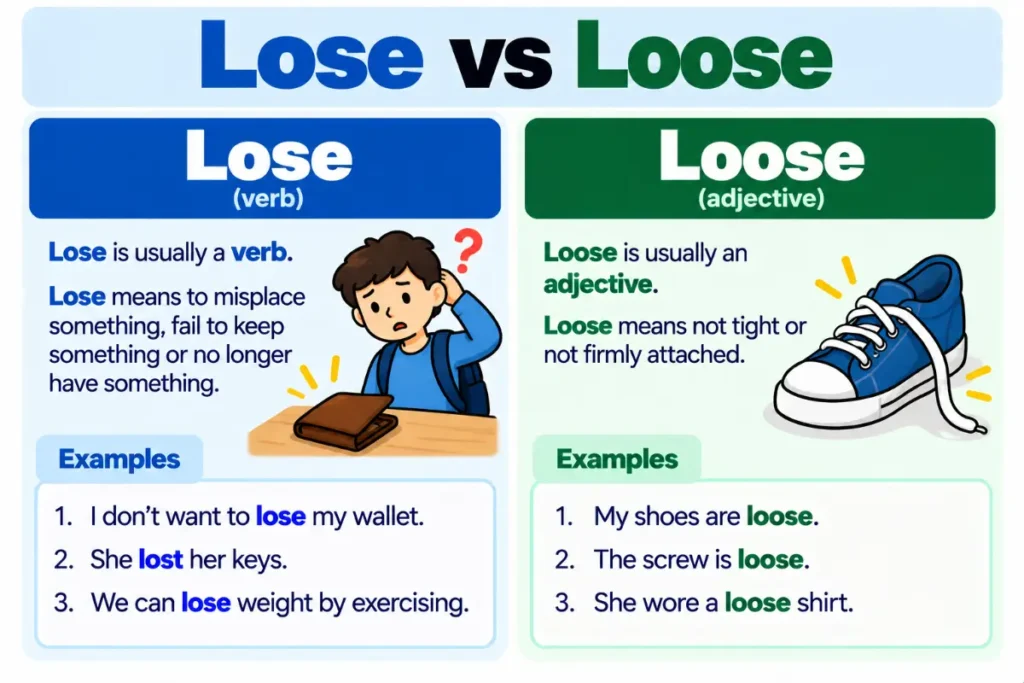
- Lose is usually a verb.
- Loose is usually an adjective.
- Lose means to misplace something fail to win or no longer have something.
- Loose means not tight secure or firmly attached.
- Lose rhymes with choose.
- Loose rhymes with goose.
- The past tense of lose is lost.
- Use lose weight rather than loose weight.
- Use loose clothing rather than lose clothing.
- Connect lose with loss and loose with extra space.
- Check the meaning before choosing the spelling.
- A missing wallet points to lose while a loose shoelace points to loose.
Conclusion
Lose vs loose is easier to remember once you focus on meaning instead of spelling. Lose is usually a verb connected with losing possession failing to win or no longer having something. Loose is usually an adjective that describes something that isn’t tight secure or firmly attached.
The fastest memory trick is to connect lose with loss. Think of something slipping away from you. Then connect loose with extra space. A loose shirt has room. A loose screw can move.
With that simple distinction you can avoid common mistakes such as writing loose weight instead of lose weight or lose clothing instead of loose clothing. Read the sentence for meaning first and the correct spelling will usually become obvious.
Frequently Asked Questions
Is lose or loose correct?
Both words are correct. They have different meanings. Use lose as a verb for misplacing something failing to win or no longer having something. Use loose mainly as an adjective for something that isn’t tight secure or firmly attached.
What is the difference between lose and loose?
The main difference is meaning and grammatical role. Lose is usually a verb connected with loss or failure. Loose is usually an adjective that describes something that isn’t tight or firmly fixed.
Is it lose weight or loose weight?
The correct expression is lose weight. Lose is the verb used for a reduction in weight. Loose doesn’t have this meaning.
Is it lose a game or loose a game??
The correct expression is lose a game. A team loses a game when it doesn’t win. Loose does not describe the act of failing to win.
Is it loose clothing or lose clothing?
The correct phrase is loose clothing. Loose describes clothing that isn’t tight or closely fitted.
Are lose and loose pronounced differently?
Yes. Lose ends with a voiced z sound. Loose ends with an unvoiced s sound. Lose rhymes with choose while loose rhymes with goose.
What is the past tense of lose?
The past tense of lose is lost. For example: I lost my keys yesterday. The past participle is also lost as in I have lost my keys.
Can loose be a verb?
Yes. Loose can function as a verb meaning to release or set free. This use is less common in everyday American English than the adjective loose.
Why do people confuse lose and loose?
The spellings are very similar and both words are common. Their pronunciation can also be difficult to distinguish in quick speech. A simple meaning based memory trick can help prevent the mistake.
Is loose a synonym for lost?
No. Loose and lost have different meanings. Loose usually means not tight or not firmly attached. Lost means no longer having something or being unable to find the correct place or direction.

Confusing Words, Spelling & Word Choice
Claire Whitmore is a U.S.-based English editor who writes about commonly confused words, spelling differences, and word choice. Her work helps readers understand subtle distinctions between similar-looking words through simple definitions, practical examples, and modern usage guidance in both American and British English.