
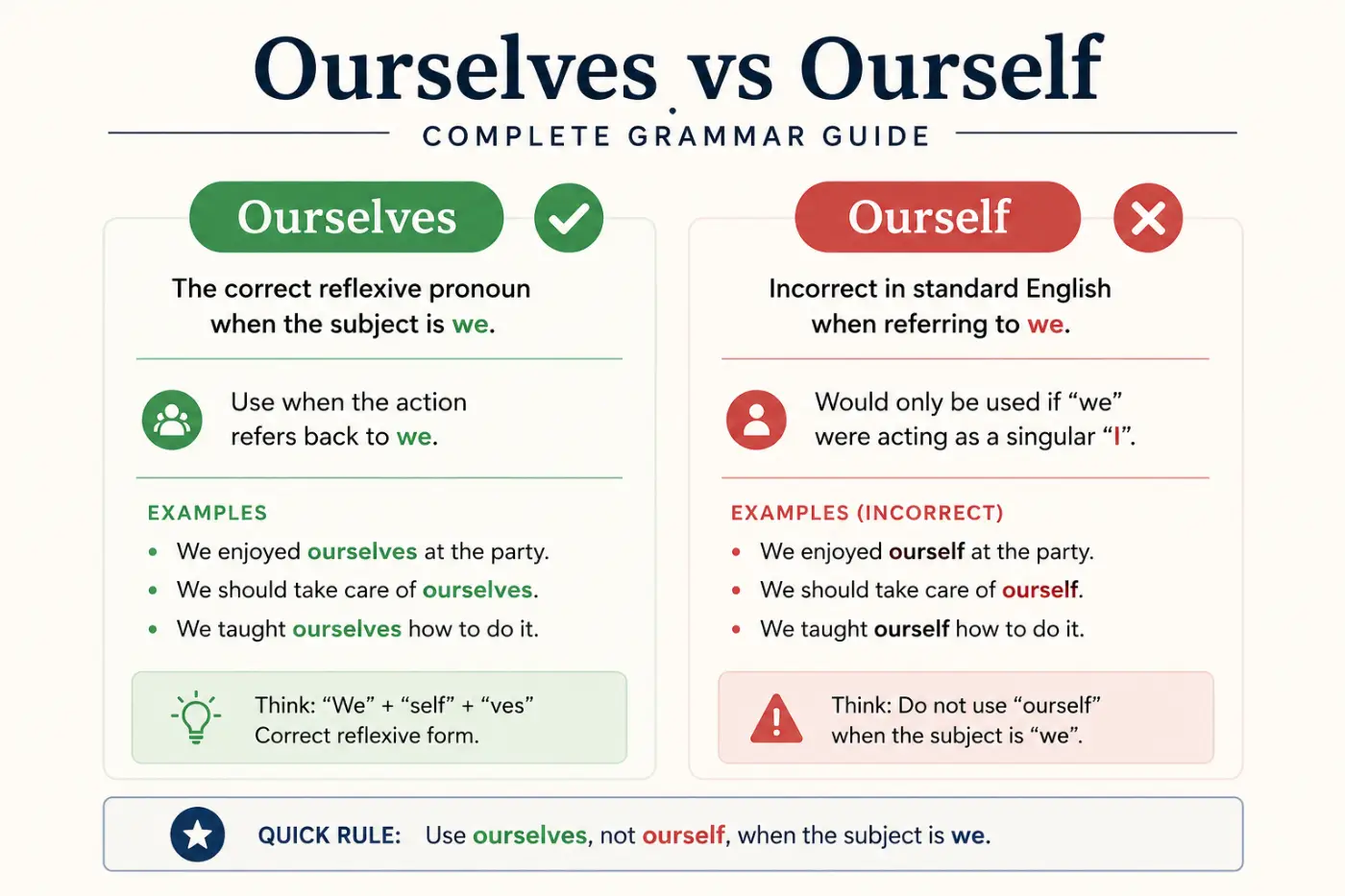
Ourselves vs Ourself can be confusing because both forms appear to refer back to we or our. The difference becomes much clearer once you understand how English handles number, reflexive pronouns, and unusual uses of the pronoun we.
In normal English, ourselves is the correct form. We use it when we refers to more than one person and the action of the sentence comes back to those same people. For example, “We prepared ourselves for the meeting” means that the people represented by we prepared the same group represented by ourselves.
Ourself is a much less common word. It can occur when we is used to represent one person, especially in an unusual formal style such as the royal we. It can also appear in some institutional or legal contexts, but these uses are uncommon in everyday American English.
This guide explains the difference between the two forms, shows how reflexive pronouns work, explains why ourself sometimes appears in published writing, and gives practical examples you can use in conversation, schoolwork, business writing, and professional communication.
Quick Answer
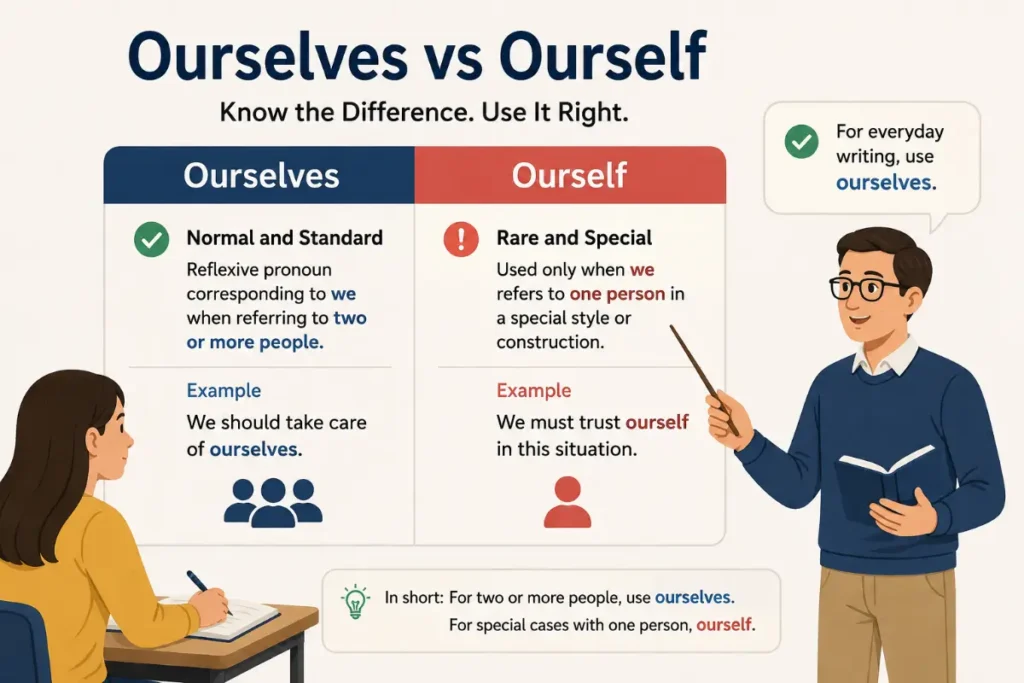
Ourselves is the normal and standard reflexive pronoun corresponding to we. It is used when we refers to two or more people. Ourself is rare and generally appears only when we refers to one person in a special style or construction. For ordinary conversation, essays, emails, and professional writing, ourselves is the form you should use.
What Does Ourselves Mean
Ourselves is a reflexive pronoun. It refers back to we or sometimes emphasizes the people included in we.
Consider this sentence:
“We taught ourselves how to use the software.”
The subject is we. The people doing the teaching are the same people receiving the result of the action. That is why the reflexive pronoun ourselves is appropriate.
Another example is:
“We introduced ourselves to the new manager.”
The people represented by we introduced those same people represented by ourselves.
The word can also be used for emphasis.
“We ourselves approved the final design.”
Here, ourselves does not receive the action in the same way as it does in “We congratulated ourselves.” Instead, it emphasizes the subject. The meaning is close to “We personally approved the final design.”
This gives ourselves two major functions.
First, it can work as a reflexive pronoun.
Second, it can work as an intensive pronoun for emphasis.
In both cases, it normally corresponds to the plural subject we.
What Does Ourself Mean
Ourself is a reflexive pronoun, but it is rare in contemporary standard English.
The most important point is that ourself does not normally replace ourselves simply because a writer prefers a shorter word. In everyday English, “We did it ourself” is generally considered incorrect when we clearly refers to several people.
For example:
“We completed the project ourselves.”
This is standard.
“We completed the project ourself.”
This is not standard for ordinary plural we.
The unusual form ourself becomes possible when we has a singular referent. One well known example is the royal we. A monarch may use we to refer to one person while speaking in an official capacity. In such a construction, ourself may appear as the corresponding reflexive form.
For example:
“We have decided that we shall represent ourself at the ceremony.”
This style is highly formal and unusual. Most speakers would never use it in ordinary conversation.
The same basic idea can occur in certain institutional contexts where an organization uses we as a singular voice. However, modern editors generally prefer clear and conventional wording, so ourself remains uncommon.
Ourselves vs Ourself Grammar Rule
The simplest grammar rule for Ourselves vs Ourself is this: use ourselves with ordinary plural we, and reserve ourself for rare situations in which we has a singular or otherwise exceptional reference.
The relationship can be remembered like this:
I → myself
You → yourself
He → himself
She → herself
It → itself
We → ourselves
You → yourselves
They → themselves
This pattern makes the standard form easy to recognize.
The subject we normally refers to more than one person. Therefore, its ordinary reflexive counterpart is ourselves.
For example:
“We blamed ourselves.”
“We reminded ourselves about the deadline.”
In every sentence, ourselves refers back to the plural subject we.
The grammar becomes unusual only when we does not represent multiple people.
Comparison Table
| Feature | Ourselves | Ourself |
|---|---|---|
| Basic type | Reflexive and intensive pronoun | Reflexive pronoun |
| Normal subject | We referring to multiple people | We referring to one person in a special use |
| Frequency | Very common | Very rare |
| Everyday American English | Standard | Usually avoided |
| Refers to a plural group | Yes | No |
| Used for emphasis | Yes | Rare |
| Common in ordinary conversation | Yes | No |
| Common in professional writing | Yes | Rare |
| Typical example | We prepared ourselves | We shall represent ourself |
| Recommended for normal writing | Yes | Usually no |
The table shows why the two forms are not interchangeable. The key issue is not simply spelling. It is the grammatical number and function of we.
Why Ourselves Is Usually Correct
There are several reasons ourselves is the natural choice in modern English.
The first is agreement. English reflexive pronouns generally agree with the person and number of their antecedents. The plural subject we takes ourselves.
The second is established usage. Native speakers routinely use ourselves in everyday speech and writing.
The third is clarity. Readers immediately understand ourselves as the reflexive form of we. The much rarer ourself can make a sentence sound unusual or archaic.
Consider these examples:
“We organized ourselves into three teams.”
“We introduced ourselves before the presentation.”
Each sentence follows the normal grammatical pattern.
Changing ourselves to ourself would make these sentences sound incorrect because we refers to several people.
For example:
“We organized ourself into three teams.”
This is not the normal standard construction.
The problem is not that ourself is impossible as a word. The problem is that it does not normally agree with a plural we.
When Ourself Can Be Correct
Ourself has a legitimate but highly restricted role.
One important setting is the royal we.
The royal we is a traditional way for a monarch to refer to themselves using we instead of I. Because the speaker is one person, the grammar behind the construction can create forms that differ from ordinary plural usage.
In this style, a speaker may use ourself to refer back to that singular we.
Another possible setting is institutional writing. An organization can sometimes speak as we, even though the organization is technically a single entity. In highly formal or specialized writing, ourself may occasionally appear.
However, this does not mean you should start using ourself whenever an organization writes “we.”
Modern English usually treats the organizational we as a normal plural pronoun for practical grammatical purposes.
For example:
“We have reviewed our policy.”
“We have prepared ourselves for the changes.”
The conventional form remains ourselves when the writer means the organization and its members collectively.
The rare nature of ourself is worth remembering. A word can be grammatically possible in a specialized construction without being a good choice for everyday writing.
Examples With Ourselves
The easiest way to understand ourselves is to see it used naturally.
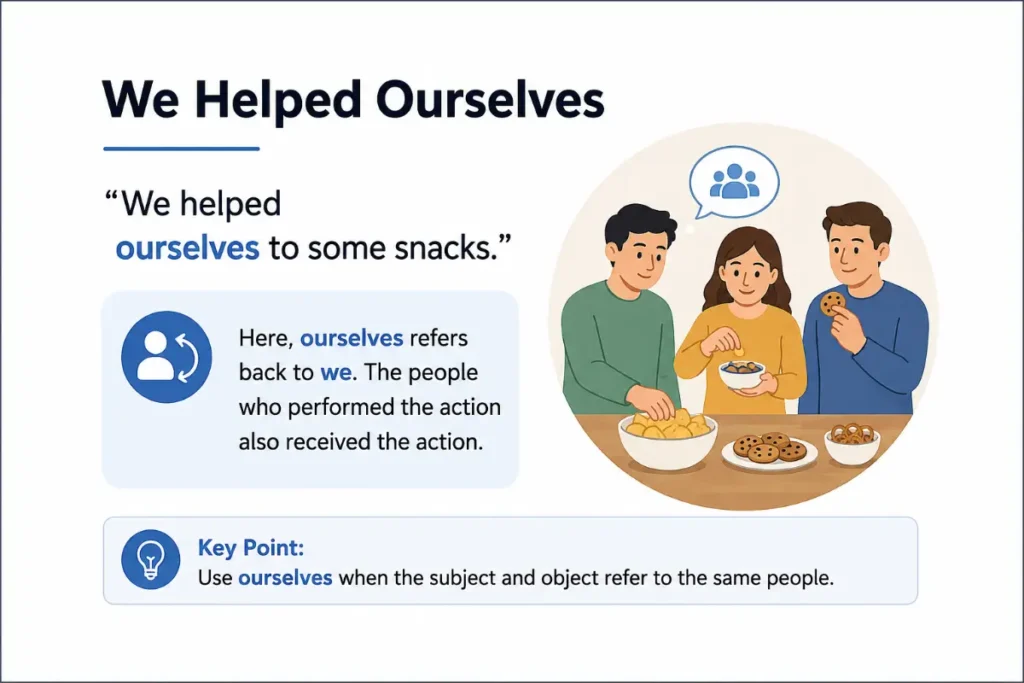
We Helped Ourselves
“We helped ourselves to some snacks.”
Here, ourselves refers back to we. The people who performed the action also received the action.
We Introduced Ourselves
“We introduced ourselves to the new employees.”
The speakers introduced the same people represented by ourselves.
We Prepared Ourselves
“We prepared ourselves for the difficult interview.”
The group prepared its own members mentally or practically.
We Enjoyed Ourselves
“We enjoyed ourselves at the concert.”
The phrase enjoy ourselves is a common English expression meaning to have a good time.
We Blamed Ourselves
“We blamed ourselves for the mistake.”
The group blamed the same people represented by we.
We Reminded Ourselves
“We reminded ourselves to submit the forms before Friday.”
The reflexive pronoun shows that the reminder was directed back toward the same group.
We Defended Ourselves
“We defended ourselves against the criticism.”
The group defended its own members.
We Kept Ourselves Busy
“We kept ourselves busy while we waited.”
The people involved occupied themselves.
We Told Ourselves the Truth
“We told ourselves that everything would be fine.”
The speakers directed the statement toward themselves.
We Ourselves Made the Decision
“We ourselves made the decision.”
Here, ourselves is intensive rather than strictly reflexive. It adds emphasis to we. The sentence stresses that the speakers personally made the decision.
This distinction matters because reflexive and intensive pronouns can look identical.
Examples With Ourself
Because ourself is unusual, examples need special context.
Consider this formal construction:
“We shall represent ourself before the council.”
Here, we may represent one person speaking in an official or traditional style. Ourself refers back to that singular speaker.
Another example is:
“We have decided to defend ourself.”
Again, the construction only makes sense if we is functioning as a singular pronoun in a specialized context.
A third example is:
“We must ask ourself whether this decision is appropriate.”
This can occur in an unusual formal style where one person uses we to refer to themselves.
These sentences should not be copied into ordinary emails, school assignments, business documents, or casual conversations. In normal English, a singular speaker would generally say:
“I shall represent myself before the council.”
“I must ask myself whether this decision is appropriate.”
These versions are clearer and more natural for modern readers.
Ourselves as a Reflexive Pronoun
A reflexive pronoun points back to the subject of the clause.
For example:
“We congratulated ourselves.”
The subject is we. The object is ourselves. Both refer to the same group.
This creates a useful pattern:
Subject → action → same people
“We” → congratulated → “ourselves”
Other examples include:
“We challenged ourselves.”
“We surprised ourselves.”
The reflexive pronoun is necessary because the action returns to the subject.
Compare:
“We congratulated ourselves.”
“We congratulated them.”
The first sentence means the group congratulated its own members. The second means the group congratulated another group. Understanding this relationship makes the choice between ourselves and other pronouns much easier.
Ourselves as an Intensive Pronoun
Ourselves can also emphasize the subject.
Consider:
“We ourselves designed the website.”
The sentence does not mean that the group literally performed an action on itself. Instead, ourselves emphasizes who designed the website.
The meaning is close to:
“We personally designed the website.”
Another example is:
“We ourselves witnessed the incident.”
This stresses that the speakers personally saw what happened.
You can often remove the intensive pronoun without destroying the grammar:
“We designed the website.”
“We witnessed the incident.”
The sentences remain grammatically complete. The word ourselves simply adds emphasis.
This is an important distinction because learners sometimes assume that every reflexive pronoun must be the direct or indirect object of a verb. That is not always true.
Common Mistakes
Using Ourself for a Plural Group
One of the most common errors is using ourself when we refers to several people.
Incorrect:
“We completed the assignment ourself.”
Standard:
“We completed the assignment ourselves.”
The correction is straightforward because the group contains multiple people.
Using Ourselves With I
Another mistake is using ourselves when the subject is I.
Incorrect:
“I prepared ourselves for the interview.”
Standard:
“I prepared myself for the interview.”
The subject and reflexive pronoun must agree.
Using Ourselves With He
Incorrect:
“He introduced ourselves to the audience.”
Standard:
“He introduced himself to the audience.”
The reflexive pronoun must refer to the subject of the clause.
Using Ourself Simply Because It Sounds Shorter
Some learners may assume that ourself is simply a shorter version of ourselves. It is not.
The difference involves grammar and usage, not just word length.
Using Ourselves as a Substitute for Us
A reflexive pronoun cannot automatically replace an ordinary object pronoun.
Incorrect:
“The manager sent the documents to ourselves.”
Standard:
“The manager sent the documents to us.”
However, ourselves can be correct in a sentence such as:
“We sent the documents to ourselves.”
The difference is that the second sentence has a reflexive relationship between the subject and object.
Using Ourselves for Emphasis in Every Sentence
Although ourselves can add emphasis, excessive use can make writing sound awkward.
For example:
“We ourselves personally completed the work ourselves.”
This is unnecessarily repetitive.
A cleaner version is:
“We personally completed the work.”
Good writing uses reflexive and intensive pronouns only when they contribute meaning.
Pronunciation Guide
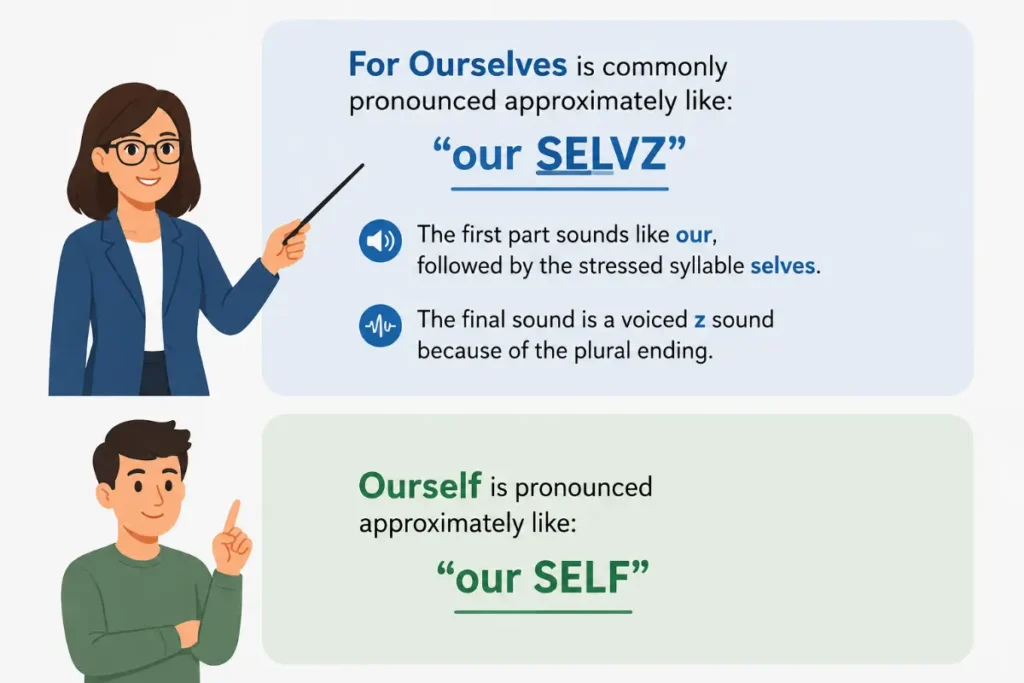
Ourselves is commonly pronounced approximately like:
“our SELVZ”
The first part sounds like our, followed by the stressed syllable selves.
The final sound is a voiced z sound because of the plural ending.
Ourself is pronounced approximately like:
“our SELF”
The difference is easy to hear. Ourselves ends in the plural form selves, while ourself ends in the singular form self.
The pronunciation itself is not the main source of confusion. Grammar and usage create most of the difficulty.
Formal and Informal Usage
Ourselves works across nearly every level of modern English.
You can use it in casual speech:
“We bought ourselves some pizza.”
You can use it in a school assignment:
“We should challenge ourselves to read more widely.”
You can use it in business writing:
“We prepared ourselves for the upcoming audit.”
You can use it in formal prose:
“We must remind ourselves that accuracy matters.”
Ourself has a much narrower range.
It may appear in historical writing, traditional formal language, specialized legal or institutional contexts, or constructions involving a singular use of we.
For most modern readers, an unexplained use of ourself will look unusual. If your goal is clear professional communication, ourselves is almost always the safer choice when we refers to multiple people.
American and British English
The basic distinction is the same in American and British English.
Both varieties normally use ourselves as the reflexive pronoun corresponding to ordinary plural we.
For example:
“We enjoyed ourselves.”
“We should remind ourselves about the deadline.”
The rare form ourself is not a normal replacement for ourselves in either variety.
Differences in regional English do not change the central grammar rule.
You should therefore avoid assuming that ourself is simply a British alternative to ourselves. It is not a normal regional equivalent.
The more important distinction is between ordinary plural we and special singular uses of we.
Related Reflexive Pronouns
Understanding the complete reflexive pronoun system helps reinforce the rule.
Myself corresponds to I.
Example:
“I taught myself to cook.”
Yourself usually corresponds to singular you.
Example:
“You should remind yourself to call.”
Himself corresponds to he.
Example:
“He introduced himself.”
Herself corresponds to she.
Example:
“She prepared herself for the exam.”
Itself corresponds to it.
Example:
“The machine turned itself off.”
Ourselves corresponds to ordinary plural we.
Example:
“We prepared ourselves.”
Yourselves corresponds to plural you.
Example:
“You should ask yourselves why this happened.”
Themselves corresponds to they.
Example:
“They organized themselves into groups.”
Once you memorize this system, the standard answer becomes much easier.
Why Is Ourselves Plural
The word ourselves contains the plural form selves, which is the plural of self.
English has several irregular plural forms connected with self.
We say:
“Myself”
“Ourselves”
“Yourself”
“Yourselves”
“Himself”
“Themselves”
The change from self to selves reflects the historical development of the word and its plural form.
This is why ourselves is not simply a stylistic variation of ourself. The ending communicates plural meaning.
Why Does Ourself Exist
The existence of ourself makes more sense when you consider that English has sometimes used we to refer to one person.
The most familiar example is the royal we. A monarch may historically speak as we rather than I to represent the authority of the crown or office.
If we is grammatically treated as singular in such a construction, a corresponding singular reflexive form can appear.
That is one reason ourself can be found in historical and formal texts.
Its existence does not undermine the standard rule. Instead, it shows that pronoun usage can change when the function of the subject changes.
The important lesson is that you should identify what we actually refers to before choosing the reflexive pronoun.
Real Life Examples
Imagine a group of coworkers preparing for a presentation.
“We reminded ourselves to speak slowly.”
This is standard because several coworkers are included in we.
Now imagine one person speaking in an unusual royal style.
“We shall prepare ourself for the ceremony.”
The form may be grammatically defensible in that specialized construction, but it sounds highly unusual to modern readers.
In ordinary business communication, the speaker would simply write:
“I shall prepare myself for the ceremony.”
Another real life situation involves a family.
“We bought ourselves new phones.”
The family members collectively bought phones for themselves.
A sports team might say:
“We challenged ourselves to improve our record.”
Again, ourselves refers to the multiple people represented by we.
A group of students could write:
“We taught ourselves how to solve the problem.”
The same relationship applies.
These examples show why context matters more than the visual similarity between the two words.
Can Ourselves Be Used Without We
Yes. Ourselves does not always appear in a sentence with the exact word we.
For example:
“The responsibility belongs to ourselves.”
However, this construction is often less natural than:
“The responsibility belongs to us.”
A better example is:
“Only ourselves can decide what happens next.”
This can be grammatical in certain contexts, but many speakers would prefer “Only we can decide what happens next.”
The important point is that reflexive pronouns have specific grammatical functions. You should not insert ourselves simply because the meaning involves a group.
Another example is:
“We need to solve the problem ourselves.”
Here, ourselves adds emphasis and means that the group must solve the problem without outside help.
Ourselves and Us
A frequent source of confusion is the difference between us and ourselves.
Us is an object pronoun.
Ourselves is a reflexive or intensive pronoun.
Compare:
“The teacher helped us.”
“The teacher helped ourselves.”
The first sentence is standard because us is the object of helped.
Now compare:
“We helped ourselves.”
Here, ourselves is correct because the object refers back to the subject we.
Another example:
“She gave us the instructions.”
“She gave ourselves the instructions.”
The first is standard.
By contrast:
“We gave ourselves the instructions.”
The second sentence is correct because the subject and object refer to the same group.
This subject and object relationship is one of the most useful ways to choose between ordinary and reflexive pronouns.
Ourselves and Our
Do not confuse ourselves with our.
Our is a possessive determiner.
Example:
“Our house is near the park.”
Ourselves is a reflexive or intensive pronoun.
Example:
“We painted the house ourselves.”
The words perform completely different grammatical jobs.
You cannot replace our with ourselves simply because both contain the letters our.
Memory Tips
The easiest memory trick is to connect we with ourselves.
Think:
We → ourselves
The word we normally represents multiple people, so its reflexive form is the plural ourselves.
Another useful trick is to remember:
I → myself
We → ourselves
The ending changes from singular self to plural selves.
When we refers to a group, ourselves is normally the right choice. The word ourself calls for a closer look because it usually appears only in unusual cases where we represents one person. If no special construction is involved, choose ourselves.
Professional Writing Tips
Professional writing rewards clarity. Because ourself is rare, using it without a compelling grammatical reason can distract readers from your message.
If you are writing an email, report, article, resume, academic paper, or business document, use ourselves when we refers to a group.
For example:
“We have prepared ourselves for the upcoming review.”
This sounds natural and professional.
Avoid:
“We have prepared ourself for the upcoming review.”
The second sentence will likely make readers pause because the reflexive pronoun does not match the ordinary plural meaning of we.
If you are writing about a monarch, historical speaker, legal document, or specialized institutional voice, check the context carefully. In such cases, ourself may have a specific grammatical purpose.
A Simple Decision Rule
When deciding between the two forms, ask one question:
How many people does we represent?
If we represents two or more people, use ourselves.
Example:
“We congratulated ourselves.”
If we represents one person in a special formal construction, ourself may be possible.
Example:
“We shall defend ourself.”
If the sentence simply means one person speaking normally, use myself instead.
Example:
“I shall defend myself.”
This three step check solves most problems involving these words.
Related Grammar and Usage Notes
Reflexive pronouns are closely connected to subject and object relationships.
A reflexive pronoun usually refers back to the subject of its clause.
“We praised ourselves.”
The subject is we, and ourselves refers back to that subject.
The same principle works with other pronouns.
“She praised herself.”
“They praised themselves.”
“He praised himself.”
The reflexive form changes according to the subject.
This is why grammar learners should study reflexive pronouns as a system rather than memorize ourselves in isolation.
Another important point is that intensive pronouns can appear for emphasis.
“We ourselves checked every document.”
In this sentence, the word emphasizes the subject rather than serving as a necessary object.
That distinction helps explain why ourselves can occur in more positions than learners may initially expect.
Is Ourself Ever Used in Modern English
Yes, but it is uncommon.
You may encounter ourself in historical documents, formal declarations, literary writing, specialized institutional language, or contexts influenced by the royal we.
Seeing the word in a published source does not automatically mean the source contains a spelling mistake.
At the same time, its appearance does not mean that ourself is a normal alternative to ourselves.
Context determines the interpretation.
For everyday writing, the practical rule remains simple: use ourselves for ordinary plural we.
Key Takeaways
Ourselves is the standard reflexive pronoun associated with ordinary plural we.
Use ourselves when two or more people are included in we.
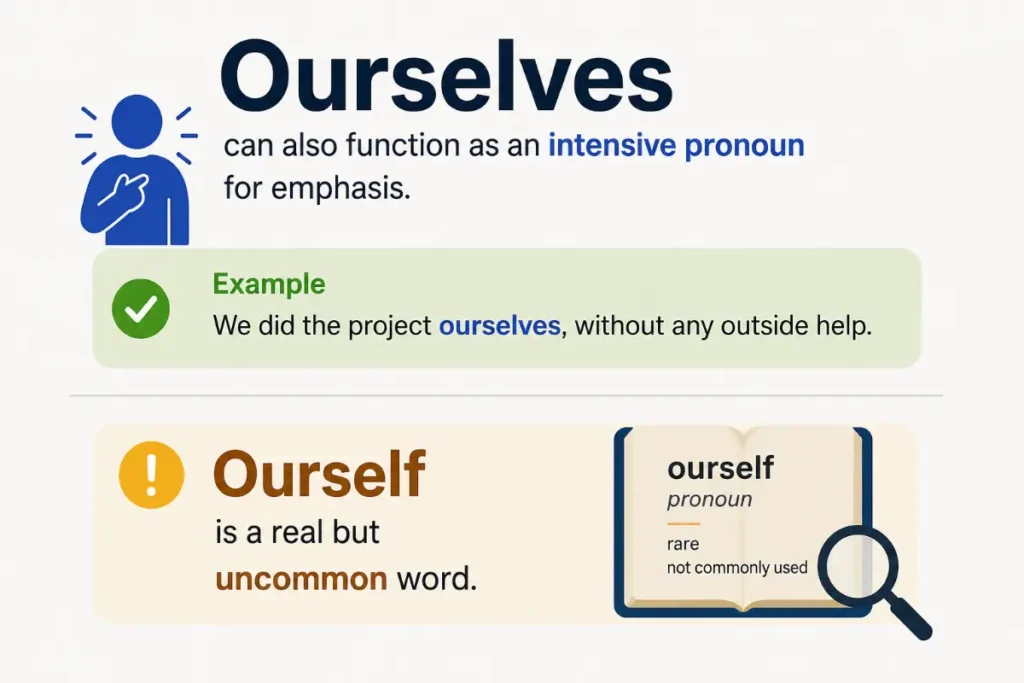
Ourselves can also function as an intensive pronoun for emphasis.
Ourself is a real but uncommon word.
Ourself can appear when we refers to one person in a special formal construction.
The royal we is one important context in which ourself can occur.
Do not use ourself as a casual shortened version of ourselves.
For everyday American English, professional writing, schoolwork, and ordinary conversation, ourselves is the correct choice.
When in doubt, identify the subject first. If we means a group, choose ourselves.
Conclusion
Ourselves vs Ourself becomes much easier once you focus on the meaning of we rather than the spelling of the two words. In ordinary English, ourselves is the standard reflexive and intensive pronoun for a plural we, while ourself has a narrow role in unusual singular or highly formal uses of we.
If you are writing a normal sentence such as “We prepared ourselves,” “We introduced ourselves,” or “We reminded ourselves,” ourselves is the form you want. Save ourself for specialized contexts where the grammar genuinely calls for it. That simple rule will keep your writing natural, accurate, and clear.
Common Search Questions
People who search for Ourselves vs Ourself often have closely related questions about grammar, pronouns, and correct usage. The answers below cover the most common points.
Is Ourselves or Ourself Correct?
Ourselves is correct in normal English when we refers to two or more people. Ourself is rare and is generally limited to special constructions where we represents one person or has an unusual formal function.
Is Ourself a Real Word?
Yes. Ourself is a real word, but it is uncommon in modern standard English. It can occur in special uses of we, particularly when one person speaks using the royal or formal we.
Can I Say We Did It Ourself?
Not in ordinary standard English when we refers to multiple people. Say, “We did it ourselves.” The plural reflexive pronoun agrees with the plural subject we.
Why Do People Say Ourself?
People may use ourself in specialized formal language, historical writing, or unusual constructions where we refers to one person. It can also appear as a deliberate stylistic choice, but it is not the normal form for plural we.
Is Ourselves Always Plural?
In ordinary English, ourselves refers to the plural pronoun we and therefore normally represents more than one person. It can also function as an intensive pronoun, but the same plural relationship generally remains.
Can Ourself Mean Myself?
In a rare construction where one person uses we to refer to themselves, ourself can correspond to that unusual singular we. In ordinary modern English, however, myself is the natural reflexive form for I.
Should I Use Ourself in Business Writing?
Usually no. If we refers to a team, company, department, or group, use ourselves. Ourself can look unusual and may distract readers unless your document specifically requires a specialized singular use of we.
What Is the Difference Between Ourselves and Ourself?
The main difference is grammatical number and usage. Ourselves is the standard plural reflexive and intensive pronoun for we. Ourself is a rare singular form used with special types of we.
Which Is More Common Ourselves or Ourself?
Ourselves is vastly more common in modern everyday English. It is the standard form used in conversation, education, journalism, business writing, and ordinary formal prose.
Is Ourself Grammatically Wrong?
Not in every possible context. It can be grammatically appropriate when we has a singular or special formal meaning. It is generally wrong, however, when used as the reflexive form of ordinary plural we.

English Grammar & Usage
Nathan Holloway is an American grammar writer and language researcher who specializes in English grammar, sentence structure, verb usage, and common writing mistakes. He enjoys breaking down confusing grammar rules into practical explanations with clear examples, making English easier for students, professionals, and everyday writers.