
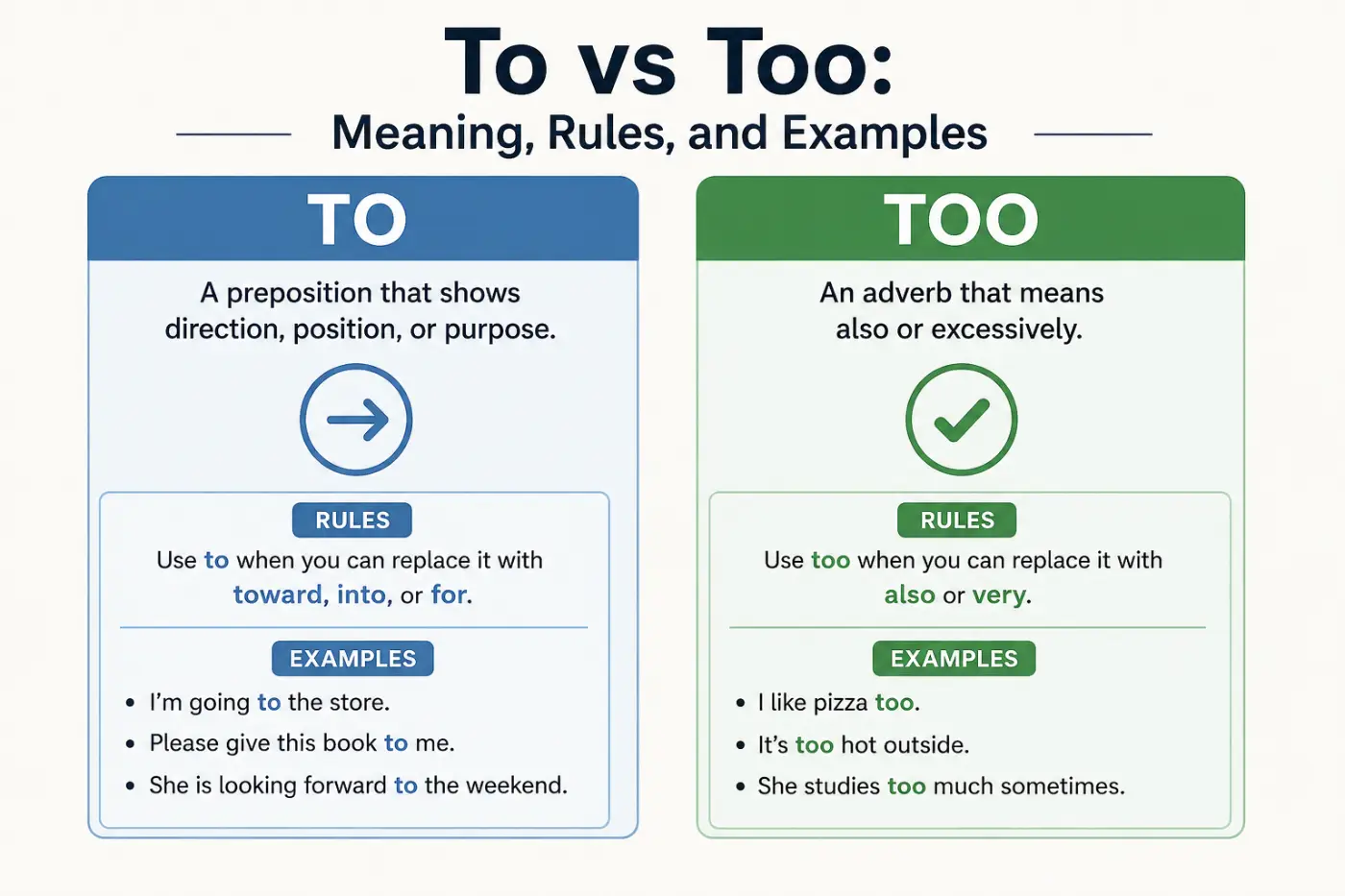
To vs Too is one of the most common spelling and grammar problems in English because the two words sound exactly alike in most standard varieties of English. When people speak, the difference disappears. When they write, however, choosing the wrong word can change the meaning or make a sentence grammatically incorrect.
Consider these sentences: “I want to leave” and “I want too leave.” The first sentence is correct because to introduces the verb “leave.” The second sentence is incorrect because too cannot perform that grammatical job.
Now compare “I want to go too” with “I want to go to.” The first sentence means that the speaker also wants to go. The second sentence feels incomplete unless another word follows it, such as “I want to go to school.”
The confusion comes from pronunciation rather than meaning. Both words are homophones, which means they have the same pronunciation but different meanings and spellings. English contains many homophones, and these pairs can cause mistakes even for experienced writers.
Short Answer
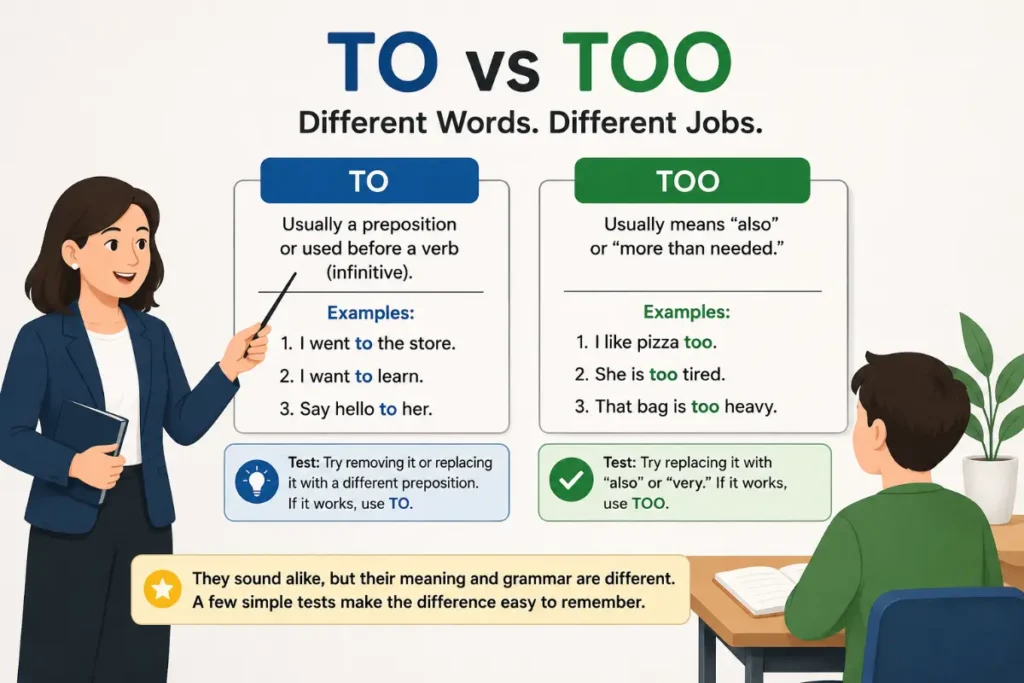
To and too are different words with different jobs. To usually works as a preposition or appears before a verb in an infinitive. Too usually means “also” or “more than needed.” They sound alike, but their meanings, grammar, and sentence patterns are different. Learning a few simple tests makes the difference easy to remember.
Table of Contents
- What To Means
- What Too Means
- The Main Difference
- How To Works as a Preposition
- How To Works With Infinitives
- How Too Works as an Adverb
- Too Meaning Also
- Too Meaning Excessively
- To vs Too in Common Expressions
- Pronunciation and Homophones
- Common Mistakes
- A Simple Decision Test
- Real Life Examples
- Related Grammar Notes
- Professional Writing Tips
- Memory Tricks
- Frequently Asked Questions
- Key Takeaways
- Conclusion
What To Means
The word to has several grammatical functions, but two are especially important for everyday writing. First, to commonly works as a preposition. It can show direction, movement, connection, or a relationship between people or things.
Examples include:
“I walked to the store.”
“She sent the letter to her friend.”
“We drove to Chicago.”
“He gave the book to Maria.”
In each sentence, to connects something to a destination, person, or place.
Second, to appears before the base form of a verb to create an infinitive.
Examples include:
“I want to learn.”
“She needs to sleep.”
“They decided to stay.”
“We hope to win.”
Here, to is not showing physical direction. Instead, it is part of the infinitive construction.
This distinction matters because writers sometimes assume that to always means movement toward something. That isn’t true. Its role depends on the sentence.
For example, “I want to read” contains to before the verb “read.” There is no movement involved. The word helps form the infinitive “to read.”
What Too Means
The word too is an adverb with two major meanings.
The first meaning is also or as well.
For example:
“I want to come too.”
This means “I also want to come.”
“She likes coffee too.”
This means “She also likes coffee.”
The second meaning is more than is desirable, necessary, suitable, or possible.
For example:
“The soup is too hot.”
This means the soup has a higher temperature than is comfortable or suitable.
“He talks too loudly.”
This means his speaking volume is higher than desired.
“This box is too heavy.”
This means the box has more weight than the speaker can comfortably handle.
The two meanings are easy to distinguish from context. In both cases, however, too functions as an adverb.
The Main Difference
The easiest way to understand the difference is to focus on grammatical function.
| Word | Main Function | Common Meaning | Example |
|---|---|---|---|
| To | Preposition or infinitive marker | Direction, relationship, or verb construction | I want to learn. |
| Too | Adverb | Also or excessively | I want to learn too. |
Another useful comparison is this:
“I went to the party.”
Here, to introduces the destination.
“I went to the party too.”
Here, too means “also.”
Notice that both words can appear in the same sentence:
“I want to go to the beach too.”
The first to is part of the infinitive “to go.” The second to introduces the destination “the beach.” The final too means “also.”
This is why context matters. You cannot choose the correct spelling simply by listening to the sound.
How To Works as a Preposition
A preposition connects a noun, pronoun, or other element to another part of a sentence. To is one of the most common prepositions in English.
It can show movement toward a destination.
“She went to school.”
“They traveled to Texas.”
“We walked to the restaurant.”
It can also identify a recipient.
“I gave the keys to John.”
“Send the message to your manager.”
“She explained the problem to her teacher.”
It can express relationships or connections.
“The answer to the question is simple.”
“This solution is important to the project.”
“He is married to a doctor.”
It can also appear in expressions involving time.
“We work from nine to five.”
“The store is open Monday to Friday.”
In these examples, to has a grammatical relationship with another word. Replacing it with too would produce an incorrect sentence.
For example:
Incorrect: “She went too school.”
Correct: “She went to school.”
The word “school” is the destination, so to is required.
How To Works With Infinitives
One of the most important uses of to is its role before the base form of a verb.
This construction is called the infinitive.
Examples include:
“to eat”
“to sleep”
“to write”
“to understand”
“to improve”
“to remember”
In a sentence, infinitives often follow verbs.
“I want to learn.”
“They decided to leave.”
“She hopes to win.”
“He plans to study.”
“We need to talk.”
The word following to in these examples is a base form of a verb. That gives you a useful test.
If you can place a verb immediately after the word, to may be the correct choice.
For example:
“I want to ___.”
The natural completion is “learn,” “go,” “sleep,” or another base verb.
“I want too learn” is incorrect because too does not introduce an infinitive.
However, be careful with this test because to can also be followed by a noun when it acts as a preposition.
“I went to school.”
“I gave it to Sarah.”
So the larger sentence still matters.
How Too Works as an Adverb
As an adverb, too modifies another part of the sentence.
One common use expresses excess.
“This coffee is too bitter.”
“The room is too small.”
“She arrived too late.”
“He drove too quickly.”
In these examples, too communicates that something goes beyond an acceptable, useful, expected, or desired level.
Compare these sentences:
“The coffee is hot.”
“The coffee is too hot.”
The first sentence simply describes the temperature. The second sentence says the temperature is excessive for the relevant situation.
This distinction can be especially important in professional writing.
“The deadline is tight” gives a general description.
“The deadline is too tight” suggests that the deadline creates a problem because there isn’t enough time.
Too Meaning Also
The second major meaning of too is “also” or “as well.”
This use commonly appears at the end of a sentence.
“I like pizza too.”
“She wants to come too.”
“We saw the movie too.”
“You can join us too.”
In these sentences, too adds information about another person or thing.
For example:
“Sarah likes the book.”
“David likes the book too.”
The second sentence means that David also likes the book.
Too can appear in other positions, especially in more formal or carefully structured writing.
“I too believe this is the right decision.”
“She too agreed with the proposal.”
These sentences are grammatically correct, but placing too at the end often sounds more natural in casual American English.
Compare:
“I agree too.”
“I too agree.”
Both are correct, but the second can sound more formal or emphatic.
Too Meaning Excessively
When too means “more than is desirable,” it often appears before an adjective or adverb.
Examples:
“too expensive”
“too difficult”
“too slow”
“too quickly”
“too late”
“too far”
It can also appear before a quantity expression.
“There are too many people here.”
“There is too much noise.”
“She spent too much money.”
These patterns are useful because too often signals that something has crossed a limit.
Compare “very” and “too.”
“She is very tired.”
This simply tells us that she is extremely tired.
“She is too tired to drive.”
This tells us that her tiredness prevents her from driving safely or appropriately.
That difference is important. Very increases intensity. Too often suggests excess that creates a problem or exceeds a limit.
To vs Too in Common Expressions
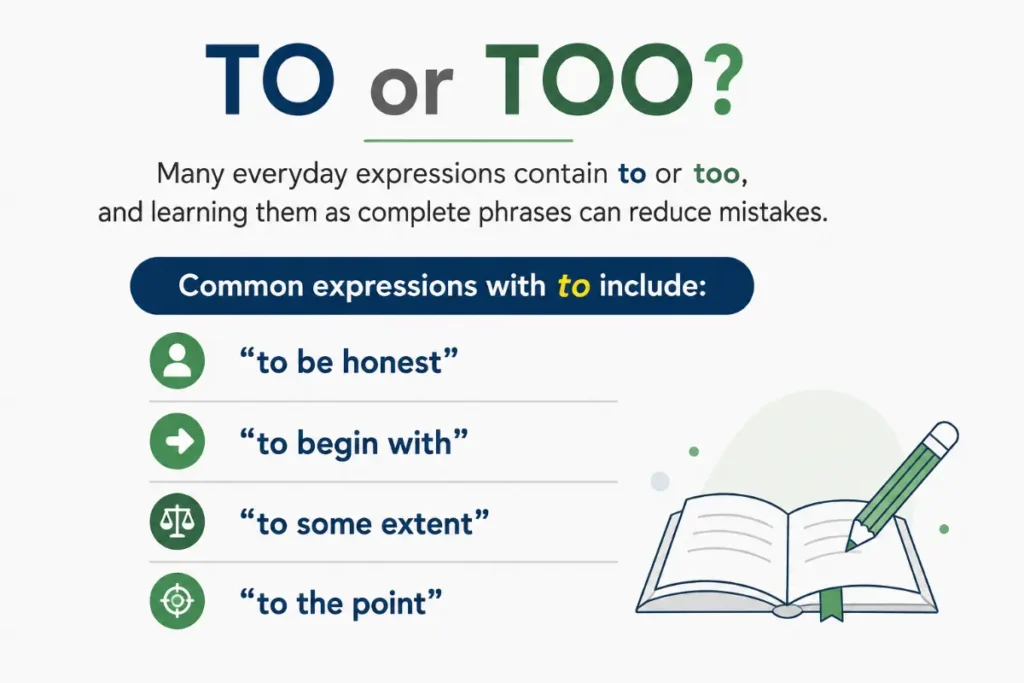
Many everyday expressions contain to or too, and learning them as complete phrases can reduce mistakes.
Common expressions with to include:
“to be honest”
“to begin with”
“to some extent”
“to the point”
“to the best of my knowledge”
“to make matters worse”
“to be fair”
“to be clear”
“to do so”
“to go ahead”
Common expressions with too include:
“too much”
“too many”
“too soon”
“too late”
“too far”
“too bad”
“too good to be true”
“me too”
“you too”
For example, “Me too” means “I also do” or “I feel the same way.”
If someone says, “I love this song,” you can respond, “Me too.”
You would not write “Me to” because to does not mean “also.”
Pronunciation and Homophones
One reason these words cause so many errors is that to and too are homophones.
In careful pronunciation, too is generally pronounced /tuː/. The word to can also be pronounced /tuː/ when emphasized, but in ordinary connected speech it is frequently reduced to /tə/.
For example, a speaker may pronounce “I want to go” with a reduced form of to that sounds like “tuh.” This reduction is extremely common in natural English speech.
The pronunciation difference can therefore vary depending on emphasis and sentence rhythm.
That creates a practical writing problem. You may hear:
“I want to go too.”
The two relevant words can sound very similar, even though their meanings are completely different.
Spelling therefore cannot be based on sound alone. You must consider the role the word plays in the sentence.
To vs Too in Everyday Sentences
To vs Too becomes much easier when you compare the words inside complete sentences.
“I want to go.”
Here, to introduces the verb “go.”
“I want to go too.”
Here, the first to introduces the verb, while too means “also.”
“She went to the store.”
Here, to introduces the destination.
“She went to the store too.”
Here, too adds the meaning “also.”
“This bag is too heavy.”
Here, too means the bag has excessive weight.
“He gave the bag to me.”
Here, to identifies the recipient.
These examples show why the surrounding words matter more than pronunciation.
Common Mistakes
One of the most frequent errors is writing too before a verb when to is required.
Incorrect: “I want too learn English.”
Correct: “I want to learn English.”
The correction works because “learn” is a base verb, and the infinitive construction requires to.
Another common mistake occurs when writers mean “also.”
Incorrect: “I want to go to.”
Correct: “I want to go too.”
The final word means “also,” so too is necessary.
Another error involves excessive quantities.
Incorrect: “There are to many people.”
Correct: “There are too many people.”
The phrase “too many” means a quantity greater than desired or appropriate.
The same pattern appears with “too much.”
Incorrect: “You added to much sugar.”
Correct: “You added too much sugar.”
The word too expresses excess.
A particularly common mistake is using to in the phrase “me too.”
Incorrect: “Me to.”
Correct: “Me too.”
Here, too means “also.”
Writers also sometimes use too when they mean direction.
Incorrect: “We drove too the airport.”
Correct: “We drove to the airport.”
The airport is the destination, so the correct word is to.
A Simple Decision Test
When you’re unsure which word to use, ask yourself what the word is doing. If the word introduces a destination, recipient, relationship, or infinitive verb, choose to.
Examples:
“go to work”
“give it to him”
“want to leave”
“learn to cook”
If the word means “also,” choose too.
Examples:
“I want to come too.”
“She likes it too.”
“Me too.”
If the word means “excessively” or “more than necessary,” choose too.
Examples:
“too expensive”
“too difficult”
“too many”
“too much”
This three part test covers most everyday situations.
Real Life Examples
School And Learning
“I want to learn to write better.”
The first to introduces the verb “learn,” and the second to introduces the verb “write.”
“She wants to go to college too.”
The first to is part of “to go,” the second introduces the destination, and too means “also.”
“This assignment is too difficult.”
Here, too means the assignment has a level of difficulty beyond what is manageable in the context.
Work And Business
“I need to send this report to my manager.”
The first to introduces the infinitive “to send,” while the second identifies the recipient.
“The meeting is too long.”
Here, too signals excessive length.
“I want to attend too.”
The final word means “also.”
Travel
“We need to go to the airport.”
The first word to forms the infinitive “to go,” while the second indicates the destination.
“The airport is too far.”
Here, too indicates excessive distance for the situation.
“Sam is coming too.”
Here, too means “also.”
Daily Conversation
“I have to leave.”
Here, to is part of the expression “have to,” which is followed by the base verb “leave.”
“I have to leave too.”
The final too adds the meaning “also.”
“You’re too early.”
Here, too means earlier than appropriate or expected.
Related Grammar Notes
Understanding this distinction becomes easier when you connect it with other grammar patterns.
To Before A Base Verb
The infinitive usually takes the form to + base verb.
Examples:
“to walk”
“to read”
“to speak”
“to understand”
“to improve”
The verb stays in its base form after to.
Correct: “I want to go.”
Incorrect: “I want to goes.”
The issue here is not confusion between to and too, but understanding the infinitive structure.
Too Before An Adjective
Too commonly comes before an adjective.
Examples:
“too cold”
“too expensive”
“too difficult”
“too noisy”
“too small”
The adjective describes the quality, while too indicates that the quality exceeds an acceptable level.
Too Before An Adverb
Too can also modify an adverb.
Examples:
“too slowly”
“too quickly”
“too loudly”
“too carefully”
“He speaks too quietly.”
The sentence suggests that his speaking volume is lower than appropriate for the situation.
Too Many And Too Much
Use “too many” with countable plural nouns.
“There are too many cars.”
“She bought too many books.”
Use “too much” with uncountable nouns.
“There is too much water.”
“He spends too much time online.”
This distinction is separate from the basic difference between to and too, but it is useful because “to many” and “to much” are common spelling errors.
Formal And Informal Usage
Both to and too are standard in American and British English. Their basic meanings and grammatical functions do not change across these varieties.
The difference is not regional.
However, sentence style can affect the placement of too.
In casual conversation, “I like it too” is extremely natural.
In more formal writing, “I too support the proposal” can sound more deliberate or emphatic.
The spelling remains the same in both American and British English.
Professional Writing Tips
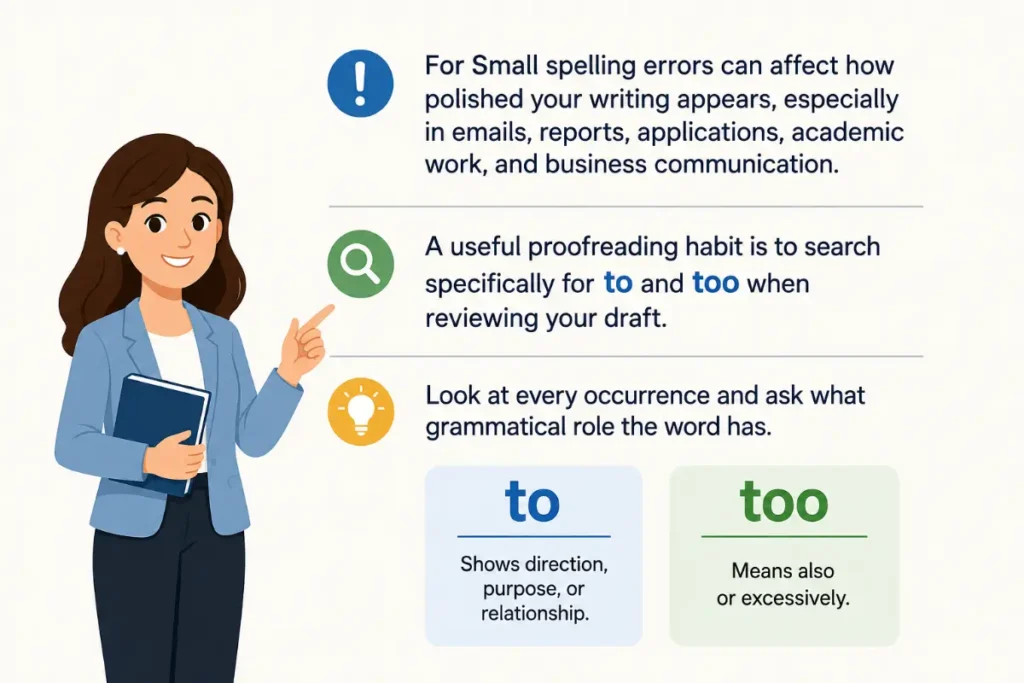
Small spelling errors can affect how polished your writing appears, especially in emails, reports, applications, academic work, and business communication.
A useful proofreading habit is to search specifically for to and too when reviewing your draft.
Look at every occurrence and ask what grammatical role the word has.
For example:
“I am happy to help too.”
The first to introduces the verb “help.” The final too means “also.”
This kind of sentence shows why proofreading by sound doesn’t work. Reading aloud may not reveal the mistake because the words can sound alike.
Instead, proofread by meaning.
Ask:
Does this word introduce a verb?
Does it show direction or a relationship?
Does it mean “also”?
Does it mean “more than necessary”?
The answers usually reveal the correct spelling immediately.
Memory Tricks
A simple memory trick is to associate the extra o in too with the idea of “more.”
Think of:
“too much”
“too many”
“too expensive”
“too difficult”
The extra o can remind you that too often means something extra or excessive.
You can also remember that too can mean “also,” which adds something extra.
“I want to come too.”
The person is being added to the group.
Another useful trick is to remember:
To goes somewhere or goes before a verb.
Examples:
“to school”
“to work”
“to eat”
“to sleep”
Too adds something or means excess.
Examples:
“me too”
“too much”
“too many”
“too expensive”
This simple contrast works well for everyday writing.
Similar Words And Confused Terms
Two
The word two is another homophone.
It refers to the number 2.
“I have two brothers.”
The three words can sound alike in ordinary speech:
“to”
“too”
“two”
Their meanings are completely different.
Tow
“Tow” is pronounced differently from to and too in most standard American English. It refers to pulling something, often a vehicle, using a rope, chain, or other equipment.
“The truck will tow the car.”
It should not be confused with the common homophone pair.
Too And Very
These words can both increase the intensity of an adjective, but their meanings differ.
“She is very tired.”
This simply describes a high degree of tiredness.
“She is too tired to work.”
This suggests that the tiredness creates a limitation.
Too And Also
“Also” and too can both express addition.
“I also want to go.”
“I want to go too.”
The words are related in meaning, but their usual positions differ. Too frequently appears at the end of a sentence in everyday English, while “also” often appears before the main verb or after a form of the verb “be.”
Why Context Matters
English spelling often requires more than listening carefully. Context gives you the information needed to choose the correct word.
Suppose someone says:
“I want to.”
That sentence may be incomplete, but to is likely introducing an omitted verb in a conversational context.
Now consider:
“I want to, too.”
Here, the first to belongs to an infinitive that is understood from context, while too means “also.”
Written English can preserve these subtle distinctions even when speech does not make them obvious.
This is one reason strong writing depends on understanding grammar rather than relying only on pronunciation.
How To Avoid These Errors Permanently
The best approach is not to memorize every possible sentence. Instead, learn the core meanings.
Remember three questions.
Does the word introduce a verb or show a relationship or destination?
Use to.
Does the word mean “also”?
Use too.
Does the word mean “more than necessary”?
Use too.
Once these patterns become familiar, the choice becomes automatic.
You can also build the habit through short editing exercises.
Take a sentence such as:
“I want to go to the concert too.”
Identify every word separately.
The first to introduces “go.”
The second to introduces “the concert.”
The final too means “also.”
Breaking the sentence apart this way helps you see the grammar instead of relying on sound.
To vs Too In Questions
Questions can contain either word depending on the intended meaning.
“Where do you want to go?”
Here, to belongs to the infinitive “to go” in the answer that might follow.
“Do you want to come too?”
Here, too means “also.”
“Is it too late?”
Here, too indicates that the time has passed an acceptable point.
“Who are you talking to?”
Here, to introduces the person receiving the action.
The same rules apply in questions as in statements.
To vs Too In Negative Sentences
Negative sentences also follow the same patterns.
“I don’t want to leave.”
Here, to introduces the verb “leave.”
“I don’t want to go too far.”
Here, to introduces the verb “go,” while too means excessively.
“I don’t want to go either.”
Notice that English usually uses “either” rather than too in negative agreement.
For example:
“I don’t like coffee.”
“I don’t like it either.”
In positive sentences, too commonly expresses agreement:
“I like coffee too.”
This is a useful related grammar point for natural conversation.
To vs Too With Adjectives
A common structure is:
too + adjective + to + verb
Examples include:
“It is too cold to swim.”
“She is too young to drive.”
“The box is too heavy to lift.”
“The question is too difficult to answer.”
The first word expresses excess. The second introduces the infinitive.
This structure is worth studying because it places the two words close together while giving them completely different functions.
In “The box is too heavy to lift,” too modifies “heavy,” while to introduces the verb “lift.”
To vs Too With Nouns
When to is a preposition, it can be followed by a noun.
Examples:
“to school”
“to work”
“to the office”
“to my friend”
“to the store”
Too generally does not perform this same prepositional function.
For example:
“She went to the store.”
The phrase identifies a destination.
“She went to the store too.”
The final too adds information about the subject.
This pattern is extremely common in everyday English.
How Editors Think About The Difference
Professional editors generally don’t treat these words as interchangeable spelling variants. They are separate words with separate grammatical functions.
The strongest proofreading approach is therefore semantic.
Instead of asking, “Does this sound right?” ask, “What does this word mean here?”
If the intended meaning is “also,” the answer is too.
If the intended meaning is “excessively,” the answer is too.
If the intended meaning involves movement, a recipient, a relationship, or an infinitive verb, to is often the correct choice.
This approach is more reliable than pronunciation because it works even when both words sound identical.
Key Takeaways
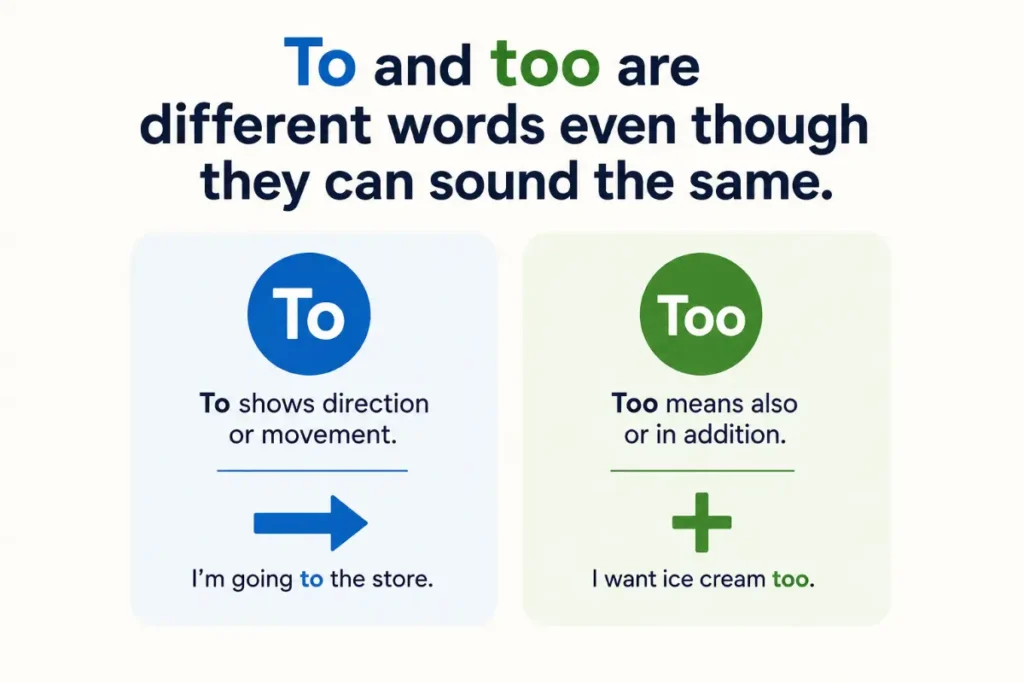
- To and too are different words even though they can sound the same.
- To commonly works as a preposition or introduces an infinitive.
- Too is an adverb.
- Too can mean “also” or “as well.”
- Too can also mean “more than necessary” or “excessively.”
- Use to in expressions such as “go to school,” “give it to me,” and “want to learn.”
- Use too in expressions such as “me too,” “too much,” “too many,” and “too expensive.”
- The extra o in too can help you remember the idea of something extra.
- Do not rely on pronunciation to choose the spelling because these words are homophones.
- Proofread by meaning and grammatical function instead of sound.
Conclusion
To vs Too becomes much easier once you stop treating the words as spelling choices based on sound and start looking at their grammatical roles. To commonly introduces an infinitive or shows a relationship such as direction or a recipient. Too means “also” or indicates that something exceeds an acceptable level.
When you see to, ask if it introduces a verb or connects something to a destination, person, or other element. When you see too, ask if you mean “also” or “more than necessary.” Those simple questions solve most common errors.
Remember the practical shortcut: to goes before many verbs and can point toward a destination, while too adds something or signals excess. Once that distinction becomes familiar, sentences such as “I want to go too,” “She went to school,” and “The coffee is too hot” become easy to write correctly.
Frequently Asked Questions
What is the difference between to and too?
To usually functions as a preposition or infinitive marker. Too is an adverb meaning “also” or “more than necessary.” Their pronunciation can be identical, but their meanings and grammatical functions are different.
Is it “I want to” or “I want too”?
The correct form is usually “I want to” when the sentence continues with a verb, as in “I want to leave.” If you mean “I also want to,” you can say “I want to, too.”
Is it “me too” or “me to”?
The correct expression is “me too” when you mean “I also.” For example, if someone says “I love this movie,” you can reply, “Me too.”
Is “too” a preposition?
No. Too is an adverb. It commonly means “also” or expresses excess, as in “I want it too” and “It is too expensive.”
Is “to” always followed by a verb?
No. To can be a preposition followed by a noun, pronoun, or other complement. It can also introduce an infinitive before a base verb. Examples include “go to school” and “want to study.”
Why do to and too sound the same?
They are homophones in most standard varieties of English. In natural speech, to is also frequently reduced, which can make the distinction even harder to hear. Spelling therefore depends on meaning and grammar.
Is “too much” correct?
Yes. “Too much” means more than is needed, wanted, or appropriate. Use it with uncountable nouns, as in “too much water” or “too much time.”
Is “too many” correct?
Yes. “Too many” is used with countable plural nouns. For example, “There are too many people in the room.” It means the number exceeds what is appropriate or desired.
Can to and too appear in the same sentence?
Yes. For example, “I want to go to the beach too.” The two instances of to have grammatical roles involving the infinitive and destination, while too means “also.”
Is the difference between to and too the same in British and American English?
Yes. The basic meanings, spellings, and grammatical functions are the same in both varieties. The difference is not a matter of American versus British spelling.

English Grammar & Usage
Nathan Holloway is an American grammar writer and language researcher who specializes in English grammar, sentence structure, verb usage, and common writing mistakes. He enjoys breaking down confusing grammar rules into practical explanations with clear examples, making English easier for students, professionals, and everyday writers.