
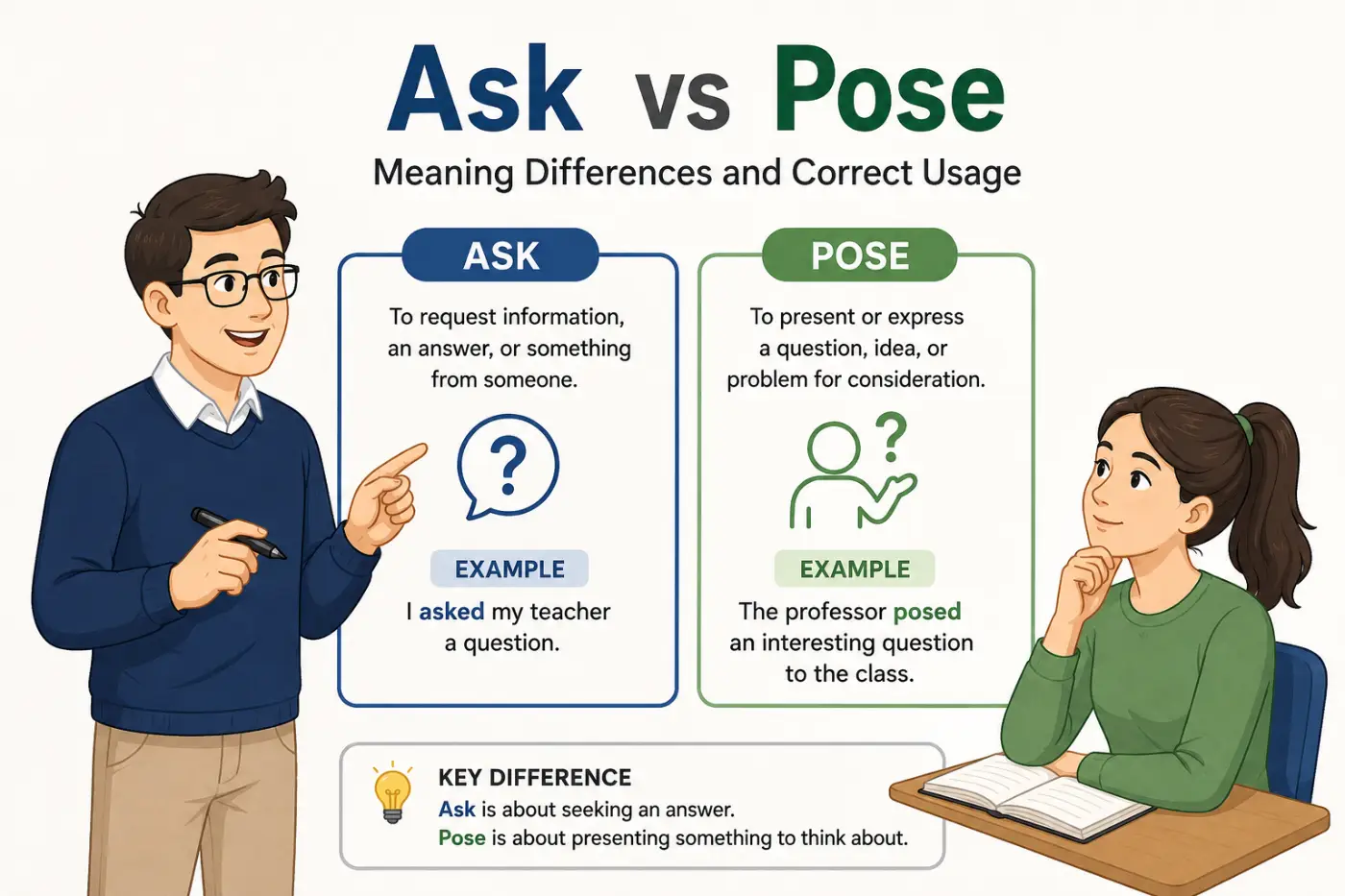
Ask vs Pose can be confusing because both verbs can describe putting a question to another person. The difference becomes clearer when you look at what each word can do beyond questions. Ask is the everyday word. You can ask a question, ask for information, ask someone for help, ask permission, ask a favor, or ask someone to do something. It works naturally in casual conversation, professional communication, academic writing, and almost every other setting.
Pose has a narrower use when it means to present a question or problem for consideration. You can pose a question to a speaker, pose a difficult question during an interview, or pose a problem for a research team to solve. This use often sounds more formal, thoughtful, or deliberate.
The two words also have completely different meanings in other contexts. Ask can mean request or inquire, while pose can mean adopt a particular position, present something for consideration, create a risk, or pretend to be someone or something.
Short Answer
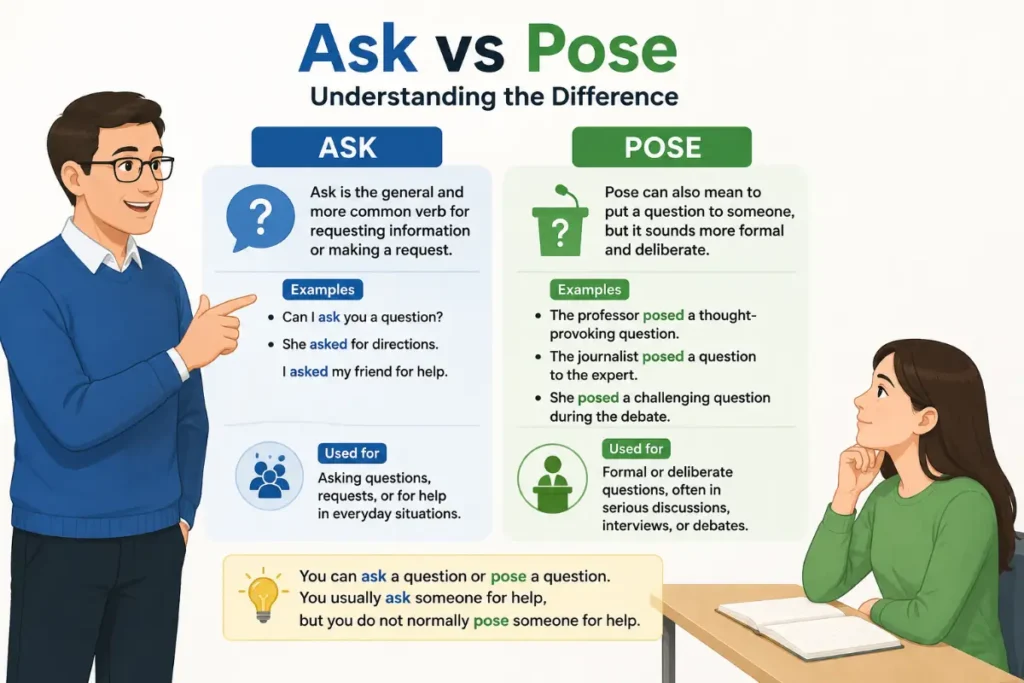
Ask is the general and more common verb for requesting information or making a request. Pose can also mean to put a question to someone, but it sounds more formal and deliberate. You can ask a question or pose a question. You usually ask someone for help, but you do not normally pose someone for help.
Table of Contents
- What Ask Means
- What Pose Means
- Ask vs Pose at a Glance
- The Main Difference Between Ask and Pose
- When to Use Ask
- When to Use Pose
- Ask a Question vs Pose a Question
- Grammar Patterns With Ask
- Grammar Patterns With Pose
- Pronunciation Guide
- Formal and Informal Usage
- Real Life Examples
- Common Mistakes
- Ask and Pose in Professional Writing
- American and British English
- Related Words and Expressions
- Memory Tips
- Key Takeaways
- Frequently Asked Questions
- Conclusion
What Ask Means
Ask is a common English verb that usually means to request information, make a request, or seek an answer.
For example:
- I asked Maria a question.
This means I requested an answer or information from Maria.
- Please ask the teacher for help.
Here, ask means request help.
- He asked me where I lived.
Here, ask means seek information.
Ask is extremely flexible. It can introduce questions, requests, invitations, instructions, favors, and expressions of interest.
You can ask someone something, ask someone for something, ask someone to do something, or ask about something.
That flexibility makes ask the natural choice in ordinary English.
What Pose Means
Pose has several meanings, and only one of them overlaps strongly with ask.
When pose means to present a question, problem, or challenge for consideration, it can function similarly to ask.
For example:
- The professor posed an interesting question.
The professor presented a question for the students to consider.
- The interviewer posed a difficult question.
The interviewer presented a challenging question that required an answer.
- The report poses several important questions.
The report raises several questions that deserve attention.
Pose can also mean to present a problem or challenge.
- The discovery poses a serious challenge for researchers.
Here, pose does not mean ask. It means create or present a challenge.
Pose also has other meanings.
- The model posed for a photograph.
Here, pose means adopt a particular physical position.
- He posed as a police officer.
Here, pose means pretend to be someone else.
These meanings show why pose cannot simply replace ask in every sentence.
Ask vs Pose at a Glance
| Feature | Ask | Pose |
|---|---|---|
| Basic meaning | Request or seek information | Present a question or issue |
| Commonness | Very common | Less common |
| Questions | Yes | Yes |
| Requests | Yes | Usually no |
| Asking for help | Yes | No |
| Asking permission | Yes | No |
| Formal questions | Yes | Yes |
| Academic writing | Yes | Yes |
| Presenting a problem | Sometimes | Yes |
| Creating a risk | No | Yes |
| Taking a position | No | Yes |
| Pretending to be someone | No | Yes |
| Everyday conversation | Very natural | Less common |
The most useful rule is simple. Use ask for ordinary questions and requests. Use pose when you are presenting a question, problem, challenge, or issue for consideration, especially in formal or academic contexts.
The Main Difference Between Ask and Pose
The central difference in Ask vs Pose is that ask focuses on seeking an answer or making a request, while pose focuses on presenting something for consideration.
Compare these sentences:
- I asked the speaker a question.
This sounds completely natural in everyday English.
- I posed the speaker a question.
This sentence is not the normal structure. The usual form is “I posed a question to the speaker.”
That difference matters because pose generally follows a different grammatical pattern.
Compare:
- I asked him a question.
- I posed a question to him.
Both sentences communicate the idea that a question was presented to him. The grammar differs.
Ask also works naturally with requests:
- I asked him for advice.
- I asked her to call me.
- I asked my manager for permission.
- I asked them to wait.
Pose does not normally work in these patterns:
- I posed him for advice.
- I posed her to call me.
- I posed my manager for permission.
- I posed them to wait.
These sentences are incorrect because pose does not normally mean request in this way.
When to Use Ask
Use ask when you want information.
- I asked him where the office was.
Use ask when you want someone to explain something.
- She asked the teacher to explain the rule again.
Choose ask when you request an object or service.
- He asked for a glass of water.
Use ask when you request permission.
- They asked for permission to enter.
Use ask when you request that someone perform an action.
- I asked my brother to close the door.
Choose ask when you invite someone.
- She asked me to dinner.
Use ask when you want to know about a topic.
- I asked about the new policy.
Ask is especially useful because it handles both questions and requests.
This gives it a much wider range than pose.
When to Use Pose
Use pose when you present a question for consideration.
- The journalist posed a difficult question.
Use pose when you present an intellectual problem.
- The study poses an interesting problem for researchers.
Select pose when something creates a challenge.
- The new evidence poses a challenge to the existing theory.
Use pose when something creates a threat or risk.
- The storm poses a serious threat to coastal communities.
Use pose when someone presents a question in a formal setting.
- During the conference, a researcher posed several questions about the findings.
In these examples, pose carries a sense of putting something forward for thought, discussion, examination, or response.
It often gives the sentence a more formal tone.
Ask a Question vs Pose a Question
One of the most common points of confusion is the difference between “ask a question” and “pose a question.”
Both are grammatically correct.
“Ask a question” is more common and works in almost any situation.
“Pose a question” is also correct, but it often suggests that the question has been deliberately formulated and presented for discussion or consideration.
Compare:
- The student asked a question.
This is neutral and natural.
- The professor posed a question.
This can sound more formal and can suggest that the professor deliberately presented an issue for the class to think about.
The difference is often about emphasis rather than basic meaning.
Ask focuses on the act of seeking an answer.
Pose focuses more on presenting the question itself.
For example:
- I asked the doctor a question about my treatment.
The focus is on getting information from the doctor.
- The doctor posed a question that made me reconsider my decision.
The focus is on the question presented by the doctor and its effect on the listener.
You can often use ask and pose interchangeably with the phrase “a question,” but ask remains the safer and more natural choice in everyday conversation.
Grammar Patterns With Ask
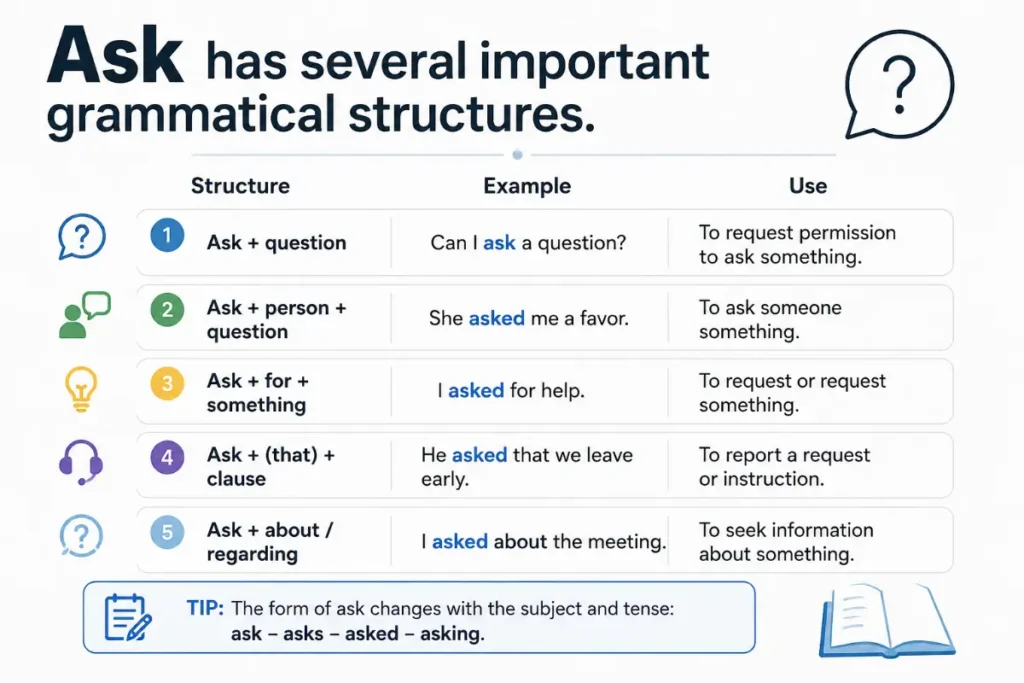
Ask has several important grammatical structures.
Ask Someone About Something
Use this structure when you want information about a subject.
- I asked him about his new job.
The phrase “about his new job” identifies the topic.
Ask Someone For Something
Use this pattern when you request something.
- She asked me for advice.
The requested thing follows for.
Ask Someone To Do Something
Use this pattern when you request an action.
- The manager asked me to send the report.
The person comes after ask, followed by to and the base form of the verb.
Ask If or Ask Whether
Ask can introduce a yes or no question.
- I asked if she was available.
- He asked whether the store was open.
In ordinary American English, if is very common in this structure.
Ask Why Where When How or What
Ask can introduce information questions.
- She asked why I was late.
- He asked where I lived.
- They asked when the meeting would begin.
- I asked how the machine worked.
- She asked what the word meant.
These patterns make ask one of the most versatile question verbs in English.
Grammar Patterns With Pose
Pose has a different grammatical pattern when it means present a question.
The most common structure is:
Pose + a question + to + person
For example:
- The interviewer posed a question to the candidate.
- The professor posed a difficult question to the class.
- The reporter posed several questions to the minister.
You can also use pose with a problem.
- The new evidence poses a problem for the research team.
Pose also works with challenge.
- The results pose a challenge for traditional theories.
Pose commonly combines with threat.
- The chemical leak poses a serious threat to nearby residents.
It can also combine with risk.
- The decision poses a significant risk to the company.
These patterns show an important feature of pose. It often introduces something that has been presented, created, or brought into consideration.
Pronunciation Guide
Ask is pronounced approximately like “ask” with the vowel sound in “cat.”
Its common American pronunciation is /æsk/.
Pose is pronounced /poʊz/.
The vowel sound in pose is similar to the vowel sound in “go,” and the final sound is a voiced z sound.
The pronunciation difference is easy to remember:
- Ask sounds like “ask.”
- Pose sounds like “poze.”
Do not pronounce pose like “poss.” The final consonant is voiced.
Formal and Informal Usage
Ask is neutral. It works in casual, professional, academic, and formal communication.
You can say:
- May I ask a question?
- I asked the manager for clarification.
- The student asked an important question.
Pose is somewhat more formal when it means present a question or issue.
For example:
- The researcher posed an important question.
This sounds appropriate in an academic article.
You could also write:
- The researcher asked an important question.
This is perfectly correct and slightly more direct.
In professional writing, pose can help emphasize that someone deliberately presented an issue for discussion.
However, you shouldn’t choose pose simply because it sounds more sophisticated. Good writing depends on precision, not on choosing the more formal word.
If ask communicates your meaning clearly, it is often the better choice.
Real Life Examples
The easiest way to understand the difference is to compare the words in realistic situations.
Everyday Conversation
- Can I ask you a question?
Ask is the natural choice because this is an ordinary conversation.
- Can I pose you a question?
This is not the standard structure. If you want to use pose, say “Can I pose a question to you?” That version sounds more formal.
Classroom
- The student asked the teacher a question.
This is natural and neutral.
- The teacher posed a challenging question to the class.
This emphasizes that the teacher presented a question for students to think about.
Interview
- The interviewer asked me about my previous experience.
Ask works naturally when describing an interview question.
- The interviewer posed a difficult question to the candidate.
Pose works well because the question is being presented as a challenge.
Research
- The study asks an important question about language development.
Ask can work in academic writing.
- The study poses an important question about language development.
Pose sounds slightly more formal and emphasizes the question as an issue for investigation.
Requesting Help
- I asked my coworker for help.
This is correct.
- I posed my coworker for help.
This is incorrect.
The reason is simple. Pose does not normally mean request in this grammatical pattern.
Requesting Permission
- She asked her supervisor for permission.
This is correct.
- She posed her supervisor for permission.
This is incorrect.
Use ask when you make a request.
Presenting a Problem
- The shortage poses a serious problem.
Pose is especially natural here because the shortage creates or presents a problem.
- The shortage asks a serious problem.
This is incorrect.
Presenting a Threat
- The storm poses a threat to the region.
Pose means creates or presents a threat.
- The storm asks a threat to the region.
This is incorrect.
Common Mistakes
Understanding common errors can make the difference between simply knowing the definitions and using the words naturally.
Mistake One Using Pose for Every Question
Some writers assume pose is a formal synonym for ask in every context.
That isn’t correct.
You can say:
- I asked her for advice.
You cannot normally replace ask with pose.
The correct distinction is that pose can replace ask mainly when you mean present a question for consideration.
Mistake Two Saying Pose Someone a Question
A common error is:
“I posed him a question.”
The standard construction is:
“I posed a question to him.”
Ask commonly takes the person directly:
“I asked him a question.”
Pose normally places the question before the person and uses to.
Mistake Three Using Pose for Requests
Incorrect:
“I posed my teacher for help.”
Correct:
“I asked my teacher for help.”
Pose does not normally mean request.
Mistake Four Thinking Pose Always Sounds Better
A more formal word isn’t automatically a better word.
If you’re talking to a friend, “Can I ask you something?” sounds natural.
“Can I pose a question to you?” sounds unusually formal for an ordinary conversation.
Choose the word that matches the situation.
Mistake Five Confusing Pose With Its Other Meanings
Pose can refer to physical positioning.
- She posed for the photograph.
It can also mean pretending.
- He posed as a doctor.
It can mean creating a problem or risk.
- The decision poses a serious risk.
Context determines the meaning.
Ask and Pose in Professional Writing
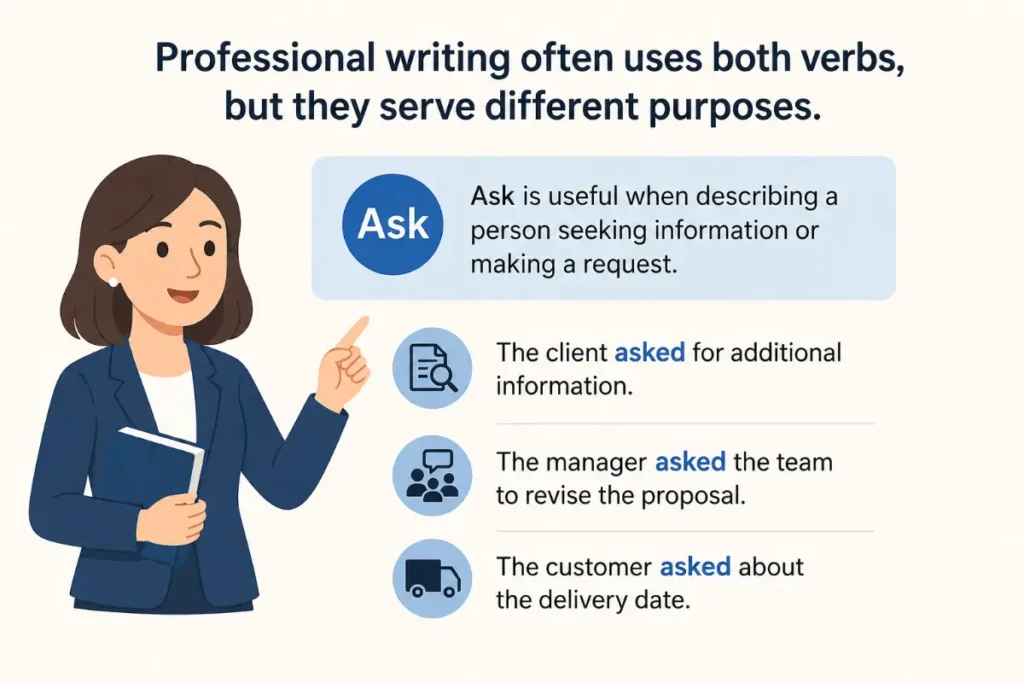
Professional writing often uses both verbs, but they serve different purposes.
Ask is useful when describing a person seeking information or making a request.
- The client asked for additional information.
- The manager asked the team to revise the proposal.
- The customer asked about the delivery date.
Pose is useful when describing an issue, question, challenge, or risk presented for consideration.
- The proposal poses several questions for the board.
- The new regulation poses challenges for small businesses.
- The change poses a potential risk to investors.
Notice how natural the combinations are.
Ask commonly appears with people and requests.
Pose commonly appears with questions, problems, challenges, risks, and threats.
That pattern is not an absolute rule, but it provides a useful guide for choosing the right verb.
American and British English
There is no major difference between American and British English in the basic distinction between ask and pose.
Both varieties commonly use ask for questions and requests.
Both also use pose for presenting questions, problems, challenges, and risks.
For example, these sentences work in both varieties:
- She asked me a question.
- The researcher posed an important question.
- The new policy poses a challenge.
- The storm poses a serious threat.
The main difference is not regional. It is contextual and stylistic.
Ask is more common in everyday communication.
Pose is often more formal or deliberate when it means present a question or issue.
Word Origin
Ask has a very old history in English. It comes from Old English forms related to ascian and has remained a central English verb for many centuries.
The word developed through the history of English and became the standard modern verb for requesting information and making requests.
Pose entered English through French and ultimately traces back to Latin roots connected with placing or setting something.
That history helps explain the modern meaning.
The core idea behind pose is connected with putting or placing something. When you pose a question, you put that question before someone for consideration.
This makes the difference between the words easier to understand.
Ask centers on seeking.
Pose centers on presenting.
A Useful Meaning Test
When you’re unsure which word to choose, ask yourself what the sentence is doing.
Use ask, If someone wants information.
- I asked where the station was.
If someone wants something, use ask.
- I asked for directions.
If someone wants another person to take an action, use ask.
This simple meaning test will solve most usage problems.
Memory Tips
A useful memory trick is to connect ask with an answer and pose with presentation.
Ask means you want something from someone.
You may want an answer, explanation, favor, object, permission, or action.
Pose means you put something before someone.
You may put a question, problem, challenge, risk, or threat before them.
Think of the difference like this:
Ask seeks. Pose presents.
That short rule captures the main distinction.
Another useful trick is to remember common phrases.
With ask:
- Ask a question.
- Ask for help.
- Ask for permission.
- Ask someone to wait.
- Ask about something.
With pose:
- Pose a question.
- Pose a problem.
- Pose a challenge.
- Pose a threat.
- Pose a risk.
Learning these natural combinations can make your writing sound much more fluent. Pose has several meanings beyond presenting questions.
It can describe physical positioning:
- The photographer asked the couple to pose.
It can mean pretend:
- The man posed as a journalist.
These meanings are distinct, so context matters.
Natural Collocations With Ask
Collocations are words that commonly appear together.
Common combinations with ask include:
- Ask a question.
- Ask for help.
- Ask for advice.
- Ask for permission.
- Ask for information.
- Ask someone to wait.
- Ask someone about something.
- Ask a favor.
- Ask a friend.
- Ask for directions.
These combinations are extremely common in natural English.
Natural Collocations With Pose
Common combinations with pose include:
- Pose a question.
- Pose a problem.
- Pose a challenge.
- Pose a threat.
- Pose a risk.
- Pose a danger.
- Pose difficulties.
- Pose an obstacle.
- Pose a dilemma.
- Pose a serious concern.
These combinations are especially common in formal, academic, journalistic, scientific, and professional writing.
When Ask and Pose Can Both Work
There are sentences where both words are grammatically correct.
- The researcher asked an important question.
- The researcher posed an important question.
Both sentences work.
The first is more direct and neutral.
The second emphasizes the act of presenting the question for consideration.
Another example:
- The journalist asked a difficult question.
- The journalist posed a difficult question.
Both are correct.
Again, ask is more neutral, while pose can make the question sound more deliberate or formally presented.
This is why you should not treat the words as strict opposites. They overlap in one specific area while remaining different in their broader meanings.
When You Must Use Ask
Use ask when the sentence describes a request.
- I asked for a glass of water.
Use ask when someone requests an action.
- She asked me to call her.
In these situations, pose doesn’t communicate the intended meaning naturally.
When Pose Is the Better Choice
Pose is often the stronger choice when a question is presented as an intellectual issue.
- The article poses an important question about education.
Pose is also strong when something creates a challenge.
- The proposal poses a challenge for local officials.
Use pose when something presents a risk.
- The investment poses a significant risk.
Use pose when something creates a threat.
- The disease poses a serious threat to public health.
These uses are common in serious and formal writing.
Quick Decision Guide
When choosing between the two, use this mental checklist.
- Are you requesting information?
Use ask.
- Are you requesting something?
Use ask.
- Are you requesting an action?
Choose ask.
- Are you requesting permission?
Use ask.
- Are you presenting a question for consideration?
Ask or pose may work.
Why the Confusion Happens
The confusion exists because dictionaries can define pose with language that overlaps with ask.
When pose means “put a question to someone,” it clearly comes close to ask.
However, close meanings don’t always create identical grammar.
English has many words that overlap in meaning but differ in sentence structure, tone, and common combinations.
Ask and pose are a good example.
The phrases “ask a question” and “pose a question” are both natural.
The phrases “ask for help” and “pose for help” are not equivalent.
Understanding the surrounding words often tells you which verb belongs in the sentence.
A Practical Editing Test
When editing your writing, look at the noun or phrase following the verb.
If you see words such as help, advice, permission, information, directions, or a request for an action, ask is usually the right choice.
If you see words such as question, problem, challenge, threat, danger, risk, or dilemma, pose may be appropriate.
For example:
- Ask for advice.
- Ask for permission.
- Ask for information.
- Pose a question.
- Pose a problem.
- Pose a challenge.
- Pose a threat.
- Pose a risk.
This isn’t a rigid grammar rule. English allows creative variation, and context can affect word choice. Still, these patterns reflect common natural usage.
Key Takeaways
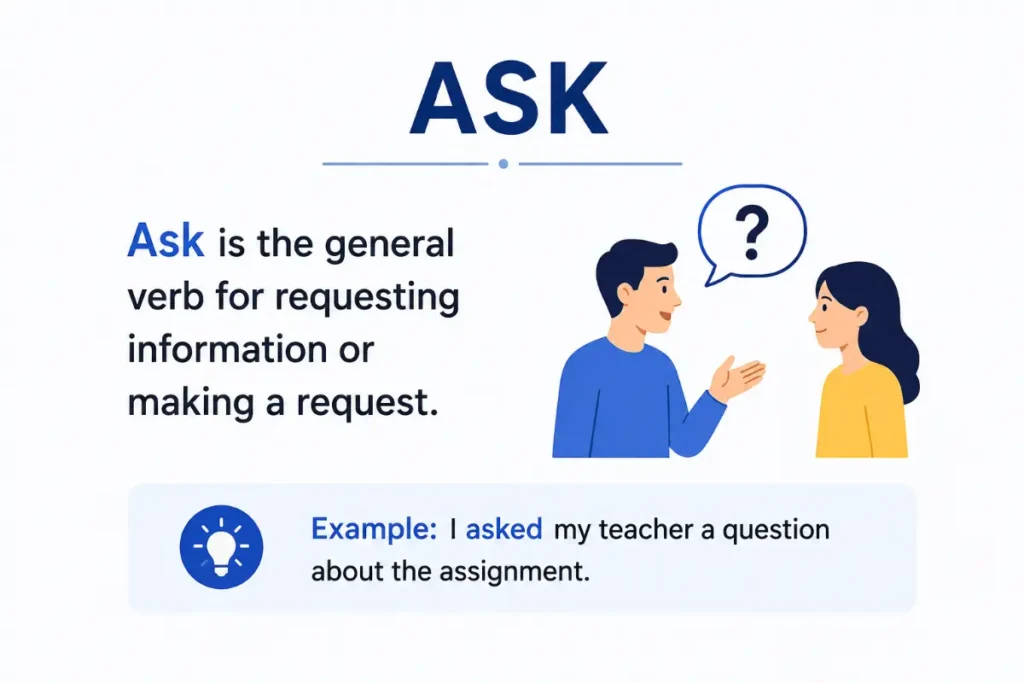
- Ask is the general verb for requesting information or making a request.
- Pose can mean present a question for consideration.
- You can ask a question or pose a question.
- Ask is much more common in everyday English.
- Pose often sounds more formal when it means present a question.
- Use ask for help, advice, permission, information, and requested actions.
- Use pose for problems, challenges, threats, risks, and questions presented for consideration.
- The natural structure is “ask someone a question.”
- The natural structure is “pose a question to someone.”
- Pose has additional meanings related to physical positioning and pretending.
- Ask and pose are not interchangeable in every sentence.
- The simplest memory rule is “Ask seeks. Pose presents.”
Conclusion
Ask vs Pose becomes easy once you focus on the purpose of the verb. Ask is the broad, everyday choice for questions and requests. You can ask for help, ask for information, ask permission, ask someone to do something, or simply ask a question.
Pose has a narrower overlap with ask. You can pose a question when you deliberately present it for consideration, especially in academic, professional, journalistic, or formal contexts. Pose also works naturally with problems, challenges, threats, risks, and dangers.
The grammar matters too. Say “I asked him a question” but “I posed a question to him.” Say “I asked for help,” not “I posed for help.”
Frequently Asked Questions
Is ask or pose correct for a question?
Both can be correct. “Ask a question” is the more common and neutral expression. “Pose a question” is also correct and often sounds more formal or deliberate.
What is the main difference between ask and pose?
Ask usually means seeking information or making a request. Pose can mean presenting a question, problem, challenge, risk, or threat for consideration.
Can I say pose a question?
Yes. “Pose a question” is a standard English expression. For example, “The professor posed an interesting question to the class.”
Can I say ask a question?
Yes. “Ask a question” is one of the most common English expressions involving ask.
Can pose mean ask?
Pose can overlap with ask when it means presenting a question to someone. It does not normally replace ask when you mean request help, permission, advice, information, or an action.
Is pose more formal than ask?
Pose often sounds more formal when it means present a question or issue. Ask is neutral and works naturally in both casual and formal communication.
Can I say pose someone a question?
The standard structure is “pose a question to someone.” For example, “She posed a question to the speaker.”
Is “pose for help” correct?
No. Use “ask for help.” For example, “I asked my friend for help.”
Can pose mean create a problem?
Yes. Pose can mean create or present a problem, challenge, threat, risk, or danger. For example, “The delay poses a serious problem.”
What is the easiest way to remember ask and pose?
Remember “Ask seeks. Pose presents.” Ask focuses on requesting something from someone. Pose focuses on putting a question, problem, or issue before someone for consideration.

English Grammar & Usage
Nathan Holloway is an American grammar writer and language researcher who specializes in English grammar, sentence structure, verb usage, and common writing mistakes. He enjoys breaking down confusing grammar rules into practical explanations with clear examples, making English easier for students, professionals, and everyday writers.