
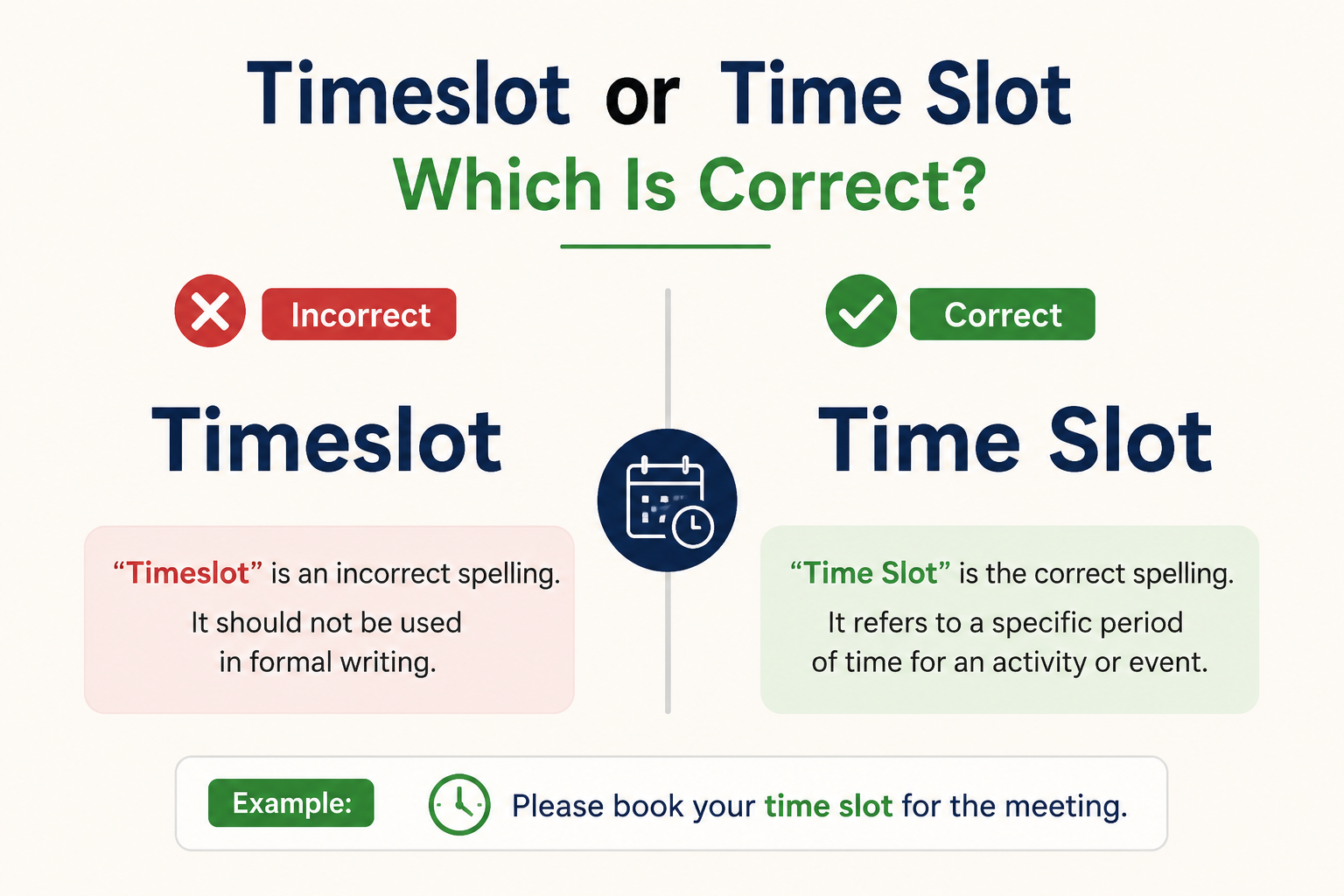
Timeslot or Time Slot is a common spelling question because English frequently combines words into compound nouns. You may see a website asking you to “choose a time slot,” while another source might use “choose a timeslot.” Both forms are understandable, but they don’t have exactly the same status in standard usage.
The expression refers to a specific period set aside for something. You might reserve a time slot for a doctor’s appointment, select a time slot for a meeting, book a delivery time slot, or assign a time slot to a television program.
The main point is simple. Time slot is generally the safest form when you’re writing for a broad American English audience. Timeslot is also found in dictionaries, professional writing, technology, scheduling systems, and media contexts, so it isn’t simply a misspelling.
This guide explains the difference between the two forms, how compound nouns work, which spelling to choose in professional writing, how pronunciation works, and how native speakers use the expression in everyday situations.
Short Answer
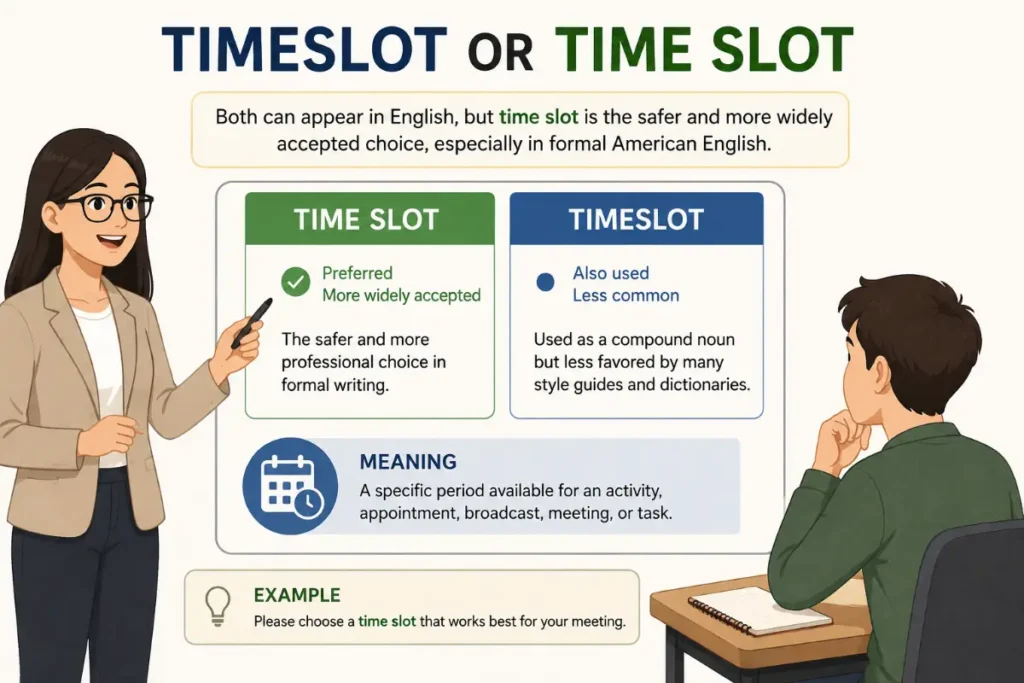
Timeslot or Time Slot can both appear in English, but time slot is the safer and more widely accepted choice, especially in formal American English. It refers to a specific period available for an activity, appointment, broadcast, meeting, or task. Timeslot is also used, particularly as a compound noun, but many style guides and dictionaries favor the two word form.
Table of Contents
- What Time Slot Means
- Is Timeslot a Word
- Time Slot vs Timeslot
- Why Two Spellings Exist
- Which Form Should You Use
- How to Use Time Slot in a Sentence
- Grammar and Plural Forms
- Time Slot in American English
- Time Slot in British English
- Formal and Informal Usage
- Common Mistakes
- Real Life Examples
- Time Slot in Different Contexts
- Related Expressions
- Memory Tips
- Professional Writing Tips
- Key Takeaways
- Frequently Asked Questions
- Conclusion
What Time Slot Means
A time slot is a particular period of time that has been assigned, reserved, or made available for a specific purpose. For example, imagine a dentist has appointments available at 9:00 a.m., 10:00 a.m., and 11:00 a.m. Each available period can be called a time slot.
The same idea applies in many other situations.
A teacher might assign a time slot for each student to give a presentation. A company might give every employee a time slot for a training session. A television network might place a program in a particular time slot. An online booking system might show several available time slots.
The expression does not necessarily describe a fixed length of time. The duration depends on the situation.
One time slot might last 15 minutes. Another could last an hour. A television time slot could last 30 minutes. A conference might assign a speaker a two hour slot.
The central idea is an allocated period.
Is Timeslot a Word
Yes. Timeslot is used as a word in English, and it appears in dictionaries and established usage. It is not simply a random spelling error created by people typing too quickly.
However, the existence of a closed compound does not mean that it is always the preferred form.
English has many compound nouns that can be written in three ways. A compound may appear as separate words, as a hyphenated expression, or as one word. Usage develops over time, and different compounds settle into different forms.
For example, English has expressions such as “school bus,” “notebook,” and “mother in law.” Their structures differ even though they combine words that work together as a unit.
The same general process explains why writers encounter both time slot and timeslot.
When a compound becomes familiar, some writers begin treating it as a single lexical unit. Other writers continue to preserve the original word boundary.
That variation does not automatically make one spelling wrong.
Still, if your goal is clear, conventional American English, time slot is usually the better default.
Time Slot vs Timeslot
The main difference is spelling rather than meaning.
| Form | Meaning | Usage | Best Choice |
|---|---|---|---|
| Time slot | A specific period assigned to an activity | Very common and widely accepted | Recommended |
| Timeslot | A specific period assigned to an activity | Established but less consistently preferred | Acceptable in many contexts |
| Time-slot | Same basic meaning | Less common | Usually unnecessary |
Both “time slot” and “timeslot” can refer to an allocated period.
Consider these examples.
Please choose a time slot for your appointment.
This is a standard and natural construction.
The network moved the show to a later timeslot.
This can also be correct, particularly in broadcasting and media writing.
The meaning remains essentially the same. The main issue is conventional spelling and editorial preference.
Why Two Spellings Exist
English has a long history of compound words changing form.
Words often begin as separate expressions. With repeated use, speakers start treating them as a single concept. Over time, writers may join the words together.
This process has produced many familiar English compounds.
“Web site” became “website” in widespread modern usage. “Data base” developed into “database.” Other compounds continue to appear as two words for much longer.
There is no universal mathematical rule that tells English speakers exactly when two words must become one.
Dictionary evidence, common usage, publishing conventions, regional preferences, and the field in which a term is used can all influence spelling.
That is why you should not assume that every closed compound is more correct simply because it looks more compact.
In practical writing, consistency matters more than forcing a compound into one word.
If your publication uses “time slot,” keep using that form throughout the document. If a particular organization or publication has an established style that uses “timeslot,” follow that house style.
Which Form Should You Use
For most American English writing, choose time slot.
This is especially useful in school assignments, professional emails, business documents, websites, customer instructions, appointment systems, and general explanatory writing.
For example:
Please select an available time slot.
Your requested time slot is no longer available.
We can offer you another time slot tomorrow.
These sentences sound natural and immediately clear.
You may encounter “timeslot” in media, scheduling software, technical documentation, advertising, and other specialized contexts. It can be perfectly understandable there.
If you’re unsure which form your audience expects, the two word version gives you the safest choice.
There is rarely a need to use a hyphen.
How to Use Time Slot in a Sentence
The expression normally functions as a noun. It can be used as the subject, object, or complement of a sentence.
The morning time slot is already booked.
Here, the expression functions as the subject.
I reserved a time slot for Friday.
Here, it is the object of the verb “reserved.”
That would be a convenient time slot for the interview.
Here, it follows the linking verb “would be.”
The expression can also be modified by adjectives.
available time slot
preferred time slot
morning time slot
afternoon time slot
evening time slot
scheduled time slot
open time slot
The noun can also appear after verbs commonly associated with scheduling.
book a time slot
reserve a time slot
choose a time slot
select a time slot
assign a time slot
change a time slot
cancel a time slot
confirm a time slot
These combinations are especially common in appointment and scheduling language.
Grammar and Plural Forms
The plural form is straightforward.
The plural of “time slot” is time slots.
For example:
Several time slots are available this afternoon.
The system displays all available time slots.
We offer morning and evening time slots.
Notice that the plural marker is added to “slot,” not “time.”
The same principle applies to the closed form.
timeslot becomes timeslots.
However, because the two word form is more common in many general writing contexts, “time slots” is the form most readers will expect.
The expression can also be preceded by determiners.
a time slot
the time slot
this time slot
that time slot
your time slot
each time slot
every time slot
You can also use numbers with the noun.
We have three time slots available.
The system offers five time slots each day.
Time Slot in American English
American English commonly uses “time slot” as two words.
You will encounter it in everyday scheduling, business communication, appointment booking, broadcasting, education, customer service, and software interfaces.
For example:
What time slot works best for you?
I booked the 2 p.m. time slot.
The interview has been assigned a 30 minute time slot.
This spelling is especially useful when you want your writing to sound familiar and neutral.
American English does contain many closed compounds, but compound formation is not always predictable. Writers therefore rely heavily on established usage.
If you’re preparing content for an American audience, “time slot” is a strong default because readers recognize it immediately and it avoids unnecessary spelling variation.
Time Slot in British English
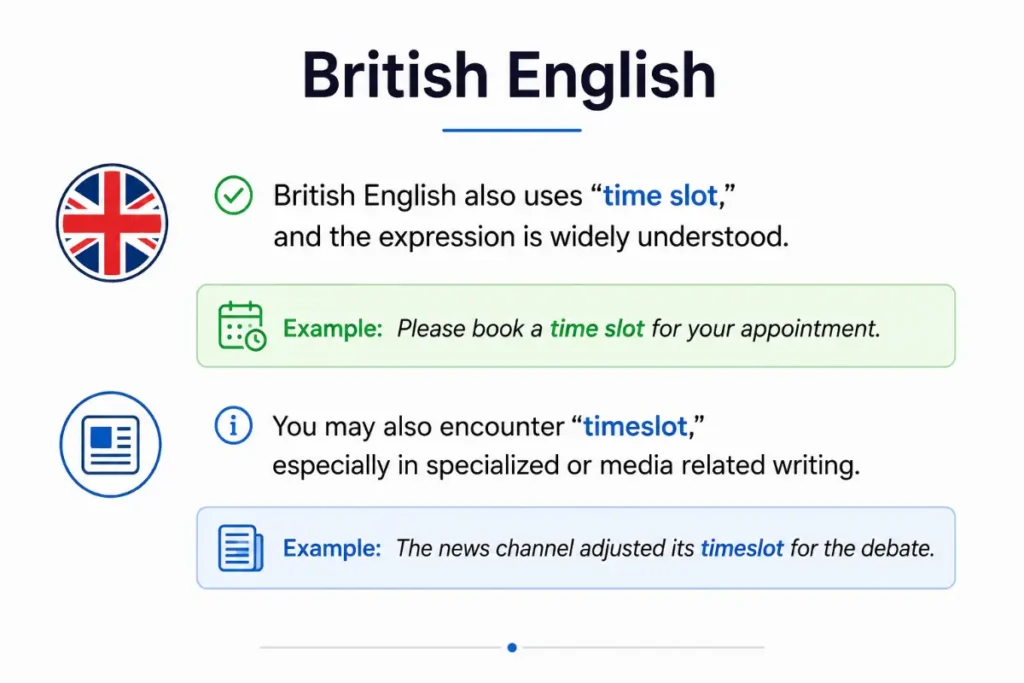
British English also uses “time slot,” and the expression is widely understood. You may also encounter “timeslot,” especially in specialized or media related writing. The important point is that the basic meaning does not change across the two major varieties of English. British and American writers can both use the expression for an allocated period.
Regional spelling differences are therefore much less significant here than they are with words such as “colour” and “color.” If you’re writing for an international audience, “time slot” is particularly safe because the phrase is transparent and familiar.
Formal and Informal Usage
“Time slot” works in both formal and informal English. In professional writing, it is often the clearest option.
Please confirm your preferred time slot by Friday.
In casual conversation, speakers use it naturally as well.
What time slot did you get?
Can you switch time slots with me?
The phrase does not sound overly technical or formal.
It also works well in instructions.
Select a time slot to continue.
Choose an available time slot below.
Click a time slot to book your appointment.
These constructions are common in online scheduling systems.
Timeslot or Time Slot in Professional Writing
When editing professional content, consistency should be your first concern. Suppose a company website uses “time slot” on one page and “timeslot” on another. Readers will probably understand both, but the inconsistent style can make the site feel less carefully edited.
Choose one form according to your preferred style guide or organizational convention. For general American English content, “time slot” is usually the stronger editorial choice.
This is particularly true for:
- Business emails.
- Academic writing.
- Customer support pages.
- Appointment instructions.
- Marketing content.
- Educational materials.
- General websites.
- Workplace documentation.
If you’re writing about television scheduling, however, you may encounter “timeslot” frequently because media terminology sometimes favors closed compounds.
The context can therefore influence the spelling you see.
Time Slot in Different Contexts
The expression has a broad range of uses.
Appointments
Medical offices, salons, repair services, and other businesses use time slots to organize appointments.
The clinic has an open time slot at 3 p.m.
The sentence means that the clinic has a specific period available for a patient.
Meetings
Companies use time slots when organizing calendars.
I’ll send you a few time slots for next week’s meeting.
This means the writer will provide several possible periods.
Interviews
Recruiters often divide interviews into scheduled periods.
Please select an interview time slot from the calendar.
The phrase tells the applicant to choose one available period.
Classes
Schools and training organizations can use time slots for lessons.
Students must reserve a time slot for their final presentation.
The sentence indicates that each presentation receives an assigned period.
Television
Broadcasting is one of the most recognizable contexts.
The network gave the program a prime evening time slot.
Here, the expression describes a scheduled period in a broadcasting timetable.
Radio
Radio programs can also occupy particular periods.
The station moved the show to a new morning time slot.
The focus is on the scheduled position in the broadcast schedule.
Deliveries
Delivery companies use scheduled periods to manage customers and routes.
Your package is scheduled for the 1 p.m. to 3 p.m. time slot.
The expression refers to the period during which delivery is expected.
Online Booking
Digital booking platforms frequently display available periods as selectable options.
Choose a time slot that fits your schedule.
This is one of the most common modern uses.
Work Schedules
Employees can be assigned specific periods for tasks.
Each employee receives a two hour time slot for training.
The expression highlights the allocated duration.
Real Life Examples
The best way to understand a compound noun is to see it in natural sentences.
I need to book a time slot for my appointment.
The speaker needs to reserve a specific period.
Do you have an earlier time slot available?
The speaker is asking for an earlier appointment period.
Our meeting time slot is from 10 to 11 a.m.
The sentence identifies the scheduled period for the meeting.
She selected the first available time slot.
The person chose the earliest option offered.
All afternoon time slots are booked.
No appointment periods remain during the afternoon.
Can we move our time slot to Thursday?
The speaker wants to reschedule the allocated period.
The interview time slot is only 30 minutes.
The sentence explains the duration.
Please arrive five minutes before your time slot.
The person has been assigned a specific period and should arrive before it begins.
The show received a better evening time slot.
The sentence describes a more favorable broadcasting position.
Several time slots remain open.
The sentence tells readers that multiple periods are still available.
Common Mistakes
Writing Time Slot as One Word Automatically
Some writers assume that familiar compound nouns must always be written as one word.
That isn’t a reliable rule.
English contains many compounds that remain open compounds. Familiarity alone does not determine spelling.
Use the established form that fits your audience and style.
Adding an Unnecessary Hyphen
Some writers use “time-slot” because they think compound nouns need hyphens.
They don’t.
When the expression functions as a normal noun, the standard general form is “time slot.”
For example:
Please choose a time slot.
There is no need for a hyphen.
Confusing Slot With Duration
A slot refers to an allocated period, but the word itself doesn’t tell you how long that period is.
A slot could last 15 minutes, 30 minutes, two hours, or longer.
The surrounding context must provide the duration.
Using Timeslot and Time Slot Randomly
Switching between forms in the same document can create an inconsistent editorial style.
Pick a preferred form and use it consistently unless you’re quoting a source or following a required terminology convention.
Treating Timeslot as a Different Concept
The closed spelling does not normally create a completely different meaning.
The difference is mainly orthographic.
Both forms can refer to a scheduled or allocated period.
Memory Tips
A simple memory trick is to think of the expression as a slot in your schedule.
You have a schedule.
Inside that schedule, you have different periods.
Each period is a time slot.
That mental image makes the meaning easy to remember.
For spelling, use this practical rule:
When in doubt, write time slot.
The two word form is clear, natural, and widely accepted.
Another useful trick is to connect the expression with other open scheduling phrases.
You can have a:
time slot
meeting time
appointment time
lunch break
work schedule
These examples show that English often keeps scheduling related combinations as separate words.
Related Grammar and Usage Notes
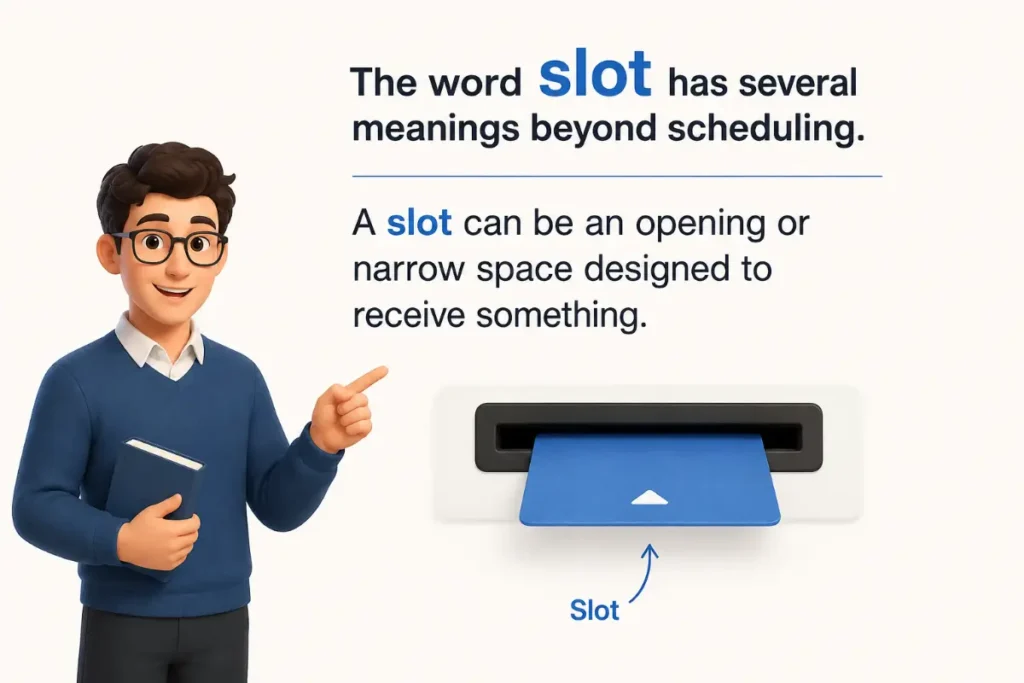
The word “slot” has several meanings beyond scheduling.
A slot can be an opening or narrow space designed to receive something.
For example:
Put the card into the slot.
Here, “slot” refers to a physical opening rather than a period of time.
The same noun can also refer to a position in a sequence or arrangement.
She earned a slot in the final round.
In that sentence, “slot” means a position or place.
The scheduling meaning developed from this broader idea of an allocated position.
A time slot is therefore a position in a timetable.
This connection can make the expression easier to understand.
Time Slot and Schedule
“Schedule” and “time slot” are related, but they are not interchangeable.
A schedule is a plan showing activities and their planned times.
A time slot is one particular period within that schedule.
For example:
My schedule is full tomorrow.
This means the entire day has many commitments.
I don’t have an open time slot tomorrow.
This means there is no particular period available for another activity.
The distinction is small but useful.
Time Slot and Appointment
An appointment is an arranged meeting or service.
A time slot is the period assigned to that appointment.
For example:
I have a doctor’s appointment at 3 p.m.
The appointment is the scheduled event.
My doctor’s time slot is 3 p.m. to 3:30 p.m.
The time slot describes the period allocated to the event.
These terms often appear together, but they describe different parts of the scheduling process.
Time Slot and Time Frame
A time frame is a broader period during which something can happen or must be completed.
A time slot is usually a more specific allocated period.
Compare these sentences:
The project must be completed within a two week time frame.
This describes a broad period.
The presentation has a 30 minute time slot.
This describes a specific allocated period.
A time frame can therefore contain many possible time slots.
Time Slot and Window
“Time window” is another related expression.
A time window usually describes a range during which something can occur.
A time slot often suggests that a particular period has been assigned or selected.
For example:
The delivery window is 9 a.m. to noon.
This gives a range.
Your delivery time slot is 10 a.m. to 11 a.m.
This gives a more specific allocated period.
The distinction can vary depending on the industry, but this is a useful general guide.
How Dictionaries Treat Compound Forms
Dictionaries don’t always agree on the preferred presentation of every compound noun.
That is normal.
Lexicographers record actual language use rather than inventing all English spellings from scratch. When speakers and writers use different forms consistently, dictionaries may record those variants.
A dictionary entry for a compound can therefore provide useful evidence that a closed form exists without proving that it is the best choice in every context.
This is one reason spelling questions require more than a simple “right or wrong” approach.
For professional editing, consider dictionary evidence together with audience, region, publication style, and current usage.
Pronunciation
Both forms are pronounced essentially the same.
The expression can be represented approximately as:
TIME SLOT
The first word carries the primary stress, and “slot” has its normal pronunciation.
The two spellings do not normally create a meaningful pronunciation difference.
That makes this a spelling and usage question rather than a pronunciation contrast.
Etymology of Slot
The word “slot” has a long history in English and developed several related meanings.
Its physical sense of an opening or narrow space is familiar today. The word later acquired broader senses involving a position, place, or assigned opportunity.
The scheduling sense follows naturally from the idea of an assigned position.
A time slot is essentially a position in a timetable.
This explains why the expression is so intuitive to English speakers.
Why Time Slot Is Usually the Best Choice
There are three practical reasons to prefer the open form in general writing.
First, it is immediately recognizable.
Second, it follows a familiar compound noun pattern in English.
Third, it avoids making a spelling choice that may conflict with a publication’s preferred style.
None of this means that “timeslot” should be treated as meaningless or automatically incorrect.
It means that writers looking for the safest general form can use “time slot.”
When Timeslot May Be Appropriate
There are situations where you may want to preserve “timeslot.”
If a company, software platform, publication, or industry consistently uses the closed form, changing it may create unnecessary inconsistency.
Terminology can also become standardized within specialized fields.
Broadcasting is one area where closed compounds are relatively common, so you may see “timeslot” in media discussions.
The key principle is consistency.
If you’re following an established terminology system, use its preferred spelling.
How to Choose the Best Form
Ask yourself three questions.
First, am I writing for a general American English audience?
If yes, “time slot” is the safest choice.
Second, does my organization or publication have a style guide?
If yes, follow that guide.
Third, am I using specialized terminology from a particular industry?
If yes, check the terminology used consistently in that field.
This approach is more useful than trying to memorize a rigid rule that applies to every situation.
Professional Editing Tip
When editing an article, website, or business document, search the entire document for both forms. If you find both “time slot” and “timeslot,” decide which form fits your style and standardize the wording. Consistency helps readers focus on the information instead of noticing small variations.
This matters especially in interfaces and instructions. Imagine a booking website that says “Choose a time slot” on one page and “Select a timeslot” on another. Neither sentence is difficult to understand, but a consistent terminology system feels more polished.
Key Takeaways
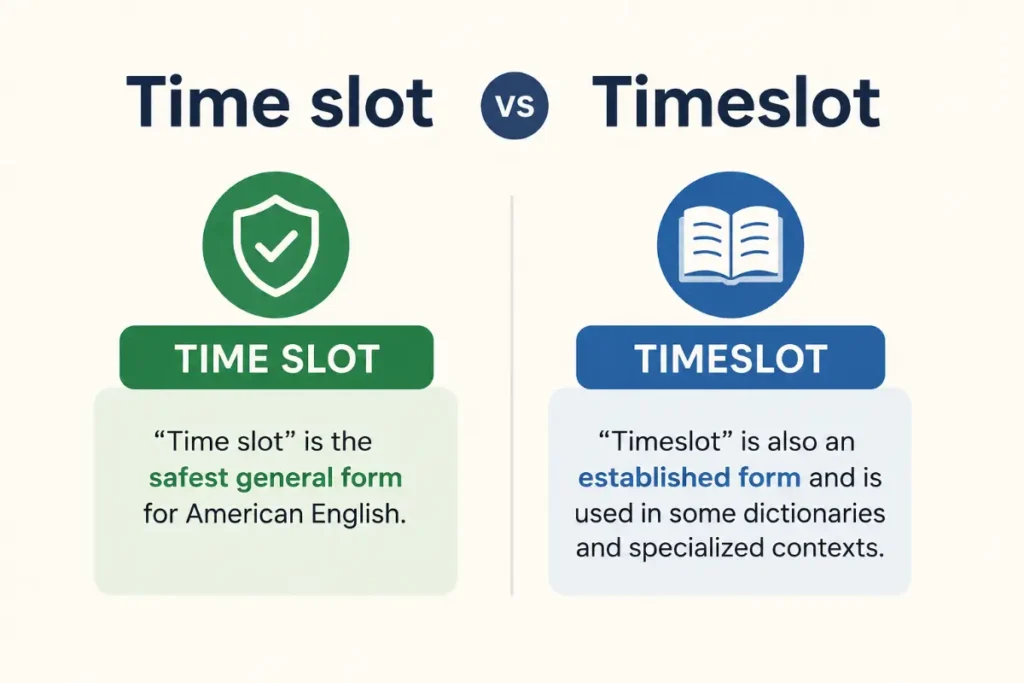
- “Time slot” is the safest general form for American English.
- “Timeslot” is also an established form and is used in some dictionaries and specialized contexts.
- Both forms refer to a specific period allocated for an activity or event.
- “Time slot” is usually preferable in general professional writing.
- The plural of “time slot” is “time slots.”
- A hyphen is normally unnecessary when the expression functions as a noun.
- Context and house style can influence the preferred spelling.
- The expression works in appointments, meetings, broadcasting, education, deliveries, work schedules, and online booking.
- “Time slot” and “timeslot” generally have the same basic meaning.
- If you’re unsure which form to choose, use “time slot.”
Conclusion
Timeslot or Time Slot is mainly a question of compound word spelling rather than meaning. Both forms can refer to a particular period assigned to an appointment, meeting, broadcast, delivery, class, interview, or other activity.
For most general American English writing, time slot is the best default. It is clear, familiar, professional, and widely accepted. “Timeslot” is also an established variant, so it should not automatically be labeled incorrect.
If you’re writing for a specific organization, publication, software platform, or industry, follow its preferred terminology. Above all, keep your spelling consistent throughout the same piece of writing.
When you need one simple rule to remember, use time slot unless your chosen style guide or professional context calls for “timeslot.”
Frequently Asked Questions
Is timeslot or time slot correct?
Both forms are used in English, but “time slot” is generally the safer choice for standard American English. “Timeslot” is an established variant that appears in some dictionaries and specialized writing. For general professional and educational content, “time slot” is usually the better option.
Is time slot one word or two words?
The standard general form is “time slot,” written as two words. “Timeslot” also occurs as a closed compound. If you need a broadly accepted form for American English, use the two word spelling.
Should I write time slot or timeslot in an email?
Use “time slot” in most professional emails. It is clear, familiar, and widely accepted. For example, “Please let me know which time slot works best for you” sounds natural and professional.
Is timeslot a spelling mistake?
No. “Timeslot” is an established form used in English. However, its acceptability and frequency can vary by context and editorial style. Calling it an outright spelling mistake would be too strong.
What is the plural of time slot?
The plural is “time slots.” Add the plural ending to “slot,” not “time.” For example, “Several time slots are available tomorrow.”
Do you hyphenate time slot?
Usually, no. When the expression is used as a noun, write “time slot” as two words. The form “time-slot” is generally unnecessary in ordinary writing.
What does time slot mean?
A time slot is a specific period assigned, reserved, or made available for an activity. An appointment, meeting, television program, delivery, interview, or class can have a time slot.
Is time slot American or British English?
“Time slot” is used in both American and British English. The expression is not limited to one regional variety. “Timeslot” can also appear in both varieties, particularly in specialized contexts.
Is time slot formal English?
Yes. “Time slot” is suitable for formal, professional, academic, and everyday communication. It is common in scheduling systems, workplace communication, appointment instructions, and business writing.
What is another word for time slot?
Depending on context, alternatives include “scheduled period,” “appointment period,” “scheduled time,” “booking period,” “window,” or simply “slot.” The best alternative depends on the exact meaning you want to express.
What is the difference between a time slot and a time frame?
A time slot is usually a specific allocated period, while a time frame is a broader period during which something can happen or must be completed. A two week project time frame can contain many individual time slots.
Can I use timeslot in formal writing?
Yes, especially if it matches the terminology used by your organization, publication, or industry. Still, “time slot” is generally the safer choice for broad formal American English writing

Confusing Words, Spelling & Word Choice
Claire Whitmore is a U.S.-based English editor who writes about commonly confused words, spelling differences, and word choice. Her work helps readers understand subtle distinctions between similar-looking words through simple definitions, practical examples, and modern usage guidance in both American and British English.