
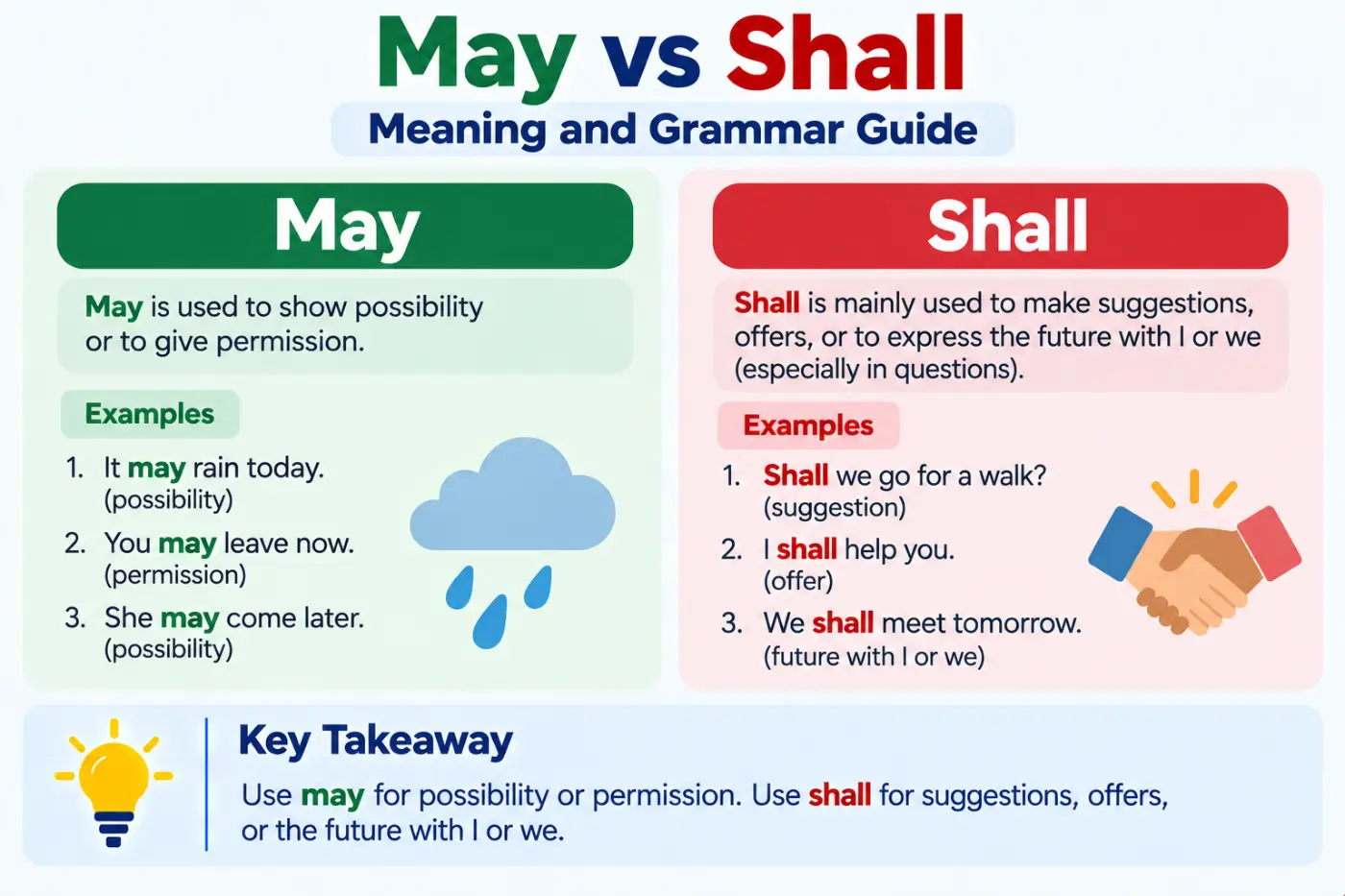
May vs shall can be confusing because both are modal verbs, yet they can communicate very different ideas. May commonly expresses permission or possibility, while shall can express a future action, a firm instruction, or a formal obligation. The intended meaning depends heavily on the sentence and the context.
For example, You may leave now gives permission. You shall leave now sounds like a command or formal requirement. In ordinary American conversation, however, Shall we leave now? has a different function. It is a polite suggestion rather than a strict command.
The confusion becomes greater because English usage has changed over time. Traditional grammar rules once gave shall and will different roles based on the subject and the speaker’s intention. Modern American English uses will much more often for ordinary future statements. Shall still has a place in formal questions, contracts, regulations, rules, and highly formal language. Understanding these patterns will help you choose the right modal without relying on outdated rules.
Short Answer
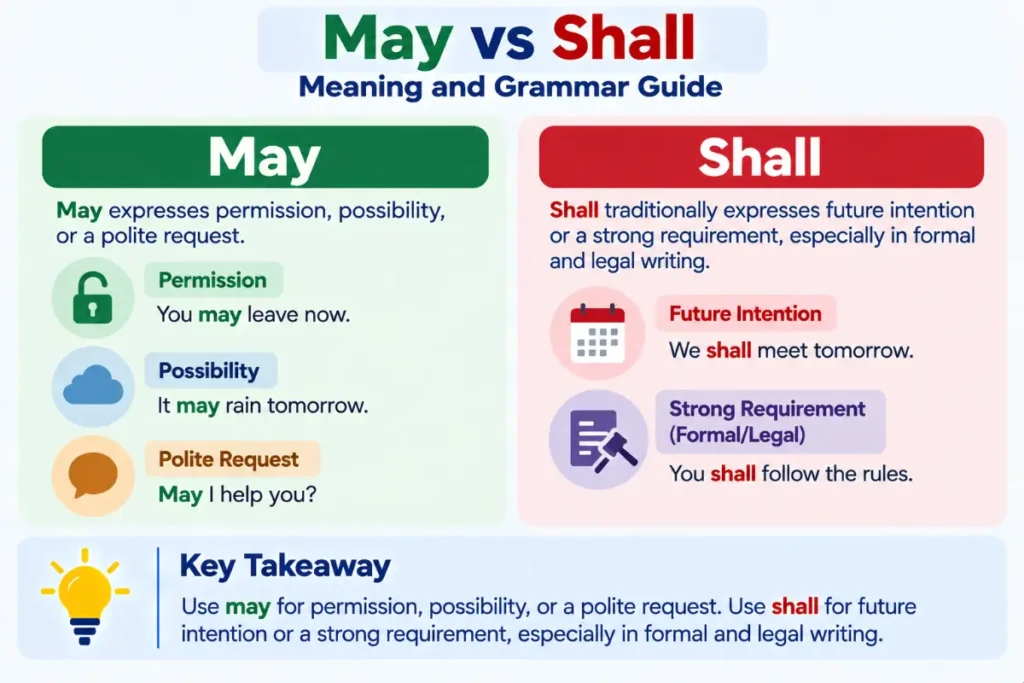
May expresses permission, possibility, or a polite request. Shall traditionally expresses future intention or a strong requirement, especially in formal and legal writing. In modern American English, will is usually more natural for ordinary future statements, while shall remains common in formal questions and certain legal or regulatory contexts.
Table Of Contents
- Meaning of may.
- Meaning of shall.
- The main difference.
- May for permission.
- May for possibility.
- Shall for future meaning.
- Shall for requirements.
- May vs shall in legal writing.
- Grammar and sentence structure.
- American and British English.
- Formal and informal usage.
- Pronunciation.
- Common mistakes.
- Real life examples.
- Memory tips.
- Related modal verbs.
- Professional writing advice.
- Frequently asked questions.
- Key takeaways.
- Conclusion.
What May Means
May is a modal auxiliary verb with several important uses. The two most common meanings are possibility and permission.
When may expresses possibility, it tells us that something is possible but not certain.
It may rain tonight.
She may arrive later.
The company may change the schedule.
In each example, the event is possible. The speaker does not present it as certain.
May can also express permission.
You may enter the room.
You may use my computer.
Students may leave after the exam.
Here, may gives someone permission to do something.
May can also appear in polite questions.
May I come in?
These forms are polite and slightly formal. In everyday American conversation, Can I is also extremely common for asking permission.
May can also appear in wishes or formal expressions.
May your efforts bring success.
This use is more literary or formal and is different from the ordinary permission and possibility meanings.
What Shall Means
Shall is also a modal auxiliary verb. Its uses are more limited in modern American English, but it remains an important word.
Traditionally, shall was associated with future statements involving I and we.
I shall return tomorrow.
We shall discuss the matter later.
These sentences are grammatical, but they sound formal or old fashioned to many American speakers. In ordinary American English, most people would say:
I will return tomorrow.
We will discuss the matter later.
Shall has remained more common in questions that make a suggestion or ask for a decision.
Shall I open the window?
In these examples, shall does not mean a strict obligation. It functions as a polite way to suggest an action or ask what should happen next.
Shall also appears in formal rules and legal language.
The applicant shall provide the required documents.
The tenant shall pay the fee by the due date.
In these contexts, shall can indicate a mandatory requirement. However, legal interpretation depends on the exact wording and surrounding provisions. The word should not be treated as having one automatic meaning in every legal document.
The Main Difference
The simplest distinction is this.
May often means permission or possibility.
Shall can express future intention, a suggestion, or a formal requirement.
Compare these sentences.
You may leave.
You are being directed or required to leave.
The difference is significant. Replacing one modal with the other can change the force of the sentence.
Now consider a question.
May I leave?
This asks for permission.
Shall I leave?
This asks for guidance or suggests that leaving might be the next action.
The two questions are not interchangeable.
Another useful pair is:
The company may change the policy.
The company might change the policy. The change is possible.
The company shall change the policy.
In a formal rule or agreement, this can state that the company is required to make the change.
The context determines the exact force of shall, especially in legal and regulatory writing.
May For Permission
One of the clearest uses of may is granting or requesting permission.
A teacher might say:
You may begin the test.
A parent might say:
You may use the car tonight.
A manager might say:
You may work from home tomorrow.
In each example, the person with authority allows an action.
May I ask something?
This asks for permission to ask a question.
May I sit here?
This asks for permission to occupy a seat.
May I borrow your notes?
This asks permission to use someone else’s notes.
In very formal settings, may can sound especially polite.
May I have a moment of your time?
In casual American English, people frequently use can for permission.
Can I use your phone?
Can I leave early?
These forms are standard in everyday speech. May is not required every time you ask for permission.
May For Possibility
It also expresses possibility.
The meeting may end early.
This means an early ending is possible.
She may be at home.
This means the speaker considers her presence at home possible.
We may need more time.
This tells the listener that needing more time is a possibility.
May is often close to might in these situations.
It may rain.
It might rain.
Both sentences express possibility. Might often sounds slightly less certain, though the exact difference depends on context and speaker intention.
May can also appear in negative statements.
He may not come.
The package may not arrive today.
These sentences indicate that the speaker considers the negative outcome possible.
Shall For Suggestions
One of the most useful modern uses of shall appears in questions with I or we.
Shall we go?
This means something like Should we go? or Would you like us to go?
Shall we start?
This asks for agreement to begin.
Shall I call her?
This offers an action and asks for guidance or approval.
Shall I carry that for you?
This can sound polite and helpful.
In American English, these questions are grammatical but can sound formal compared with alternatives such as:
Should we go?
Do you want to go?
Should I call her?
Do you want me to call her?
Still, shall we remains perfectly natural in certain situations. You may hear it in formal meetings, speeches, British English, or polite suggestions.
Shall For Future Meaning
Traditional English grammar gave shall a special role in first person future statements.
I shall return.
We shall see.
We shall overcome.
These forms still exist, but ordinary American English usually favors will.
I will return.
We will see.
This does not mean shall is wrong. It means the traditional distinction between shall and will is no longer the normal pattern for everyday American speech.
Shall can create a formal, deliberate, or literary tone.
We shall remember this day.
The sentence sounds more solemn than:
We will remember this day.
The choice is therefore partly about register. Shall can add formality or emphasis in contexts where will would sound more ordinary.
Shall For Requirements
Formal documents sometimes use shall to express a requirement.
The contractor shall submit the report by Friday.
The employee shall follow all applicable procedures.
The applicant shall provide proof of identity.
Here, shall is not simply predicting the future. It establishes an obligation within the document.
This use is especially common in legal, regulatory, contractual, and technical language. Some official drafting rules specifically distinguish shall from may. For example, US federal regulations can define shall as imperative and may as permissive within the relevant regulation.
Still, legal interpretation is more complicated than a simple word substitution. Legal authorities note that shall can sometimes receive a different interpretation depending on context and legislative intent.
That is why professional legal drafting should focus on the complete provision rather than assuming that one modal always has exactly one legal effect.
May vs Shall In Legal Writing
The contrast becomes especially important in contracts and regulations.
Consider:
The applicant may submit additional documents.
This normally gives the applicant permission or discretion to submit them.
Now consider:
The applicant shall submit additional documents.
This normally communicates a requirement in a formal legal or regulatory context.
The difference can affect what a reader understands the person or organization is allowed or required to do.
US federal regulations provide clear examples of this drafting distinction. One federal regulation states that shall is used in an imperative sense while may is used in a permissive sense.
Another federal regulation similarly distinguishes shall and may while also defining must as imperative and should as recommendatory.
However, legal language must always be read in context. Cornell Law School’s Wex explains that may ordinarily implies permission or discretion, while shall generally indicates a mandatory provision, but courts can interpret these words differently depending on the surrounding language and legal purpose.
For general English writing, you usually do not need to worry about these specialized legal distinctions. Use the word that clearly communicates your intended meaning.
Comparison Table
| Feature | May | Shall |
|---|---|---|
| Main function | Permission or possibility | Future meaning, suggestion, or formal requirement |
| Part of speech | Modal auxiliary verb | Modal auxiliary verb |
| Permission | Common | Not normally used for permission |
| Possibility | Common | Not normally used for ordinary possibility |
| Suggestion | Rare | Common in shall I and shall we questions |
| Ordinary American future | Possible but not a simple future marker | Formal and relatively uncommon |
| Legal or regulatory use | Often indicates permission or discretion | Often indicates a requirement |
| Formality | Neutral to formal | Often formal |
| Everyday speech | Very common | Less common |
| Example | You may leave now. | Shall we leave now? |
Grammar And Sentence Structure
Both may and shall are modal auxiliary verbs. They are followed by the base form of the main verb.
Correct:
You may leave.
She may arrive.
We shall begin.
They shall comply.
Incorrect:
You may to leave.
She may arrives.
We shall to begin.
After a modal verb, use the base form.
May I ask?
Not:
May I to ask?
Shall we begin?
Not:
Shall we to begin?
Modal verbs also do not take the usual third person s ending.
Correct:
He may come.
Incorrect:
He mays come.
Correct:
She shall attend.
Incorrect:
She shalls attend.
The same general rule applies to other modal verbs such as can, could, should, and might.
Negative Forms
May becomes may not.
You may not enter.
This can mean that permission is denied or that something is not permitted. In some contexts, may not can also mean that something is possibly not true.
He may not attend.
Here, the meaning is possibility.
This creates an important distinction.
You may not enter.
This commonly means you do not have permission to enter.
He may not come.
This commonly means it is possible that he will not come.
Context makes the intended meaning clear.
Shall becomes shall not.
We shall not forget.
The contracted form shan’t exists, especially in British English, but it is uncommon in modern American English.
The formal phrase shall not can also appear in legal and regulatory writing.
Questions With May
May commonly appears in polite permission questions.
May I speak with the manager?
These questions are polite and standard.
In everyday American English, can and could are also common.
Can I leave early?
Could I use your computer?
The choice depends on tone.
May I sounds polite and somewhat formal.
Could I sounds polite and conversational.
Can I sounds ordinary and direct.
All three can work in appropriate contexts.
Questions With Shall
Shall is particularly useful in questions that propose an action.
Shall we begin?
These questions ask for a decision or offer a possible action.
This is one of the strongest reasons to keep shall in your active vocabulary. Even though it is less common than will in ordinary future statements, it still performs a useful function in questions.
Common Mistakes
Mistake One
Incorrect:
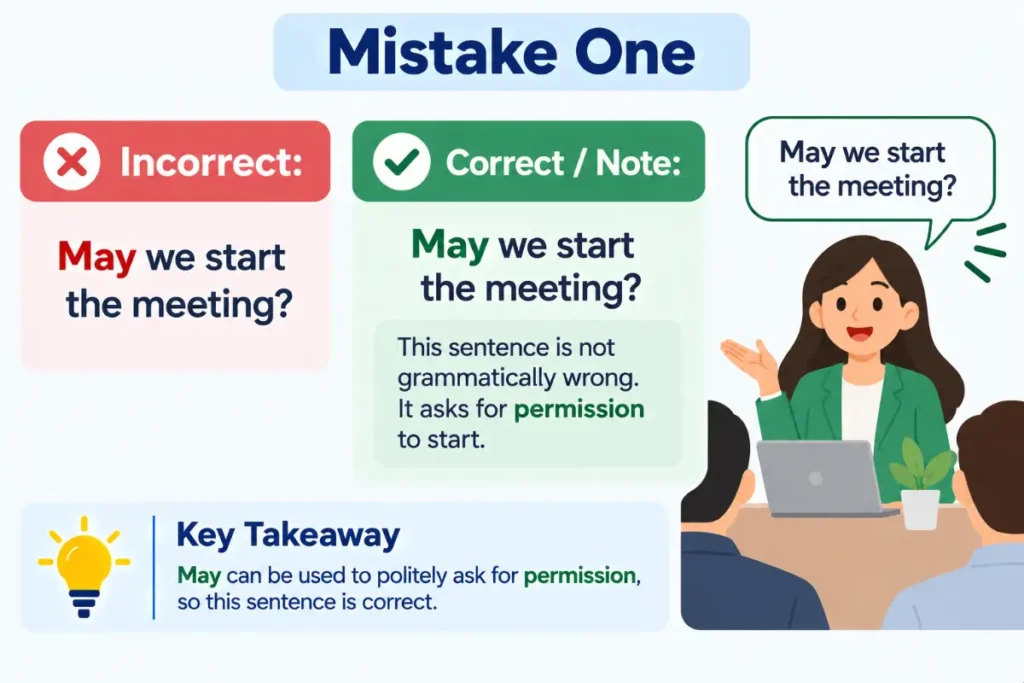
May we start the meeting?
This sentence is not grammatically wrong. It asks for permission to start.
If you want to suggest starting the meeting together, say:
Shall we start the meeting?
The meaning changes from permission to suggestion.
Mistake Two
Incorrect:
Shall I use your phone?
This sentence is grammatically correct. It asks for guidance or permission in a formal or polite way.
However, in casual American English:
Can I use your phone?
may sound more natural.
Mistake Three
Incorrect:
You shall leave if you want.
This can sound strange because shall often carries a formal or mandatory tone.
For ordinary permission:
You may leave if you want.
is clearer.
Mistake Four
Incorrect:
He mays come later.
Correct:
He may come later.
Modal verbs do not take the third person s ending.
Mistake Five
Incorrect:
We shall to discuss the issue.
Correct:
We shall discuss the issue.
A modal is followed directly by the base form of the verb.
Mistake Six
Incorrect:
May we should leave now?
Correct:
May we leave now?
Or:
Should we leave now?
Using two modal structures together in this way is not standard.
Pronunciation Guide
May is pronounced /meɪ/. It has one syllable and contains the same long vowel sound found in day and say.
Shall is pronounced /ʃæl/ in common American pronunciation. It begins with the sh sound and contains the short vowel found in words such as shall and shall not.
The two words are easy to distinguish when spoken clearly.
May.
Shall.
The pronunciation difference is much greater than the spelling similarity might suggest.
In natural conversation, shall can sound less prominent because speakers often use it in short questions.
Shall we go?
Shall I help?
The stress usually falls more strongly on the main verb or the important information rather than on shall itself.
Real Life Examples
Everyday Conversation
May I borrow your charger?
This asks for permission.
Shall we get something to eat?
This suggests an action and asks the other person to agree.
Workplace Communication
You may use the conference room after three.
This grants permission.
Shall we schedule the meeting for Thursday?
This proposes a meeting time.
Academic Writing
The results may indicate a relationship between the two variables.
This expresses possibility rather than certainty.
The researchers shall follow the procedures established by the study protocol.
In a formal rule or instruction, shall can communicate a requirement.
Formal Communication
May I request an extension?
This is a polite and formal request.
The applicant shall provide all required documents.
This establishes a formal obligation.
Storytelling
She wondered if she might be late.
The possibility is uncertain.
Shall we ever know the truth?
Here, shall creates a formal or literary tone and presents the question in a deliberate way.
American English And British English
The basic meanings of may and shall are shared across major English varieties, but their frequency differs.
In modern American English, will is much more common than shall for ordinary future statements.
I will call you tomorrow.
We will meet next week.
Shall remains natural in certain questions.
Shall I help you?
British English retains shall more strongly in some formal and everyday contexts, particularly with I and we. A British speaker may naturally say:
I shall see you tomorrow.
An American speaker is more likely to say:
I will see you tomorrow.
Neither pattern creates a simple rule that applies to every speaker. Personal style, region, formality, and context all matter.
May remains common in both varieties for permission and possibility.
May I come in?
It may rain later.
The important point is that the modern difference is mainly about frequency and register rather than a completely different grammar system.
Formal And Informal Usage
May works comfortably in both formal and informal contexts.
You may begin.
This can sound formal but natural.
You may want to check your email.
This is also common in everyday advice.
Shall has a narrower modern range.
In casual American conversation, people often prefer:
Should we go?
Do you want me to call?
Will we meet tomorrow?
In formal or traditional writing, shall can appear more naturally:
Shall we proceed?
I shall return shortly.
The parties shall comply with the agreement.
The last example belongs to a specialized legal or contractual style.
May And Might
May and might are closely related because both can express possibility.
It may rain tonight.
It might rain tonight.
Both sentences say rain is possible.
Might often presents a possibility with a slightly more tentative tone, although the distinction is not absolute.
May can also express permission.
You may leave now.
Might cannot normally replace may in this meaning.
You might leave now.
This usually sounds like a possibility rather than permission.
That distinction is important.
May therefore has at least two major functions:
Permission.
Possibility.
Might primarily expresses possibility and related hypothetical meanings.
Shall And Will
The relationship between shall and will has a long history in English grammar.
Traditional rules attempted to assign shall and will according to grammatical person and intention. Modern American English has largely simplified this pattern.
For ordinary future statements, will is now the normal choice.
I will call tomorrow.
She will arrive soon.
They will finish later.
Shall remains useful for certain formal expressions and especially questions.
Shall I help?
It can also appear in formal requirements.
The supplier shall provide the materials.
So the modern learner should not try to force an old rule onto every sentence. Learn the patterns that speakers and writers actually use.
Memory Tips
A simple memory system can make the distinction easier.
Think Permission For May
Remember:
May means permission.
You may go.
You may use the computer.
Think Possibility For May
May can also mean something is possible.
It may rain.
She may arrive late.
They may agree.
Think Suggestion For Shall
Remember:
Shall we begin?
Shall we order dinner?
This pattern is extremely useful.
Think Formal Requirement For Shall
In formal rules or legal language, shall can indicate an obligation.
The applicant shall submit the form.
The contractor shall provide the report.
Always consider the full context when reading legal language.
Related Modal Verbs
Understanding nearby modal verbs can make may and shall easier to use.
Can
It commonly expresses ability or informal permission.
Can I leave early?
Could
It can express past ability, possibility, or polite requests.
Could I ask a question?
Might
Might expresses possibility.
She might come later.
Should
It often expresses advice, expectation, or a recommended action.
Should we leave now?
Will
Will commonly expresses future actions, decisions, willingness, or predictions.
I will call you tomorrow.
Must
Must expresses strong necessity or obligation.
You must submit the form.
The key is to avoid treating all modal verbs as interchangeable. Each one adds a different shade of meaning.
Professional Writing Tips
When writing ordinary American English, choose the modal that makes the intended meaning obvious.
If you mean permission, may is often appropriate.
You may enter the building.
If you mean possibility, may can work.
The package may arrive tomorrow.
If you want to make a suggestion, shall is useful in questions.
Shall we review the proposal?
If you are writing a formal rule or contract, pay close attention to the established drafting style of the document. Do not casually replace may with shall or shall with may because the change can alter the force of the provision.
An especially useful editing habit is to replace the modal with a plain phrase before deciding.
May can often mean:
It is possible.
You are permitted to.
Shall can sometimes mean:
Are we going to?
Should we?
You are required to.
If the plain meaning matches your intended message, the modal is probably doing the job you want.
Expert Editor Insight
A professional editor treats may and shall as meaning choices rather than decorative alternatives. In ordinary writing, may often signals permission or possibility, while shall is more marked and formal. The biggest mistake is assuming that shall is simply a stronger version of may. It is not. In legal and regulatory writing, the distinction can carry real consequences, so editors examine the surrounding provision and document style rather than relying on a one word rule.
Key Takeaways
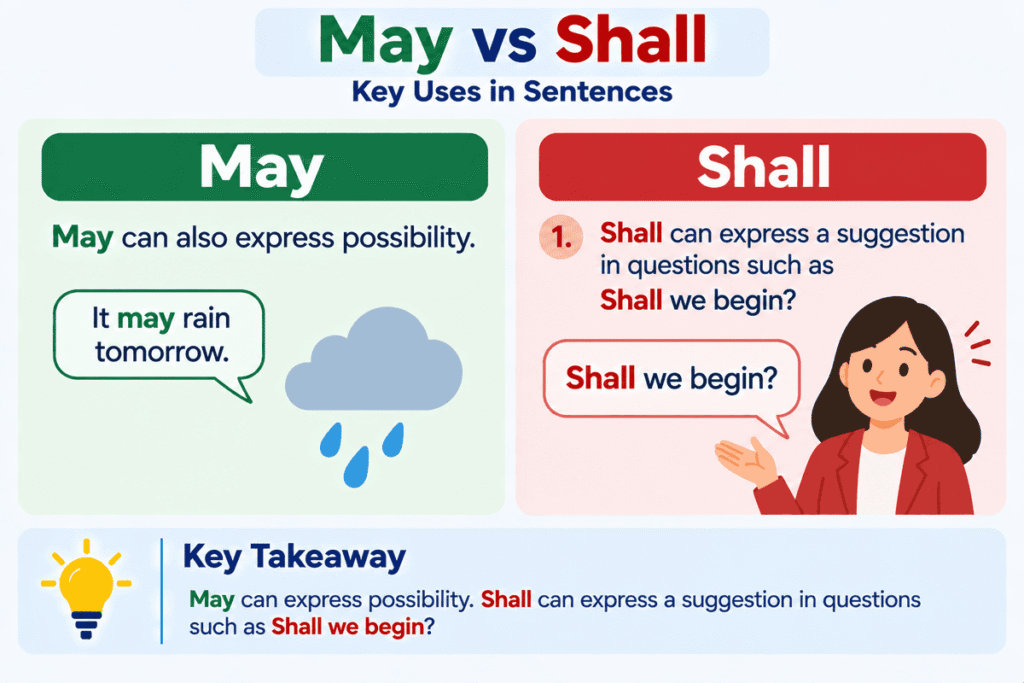
- May commonly expresses permission.
- May can also express possibility.
- Shall can express a suggestion in questions such as Shall we begin?
- Shall can express future meaning in formal or traditional English.
- Shall can indicate a formal requirement in some legal and regulatory contexts.
- Will is usually more natural than shall for ordinary future statements in American English.
- May I ask? is a polite permission question.
- Shall I help? offers an action and asks for guidance or agreement.
- You may leave means you have permission to leave.
- You shall leave can communicate a command or requirement in a suitable formal context.
- Modal verbs are followed by the base form of the main verb.
- Do not add s to may or shall.
- Do not place to directly after may or shall.
- Always consider context before interpreting shall in formal or legal writing.
Conclusion
May vs shall becomes much clearer when you focus on function. May commonly expresses permission or possibility, while shall can express a suggestion, formal future meaning, or a requirement in certain formal contexts. In everyday American English, will usually handles ordinary future statements more naturally.
Remember three simple patterns. May I asks for permission. It may happen expresses possibility. Shall we suggests an action. Once these patterns become familiar, you can choose the right modal without relying on complicated traditional rules.
For professional writing, especially contracts and regulations, read the entire sentence and surrounding provision before changing one modal for another. The smallest word can change the force of a sentence, so clarity should always come first.
Frequently Asked Questions
What is the main difference between may and shall?
May commonly expresses permission or possibility. Shall can express future intention, a suggestion, or a formal requirement. For example, You may leave means you have permission to leave, while Shall we leave? suggests leaving and asks for agreement. In formal rules and legal documents, shall can indicate an obligation, but its exact force depends on context.
Is may more polite than can?
May can sound more formal or traditionally polite when asking for permission. For example, May I come in? is a polite request. Can I come in? is also standard in modern American English and sounds more conversational. The difference is mainly one of tone and register rather than a simple rule that makes can incorrect.
Is shall still used in American English?
Yes. Shall remains part of American English, but it is less common than will for ordinary future statements. You may still hear Shall we begin? and Shall I help? It also appears in formal, legal, contractual, and regulatory writing. In everyday American conversation, will and should usually cover many situations that older grammar rules assigned to shall.
Does shall mean must?
Shall can communicate a mandatory requirement in formal legal or regulatory language, but it does not automatically mean must in every sentence. In ordinary English, shall can express future meaning or a suggestion. Context matters greatly. For a contract or regulation, the complete provision should be examined rather than treating shall as having one fixed meaning.
Can may express future meaning?
Yes. May can describe a possible future event. For example, The meeting may end early means an early ending is possible. May does not normally make a future event certain. It can also express permission, as in You may leave now. The intended meaning comes from the sentence and surrounding context.
Should I use shall or will for the future?
In ordinary American English, will is usually the natural choice for simple future statements. Say I will call you tomorrow rather than I shall call you tomorrow unless you intentionally want a formal or traditional tone. Shall remains useful in questions such as Shall we begin? and in some formal or legal contexts.
Is Shall we a question or a command?
Shall we is normally a question that proposes an action or asks for agreement. Shall we begin? means something like Should we begin? or Are we ready to begin? It does not normally command the listener. The construction is especially common in polite, formal, British, and traditional styles.
Can may and shall be used together?
They can appear in the same sentence when they serve different grammatical purposes, but they do not normally combine directly as two modals. For example, The committee may approve the proposal and shall record its decision uses each modal for a different purpose. Avoid constructions such as may shall or shall may.
Which is more formal, may or shall?
Shall generally sounds more formal or marked than may in modern American English. May is common in everyday requests and statements of possibility, while shall is less frequent outside specific patterns. Legal and regulatory documents can use shall to express requirements. In ordinary conversation, shall often sounds more formal than speakers need.
What does may mean in a legal document?
In legal drafting, may commonly indicates permission, authority, or discretion. For example, a provision saying an official may approve an application generally suggests that approval is permitted rather than automatically required. Still, legal meaning depends on the entire text and applicable rules of interpretation. A single modal should not be read in isolation.

English Grammar & Usage
Nathan Holloway is an American grammar writer and language researcher who specializes in English grammar, sentence structure, verb usage, and common writing mistakes. He enjoys breaking down confusing grammar rules into practical explanations with clear examples, making English easier for students, professionals, and everyday writers.