
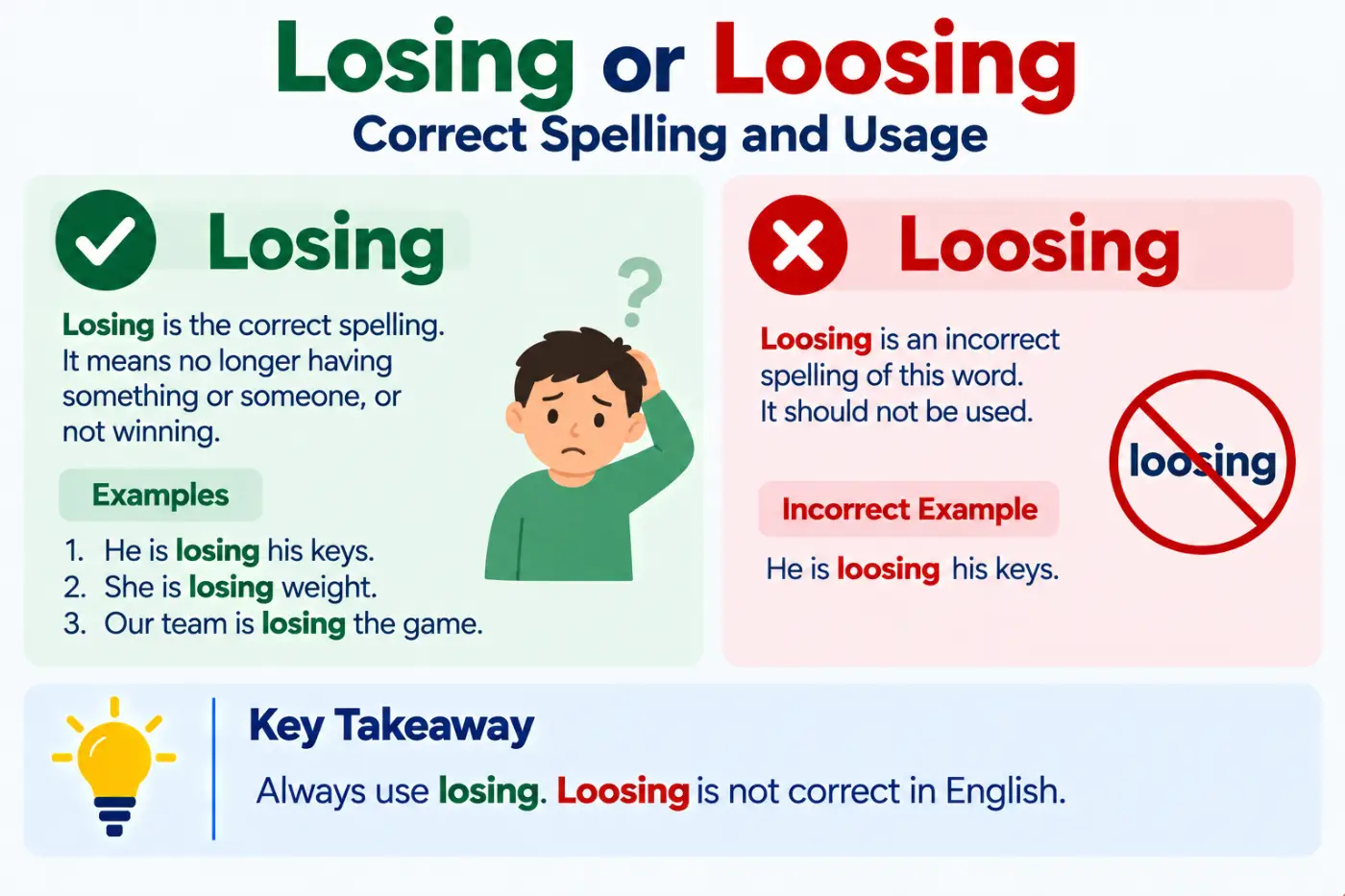
Loosing or losing is a common English confusion because the two words differ by only one letter. They also sound similar enough in everyday speech that the distinction can disappear when you hear them quickly. The correct choice depends entirely on what you mean. Losing usually refers to no longer having something, failing to win, or becoming less of something. Loosing means releasing or setting something free.
That small spelling difference changes the meaning. If you write I am loosing my phone when you mean that you keep misplacing it, you have chosen the wrong word. The correct sentence is I am losing my phone. On the other hand, The soldier is loosing the arrow can be correct if the meaning is that the soldier is releasing the arrow from a bow.
The good news is that the difference becomes simple once you connect each word to its base form. Losing comes from lose. Loosing comes from loose. This guide explains the meanings, grammar, pronunciation, history, examples, common mistakes, memory tricks, and practical usage so you can choose the right form with confidence.
Short Answer
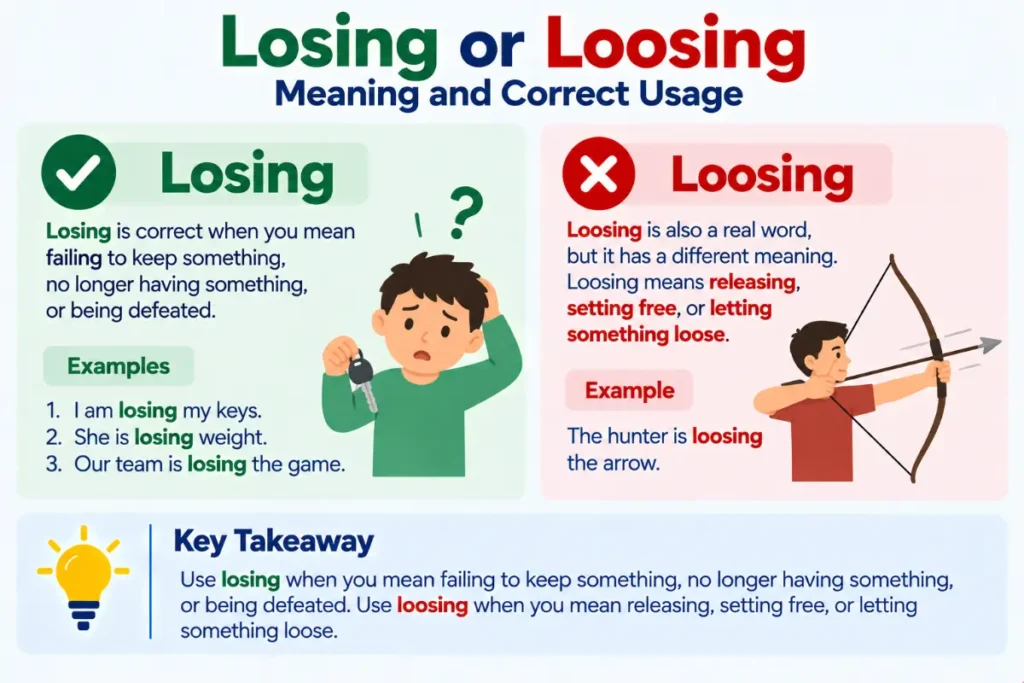
Losing is correct when you mean failing to keep something, no longer having something, or being defeated. Loosing is also a real word, but it has a different meaning. Loosing means releasing, setting free, or letting something loose. For example, I am losing my keys is correct, while The hunter is loosing the arrow means the hunter is releasing it.
Table Of Contents
- The basic difference.
- What losing means.
- What loosing means.
- Comparison table.
- Why the spelling causes confusion.
- Grammar and verb forms.
- Pronunciation.
- Common sentence patterns.
- Real life examples.
- Common mistakes.
- Memory tips.
- Related words.
- Formal and informal usage.
- American and British English.
- Word origins.
- Professional editing tips.
- Frequently asked questions.
- Key takeaways.
- Conclusion.
The Basic Difference
The easiest way to understand the difference is to look at the words they come from.
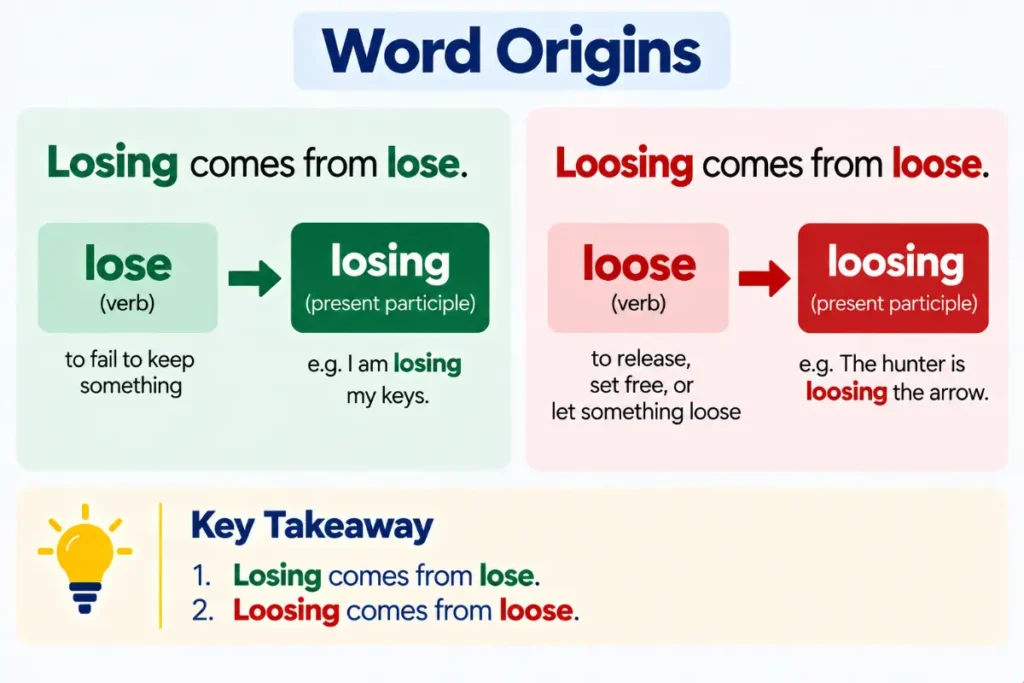
Losing comes from lose.
Lose means to no longer have something, fail to win, fail to find something, or suffer a disadvantage.
Examples include:
I am losing my patience.
She is losing her keys again.
Our team is losing the game.
He is losing interest in the project.
Loosing comes from loose.
Loose means not tight, not firmly attached, or free from restraint. The verb loose means to release or set free.
Examples include:
The rider is loosing the horse.
The archer is loosing an arrow.
The soldiers were loosing the prisoners.
The verb loosing is much less common in modern everyday English than losing. Still, it is a legitimate word in the right context.
This distinction matters because loosing is not simply an alternative spelling of losing. Each form belongs to a different word family and carries a different meaning.
What Losing Means
Losing is the present participle and gerund form of lose.
The verb lose has several common meanings.
It can mean to stop having something.
I am losing my phone.
Here the speaker means that the phone may be misplaced or no longer in their possession.
Lose can also mean fail to win.
Our team is losing the game.
In this sentence, the team is not winning.
Lose can mean fail to find or keep track of something.
She keeps losing her keys.
It can also describe a reduction.
The company is losing money.
The patient is losing weight.
He is losing interest.
The exact meaning comes from context, but the central idea often involves something becoming absent, reduced, or no longer possessed.
The form losing is created by adding ing to lose.
Lose becomes losing.
The final e is dropped before ing. This is a standard spelling pattern in English.
Compare:
lose → losing
use → using
move → moving
choose → choosing
The spelling may look unusual at first, but the pattern is regular.
What Loosing Means
Loosing comes from the verb loose.
Loose as an adjective means not tight or not firmly fixed.
For example:
The rope is loose.
The shirt feels loose.
The screw is loose.
As a verb, loose means to release something or allow it to move freely.
For example:
The farmer loosed the animals from the enclosure.
The archer loosed an arrow.
The prisoners were loosed from their chains.
The present participle is loosing.
The archer is loosing an arrow.
This word exists in standard English, but it is relatively uncommon in everyday American conversation. Most people are much more likely to say releasing an arrow or letting the animals go.
That difference in frequency explains part of the confusion. People see loosing occasionally, but they usually encounter losing far more often.
Comparison Table
| Word | Base Word | Main Meaning | Part Of Speech | Commonness | Example |
|---|---|---|---|---|---|
| Losing | Lose | No longer having something or failing to win | Present participle or gerund | Very common | She is losing her keys. |
| Loosing | Loose | Releasing or setting something free | Present participle or gerund | Uncommon | The archer is loosing an arrow. |
Why The Spelling Causes Confusion
The difference between losing and loosing is easy to miss because the words contain almost the same letters.
Lose has one o and one s before the ending.
Loose has two o letters.
When you add ing, you get:
lose → losing
loose → loosing
The extra o belongs to loose. It does not belong to lose.
There is another source of confusion. Losing and loosing can sound similar in some accents and fast speech. The difference between the vowel sounds may not stand out clearly to every listener.
Spelling therefore becomes important.
A useful strategy is to avoid spelling the word from sound alone. Think about the base word first.
Ask yourself:
Do I mean lose?
Or do I mean loose?
If you mean lose, use losing.
If you mean loose, use loosing.
This simple check solves most cases.
Grammar And Verb Forms
Losing is an ing form of lose.
The main forms of lose are:
| Verb Form | Example |
|---|---|
| Base form | lose |
| Third person singular | loses |
| Past tense | lost |
| Past participle | lost |
| Present participle | losing |
Examples:
I lose my keys often.
She loses her keys often.
I lost my keys yesterday.
I am losing my keys again.
Notice how the past form changes completely from lose to lost.
Loosing follows the verb loose.
| Verb Form | Example |
|---|---|
| Base form | loose |
| Third person singular | looses |
| Past tense | loosed |
| Past participle | loosed |
| Present participle | loosing |
Examples:
They loose the animals.
He looses the rope.
They loosed the prisoners.
The animals were loosed.
The soldiers are loosing the captives.
These forms are grammatically correct, but the verb itself is much less common than lose.
Losing In Common Sentences
It appears in many everyday structures.
Losing Something
I keep losing my glasses.
The speaker repeatedly fails to keep track of the glasses.
Losing A Game
Our team is losing the game.
The team is currently behind.
Losing Money
The business is losing money.
The business is experiencing a financial loss.
Losing Weight
She is losing weight.
Her body weight is decreasing.
Losing Interest
He is losing interest in the project.
His level of interest is becoming weaker.
Losing Time
We are losing time.
The available time is becoming shorter.
Losing Control
The driver is losing control of the vehicle.
The driver is gradually becoming unable to control it.
These examples show how broad the meaning of lose can be. The word does not only describe physical objects.
Loosing In Common Sentences
Loosing appears in a narrower range of situations.
Releasing An Arrow
The archer is loosing an arrow.
This means the archer is releasing the arrow from the bow.
Releasing Animals
The keeper is loosing the horses.
The keeper is allowing the horses to go free.
Releasing A Captive
The guards were loosing the prisoners.
This means they were releasing them.
Releasing Something From Restraint
The rope was loosing the animal from its restraint.
This usage is less common and can sound literary depending on context.
In modern everyday English, release or let go is often preferred.
For example:
The archer released the arrow.
The keeper let the horses go.
These sentences sound more familiar to most modern readers.
Losing And Loosing In Context
Context usually makes the intended word clear.
Consider:
She is losing the race.
This means she is behind and not winning.
Now compare:
She is loosing the horse.
This means she is releasing the horse.
The two sentences differ by one letter but describe completely different actions.
Another useful pair is:
I am losing my grip.
This means I am gradually failing to maintain my hold or control.
I am loosing the rope.
This means I am releasing the rope.
The first comes from lose. The second comes from loose.
Pronunciation Guide
The pronunciation difference can be subtle.
Losing is commonly pronounced /ˈluːzɪŋ/.
The first vowel has the long oo sound found in words such as food and moon. The s is pronounced like the z sound.
Loosing is commonly pronounced /ˈluːsɪŋ/.
The vowel is similar, but the final consonant before ing is different. In loosing, the s has the unvoiced sound found in words such as loose.
This creates a useful pronunciation contrast.
Losing has a z sound.
Loosing has an s sound.
The distinction can be easier to hear when you exaggerate the consonant slightly.
Losing.
Loosing.
In ordinary fast speech, the difference may become less obvious. That is another reason spelling and context matter.
Common Sentence Patterns
Learning common patterns can help you recognize the right word quickly.
Lose Something
I am losing my wallet.
This means the speaker may no longer have the wallet or may be unable to find it.
Lose A Competition
They are losing the match.
This means they are not currently winning.
Lose Control
She is losing control.
This means her control is becoming weaker.
Lose Interest
He is losing interest in the subject.
His interest is declining.
Loose Something
The dog was loosed from its chain.
This means someone released the dog.
Loose An Arrow
The hunter loosed an arrow.
This means the hunter released an arrow from a bow.
The last two patterns are less common in ordinary modern conversation but remain understandable and grammatically legitimate.
Common Mistakes
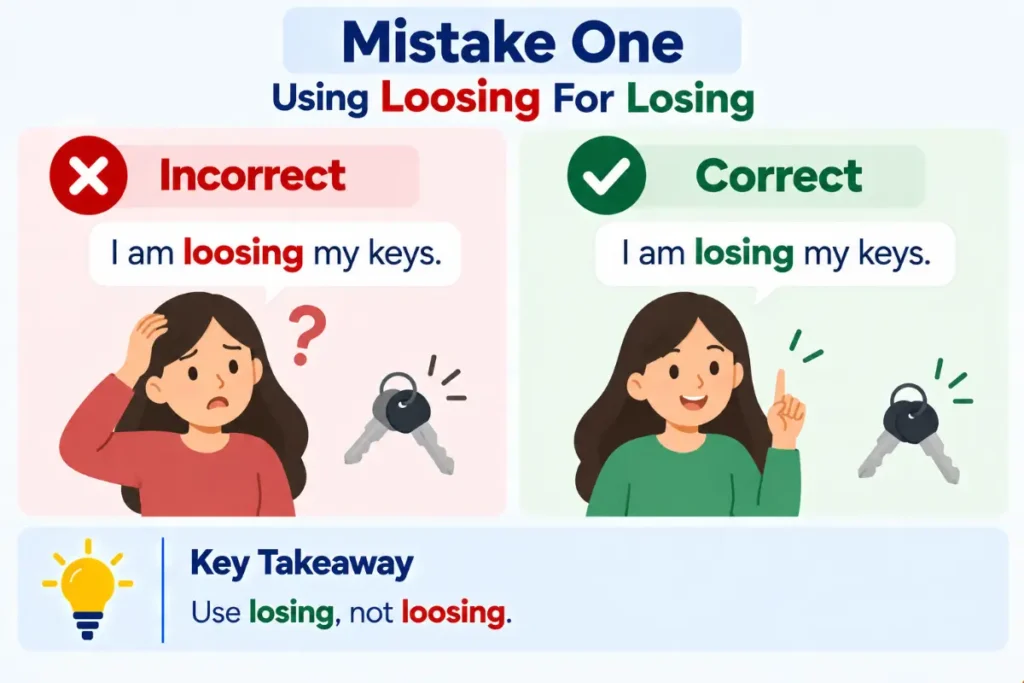
Mistake One: Using Loosing For Losing
Incorrect:
I am loosing my keys.
Correct:
I am losing my keys.
The intended meaning is that the speaker keeps misplacing the keys. The correct base verb is lose.
Mistake Two: Using Losing For Loosing
Incorrect:
The archer is losing the arrow.
Correct:
The archer is loosing the arrow.
If the intended meaning is releasing an arrow, loose is the correct base verb.
However, in modern everyday English, The archer is releasing the arrow may sound more natural.
Mistake Three: Confusing Loose And Lose
Incorrect:
My shirt is lose.
Correct:
My shirt is loose.
Loose is the adjective meaning not tight.
Mistake Four: Writing Loose When You Mean Lose
Incorrect:
I don’t want to loose this opportunity.
Correct:
I don’t want to lose this opportunity.
An opportunity can be lost, but it is not normally loosed.
Mistake Five: Treating Loosing As A Typo
Loosing is not automatically wrong. It is a legitimate form of loose.
The problem occurs when writers use it where they mean losing.
That distinction is important because calling every occurrence of loosing incorrect would oversimplify English grammar.
Memory Tips
The best memory trick is to connect each word with its base form.
Lose Gives You Losing
Think:
Lose → losing.
If something is slipping away, disappearing, or no longer being kept, think lose.
I am losing my phone.
We are losing the game.
She is losing patience.
Loose Gives You Loosing
Think:
Loose → loosing.
If something is being released or set free, think loose.
The farmer is loosing the animals.
The archer is loosing an arrow.
Watch The Extra O
Loose has two o letters.
Lose has one.
That gives you a simple visual trick.
Loose → loosing.
Lose → losing.
You can also connect the extra o with the idea of something becoming free or loose.
Loose Versus Lose
The larger confusion often begins with loose and lose rather than the ing forms.
Loose is usually an adjective.
The rope is loose.
The door handle is loose.
My shirt is loose.
Lose is a verb.
I might lose my keys.
We could lose the game.
She doesn’t want to lose her job.
A simple test is to ask if the word describes something or expresses an action.
Loose commonly describes a condition.
Lose describes an action or change.
This distinction carries directly into the ing forms.
Loose → loosing.
Lose → losing.
Formal And Informal Usage
Losing is completely normal in formal and informal English. It appears frequently in business writing, academic work, journalism, conversation, and everyday messages.
Examples:
The company is losing customers.
The study examines factors associated with losing motivation.
The team is losing momentum.
Loosing is grammatically legitimate but less common in modern everyday English. You may encounter it in historical writing, literature, descriptions of archery, religious language, or contexts involving release.
For modern professional writing, release is often clearer than loose when the meaning involves setting something free.
Instead of:
The mechanism is loosing the object.
You might write:
The mechanism is releasing the object.
The choice depends on the context, but clarity should usually come first.
American And British English
American and British English use lose, loose, losing, and loosing with the same basic meanings.
There is no major regional spelling difference that turns one form into another.
American English:
She is losing her patience.
British English:
She is losing her patience.
American English:
The archer is loosing an arrow.
British English:
The archer is loosing an arrow.
The difference between the two varieties is therefore not the central issue here. The important distinction comes from the meanings of lose and loose.
Canadian and Australian English follow the same basic pattern.
Word Origins
Lose and loose have separate histories even though their spellings look closely related.
Lose comes from an old Germanic word family associated with loss and being deprived of something. Over time, it developed the broad meanings used in modern English, including failing to keep something, failing to win, and becoming deprived of something.
Loose has a different Germanic history connected with ideas of being free, released, or not tightly bound. The adjective loose developed meanings involving physical freedom and lack of tightness. The verb loose developed the sense of releasing or setting free.
This shared Germanic background does not mean the words are interchangeable. Their meanings developed along different paths.
Understanding the word families is more useful for modern spelling than memorizing historical details. Lose gives losing. Loose gives loosing.
Related Words And Expressions
Several words belong to the same semantic area and can help clarify the distinction.
Lost
Lost is the past tense and past participle of lose.
I lost my keys.
I have lost my keys.
Loss
Loss is the noun related to lose.
The company suffered a major loss.
Loosely
Loosely is an adverb related to loose.
The rope was loosely tied.
Loosen
Loosen means to make something less tight.
Please loosen the knot.
Loosened
Loosened is the past form of loosen.
The knot was loosened.
Release
Release means let go or set free. It is often a natural modern alternative to loose as a verb.
Misplace
Misplace means put something somewhere and then be unable to remember where it is.
I keep misplacing my keys.
Defeat
Defeat means win against someone in a competition or conflict.
The team defeated its opponent.
These related terms help show that lose has a much wider everyday range than loose as a verb.
Real Life Examples
Everyday Conversation
I keep losing my phone around the house.
The speaker repeatedly fails to keep track of the phone.
I’m losing my patience.
The speaker feels that patience is gradually disappearing.
Workplace Communication
The company is losing customers because of the delay.
Here losing describes a decline in the number of customers.
The team is losing valuable time.
The available time is decreasing.
Academic Writing
Students may struggle with losing motivation during long projects.
The word describes motivation becoming weaker.
Historical texts sometimes describe soldiers loosing prisoners.
Here the word means releasing prisoners.
News Writing
The team is losing ground in the competition.
This means the team is falling behind.
The organization reported losses after losing several major contracts.
The word losing describes the failure to retain contracts.
Literature
The hunter loosed an arrow toward the distant target.
This uses the older or literary sense of releasing an arrow.
She feared losing everything she had built.
Here losing expresses the possibility of no longer having something.
How Native Speakers Choose The Word
Native speakers usually choose between these words without consciously thinking about grammar rules. The meaning of the sentence guides the choice.
If something is disappearing, being lost, or no longer being retained, lose is the natural choice.
If something is being released, loose can work.
In modern conversation, speakers often choose release instead of loose as a verb because it is more common and immediately clear.
That means you should not force loosing into a sentence simply because it is technically correct. A word can be grammatically valid while still being unusual for the context.
For example:
The archer is loosing the arrow.
This is correct.
The archer is releasing the arrow.
This is also correct and may sound more natural to many modern readers.
Good writing considers both correctness and natural usage.
Professional Editing Tips
A professional editor would first identify the base word.
If the sentence means no longer having something, use lose.
If it means releasing something, loose may be appropriate.
Then check the sentence for context.
For example:
The company is loosing money.
This is wrong because money can be lost, not loosed.
Correct:
The company is losing money.
Now consider:
The archer is losing an arrow.
If the intended meaning is releasing the arrow, use loosing.
Correct:
The archer is loosing an arrow.
However, an editor might choose releasing instead if the audience needs modern and straightforward wording.
The best editing decision therefore considers meaning, grammar, audience, and natural usage together.
Why Spellcheck Can Be Misleading
Spellcheck tools can identify many spelling problems, but they cannot always determine what you mean.
Both losing and loosing are legitimate English forms. A spelling checker may therefore accept both.
That does not mean both work in every sentence.
For example:
I am loosing my job.
The spelling of loosing is technically valid, but the meaning is probably wrong if you intend to say that you may no longer have your job.
The intended sentence is:
I am losing my job.
This is a meaning problem rather than a simple spelling problem.
That distinction is important for careful editing. Grammar and spelling tools can help, but context still matters.
Key Takeaways
- Losing comes from lose.
- Loosing comes from loose.
- Losing usually means no longer having something, failing to win, or experiencing a decline.
- Loosing means releasing or setting something free.
- Losing is extremely common in modern English.
- Loosing is a real word but appears much less often.
- Losing your job is correct.
- Losing weight is correct.
- Losing a game is correct.
- Losing an opportunity is correct.
- Loosing an arrow can be correct when the meaning is releasing it.
- Loose means not tight.
- Lose means no longer have or fail to keep something.
- If you mean loss, think lose and losing.
- If you mean release, think loose and loosing.
Conclusion
Loosing or losing looks like a tiny spelling difference, but the two words carry different meanings. Losing comes from lose and describes no longer having something, failing to win, or experiencing a decline. Loosing comes from loose and means releasing or setting something free. In everyday English, losing is by far the form you will need most often.
The easiest way to remember the difference is to look at the base word. Lose becomes losing, while loose becomes loosing. If you are talking about a job, game, opportunity, money, weight, patience, or possession, losing will usually be the right choice.
Before you finish writing, ask yourself one simple question: am I describing loss or release? If it is loss, choose losing. If it is release, loosing may be correct.
Frequently Asked Questions
Which is correct loosing or losing?
Both words are real English words, but they have different meanings. Losing comes from lose and usually means no longer having something, failing to win, or experiencing a reduction. Loosing comes from loose and means releasing or setting something free. In most everyday situations involving loss, the correct form is losing.
Is loosing a real word?
Yes. Loosing is a legitimate word formed from the verb loose. It means releasing or setting something free. For example, The archer is loosing an arrow is grammatically valid. However, the word is much less common in modern everyday English than losing. Many writers use releasing or letting go instead.
What is the difference between losing and loosing?
Losing means experiencing loss or failing to keep or win something. Loosing means releasing something. Losing comes from lose, while loosing comes from loose. Compare I am losing my keys with The archer is loosing an arrow. The first describes loss. The second describes release.
Is it losing weight or loosing weight?
The correct phrase is losing weight. Weight can decrease, so the verb lose is used. For example, She is losing weight after changing her diet. Loosing weight would suggest releasing weight or setting it free, which is not the intended meaning in normal English.
Is it losing my job or loosing my job?
The correct phrase is losing my job. If someone is losing their job, they are no longer going to have that employment. Loosing my job would imply releasing the job, which does not express the normal meaning. The base verb is lose, so the ing form is losing.
Is losing an opportunity correct?
Yes. Losing an opportunity is standard English because lose can mean failing to keep or take advantage of something. For example, I don’t want to lose this opportunity means the speaker does not want the opportunity to disappear or become unavailable. Loosing an opportunity would not express this normal meaning.
How do you pronounce losing and loosing?
Losing is commonly pronounced with a z sound before the ing ending, while loosing has an s sound. The vowel sounds are also close, which can make the words difficult to distinguish in fast speech. Because pronunciation can vary by accent, checking the base word is often more reliable than trying to choose the spelling from sound alone.
How can I remember losing and loosing?
Connect each word to its base form. Lose gives you losing, while loose gives you loosing. Remember that loose contains two o letters and describes something that is not tight or that can be released. Lose describes something being lost or no longer retained. This simple connection makes the spelling much easier to remember.
Is losing more common than loosing?
Yes. Losing is far more common in ordinary modern English because lose has many everyday meanings. People lose keys, money, games, jobs, time, patience, interest, and opportunities. Loosing has a much narrower meaning involving release and is more likely to appear in literary, historical, or specialized contexts.
Can I use loosing in formal writing?
You can use loosing in formal writing when you genuinely mean releasing or setting something free. For example, a historical discussion of archery may appropriately use loosing an arrow. However, if you mean losing something, use losing. If loosing sounds unfamiliar to your audience, releasing may communicate the same idea more clearly.

Confusing Words, Spelling & Word Choice
Claire Whitmore is a U.S.-based English editor who writes about commonly confused words, spelling differences, and word choice. Her work helps readers understand subtle distinctions between similar-looking words through simple definitions, practical examples, and modern usage guidance in both American and British English.