
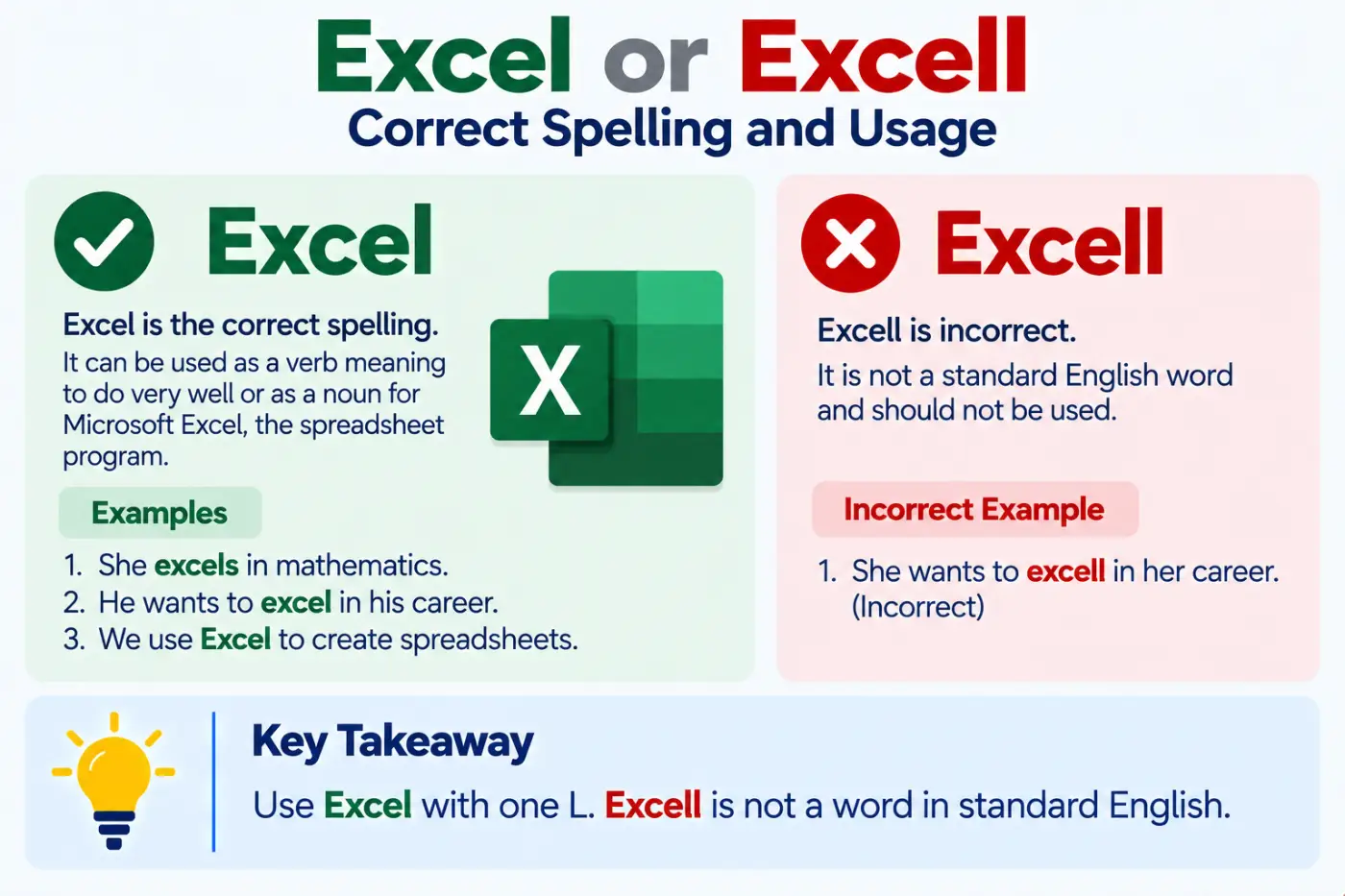
Excel or excell is a common spelling question because the word sounds as if it might need two l letters at the end. The correct spelling is excel when you mean to be exceptionally good at something. The form excell is not the standard spelling of the English verb.
The confusion becomes understandable when you look at related forms. English often doubles a final consonant when adding certain endings, and excel does this in forms such as excelling. That can make writers assume that the base verb should also contain two l letters. It doesn’t. The base form is excel.
This guide explains the meaning, grammar, pronunciation, history, verb forms, and everyday usage of the word. You’ll also see practical examples, common spelling mistakes, regional usage, professional writing advice, and simple memory tricks. By the end, you’ll know exactly when to use excel and why excell should normally be corrected.
Short Answer
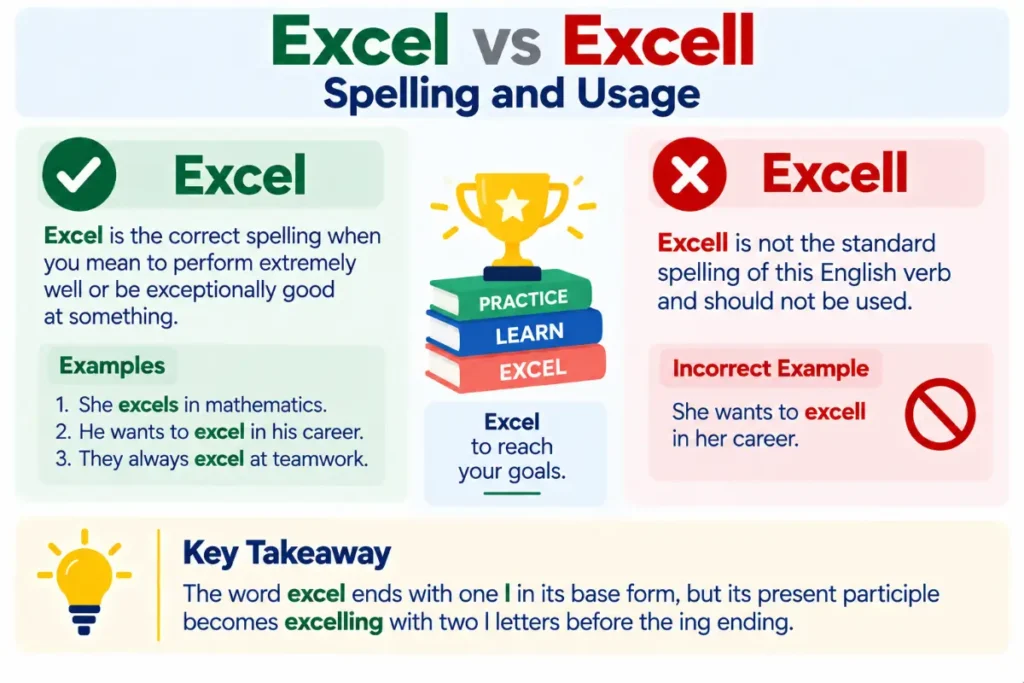
Excel is the correct spelling when you mean to perform extremely well or be exceptionally good at something. Excell is not the standard spelling of this English verb. The word excel ends with one l in its base form, but its present participle becomes excelling with two l letters before the ing ending.
Table Of Contents
- Meaning of excel.
- Why excell is incorrect.
- Main spelling difference.
- Grammar and verb forms.
- How to use excel in sentences.
- Pronunciation.
- Word origin.
- Common expressions.
- Real life examples.
- Common mistakes.
- Memory tips.
- Formal and informal usage.
- American and British English.
- Related words.
- Expert editor insight.
- Frequently asked questions.
- Key takeaways.
- Conclusion.
What Excel Means
Excel is a verb that means to be exceptionally good at something or to perform at a very high level.
For example:
She excels at mathematics.
This means she performs exceptionally well in mathematics.
You can also say:
He excels in leadership.
This means he is particularly successful or skilled in leadership.
The word usually describes a strength, ability, activity, subject, profession, or area of performance. It often appears when someone performs noticeably better than average.
Excel can also refer to surpassing others in achievement or quality.
The company excels at customer service.
Here the sentence says that the company performs especially well in that area.
The word is useful because it expresses a stronger idea than simply being good. If someone is good at something, they perform well. If someone excels at it, they stand out because of their ability or performance.
Why Excell Is Incorrect
Excell is not the standard spelling of the English verb meaning to perform exceptionally well.
If you write:
She excells at writing.
The spelling should be:
She excels at writing.
The confusion usually comes from the verb forms. The base form has one l at the end.
Excel.
But when the ending ing is added, the final consonant is doubled.
Excelling.
This is a normal spelling pattern in English. The doubled l in excelling does not mean that the base form contains two l letters.
The same kind of pattern appears in other words.
Control becomes controlling.
Travel can become travelling in British English and traveling in American English.
Refer becomes referring.
The important point is that the spelling of the base verb and the spelling of its inflected forms can differ.
Excel Or Excell The Main Difference
The central difference is simple.
| Form | Standard English | Meaning | Example |
|---|---|---|---|
| Excel | Yes | Perform exceptionally well | She excels at science. |
| Excell | No | Not the standard spelling of the verb | Excell is usually a spelling error. |
Excel is a standard English verb.
Excell is normally an incorrect spelling.
There is no need to add a second l to the base form. The correct spelling is e x c e l.
This remains true in American English and British English when the word is used as the verb meaning to perform exceptionally well.
Grammar And Verb Forms
Excel is a regular verb. Its basic forms follow a predictable pattern.
| Verb Form | Correct Form | Example |
|---|---|---|
| Base form | excel | I want to excel. |
| Third person singular | excels | She excels at math. |
| Past tense | excelled | He excelled in school. |
| Past participle | excelled | She has excelled in her field. |
| Present participle | excelling | They are excelling this year. |
The base form is excel.
When you add s for the third person singular, the word becomes excels.
She excels at science.
When you form the past tense, the final l is doubled before ed.
He excelled in college.
The same doubling happens with the present participle.
She is excelling in her new role.
This spelling change explains a large part of the confusion. The base word has one l, while the past and ing forms have two.
Why Excel Becomes Excelled
English spelling rules sometimes require a final consonant to double before a suffix is added.
With excel, the final l doubles in excelled.
Excel plus ed becomes excelled.
The same pattern appears in excelling.
Excel plus ing becomes excelling.
This does not mean that excell is the base spelling. Instead, the doubled l appears because of the way the word changes when certain endings are attached.
Compare these forms:
I excel at writing.
I am excelling at writing.
The spelling changes only when the suffix requires it.
This distinction is useful for proofreading because many writers remember the doubled l from excelled or excelling and accidentally transfer it back to the base form.
How To Use Excel In A Sentence
Excel is commonly followed by at or in.
Excel At
Use excel at when referring to an activity, skill, subject, or specific task.
She excels at solving problems.
He excels at public speaking.
They excel at designing simple websites.
The student excels at mathematics.
The structure is:
Subject + excel + at + activity or skill.
Excel In
Use excel in when referring to a field, area, profession, subject, or broader domain.
She excels in science.
He excels in business.
The company excels in software development.
They excel in academic research.
Both at and in can be correct depending on the noun that follows and the intended meaning. Native speakers choose between them based on context rather than a single rigid rule.
Excel As A Transitive Verb
Excel can also be used in a way that means to surpass or exceed something.
For example:
The new design excels its predecessor in efficiency.
This construction is less common in everyday American English than excel at or excel in. Many speakers would choose surpasses instead.
The more familiar pattern is:
The new design excels in efficiency.
For most everyday writing, excel at and excel in are the forms worth learning first.
Real Life Examples
Everyday Conversation
My daughter really excels at drawing.
The sentence says that the daughter has an unusually strong ability in drawing.
He always excels at sports.
This means he performs exceptionally well in sports.
School
Maria excels in mathematics.
The sentence describes strong academic performance.
The student excelled in science last semester.
Here excelled is the past tense because the performance happened in the past.
Work
She excels at solving difficult customer problems.
This describes a professional strength.
Our team excels in project planning.
The sentence identifies project planning as the team’s area of strong performance.
Business
The company excels in customer support.
This says the company performs particularly well in customer support.
Their new service excels at helping small businesses save time.
Here excels at introduces the particular activity or function.
Academic Writing
Students who excel in reading often develop strong vocabulary skills.
The verb describes students who perform especially well in reading.
The study examined factors that helped participants excel academically.
Here excel functions naturally in a more formal sentence.
Personal Development
You don’t need to excel at everything.
This means you don’t need to be exceptionally good at every activity.
She worked hard to excel in her chosen field.
The sentence emphasizes sustained effort and strong performance.
Common Expressions With Excel
Excel frequently appears in a small number of useful patterns.
Excel At Something
This is one of the most common structures.
He excels at chess.
She excels at teaching children.
Excel In Something
This is also very common.
She excels in mathematics.
He excels in business.
Excel Academically
This means to perform exceptionally well in school or academic work.
The student excels academically.
Excel Professionally
This refers to unusually strong performance in a career or workplace.
She has continued to excel professionally.
Excel In A Field
This describes outstanding performance within a broader area.
He excels in medicine.
These patterns make the word easy to use once you understand its central meaning.
Pronunciation Guide
Excel is pronounced /ɪkˈsɛl/ in standard American English.
The word has two syllables.
The stress falls on the second syllable.
The first part begins with a short sound similar to the beginning of expect. The second syllable contains the stressed vowel found in words such as bell and sell.
The final sound is an l sound.
One reason pronunciation contributes to spelling confusion is that the spoken word gives no clear signal about how many l letters should appear in writing. English spelling often requires learners to remember letters that are not obvious from pronunciation alone.
A useful approach is to learn the base word and its related forms together.
Excel.
Excels.
Excelled.
Excelling.
Seeing the family as a group makes the spelling pattern easier to remember.
Word Origin
Excel entered English through French and ultimately traces back to Latin roots associated with raising, surpassing, or being elevated.
The modern English meaning developed around the idea of surpassing or standing above others in performance or quality.
This history connects excel with words and ideas involving superiority or height. The modern verb is now commonly used in a positive performance sense.
For example:
She excels at music.
The sentence suggests that her performance rises above ordinary expectations.
You don’t need to know the historical development to spell the word correctly, but the idea of rising above average is a useful way to understand its meaning.
Common Mistakes With Excel
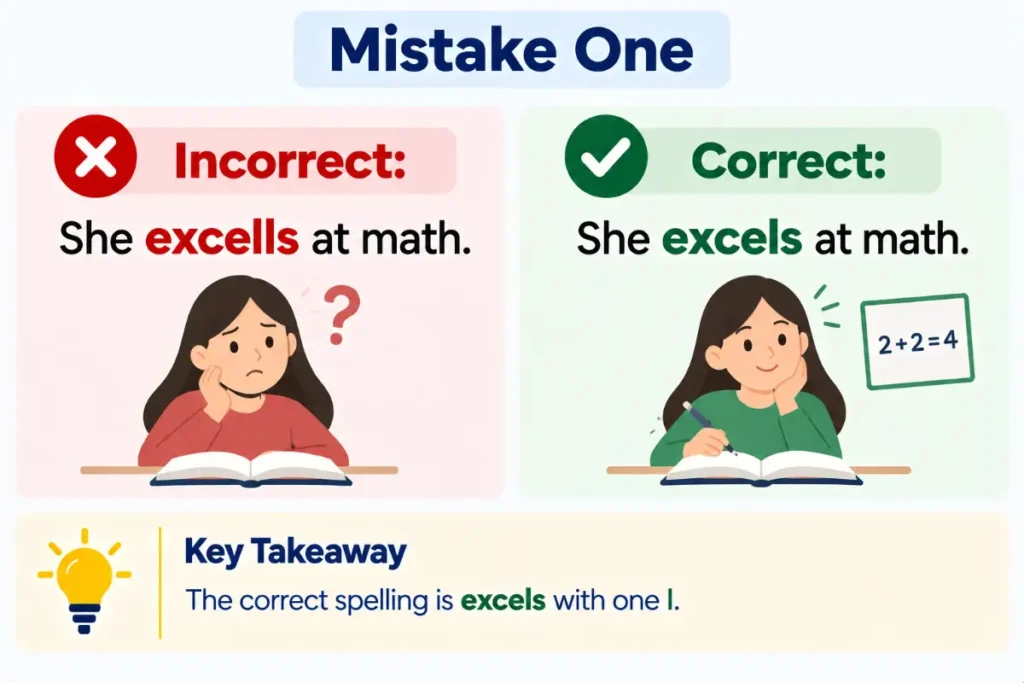
Mistake One
Incorrect:
She excells at math.
Correct:
She excels at math.
The base form has one l.
Mistake Two
Incorrect:
He excel at science.
Correct:
He excels at science.
The subject he requires the third person singular form excels.
Mistake Three
Incorrect:
She excelled at her work.
This sentence is actually correct.
Writers sometimes think excelled is wrong because it contains two l letters. It is correct because the final l doubles before the ed ending.
Mistake Four
Incorrect:
They are excel at sports.
Correct:
They excel at sports.
Or:
They are excelling at sports.
The first sentence uses the base form after they. The second uses the present participle after are.
Mistake Five
Incorrect:
He is excelled at math.
Correct:
He excels at math.
The form excelled does not normally work as the adjective in this construction. Use excels for a present ability.
Common Spelling Confusion
The biggest spelling trap is transferring the double l from excelled or excelling to the base form.
Writers may see:
excelled
excelling
and mentally assume:
excell
That is a spelling mistake.
The same issue can happen when people hear the word and try to spell it phonetically. The pronunciation does not tell you that the base form needs one l rather than two.
Typing speed can also play a role. When people type quickly, they may accidentally add or remove repeated letters.
Another source of confusion is the familiar word excellent.
Excellent begins with excell, so the eye may expect excel to contain the same sequence.
Compare:
excel
excellent
The words are related historically, but their spellings are not identical.
Excel And Excellent
Excel and excellent are related in meaning, but they perform different grammatical jobs. It is a verb.
She excels at writing.
Excellent is an adjective.
She is an excellent writer.
The relationship is easy to see.
Someone who excels at something can be described as excellent at that activity.
For example:
He excels at teaching.
He is an excellent teacher.
The first sentence uses a verb. The second uses an adjective.
This distinction is useful because excellent contains two l letters in the middle. That spelling may contribute to confusion with the verb.
Excel And Exceed
Excel and exceed can overlap in meaning, but they are not always interchangeable. It often means perform exceptionally well.
She excels at mathematics.
Exceed usually means go beyond a limit, amount, expectation, or standard.
The project exceeded our expectations.
You can sometimes replace excel with surpass, but the exact choice depends on the sentence.
Excel often sounds positive when describing ability or performance.
She excels at leadership.
Exceed focuses more directly on going beyond a particular point.
The costs exceeded the budget.
Excel And Succeed
Succeed is another related word.
To succeed means to achieve a desired result or accomplish a goal.
To excel means to perform exceptionally well.
A person can succeed without excelling.
For example, a student might pass a difficult course and therefore succeed, but another student might earn outstanding results and excel.
This difference gives excel a stronger sense of exceptional performance.
Formal And Informal Usage
Excel is neutral in register. It works in everyday conversation, professional writing, academic writing, journalism, and formal documents.
You can say:
She excels at sports.
This sounds natural in casual conversation.
You can also write:
The researchers identified several factors that allowed participants to excel academically.
This is appropriate for academic writing.
In professional communication, excel can describe individual strengths, team performance, business capabilities, or organizational results.
Our customer service team excels in resolving complex cases.
The word itself does not sound excessively formal. Its tone depends mostly on the surrounding language.
British And American English
American and British English use excel with the same basic spelling and meaning.
American English:
She excels at mathematics.
British English:
She excels at mathematics.
The base verb remains excel in both varieties.
The same is true of the related forms excelled and excelling.
There can be differences in spelling for some English words between the United States and the United Kingdom, but excel is not one of the common examples. You should not add a second l simply because you are writing for a particular English speaking region.
Canadian and Australian English also use the same standard spelling.
Excel In Professional Writing
The word works particularly well when describing measurable strengths.
For example:
The company excels in customer service.
The candidate excels at problem solving.
The department excels in research and development.
The student excels academically.
However, professional writers should avoid using excel as empty praise. Strong writing connects the claim to something specific.
Instead of:
Our team excels.
Write:
Our team excels at resolving complex customer issues within a short response time.
The second sentence tells the reader what the team does well.
This principle improves credibility. A strong verb becomes more useful when the sentence explains the specific strength behind it.
Memory Tips
The easiest way to remember the spelling is to keep the base form separate from its changed forms.
One L In The Base Form
Think:
Excel.
One l.
Two L Letters In Excelled
Think:
Excelled.
The second l appears when the ending ed is added.
Two L Letters In Excelling
Think:
Excelling.
The second l appears before ing.
Compare The Family
Excel.
Excels.
Excelled.
Excelling.
The base form is the one to watch. If you mean the verb in its basic form, use excel.
A Simple Spelling Test
When you’re unsure, put the word into a simple present sentence.
She can ___ at anything she studies.
The correct answer is excel.
She can excel at anything she studies.
You would not write:
She can excell at anything she studies.
The same test works after to.
He wants to excel in his career.
The infinitive uses the base form.
This is a useful proofreading technique because it removes the temptation to copy the spelling from related forms such as excelled.
Related Grammar And Usage Notes
Excel often appears after modal verbs and auxiliary verbs.
You can excel with enough practice.
The base form excel follows can.
She will excel in this role.
The base form follows will.
They may excel at the task.
Again, excel stays in its base form after the modal verb may.
The same principle applies after to.
She wants to excel.
He hopes to excel.
They trained hard to excel.
When a sentence has he, she, or it in the simple present, add s.
He excels.
She excels.
The company excels.
This is basic subject verb agreement.
In the past, use excelled.
He excelled.
She excelled.
The company excelled.
For the continuous form, use excelling.
He is excelling.
She is excelling.
They are excelling.
Understanding these patterns prevents many grammar errors.
Real Life Usage By Context
Daily Conversation
You really excel at cooking.
This tells someone that cooking is one of their strongest abilities.
I think she’ll excel in college.
This expresses confidence that she will perform exceptionally well.
Workplace
Our sales team excels at building long term client relationships.
The sentence identifies a specific professional strength.
He excelled in his previous position.
The past tense shows that the strong performance occurred in an earlier role.
School
My brother excels in science.
This describes strong academic performance.
She excelled in every subject last year.
The past form indicates performance during a completed period.
Academic Writing
Students who excel academically often demonstrate strong study habits.
The verb describes unusually strong academic performance.
The researchers examined how students can excel in demanding learning environments.
Here the word works naturally in a formal academic context.
Business Writing
The company excels in technical support.
This identifies a particular organizational strength.
The new service allows small businesses to excel in areas that once required large teams.
Here excel means achieve a high level of performance.
Exceptions And Less Common Uses
Excel is usually connected with strong performance, but it can also be used in a broader sense of surpassing or being superior.
For example:
This model excels its predecessor in speed.
This construction is grammatically possible, but it is less common in everyday American English. Surpasses may sound more natural in many contexts.
Most learners should focus first on the common patterns:
Excel at something.
Excel in something.
These cover the vast majority of practical situations.
Expert Editor Insight
An experienced editor treats excel and excell differently from the moment the base form appears. The standard verb is excel with one l, while excelled and excelling correctly contain two l letters because the final consonant doubles before those endings. Spellcheckers usually catch excell when it is used as an ordinary English verb, but context still matters because names, brands, and specialized labels can have unusual spellings. For normal English writing, keep the base form simple: excel.
Key Takeaways
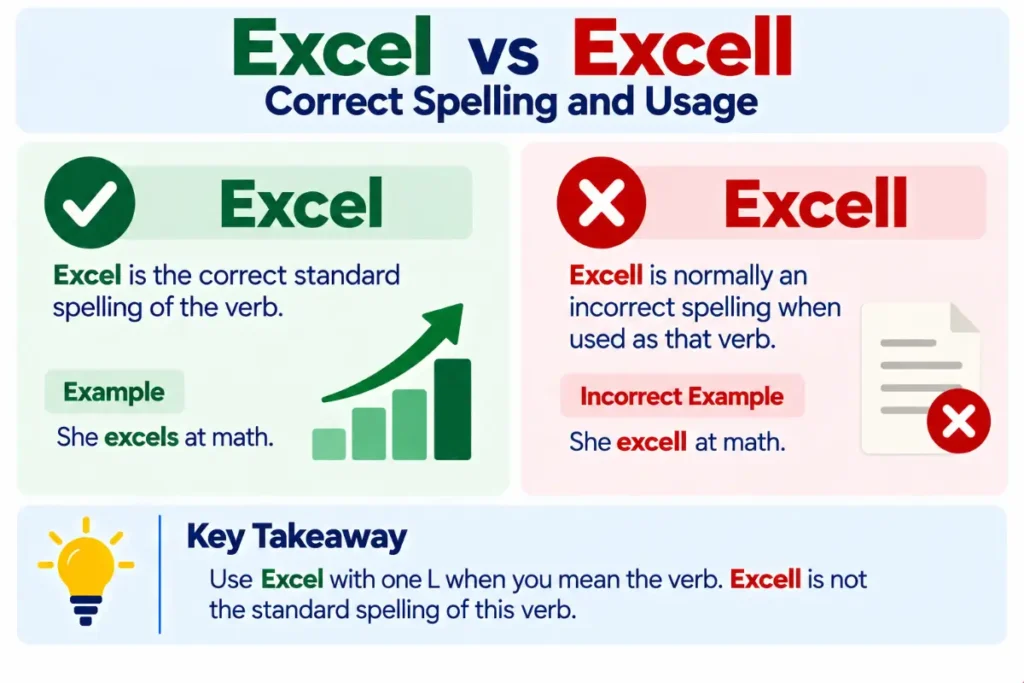
- Excel is the correct standard spelling of the verb.
- Excell is normally an incorrect spelling when used as that verb.
- Excel means to perform exceptionally well.
- Excel is commonly followed by at or in.
- Write She excels at math.
- Write He excels in business.
- The past tense is excelled.
- The present participle is excelling.
- The double l in excelled and excelling does not belong in the base form.
- Excel and excellent are related but have different grammatical roles.
- Excel is used in American English and British English with the same standard spelling.
- The easiest memory trick is to remember one l in the base form and two l letters in excelled and excelling.
Conclusion
Excel or excell has a straightforward answer. Excel is the correct standard spelling when you mean to perform exceptionally well. Excell is normally a spelling mistake. The base verb uses one l, while forms such as excelled and excelling use two l letters because the final consonant doubles before those endings.
The word works naturally in many settings. You can excel at a skill, excel in a field, excel academically, or excel professionally. It is a neutral verb that fits everyday conversation as well as school, business, and formal writing.
For a quick memory trick, keep the base form separate from its changed forms. Think excel with one l, then remember that the extra l appears in excelled and excelling. If you are proofreading a sentence and see excell as the base verb, remove one l.
Frequently Asked Questions
Which is correct excel or excell?
Excel is the correct standard spelling of the English verb meaning to perform exceptionally well. Excell is normally a spelling error. The base form has one l. The double l appears in forms such as excelled and excelling because the final consonant doubles when those endings are added. For example, write She excels at math, not She excells at math.
What does excel mean?
Excel means to perform exceptionally well or to be especially successful in a particular area. You can excel at an activity or excel in a field. For example, She excels at writing means she is exceptionally good at writing. The word expresses stronger performance than simply being good at something.
Why does excel have one l but excelling has two?
The base verb is excel with one l. When the ending ing is added, the final consonant doubles, producing excelling. The same pattern appears in excelled. This spelling change does not alter the base form. You should therefore write excel when using the basic verb and excelling when describing an ongoing action.
Is excell a real English word?
Excell is not the standard spelling of the common English verb meaning to perform exceptionally well. You may encounter Excell as part of a proper name, company name, product name, or other specialized label, but those uses do not make it the standard verb spelling. In ordinary English writing, use excel.
How do you pronounce excel?
Excel is pronounced /ɪkˈsɛl/ in standard American English. It has two syllables with the main stress on the second syllable. The final vowel sound is similar to the vowel in words such as sell and bell. The pronunciation does not reveal the number of l letters in the spelling, so learning the written form separately is helpful.
What is the past tense of excel?
The past tense is excelled. The final l doubles before the ed ending. For example, She excelled in science last year. The past participle is also excelled, as in She has excelled throughout her career. Do not change the base form to excell. The spelling change happens only when the appropriate ending is added.
What is the difference between excel and excellent?
Excel is a verb, while excellent is an adjective. You can say She excels at mathematics because excel describes what she does. You can also say She is an excellent mathematician because excellent describes her. The words are related in meaning, but they have different grammatical functions and different spelling patterns.
Should I say excel at or excel in?
Both constructions are standard. Excel at commonly introduces an activity, task, or skill, such as He excels at writing. Excel in often introduces a field, subject, or broader area, such as She excels in medicine. The distinction is flexible in real English, so context and natural phrasing should guide your choice.
Is excel appropriate in formal writing?
Yes. Excel is a standard neutral verb that works well in professional, academic, and formal writing. It can describe strong performance by people, teams, organizations, or systems. For precise professional writing, connect the verb to a specific area of performance. For example, The team excels at resolving complex customer issues is stronger than simply saying The team excels.
Can excel be used with a person as the object?
Usually, modern everyday English uses excel with at or in rather than treating a person as a direct object. You would normally say She excels at mathematics rather than She excels mathematics. The direct object construction exists in historical and less common usage, but the at and in patterns are much more useful for contemporary learners.

Confusing Words, Spelling & Word Choice
Claire Whitmore is a U.S.-based English editor who writes about commonly confused words, spelling differences, and word choice. Her work helps readers understand subtle distinctions between similar-looking words through simple definitions, practical examples, and modern usage guidance in both American and British English.