
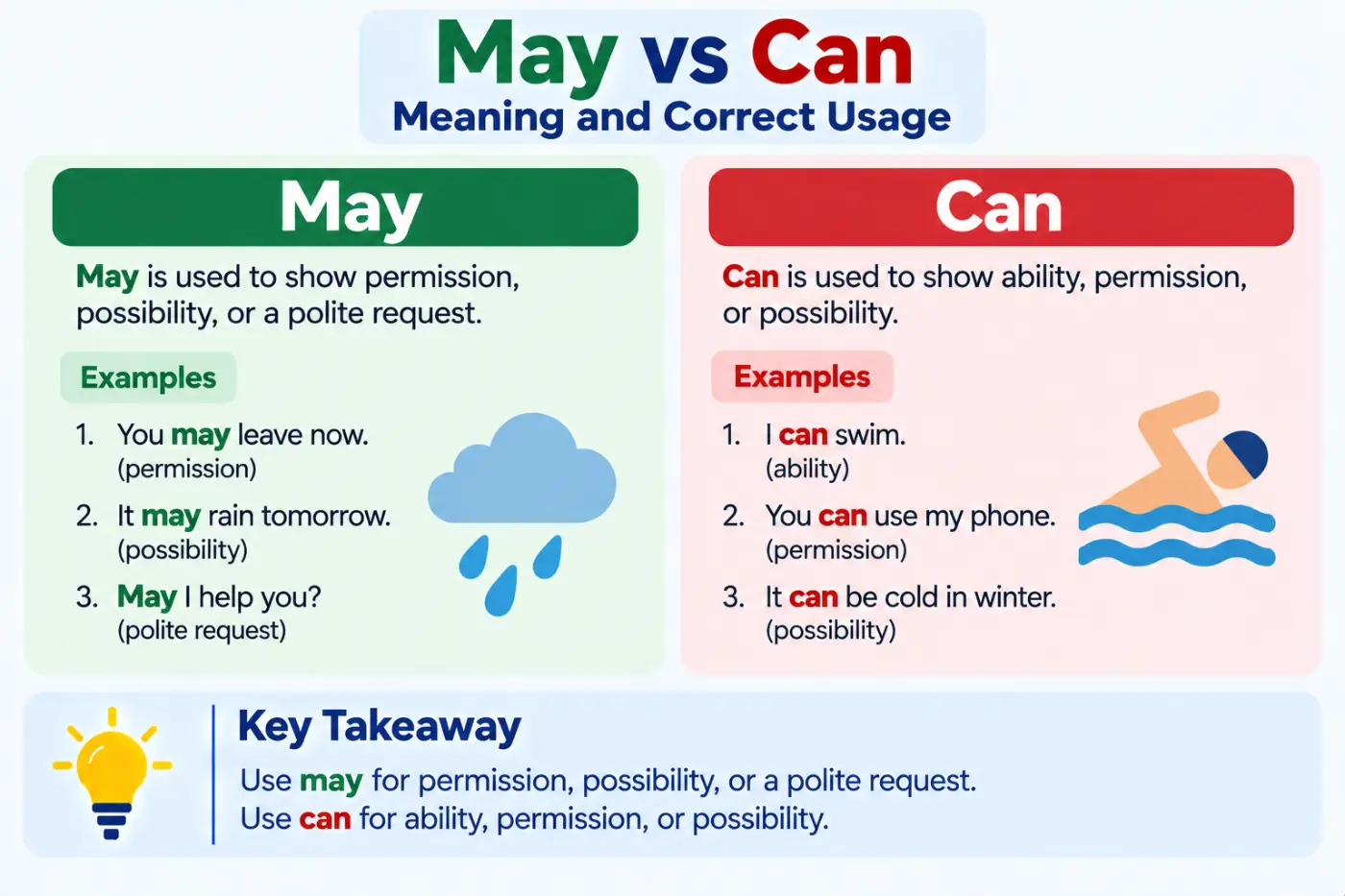
May vs can is one of those grammar questions that looks simple until you have to choose one in a real sentence. Both words can express permission and possibility, but can also has a strong connection with ability. May does not normally express physical or learned ability in standard English.
The confusion becomes clearer when you compare sentences such as Can I leave early? and May I leave early? Both can ask for permission. The first sounds natural and conversational, while the second sounds more formal and polite. Now compare She can swim with She may swim. The meanings change completely. The first describes ability. The second can describe permission or possibility depending on context.
This guide explains the difference in plain American English. You’ll learn how these modal verbs work, how native speakers use them, when they overlap, and which choice sounds natural in different situations. You’ll also see examples from everyday speech, school, work, formal writing, and professional communication.
Short Answer
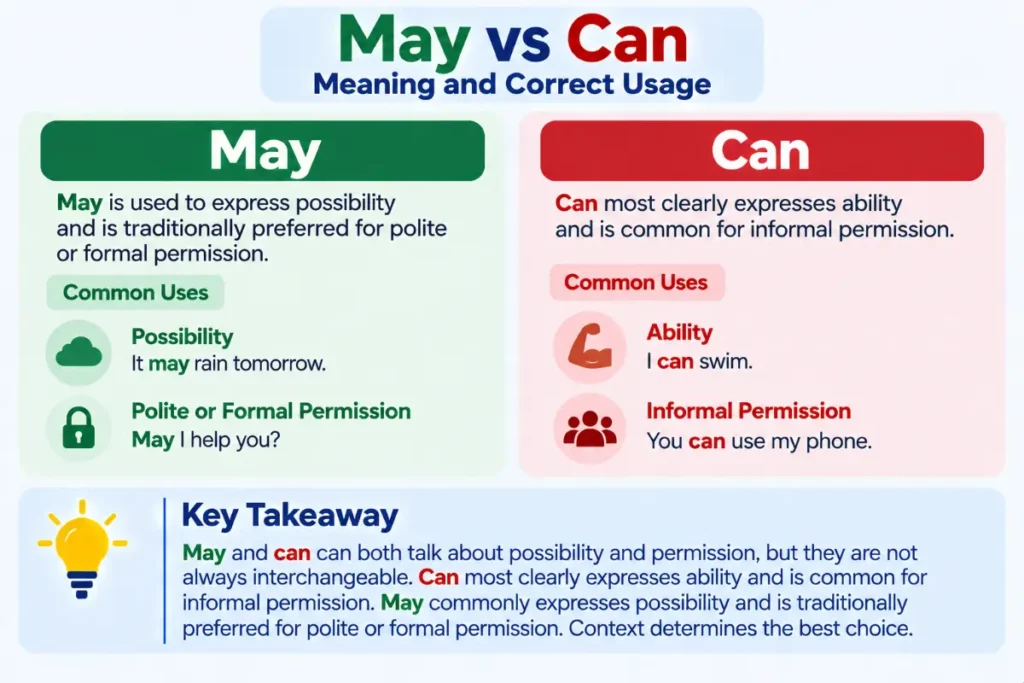
May and can can both talk about possibility and permission, but they are not always interchangeable. Can most clearly expresses ability and is common for informal permission. May commonly expresses possibility and is traditionally preferred for polite or formal permission. Context determines the best choice.
Table Of Contents
- What may means.
- What can means.
- The main difference.
- Permission.
- Possibility.
- Ability.
- Grammar rules.
- Questions with may and can.
- Negative forms.
- Past and future meanings.
- Formal and informal usage.
- Common mistakes.
- Pronunciation.
- Word origins.
- American and British English.
- Real life examples.
- Memory tips.
- Related modal verbs.
- Professional writing advice.
- Frequently asked questions.
- Key takeaways.
- Conclusion.
What May Means
May is a modal auxiliary verb. It commonly expresses possibility or permission.
Consider this sentence:
It may rain tonight.
Here may expresses possibility. The speaker thinks rain is possible but does not present it as certain.
Now consider:
May I come in?
Here may asks for permission.
The same modal verb can therefore serve different purposes depending on context.
May is followed by the base form of another verb.
I may go.
She may arrive later.
They may need help.
You may leave now.
It does not take to before the main verb.
Incorrect:
I may to go.
Correct:
I may go.
May also stays the same for different subjects.
I may leave.
She may leave.
They may leave.
There is no form such as mays in standard English.
May is also useful when the speaker wants to sound careful or less certain.
The package may arrive tomorrow.
This does not promise that the package will arrive. It simply presents tomorrow as one possible outcome.
What Can Means
Can is also a modal auxiliary verb. Its most basic meanings include ability and possibility. It can also express permission in ordinary conversation.
Consider:
I can swim.
This describes ability. The speaker has the skill needed to swim.
Now consider:
Can I use your phone?
Here can asks for permission.
Can can also express possibility in certain contexts.
Accidents can happen.
This means accidents are possible in general.
You can also use can to describe something that is physically or practically possible.
We can finish the project today.
This suggests that finishing today is possible based on the available circumstances.
Like may, can takes the base form of the main verb.
I can drive.
She can help.
They can come.
Can does not change according to the subject.
I can go.
He can go.
We can go.
They can go.
The negative form is cannot or can’t.
I cannot stay.
I can’t stay.
The Main Difference
The easiest way to understand the difference is to look at the meaning behind the sentence.
Can most strongly connects with ability.
I can drive.
May most strongly connects with possibility or permission.
I may drive to work tomorrow.
The first sentence says the speaker has the ability to drive. The second says driving tomorrow is one possible plan.
However, the two verbs overlap in some situations.
Can I leave now?
May I leave now?
Both can ask for permission. The difference is mainly tone and traditional usage.
Can I leave now? sounds natural and conversational.
May I leave now? sounds more formal or polite.
This does not mean can is grammatically wrong when asking for permission. Modern American English commonly uses can in permission questions.
The key is to avoid thinking of may as the only correct permission word. Real English is more flexible than that.
Permission And Requests
Permission is one of the areas that creates the most confusion.
Can For Permission
It is extremely common in everyday American English when someone asks if they are allowed to do something.
Can I borrow your pen?
Can I sit here?
These sentences sound normal and natural in conversation.
May For Permission
It also asks for permission, but it often sounds more formal or respectful.
May I come in?
May I ask you a question?
This style is common in formal situations, classrooms, customer service, official communication, and polite requests.
Still, the exact level of formality depends on the speaker and situation.
Can Or May In Everyday American English
In ordinary conversation, can is often the more natural choice.
Imagine a friend is sitting beside you.
Can I have some water?
That sounds completely normal.
May I have some water?
That is also grammatical, but it can sound more formal than the situation requires.
Now imagine a student speaking to a principal.
May I leave early?
The formal tone may fit better.
The important point is that both forms can ask for permission. The difference is mainly register and context.
Possibility
May and can can both relate to possibility, but they do not always express the same kind of possibility.
May For Specific Possibility
It often presents a particular event as possible.
She may arrive late.
This means there is a possibility that she will arrive late.
The speaker is not saying that she has the ability to arrive late. The sentence concerns uncertainty about a future event.
Can For General Possibility
Can often describes something that is possible in general.
Summer storms can develop quickly.
This means summer storms have the potential to develop quickly.
Can is also common when circumstances make something possible.
We can finish this today.
This suggests that the situation allows the action to happen.
Compare these examples:
It may snow tonight.
Snow can occur in this region during winter.
The first sentence discusses a particular possibility. The second describes general possibility.
That distinction is useful in academic and professional writing because it helps you express uncertainty precisely.
Ability
Ability is one area where can has a clear advantage.
I can speak Spanish.
She can play the piano.
He can solve difficult problems.
They can lift the box.
These sentences describe ability.
May does not normally replace can in this meaning.
I may speak Spanish.
This usually does not mean that I have the ability to speak Spanish. Instead, it could mean that I might speak Spanish under some condition or at some point.
For example:
I may speak Spanish at the meeting.
Here may describes a possible future action.
That is very different from:
I can speak Spanish.
Here can describes ability.
This distinction is one of the most important rules to remember.
Comparison Table
| Feature | May | Can |
|---|---|---|
| Main meaning | Possibility or permission | Ability possibility or permission |
| Ability | Not normally used | Common |
| Specific possibility | Very common | Possible in suitable contexts |
| General possibility | Possible | Very common |
| Permission | Common and often formal | Very common in everyday speech |
| Formal tone | Often more formal | Usually more conversational |
| Negative | May not | Cannot or can’t |
| Question | May I leave? | Can I leave? |
| Example | She may come later. | She can come later. |
| Main distinction | Possibility or permission | Ability possibility or practical possibility |
Grammar Rules
May and can are modal auxiliary verbs. Modal verbs have special grammar rules.
They are followed by the base form of a verb.
I may go.
I can go.
She may arrive.
She can arrive.
They may help.
They can help.
Do not add s after the modal.
Incorrect:
She may goes home.
Correct:
She may go home.
Incorrect:
He can drives.
Correct:
He can drive.
Modal verbs also do not normally use do or does to form questions.
Incorrect:
Do may I leave?
Correct:
May I leave?
Incorrect:
Do can I come in?
Correct:
Can I come in?
Modal verbs also form negatives directly.
She may not come.
She can’t come.
The grammar is simple once you remember that the modal carries the tense and meaning while the following verb stays in its base form.
Questions With May And Can
Both verbs can appear in questions, but their meanings depend on the context.
Can you help me?
This can ask about ability or willingness.
May I help you?
This usually asks permission or offers polite assistance depending on the context.
Can I open the window?
This usually asks permission in casual conversation.
May I open the window?
This asks permission with a more formal tone.
Can you swim?
This asks about ability.
May I swim here?
This asks about permission.
The surrounding words often make the intended meaning obvious.
Negative Forms
The negative form of may is may not.
You may not enter this area.
This can mean permission is denied.
It can also express possibility.
She may not come.
Here the meaning is that her arrival is not certain and may fail to happen.
Can has two common negative forms.
Cannot is the standard written form.
Can’t is the common contraction.
I cannot attend the meeting.
I can’t attend the meeting.
The negative meaning usually concerns inability or lack of possibility.
I can’t swim.
This means I do not have the ability.
We can’t leave yet.
This means leaving is not possible at the moment.
May Not Can Mean Two Different Things
May not deserves special attention because context can change its meaning.
Consider:
You may not enter.
This usually means you do not have permission to enter.
Now consider:
He may not come.
This usually means there is a possibility that he will not come.
The grammar looks similar but the meaning is different.
Context provides the answer.
This distinction matters in formal writing because a short phrase can carry a surprisingly different message.
Past And Future Meanings
May and can have interesting relationships with time.
Can has a past form for ability: could.
I can swim now.
I could swim when I was five.
Could is commonly used for past ability.
May does not have a simple past form used in the same way. Might often expresses a weaker or more remote possibility.
She may come.
She might come.
Both describe possibility, although might often sounds less certain.
For future possibility, may works naturally.
The meeting may start late.
Can can also refer to future possibility when circumstances allow something.
We can meet tomorrow.
This sentence often suggests that tomorrow is a possible time because the people involved are available.
Again, the exact meaning depends on context.
Formal And Informal Usage
May and can are both standard English words. The difference is not simply correct versus incorrect.
In informal American conversation, can is very common for permission.
Can I borrow your charger?
Can we start now?
In more formal contexts, may can sound more polished.
May I ask a question?
May I leave the meeting early?
However, using may does not automatically make a sentence better. Formal writing should still sound natural.
A business email might say:
Can you send me the updated file?
That is perfectly professional.
A more formal request might say:
May I ask you to send the updated file?
The second sentence creates a more formal tone, but the first is not grammatically poor.
Common Mistakes
Using May For Ability
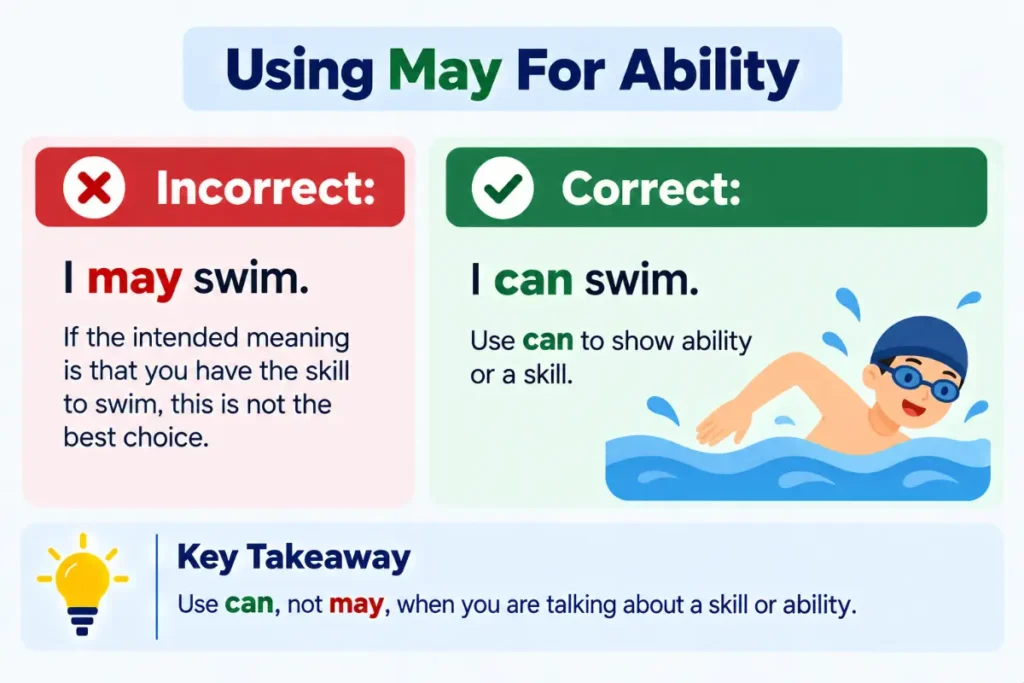
Incorrect:
I may swim.
If the intended meaning is that you have the skill to swim, use can.
Correct:
I can swim.
If you mean that swimming is something you might do later, may is possible.
I may swim this afternoon.
Treating Can As Incorrect For Permission
Some traditional grammar lessons teach that can means ability and may means permission. Modern English usage is more flexible.
Can I leave early?
This is normal in everyday American English.
May I leave early?
This is also correct and sounds more formal.
The mistake is assuming that can can never express permission.
Adding To After May Or Can
Incorrect:
I may to leave.
Incorrect:
I can to help.
Correct:
I may leave.
Correct:
I can help.
Modal verbs are followed directly by the base form.
Adding S To The Main Verb
Incorrect:
She can drives.
Correct:
She can drive.
Incorrect:
He may arrives later.
Correct:
He may arrive later.
Confusing Specific And General Possibility
May often refers to a particular uncertain event.
It may rain tonight.
Can often describes general possibility.
It can rain heavily during hurricane season.
The distinction helps make your writing more precise.
Pronunciation Guide
May is pronounced /meɪ/.
Can is commonly pronounced /kæn/ when stressed. In natural speech, can often has a reduced pronunciation that sounds closer to /kən/.
The difference is easy to hear when both words receive normal sentence stress.
May contains a long vowel sound that forms a diphthong.
Can contains the short vowel sound found in words such as man and plan when pronounced in its strong form.
In ordinary speech, the pronunciation of can often becomes weaker because it is an unstressed function word.
For example:
I can help.
A native speaker may reduce can considerably.
May is usually pronounced more clearly because it tends to receive more emphasis when used to express possibility or permission.
Word Origins
May and can have different historical roots.
May comes from an Old English modal verb related to the idea of having power or ability. Over time, its uses expanded to include permission and possibility.
Can also comes from Old English and is historically connected with knowing how to do something or having the ability to do it. This connection helps explain why can remains strongly associated with ability in modern English.
The two words developed overlapping uses over centuries. That historical development helps explain why both can sometimes express possibility or permission today.
You do not need to memorize the history to use them correctly, but it shows why English grammar cannot always be reduced to one rigid rule.
American English
American English commonly uses can for permission in everyday conversation.
Can I use your phone?
Can I sit here?
These forms are natural and widely understood.
May is also standard American English.
May I leave early?
The main difference is often tone. May can sound more formal or careful, while can usually sounds more relaxed.
American English also uses can for practical possibility.
We can finish this today.
The store can get busy after five.
May is commonly used for uncertain possibility.
The store may close early.
British English
British English uses the same core distinction between the two verbs.
Can commonly expresses ability.
I can swim.
May commonly expresses possibility.
It may rain later.
Both can and may can ask for permission, although may often carries a more formal tone.
The difference between American and British English is therefore not a major grammatical split here. Differences are more likely to come from individual style, social context, or level of formality.
Australian And Canadian English
Australian and Canadian English also use both modal verbs in broadly similar ways.
Can commonly expresses ability and everyday permission.
May commonly expresses possibility and formal permission.
The same practical rule works across these varieties.
If you mean ability, can is usually the natural choice.
If you are asking permission, both can and may can work, with may generally sounding more formal.
Real Life Examples
Daily Conversation
Can I borrow your jacket?
This asks for permission in a casual way.
I may go out later.
This expresses an uncertain future plan.
School
May I leave the classroom?
This is a polite and formal request for permission.
I can solve this problem.
This expresses ability.
Workplace
Can you send me the report?
Here can asks about the person’s ability or willingness to perform the action.
The client may approve the proposal tomorrow.
Here may expresses uncertainty about a future event.
Academic Writing
This approach may reduce the risk of errors.
May presents the result as possible rather than certain.
Certain conditions can increase the likelihood of failure.
Can expresses a general possibility.
Customer Service
May I have your order number?
This is a polite request for information.
You can contact our support team for assistance.
Here can expresses an available option or possibility.
Social Situations
Can I sit with you?
This is a natural casual request for permission.
We may watch a movie tonight.
This describes a possible plan.
May Or Can In Questions
Questions often make the distinction especially clear.
Can you open the door?
This can mean Are you able to open the door? It can also function as a polite request.
May I open the door?
This normally asks for permission.
Can I open the door?
This also asks for permission and sounds natural in everyday conversation.
Now compare:
Can she drive?
This asks about ability.
May she drive?
This can ask about permission, especially in a formal or institutional context.
The surrounding situation determines the intended meaning.
Related Modal Verbs
Understanding may and can becomes easier when you compare them with related modal verbs.
Might
Might commonly expresses possibility with a more tentative tone.
It might rain tonight.
Could
Could can describe past ability.
I could swim when I was six.
It can also express possibility.
It could rain later.
Must
Must often expresses strong necessity or a strong conclusion.
You must wear a seat belt.
Should
Should commonly expresses advice, expectation, or something considered appropriate.
You should call her.
Will
Will often expresses future intention, prediction, or willingness.
I will call you tomorrow.
Each modal has its own range of meanings. The best choice depends on what you want to communicate rather than on a simple one word translation.
Memory Tips
The easiest way to remember the core difference is to connect each word with a short idea.
Can equals ability.
I can swim.
I can help.
May equals possibility.
It may rain.
She may come.
They may arrive late.
For permission, remember that both can work.
Can I leave?
May I leave?
The first sounds more conversational. The second sounds more formal.
Another useful memory trick is to think about certainty.
May often leaves the door open.
She may come.
Can often tells you that something is possible because circumstances or ability allow it.
We can go.
This does not cover every possible use, but it gives you a strong starting point.
Professional Writing Tips
In professional writing, precision matters more than blindly following old classroom rules.
If you want to express uncertainty, may is often useful.
The shipment may arrive tomorrow.
If you want to describe ability or available capacity, can is usually clearer.
Our team can complete the work by Friday.
If you want to ask permission formally, may can create a respectful tone.
May I request an extension?
For ordinary requests, can is often more direct.
Can you send the document by Friday?
There is no need to make every request sound formal. Good professional writing is clear and appropriate to the relationship.
A Practical Decision Guide
When you are unsure which modal to use, ask yourself one question.
What exactly am I trying to express?
If the answer is ability, choose can.
I can drive.
If the answer is a specific possibility, choose may.
She may arrive late.
If the answer is general possibility, can may work.
Mistakes can happen.
If the answer is permission, both may and can can work.
Can I leave?
May I leave?
Choose may when you want a more formal or respectful tone.
Choose can when you want a natural conversational tone.
This approach is more useful than memorizing a rigid rule because real English depends on meaning and context.
Expert Editor Insight
An experienced editor does not automatically replace can with may in every sentence about permission. Modern American English regularly uses can for permission, especially in conversation and friendly professional communication. The editor first identifies the intended meaning, then checks tone. If the sentence describes ability, can is usually the natural choice. If it describes a specific uncertain event, may often gives the reader a clearer signal. Good editing is about precision, not old grammar myths.
Key Takeaways
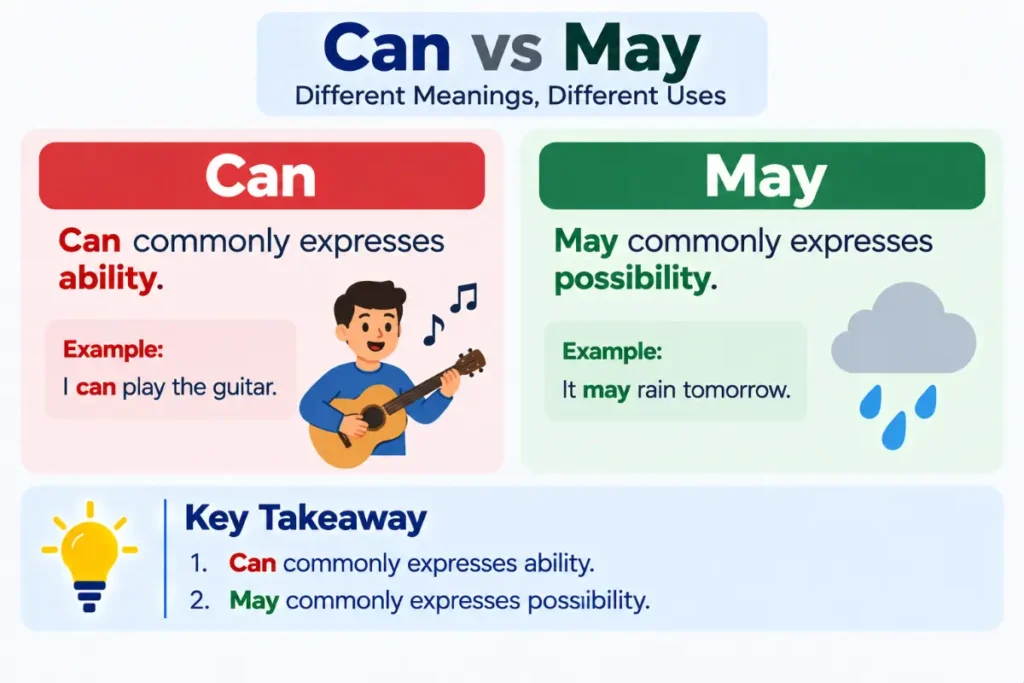
- Can commonly expresses ability.
- May commonly expresses possibility.
- Both can express permission.
- Can I leave? is natural in everyday American English.
- May I leave? sounds more formal or polite.
- Can can express general or practical possibility.
- May often expresses a particular uncertain event.
- May does not normally describe learned or physical ability.
- Modal verbs are followed by the base form of the verb.
- Say I can go rather than I can to go.
- Say she may arrive rather than she may arrives.
- May not can express denied permission or a negative possibility depending on context.
- Can and may do not change according to the subject.
- Context matters more than a rigid classroom rule.
Conclusion
May vs can is mainly a question of meaning, context, and tone. Can is strongly associated with ability and also works naturally for general possibility and everyday permission. May commonly expresses possibility and is often used for formal permission. Both are standard modal verbs, so neither should be treated as a universal replacement for the other.
The easiest rule is to start with meaning. Use can for ability, such as I can swim. Use may for a specific possibility, such as It may rain. For permission, choose can for a conversational tone and may when a more formal request fits the situation.
When you edit your own writing, ask what you actually mean before choosing the modal. That one habit will help you avoid most common mistakes and make your English sound more precise.
Frequently Asked Questions
What is the main difference between may vs can?
The main difference is meaning. Can strongly expresses ability and can also express general possibility or permission. May commonly expresses possibility and permission. For example, I can swim describes ability, while It may rain describes possibility. For permission, Can I leave? is natural in conversation, while May I leave? sounds more formal.
Is can correct for asking permission?
Yes. Can is widely used to ask for permission in modern American English. Can I use your phone? and Can I leave early? are natural questions. May can also ask permission and often sounds more formal or polite. The traditional rule that can is only for ability does not accurately describe everyday modern English usage.
Is may more polite than can?
May can sound more formal or respectful when asking permission, but politeness depends on the whole sentence and situation. May I speak with you? has a formal tone. Can I speak with you? sounds more conversational. Neither form is automatically rude or polite. Tone, relationship, and context all influence how a request is received.
Can may express ability?
May does not normally express ability. If you want to say that someone has the skill or capacity to do something, can is generally the correct choice. For example, I can drive means I have the ability to drive. I may drive usually means driving is a possible action or plan, not that driving is a skill.
When should I use may for possibility?
Use may when you want to say that a particular event is possible but not certain. For example, The meeting may start late means there is a possibility of a late start. May is especially useful in careful writing when you want to avoid presenting an uncertain event as a fact.
Is may vs can a grammar rule or a style choice?
It involves both grammar and style. The core meanings differ, especially for ability and possibility. Permission creates overlap because both forms are accepted. In that area, style and formality often guide the choice. Can sounds natural in everyday American English, while may can sound more formal.
Which is better in formal writing, may or can?
Neither is always better. Choose the word that expresses the intended meaning. Use can for ability or practical possibility and may for uncertainty or formal permission. For example, Our team can complete the project describes capability, while The project may require additional funding describes possibility.
Can may and can be used in the same sentence?
Yes. They can appear together when they express different meanings. For example, You can leave now, but you may want to wait for the manager. Can gives permission or indicates possibility, while may presents a possible preference or action. The two modals can work together as long as their meanings remain clear.
Is may more formal than can?
May is often more formal when used to ask for permission. Can is usually more conversational. However, may is not automatically formal in every use. It commonly appears in formal and neutral writing to express possibility. Can also appears frequently in professional and academic writing when it expresses ability or general possibility.
Can I say may I in everyday conversation?
Yes. May I is completely acceptable in everyday conversation. It simply gives the request a more formal or polite tone. For example, May I sit here? is grammatically correct. Among close friends, Can I sit here? may sound more relaxed. Both are valid choices, so the setting should guide you.

English Grammar & Usage
Nathan Holloway is an American grammar writer and language researcher who specializes in English grammar, sentence structure, verb usage, and common writing mistakes. He enjoys breaking down confusing grammar rules into practical explanations with clear examples, making English easier for students, professionals, and everyday writers.