
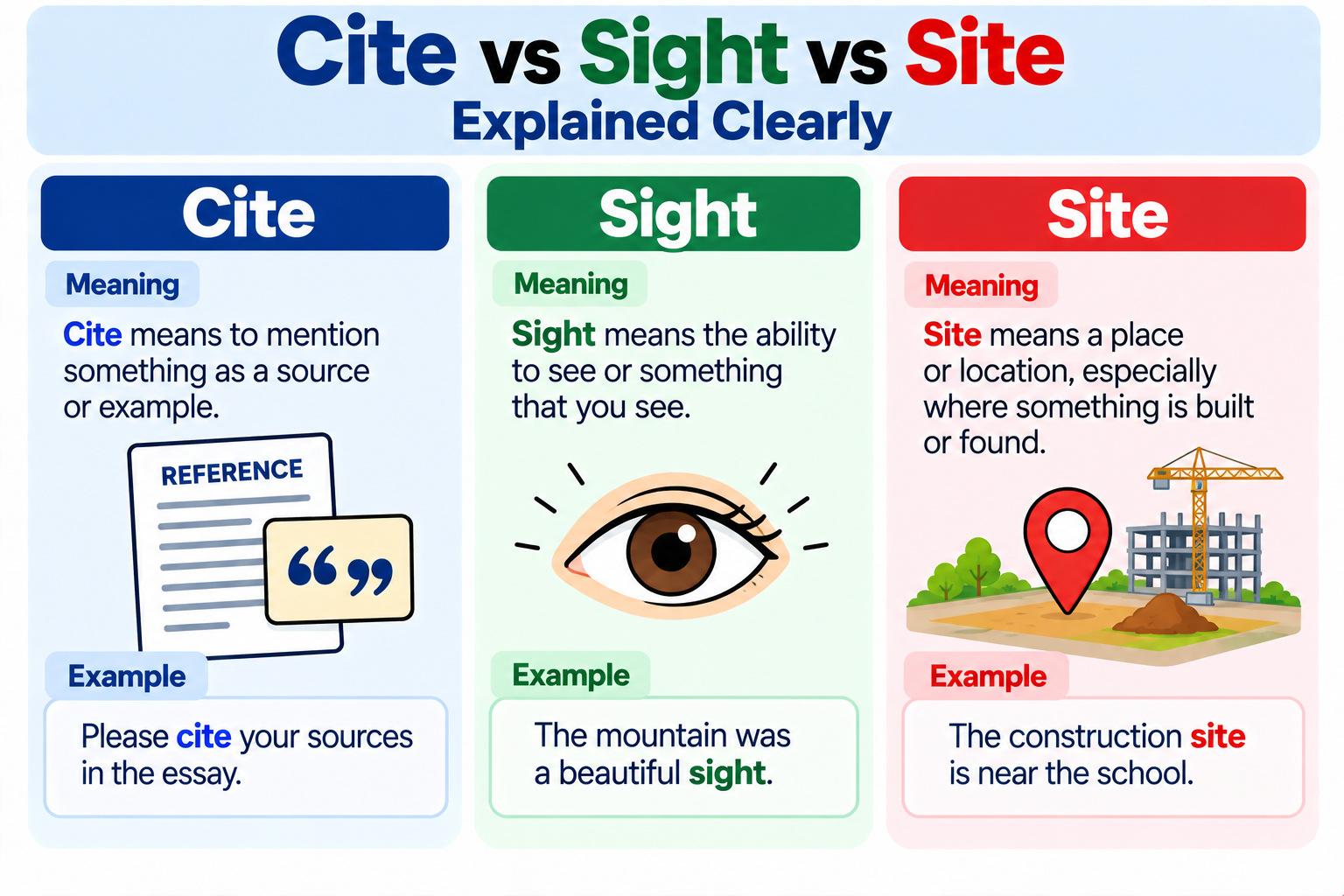
Cite vs sight vs site can be confusing because all three words have the same basic pronunciation in standard American English. They look different on the page but sound almost identical when spoken. That makes context especially important when you are writing.
The easiest way to remember the difference is to connect each spelling with its meaning. Cite relates to sources and evidence. Sight relates to seeing. Site relates to a place or location. Once you connect the spelling to the meaning, choosing the correct word becomes much more natural.
These words are homophones. Homophones are words that sound the same but have different meanings and spellings. English has many examples such as right and write or their and there. Cite, sight, and site belong to the same group. They aren’t interchangeable, even though they sound the same.
Short Answer
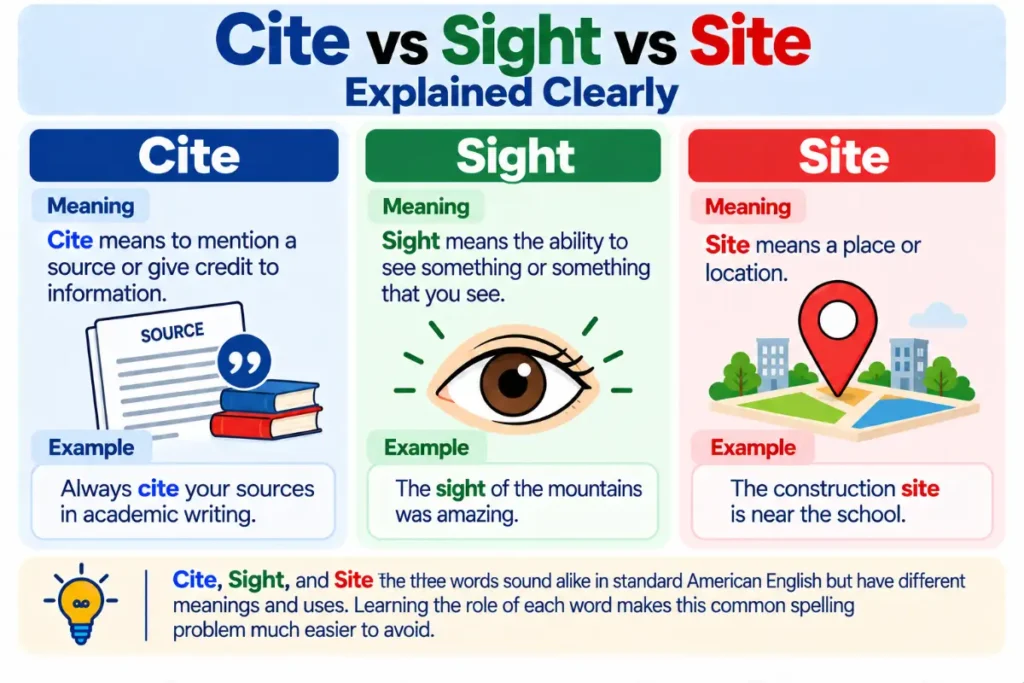
Cite means to mention a source or give credit to information. Sight means the ability to see something or something that you see. Site means a place or location. The three words sound alike in standard American English but have different meanings and uses. Learning the role of each word makes this common spelling problem much easier to avoid.
Table of Contents
- What cite means.
- What sight means.
- What site means.
- The difference between cite sight and site.
- How to use cite correctly.
- How to use sight correctly.
- How to use site correctly.
- Common expressions with cite.
- Common expressions with sight.
- Common expressions with site.
- Cite vs sight vs site in real life.
- Common mistakes.
- Pronunciation and spelling.
- Word origins.
- Memory tricks.
- Professional writing tips.
- Related word differences.
- Key takeaways.
- Frequently asked questions.
- Conclusion.
What Cite Means
Cite is a verb. It means to mention a person, book, article, study, law, case, or other source as evidence or support.
For example:
She cited a recent study in her report.
The writer cited three sources to support the claim.
The lawyer cited an earlier court decision.
In academic and professional writing, cite often means to give credit to the source of information. A citation helps readers find the original material and understand where a statement came from.
Cite can also mean to officially name or refer to something as an example.
The coach cited teamwork as the main reason for the team’s success.
The manager cited poor communication as a major problem.
In legal English, cite has another important use. A lawyer can cite a law, court case, or legal authority to support an argument.
The attorney cited a previous ruling.
The court cited the relevant section of the law.
Cite is always connected to the idea of referring to something. Think of it as pointing your reader toward a source or example.
Cite As A Verb
Cite is normally used as a verb.
You might cite a book.
You might cite a study.
The related noun is citation.
For example:
The article includes several citations.
The student forgot to add a citation for the statistic.
Citation and cite belong to the same word family. Sight and site do not have the same meaning or grammatical role.
Examples With Cite
- Please cite your sources at the end of the paper.
- The researcher cited several medical studies.
- The journalist cited public records in the article.
- The teacher asked students to cite their evidence.
- The lawyer cited a previous case.
- The report cites several government documents.
- She cited her experience as an example.
Each example involves referring to a source, authority, piece of evidence, or example. That connection is the key to using cite correctly.
What Sight Means
Sight is mainly a noun. It relates to seeing or the ability to see.
For example:
Her sight has improved.
The bright light affected his sight.
Sight can also mean something that you see.
The mountain was a beautiful sight.
The old building was an unusual sight.
The word can describe a visual experience, a view, or something that catches your attention.
Sight also appears in many common expressions. You can keep someone in sight, lose sight of something, catch sight of something, or see something at first sight.
For example:
I caught sight of an old friend across the room.
Keep the child in sight.
We lost sight of the boat.
She fell in love with the town at first sight.
These expressions all connect to seeing or visibility.
Sight As A Noun
Sight is usually a noun.
You can have good sight.
You can lose your sight.
The word can also refer to the sense of vision itself.
The accident affected his sight.
The doctor tested her sight.
The phrase line of sight describes an unobstructed path between someone and something they can see.
The tree blocked my line of sight.
Sight can also describe something remarkable or impressive to look at.
The waterfall was an amazing sight.
The fireworks were an incredible sight.
Examples With Sight
- The doctor tested his sight.
- We caught sight of a deer in the woods.
- Keep the building in sight.
- The sunset was a beautiful sight.
- She lost sight of her friend in the crowd.
- The tall wall blocked our line of sight.
- He had poor sight as a child.
- The fireworks were an unforgettable sight.
Every example has a connection to seeing, vision, or something visible.
What Site Means
Site is a noun. It means a place, location, or area where something exists, happens, or is built.
For example:
The company chose a new site for its office.
The construction site is closed today.
The school will be built on this site.
Site is common in discussions about buildings, construction, businesses, events, technology, and historical locations.
A construction site is a place where construction work happens.
A website is a place on the internet where information or services are provided.
A historical site is a location connected with an important event or period.
A campsite is a place where people set up tents or stay outdoors.
The word site can also describe a location where an event or activity takes place.
The festival site opened early.
The team inspected the event site.
Site As A Noun
Site is generally used as a noun.
You can visit a site.
You can choose a site.
The central idea remains location.
If you can replace the word with place or location, site may be the correct choice.
For example:
The company selected a new site.
The company selected a new location.
Both sentences make sense because site refers to a place.
Examples With Site
- The company purchased a site for its new headquarters.
- Workers arrived at the construction site early.
- The museum stands on an important historical site.
- We visited the site of the old castle.
- The team inspected the building site.
- The website contains useful information.
- The event site can hold thousands of people.
- The developers selected a suitable site for the project.
The common idea in every sentence is location.
The Difference Between Cite Sight And Site
The easiest way to understand cite vs sight vs site is to give each word one central meaning.
| Word | Part of Speech | Main Meaning | Simple Memory |
|---|---|---|---|
| Cite | Verb | Mention or refer to a source | Cite a source |
| Sight | Noun | Seeing or something seen | Sight means seeing |
| Site | Noun | A place or location | Site means place |
Cite is the only one of the three that is primarily a verb. Sight and site are mainly nouns.
Cite connects with sources.
Sight connects with vision.
Site connects with location.
That simple three part distinction handles most everyday situations.
How To Use Cite Correctly
Use cite when you are referring to a source, authority, example, or piece of supporting evidence.
A student cites a book.
A researcher cites a study.
A lawyer cites a case.
A writer cites a source.
A report cites evidence.
The word can also be followed by an object that represents the reason or example being mentioned.
The report cited rising costs as a major concern.
The teacher cited the student’s improvement as an example of steady progress.
Cite is especially common in academic writing. Students often need to cite books, articles, websites, studies, reports, and other sources.
It is also common in journalism and professional writing.
The article cited government data.
The report cited several industry studies.
The journalist cited public records.
Cite In Different Tenses
Because cite is a regular verb, its past tense is cited.
Present:
The writer cites several sources.
Past:
The writer cited several sources.
Present participle:
The writer is citing several sources.
The related noun is citation.
For example:
The paper needs another citation.
This relationship can help you recognize cite in academic and professional contexts.
How To Use Sight Correctly
Use sight when you are talking about vision, seeing, or something that can be seen.
For example:
My sight is getting better.
That was an amazing sight.
We lost sight of the car.
The first sentence refers to vision. The second refers to something seen. The third uses a common expression related to visibility.
Sight is also common in descriptions.
The sight of the ocean made everyone smile.
The sight of the old house brought back memories.
Here, sight means something that a person sees.
Common Expressions With Sight
Several useful expressions contain sight.
Keep in sight means to keep something visible.
Keep the children in sight.
Lose sight of means to stop seeing something or to forget an important idea.
Don’t lose sight of your goal.
Catch sight of means to see something briefly or suddenly.
I caught sight of a fox near the road.
At first sight means after seeing something for the first time.
The painting impressed me at first sight.
Out of sight means not visible.
The car disappeared out of sight.
These expressions make sight easier to remember because they all connect with vision.
How To Use Site Correctly
Use site when you mean a place or location.
For example:
The workers arrived at the site.
The company found a better site for the building.
The city plans to develop the site.
Site is also part of many compound words and phrases.
Construction site refers to a place where construction work happens.
Job site refers to the place where someone works.
Website refers to a location on the internet.
Campsite refers to a place where people camp.
Historic site refers to a location connected with history.
Site can also describe a place connected with a particular event.
The concert site was crowded.
The accident site was closed to traffic.
The archaeological site contains ancient remains.
The key idea is always location.
Cite vs Sight vs Site In Real Life
Understanding the words in isolation helps, but real sentences make the difference much clearer.
Consider this sentence:
The writer cited the website as a source.
Cited is correct because the writer referred to a source.
Now consider:
The website was a beautiful sight.
Sight is correct because the sentence describes something that could be seen.
Now consider:
The website is hosted on a new site.
Site is correct because the word refers to a location or online place.
The same sound can therefore appear in three very different contexts.
Another useful set of examples involves a construction project.
The engineer cited a safety report.
The workers inspected the site.
The damaged structure was a frightening sight.
The three words can appear in the same general situation but perform completely different jobs.
That is why spelling alone isn’t enough. You need to understand the meaning of the sentence.
Common Expressions With Cite
Cite appears most often in formal and informational writing.
Common patterns include cite a source, cite evidence, cite an example, cite a study, cite a case, and cite a reason.
For example:
The researcher cited a recent study.
The lawyer cited legal precedent.
The report cited several reasons for the change.
The teacher asked the student to cite evidence.
In academic writing, cite is closely connected with citation styles. Students may use systems such as APA or MLA depending on their school or field. The exact formatting rules differ, but the basic idea stays the same. You identify the source of information so readers can trace it.
Common Expressions With Sight
Sight has a much wider range of everyday expressions.
Some of the most useful include:
- Catch sight of something.
- Keep something in sight.
- Lose sight of something.
- Come into sight.
- Go out of sight.
- At first sight.
- At the sight of something.
- A beautiful sight.
- A common sight.
- A rare sight.
For example:
The birds came into sight after a few minutes.
The boat went out of sight behind the island.
She smiled at the sight of her children.
The northern lights were a rare sight.
These phrases are useful because they reinforce the connection between sight and vision.
Common Expressions With Site
Site often appears in phrases describing places.
Some common examples include construction site, job site, historical site, archaeological site, campsite, event site, and website.
For example:
The construction site closes at six.
The archaeological site attracts visitors every year.
We found a quiet campsite near the lake.
The event site has several entrances.
The company redesigned its website.
Again, the central idea is location.
Common Mistakes
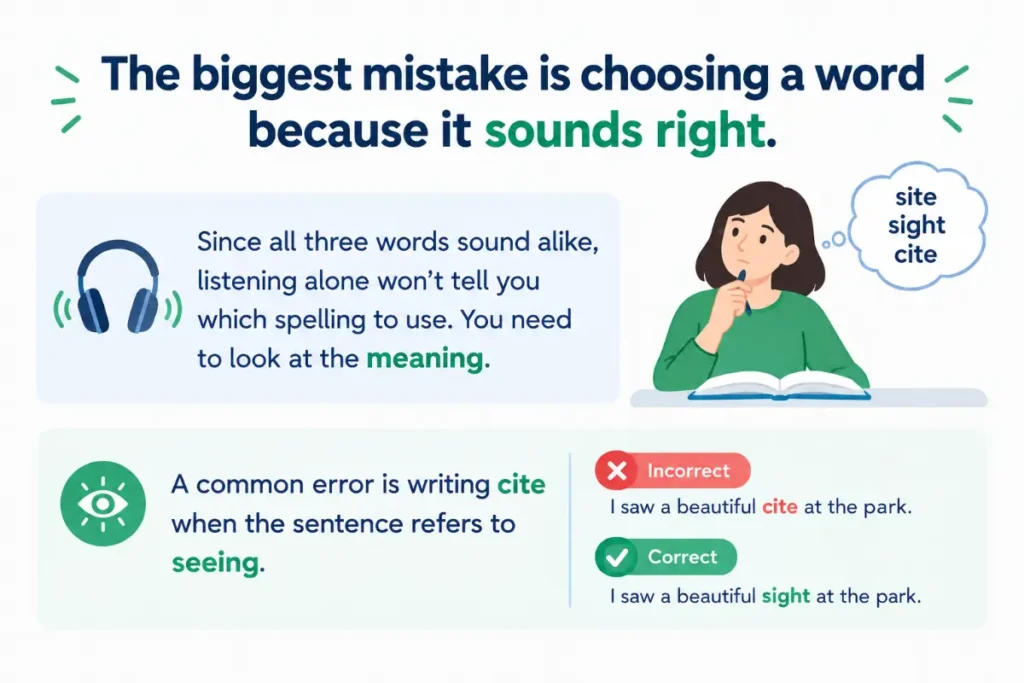
The biggest mistake is choosing a word because it sounds right.
Since all three words sound alike, listening alone won’t tell you which spelling to use. You need to look at the meaning.
A common error is writing cite when the sentence refers to seeing.
Incorrect:
The sunset was a beautiful cite.
Correct:
The sunset was a beautiful sight.
Another common error is using sight when you mean a location.
Incorrect:
The workers arrived at the construction sight.
Correct:
The workers arrived at the construction site.
Writers also sometimes use site when they mean to refer to a source.
Incorrect:
The student sited the research paper.
Correct:
The student cited the research paper.
The correct form is cited because the student referred to the research paper.
Mistake With Website
Website contains site because a website is a place or location on the internet.
For example:
I found the information on the company’s website.
Site does not mean vision in this word. It carries its location related meaning.
This connection can help you remember the spelling.
Mistake With Citation
Citation comes from cite.
For example:
The article contains a citation.
The student cited the article.
If you are talking about giving credit to a source, cite and citation belong to the same word family.
Pronunciation And Spelling
In standard American English, cite, sight, and site are homophones. They share the same basic pronunciation.
The spelling is different because the words developed from different historical sources and carry different meanings.
This is one reason English spelling can feel tricky. Sound does not always tell you which spelling to choose.
For spelling questions, focus on the meaning first.
If the meaning involves a source, think cite.
If the meaning involves a place, think site.
That mental check is more reliable than trying to hear a spelling difference that isn’t present.
Word Origins
The different spellings reflect different histories.
Cite comes through French from Latin roots associated with calling or summoning and developed into the modern idea of referring to or mentioning an authority or source.
Sight is connected with Old English words related to seeing and vision.
Site comes through French from Latin situs, which relates to position or location.
The three words therefore have separate histories even though modern English pronounces them alike.
You don’t need to memorize the etymology to use the words correctly. Still, understanding that they come from different word families explains why their spellings and meanings are so different.
American And British English
The basic distinction between cite, sight, and site is the same in American and British English.
American English uses cite for referring to a source.
British English also uses cite for referring to a source.
Both varieties use sight for vision and something seen.
Both varieties use site for a place or location.
The spelling difference is therefore not an American versus British issue. The same three spellings carry the same basic meanings across major English varieties.
Formal And Informal Usage
Cite is common in formal writing but also appears in ordinary conversation.
For example:
The article cites several studies.
That’s a natural sentence in professional writing.
Sight is extremely common in everyday English.
You might say:
I caught sight of him at the store.
Site is also common in everyday and professional English.
For example:
I’ll meet you at the job site.
The words themselves aren’t restricted to one level of formality. The surrounding context determines the register.
How To Choose The Correct Word
When you aren’t sure which spelling to use, don’t focus on pronunciation.
Ask what the word means.
If you mean mention a source, use cite.
If you mean vision or something seen, use sight.
You can also test the sentence with a replacement word.
If source or refer to works, choose cite.
If seeing or view works, choose sight.
For example:
The researcher cited the report.
You can replace cited with referred to.
The mountain was an impressive sight.
You can replace sight with something seen.
The team selected a new site.
You can replace site with location.
This replacement method works well when proofreading.
Memory Tips
The easiest memory trick is to connect each word with a simple idea.
Cite means source.
Sight means see.
Site means place.
You can make the connections even stronger with short phrases.
Cite a source.
Sight means seeing.
Site is a place.
Another useful trick is to remember that citation begins with cite. If you are thinking about academic references or source information, cite is probably the word you need.
For sight, think of your eyes. Sight is connected directly to vision.
For site, think of a construction site. A construction site is a physical place.
These three mental pictures make the spellings much easier to recall.
Professional Writing Tips
Professional writers should pay special attention to these words because spell check may not catch the mistake.
A spelling checker can recognize cite, sight, and site as valid English words. If you use the wrong one in a sentence, the software may not flag it.
For example:
The report cited several sources.
The report sited several sources.
The second sentence contains the wrong word for the intended meaning, but sited can appear as a valid form in certain contexts. Automated tools may not understand what you intended.
Context matters.
Proofread by meaning rather than spelling alone. Ask yourself what role the word plays in the sentence.
If you’re discussing evidence, sources, or references, check for cite.
If you’re discussing a physical or online location, check for site.
This extra second of attention can prevent an embarrassing error in a report, article, email, essay, or business document.
Related Word Differences
Cite, sight, and site belong to a larger group of English homophones.
Other common examples include:
- To, too, and two.
- Their, there, and they’re.
- Your and you’re.
- Principal and principle.
- Stationary and stationery.
- Accept and except.
- Lead and led.
These words create similar problems because pronunciation doesn’t always reveal spelling.
The solution is the same. Learn the meaning and grammatical role of each word instead of memorizing the sound alone.
A Detailed Comparison
| Feature | Cite | Sight | Site |
|---|---|---|---|
| Main role | Verb | Noun | Noun |
| Main meaning | Refer to a source | Vision or something seen | Place or location |
| Common context | Research and evidence | Seeing and views | Places and locations |
| Related word | Citation | Visual | Location |
| Example | Cite the article | A beautiful sight | A construction site |
| Memory word | Source | See | Place |
This table captures the central distinction.
Cite is about referring.
Sight is about seeing.
Site is about location.
Real Life Example Sentences
Here are examples that show how the words work in ordinary situations.
School
The student cited two books in her essay.
The teacher asked the class to cite reliable sources.
The view from the classroom window was a beautiful sight.
The school selected a new site for its sports field.
Each sentence uses a different word because each sentence expresses a different idea.
Work
The manager cited customer feedback in the report.
The damaged building was a disturbing sight.
The workers met at the job site at eight.
Again, source, seeing, and location guide the choice.
Travel
The guide cited a local history book.
The mountain was an incredible sight.
The tour began at a historic site.
These examples show why the words can appear in similar topics while still having completely different meanings.
Technology
The writer cited a research report.
The image was a strange sight.
The company launched a new website.
Technology creates a particularly useful example because website contains site. A website is an online location.
Quick Practice
Choose cite, sight, or site in each sentence.
- The student needed to ___ the article.
- The waterfall was an amazing ___.
- The company purchased a new ___ for its office.
- The lawyer ___ an earlier court case.
- We lost ___ of the boat.
- The workers arrived at the construction ___.
- The report ___ several government studies.
- The old castle was an impressive ___.
- The museum stands on a historic ___.
- Please ___ your sources.
The answers are:
- cite.
- sight.
- site.
- cited.
- sight.
- site.
- cited.
- sight.
- site.
- cite.
Notice the pattern. Source and evidence call for cite. Vision calls for sight. Location calls for site.
Why These Words Are So Easy To Confuse
The main reason is pronunciation.
When you hear someone say the word, you generally can’t tell which spelling they mean from the sound alone. The surrounding sentence provides the clue.
Imagine hearing:
I need to cite this study.
I need to see this site.
The individual words can sound alike, but the meanings are completely different.
English has many homophones for this reason. Spelling often preserves historical differences that pronunciation no longer shows.
The good news is that cite, sight, and site have very clear semantic boundaries. Once you learn the three core meanings, the problem becomes much smaller.
A Simple Rule To Remember
Use this three word rule:
Cite means source.
Sight means see.
Site means place.
If you are writing about research, evidence, references, or authorities, use cite.
If you are writing about a physical location, online location, construction area, or historical location, use site.
This rule covers most situations you will encounter in school, work, journalism, business, and everyday writing.
Key Takeaways
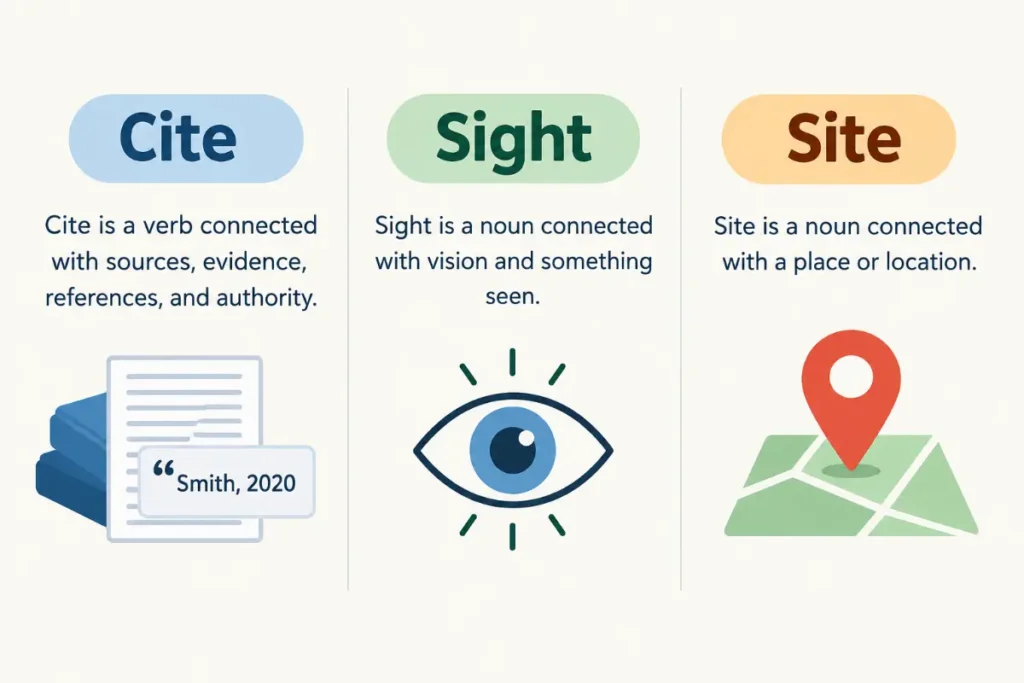
- Cite is a verb connected with sources, evidence, references, and authority.
- Sight is a noun connected with vision and something seen.
- Site is a noun connected with a place or location.
- Cite, sight, and site are homophones in standard American English.
- Use cite when you refer to a source.
- Use sight when you mean vision or something visible.
- Use site when you mean a place or location.
- Citation comes from cite.
- Website contains site because a website is an online location.
- Meaning is the best way to choose the correct spelling.
Conclusion
Cite vs sight vs site becomes much easier once you connect each spelling with its core meaning. Cite relates to sources and references. Sight relates to seeing and vision. Site relates to a place or location. Although the three words sound alike, their jobs in a sentence are completely different.
The most useful memory rule is simple. Cite a source. Sight means seeing. Site means place. When you pause for a moment and identify the meaning before choosing the spelling, these homophones become far easier to handle.
Good spelling depends on more than recognizing sounds. It also depends on understanding meaning, grammar, and context. Keep the three core connections in mind and you’ll be able to use cite, sight, and site accurately in school assignments, professional writing, research, emails, articles, and everyday English.
Frequently Asked Questions
What is the difference between cite sight and site?
Cite is a verb meaning to refer to or mention a source or authority. Sight is a noun related to vision or something seen. Site is a noun meaning a place or location. The three words sound alike but have different meanings and spellings.
Are cite sight and site pronounced the same?
Yes. In standard American English, cite, sight, and site are homophones. They have the same basic pronunciation even though their meanings and spellings differ.
Is cite a noun or a verb?
Cite is primarily a verb. It means to refer to a source, authority, example, or piece of evidence. Its related noun is citation.
Is sight a noun?
Yes. Sight is mainly a noun. It can mean the ability to see or something that is seen. It also appears in many common expressions related to vision.
Is site a noun?
Yes. Site is primarily a noun meaning a place or location. Common examples include construction site, historical site, job site, campsite, and website.
How do I remember cite vs sight vs site?
Connect each word with one simple idea. Cite means source. Sight means seeing. Site means place. You can also remember citation with cite and construction site with site.
Which word means a location?
Site means a location or place. For example, the company chose a new site for its building.
Which word should I use for a research source?
Use cite when you mean to refer to a research source. For example, the student cited a scientific study in the paper.
Can cite mean mention?
Yes. Cite can mean to mention or refer to something as an example, source, reason, or authority.
Does sight mean something you can see?
Yes. Sight can refer to something that is seen. For example, the waterfall was a beautiful sight.
Is website related to site?
Yes. The word website contains site because a website is an online place or location where information or services are available.
Why do cite sight and site have different spellings?
They have different spellings because they developed from different historical word families. Their pronunciations became alike in modern English, but their meanings and spellings remained different.

Confusing Words, Spelling & Word Choice
Claire Whitmore is a U.S.-based English editor who writes about commonly confused words, spelling differences, and word choice. Her work helps readers understand subtle distinctions between similar-looking words through simple definitions, practical examples, and modern usage guidance in both American and British English.