
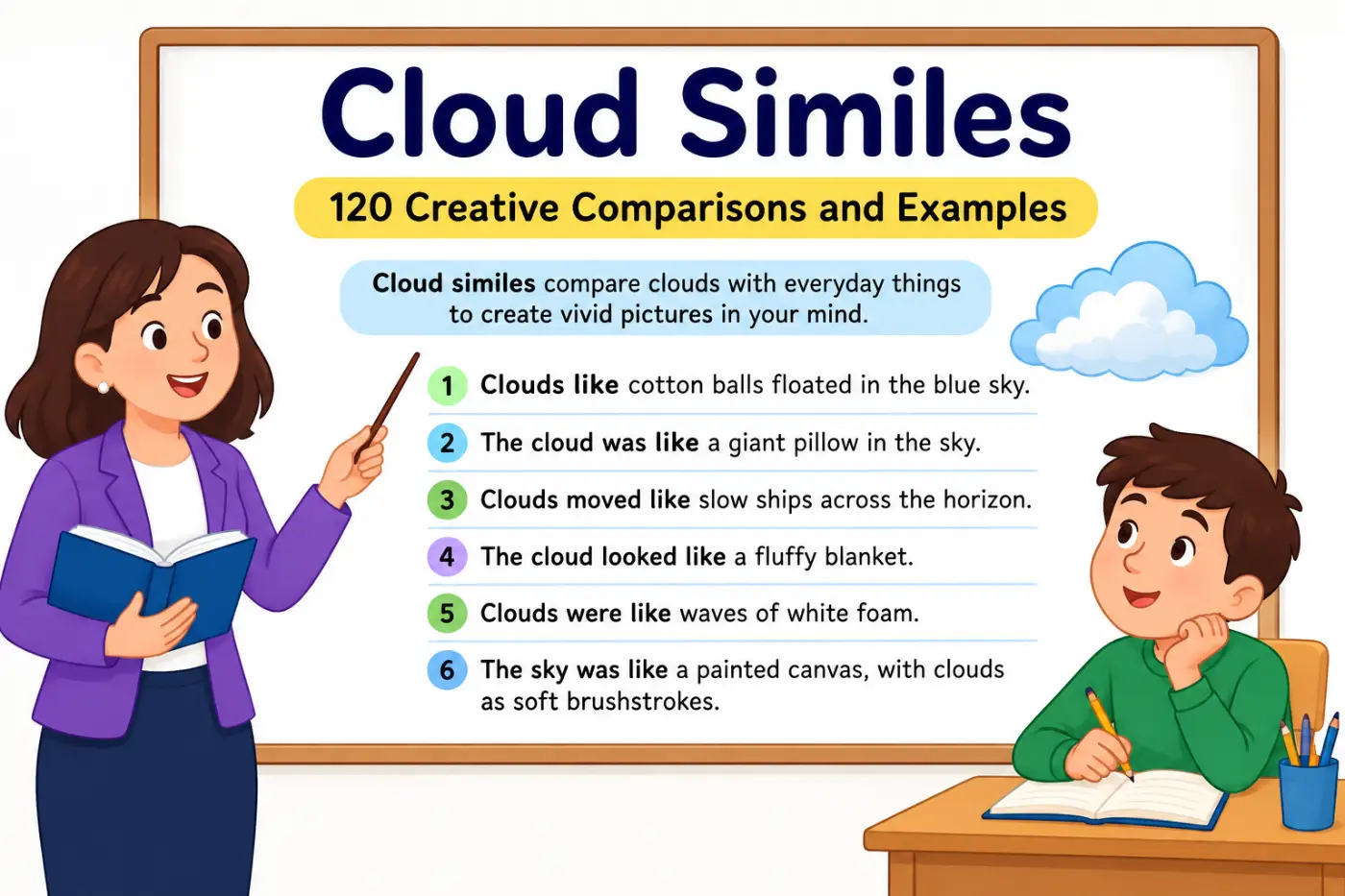
Clouds can look soft, heavy, bright, dark, delicate, or strangely shaped, which makes them perfect for creative comparisons. Cloud Similes help turn simple descriptions into vivid images that readers can easily picture. Instead of saying, “The clouds moved across the sky,” you could write, “The clouds drifted like silver ships across the blue sky.” The second sentence creates a much clearer picture and gives the description more life.
Cloud Similes are useful in creative writing, poetry, descriptive essays, stories, speeches, classroom assignments, and everyday conversations. They can help you describe a cloud’s shape, color, size, texture, movement, or mood in a simple and memorable way. A fluffy cloud might look like a pillow, while a dark storm cloud might resemble a heavy curtain covering the sky.
A simile compares one thing with another using words such as like or as. The comparison doesn’t need to be literally true. Instead, it connects the thing you’re describing with something familiar so the reader can form a stronger mental image.
Short Answer
Cloud similes compare clouds to familiar people, objects, animals, places, foods, and scenes using words such as like or as. For example, “The cloud was like a giant pillow floating across the sky” creates a clear mental picture. Good cloud similes can make descriptions more vivid, poetic, emotional, and memorable.
Table of Contents
- What Is a Cloud Simile
- How Cloud Similes Work
- Similes for Soft and Fluffy Clouds
- Similes for White Clouds
- Similes for Gray and Dark Clouds
- Similes for Storm Clouds
- Similes for Moving Clouds
- Similes for Clouds at Sunrise
- Similes for Clouds at Sunset
- Similes for Clouds at Night
- Similes for Unusual Cloud Shapes
- Similes for Thin and Wispy Clouds
- Similes for Huge Clouds
- Similes for Peaceful Clouds
- Similes for Dramatic Clouds
- Similes for Clouds in Creative Writing
- Common Mistakes
- How to Choose the Right Simile
- Memory Tips
- Related Figurative Language
- Frequently Asked Questions
- Key Takeaways
- Conclusion
What Is a Cloud Simile
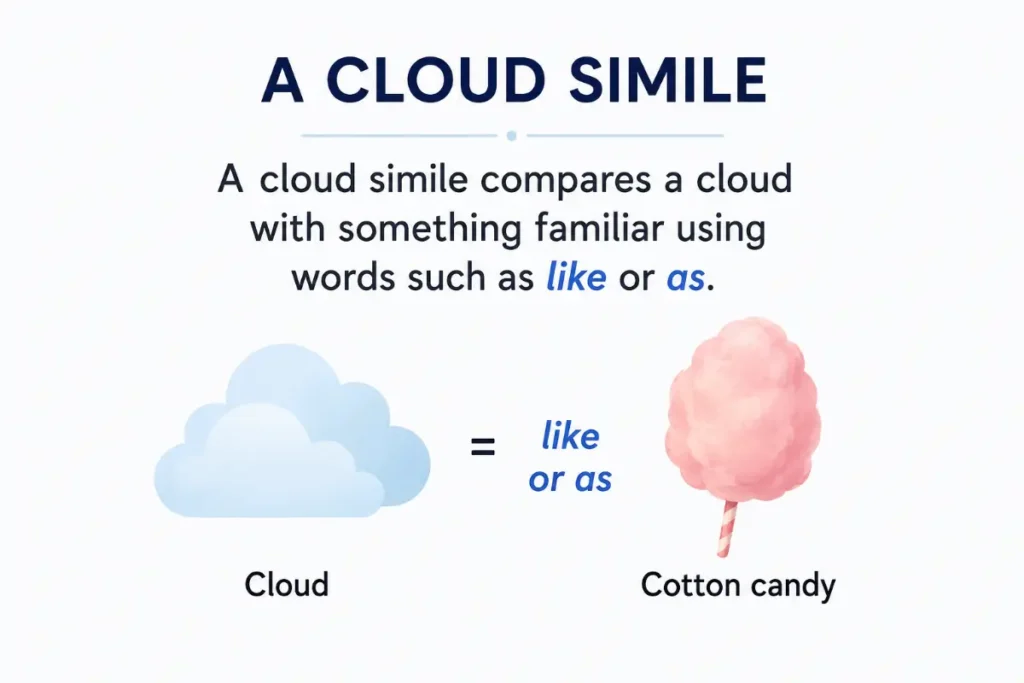
A cloud simile is a comparison that describes a cloud by connecting it to something familiar. The comparison normally uses like or as.
For example:
The cloud was like a giant ball of cotton.
The cloud isn’t actually cotton. The writer compares its soft, rounded appearance to cotton so the reader can picture it more easily.
Another example is:
The storm clouds gathered like soldiers preparing for battle.
The clouds aren’t soldiers. The comparison suggests that they looked organized, powerful, and threatening.
A strong simile usually has two parts. The first part is the subject being described, and the second part is the image used for comparison.
The clouds were like ships on a blue ocean.
The clouds are the subject. Ships are the comparison. The blue sky becomes the background that connects the two images.
How Cloud Similes Work
The best similes don’t simply compare two random things. They highlight a specific quality.
A cloud might be compared to cotton because it looks soft. It might be compared to a mountain because it looks enormous. It might be compared to smoke because it is gray and spreading.
Consider these three examples.
The cloud was like cotton.
This focuses on softness.
The cloud was like a mountain.
This focuses on size and shape.
The cloud was like smoke spreading across the sky.
This focuses on movement and appearance.
The comparison changes the mental picture even though the subject remains the same.
When creating a simile, ask yourself what you want the reader to notice. Is the cloud soft, bright, dark, enormous, fast moving, peaceful, mysterious, or threatening? Choose an image that strengthens that exact quality.
Similes for Soft and Fluffy Clouds
Soft clouds often remind people of pillows, cotton, foam, wool, and other gentle materials. These comparisons work well in children’s writing, peaceful descriptions, poetry, and scenes involving pleasant weather.
- The cloud was like a giant pillow floating overhead. This emphasizes its soft and comfortable appearance.
- The clouds looked like heaps of cotton in the blue sky. This highlights their fluffy texture.
- The cloud floated like a feather above the rooftops. This suggests lightness and delicacy.
- The clouds were as soft as wool in a basket. This creates a warm and gentle image.
- The cloud looked like a scoop of whipped cream. This emphasizes its rounded and fluffy shape.
- The clouds drifted like tufts of white cotton. This suggests both softness and slow movement.
- The cloud was like a soft blanket spread across the sky. This gives the sky a cozy feeling.
- The clouds looked as fluffy as freshly brushed wool. This focuses on their thick texture.
- The cloud hovered like a puff of foam. This suggests a light and rounded appearance.
- The clouds resembled piles of soft pillows stacked in the distance. This emphasizes their large, rounded shapes.
Similes for White Clouds
White clouds stand out strongly against a blue sky. Writers can compare them to snow, pearls, marble, paper, sails, and other bright objects.
- The cloud was white like fresh snow. This emphasizes its clean and bright appearance.
- The clouds floated like white sails across the sky. This creates an image of graceful movement.
- The clouds shone like pearls against the blue. This gives them a delicate and beautiful quality.
- The cloud looked like a piece of white marble suspended above the hills. This focuses on its bright, solid appearance.
- The clouds were as white as freshly washed linen. This suggests cleanliness and brightness.
- The cloud appeared like a bright island in a blue ocean. The sky becomes an imaginary ocean around the cloud.
- The clouds looked like pieces of torn paper scattered across the sky. This emphasizes their irregular shapes.
- The white clouds floated like swans across the horizon. This creates a graceful and elegant image.
- The cloud was like a bright mound of snow in the distance. This emphasizes its rounded shape.
- The clouds gleamed like polished stones in the afternoon light. This gives the clouds a bright, almost shining quality.
Similes for Gray and Dark Clouds
Gray clouds can make the sky look quiet, heavy, cold, or gloomy. These comparisons work well when describing rain or a change in weather.
- The clouds were like sheets of gray metal covering the sky. This creates a cold and heavy feeling.
- The cloud hung like a dark curtain above the town. This suggests that the sky felt closed and gloomy.
- The clouds looked like ash spreading across the horizon. This emphasizes their gray color.
- The sky was covered with clouds like a blanket of smoke. This suggests a thick and hazy appearance.
- The gray clouds gathered like piles of wet wool. This combines their color, weight, and texture.
- The clouds looked as dull as old stone. This emphasizes their lack of brightness.
- The cloud drifted like a shadow across the hills. This suggests darkness and movement.
- The clouds hung over the city like a heavy ceiling. This makes the sky feel low and oppressive.
- The gray clouds spread like ink in water. This focuses on their gradual expansion.
- The clouds covered the sky like a thick gray cloth. This emphasizes how completely they block the blue sky.
Similes for Storm Clouds
Storm clouds create some of the strongest images in descriptive writing. They can suggest danger, power, fear, tension, or approaching change.
- The storm clouds gathered like an army on the horizon. This suggests strength and approaching danger.
- The clouds rolled in like dark waves. This makes the storm seem powerful and fast moving.
- The storm cloud looked like a giant bruise across the sky. This creates a dark and dramatic image.
- The clouds towered like mountains before the storm. This emphasizes their enormous size.
- The clouds advanced like a dark wall. This suggests that the storm was spreading quickly.
- The storm clouds hung like a warning over the village. This creates a sense of danger.
- The clouds twisted like black smoke above the fields. This emphasizes their irregular movement.
- The storm gathered like a giant fist closing over the land. This creates a powerful image of approaching weather.
- The clouds looked like dark ships sailing toward the town. This emphasizes their movement and size.
- The storm clouds pressed against the sky like a heavy lid. This makes the atmosphere feel closed and oppressive.
Similes for Moving Clouds
Clouds constantly change shape and position. Their movement can be slow, fast, smooth, restless, or unpredictable.
- The clouds moved like ships sailing across a blue sea. This gives their movement a calm and steady quality.
- The cloud drifted like a balloon released into the wind. This suggests light and uncontrolled movement.
- The clouds raced like horses across the sky. This emphasizes speed.
- The cloud floated like a leaf on a gentle stream. This suggests slow and peaceful movement.
- The clouds scattered like birds startled from a tree. This describes sudden movement in different directions.
- The cloud slipped across the sky like a shadow. This suggests quiet and smooth movement.
- The clouds rolled like waves across the horizon. This gives them a powerful flowing motion.
- The clouds wandered like travelers with no destination. This creates a relaxed and imaginative image.
- The cloud sailed like a paper boat through the blue sky. This emphasizes its lightness.
- The clouds hurried like children running home before rain. This gives the scene a lively and playful feeling.
Similes for Clouds at Sunrise
Sunrise changes ordinary clouds into colorful shapes. Pink, orange, gold, and red light can make them appear almost magical.
- The clouds glowed like embers at sunrise. This emphasizes their warm red and orange colors.
- The clouds looked like golden islands in a pink sky. This creates a peaceful sunrise scene.
- The clouds shone like ribbons of copper above the horizon. This highlights their warm metallic color.
- The clouds were like brushes dipped in orange paint. This suggests that the sunrise has colored them.
- The clouds glowed like lanterns in the morning light. This emphasizes their warm brightness.
- The clouds looked as pink as rose petals. This creates a soft and delicate image.
- The clouds floated like golden ships on a sea of light. This combines movement with sunrise colors.
- The clouds burned like small fires along the horizon. This gives the sunrise a dramatic quality.
- The clouds appeared like peach colored mountains in the distance. This emphasizes their shape and warm color.
- The clouds shone like coins touched by sunlight. This highlights their golden appearance.
Similes for Clouds at Sunset
Sunset clouds can become orange, red, purple, pink, gold, and deep gray. They work especially well in poetry and reflective writing.
- The clouds glowed like burning coals at sunset. This emphasizes deep orange and red colors.
- The clouds looked like islands painted with gold. This gives the scene a rich and peaceful quality.
- The clouds stretched like ribbons of fire across the horizon. This highlights their long shapes and warm colors.
- The clouds were like rose petals scattered across the evening sky. This creates a soft and romantic image.
- The clouds shone like copper beneath the setting sun. This emphasizes their warm metallic color.
- The clouds looked like mountains dipped in pink paint. This focuses on their shape and color.
- The sunset clouds floated like glowing ships. This creates a calm image of movement.
- The clouds burned like orange flames along the horizon. This creates a strong and dramatic scene.
- The clouds appeared like purple velvet in the fading light. This suggests richness and softness.
- The clouds glimmered like jewels scattered across the evening sky. This emphasizes their colorful brightness.
Similes for Clouds at Night
Night clouds can look mysterious, pale, dark, silver, or almost invisible. Moonlight can create strong contrasts.
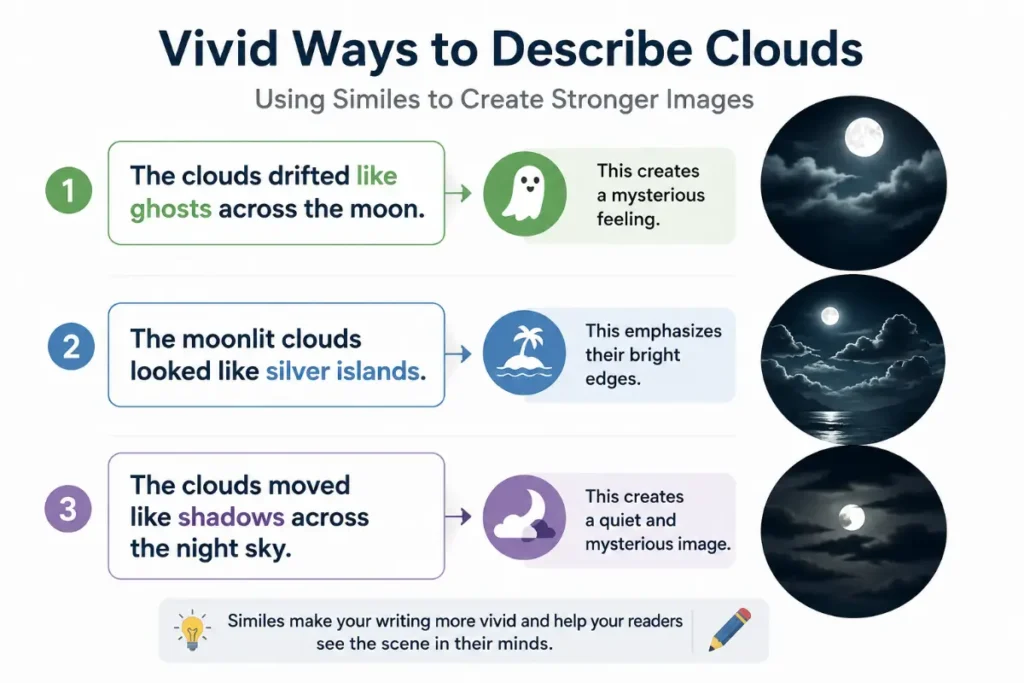
- The clouds drifted like ghosts across the moon. This creates a mysterious feeling.
- The moonlit clouds looked like silver islands. This emphasizes their bright edges.
- The clouds moved like shadows across the night sky. This creates a quiet and mysterious image.
- The cloud looked like a dark curtain around the moon. This focuses on its shape and position.
- The clouds were as pale as smoke beneath the moonlight. This emphasizes their faint appearance.
- The clouds floated like white ships through the darkness. This creates contrast between the clouds and night.
- The cloud passed over the moon like a veil. This suggests a thin layer that partially hides the moon.
- The clouds gathered like silent watchers above the sleeping town. This gives them a mysterious personality.
- The cloud edges shone like silver thread in the darkness. This highlights the moonlit edges.
- The clouds looked like dark mountains beneath the stars. This emphasizes their large and shadowy forms.
Similes for Unusual Cloud Shapes
Clouds often resemble familiar objects or creatures. These comparisons are useful when the shape itself catches your attention.
- The cloud looked like a giant rabbit hopping across the sky. This gives the cloud a playful shape.
- The cloud resembled a sleeping dragon. This creates a fantasy image.
- The cloud looked like a whale floating above the hills. This emphasizes a large curved shape.
- The cloud was shaped like a sailing ship. This gives the sky a nautical image.
- The cloud looked like a castle with towers reaching upward. This highlights tall cloud formations.
- The cloud resembled an elephant with its trunk stretched forward. This creates a playful visual comparison.
- The clouds looked like mountains stacked one behind another. This emphasizes their height and layered appearance.
- The cloud appeared like a giant bird spreading its wings. This suggests a broad and dramatic shape.
- The cloud looked like a giant mushroom growing above the forest. This emphasizes its rounded top and narrow base.
- The clouds resembled waves frozen in the sky. This combines shape and stillness.
Similes for Thin and Wispy Clouds
Thin clouds often appear delicate, stretched, or almost transparent. They can resemble feathers, threads, brushstrokes, or smoke.
- The thin cloud looked like a feather floating in the wind. This emphasizes its lightness.
- The wispy clouds stretched like strands of silk. This highlights their long and delicate shape.
- The clouds looked like brushstrokes across a blue canvas. This presents the sky as a painting.
- The thin clouds drifted like threads pulled across the sky. This emphasizes their narrow shapes.
- The clouds appeared like faint smoke from a distant fire. This suggests their light and hazy appearance.
- The wisps of cloud looked like strands of silver hair. This creates a delicate visual image.
- The clouds stretched like ribbons in a gentle breeze. This emphasizes their long flowing shapes.
- The thin clouds were as delicate as spider silk. This focuses on their fragile appearance.
- The clouds floated like scraps of tissue paper. This emphasizes their thin and light quality.
- The wispy clouds looked like pale brush marks on glass. This creates a subtle artistic image.
Similes for Huge Clouds
Large clouds can dominate the entire sky. Comparing them to mountains, buildings, walls, and giants helps readers understand their scale.
- The cloud rose like a mountain above the valley. This emphasizes its enormous height.
- The clouds towered like skyscrapers in the distance. This highlights their vertical size.
- The cloud stretched like a giant wall across the horizon. This emphasizes its width.
- The clouds rose like enormous castles above the fields. This gives them a grand appearance.
- The cloud looked like a giant mountain floating in the sky. This emphasizes both size and shape.
- The clouds stood like giants over the town. This makes them seem powerful and enormous.
- The cloud expanded like a huge wave rising before the shore. This suggests increasing size and movement.
- The clouds filled the sky like a vast white fortress. This emphasizes their scale.
- The cloud looked like an enormous ship suspended above the earth. This combines size with shape.
- The clouds rose like towering cliffs beyond the trees. This gives them a strong vertical appearance.
Similes for Peaceful Clouds
Peaceful cloud descriptions work well in reflective writing, nature essays, poems, and relaxing scenes.
- The clouds drifted like sleepy boats on a quiet sea. This creates a calm and gentle image.
- The clouds floated like feathers in a quiet breeze. This emphasizes softness and peaceful movement.
- The cloud rested like a pillow above the meadow. This gives the scene a comfortable feeling.
- The clouds moved like slow dancers across the sky. This gives their movement a graceful quality.
- The clouds were as calm as boats on still water. This emphasizes peacefulness.
- The cloud floated like a soft thought through the blue sky. This creates a dreamy and reflective image.
- The clouds drifted like quiet travelers above the hills. This gives them a gentle sense of movement.
- The cloud rested like a white blanket over the distant mountains. This emphasizes softness and stillness.
- The clouds moved like slow waves in a peaceful sea. This creates a relaxed image.
- The cloud hovered like a quiet guardian above the field. This gives the cloud a gentle protective quality.
Similes for Dramatic Clouds
Dramatic clouds can make an ordinary landscape feel powerful or mysterious. Strong comparisons help create tension and emotional weight.
- The clouds twisted like giant flames above the horizon. This emphasizes movement and intensity.
- The storm cloud looked like a black crown over the hills. This gives the cloud a striking shape.
- The clouds gathered like a dark crowd before the rain. This creates a sense of expectation.
- The clouds rolled across the sky like thunderous waves. This emphasizes power and movement.
- The cloud spread like spilled ink across the blue. This highlights its expanding darkness.
- The clouds towered like silent giants over the valley. This creates a powerful and imposing image.
- The clouds curled like smoke around the mountain peaks. This emphasizes their twisting shape.
- The storm clouds hung like a dark cloak over the countryside. This creates a gloomy and dramatic atmosphere.
- The clouds surged like an advancing tide. This emphasizes forceful movement.
- The sky filled with clouds like a stage preparing for a dramatic performance. This gives the scene a feeling of anticipation.
Similes for Clouds in Creative Writing
Writers can use cloud comparisons to express emotions, establish atmosphere, or connect nature with a character’s experience.
- The clouds drifted like forgotten memories. This creates a reflective and slightly sad mood.
- The cloud hung above him like an unanswered question. This connects the sky with uncertainty.
- The clouds scattered like worries after a good night’s sleep. This suggests relief.
- The storm cloud followed the traveler like a dark companion. This creates a feeling of tension.
- The clouds opened like curtains around the morning sun. This suggests hope and renewal.
- The clouds gathered like thoughts inside a troubled mind. This connects changing weather with emotion.
- The white clouds floated like dreams that had escaped into the sky. This creates a gentle imaginative image.
- The dark clouds pressed down like sadness over the empty road. This creates an emotional atmosphere.
- The clouds broke apart like fear giving way to courage. This suggests emotional change.
- The clouds moved like pages turning in a giant book. This gives the changing sky a storytelling quality.
How to Use Cloud Similes in Sentences
A good simile should fit naturally into the sentence. You don’t need to force a comparison into every description.
Consider this simple sentence:
The clouds moved across the sky.
It tells the reader what happened, but the image remains basic.
Now consider:
The clouds moved like white ships across the blue sky.
The second version gives the reader a stronger visual image. The comparison also suggests smooth, steady movement.
Another example is:
Dark clouds covered the town like a heavy blanket.
The comparison communicates more than color. It suggests that the clouds completely covered the area and created a heavy atmosphere.
A simile can also appear at the beginning of a sentence.
Like ships on a blue ocean, the clouds drifted toward the horizon.
This structure puts more emphasis on the comparison.
How to Choose the Right Cloud Simile
Start with the quality you want to describe.
If the cloud looks soft, think about pillows, cotton, wool, feathers, foam, or blankets.
If the cloud appears during sunset, warm comparisons such as fire, copper, gold, roses, jewels, and glowing lanterns can work well.
The strongest comparison matches the visual quality instead of simply sounding impressive.
Common Mistakes With Cloud Similes
Using A Metaphor Instead Of A Simile
A simile normally uses like or as to make a comparison.
The cloud was like a mountain.
This is a simile.
The cloud was a mountain.
This is a metaphor.
Both forms can create vivid writing, but they use different structures.
Making The Comparison Too Literal
A simile works because the comparison is imaginative.
The cloud looked like another cloud.
This doesn’t give the reader a useful mental picture.
A stronger sentence would be:
The cloud looked like a giant pillow floating above the house.
The second comparison gives the reader a specific visual quality.
Using A Comparison That Doesn’t Match
A simile should make sense within the context.
The tiny wispy cloud was like a massive mountain.
The comparison creates confusion if the writer intends to describe the cloud’s actual appearance.
A better comparison might be:
The tiny wispy cloud was like a feather drifting across the sky.
Repeating The Same Comparison
Using “clouds like cotton” several times can make writing feel predictable. A writer can keep the idea of softness while changing the image to pillows, wool, foam, feathers, or whipped cream.
Overloading One Sentence
Too many comparisons can weaken the main image.
The cloud was like cotton, a pillow, a ship, a mountain, and a blanket.
The reader doesn’t know which image to focus on.
One strong comparison usually works better than several competing comparisons.
Are Cloud Similes Good For Kids
Yes. Similes are useful for helping children understand descriptive writing because they connect unfamiliar images with familiar objects.
For example:
The cloud was like a fluffy pillow.
A child can immediately imagine a soft white cloud.
Teachers can also ask students to observe the sky and create comparisons based on shape, color, movement, and texture. This activity builds vocabulary and helps students understand figurative language.
For younger learners, simple comparisons usually work best.
The cloud was like cotton.
The clouds moved like birds.
The sky was as blue as the ocean.
Older students can experiment with emotional and imaginative comparisons.
The storm cloud followed the lonely road like a dark shadow.
Are Cloud Similes Used In Poetry
Yes. Similes are common in poetry because they allow writers to create vivid images with relatively few words.
A poet might write:
The clouds drifted like pale ships beneath the moon.
The comparison gives the reader an image while also creating a calm nighttime mood.
Poetry often uses comparisons that have emotional meaning. A dark cloud might represent sadness, uncertainty, fear, or conflict. A bright cloud might suggest hope, freedom, peace, or renewal.
The comparison doesn’t need to explain everything directly. A carefully chosen image can allow the reader to feel the atmosphere.
Similes For Different Writing Situations
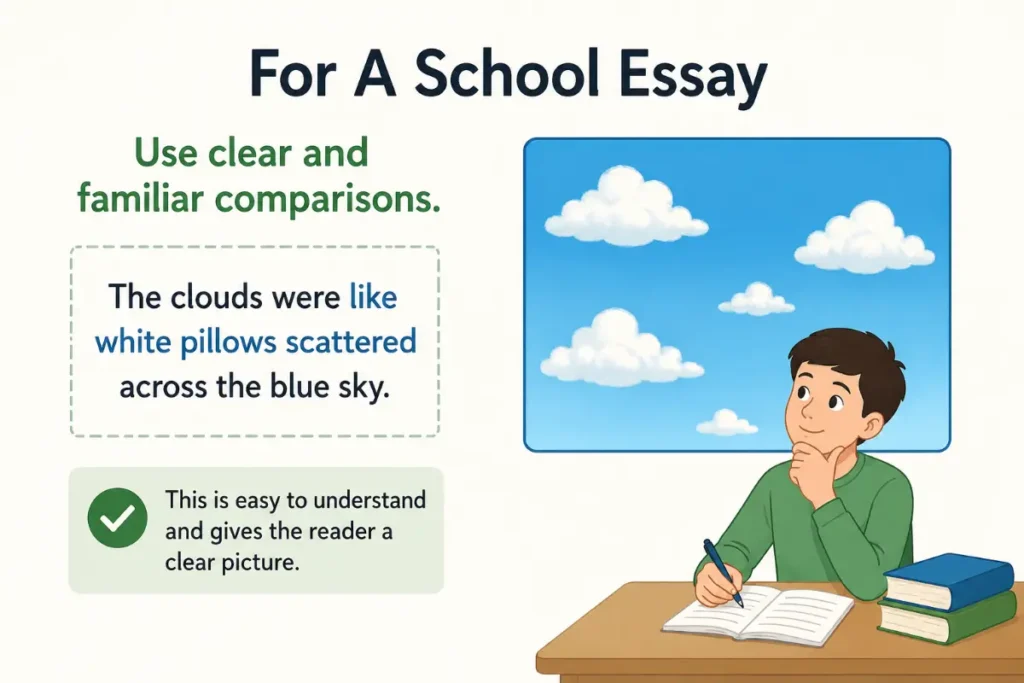
For A School Essay
Use clear and familiar comparisons.
The clouds were like white pillows scattered across the blue sky.
This is easy to understand and gives the reader a clear picture.
For A Story
Use a comparison that supports the scene.
Dark clouds gathered like an army beyond the village.
This creates tension and prepares the reader for a storm.
For A Poem
You can use more imaginative language.
The clouds drifted like forgotten dreams beneath the evening moon.
This creates a reflective mood.
For A Children’s Story
Choose playful comparisons.
The little cloud bounced across the sky like a fluffy ball.
This makes the scene friendly and imaginative.
For Nature Writing
Focus on observation.
The clouds stretched like long brushstrokes across the morning sky.
This sounds descriptive without becoming overly dramatic.
Memory Tips
Remember the basic formula:
Subject + like or as + comparison.
For example:
The cloud was like a pillow.
You can also remember four useful questions.
What does it look like?
How does it move?
What mood does it create?
What familiar thing shares that quality?
If it moves quickly, choose something fast.
If it looks peaceful, choose something calm.
This simple method makes it easier to create original similes instead of memorizing fixed phrases.
Related Figurative Language
Metaphor
A metaphor directly identifies one thing with another.
The cloud was a giant ship.
Unlike a simile, it doesn’t normally use like or as.
Personification
Personification gives human qualities to something that isn’t human.
The clouds marched across the sky.
Clouds cannot literally march, but the verb creates a human style of movement.
Imagery
Imagery uses descriptive language to help readers experience a scene through their senses.
The cold gray clouds pressed over the silent fields.
This sentence uses visual and emotional imagery.
Alliteration
Alliteration repeats the initial sound of nearby words.
Soft silver clouds slipped across the sky.
The repeated s sound gives the sentence a noticeable rhythm.
Hyperbole
Hyperbole uses deliberate exaggeration.
The cloud was as enormous as the whole world.
The cloud isn’t literally the size of the world. The exaggeration emphasizes its impressive appearance.
Professional Writing Tips
A strong simile should serve the sentence instead of showing off the writer’s vocabulary. Simple comparisons often create clearer images than complicated ones.
Think about the reader’s experience. If the reader can picture the cloud immediately, the comparison has done its job.
Also consider tone. A playful story might use a cloud like a bouncing ball, while a suspense story might compare clouds to a dark army.
Avoid choosing a comparison simply because it sounds poetic. The image should connect naturally to the subject.
Specificity also helps. Instead of writing “The cloud was like something soft,” choose a recognizable object such as a pillow, feather, or piece of wool.
Key Takeaways
- A cloud simile compares a cloud with something familiar using words such as like or as.
- Strong similes focus on a specific quality such as color, shape, size, texture, movement, or mood.
- Soft clouds can be compared with pillows, cotton, wool, feathers, foam, and blankets.
- Dark clouds can be compared with smoke, ink, curtains, shadows, walls, and heavy cloth.
- Storm clouds work well with powerful comparisons involving armies, waves, mountains, giants, and dark walls.
- Sunset clouds can be compared with fire, copper, gold, roses, jewels, and glowing lanterns.
- Unusual cloud shapes can become playful comparisons with animals, castles, ships, mountains, and other recognizable forms.
- The best simile fits the context and helps the reader form a clear mental image.
- Avoid using several unrelated comparisons in one sentence.
- Original comparisons usually make descriptive writing more memorable than repeated stock phrases.
Conclusion
Cloud Similes give ordinary descriptions a stronger visual and emotional effect. Instead of simply telling readers that clouds are white, dark, large, soft, or moving, a well chosen comparison helps them see those qualities for themselves. The most effective approach is simple. Look closely at the cloud, identify its strongest quality, and connect that quality to something familiar. A fluffy cloud might become a pillow, a storm cloud might become an army, and a thin cloud might become a feather.
The 140 examples in this guide provide a starting point, but the best similes often come from careful observation. Look at the shape, color, movement, light, and mood of the sky. Then choose an image that makes the description clearer rather than simply more complicated.
Used thoughtfully, Cloud Similes can strengthen stories, poems, essays, classroom assignments, nature descriptions, and everyday creative writing. The goal isn’t to make every sentence elaborate. The goal is to give the reader an image that feels immediate, natural, and easy to remember.
Frequently Asked Questions
What Is A Simile For A Cloud?
A useful example is “The cloud was like a giant pillow floating in the sky.” This compares the cloud with a pillow to emphasize its soft, rounded, and comfortable appearance.
What Is A Good Simile For Clouds?
A strong example is “The clouds floated like white ships across a blue ocean.” It compares the sky to an ocean and the clouds to ships, creating a clear picture of slow movement.
What Is A Simile For Fluffy Clouds?
You can say, “The clouds looked like heaps of cotton.” The comparison works because both clouds and cotton can appear soft, white, light, and fluffy.
What Is A Simile For Dark Clouds?
“The dark clouds spread like ink across the sky” is a strong example. It emphasizes how the clouds gradually cover the blue sky while highlighting their dark color.
What Is A Simile For Storm Clouds?
“The storm clouds gathered like an army on the horizon” creates a dramatic comparison. It suggests that the clouds are powerful, organized, and approaching.
What Is A Simile For Clouds Moving?
“The clouds moved like ships across a blue sea” works well for slow and graceful movement. For fast movement, “The clouds raced like horses across the sky” creates a stronger sense of speed.
Can A Simile Describe Cloud Color?
Yes. A simile can describe color very effectively. For example, “The clouds glowed like embers at sunset” connects the orange and red colors of clouds with the warm appearance of burning embers.
How Do I Make My Own Cloud Similes?
First identify one noticeable quality of the cloud. Then think of something familiar that shares that quality. If the cloud is thin, you might compare it with silk or a feather. If it is enormous, you might compare it with a mountain or castle.
Are Cloud Similes And Cloud Metaphors The Same?
No. A simile usually makes a comparison with like or as, while a metaphor makes a direct comparison. “The cloud was like a ship” is a simile, while “The cloud was a ship” is a metaphor.
Can I Use Cloud Similes In Academic Writing?
You can use them in descriptive assignments, literary analysis, creative writing, and other contexts where figurative language is appropriate. In highly technical or scientific writing, direct descriptions are usually clearer.

English Grammar & Usage
Nathan Holloway is an American grammar writer and language researcher who specializes in English grammar, sentence structure, verb usage, and common writing mistakes. He enjoys breaking down confusing grammar rules into practical explanations with clear examples, making English easier for students, professionals, and everyday writers.