
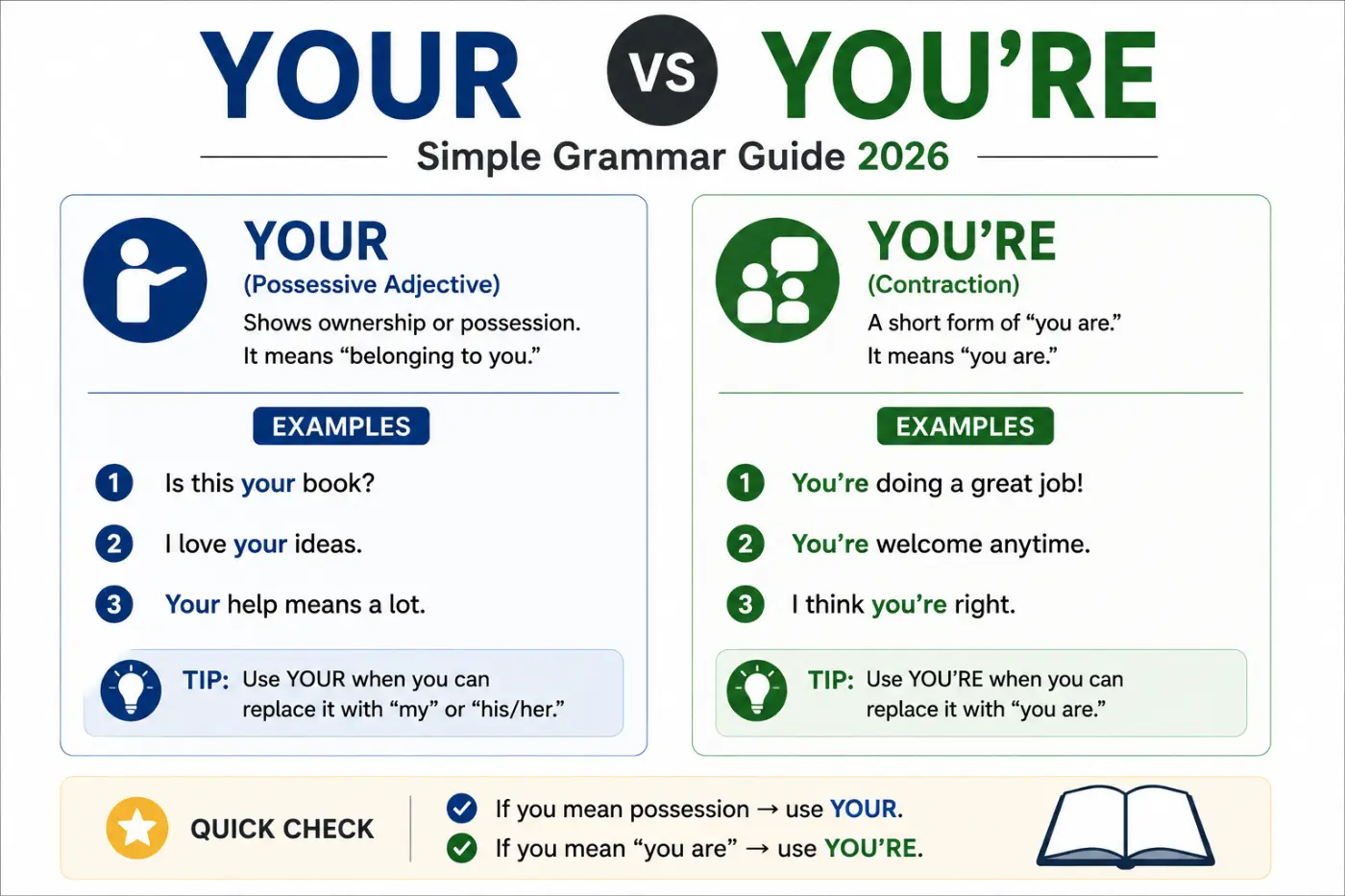
Your vs You’re is one of the most common grammar mistakes in English because the two words sound almost exactly the same in normal speech. They look different on the page, but when you hear someone say them, the difference can disappear.
The confusion usually happens because both words have the same pronunciation in most varieties of English. Writers must therefore rely on grammar and meaning rather than sound.
This guide explains the difference between the two words, shows you how to choose the correct form, covers common mistakes, and gives you practical examples for school, work, texting, social media, and everyday conversation.
Short Answer
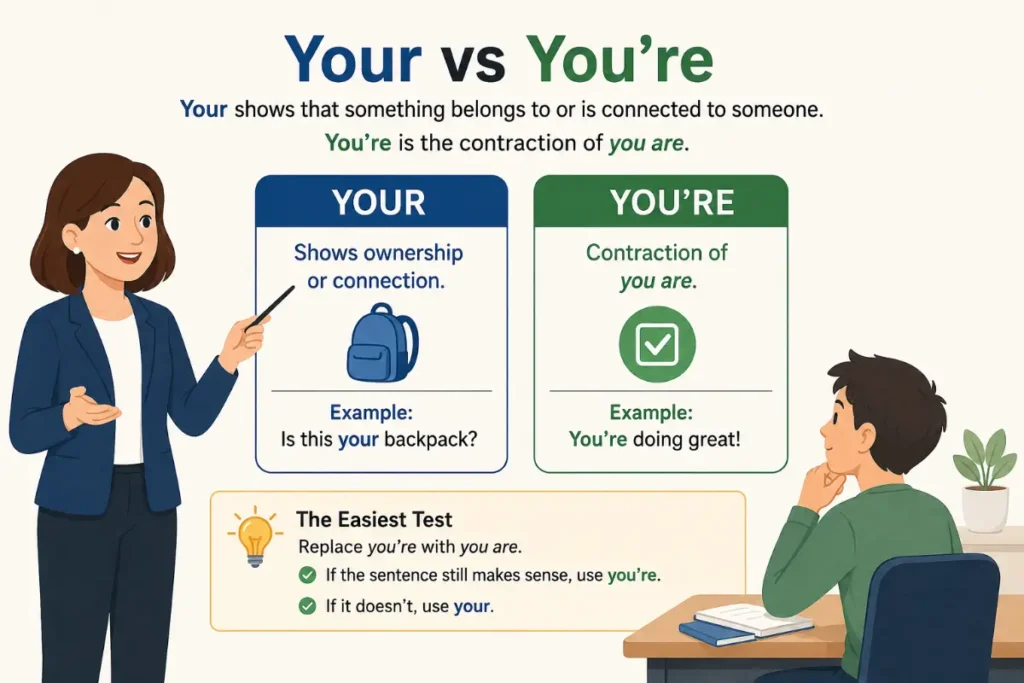
Your shows that something belongs to or is connected to someone. You’re is the contraction of you are. The easiest test is to replace you’re with you are. If the sentence still makes sense, use you’re. If it doesn’t, use your.
Table of Contents
- What Your Means
- What You’re Means
- The Main Difference
- The Easy You Are Test
- Your as a Possessive Determiner
- You’re as a Contraction
- Comparison Table
- Examples With Your
- Examples With You’re
- Examples With Both Words
- Common Mistakes
- Why These Words Cause Confusion
- Pronunciation
- Grammar Rules
- Your Before Nouns
- You’re Before Adjectives
- You’re Before Present Participles
- You’re Before Past Participles
- Your With Body Parts and Relationships
- Your in Formal Writing
- You’re in Formal Writing
- Your and You’re in Questions
- Your and You’re in Negative Sentences
- Your and You’re in Questions With Do
- Memory Tips
- Similar Confusing Words
- Professional Writing Tips
- Real Life Examples
- Key Takeaways
- Frequently Asked Questions
- Conclusion
What Your Means
Your is a possessive determiner. It comes before a noun and tells us that the noun belongs to, concerns, or is connected with the person being addressed.
For example:
- Your car is outside.
- I like your idea.
- Where is your notebook?
- Your brother called earlier.
- Please check your email.
In each sentence, your connects the noun with the person being spoken to.
The word doesn’t always mean literal ownership. English often uses your for relationships, body parts, ideas, opinions, responsibilities, and things associated with someone.
For example:
Your mother is waiting outside.
The word your identifies the relationship between the listener and their mother.
Similarly:
Wash your hands before dinner.
The hands aren’t possessions in the same sense as a phone or car. Your simply identifies whose hands the speaker means.
This distinction matters because some learners assume that your can appear only when someone owns something. In English, possessive determiners have a much broader function.
What You’re Means
You’re is a contraction of you are.
The apostrophe represents letters removed from the longer expression.
You are → You’re
For example:
- You’re very kind.
- You’re my best friend.
- You’re working too hard.
- You’re invited to the meeting.
- You’re responsible for this task.
You can expand every one of these sentences.
You’re very kind.
You are very kind.
You’re working too hard.
You are working too hard.
You’re responsible for this task.
You are responsible for this task.
If replacing you’re with you are produces a grammatical sentence with the same meaning, you’re is the correct choice.
The Main Difference
The difference between your and you’re is grammatical rather than pronunciation based.
Your shows possession or association.
You’re means you are.
A simple way to remember the distinction is:
Your = belongs to you or relates to you.
You’re = you are.
Compare these sentences:
Your answer is correct.
The answer belongs to or is associated with you.
You’re correct.
This means you are correct.
The two words can appear next to each other in the same sentence.
You’re proud of your achievement.
Here, you’re means you are, while your shows the connection between the achievement and the person being addressed.
This is one of the best ways to understand the difference because both forms can appear naturally in the same sentence.
The Easy You Are Test
The most reliable test is to replace you’re with you are.
Take this sentence:
You’re ready.
Replace the contraction:
You are ready.
The sentence works, so you’re is correct.
Now try this:
Your ready.
Replace your with you are:
You are ready.
This creates a sentence that appears grammatical, but it changes the original structure because your was supposed to modify something. The phrase needs a noun after your, such as:
Your ready answer impressed everyone.
In ordinary sentences, you can usually spot the difference by checking what comes after the word.
If the word is followed by a noun, your is often correct.
If the word means you are, you’re is correct.
This test works in most everyday situations and is much more dependable than trying to hear the difference.
Your as a Possessive Determiner
Your belongs to the group of possessive determiners that includes my, his, her, its, our, and their.
These words normally appear before nouns.
Compare:
My book.
Your book.
His book.
Her book.
Our book.
Their book.
The possessive determiner tells us who the noun is associated with.
Because your functions as a determiner, it normally needs a noun or another noun related expression after it.
For example:
- Your house looks beautiful.
- Your answer surprised me.
- Your parents called.
- Your decision makes sense.
- Your new laptop is fast.
The noun doesn’t always appear immediately after your.
For example:
I like your new red car.
Here, car is the noun. The words new and red describe it.
You’re as a Contraction
You’re combines the pronoun you with the verb are.
The full form is:
You are
The contracted form is:
You’re
The contraction can be followed by many kinds of words.
It can appear before an adjective.
You’re happy.
It can appear before a noun phrase.
You’re a talented writer.
It can appear before a present participle.
You’re learning quickly.
It can appear before a past participle.
You’re invited.
It can appear before a prepositional phrase.
You’re in the right room.
The key point remains the same. You’re always contains the meaning you are.
Comparison Table
| Word | Full Form | Grammar Role | Main Meaning | Example |
|---|---|---|---|---|
| Your | No expanded form | Possessive determiner | Belonging to or associated with you | Your book is here. |
| You’re | You are | Contraction | You are | You’re very helpful. |
Another useful comparison is:
| Sentence | Correct Word | Reason |
|---|---|---|
| Your dog is friendly. | Your | It shows association with the listener. |
| You’re friendly. | You’re | It means you are friendly. |
| Your answer is clear. | Your | It modifies the noun answer. |
| You’re correct. | You’re | It means you are correct. |
| Your shoes are clean. | Your | It modifies shoes. |
| You’re wearing clean shoes. | You’re | It means you are wearing them. |
Examples With Your
Here are practical examples that show how your works.
- Your keys are on the table.
Your identifies the keys as belonging to or being associated with the person being addressed. - I enjoyed your presentation.
Your connects the presentation with the listener. - Please bring your notebook tomorrow.
Your identifies which notebook the speaker means. - Your sister called me.
Your describes the relationship between the listener and the sister. - I understand your concern.
Your connects the concern with the listener. - Your answer was correct.
Your modifies the noun answer. - Where did you put your wallet?
Your identifies the wallet associated with the listener. - Your idea could solve the problem.
Your connects the idea with the person being addressed. - Take your seat.
Your identifies the seat intended for the listener. - Your favorite restaurant is nearby.
Your modifies the noun phrase favorite restaurant.
Examples With You’re
These examples show how you’re works.
- You’re very patient.
You’re means you are. - You’re doing a great job.
You’re means you are and introduces the present progressive verb phrase. - You’re ready to leave.
You’re means you are. - You’re the person I need.
You’re means you are. - You’re responsible for the report.
You’re means you are. - You’re getting better every day.
You’re means you are getting. - You’re welcome.
You’re means you are. - You’re invited to the party.
You’re means you are invited. - You’re in the wrong room.
You’re means you are in the wrong room. - You’re exactly right.
You’re means you are exactly right.
Examples With Both Words
Seeing the two forms together makes the distinction easier to remember.
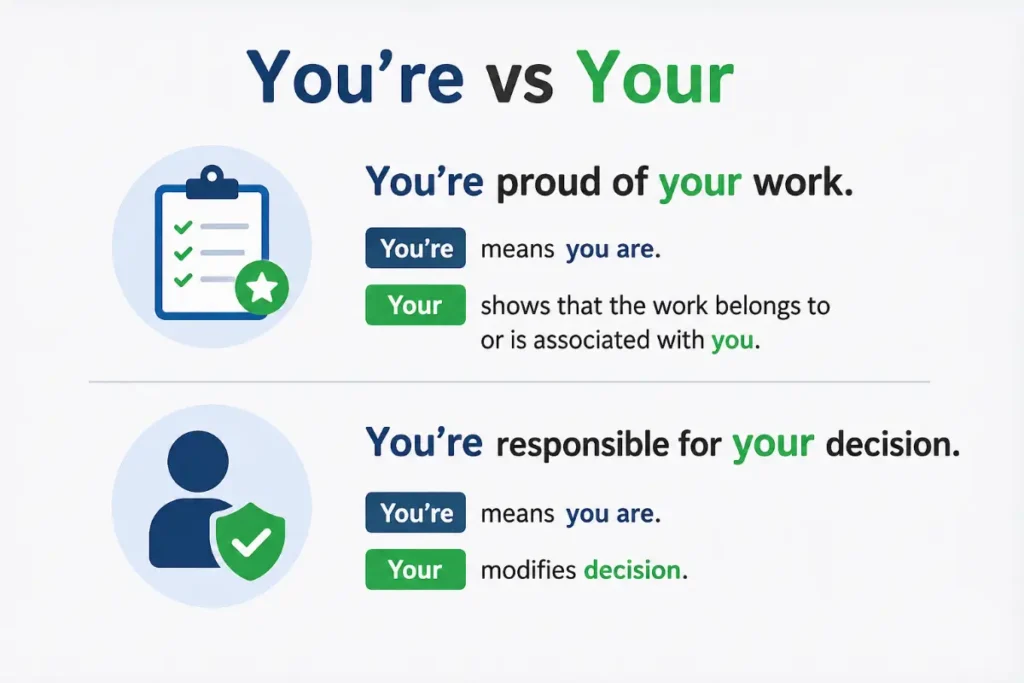
- You’re proud of your work.
You’re means you are. Your shows that the work belongs to or is associated with you. - You’re responsible for your decision.
You’re means you are. Your modifies decision. - You’re wearing your new shoes.
You’re means you are wearing. Your identifies whose shoes they are. - You’re improving your writing.
You’re means you are improving. Your modifies writing. - You’re using your time wisely.
You’re means you are using. Your identifies the time associated with you. - You’re sharing your experience with others.
You’re means you are sharing. Your modifies experience. - You’re checking your email before work.
You’re means you are checking. Your modifies email. - You’re making your point clearly.
You’re means you are making. Your modifies point.
These sentences reveal an important pattern. The two words can perform completely different grammatical jobs within the same sentence.
Common Mistakes
Many errors happen because speakers don’t hear a strong difference between the words.
Mistake 1 Using Your Before an Adjective
Incorrect:
Your very kind.
Correct:
You’re very kind.
The phrase means you are very kind, so the contraction is required.
Mistake 2 Using You’re Before a Noun
Incorrect:
You’re car is outside.
Correct:
Your car is outside.
The word car is a noun, and the sentence identifies the car associated with the listener. It doesn’t mean you are car.
Mistake 3 Writing Your Welcome
Incorrect:
Your welcome.
Correct:
You’re welcome.
The correct expression means you are welcome.
This mistake is extremely common in informal online writing because the two forms sound the same.
Mistake 4 Writing Your Right
Incorrect:
Your right.
Correct:
You’re right.
The sentence means you are right.
Mistake 5 Writing You’re Name
Incorrect:
What’s you’re name?
Correct:
What’s your name?
The noun name needs the possessive determiner your.
The sentence means:
What is your name?
It doesn’t mean:
What is you are name?
Why These Words Cause Confusion
The main reason is pronunciation. In most standard varieties of English, your and you’re are pronounced the same or very similarly in ordinary speech. Context usually tells listeners which word the speaker means.
Writing works differently. Readers can’t depend on context alone when the grammar is incorrect.
This creates a common problem in texting, comments, emails, school assignments, and social media posts. A writer may know the difference but type the wrong form because the correct pronunciation doesn’t help them decide.
The apostrophe in you’re provides a useful visual clue. It tells you that letters have been omitted from you are.
No apostrophe appears in your.
Pronunciation
In common American English, your and you’re are often pronounced similarly. Your may be pronounced like yor or with a reduced vowel in connected speech.
You’re is commonly pronounced like yor as well.
Because pronunciation doesn’t reliably distinguish the words, spelling becomes especially important.
Compare these forms:
Your book.
You’re ready.
When spoken quickly, the first word in each sentence may sound almost identical. The grammatical structure provides the real distinction.
This explains why even fluent English speakers sometimes make this mistake when typing quickly.
Grammar Rules
The simplest grammar rule is:
Use your before a noun or noun phrase when you want to show possession or association.
For example:
your new job
your favorite song
Use you’re when the sentence means you are.
For example:
you’re correct
you’re invited
A useful grammatical question is:
What job is the word doing?
If it identifies something associated with you, choose your.
If it contains the verb are, choose you’re.
Your Before Nouns
One of the easiest ways to recognize your is to look for a noun after it.
Consider:
your house
your teacher
The word your works as a determiner.
It can also come before a noun with adjectives.
your beautiful house
your difficult assignment
In each case, your helps identify the particular noun being discussed.
You’re Before Adjectives
You’re commonly appears before adjectives because you are can link the subject you to a description.
Examples include:
- You’re smart.
- You’re funny.
- You’re tired.
- You’re confident.
- You’re ready.
- You’re correct.
- You’re helpful.
- You’re responsible.
Expand the contraction and the grammar becomes obvious.
You’re tired.
You are tired.
You’re responsible.
You are responsible.
This is one of the fastest ways to identify the correct form.
You’re Before Present Participles
You’re can appear before an ing form when the sentence uses the present progressive.
Examples:
- You’re learning English.
- You’re working hard.
- You’re making progress.
- You’re reading a new book.
- You’re improving your grammar.
- You’re speaking clearly.
The structure is:
You + are + verb ending in ing
The contraction changes that structure to:
You’re + verb ending in ing
For example:
You are learning.
becomes:
You’re learning.
This makes you’re easy to recognize in many sentences.
You’re Before Past Participles
You’re can also appear with past participles, especially in passive constructions.
Examples:
- You’re invited.
- You’re expected to arrive early.
- You’re encouraged to ask questions.
- You’re required to sign the form.
- You’re selected for the next round.
Expand the contraction:
You’re invited.
becomes:
You are invited.
The grammar works perfectly.

Your With Body Parts and Relationships
English frequently uses your with body parts and personal relationships.
Examples:
- Raise your hand.
- Wash your face.
- Brush your teeth.
- Close your eyes.
- Call your mother.
- Ask your teacher.
- Visit your grandparents.
- Listen to your doctor.
These examples show that your doesn’t necessarily express ownership in a strict legal or physical sense.
It identifies a connection between the person being addressed and the noun.
This is why phrases such as your hand, your mother, and your opinion are all grammatically natural.
Your in Formal Writing
Your works naturally in formal and informal writing.
Examples include:
Please submit your application by Friday.
Thank you for your assistance.
We appreciate your feedback.
Please review your document carefully.
There is no reason to avoid your in professional writing. It is a standard English possessive determiner.
It can also appear in formal instructions.
Please enter your full name.
Bring your identification to the appointment.
Check your account information before submitting the form.
You’re in Formal Writing
You’re is grammatically correct in formal writing, but some highly formal styles may prefer the expanded form you are.
For example, a formal letter might say:
You are invited to attend the meeting.
A friendly email might say:
You’re invited to attend the meeting.
Both are grammatical.
The choice depends on tone, house style, and context. Academic writing sometimes favors fewer contractions, while ordinary professional communication commonly uses them.
The important point is that you’re isn’t grammatically wrong simply because it contains an apostrophe.
Your and You’re in Questions
Both forms can appear in questions.
Examples with your:
- Where is your phone?
- What is your name?
- Is this your bag?
- Did you finish your homework?
- How was your trip?
Examples with you’re:
- Are you sure you’re ready?
- Why are you leaving?
- Do you think you’re prepared?
- How are you feeling?
- Are you saying you’re finished?
Remember that you’re already contains the verb are.
This means you shouldn’t add another unnecessary are directly after it.
Incorrect:
You’re are ready.
Correct:
You’re ready.
Or:
You are ready.
Your and You’re in Negative Sentences
The same distinction applies to negative sentences.
For your, the negative word belongs somewhere else in the sentence.
Your answer isn’t clear.
Here, your modifies answer.
For you’re, the contraction means you are.
You’re not late.
This means:
You are not late.
Another example:
You’re not using your time well.
Here, both words appear naturally.
You’re means you are.
Your identifies the time associated with the listener.
Your and You’re in Questions With Do
A useful point involves questions beginning with do, does, or did.
Consider:
Do you like your new job?
The word your modifies new job.
You wouldn’t write:
Do you like you’re new job?
That would mean something like Do you like you are new job?, which doesn’t work grammatically.
Now consider:
Do you think you’re ready?
Here, you’re means you are.
The structure is:
Do you think you are ready?
The contraction makes it:
Do you think you’re ready?
This contrast is useful because the same sentence pattern can contain either form depending on the grammatical role.
Memory Tips
The best memory trick is short:
Your has an o in you.
This isn’t a grammar rule, but it can help you remember the relationship between your and the person you.
Another useful trick is:
You’re contains are.
Look at the letters in you’re and remember that it comes from you are.
You can also ask yourself:
Can I say you are?
If yes, use you’re.
If no, consider your.
For example:
You’re amazing.
Test:
You are amazing.
It works.
Now:
Your book is amazing.
Test:
You are book is amazing.
It doesn’t work.
Therefore, your is correct.
A final memory sentence can combine both forms:
You’re using your grammar skills.
Read it as:
You are using the grammar skills associated with you.
That single sentence shows the difference clearly.
Similar Confusing Words
English has many word pairs that sound alike or nearly alike but have different grammatical functions.
Its and It’s
Its is a possessive determiner.
The dog wagged its tail.
It’s means it is or it has.
It’s raining.
The pattern is similar to your and you’re because the apostrophe signals a contraction.
Their and They’re
Their shows possession or association.
They’re means they are.
They’re waiting outside.
This pair follows almost the same grammatical distinction as your and you’re.
There and Their
There commonly refers to a place or introduces an expression.
The book is over there.
Their shows possession.
Their book is on the table.
These words can sound similar in some varieties of English, so context matters.
Who’s and Whose
Who’s means who is or who has.
Whose asks about possession.
Whose jacket is this?
Again, the apostrophe marks the contraction.
Professional Writing Tips
Correct use of these words matters because small grammar errors can affect how readers judge a piece of writing.
A mistake such as your welcome may be understood immediately, but it can still make a message look careless.
This matters especially in:
- Job applications.
- Business emails.
- School assignments.
- Reports.
- Website copy.
- Customer service messages.
- Professional profiles.
- Formal letters.
- Marketing materials.
- Public announcements.
Before sending an important message, search for your and you’re separately.
For every you’re, ask:
Does this mean you are?
For every your, ask:
Does this introduce something connected with you?
This quick check catches many mistakes without requiring a complicated grammar review.
Real Life Examples
Text Messages
You’re coming tonight, right?
The writer means you are coming.
Don’t forget your jacket.
The jacket belongs to or is associated with the person being addressed.
Workplace Emails
You’re responsible for your section of the report.
The first word means you are. The second identifies the section connected with the reader.
School Writing
You’re expected to complete your assignment on time.
You’re means you are.
Your modifies assignment.
Social Media
You’re doing great. Keep sharing your ideas.
The first word means you are.
Your ideas are helpful.
The second sentence uses your because it modifies ideas.
Everyday Conversation
You’re forgetting your keys again.
You’re means you are forgetting.
Your identifies the keys associated with the listener.
Customer Service
You’re entitled to your refund under the terms of the policy.
You’re means you are.
Your modifies refund.
A Simple Decision Process
When you aren’t sure which form to use, follow these steps.
Step 1 Check for the Meaning You Are
Replace the word with you are.
If the sentence still works, choose you’re.
Step 2 Look for a Noun
If the word comes before a noun and identifies something connected with the listener, choose your.
For example:
your computer
your opinion
Step 3 Check the Meaning
Ask whether the sentence describes the person or identifies something associated with the person.
If it describes the person using you are, choose you’re.
If it identifies something associated with the person, choose your.
Step 4 Check the Apostrophe
Remember that you’re contains an apostrophe because it is shortened from you are.
Your does not contain an apostrophe.
Quick Practice
Choose the correct word in each sentence.
- Your / You’re going to love this book.
- I like your / you’re new shoes.
- Your / You’re absolutely right.
- Where is your / you’re phone?
- I think your / you’re ready.
- Your / You’re answer makes sense.
- Your / You’re doing well.
- Don’t forget your / you’re keys.
- Your / You’re invited to dinner.
- I appreciate your / you’re help.
Answers:
- You’re because it means you are going to love this book.
- Your because it modifies new shoes.
- You’re because it means you are absolutely right.
- Your because it modifies phone.
- You’re because it means you are ready.
- Your because it modifies answer.
- You’re because it means you are doing well.
- Your because it modifies keys.
- You’re because it means you are invited.
- Your because it modifies help.
Key Takeaways
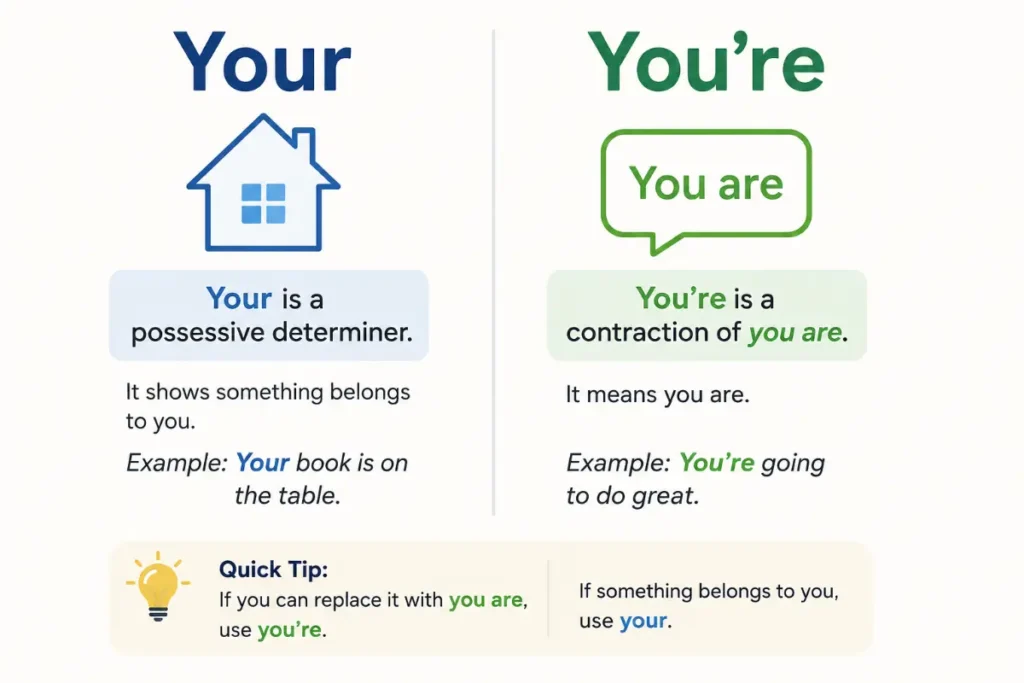
- Your is a possessive determiner.
- You’re is a contraction of you are.
- Your normally appears before a noun or noun phrase.
- You’re can appear before adjectives, verbs, participles, and other structures that follow you are.
- Replace you’re with you are to check the sentence.
- If you are doesn’t work, don’t use you’re.
- The two words usually sound the same or very similar in ordinary speech.
- The apostrophe in you’re signals the contraction.
- Your can show ownership, relationship, association, or connection.
- You’re describes or identifies the person being addressed through the verb are.
Conclusion
The difference between your and you’re becomes easy once you focus on grammar instead of pronunciation. Your shows that something belongs to or is associated with the person being addressed. You’re means you are.
When you see you’re, try expanding it to you are. If the sentence still works, you’ve found the correct form. When the word introduces a noun that connects to the listener, your is usually the right choice. The most useful rule to remember is simple: your shows possession or association, while you’re means you are.
With that one distinction in mind, you can avoid one of the most common spelling and grammar mistakes in English and use both forms confidently in everyday and professional writing.
Frequently Asked Questions
Is Your or You’re correct?
Both are correct words, but they have different grammatical functions. Your shows possession or association, while you’re means you are. The correct choice depends on the meaning and structure of the sentence.
What is the easiest way to remember Your vs You’re?
Remember that you’re can be expanded to you are. If replacing the word with you are works, use you’re. Use your when the word identifies something belonging to or associated with the person being addressed.
Is Your a possessive word?
Yes. Your is a possessive determiner. It normally comes before a noun or noun phrase and identifies something connected with the person being addressed, as in your house, your opinion, or your friend.
Is You’re a possessive word?
No. You’re isn’t possessive. It is a contraction of you are. Possessive meaning comes from your, not you’re.
Can Your and You’re appear in the same sentence?
Yes. For example, You’re proud of your work contains both forms. You’re means you are, while your identifies the work associated with the person being addressed.
Why do Your and You’re sound the same?
In most varieties of English, the words have the same or nearly the same pronunciation in normal speech. This makes them easy to confuse when writing, so grammar and sentence meaning must guide the spelling.
Is You’re informal?
You’re is a standard English contraction and isn’t grammatically incorrect in formal writing. Some highly formal styles prefer you are, but you’re is common and acceptable in many professional contexts.
Why is Your Welcome wrong?
Your welcome is incorrect when you intend the common response to thank you. The correct form is you’re welcome because the phrase means you are welcome.
Which is correct Your right or You’re right?
You’re right is correct because it means you are right. Your right would normally need a noun after your, such as your right hand or your right to speak.
Which is correct Your name or You’re name?
Your name is correct. Your modifies the noun name. The phrase you’re name would incorrectly expand to you are name, which doesn’t work grammatically.
Can You’re come before a noun?
Yes. You’re can appear before a noun phrase when it means you are. For example, You’re a good friend means You are a good friend.
Can Your come before an adjective?
It can appear before an adjective when the adjective is part of a larger noun phrase, such as your new car. But your happy by itself is not correct if you mean you are happy. In that case, use you’re happy

English Grammar & Usage
Nathan Holloway is an American grammar writer and language researcher who specializes in English grammar, sentence structure, verb usage, and common writing mistakes. He enjoys breaking down confusing grammar rules into practical explanations with clear examples, making English easier for students, professionals, and everyday writers.