
Adapt vs Adopt is a common English word comparison because the two verbs look and sound almost alike. Both words can appear in discussions about changes, decisions, plans, methods, behavior, and new situations. That similarity makes it easy to choose the wrong verb.
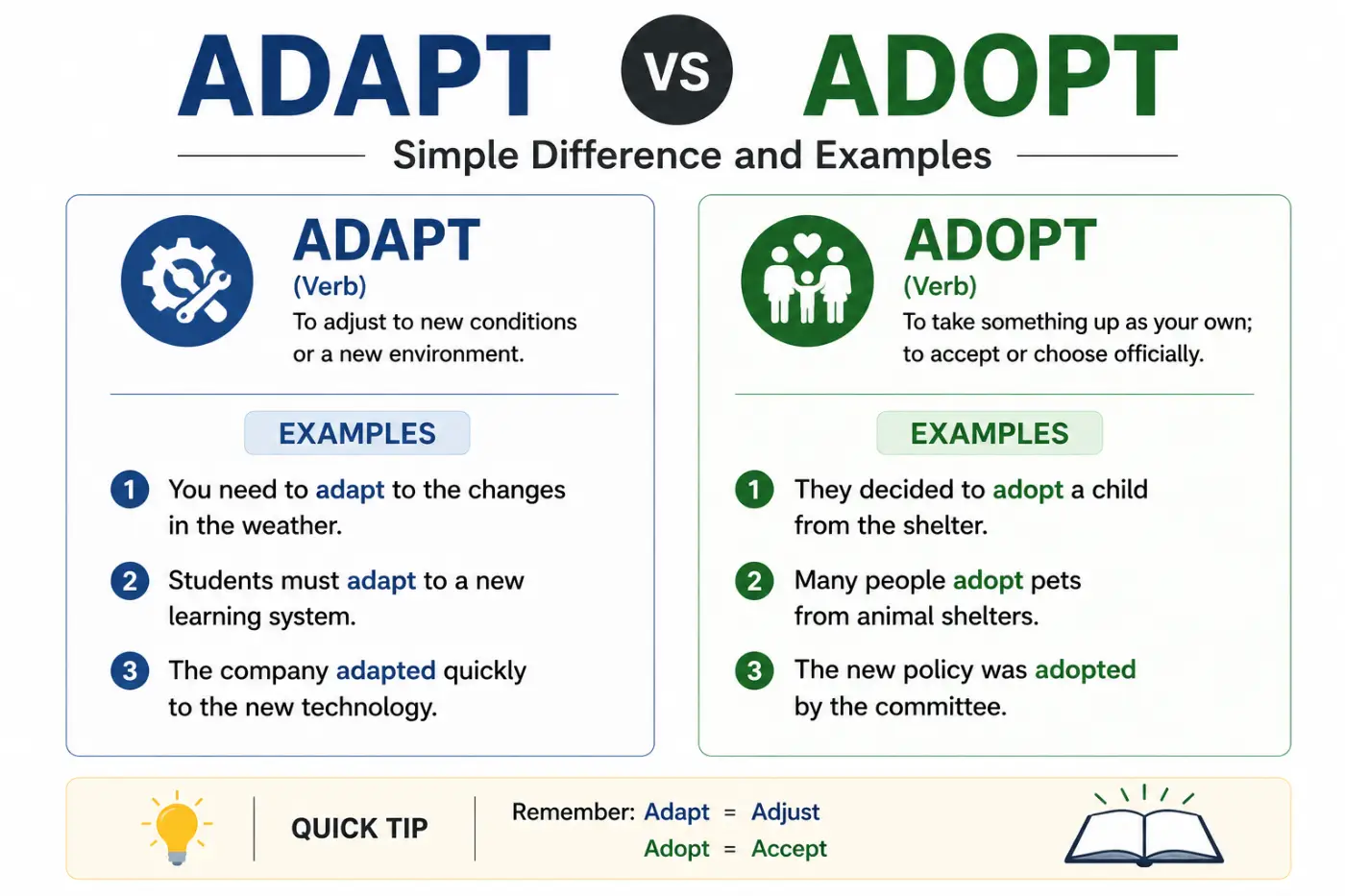
The difference is actually simple. Adapt means to change or adjust something so it fits a new condition. Adopt means to accept, choose, or start using something. You can adapt a strategy after circumstances change, but you adopt a strategy when you decide to use it.strategy. In the second, it accepted or chose a strategy for use.
This guide explains the difference between the two verbs, their meanings, pronunciation, grammar, origins, common mistakes, real life examples, and practical memory tips. By the end, you should be able to choose the correct word naturally in everyday conversation, academic writing, business communication, and professional documents.
Short Answer
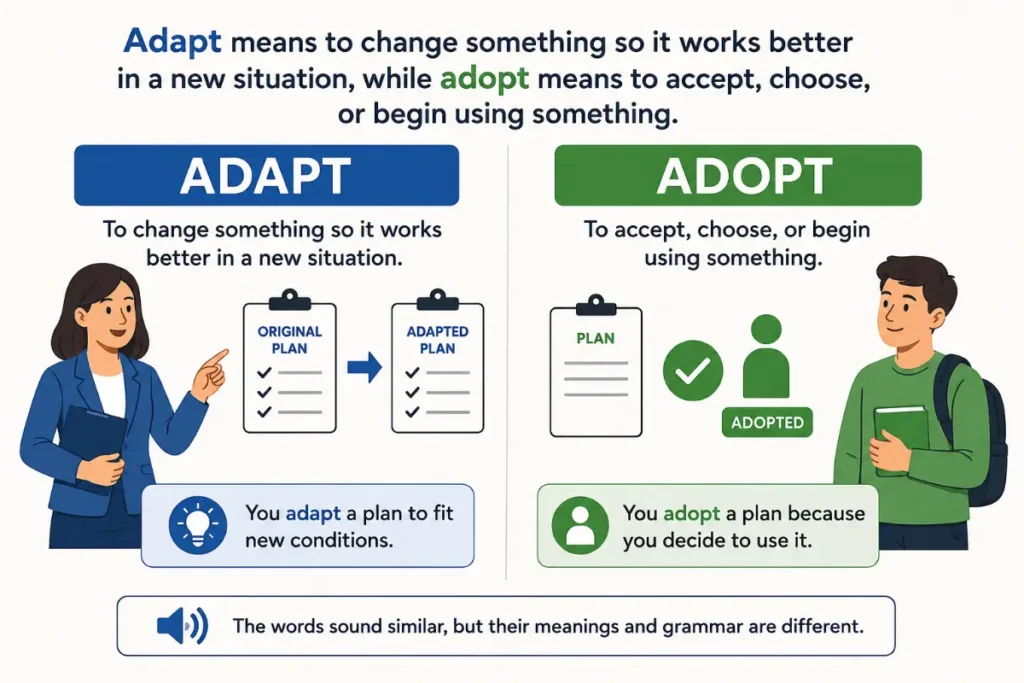
Adapt means to change something so it works better in a new situation, while adopt means to accept, choose, or begin using something. You adapt a plan to fit new conditions. You adopt a plan because you decide to use it. The words sound similar, but their meanings and grammar are different.
Table of Contents
- The Basic Difference
- What Adapt Means
- What Adopt Means
- Adapt vs Adopt Comparison
- How Adapt Works in a Sentence
- How Adopt Works in a Sentence
- Adapt and Adopt in Real Life
- Adaptable and Adaptive
- Adopted and Adoptive
- Pronunciation Guide
- Word Origins
- Common Mistakes
- How to Choose the Correct Word
- Memory Tips
- Professional Writing Tips
- Related Words
- Key Takeaways
- Frequently Asked Questions
- Conclusion
The Basic Difference
The easiest way to remember the difference is this:
Adapt means change.
Adopt means accept or choose.
When you adapt something, you modify it so that it works in a different situation. When you adopt something, you decide to accept it, use it, or make it your own.
For example:
- We adapted the lesson for younger students.
The lesson already existed, but changes were made to make it suitable for younger students.
- We adopted a new teaching method.
The speakers chose a new method and began using it.
This distinction works in most ordinary situations. If the idea involves adjusting or modifying, use adapt. If it involves accepting, choosing, or beginning to use, use adopt.
What Adapt Means
Adapt is a verb that means to change something so that it becomes suitable for a new purpose, condition, environment, or situation. It can also describe a person’s ability to adjust to changing circumstances.
For example:
- Plants adapt to changes in their environment.
The plants adjust to new environmental conditions.
- She adapted the lesson for online students.
She changed the lesson so it would work better in an online setting.
- The business adapted its services after customer needs changed.
The business modified its services to fit new needs.
Adapt can be used with both people and things. A person can adapt to a new situation, while a plan, product, system, story, or organization can be adapted for a different purpose.
Adapt Means Adjust
One useful synonym for adapt is adjust.
If you adjust something, you make a change to improve its suitability or effectiveness. The same basic idea applies to adapt.
For example:
- He adapted his schedule to accommodate his new job.
He changed his schedule because his circumstances changed.
- The engineer adapted the design for colder temperatures.
The engineer modified the design so it would work in a different environment.
Adapt To
The structure adapt to is especially common when talking about a person, animal, organization, or system responding to a new situation.
For example:
- Children usually adapt to new environments quickly.
The children become comfortable with the new conditions.
- Employees must adapt to changing technology.
The employees need to adjust their skills or behavior as technology changes.
- The company adapted to the changing market.
The company changed its approach in response to market conditions.
The preposition to is important in these constructions. We normally say adapt to something, not adapt something when we mean becoming adjusted to a condition.
Adapt Something For Something
Adapt can also mean changing an existing thing so that it works for another purpose.
For example:
- The teacher adapted the activity for advanced students.
The teacher changed the activity to suit a particular group.
- The publisher adapted the book for younger readers.
The publisher changed the book so younger readers could understand or enjoy it.
- The software was adapted for mobile devices.
The software was modified to work properly on mobile devices.
What Adopt Means
Adopt is a verb with several related meanings. The central idea is accepting, choosing, or taking something as your own.
You can adopt a plan, policy, method, habit, approach, attitude, rule, or opinion.
For example:
- The school adopted a new attendance policy.
The school officially accepted and began using the policy.
- She adopted a healthier lifestyle.
She chose to follow a healthier way of living.
- The company adopted a flexible work policy.
The company decided to use the policy.
Adopt does not normally mean simply changing something. Instead, it focuses on the decision to accept or use something.
Adopt Means Accept
One useful way to understand adopt is to connect it with accept.
When you adopt an idea, you accept it as something you will follow or use.
For example:
- The committee adopted the proposal.
The committee officially accepted the proposal.
- The organization adopted new safety standards.
The organization accepted the standards and made them part of its practices.
- The team adopted a different approach.
The team chose and began using a different approach.
Adopt Means Begin Using
Adopt is also common when a person or organization starts using something that already exists.
For example:
- Many companies have adopted remote work policies.
The companies chose to use those policies.
- The school adopted a new learning platform.
The school started using the platform.
- He adopted a more practical approach to budgeting.
He chose to use a different approach.
Adopt Has a Family Meaning
Adopt also has a well known family related meaning. A person can legally take another person’s child into their family and become the child’s parent.
For example:
- They adopted a child from another country.
They legally became the child’s parents.
- The couple decided to adopt.
They decided to become adoptive parents.
This meaning is completely different from changing something to make it suitable, but the central idea of taking something or someone into your own family or life remains useful for understanding the word.
Adapt vs Adopt Comparison
The clearest comparison is shown below.
| Word | Main Meaning | Common Pattern | Example |
|---|---|---|---|
| Adapt | Change or adjust | adapt to something | We adapted to the new schedule. |
| Adapt | Modify for a purpose | adapt something for something | She adapted the lesson for children. |
| Adopt | Accept or choose | adopt something | They adopted a new policy. |
| Adopt | Begin using | adopt something | The company adopted new software. |
| Adopt | Take a child legally | adopt a child | They adopted a baby. |
The key difference is the action involved.
Adapt focuses on change.
Adopt focuses on acceptance or choice.
That difference is more useful than trying to memorize complicated grammar definitions.
How Adapt Works in a Sentence
Adapt commonly appears in three useful structures.
Adapt To
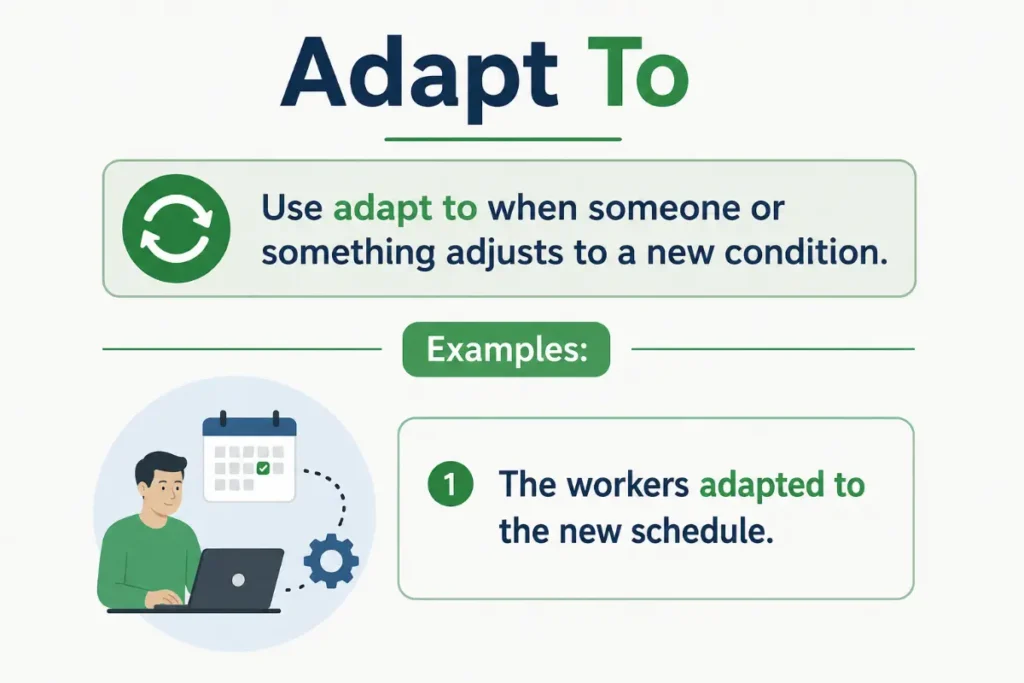
Use adapt to when someone or something adjusts to a new condition.
Examples:
- The workers adapted to the new schedule.
The workers adjusted their routines.
- The animals adapted to the colder climate.
The animals adjusted to environmental changes.
- She quickly adapted to university life.
She became comfortable with the new situation.
Adapt Something
Use adapt something when you change an existing thing.
Examples:
- The designer adapted the original plan.
The designer modified the plan.
- The teacher adapted the material.
The teacher changed the material to make it more suitable.
- The company adapted its product.
The company modified the product.
Adapt Something For
Use adapt something for when the change is made for a particular audience, purpose, environment, or use.
Examples:
- The author adapted the story for children.
The story was changed to suit children.
- The engineer adapted the machine for outdoor use.
The machine was modified for a particular environment.
- The instructor adapted the course for beginners.
The course was changed to meet beginners’ needs.
How Adopt Works in a Sentence
Adopt is generally used with a direct object when it means accept, choose, or begin using something.
Adopt A Plan
- The board adopted the proposed plan.
The board officially accepted the plan.
- The team adopted a new training plan.
The team chose to use the plan.
Adopt A Policy
- The company adopted a stricter privacy policy.
The company accepted and implemented the policy.
- The city adopted new parking rules.
The city officially approved the rules.
Adopt An Approach
- We should adopt a more practical approach.
We should choose and use a different approach.
- The manager adopted a flexible approach to scheduling.
The manager chose to use flexibility when making schedules.
Adopt A Habit
- He adopted the habit of reading every morning.
He began following the habit.
- She adopted healthier eating habits.
She chose to make those habits part of her lifestyle.
Adapt and Adopt in Real Life
These words appear frequently in business, education, technology, science, personal development, and everyday conversation.
Understanding the context often makes the correct choice obvious.
Business
Businesses often adapt to market changes and adopt new policies.
- The company adapted to lower customer demand.
The company changed its operations in response to the market.
- The company adopted a new pricing strategy.
The company chose to use the strategy.
- Employees adapted to the new software.
Employees adjusted to the new system.
- The company adopted the software across all departments.
The company decided to use the software.
Notice the difference. The employees adapted to the software, while the company adopted the software.
Education
Education provides many useful examples.
- Teachers adapt their lessons to different students.
Teachers modify lessons to meet student needs.
- The school adopted a new curriculum.
The school accepted and implemented a new curriculum.
- Students adapt to different teaching styles.
Students adjust to different classroom methods.
- The district adopted new testing standards.
The district officially accepted the standards.
Technology
Technology changes quickly, so both verbs are common in technical writing.
- Users must adapt to new software.
Users need to become comfortable with the software.
- The company adopted cloud based storage.
The company chose to use that technology.
- The developer adapted the application for smaller screens.
The developer modified the application.
- The business adopted a new security system.
The business chose to implement the system.
Personal Life
The same distinction appears in ordinary conversations.
- I had to adapt to my new schedule.
I had to adjust my routine.
- I adopted a healthier morning routine.
I chose to begin following a new routine.
- She adapted to life in a new city.
She became comfortable with her new surroundings.
- He adopted a positive attitude.
He chose to develop and maintain that attitude.
Adaptable and Adaptive
The words adaptable and adaptive come from adapt, not adopt.
Adaptable
Adaptable describes a person or thing that can adjust successfully to new conditions.
For example:
- She is highly adaptable.
She can adjust easily when circumstances change.
- Adaptable employees often handle unexpected changes well.
These employees can modify their approach when needed.
Adaptive
Adaptive usually describes something designed to change or respond to conditions.
For example:
- The website uses adaptive design.
The design responds to different device or screen conditions.
- Adaptive learning software changes lessons based on student performance.
The software responds to the learner’s needs.
A simple memory connection is:
Adapt, adaptable, adaptation.
These words all relate to adjustment or change.
Adopted and Adoptive
The words adopted and adoptive come from adopt.
Adopted
Adopted can describe something that has been accepted or chosen.
For example:
- The adopted policy will take effect next month.
The policy has been officially accepted.
It can also describe a child who has been legally taken into another family.
- Their adopted daughter loves music.
She became their daughter through adoption.
Adoptive
Adoptive commonly describes a parent or family connected with adoption.
For example:
- Her adoptive parents supported her education.
The parents legally became her parents through adoption.
- The child visited his adoptive family.
The family is connected to him through adoption.
A useful memory connection is:
Adopt, adopted, adoption, adoptive.
All relate to accepting, choosing, or taking something or someone as your own.
Pronunciation Guide
Adapt and adopt have similar sounds, but their vowel sounds differ.
Adapt is pronounced approximately uh DAPT.
Adopt is pronounced approximately uh DOPT.
The final consonant sounds are also different.
Adapt ends with a sound like dapt, while adopt ends with a sound like dopt.
When speaking quickly, the difference can become less noticeable. That is one reason learners sometimes confuse the words in writing.
The safest approach is to connect pronunciation with meaning.
If you mean adjust, think adapt.
If you mean accept or choose, think adopt.
Word Origins
Adapt comes from the Latin verb adaptare, meaning to adjust or fit. Adopt comes from the Latin verb adoptare, meaning to choose or take as one’s own. The two words are historically related in form, which helps explain why they look and sound similar. Their meanings developed in different directions.
Adapt became strongly associated with adjustment and suitability. Adopt became associated with accepting, choosing, or taking something as one’s own. Understanding these roots is not necessary for everyday use, but they provide a useful explanation for the similarity between the words.
Common Mistakes
Many mistakes happen because writers remember that both words involve change. The important question is what kind of change is happening.
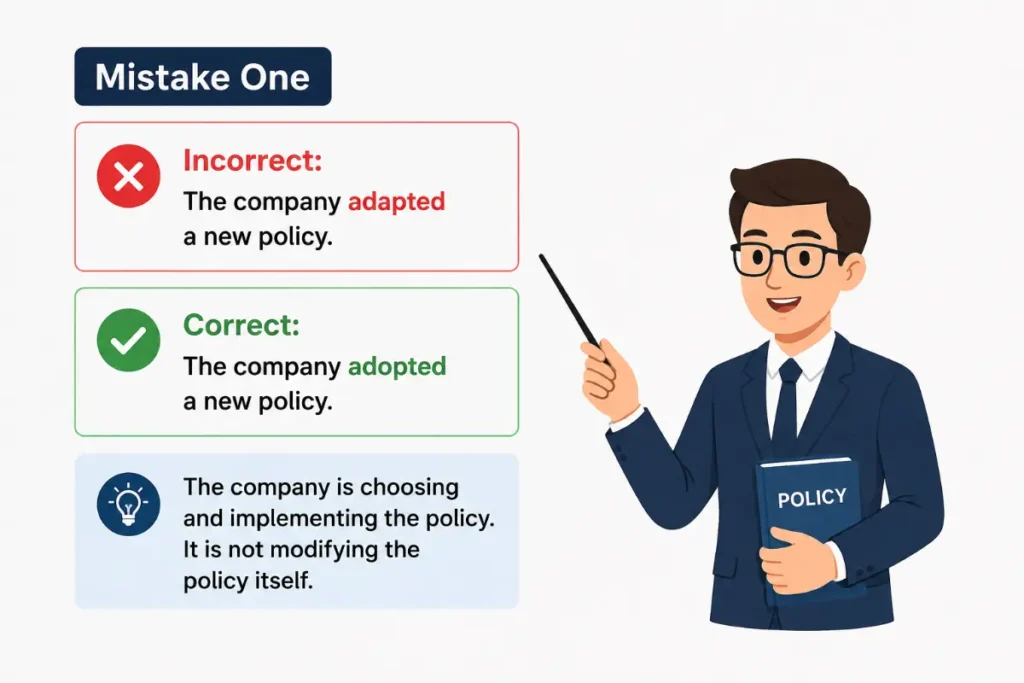
Mistake One
Incorrect: The company adapted a new policy.
Correct: The company adopted a new policy.
The company is choosing and implementing the policy. It is not modifying the policy itself.
Mistake Two
Incorrect: She adopted to the new environment.
Correct: She adapted to the new environment.
A person adjusts to an environment, so adapt is the correct verb.
Mistake Three
Incorrect: The teacher adopted the lesson for beginners.
Correct: The teacher adapted the lesson for beginners.
The teacher changed the lesson to make it suitable for beginners.
Mistake Four
Incorrect: The school adapted a new curriculum.
Correct: The school adopted a new curriculum.
The school chose and implemented the curriculum.
Mistake Five
Incorrect: The employees adopted to the new system.
Correct: The employees adapted to the new system.
Employees adjust to a system. They do not normally adopt to it.
Mistake Six
Incorrect: The designer adopted the original plan for mobile users.
Correct: The designer adapted the original plan for mobile users.
The designer modified the plan to make it suitable for mobile users.
How to Choose the Correct Word
When you are unsure which word to use, ask yourself one question.
Am I changing something so it fits, or am I accepting or choosing something?
If you are changing or adjusting something, choose adapt.
If you are accepting, choosing, or beginning to use something, choose adopt.
Consider these pairs.
- We adapted the plan to fit the new budget.
The plan was changed.
- We adopted the new plan.
The plan was accepted and chosen.
Another pair:
- She adapted to her new workplace.
She adjusted to the workplace.
- She adopted a new work routine.
She chose to use a new routine.
The same basic rule works across many situations.
Memory Tips
A short memory trick can make the difference easier to remember.
Adapt Equals Adjust
Both words begin with A, but connect adapt with adjust.
Adapt = adjust.
When conditions change, you adapt.
Adopt Equals Accept
Connect adopt with accept.
Adopt = accept or choose.
When you decide to use a new idea, policy, method, or habit, you adopt it.
Think About Direction
Adapt often involves movement from an old condition toward a new condition.
Adopt often involves movement from an option toward a decision.
For example:
- You adapt your schedule because your circumstances changed.
- You adopt a new schedule because you chose it.
This simple contrast can help you select the right verb quickly.
Professional Writing Tips
Choosing between these words carefully can make professional writing more precise.
In business writing, adopt is useful when describing official decisions.
For example:
- The organization adopted a new policy.
- The board adopted the proposed recommendation.
- The department adopted a standardized procedure.
Use adapt when describing modifications made in response to circumstances.
For example:
- The organization adapted its policy to address new requirements.
- The team adapted its strategy after reviewing customer feedback.
- The department adapted the procedure for smaller offices.
This distinction makes reports and business documents clearer because the reader can see the difference between making a decision and making a modification.
Related Words
Several words are closely connected to these verbs.
Adaptation
Adaptation is the noun form related to adapt.
It refers to the process or result of changing something so it can function in a new situation.
Example:
- The adaptation of the program made it easier for beginners to use.
Adaptability
Adaptability means the ability to adjust to changing conditions.
Example:
- Adaptability is valuable when a workplace changes quickly.
Adoption
Adoption is the noun related to adopt.
It can mean the act of accepting or beginning to use something.
Example:
- The adoption of the new policy took several months.
It can also refer to the legal process of becoming the parent of a child.
Adoptive
Adoptive describes someone or something connected with adoption.
Example:
- His adoptive parents encouraged his education.
Adaptation And Adoption
These nouns preserve the same distinction as the verbs.
Adaptation focuses on change and adjustment.
Adoption focuses on acceptance and choice.
For example:
- The adaptation of the product improved its performance in cold weather.
The product was changed.
- The adoption of the product increased after the company introduced better training.
People chose to use it.
When Both Words Can Appear Together
Sometimes both verbs are correct in the same sentence because they describe two different actions.
For example:
- The company adopted a new strategy and adapted it to local markets.
The company first chose the strategy. Then it modified the strategy to suit local markets.
Another example:
- The school adopted a new curriculum and adapted it for younger students.
The school accepted the curriculum, then changed parts of it for a specific group.
This is an excellent way to see the distinction. A thing can be adopted first and adapted later.
For example, an organization may adopt a policy and then adapt that policy to meet local needs.
Adapt To A Situation
Use adapt when a person or organization responds successfully to circumstances.
Examples:
- Good leaders adapt to changing conditions.
Leaders change their approach when circumstances require it.
- New employees often need time to adapt to workplace culture.
Employees gradually become comfortable with the new environment.
- Animals adapt to environmental changes.
Animals adjust to changes in their surroundings.
The phrase adapt to is especially important because English learners sometimes incorrectly replace it with adopt.
Adopt A New Idea
Use adopt when someone accepts an idea and decides to follow or use it.
Examples:
- The committee adopted the recommendation.
The committee accepted the recommendation.
- The manager adopted the employee’s suggestion.
The manager chose to use the suggestion.
- The school adopted a new teaching philosophy.
The school accepted the philosophy and made it part of its approach.
Adapt A Story Or Book
Adapt has another common meaning in literature, film, television, and theater.
A story can be adapted when an existing work is changed for another medium.
For example:
- The director adapted the novel for film.
The director changed the story so it could work as a movie.
- The playwright adapted the short story for the stage.
The story was changed for theatrical performance.
This meaning is easy to connect with the main definition because the original work is modified for a new purpose.
The noun adaptation is common in this context.
For example:
- The movie is an adaptation of a popular novel.
The movie is based on an existing work that was changed for film.
Adapt In Science And Nature
Adapt is also important in biology and environmental science.
Living organisms can adapt to environmental conditions over generations. In everyday language, people may also say that animals adapt to changes in their surroundings.
For example:
- Some animals adapt to extreme temperatures.
The animals become suited to difficult environmental conditions.
- Plants adapt to limited water availability.
The plants develop or maintain characteristics that help them survive under those conditions.
In scientific writing, the noun adaptation can refer to a trait or characteristic that helps an organism survive and reproduce in a particular environment.
This scientific meaning should not be confused with adopt.
An organism does not adopt to its environment. It adapts to its environment.
Adapt In Personal Development
Adapt is common when discussing learning, careers, relationships, and personal growth.
For example:
- Successful professionals adapt to new expectations.
They adjust their behavior and skills.
2 .Families adapt to major life changes.
They adjust their routines and expectations.
Adopt can also appear in the same topics, but it describes choosing something.
For example:
- She adopted a healthier routine.
She chose to follow the routine.
- He adopted a more positive attitude.
He chose to approach situations differently.
The distinction remains consistent even when the topic changes.
Formal And Informal Usage
Both words are standard English and are appropriate in formal and informal writing.
Adapt is common in conversations about change, adjustment, flexibility, and suitability.
Adopt is common in conversations about decisions, policies, methods, habits, ideas, and family relationships.
In professional writing, choosing the correct word can make your meaning more exact.
For example, saying that a company adopted a strategy tells the reader that the company selected and implemented it.
Saying that the company adapted the strategy tells the reader that the company modified it.
That difference can matter in reports, research papers, business documents, and technical instructions.
American And British English
There is no major difference between American and British English in the basic meanings of adapt and adopt.
Both varieties use adapt to mean adjust or modify.
Both use adopt to mean accept, choose, begin using, or legally take a child into a family.
The pronunciation may vary slightly between speakers and regions, but the spelling and core meanings remain the same.
Therefore, this is not a case where American English prefers one word and British English prefers another.
The issue is meaning, not regional spelling.
Quick Usage Test
Try filling in the blanks.
- The company had to _____ to changing customer needs.
The answer is adapt because the company needed to adjust.
- The company decided to _____ a new customer service policy.
The answer is adapted because she adjusted to a new environment.
Key Takeaways
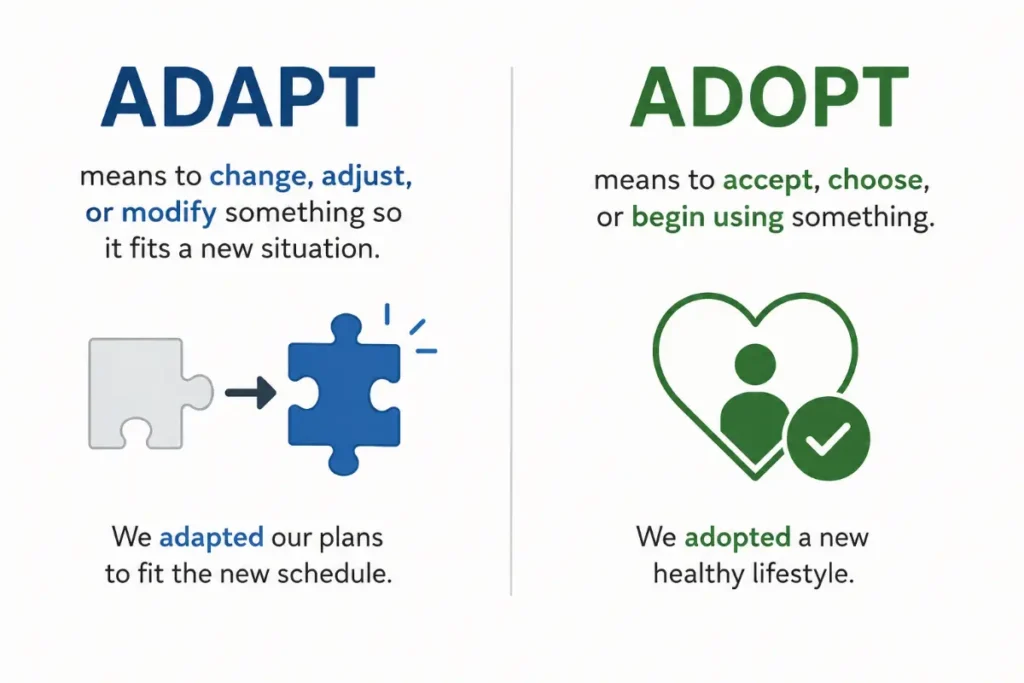
- Adapt means to change, adjust, or modify something so it fits a new situation.
- Adopt means to accept, choose, or begin using something.
- People adapt to new situations.
- Organizations adopt policies, plans, ideas, methods, and systems.
- You can adapt something for a particular audience or purpose.
- You can adopt a habit when you choose to begin following it.
- Adaptable, adaptive, and adaptation are related to adjustment and change.
- Adopted, adoption, and adoptive are related to acceptance, choice, or legal adoption.
- The easiest memory trick is adapt equals adjust and adopt equals accept.
- Both words are standard in American and British English.
Conclusion
The difference between the two words becomes clear once you focus on the action being described. Adapt means to adjust or modify something so it works in a new situation. Adopt means to accept, choose, or begin using something.
When you adjust to different conditions, you adapt to the new environment. A plan can also be adapted to serve a specific purpose. By contrast, you adopt a policy, method, habit, idea, or strategy when you choose to accept and use it. A simple memory rule can solve most mistakes: adapt equals adjust, while adopt equals accept.
For example, a company can adopt a new strategy and then adapt that strategy to suit a different market. A student can adapt to a new school and adopt better study habits. Once you understand that distinction, these two commonly confused verbs become much easier to use accurately in everyday speech and professional writing.
Frequently Asked Questions
What is the difference between adapt and adopt?
Adapt means to change or adjust something so it fits a new situation. Adopt means to accept, choose, or begin using something. You adapt a plan to meet new conditions, but you adopt a plan when you decide to use it.
Is it adapt to or adopt to?
The correct expression is adapt to when you mean adjust to something. For example, “She adapted to her new job.” Adopt does not normally take to in this meaning.
Do you adapt or adopt a new policy?
You normally adopt a new policy because you accept and implement it. You can adapt the policy later if you modify it to suit a particular situation.
Do you adapt or adopt a new habit?
You normally adopt a new habit because you choose to begin following it. For example, “He adopted the habit of exercising every morning.”
Do you adapt or adopt a strategy?
You adopt a strategy when you choose and begin using it. You adapt a strategy when you modify it to fit new circumstances.
What is an example of adapt?
“The company adapted its services to meet changing customer needs.” The company changed its services so they would work better under new conditions.
What is an example of adopt?
“The school adopted a new attendance policy.” The school accepted and implemented the policy.
Can both adapt and adopt be used in one sentence?
Yes. For example, “The company adopted a new strategy and adapted it for international markets.” The company first chose the strategy and then modified it for a specific purpose.
Is adaptation related to adapt?
Yes. Adaptation is the noun related to adapt. It can refer to the process of adjusting or modifying something, or to a version of an existing work created for another medium.
Is adoption related to adopt?
Yes. Adoption is the noun related to adopt. It can refer to accepting or beginning to use something, as well as the legal process of taking a child into a family.
Are adapt and adopt synonyms?
No. They are related in form but have different meanings. Adapt focuses on adjustment or modification, while adopt focuses on acceptance, choice, or taking something as one’s own.
Why are adapt and adopt easy to confuse?
They have similar spellings, similar pronunciations, and related historical roots. Both can appear when people or organizations respond to change, but adapt describes modification while adopt describes acceptance or choice.

English Grammar & Usage
Nathan Holloway is an American grammar writer and language researcher who specializes in English grammar, sentence structure, verb usage, and common writing mistakes. He enjoys breaking down confusing grammar rules into practical explanations with clear examples, making English easier for students, professionals, and everyday writers.